Entity-aware Image Caption Generation
Di Lu1, Spencer Whitehead1, Lifu Huang1,Heng Ji1, Shih-Fu Chang2
1Computer Science Department, Rensselaer Polytechnic Institute
{lud2,whites5,huangl7,jih}@rpi.edu
2Computer Science Department, Columbia University
Abstract
Current image captioning approaches gener-ate descriptions which lack specific informa-tion, such as named entities that are involved in the images. In this paper we propose a new task which aims to generate informative im-age captions, given imim-ages and hashtags as in-put. We propose a simple but effective ap-proach to tackle this problem. We first train a convolutional neural networks - long short term memory networks (CNN-LSTM) model to generate a template caption based on the in-put image. Then we use a knowledge graph based collective inference algorithm to fill in the template with specific named entities re-trieved via the hashtags. Experiments on a new benchmark dataset collected from Flickr show that our model generates news-style image de-scriptions with much richer information. Our model outperforms unimodal baselines signif-icantly with various evaluation metrics.1
1 Introduction
As information regarding emergent situations dis-seminates through social media, the information is presented in a variety of data modalities (e.g.text, images, and videos), with each modality providing a slightly different perspective. Images have the capability to vividly represent events and entities, but without proper contextual information they become less meaningful and lose utility. While images may be accompanied by associated tags or other meta-data, which are inadequate to con-vey detailed events, many lack the descriptive text to provide such context. For example, there are 17,285 images on Flickr from the Women’s March on January 21, 2017,2most of which contain only
1
Datasets and programs: https://github.com/ dylandilu/Entity-aware-Image-Captioning
2https://en.wikipedia.org/wiki/2017 Women%27s March
a few tags and lack any detailed text descriptions. The absence of context leaves individuals with no knowledge of details such as the purpose or loca-tion of the march.
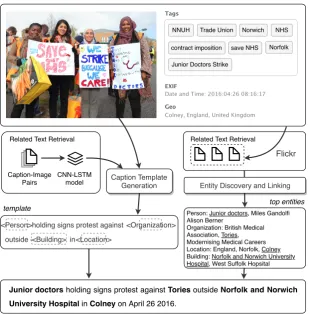
Image captioning offers a viable method to di-rectly provide images with the necessary contex-tual information through texcontex-tual descriptions. Ad-vances in image captioning (Xu et al.,2015;Fang et al.,2015;Karpathy and Fei-Fei,2015;Vinyals et al.,2015) are effective in generating sentence-level descriptions. However, sentences generated by these approaches are usually generic descrip-tions of the visual content and ignore background information. Such generic descriptions do not suf-fice in emergent situations as they, essentially, mir-ror the information present in the images and do not provide detailed descriptions regarding events and entities present in, or related to, the images, which is imperative to understanding emergent sit-uations. For example, given the image in Fig-ure1, the state-of-the-art automatically generated caption is ‘Several women hold signs in front of a building.’, which is lacking information regarding relevant entities (e.g.‘Junior doctors’, ‘Tories’).
In our work, we propose an ambitious task:
<per> holding signs protest against
outside <building> in <gpe>
Flickr
<Building>
Person: Junior doctors, Miles Gandolfi Alison Berner
Organization: British Medical Association, Tories, Modernising Medical Careers Location: England, Norfolk, Colney Building: Norfolk and Norwich University Hospital, West Suffolk Hopsital NNUH
Junior Doctors Strike Trade Union
contract imposition
NHS Norwich
Norfolk save NHS
Related Text Retrieval Tags
EXIF
Date and Time: 2016:04:26 08:16:17
Geo
Colney, England, United Kingdom
Caption Template Generation
<Person> <Organization>
<Location>
Entity Discovery and Linking
Caption-Image Pairs
CNN-LSTM model
template
Related Text Retrieval
top entities
Junior doctors holding signs protest against Tories outside Norfolk and Norwich University Hospital in Colney on April 26 2016.
[image:2.595.145.456.59.374.2]Flickr
Figure 1: The overall framework.
to fill the slot. Atemplatefor the example in Fig-ure1is:<Person>holding signs protest against <Organization> outside <Building> in <Location>.
Second, given the associated tags of an im-age, we apply entity discovery and linking (EDL) methods to extract specific entities from
pre-vious posts that embed the same tags.
Fi-nally, we select appropriate candidates for each slot based upon the entity type and frequency. For example, we select the person name ‘ Ju-nior doctors’ to fill in the slot <Person> be-cause it co-occurs frequently with other entities such as ‘Tories’ in the text related to the tags #N HS,#J uniorDoctorsStrike. This frame-work offers a distinct advantage in that it is very flexible, so more advanced captioning or EDL methods as well as other data can be used almost interchangeably within the framework.
To the best of our knowledge, we are the first to incorporate contextual information into image captioning without large-scale training data or top-ically related news articles and the generated im-age captions are closer to news captions.
2 Approach Overview
Figure1shows the overall framework of our pro-posed model. Given an image with associated tags and other meta-data, such as geographical tags and EXIF data,3 we first feed the image into a template caption generator to generate a sen-tence composed of context words, such as “stand”, and slots, such as<person>, to represent miss-ing specific information like named entities (Sec-tion3). The template caption generator, which fol-lows the encoder-decoder model (Cho et al.,2014) with a CNN encoder and LSTM decoder (Vinyals et al.,2015), is trained using news image-template caption pairs.
We then retrieve topically-related images from the Flickr database, which have the same tags as the input image. Next, we apply EDL algorithms to the image titles to extract entities and link them to external knowledge bases to retrieve their fine-grained entity types. Finally, for each slot gener-ated by the template generator, we choose to fill the slot with the appropriate candidate based on entity type and frequency (Section4).
3EXIF data contains meta-data tags of photos such as
3 Template Caption Generation
Language models (LM) are widely used to gener-ate text (Wen et al.,2015;Tran and Nguyen,2017) and play a crucial role in most of the existing im-age captioning approaches (Vinyals et al., 2015;
Xu et al., 2015). These models, learned from large-scale corpora, are able to predict a probabil-ity distribution over a vocabulary. However, LM struggle to generate specific entities, which occur sparsely, if at all, within training corpora. More-over, the desired entity-aware captions may con-tain information not directly present in the image alone. Unless the LM is trained or conditioned on data specific to the emergent situation of inter-est, the LM alone cannot generate a caption that incorporates the specific background information. We address this issue by only relying on the LM to generate abstract slot tokens and connecting words or phrases, while slot filling is used to incorpo-rate specific information. This approach allows the LM to focus on generating words or phrases with higher probability, since each slot token ef-fectively has a probability equal to the sum of all the specific entities that it represents, thereby cir-cumventing the issue of generating lower proba-bility or out-of-vocabulary (OOV) words.
In this section, we describe a novel method to train a model to automatically generate tem-plate captions with slots as ‘placeholders’ for spe-cific background information. We first present the schemas which define the slot types (Section3.1) and the procedure to acquire training data for tem-plate generation (Section 3.2). Finally, we intro-duce the model for template caption generation (Section3.3).
3.1 Template Caption Definition
Named entities are the most specific informa-tion which cannot be easily learned by LM. Thus, in this work, we define slots as place-holders for entities with the same types. We use the fine grained entity types defined in DB-pedia 4 (Auer et al., 2007) to name the slots because these types are specific enough to dif-ferentiate between a wide range of entities and still general enough so that the slots have higher probabilities in the language model. For
exam-ple, Personis further divided into Athlete,
Singer, Politician, and so on. Therefore,
4We use the sixth level entity types in Yago ontology
(Wordnet types only).
a template caption like ‘Athletecelebrates after scoring.’ can be generated by the language model through leveraging image features, where the slot
Athlete means a sports player (e.g., Cristiano Ronaldo, Lionel Messi).
3.2 Acquisition of Image-Template Caption
Pairs
High quality training data is crucial to train
a template caption generator. However, the
image-caption datasets used in previous work, such as Microsoft Common Objects in
Con-text (MS COCO) (Lin et al., 2014) and
[image:3.595.316.519.400.499.2]Flickr30K (Rashtchian et al., 2010), are not suit-able for this task because they are designed for non-specific caption generation and do not contain detailed, specific information such as named enti-ties. Further, manual creation of captions is expen-sive. In this work, we utilize news image-caption pairs, which are well written and can be easily col-lected. We use the example in Figure2to describe our procedure to convert caption to image-template caption pairs: preprocessing, compres-sion,generalization.
Figure 2: Procedure of Converting News Captions
into Templates.
Preprocessing: We first apply the following pre-processing steps: (1) remove words in paren-theses, such as‘(C)’and‘(R)’in Figure2, because they usually represent auxiliary information and are not aligned with visual concepts in images; (2) if a caption includes more than one sentence, we choose the longer one. Based on our observation, shorter sentences usually play the role of back-ground introduction, which are not aligned with the key content in images; (3) remove captions with less than 10 tokens because they tend to be not informative enough. The average length of the news image captions is 37 tokens.
Compression: The goal of compression is to
informa-tion related to objects and concepts in the im-ages, which are usually subjects, verbs and ob-jects in sentences. In this paper, we propose a simple but efficient compression method based on dependency parsing. We do not use other com-plicated compressions (Kuznetsova et al., 2014) because our simple method achieves comparative results on image caption dataset. We first ap-ply the Stanford dependency parser (De Marn-effe and Manning, 2008) on preprocessed
cap-tions. Then, we traverse the parse tree
from the root (e.g.‘pours’) via <governor,
grammatical relations, dependent>
triples using breadth-first search. We decide to keep a dependent or not based on its grammati-cal relation with the governor. Based on our ob-servations, among the 50 grammatical relations in the Stanford dependency parser, we keep the de-pendents that have the following grammatical re-lations with their governors:nsubj, obj, iobj, dobj, acomp, det, neg, nsubjpass, pobj, predet, prep, prt, vmod, nmod, cc.
Generalization: The last step for preparing training data is to extract entities from captions and replace them with the slot types we defined
in Section 3.1. We apply Stanford CoreNLP
name tagger (Manning et al., 2014) to the cap-tions to extract entity mencap-tions of the following
types: Person, Location, Organization,
andMiscellaneous. Next, we use an English
Entity Linking algorithm (Pan et al.,2015) to link the entity mentions to DBpedia and retrieve their fine-grained types.5 We choose the higher level type if there are multiple fine-grained types for a name. For example, the entity types ofManchester United, Eric Bailly, and Jesse Lingard are Soc-cerTeam, Athlete, and Athlete, respectively. For entity mentions that cannot be linked to DBpedia, we use their coarse-grained entity types, which are the outputs of name tagger.
Finally, we replace the entities in the com-pressed captions with their corresponding slots:
Generalized Template: <Athlete> pours champagne over<Athlete>.
3.3 Generation Model
Using the template caption and image pairs (S, I) as training data, we regard the template cap-tion generacap-tion as a regular image capcap-tioning
5This yields a total of 95 types after manually cleaning.
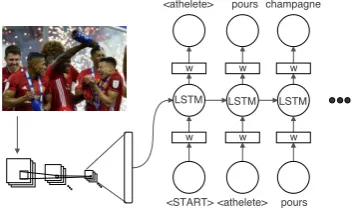
task. Thus, we adapt the encoder-decoder archi-tecture which is successful in the image captioning task (Vinyals et al., 2015; Xu et al., 2015). Our model (Figure 3) is most similar to the one pro-posed in (Vinyals et al., 2015). Note, other cap-tioning methods may easily be used instead.
Encoder: Similar to previous work (Vinyals et al., 2015; Xu et al., 2015; Karpathy and Fei-Fei, 2015; Venugopalan et al., 2017), we encode images into representations using a ResNet (He et al., 2016) model pre-trained on the ImageNet dataset (Deng et al.,2009) and use the outputs be-fore the last fully-connected layer.
Decoder:We employ a Long Short Term
Mem-ory (LSTM) (Hochreiter and Schmidhuber,1997) based language model to decode image represen-tations into template captions. We provide the LSTM the image representation, I, as the initial hidden state. At the tth step, the model predicts the probabilities of words/slots, yt, based on the
[image:4.595.328.505.389.495.2]word/slot generated at last time step,yt−1, as well as the hidden state,st.
Figure 3: LSTM language generator.
4 Template Caption Entity Population
Colney
Tories
Norfolk and Norwich University Hospital
Modernising
Royal West
British England
Junior doctors
Miles Alison Berner
Norfolk
Organization
Building Person
Location
co-occur (0.03)
co-occur (0.32)
co-occur (0.19)
co-occur (0.53)
co-occur
(0.61)
co-occur
(0.08)
co-occur (0.16)
[image:5.595.126.477.66.272.2]co-occur (0.61)
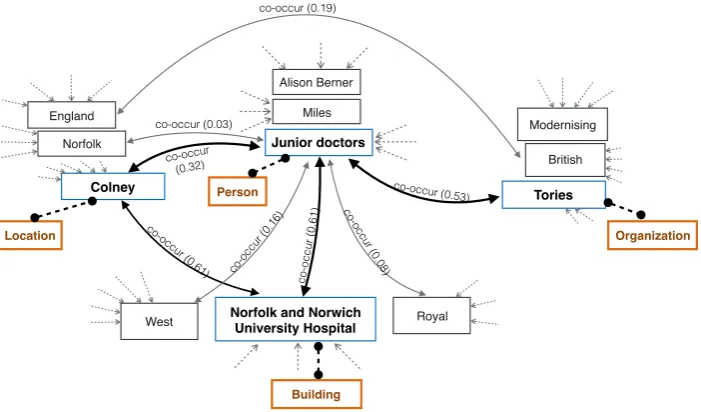
Figure 4: Knowledge graph construction.
4.1 Candidate Entity Retrieval
Users on social media typically post images with tags that are event-related (e.g. #occupywall-street), entity-related (e.g. #lakers), or topic-related (e.g. #basketball). On our Flickr test-ing dataset, the average number of tags associated with an image is 11.5 and posts with the same tags likely share common entities. Therefore, given an image and its tags, we retrieve images from Flickr with the same tags by a window size of seven-day based on taken date of the photo, and then utilize the textual information accompanying the retrieved images as context. We filter out the high frequency hashtags(>200in testing dataset). Be-cause some common tags, such as ‘#concert’, ap-pear in lots of posts related to different concerts.
Given the related text, we apply EDL algo-rithms (Pan et al.,2015) to extract named entities and link them to DBpedia to obtain their entity types. For each entity type, we rank the candi-dates based on their frequency in the context and only keep the top 5 candidate entities.
4.2 Quantified Collective Validation
Each slot in the template must be filled with an en-tity from its corresponding candidate entities. We can regard this step as an entity linking problem, whose goal is to choose an entity from several can-didates given an entity mention. We utilize the QCV algorithm to construct a number of candidate graphs for a given set of slots (Wang et al.,2015), where each combination of candidate entities
sub-stituted into the slots yields a different graph (Fig-ure4). For each candidate combination graph,Gic, we compute the edge weights between each pair of candidates in the graph as
Hr=
fchct
max(fch, fct)
(1)
wherer ∈ E(Gi
c)is an edge inGic,ch andctare
the head candidate and tail candidate of the edge, fchct is the co-occurrence frequency of the pair
of candidates, and fch and fct are the individual
frequencies of head candidate and tail candidate, respectively. For example, in Figure 4, Colney
(Location) and Junior doctors (Person) co-occur frequently, therefore the edge between them has a larger weight.
We compute the summed edge weight, ω(Gic), for eachGicby
ω(Gic) = X
r∈E(Gi c)
Hr (2)
and select the combination of candidates with the largestω(Gic)to fill in the set of slots.
4.3 Post-processing
Some images in Flickr have EXIF data which gives the date that an image is taken. We convert this information into the format such as ‘April 26 2016’ and add it to the generated captions as post-processing, by which we obtain the complete cap-tion: ‘Junior doctors holding signs protest against Tories outside Norfolk and Norwich University Hospital in Colney onApril 26 2016.’. We leave the generated caption without adding date infor-mation if it is not available. For those slots that cannot be filled by names, we use general words to replace them, such as using the word‘Athlete’
to replace the slotAthlete.
5 Experiments
5.1 Data
We require images with well-aligned, news-style captions for training. However, we want to test our model on real social media data and it is difficult to collect these informative captions for social me-dia data. Therefore, we acquire training data from news outlets and testing data from social media. We select two different topics, social events and sports events, as our case studies.
Train Dev Test
Number of Images 29,390 4,306 3,688 Number of Tokens 1,086,350 161,281 136,784 Social Event 6,998 976 872 Sports Event 22,392 3,330 2,816
[image:6.595.75.286.433.540.2]Person 32,878 4,539 4,156 Location 42,786 5,657 5,432 Organization 17,290 2,370 2,124 Miscellaneous 8,398 1,103 1,020
Table 1: Statistics of datasets for template
genera-tion.
Template Generator Training and Testing.
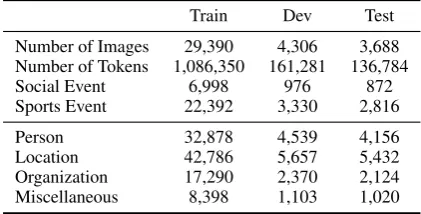
To train the template caption generator, we col-lect 43,586 image-caption pairs from Reuters6, us-ing topically-related keywords7as queries. We do not use existing image caption datasets, such as MSCOCO (Lin et al.,2014), because they do not contain many named entities. After the compres-sion and generalization procedures (Section 3.2) we keep 37,384 images and split them into train,
6https://www.reuters.com/
7Social Events: concert, festival, parade, protest,
cere-mony; Sports Events: Soccer, Basketball, Soccer, Baseball, Ice Hockey
development, and test sets. Table 1 shows the statistics of the datasets.
Entity-aware Caption Testing. Since news
images do not have associated tags, for the pur-pose of testing our model in a real social media setting, we use images from Flickr for our cap-tion evaluacap-tion8, which is an image-centric, repre-sentative social media platform. We use the same keywords as for template generator training to re-trieve multi-modal data with Creative Commons license9, for social and sports events. We choose the images that already have news-style descrip-tions from users and manually confirm they are well-aligned. In total, we collect 2,594 images for evaluation. For each image, we also obtain the tags (30,148 totally) and meta-data, such as EXIF and geotag data, when they are available.
5.2 Models for Comparison
We compare our entity-aware model with the fol-lowing baselines:
CNN-RNN-raw. We use the model proposed
byVinyals et al.(2015) to train an image caption-ing model on the raw news image-caption pairs, and apply to Flickr testing data directly.
CNN-RNN-compressed. We use the model
pro-posed byVinyals et al.(2015) to train a model on the compressed news image-caption pairs.
Text-summarization. We apply SumBasic
sum-marization algorithms (Vanderwende et al.,2007), that is a summarization for multiple documents based on frequency of word and semantic content units, to text documents retrieved by hashtag.
Entity-aware. We apply trained template genera-tor on Flickr testing data, and then fill in the slots with extracted background information.
5.3 Evaluation Metrics
We use three standard image captioning evalua-tion metrics, BLEU (Papineni et al., 2002) and
METEOR (Denkowski and Lavie, 2014),
RE-OUGE (Lin, 2004) and CIDEr (Vedantam et al.,
2015), to evaluate the quality of both the gener-ated templates and genergener-ated captions. BLEU is a metric based on correlations at the sentence level. METEOR is a metric with recall weighted higher than precision and it takes into account stemming as well as synonym matching. ROUGE is pro-posed for evaluation of summarization and relies
8
https://www.flickr.com/
highly on recall. CIDEr metric downweights the n-grams common in all image captions, which are similar to tf-idf. Since the goal of this task is to generate entity-aware descriptions, we also mea-sure the entity F1 scores for the final captions, where we do fuzzy matching to manually count the overlapped entities between the system out-put and reference captions. Besides, we do human evaluation with a score in range of 0 to 3 using the criteria as follows: Score 0: generated caption is not related to the ground-truth; Score 1: generated caption is topically-related to the ground-truth, but has obvious errors; Score 2: generated caption is topically-related to the ground-truth, and has over-lapped named entities; Score 3: generated caption well describes the image.
5.4 Template Evaluation
Raw: new york giants kicker josh brown kicks a field goal during the first quarter against the san francisco 49ers at metlife stadium.
Generated Coarse Template: <Person>runs with ball against<Location> <Location>in the first half of their<Miscellaneous>football game in
<Location>
Generated Fine Template: <Footballteam>
kicker <Player> kicks a field goal out of the game against the <Footballteam> at
<Organization>stadium
Figure 5: Example of generated template.
Table 2 shows the performances of
tem-plate generator based on coarse-grained and fine-grained type respectively, and Figure5 shows an example of the template generated. Coarse tem-plates are the ones after we replace names with these coarse-grained types. Entity Linking classi-fies names into more fine-grained types, so the cor-responding templates are fine templates. The gen-eralization method of replacing the named entities with entity types can reduce the vocabulary size significantly, which reduces the impact of sparse named entities in training data. The template generation achieves close performance with state-of-the-art generic image captioning on MSCOCO dataset (Xu et al.,2015). The template generator
based on coarse-grained entity type outperforms the one based on fine-grained entity type for two reasons: (1) fine template relies on EDL, and in-correct linkings import noise; (2) named entities usually has multiple types, but we only choose one during generalization. Thus the caption, ‘Bob Dy-lan performs at the Wiltern Theatre in Los Ange-les’, is generalized into ‘<Writer>performs at the<Theater>in<Loaction>’, but the cor-rect type forBob Dylan in this context should be
Artist.
5.5 Flickr Caption Results
Table4shows the comparison between our model and the baselines. The scores are much lower than traditional caption generation tasks such as COCO, because we use the real captions as ground-truth. Our model outperforms all the baselines on all metrics except BLEU-4, where Text-summarization model achieves better score. Generally, the model based on textual features (Text-summarization) has better performance than vision-based models (RNN-raw and
CNN-RNN-compressed). It indicates textual
sum-marization algorithm is more effective when it involves specific knowledge generation. Text-summarization model generates results from doc-uments retrieved by hashtags, so it tends to in-clude some long phrases common in those docu-ments. However the templates generated by our model is based on the language model trained from the news captions, which has different style with Flickr captions. It results in that Text-summarization model achieves better BLEU-4 score. Our model improves CIDEr score more sig-nificantly compared with other metrics, because CIDEr downweights the n-grams common in all captions, where more specific information such as named entities contribute more to the scores. The experimental results demonstrate that our model is effective to generate image captions with specific knowledge.
5.6 Analysis
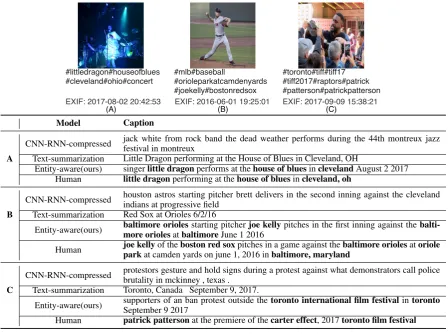
Figure 6 shows some examples of the captions generated by the entity-aware model.
Approach Vocabulary BLEU-1 BLEU-2 BLEU-3 BLEU-4 METEOR ROUGE CIDEr
Raw-caption 10,979 15.1 11.7 9.9 8.8 8.8 24.2 34.7
[image:8.595.75.524.175.509.2]Coarse Template 3,533 46.7 36.1 29.8 25.7 22.4 43.5 161.6 Fine Template 3,642 43.0 33.4 27.8 24.3 20.3 39.8 165.3
Table 2: Comparison of Template Generator with coarse/fine-grained entity type. Coarse Template is
generalized by coarse-grained entity type (name tagger) and fine template is generalized by fine-grained entity type (EDL).
#mlb#baseball
#orioleparkatcamdenyards #joekelly#bostonredsox EXIF: 2016-06-01 19:25:01 #littledragon#houseofblues
#cleveland#ohio#concert
EXIF: 2017-08-02 20:42:53
#toronto#tiff#tiff17 #tiff2017#raptors#patrick #patterson#patrickpatterson EXIF: 2017-09-09 15:38:21
(A) (B) (C)
Model Caption
A
CNN-RNN-compressed jack white from rock band the dead weather performs during the 44th montreux jazz festival in montreux
Text-summarization Little Dragon performing at the House of Blues in Cleveland, OH
Entity-aware(ours) singerlittle dragonperforms at thehouse of bluesinclevelandAugust 2 2017 Human little dragonperforming at thehouse of bluesincleveland, oh
B
CNN-RNN-compressed houston astros starting pitcher brett delivers in the second inning against the cleveland indians at progressive field
Text-summarization Red Sox at Orioles 6/2/16
Entity-aware(ours) baltimore oriolesstarting pitcherjoe kellypitches in the first inning against the balti-more oriolesatbaltimoreJune 1 2016
Human joe kellyof theboston red soxpitches in a game against thebaltimore oriolesatoriole parkat camden yards on june 1, 2016 inbaltimore, maryland
C
CNN-RNN-compressed protestors gesture and hold signs during a protest against what demonstrators call police brutality in mckinney , texas .
Text-summarization Toronto, Canada September 9, 2017.
Entity-aware(ours) supporters of an ban protest outside thetoronto international film festivalintoronto September 9 2017
Human patrick pattersonat the premiere of thecarter effect, 2017toronto film festival
Figure 6: Examples of generated entity-aware caption.
BLEU-1 BLEU-2 BLEU-3 BLEU-4 METEOR ROUGE CIDEr F1 Human∗
CNN-RNN-raw 7.5 2.7 0.9 0.3 2.6 7.5 1.1 1.2 0.49
CNN-RNN-compress 8.3 3.3 1.1 0.5 3.0 9.2 1.5 2.1 0.50
Text-summarization 9.5 8.0 7.1 6.5 9.9 11.9 17.2 35.4 0.59 Entity-aware(ours) 25.5 14.9 8.0 4.7 11.0 21.1 29.9 39.7 0.87
Table 4: Comparison between our entity-aware model and baseline models on various topics. (∗We make
human evaluation on 259 images randomly selected.)
Relation Error of Filled Entities: Some of our errors result from ignoring of relations be-tween entities. In Example (B) of Figure6
our model generate a good template, but con-nects ‘Joe Kelly’, who is actually a pitcher of ‘Res Sox’, with ‘Baltimore Orioles’ incor-rectly. One possible solution is to incorporate
relation information when the model fills in the slots with entities.
[image:8.595.79.536.541.601.2]the image. One potential improvement is to incorporate the information from associ-ated tags, such as the number of tags and the named entity types related to the tags, as features during template caption genera-tion to make generated templates dynami-cally change according to the context.
6 Related Work
The goal of image captioning is to automatically generate a natural language sentence given an im-age. (Kulkarni et al., 2013; Yang et al., 2011;
Mitchell et al.,2012) perform object recognition in images and fill hand-made templates with the rec-ognized objects. (Kuznetsova et al., 2012, 2014) retrieve similar images, parse associated captions into phrases, and compose them into new sen-tences. Due to the use of static, handmade tem-plates, these approaches are unable to generate a variety of sentence realizations, which can result in poorly generated sentences and requires one to manually create more templates to extend the gen-eration. Our approach overcomes this by dynami-cally generating the output.
More recent work utilizes neural networks and applies an encoder-decoder model (Cho et al.,
2014).Vinyals et al.(2015) use a CNN to encode images into a fixed size vector representation and a LSTM to decode the image representations into a sentence.Xu et al.(2015) incorporate an atten-tion mechanism (Bahdanau et al., 2015) and at-tend to the output from a convolutional layer of a CNN to produce the image representations for the decoder. Instead of encoding a whole image as a vector, (Johnson et al.,2016) apply R-CNN object detection (Girshick et al.,2014), match text snip-pets to the regions of the image detected by the R-CNN, and use a recurrent neural network (RNN) language model, similar to (Vinyals et al.,2015), to generate a description of each region.
The surface realization for state-of-the-art neu-ral approaches is impressive, but, in the context of generating entity-aware captions, these methods fall short as they heavily rely on training data for language modeling. (Tran et al., 2016) leverage face and landmark recognition to generate cap-tions containing named persons, but such large-scale training is difficult. Consequently, OOV words like named entities, which are a quintessen-tial aspect of entity-aware captions because OOV words typically represent entities or events, are
difficult to generate due to low training probabil-ities. Some work has been done to incorporate novel objects into captions (Venugopalan et al.,
2017), but this does not address the need to gen-erate entity-aware captions and incorporate con-textual information; rather, it gives the ability to generate more fine-grained entities within cap-tions that still lack the necessary context. (Feng and Lapata, 2013) also generates a caption with named entities, but from associated news articles, in which there is much more textual context than our setting. Our approach uses neural networks to generate dynamic templates and then fills in the templates with specific entities. Thus, we are able to combine the sentence variation and sur-face realization quality of neural language model-ing and the capability to incorporate novel words of template-based approaches.
7 Conclusions and Future Work
In this paper we propose a new task which aims to automatically generate entity-aware image de-scriptions with limited textual information. Exper-iments on a new benchmark dataset collected from Flickr show that our approach generates more in-formative captions compared to traditional image captioning methods. Moreover, our two-step ap-proach can easily be applied to other language generation tasks involving specific information.
In the future, we will expand the entity-aware model to incorporate the relations between can-didates when the model fills in the slots, which can avoid the cases such as‘Cristiano Ronaldo of Barcelona’. We will also make further research on context-aware fine-grained entity typing to train a better template generator. Another research direc-tion based on this work is to develop an end-to-end neural architecture to make the model more flexi-ble without generating a template in the middle.
Acknowledgments
This work was supported by the U.S. DARPA AIDA Program No. FA8750-18-2-0014 and U.S.
ARL NS-CTA No. W911NF-09-2-0053. The
References
S¨oren Auer, Christian Bizer, Georgi Kobilarov, Jens Lehmann, Richard Cyganiak, and Zachary Ives. 2007. Dbpedia: A nucleus for a web of open data. InThe semantic web, pages 722–735. Springer.
Dzmitry Bahdanau, Kyunghyun Cho, and Yoshua
Ben-gio. 2015. Neural machine translation by jointly
learning to align and translate. In Proceedings of
the third International Conference on Learning Rep-resentations.
Kyunghyun Cho, Bart Van Merri¨enboer, Caglar Gul-cehre, Dzmitry Bahdanau, Fethi Bougares, Holger
Schwenk, and Yoshua Bengio. 2014. Learning
phrase representations using rnn encoder-decoder for statistical machine translation. InProceedings of the 2014 Conference on Empirical Methods in Nat-ural Language Processing.
Marie-Catherine De Marneffe and Christopher D Man-ning. 2008. Stanford typed dependencies manual. Technical report, Technical report, Stanford Univer-sity.
Jia Deng, Wei Dong, Richard Socher, Li-Jia Li, Kai Li, and Li Fei-Fei. 2009. Imagenet: A large-scale
hierarchical image database. InIn Proceedings of
the 2009 IEEE Conference on Computer Vision and Pattern Recognition.
Michael Denkowski and Alon Lavie. 2014. Meteor
universal: Language specific translation evaluation for any target language. InProceedings of the ninth workshop on statistical machine translation.
Hao Fang, Saurabh Gupta, Forrest Iandola, Rupesh K Srivastava, Li Deng, Piotr Doll´ar, Jianfeng Gao, Xi-aodong He, Margaret Mitchell, John C Platt, et al. 2015. From captions to visual concepts and back. In Proceedings of the 2015 IEEE Conference on Com-puter Vision and Pattern Recognition.
Yansong Feng and Mirella Lapata. 2013. Automatic
caption generation for news images. IEEE
transac-tions on pattern analysis and machine intelligence, 35(4):797–812.
Ross Girshick, Jeff Donahue, Trevor Darrell, and Jiten-dra Malik. 2014. Rich feature hierarchies for accu-rate object detection and semantic segmentation. In Proceedings of the 2014 IEEE conference on com-puter vision and pattern recognition.
Kaiming He, Xiangyu Zhang, Shaoqing Ren, and Jian Sun. 2016. Deep residual learning for image
recog-nition. In Proceedings of the IEEE conference on
computer vision and pattern recognition, pages 770– 778.
Sepp Hochreiter and J¨urgen Schmidhuber. 1997.
Long short-term memory. Neural computation,
9(8):1735–1780.
Justin Johnson, Andrej Karpathy, and Li Fei-Fei. 2016.
Densecap: Fully convolutional localization
net-works for dense captioning. InProceedings of the
IEEE Conference on Computer Vision and Pattern Recognition, pages 4565–4574.
Andrej Karpathy and Li Fei-Fei. 2015. Deep visual-semantic alignments for generating image
descrip-tions. InProceedings of the 2015 IEEE Conference
on Computer Vision and Pattern Recognition.
Girish Kulkarni, Visruth Premraj, Vicente Ordonez, Sagnik Dhar, Siming Li, Yejin Choi, Alexander C Berg, and Tamara L Berg. 2013. Babytalk: Under-standing and generating simple image descriptions. IEEE Transactions on Pattern Analysis and Machine Intelligence, 35(12):2891–2903.
Polina Kuznetsova, Vicente Ordonez, Alexander C Berg, Tamara L Berg, and Yejin Choi. 2012. Col-lective generation of natural image descriptions. In Proceedings of the 50th Annual Meeting of the As-sociation for Computational Linguistics.
Polina Kuznetsova, Vicente Ordonez, Tamara L Berg, and Yejin Choi. 2014. Treetalk: Composition and
compression of trees for image descriptions.
Trans-actions of the Association of Computational Linguis-tics.
Chin-Yew Lin. 2004. Rouge: A package for
auto-matic evaluation of summaries. Text Summarization
Branches Out.
Tsung-Yi Lin, Michael Maire, Serge Belongie, James Hays, Pietro Perona, Deva Ramanan, Piotr Doll´ar,
and C Lawrence Zitnick. 2014. Microsoft coco:
Common objects in context. InProceedings of the
2014 European Conference on Computer Vision.
Christopher Manning, Mihai Surdeanu, John Bauer, Jenny Finkel, Steven Bethard, and David McClosky. 2014. The stanford corenlp natural language
pro-cessing toolkit. In Proceedings of 52nd annual
meeting of the association for computational lin-guistics: system demonstrations, pages 55–60.
Margaret Mitchell, Xufeng Han, Jesse Dodge, Alyssa Mensch, Amit Goyal, Alex Berg, Kota Yamaguchi, Tamara Berg, Karl Stratos, and Hal Daum´e III. 2012. Midge: Generating image descriptions from
com-puter vision detections. InProceedings of the 13th
Conference of the European Chapter of the Associa-tion for ComputaAssocia-tional Linguistics.
Xiaoman Pan, Taylor Cassidy, Ulf Hermjakob, Heng Ji, and Kevin Knight. 2015. Unsupervised entity
link-ing with abstract meanlink-ing representation. In
Pro-ceedings of the 2015 Conference of the North Amer-ican Chapter of the Association for Computational Linguistics–Human Language Technologies.
Kishore Papineni, Salim Roukos, Todd Ward, and Wei-Jing Zhu. 2002. Bleu: a method for automatic
eval-uation of machine translation. In Proceedings of
Cyrus Rashtchian, Peter Young, Micah Hodosh, and Julia Hockenmaier. 2010. Collecting image
anno-tations using amazon’s mechanical turk. In
Pro-ceedings of the 2010 Conference of the North Amer-ican Chapter of the Association for Computational Linguistics–Human Language Technologies Work-shop on Creating Speech and Language Data with Amazon’s Mechanical Turk.
Kenneth Tran, Xiaodong He, Lei Zhang, Jian Sun, Cor-nelia Carapcea, Chris Thrasher, Chris Buehler, and Chris Sienkiewicz. 2016. Rich image captioning in
the wild. InProceedings of the 2016 IEEE
Confer-ence on Computer Vision and Pattern Recognition Workshops.
Van-Khanh Tran and Le-Minh Nguyen. 2017. Natu-ral language generation for spoken dialogue system
using rnn encoder-decoder networks. In
Proceed-ings of the 21st Conference on Computational Natu-ral Language Learning.
Lucy Vanderwende, Hisami Suzuki, Chris Brockett, and Ani Nenkova. 2007. Beyond sumbasic: Task-focused summarization with sentence simplification
and lexical expansion. Information Processing &
Management, 43(6):1606–1618.
Ramakrishna Vedantam, C Lawrence Zitnick, and Devi Parikh. 2015. Cider: Consensus-based image
de-scription evaluation. In Proceedings of the IEEE
conference on computer vision and pattern recog-nition, pages 4566–4575.
Subhashini Venugopalan, Lisa Anne Hendricks, Mar-cus Rohrbach, Raymond Mooney, Trevor Darrell,
and Kate Saenko. 2017. Captioning images with
diverse objects. In Proceedings of the 2017 IEEE
Conference on Computer Vision and Pattern Recog-nition.
Oriol Vinyals, Alexander Toshev, Samy Bengio, and Dumitru Erhan. 2015. Show and tell: A neural
im-age caption generator. InProceedings of the 2015
IEEE Conference on Computer Vision and Pattern Recognition.
Han Wang, Jin Guang Zheng, Xiaogang Ma, Peter Fox, and Heng Ji. 2015. Language and domain indepen-dent entity linking with quantified collective
valida-tion. InProceedings of the 2015 Conference on
Em-pirical Methods in Natural Language Processing.
Tsung-Hsien Wen, Milica Gasic, Nikola Mrksic, Pei-Hao Su, David Vandyke, and Steve Young. 2015. Semantically conditioned lstm-based natural lan-guage generation for spoken dialogue systems. In Proceedings of the 2015 Conference on Empirical Methods in Natural Language Processing.
Kelvin Xu, Jimmy Ba, Ryan Kiros, Kyunghyun Cho, Aaron C Courville, Ruslan Salakhutdinov, Richard S Zemel, and Yoshua Bengio. 2015. Show, attend and tell: Neural image caption generation with visual
at-tention. In Proceedings of the 2015 International
Conference on Machine Learning.
Yezhou Yang, Ching Lik Teo, Hal Daum´e III, and Yian-nis Aloimonos. 2011. Corpus-guided sentence
gen-eration of natural images. In Proceedings of the