Supervised Phrase Table Triangulation with Neural Word Embeddings
for Low-Resource Languages
Tomer Levinboim and David Chiang Department of Computer Science and Engineering
University of Notre Dame
{levinboim.1,dchiang}@nd.edu
Abstract
In this paper, we develop a supervised learning technique that improves noisy phrase translation scores obtained by phrase table triangulation. In particular, we extract word translation distributions from small amounts of source-target bilin-gual data (a dictionary or a parallel corpus) with which we learn to assign better scores to translation candidates obtained by trian-gulation. Our method is able to gain im-provement in translation quality on two tasks: (1) On Malagasy-to-French transla-tion via English, we use only 1k dictransla-tionary entries to gain +0.5 Bleu over triangula-tion. (2) On Spanish-to-French via English we use only 4k sentence pairs to gain+0.7 Bleu over triangulation interpolated with a phrase table extracted from the same 4k sentence pairs.
1 Introduction
Phrase-based statistical machine translation sys-tems require considerable amounts of source-target parallel data to produce good quality trans-lation. However, large amounts of parallel data are available for only a fraction of language pairs, and mostly when one of the languages is English.
Phrase table triangulation (Utiyama and Isa-hara, 2007; Cohn and Lapata, 2007; Wu and Wang, 2007) is a method for generating source-target phrase tables without having access to any source-target parallel data. The intuition behind triangulation (and pivoting techniques in general) is the transitivity of translation: if a source lan-guage phrase s translates to a pivot language phrase pwhich in turn translates to a target lan-guage phraset, thensshould likely translate tot. Following this intuition, a triangulated source-target phrase table ˆT can be composed from a source-pivot and pivot-target phrase table (§2).
However, the resulting triangulated phrase table ˆ
T contains many spurious phrase pairs and noisy probability estimates. Therefore, early triangula-tion work (Wu and Wang, 2007) already realis-tically assumed access to a limited source-target parallel data from which a relatively high-quality source-target phrase table T can be directly esti-mated. The two phrase tables were then combined, resulting in a higher quality phrase table that pro-poses translations for many source phrases not found inT. Wu and Wang (2007) report that in-terpolation of the two phrase tablesT and ˆT leads to higher quality translations. However, the trian-gulated phrase table ˆT is obtained without using the source-target bilingual data, which suggests that the source-target data is not used as fully as it could be.
In this paper, we develop a supervised learning algorithm that corrects triangulated word transla-tion probabilities by relying on word translatransla-tion distributionswsupderived from the limited
source-target data. In particular, we represent source and target words using word embeddings (Mikolov et al., 2013) and learn a transformation between the two embedding spaces in order to approxi-mate wsup, thus down-weighting incorrect
trans-lation candidates proposed by triangutrans-lation (§3). By representing words as embeddings, our model can generalize the information contained in the source-target data (as encoded in the distributions
wsup) to a much larger vocabulary, and can
as-sign lexical-weighting probabilities to most of the phrase pairs in ˆT.
Fixing English as the pivot language (the most realistic pivot language choice), on a low-resource Spanish-to-French translation task our model gains+0.7 Bleuon top of standard phrase table interpolation. On Malagasy-to-French trans-lation, our model gains +0.5 Bleu on top of tri-angulation when using only 1k Malagasy-French dictionary entries (§4).
2 Preliminaries
Let s,p,tdenote words and s,p,t denote phrases in the source, pivot, and target languages, respec-tively. Also, letT denote a phrase table estimated over a parallel corpus and ˆT denote a triangu-lated phrase table. We use similar notation for their respective phrase translation features φ, lexical-weighting features lex, and the word translation probabilitiesw.
2.1 Triangulation (weak baseline)
In phrase table triangulation, a source-target phrase table Tst is constructed by combining a
source-pivot and pivot-target phrase tableTsp,Tpt,
each estimated on its respective parallel data. For each resulting phrase pair (s,t), we can also com-pute an alignment ˆa as the most frequent align-ment obtained by combining source-pivot and pivot-target alignmentsaspandaptacross all pivot phrasesp as follows:{(s,t) | ∃p : (s,p) ∈ asp ∧
(p,t)∈apt}.
The triangulated source-to-target lexical weights, denoted lexcst, are approximated in two
steps: First, word translation scores ˆwst are
ap-proximated by marginalizing over the pivot words:
ˆ
wst(t|s)=
X
p
wsp(p|s)·wpt(t| p). (1)
Next, given a (triangulated) phrase pair (s,t) with alignment ˆa, let ˆas,: = {t | (s,t) ∈ aˆ}; the
lexical-weighting probability is (Koehn et al., 2003):
c
lexst(t|s,ˆa)=
Y
s∈s
1
|aˆs,:|
X
t∈asˆ,:
ˆ
wst(t| s). (2)
The triangulated phrase translation scores, de-noted ˆφst, are computed by analogy with Eq. 1.
We also compute these scores in the reverse direction by swapping the source and target lan-guages.
2.2 Interpolation (strong baseline)
Given access to source-target data, an ordinary source-target phrase tableTstcan be estimated
di-rectly. Wu and Wang (2007) suggest interpolating phrase pairs entries that occur in both tables:
Tinterp=αTst+(1−α) ˆTst. (3)
Phrase pairs appearing in only one phrase table are added as-is. We refer to the resulting table as the interpolated phrase table.
3 Supervised Word Translations
While interpolation (Eq. 3) may help correct some of the noisy triangulated scores, its effect is lim-ited to phrase pairs appearing in both phrase ta-bles. Here, we suggest a discriminative supervised learning method that can affect all phrase pairs.
Our idea is to regard word translation distri-butions derived from source-target bilingual data (through word alignments or dictionary entries) as the correct translation distributions, and use them to learn discriminately: correct target words should become likely translations, and incorrect ones should be down-weighted. To generalize be-yond the vocabulary of the source-target data, we appeal to word embeddings.
We present our formulation in the source-to-target direction. The source-to-target-to-source direction is obtained simply by swapping the source and tar-get languages.
3.1 Model
Letcsupst denote the number of times source word
swas aligned to target wordt(in word alignment, or in the dictionary). We define the word transla-tion distributransla-tions wsup(t | s) = csup
st /csups , where csups =Ptcsupst . Furthermore, letq(t| s) denote the word translation probabilities we wish to learn and consider maximizing the log-likelihood function:
arg max
q L(q)=arg maxq X
(s,t)
csupst logq(t| s).
Clearly, the solutionq(· | s) := wsup(· | s)
maxi-mizes L. However, we would like a solution that generalizes to source words s beyond those ob-served in the source-target corpus – in particular, those source words that appear in the triangulated phrase table ˆT, but not inT.
In order to generalize, we abstract from words to vector representations of words. Specifically, we constrainqto the following parameterization:
q(t| s)= Z1
sexp
vTsAvt+ fstTh
Zs= X
t∈T(s)
expvTsAvt+ fstTh
.
Here, the vectorsvsandvt represent monolingual
features and the vector fstrepresents bilingual
fea-tures. The parametersAandhare to be learned. In this work, we use monolingual word embed-dings forvs andvt, and set the vector fst to
that fst := wˆst. Therefore, the matrix A is a
lin-ear transformation between the source and target embedding spaces, andh(now a scalar) quantifies how the triangulated scores ˆware to be trusted.
In the normalization factor Zs, we let t range
only over possible translations of s suggested by eitherwsup or the triangulated word probabilities.
That is:
T(s)={t|wsup(t| s)>0 ∨ wˆ(t|s)>0}.
This restriction makes efficient computation pos-sible, as otherwise the normalization term would have to be computed over the entire target vocab-ulary.
Under this parameterization, our goal is to solve the following maximization problem:
max
A,h L(A,h)=maxA,h
X
s,t
csupst logq(t| s). (4)
3.2 Optimization
The objective function in Eq. 4 is concave in both
A andh. This is because after taking the log, we are left with a weighted sum of linear and concave (negative log-sum-exp) terms inAandh. We can therefore reach the global solution of the problem using gradient descent.
Taking derivatives, the gradient is
∂L
∂A = X
s,t
mstvsvTt ∂∂Lh = X
s,t
mstfst
where the scalarmst = csupst −csups q(t | s) for the
current value ofq.
For quick results, we limited the number of gra-dient steps to 200 and selected the iteration that minimized the total variation distance towsupover
a held out dev set:
X
s
||q(· |s)−wsup(· |s)||1. (5)
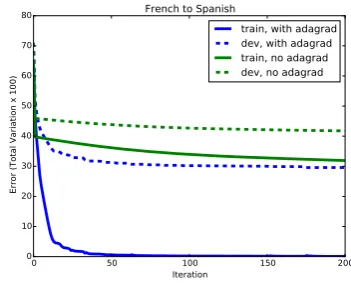
We obtained better convergence rate by us-ing a batch version of the effective and easy-to-implement Adagrad technique (Duchi et al., 2011). See Figure 1.
3.3 Re-estimating lexical weights
Having learned the model (Aandh), we can now useq(t | s) to estimate the lexical weights (Eq. 2) of any aligned phrase pairs (s,t,ˆa), assuming it is composed of embeddable words.
0 50 100 150 200
Iteration 0
10 20 30 40 50 60 70 80
Error (Total Variation x 100)
French to Spanish
[image:3.595.324.500.70.213.2]train, with adagrad dev, with adagrad train, no adagrad dev, no adagrad
Figure 1: The (target-to-source) objective function per iteration. Applying batch Adagrad (blue) sig-nificantly accelerates convergence.
However, we found the supervised word trans-lation scoresqto be too sharp, sometimes assign-ing all probability mass to a sassign-ingle target word. We therefore interpolatedqwith the triangulated word translation scores ˆw:
qβ =βq+(1−β) ˆw. (6)
To integrate the lexical weights induced by qβ
(Eq. 2), we simply appended them as new features in the phrase table in addition to the existing lexi-cal weights. Following this, we can search for aβ
value that maximizes Bleuon a tuning set.
3.4 Summary of method
In summary, to improve upon a triangulated or in-terpolated phrase table, we:
1. Learn word translation distributionsqby super-vision against distributions wsup derived from
the source-target bilingual data (§3.1).
2. Smooth the learned distributionsqby interpo-lating with triangulated word translation scores
ˆ
w(§3.3).
3. Compute new lexical weights and append them to the phrase table (§3.3).
4 Experiments
4.1 Data
Fixing the pivot language to English, we applied our method on two data scenarios:
1. Spanish-to-French: two related languages
used to simulate a low-resource setting. The baseline is phrase table interpolation (Eq. 3).
2. Malagasy-to-French:two unrelated languages for which we have a small dictionary, but no parallel corpus (aside from tuning and testing data). The baseline is triangulation alone (there is no source-target model to interpolate with). Table 1 lists some statistics of the bilin-gual data we used. European-language bitexts were extracted from Europarl (Koehn, 2005). For Malagasy-English, we used the Global Voices par-allel data available online.1The Malagasy-French
dictionary was extracted from online resources2
and the small Malagasy-French tune/test sets were extracted3from Global Voices.
lines of data language pair train tune test
[image:4.595.98.267.365.459.2]sp-fr 4k 1.5k 1.5k mg-fr 1.1k 1.2k 1.2k sp-en 50k – – mg-en 100k – – en-fr 50k – –
Table 1: Bilingual datasets. Legend: sp=Spanish, fr=French, en=English, mg=Malagasy.
Table 2 lists token statistics of the monolin-gual data used. We used word2vec4 to generate
French, Spanish and Malagasy word embeddings. The French and Spanish embeddings were (in-dependently) estimated over their combined to-kenized and lowercased Gigaword5 and Leipzig
news corpora.6 The Malagasy embeddings were
similarly estimated over data form Global Voices,7
the Malagasy Wikipedia and the Malagasy Com-mon Crawl.8 In addition, we estimated a 5-gram
French language model over the French monolin-gual data.
1http://www.ark.cs.cmu.edu/global-voices 2http://motmalgache.org/bins/homePage 3https://github.com/vchahun/gv-crawl
4https://radimrehurek.com/gensim/models/word2vec.html 5http://catalog.ldc.upenn.edu
6http://corpora.uni-leipzig.de/download.html 7http://www.isi.edu/˜qdou/downloads.html 8https://commoncrawl.org/the-data/
language words French 1.5G Spanish 1.4G Malagasy 58M
Table 2: Size of monolingual corpus per language as measured in number of tokens.
4.2 Spanish-French Results
To produce wsup, we aligned the small
Spanish-French parallel corpus in both directions, and symmetrized using the intersection heuristic. This was done to obtain high precision alignments (the often-used grow-diag-final-and heuristic is opti-mized for phrase extraction, not precision).
We used the skip-gram model to estimate the Spanish and French word embeddings and set the dimension to d = 200 and context window to
w= 5 (default). Subsequently, to run our method, we filtered out source and target words that either did not appear in the triangulation, or, did not have an embedding. We took words that appeared more than 10 times in the parallel corpus for the training set (∼690 words), and between 5–9 times for the held out dev set (∼530 words). This was done in both source-target and target-source directions.
In Table 3 we show that the distributions learned by our method are much better approximations of
wsupcompared to those obtained by triangulation.
Method source→target target→source triangulation 71.6% 72.0% our scores 30.2% 33.8% Table 3: Average total variation distance (Eq. 5) to the dev set portion ofwsup(computed only over
words whose translations inwsupappear in the
tri-angulation). Using word embeddings, our method is able to better generalize on the dev set.
We then examined the effect of appending our supervised lexical weights. We fixed the word level interpolationβ:=0.95 (effectively assigning very little mass to triangulated word translations
ˆ
w) and searched forα∈ {0.9,0.8,0.7,0.6}in Eq. 3 to maximize Bleuon the tuning set.
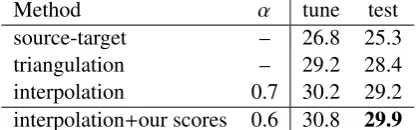
Our MT results are reported in Table 4. While interpolation improves over triangulation alone by
Method α tune test source-target – 26.8 25.3 triangulation – 29.2 28.4 interpolation 0.7 30.2 29.2 interpolation+our scores 0.6 30.8 29.9
Table 4: Spanish-French Bleu scores. Append-ing lexical weights obtained by supervision over a small source-target corpus significantly out-performs phrase table interpolation (Eq. 3) by
+0.7 Bleu.
4.3 Malagasy-French Results
For Malagasy-French, thewsup distributions used
for supervision were taken to be uniform distri-butions over the dictionary translations. For each training direction, we used a 70%/30% split of the dictionary to form the train and dev sets.
Having significantly less Malagasy monolin-gual data, we usedd = 100 dimensional embed-dings and aw=3 context window to estimate both Malagasy and French words.
As before, we added our supervised lexical weights as new features in the phrase table. How-ever, instead of fixing β = 0.95 as above, we searched forβ∈ {0.9,0.8,0.7,0.6}in Eq. 6 to max-imize Bleuon a small tune set. We report our re-sults in Table 5. Using only a dictionary, we are able to improve over triangulation by+0.5 Bleu, a statistically significant difference (p<0.01).
Method β tune test
triangulation – 12.2 11.1 triangulation+our scores 0.6 12.4 11.6
Table 5: Malagasy-French Bleu. Supervision with a dictionary significantly improves upon simple triangulation by+0.5 Bleu.
5 Conclusion
In this paper, we argued that constructing a trian-gulated phrase table independently from even very limited source-target data (a small dictionary or parallel corpus) underutilizes that parallel data.
Following this argument, we designed a super-vised learning algorithm that relies on word trans-lation distributions derived from the parallel data as well as a distributed representation of words (embeddings). The latter enables our algorithm to assign translation probabilities to word pairs that do not appear in the source-target bilingual data.
We then used our model to generate new lexi-cal weights for phrase pairs appearing in a trian-gulated or interpolated phrase table and demon-strated improvements in MT quality on two tasks. This is despite the fact that the distributions (wsup)
we fit our model to were estimated automatically, or even na¨ıvely as uniform distributions.
Acknowledgements
The authors would like to thank Daniel Marcu and Kevin Knight for initial discussions and a sup-portive research environment at ISI, as well as the anonymous reviewers for their helpful comments. This research was supported in part by a Google Faculty Research Award to Chiang.
References
Trevor Cohn and Mirella Lapata. 2007. Machine translation by triangulation: Making effective use of
multi-parallel corpora. In Proc. ACL, pages 728–
735.
John Duchi, Elad Hazan, and Yoram Singer. 2011. Adaptive subgradient methods for online learning
and stochastic optimization. J. Machine Learning
Research, 12:2121–2159, July.
Philipp Koehn, Franz Josef Och, and Daniel Marcu.
2003. Statistical phrase-based translation. InProc.
NAACL HLT, pages 48–54.
Philipp Koehn, Hieu Hoang, Alexandra Birch, Chris Callison-Burch, Marcello Federico, Nicola Bertoldi, Brooke Cowan, Wade Shen, Christine Moran, Richard Zens, Chris Dyer, Ondˇrej Bojar, Alexan-dra Constantin, and Evan Herbst. 2007. Moses: Open source toolkit for statistical machine
transla-tion. InProc. ACL, Interactive Poster and
Demon-stration Sessions, pages 177–180.
Philipp Koehn. 2004. Statistical significance tests for
machine translation evaluation. In Proc. EMNLP,
pages 388–395.
Philipp Koehn. 2005. Europarl: A parallel corpus for
statistical machine translation. InProc. MT Summit,
pages 79–86.
Tomas Mikolov, Kai Chen, Greg Corrado, and Jeffrey Dean. 2013. Efficient estimation of word
represen-tations in vector space. In Proc. ICLR, Workshop
Track.
Masao Utiyama and Hitoshi Isahara. 2007. A com-parison of pivot methods for phrase-based statistical
machine translation. In Proc. HLT-NAACL, pages
484–491.
Hua Wu and Haifeng Wang. 2007. Pivot language ap-proach for phrase-based statistical machine