Solving Geometry Problems:
Combining Text and Diagram Interpretation
Minjoon Seo, Hannaneh Hajishirzi, Ali Farhadi, Oren Etzioni, Clint Malcolm
University of Washington, Allen Institute for Artificial Intelligence
{minjoon,hannaneh,clintm}@washington.edu,{alif,orene}@allenai.org
Abstract
This paper introduces GEOS, the first au-tomated system to solve unaltered SAT ge-ometry questions by combining text un-derstanding and diagram interpretation. We model the problem of understanding geometry questions as submodular opti-mization, and identify a formal problem description likely to be compatible with both the question text and diagram. GEOS then feeds the description to a geometric solver that attempts to determine the cor-rect answer. In our experiments, GEOS achieves a 49% score on official SAT tions, and a score of 61% on practice ques-tions.1 Finally, we show that by
integrat-ing textual and visual information, GEOS boosts the accuracy of dependency and se-mantic parsing of the question text. 1 Introduction
This paper introduces the first fully-automated system for solving unaletered SAT-level geomet-ric word problems, each of which consists of text and the corresponding diagram (Figure 1). The ge-ometry domain has a long history in AI, but previ-ous work has focused on geometric theorem prov-ing (Feigenbaum and Feldman, 1963) or geomet-ric analogies (Evans, 1964). Arithmetic and alge-braic word problems have attracted several NLP researchers (Kushman et al., 2014; Hosseini et al., 2014; Roy et al., 2015), butgeometricword prob-lems were first explored only last year by Seo et al. (2014). Still, this system merely aligned diagram elements with their textual mentions (e.g., “Circle O”)—it did not attempt to fully represent geome-try problems or solve them. Answering geomegeome-try questions requires a method that interpert question text and diagrams in concert.
1The source code, the dataset and the annotations are
pub-licly available atgeometry.allenai.org.
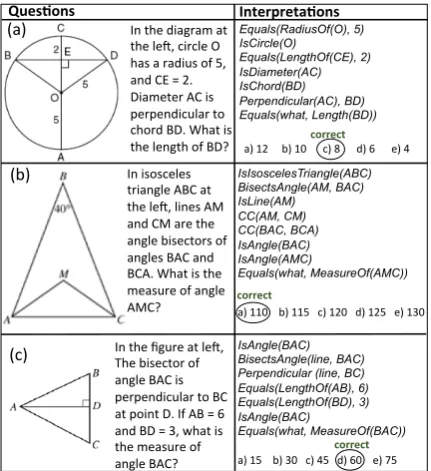
In the diagram at the le., circle O has a radius of 5, and CE = 2. Diameter AC is perpendicular to chord BD. What is the length of BD? In isosceles triangle ABC at the le., lines AM and CM are the angle bisectors of angles BAC and BCA. What is the measure of angle AMC?
In the figure at le., The bisector of angle BAC is perpendicular to BC at point D. If AB = 6 and BD = 3, what is the measure of angle BAC?
Equals(RadiusOf(O), 5) IsCircle(O)
Equals(LengthOf(CE), 2) IsDiameter(AC) IsChord(BD) Perpendicular(AC), BD) Equals(what, Length(BD))
IsIsoscelesTriangle(ABC) BisectsAngle(AM, BAC) IsLine(AM)
CC(AM, CM) CC(BAC, BCA) IsAngle(BAC) IsAngle(AMC)
Equals(what, MeasureOf(AMC))
a) 110 b) 115 c) 120 d) 125 e) 130
IsAngle(BAC) BisectsAngle(line, BAC) Perpendicular (line, BC) Equals(LengthOf(AB), 6) Equals(LengthOf(BD), 3) IsAngle(BAC)
Equals(what, MeasureOf(BAC))
a) 15 b) 30 c) 45 d) 60 e) 75
correct
correct
correct (a)
(b)
(c)
Ques*ons
[image:1.595.309.525.204.440.2]a) 12 b) 10 c) 8 d) 6 e) 4 Interpreta*ons
Figure 1:Questions (left column) and interpretations (right column) derived by GEOS.
The geometry genre has several distinctive char-acteristics. First, diagrams provide essential in-formation absent from question text. In Figure 1 problem (a), for example, the unstated fact that lines BD and AC intersect at E is necessary to solve the problem. Second, the text often includes difficult references to diagram elements. For ex-ample, in the sentence “In the diagram, the longer line is tangent to the circle”, resolving the ref-erent of the phrase “longer line” is challenging. Third, the text often contains implicit relations. For example, in the sentence “AB is 5”, the rela-tionsIsLine(AB)andlength(AB)=5are implicit.
Fourth, geometric terms can be ambiguous as well. For instance, radius can be a type identifier in “the length of radius AO is 5”, or a predicate in “AO is the radius of circle O”. Fifth, identifying the correct arguments for each relation is challeng-ing. For example, in sentence “Lines AB and CD are perpendicular to EF”, the parser has to deter-minewhatis perpendicular to EF—line AB? line
CD? Or both AB and CD? Finally, it is hard to obtain large number of SAT-level geometry ques-tions; Learning from a few examples makes this a particularly challenging NLP problem.
This paper introduces GEOS, a system that maps geometry word problems into a logical rep-resentation that is compatible with both the prob-lem text and the accompanying diagram (Fig-ure 1). We cast the mapping problem as the prob-lem of selecting the subset of relations that is most likely to correspond to each question.
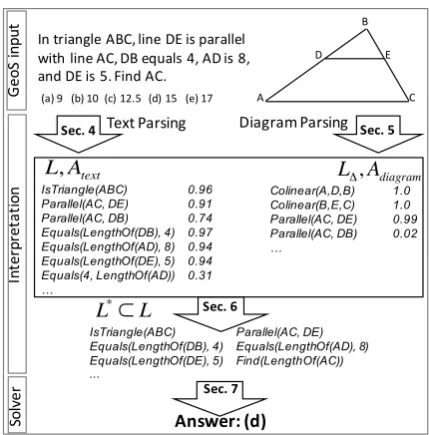
We compute the mapping in three main steps (Figure 2). First, GEOS uses text- and diagram-parsing to overgenerate a set of relations that po-tentially correspond to the question text, and asso-ciates a score with each. Second, GEOS generates a set of relations (with scores) that corresponds to the diagram. Third, GEOS selects a subset of the relations that maximizes the joint text and diagram scores. We cast this maximization as a submodu-lar optimization problem, which enables GEOS to use a close-to-optimal greedy algorithm. Finally, we feed the derived formal model of the problem to a geometric solver, which computes the answer to the question.
GEOS is able to solve unseen and unaltered multiple-choice geometry questions. We report on experiments where GEOS achieves a 49% score on official SAT questions, and a score of 61% on practice questions, providing the first results of this kind. Our contributions include: (1) designing and implementing the first end-to-end system that solves SAT plane geometry problems; (2) formal-izing the problem of interpreting geometry ques-tions as a submodular optimization problem; and (3) providing the first empirical results on the ge-ometry genre, making the data and software avail-able for future work.
2 Related Work
Semantic parsing is an important area of NLP re-search (Zettlemoyer and Collins, 2005; Ge and Mooney, 2006; Flanigan et al., 2014; Eisenstein et al., 2009; Kate and Mooney, 2007; Goldwasser and Roth, 2011; Poon and Domingos, 2009; Be-rant and Liang, 2014; Kwiatkowski et al., 2013; Reddy et al., 2014). However, semantic parsers do not tackle diagrams—a critical element of the ge-ometry genre. In addition, the overall number of available geometry questions is quite small com-pared to the size of typical NLP corpora, making it
challenging to learn semantic parsers directly from geometry questions. Relation extraction is another area of NLP that is related to our task (Cowie and Lehnert, 1996; Culotta and Sorensen, 2004). Again, both diagrams and small corpora are prob-lematic for this body of work.
Our work is part of grounded language acqui-sition research (Branavan et al., 2012; Vogel and Jurafsky, 2010; Chen et al., 2010; Hajishirzi et al., 2011; Liang et al., 2009; Koncel-Kedziorski et al., 2014; Bordes et al., 2010; Kim and Mooney, 2013; Angeli and Manning, 2014; Hixon et al., 2015; Koncel-Kedziorski et al., 2014; Artzi and Zettlemoyer, 2013) that involves mapping text to a restricted formalism (instead of a full, do-main independent representation). In the geom-etry domain, we recover the entities (e.g., circles) from diagrams, derive relations compatible with both text and diagram, and re-score relations de-rived from text parsing using diagram information. Casting the interpretation problem as selecting the most likely subset of literals can be generalized to grounded semantic parsing domains such as navi-gational instructions.
Coupling images and the corresponding text has attracted attention in both vision and NLP (Farhadi et al., 2010; Kulkarni et al., 2011; Gupta and Mooney, 2010; Gong et al., 2014; Fang et al., 2014). We build on this powerful paradigm, but instead of generating captions we show how pro-cessing multimodal information help improve tex-tual or visual interpretations for solving geometry questions.
Diagram understanding has been explored since early days in AI (Lin et al., 1985; Hegarty and Just, 1989; Novak, 1995; O’Gorman and Kasturi, 1995; Bulko, 1988; Srihari, 1994; Lovett and Forbus, 2012). Most previous approaches differ from our method because they address the twin problems of diagram understanding and text understanding in isolation. Often, previous work relies on manual identification of visual primitives, or on rule-based system for text analysis. The closest work to ours is the recent work of Seo et al. (2014) that aligns geometric shapes with their textual mentions, but does not identify geometric relations or solve ge-ometry problems.
3 Problem Formulation
In triangle ABC, line DE is parallel with line AC, DB equals 4, AD is 8, and DE is 5. Find AC.
IsTriangle(ABC) 0.96 Parallel(AC, DE) 0.91 Parallel(AC, DB) 0.74 Equals(LengthOf(DB), 4) 0.97 Equals(LengthOf(AD), 8) 0.94 Equals(LengthOf(DE), 5) 0.94 Equals(4, LengthOf(AD)) 0.31 …
Text Parsing Diagram Parsing
Answer: (d)
Sec. 4
Sec. 6
Colinear(A,D,B) 1.0 Colinear(B,E,C) 1.0 Parallel(AC, DE) 0.99 Parallel(AC, DB) 0.02 …
L,Atext
L* ⊂L
LΔ,Adiagram
IsTriangle(ABC) Parallel(AC, DE) Equals(LengthOf(DB), 4) Equals(LengthOf(AD), 8) Equals(LengthOf(DE), 5) Find(LengthOf(AC)) ...
Sec. 7
Ge
oS
in
pu
t
In
te
rp
re
ta
tio
n
So
lv
er
Sec. 5 B
D E
A C
[image:3.595.75.290.60.278.2](a) 9 (b) 10 (c) 12.5 (d) 15 (e) 17
Figure 2: Overview of our method for solving geometry questions.
in raster graphics, and multiple choice answers c = {c1, . . . , cM}(M = 5 in SAT). Answering
a geometry question is to find a correct choiceci.
Our method, GEOS, consists of two steps (Fig-ure 2): (1) interpreting a geometry question by deriving a logical expression that represents the meaning of the text and the diagram, and (2) solv-ing the geometry question by checking the satis-fiablity of the derived logical expression. In this paper we mainly focus on interpreting geometry questions and use a standard algebraic solver (see section 7 for a brief description of the solver).
Definitions: We formally represent logical
ex-pressions in the geometry domain with the lan-guage Ω, a subset of typed first-order logic that includes:
• constants, corresponding to known numbers (e.g.,5and2in Figure 1) or entities with known
geometric coordinates.
• variables, corresponding to unknown numbers or geometrical entities in the question (e.g., O
andCEin Figure 1).
• predicates, corresponding to geometric or arith-metic relations (e.g., Equals, IsDiameter,
IsTangent).
• functions, corresponding to properties of geo-metrical entities (e.g., LengthOf, AreaOf) or
arithmetic operations (e.g.,SumOf,RatioOf).
Each element in the geometry language has either boolean (e.g., true), numeric (e.g., 4), or entity (e.g.,line,circle) type. We refer to all symbols
in the languageΩasconcepts.
We use the termliteralto refer to the application of a predicate to a sequence of arguments (e.g.,
IsTriangle(ABC)). Literals are possibly negated
atomic formulas in the languageΩ. Logical for-mulas contain constants, variables, functions, ex-istential quantifiers and conjunctions over literals (e.g.,∃x, IsTriangle(x)∧IsIsosceles(x)).
Interpretationis the task of mapping a new
ge-ometry question with each choice,(t, d, cm), into
a logical formula γ in Ω. More formally, the goal is to findγ∗= arg max
γ∈Γscore(γ;t, d, cm)
whereΓis the set of all logical formulas inΩand scoremeasures the interpretation score of the for-mula according to both text and diagram. The problem of deriving the best formula γ∗ can be
modeled as a combinatorial search in the space of literalsL(note that each logical formulaγ is rep-resented as a conjunction over literalsli).
GEOS efficiently searches this combinatorial space taking advantage of a submodular set func-tion that scores a subset of literals using both text and diagram. The best subset of literals is the one that has a highaffinitywith both text and diagram and is coherenti.e., does not suffer from redun-dancy (see Section 6). More formally,2
L∗ = arg max
L0⊂LλA(L
0, t, d)
| {z } Affinity
+H| {z }(L0, t, d) Coherence
, (1)
whereA(L0, t, d) measures the affinity of the
lit-erals in L0 with both the text and the diagram, H(L0, t, d) measures the coverage of the literals
inL0 compared to the text and discourages
redun-dancies, andλis a trade-off parameter betweenA andH.
The affinity A is decomposed into text-based affinity, Atext, and diagram-based affinity, Adiagram. The text-based affinity closely mirrors
the linguistic structure of the sentences as well as type matches in the geometry language Ω. For modeling the text score for each literal, we learn a log-linear model. The diagram-based affinity Adiagram grounds literals into the diagram, and
scores literals according to the diagram parse. We describe the details on how to compute Atext in
section 4 andAdiagramin section 5.
4 Text Parser
The text-based scoring function Atext(L, t)
com-putes the affinity score between the set of
liter-2We omit the argumentc
1. {lj},Atext←TEXTPARSING(languageΩ, text-choice pair(t, ci)) (Section 4) (i) concept identification:initialize a hypergraphGwith concept nodes.
(ii) relation identification:add a hyperedge (relation)rjbetween two or three related concept nodes and assign a weightAtext(rj, t;θ)based on the learned classifier.
(iii) literals parsing:obtain all subtrees ofG, which are equivalent to all possible literals,{l0
j}. LetAtext(lj, t) =
P
jAtext(rj, t;θ)for allrjin the literalli.
(iv) relation completion:obtain a complete literallj for each (under-specified)l0j, dealing with implication and coordinating conjunctions.
2. L∆,Adiagram←DIAGRAMPARSING(diagram imaged, literals{lj}) (Section 5)
3. L∗←GREEDYMAXIMIZATION(literalsL={l
j}, score functionsAtextandAdiagram) (Section 6) (i) initialization:L0← {}
(ii) greedy addition:add(L0, l
j)s.t.lj=argmaxlj∈L\L0F(L0∪ {lj})− F(L0), whereF=λA+H
(iii) iteration: repeat step (ii) while the gain is positive. 4. Answerc∗←one of choices s.t.L∗∪L
[image:4.595.88.517.60.212.2]∆are simultaneously satisfiable according to SOLVER (Section 7) Figure 3:Solving geometry questions with GEOS.
IsTangentTo
RadiusOf
O
Equals
5 Predicates
Func.ons
Constants, Variables
“A tangent line is drawn to circle O
with radius of 5”
line
IsCircle
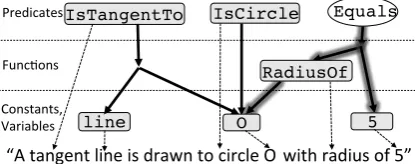
Figure 4: Hypergraph representation of the sentence “A tangent line is drawn to circle O with radius of 5”.
als L and the question text t. This score is the sum of the affinity scores of individual literals lj ∈ L i.e.,Atext(L, t) = PjAtext(lj, t)where Atext(lj, t) 7→[−∞,0].3 GEOS learns a
discrim-inative model Atext(lj, t;θ) that scores the
affin-ity of every literal lj ∈ Land the question textt
through supervised learning from training data. We represent literals using a hypergraph (Fig-ure 4) (Klein and Manning, 2005; Flanigan et al., 2014). Each node in the graph corresponds to a concept in the geometry language (i.e. constants, variables, functions, or predicates). The edges capture the relations between concepts; concept nodes are connected if one concept is the argument of the other in the geometry language. In order to interpret the question text (Figure 3 step 1), GEOS first identifies concepts evoked by the words or phrases in the input text. Then, it learns the affin-ity scores which are the weights of edges in the hypergraph. It finally completes relations so that type matches are satistfied in the formal language.
4.1 Concept Identification
Concepts are defined as symbols in the geometry languageΩ. The concept identification stage maps words or phrases to their corresponding concepts
3For the ease of notation, we useA
textas a function tak-ing sets of literals or a literal.
in the geometry language. Note that a phrase can be mapped to several concepts. For instance, in the sentence “ABCD is a square with an area of 1”, the word “square” is a noun referring to some object, so it maps to a variablesquare. In a similar sentence “square ABCD has an area 1”, the word “square” describes the variableABCD, so it maps to
a predicateIsSquare.
GEOS builds a lexicon from training data that maps stemmed words and phrases to the con-cepts in the geometry language Ω. The lexicon is derived from all correspondences between ge-ometry keywords and concepts in the gege-ometry language as well as phrases and concepts from manual annotations in the training data. For in-stance, the lexicon contains (“square”, {square,
IsSquare}) including all possible concepts for the
phrase “square”. Note that GEOS does not make any hard decision on which identification is cor-rect in this stage, and defers it to the relation iden-tification stage (Section 4.2). To identify num-bers and explicit variables (e.g. “5”, “AB”, “O”), GEOS uses regular expressions. For an input text t, GEOS assigns one node in the graph (Figure 4) for each concept identified by the lexicon.
4.2 Relation Identification
A relation is a directed hyperedge between concept nodes. A hyperedge connects two nodes (for unary relations such as the edge be-tweenRadiusOfandOin Figure 4) or three nodes
(for binary relations such as the hyperedge be-tween Equals and its two arguments RadiusOf
and5in Figure 4).
We use a discriminative model (logistic re-gression) to predict the probability of a rela-tion ri being correct in text t: Pθ(yi|ri, t) =
1
[image:4.595.78.286.247.329.2]Dependency tree distance Shortest distance between the words of the concept nodes in the dependency tree. We use indicator features for distances of -3 to 3. Positive distance shows if the child word is at the right of the parent’s in the sentence, and negative otherwise.
Word distance Distance between the words of the concept nodes in the sentence.
Dependency tree edge label Indicator functions for the outgoing edges of the parent and child for the shortest path between them.
Part of speech tag Indicator functions for the POS tags of the parent and the child. Relation type Indicator functions for unary / binary parent and child nodes.
Return type Indicator functions for the return types of the parent and the child nodes. For example, return type ofEqualsisboolean, and that ofLengthOfisnumeric.
Table 1:The features of the unary relations. The features of the binary relations is computed in a similar way.
(a) sentence: “What is the perimeter of ABCE?”
intermediate: ∃ what, ABCE: Bridged(what, PerimeterOf(ABCE))
final: ∃ what, ABCE: Equals(what, PerimeterOf(ABCE))
(b) sentence: “AM and CM bisect BAC and BCA.”
intermediate: ∃ AM, CM, BAC, BCA: BisectsAngle(AM, BAC) ∧ CC(AM, CM) ∧ CC(BAC, BCA)
[image:5.595.73.529.57.264.2]final: ∃ AM, CM, BAC, BCA: BisectsAngle(AM, BAC) ∧ BisectsAngle(CM, BCA)
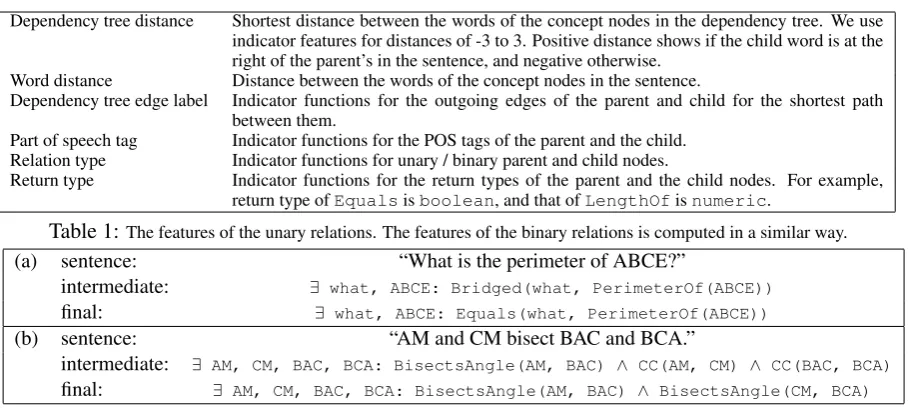
Figure 5:Showing the two-stage learning with the intermediate representation that demonstrates implication.
for ri being correct in t, ftext(ri, t) is a feature
vector oftandri, andθis a vector of parameters
to be learned. We define the affinity score of ri
by Atext(ri, t;θ) = logPθ(yi|ri, t). The weight
of the corresponding hyperedge is the relation’s affinity score. We learnθusing the maximum like-lihood estimation of the training data (details in Section 8), with L2 regularization.
We train two separate models for learning unary and binary relations. The training data consists of sentence-relation-label tuples (t, r, y); for in-stance, (“A tangent line is drawn to circle O”,
IsTangent(line, O), 1) is a positive training
example. All incorrect relations in the sen-tences of the training data are negative exam-ples (e.g. (“A tangent line is drawn to circle O”,
IsCircle(line), 0)).
The features for the unary and binary models are shown in Table 1 for the texttand the relation ri. We use two main feature categories. Structural
features: these features capture the syntactic cues of the text in the form of text distance, dependency tree labels, and part of speech tags for the words associated with the concepts in the relation. Ge-ometry language features: these features capture the cues available in the geometry language Ωin the form of the types and the truth values of the corresponding concepts in the relation.
At inference, GEOS uses the learned models to calculate the affinity scores of all the literals derived from the text t. The affinity score of each literal lj is calculated from the edge
(rela-tion) weights in the corresponding subgraph, i.e. Atext(lj, t) = PiAtext(ri, t;θ) for all ri in the
literallj.
4.3 Relation Completion
So far, we have explained how to score the affini-ties between explicit relations and the question text. Geometry questions usually includeimplicit concepts. For instance, “Circle O has a radius of 5” implies theEquals relationship between
“Ra-dius of circle O” and “5”. In addition, geometry questions include coordinating conjunctions be-tween entities. In “AM and CM bisect BAC and BCA”, “bisect” is shared by two lines and two an-gles (Figure 5 (b)). Also, consider two sentences: “AB and CD are perpendicular” and “AB is per-pendicular to CD”. Both have the same semantic annotation but very different syntactic structures.
It is difficult to directly fit the syntactic struc-ture of question sentences into the formal language
Ωforimplicationsandcoordinating conjunctions, especially due to small training data. We, instead, adopt a two-stage learning inspired by recent work in semantic parsing (Kwiatkowski et al., 2013). Our solution assumes an intermediate representa-tion that is syntactically sound but possibly under-specified. The intermediate representation closely mirrors the linguistic structure of the sentences. In addition, it can easily be transferred to the formal representation in the geometry languageΩ.
Figure 5 shows how implications and coordinat-ing conjunctions are modeled in the intermediate representation. Bridged in Figure 5 (a) indicates
that there is a special relation (edge) between the two concepts (e.g., what and PerimeterOf), but the alignment to the geometry language L is not clear. CC in Figure 5 (b) indicates that there is a
the under-specified relations by mapping them to the corresponding well-defined relations in the for-mal language.
Implication: We train a log-linear classifier to
identify if a Bridged relation (implied concept)
exists between two concepts. Intuitively, the clas-sification score indicates the likelihood that certain two concepts (e.g., What and PerimeterOf) are
bridged. For training, positive examples are pairs of concepts whose underlying relation is under-specified, and negative examples are all other pairs of concepts that are not bridged. For instance,
(what,PerimeterOf) is a positive training
exam-ple for thebridgedrelation. We use the same
fea-tures in Table 1 for the classifier.
We then use a deterministic rule to mapbridged relations in the intermediate representation to the correct completed relations in the final represen-tation. In particular, we mapbridged toEquals
if the two children concepts are of type number,
and to IsAif the concepts are of type entity (e.g.
point,line,circle).
Coordinating Conjunctions: CCrelations model
coordinating conjunctions in the intermediate rep-resentation. For example, Figure 5 (b) shows the conjunction between the two anglesBACandBCA. We train a log-linear classifier for theCCrelations,
where the setup of the model is identical to that of the binary relation model in Section 4.2.
After we obtain a list ofCC(x,y)in the
interme-diate representation, we use deterministic rules to coordinate the entitiesxandyin eachCCrelation
(Figure 5 (b)). First, GEOS forms a set{x, y}for every two conceptsxandythat appear inCC(x,y)
and transforms every x and y in other literals to {x, y}. Second, GEOS transforms the relations with expansion and distribution rules (Figure 3 Step 1 (iv)). For instance,Perpendicular({x,y})
will be transferred toPerpendicular(x, y)
(ex-pansion rule), andLengthOf{x,y})will be
trans-ferred toLengthOf(x) ∧LengthOf(y)
(distribu-tion rule).
5 Diagram Parser
We use the publicly available diagram parser (Seo et al., 2014) to obtain the set of all visual elements (points, lines, circles, etc.), their coordinates, their relationships in the diagram, and their alignment with entity references in the text (e.g. “line AB”, “circle O”). The diagram parser serves two pur-poses: (a) computing the diagram score as a
mea-sure of the affinity of each literal with the diagram; (b) obtaining high-confidence visual literals which cannot be obtained from the text.
Diagram score: For each literal lj from
the text parsing, we obtain its diagram score Adiagram(lj, d) 7→ [−∞,0]. GEOS grounds each
literal derived from the text by replacing every variable (entity or numerical variable) in the re-lation to the corresponding variable from the dia-gram parse. The score function is the relaxed in-dicator function of whether a literal is true accord-ing to the diagram. For instance, in Figure 1 (a), consider the literall=Perpendicular(AC, BD). In order to obtain its diagram score, we compute the angle between the linesACandBDin the di-agram and compare it with π/2. The closer the two values, the higher the score (closer to0), and the farther they are, the lower the score. Note that the variablesACandBDare grounded into the
dia-gram before we obtain the score; that is, they are matched with the actual corresponding linesAC andBDin the diagram.
The diagram parser is not able to evaluate the correctness of some literals, in which case their diagram scores are undefined. For instance,
Equals(LengthOf(AB), 5) cannot be evaluated
in the diagram because the scales in the diagram (pixel) and the text are different. For another ex-ample, Equals(what, RadiusOf(circle))
can-not be evaluated because it contains an un-grounded (query) variable, what. When the dia-gram score of a literallj is undefined, GEOS lets Adiagram(lj) =Atext(lj).
If the diagram score of a literal is very low, then it is highly likely that the literal is false. For example, in Figure 2, Parallel(AC, DB) has a very low diagram score, 0.02, and is apparently false in the diagram. Concretely, if for some lit-erallj, Adiagram(li) < , then GEOS disregards
the text score of li by replacing Atext(lj) with Adiagram(lj). On the other hand, even if the
dia-gram score of a literal is very high, it is still possi-ble that the literal is false, because many diagrams are not drawn to scale. Hence, GEOS adds both text and diagram scores in order to score literals (Section 6).
High-confidence visual literals: Diagrams often
contain critical information that is not present in the text. For instance, to solve the question in Fig-ure 1, one has to know that the pointsA,E, andC
numer-ical labels (e.g. one of the labels in Figure 1(b) in-dicates the measure of the angleABC= 40 degrees).
This kind of information is confidently parsed with the diagram parser by Seo et al. (2014). We denote the set of the high-confidence literals byL∆ that
are passed to the solver (Section 7).
6 Optimization
Here, we describe the details of the objective func-tion (Equafunc-tion 1) and how to efficiently maximize it. The integrated affinity score of a set of literals L0(the first term in Equation 1) is defined as:
A(L0, t, d) = X l0
j∈L0
Atext(l0j, t) +Adiagram(l0j, d)
where Atext and Adiagram are the text and
dia-gram affinities ofl0
j, respectively.
To encourage GEOS to pick a subset of literals that cover the concepts in the question text and, at the same time, avoid redundancies, we define the coherence function as:
H(L0, t, d) =Ncovered(L0)−Rredundant(L0)
whereNcoveredis the number of the concept nodes
used by the literals inL0, andN
redundantis the
num-ber of redundancies among the concept nodes of the literals. To account for the different scales be-tweenAandH, we use the trade-off parameterλ in Equation 1 learned on the validation dataset.
Maximizing the objective function in Equation 1 is an NP-hard combinatorial optimization prob-lem. However, we show that our objective func-tion is submodular (see Appendix (Secfunc-tion 11) for the proof of submodularity). This means that there exists a greedy method that can provide a reliable approximation. GEOS greedily maximizes Equa-tion 1 by starting from an empty set of literals and adding the next literalljthat maximizes the gain of
the objective function until the gain becomes nega-tive (details of the algorithm and the gain function are explained in Figure 3 step 3).
7 Solver
We now have the best set of literalsL∗ from the
optimization, and the high-confidence visual lit-erals L∆ from the diagram parser. In this step,
GEOS determines if an assignment exists to the variablesXinL∗∪L∆that simultaneously
satis-fies all of the literals. This is known as the problem
of automated geometry theorem proving in com-putational geometry (Alvin et al., 2014).
We use a numerical method to check the satis-fiablity of literals. For each literallj inL∗∪L∆,
we define a relaxed indicator function gj : S 7→ zj ∈ [−∞,0]. The function zj = gj(S)
indi-cates the relaxed satisfiability of lj given an
as-signment S to the variables X. The literal lj
is completely satisfied if gj(S) = 0. We
for-mulate the problem of satisfiability of literals as the task of finding the assignmentS∗ to X such
that sum of all indicator functionsgj(S∗)is
maxi-mized, i.e.S∗ = arg max
SPjgj(S). We use the
basing-hopping algorithm (Wales and Doye, 1997) with sequential least squares programming (Kraft, 1988) to globally maximize the sum of the indica-tor functions. If there exists an assignment such
thatPjgj(S) = 0, then GEOS finds an
assign-ment toXthat satisfies all literals. If such assign-ment does not exist, then GEOS concludes that the literals are not satisfiable simultaneously. GEOS chooses to answer a geometry question if the lit-erals of exactly one answer choice are simultane-ously satisfiable.
8 Experimental Setup
Logical LanguageΩ: Ωconsists of 13 types of
entities and 94 function and predicates observed in our development set of geometry questions.
Implementation details: Sentences in geometry
questions often contain in-line mathematical ex-pressions, such as “If AB=x+5, what is x?”. These mathematical expressions cause general purpose parsers to fail. GEOS uses an equation analyzer and pre-processes question text by replacing “=” with “equals”, and replacing mathematical terms (e.g., “x+5”) with a dummy noun so that the de-pendency parser does not fail.
GEOS uses Stanford dependency parser (Chen and Manning, 2014) to obtain syntactic informa-tion, which is used to compute features for rela-tion identificarela-tion (Table 1). For diagram parsing, similar to Seo et al. (2014), we assume that GEOS has access to ground truth optical character recog-nition for labels in the diagrams. For optimization, we tune the parametersλto0.5, based on the train-ing examples.4
Dataset: We built a dataset of SAT plane
ge-ometry questions where every question has a
tex-4In our dataset, the number of all possible literals for each
Total Training Practice Official
Questions 186 67 64 55
Sentences 336 121 110 105
Words 4343 1435 1310 1598
Literals 577 176 189 212
[image:8.595.75.290.62.144.2]Binary relations 337 110 108 119 Unary relations 437 141 150 146
Table 2:Data and annotation statistics
tual description in English accompanied by a dia-gram and multiple choices. Questions and answers are compiled from previous official SAT exams and practice exams offered by the College Board (Board, 2014). In addition, we use a portion of the publicly available high-school plane geometry questions (Seo et al., 2014) as our training set.
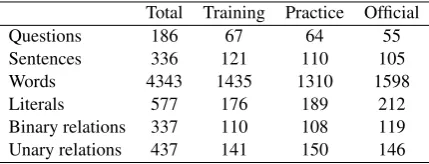
We annotate ground-truth logical forms for all questions in the dataset. Table 2 shows details of the data and annotation statistics. For evaluat-ing dependency parsevaluat-ing, we annotate 50 questions with the ground truth dependency tree structures of all sentences in the questions.5
Baselines: Rule-based text parsing +GEOS
dia-gramsolves geometry questions using literals ex-tracted from a manually defined set of rules over the textual dependency parser, and scored by dia-gram. For this baseline, we manually designed 12 high-precision rules based on the development set. Each rule compares the dependency tree of each sentence to pre-defined templates, and if a tem-plate pattern is matched, the rule outputs the re-lation or function structure corresponding to that template. For example, a rule assigns a relation parent(child-1, child-2) for a triplet of (parent, child-1, child-2) where child-1 is the subject of parentandchild-2 is the object of the parent.
GEOS without text parsing solves geometry questions using a simple heuristic. With simple textual processing, this baseline extracts numeri-cal relations from the question text and then com-putes the scale between the units in the question and the pixels in the diagram. This baseline rounds the number to the closest choice available in the multiple choices.
GEOS without diagram parsing solves geom-etry questions only relying on the literals inter-preted from the text. It outputs all literals whose text scores are higher than a tuned threshold,0.6
on the training set.
GEOS without relation completion solves
ge-5The source code, the dataset and the annotations are
pub-licly available atgeometry.allenai.org.
ometry questions when text parsing does not use the intermediate representation and does not in-clude the relation completion step.
9 Experiments
We evaluate our method on three tasks: solving geometry question, interpreting geometry ques-tions, and dependency parsing.
Solving Geometry Questions: Table 3 compares
the score of GEOS in solving geometry questions in practice and official SAT questions with that of baselines. SAT’s grading scheme penalizes a wrong answer with a negative score of0.25. We report the SAT score as the percentage of correctly answered questions penalized by the wrong an-swers. For official questions, GEOS answers 27
questions correctly, 1 questions incorrectly, and leaves 27 un-answered, which gives it a score of
26.75 out of 55, or 49%. Thus, GEOS’s preci-sion exceeds 96% on the 51% of questions that it chooses to answer. For practice SAT questions, GEOS scores61%.6
In order to understand the effect of individ-ual components of GEOS, we compare the full method with a few ablations. GEOS signifi-cantly outperforms the two baselines GEOS with-out text parsingand GEOSwithout diagram pars-ing, demonstrating that GEOS benefits from both text and diagram parsing. In order to understand the text parsing component, we compare GEOS with Rule-based text parsing + GEOS Diagram and GEOS without relation completion. The re-sults show that our method of learning to interpret literals from the text is substantially better than the rule-based baseline. In addition, the relation com-pletion step, which relies on the intermediate rep-resentation, helps to improve text interpretation.
Error Analysis: In order to understand the errors
made by GEOS, we useoracle text parsingand or-acle diagram parsing(Table 3). Roughly 38% of the errors are due to failures in text parsing, and about 46% of errors are due to failures in diagram parsing. Among them, about 15% of errors were due to failures in both diagram and text parsing. For an example of text parsing failure, the liter-als in Figure 6 (a) are not scored accurately due to missing coreference relations (Hajishirzi et al., 2013). The rest of errors are due to problems that require more complex reasoning (Figure 6 (b)).
6Typically,50thpercentile (penalized) score in SAT math
SAT score (%)
Method Practice Official
GEOS w/o diagram parsing 7 5
GEOS w/o text parsing 10 10
Rule-based text parsing + GEOS diagram 31 24
GEOS w/o relation completion 42 33
GEOS 61 49
Oracle text parsing + GEOS diagram parsing 78 75 GEOS text parsing + oracle diagram parsing 81 79 Oracle text parsing + oracle diagram parsing 88 84
Table 3:SAT scores of solving geometry questions.
P R F1
Rule-based text parsing 0.99 0.23 0.37 GEOS w/o diagram 0.57 0.82 0.67
[image:9.595.74.294.60.233.2]GEOS 0.92 0.76 0.83
Table 4:Precision and recall of text interpretation.
Interpreting Question Texts: Table 4 details
the precision and recall of GEOS in deriving lit-erals for geometry question texts for official SAT questions. The rule-based text parsing baseline achieves a high precision, but at the cost of lower recall. On the other hand, the baseline GEOS with-out diagramachieves a high recall, but at the cost of lower precision. Nevertheless, GEOS attains substantially higher F1 score compared to both baselines, which is the key factor in solving the questions. Direct application of a generic seman-tic parser (Berant et al., 2013) with full supervi-sion does not perform well in the geometry do-main, mainly due to lack of enough training data. Our initial investigations show the performance of 33% F1 in the official set.
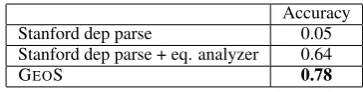
Improving Dependency Parsing: Table 5 shows
the results of different methods in dependency parsing. GEOS returns a dependency parse tree by selecting the dependency tree that maximizes the text score in the objective function from the top 50 trees produced by a generic dependency parser, Stanford parser (Chen and Manning, 2014). Note that Stanford parser cannot handle mathematical symbols and equations. We report the results of a baseline that extends the Stanford dependency parser by adding a pre-processing step to separate the mathematical expressions from the plain sen-tences (Section 8).
We evaluate the performance of GEOS against the best tree returned by Stanford parser by re-porting the fraction of the questions whose depen-dency parse structures match the ground truth an-notations. Our results show an improvement of 16% over the Stanford dependency parser when equipped with the equation analyzer. For exam-ple, in “AB is perpendicular to CD at E”, the
Stan-Accuracy
Stanford dep parse 0.05
Stanford dep parse + eq. analyzer 0.64
[image:9.595.324.506.61.107.2]GEOS 0.78
Table 5:Accuracy of dependency parsing.
In the figure at the le-, the smaller circles each have radius 3. They are tangent to the larger circle at points A and C, and are tangent to each other at point B, which is the center of the larger circle. What is the perimeter of the shaded region?
In the figure at the le-, a shaded polygon which has equal angles is parCally covered with a sheet of blank paper. If x+y=80, how many sides does the polygon have?
(a) 6*pi (b) 8*pi (c) 9*pi (d) 8*pi (e) 15*pi
(a) 10 (b) 9 (c) 8 (d) 7 (e) 6 (a)
(b)
Fails to resolve “they” to “each other”
Requires complex reasoning: Cannot understand that the polygon is “hidden”
Figure 6:Examples of Failure: reasons are in red.
ford dependency parser predicts that “E” depends on “CD”, while GEOS predicts the correct parse in which “E” depends on “perpendicular”.
10 Conclusion
This paper introduced GEOS, an automated sys-tem that combines diagram and text interpretation to solve geometry problems. Solving geometry questions was inspired by two important trends in the current NLP literature. The first is in designing methods for grounded language acquisition to map text to a restricted formalism (instead of a full, domain independent representation). We demon-strate a new algorithm for learning to map text to a geometry language with a small amount of train-ing data. The second is designtrain-ing methods in cou-pling language and vision and show how process-ing multimodal information help improve textual or visual interpretations.
Our experiments on unseen SAT geometry problems achieve a score of49%of official ques-tions and a score of 61% on practice questions, providing a baseline for future work. Future work includes expanding the geometry language and the reasoning to address a broader set of geom-etry questions, reducing the amount of supervi-sion, learning the relevant geometry knowledge, and scaling up the dataset.
Acknowledgements. The research was
[image:9.595.314.520.120.265.2]References
Chris Alvin, Sumit Gulwani, Rupak Majumdar, and Supratik Mukhopadhyay. 2014. Synthesis of ge-ometry proof problems. InAAAI.
Gabor Angeli and Christopher D. Manning. 2014. Naturalli: Natural logic inference for common sense reasoning. InEMNLP.
Yoav Artzi and Luke Zettlemoyer. 2013. Weakly su-pervised learning of semantic parsers for mapping instructions to actions. TACL, 1.
J. Berant and P. Liang. 2014. Semantic parsing via paraphrasing. InACL.
Jonathan Berant, Andrew Chou, Roy Frostig, and Percy Liang. 2013. Semantic parsing on freebase from question-answer pairs. InEMNLP.
College Board. 2014. The college board.
Antoine Bordes, Nicolas Usunier, and Jason Weston. 2010. Label ranking under ambiguous supervision for learning semantic correspondences. InICML. SRK Branavan, Nate Kushman, Tao Lei, and Regina
Barzilay. 2012. Learning high-level planning from text. InACL.
William C. Bulko. 1988. Understanding text with an accompanying diagram. InIEA/AIE.
Danqi Chen and Christopher D Manning. 2014. A fast and accurate dependency parser using neural net-works. InEMNLP.
David Chen, Joohyun Kim, and Raymond Mooney. 2010. Training a multilingual sportscaster: Using perceptual context to learn language. JAIR, 37. Jim Cowie and Wendy Lehnert. 1996. Information
extraction. Communications of the ACM, 39(1). Aron Culotta and Jeffrey Sorensen. 2004. Dependency
tree kernels for relation extraction. InACL.
Jacob Eisenstein, James Clarke, Dan Goldwasser, and Dan Roth. 2009. Reading to learn: Constructing features from semantic abstracts. InEMNLP. Thomas G Evans. 1964. A heuristic program to solve
geometric-analogy problems. InProceedings of the April 21-23, 1964, spring joint computer confer-ence.
Hao Fang, Saurabh Gupta, Forrest Iandola, Rupesh Sri-vastava, Li Deng, Piotr Doll´ar, Jianfeng Gao, Xi-aodong He, Margaret Mitchell, John Platt, et al. 2014. From captions to visual concepts and back. InCVPR.
Ali Farhadi, Mohsen Hejrati, Mohammad Amin Sadeghi, Peter Young, Cyrus Rashtchian, Julia Hockenmaier, and David Forsyth. 2010. Every pic-ture tells a story: Generating sentences from images. InECCV.
E.A. Feigenbaum and J. Feldman, editors. 1963.
Com-puters and Thought. McGraw Hill, New York.
Jeffrey Flanigan, Sam Thomson, Jaime Carbonell, Chris Dyer, and Noah A. Smith. 2014. A discrim-inative graph-based parser for the abstract meaning representation. InACL.
Ruifang Ge and Raymond J. Mooney. 2006. Discrimi-native reranking for semantic parsing. InACL.
Dan Goldwasser and Dan Roth. 2011. Learning from natural instructions. InIJCAI.
Yunchao Gong, Liwei Wang, Micah Hodosh, Ju-lia Hockenmaier, and Svetlana Lazebnik. 2014. Improving image-sentence embeddings using large weakly annotated photo collections. InECCV.
Sonal Gupta and Raymond J. Mooney. 2010. Us-ing closed captions as supervision for video activity recognition. InAAAI.
Hannaneh Hajishirzi, Julia Hockenmaier, Erik T. Mueller, and Eyal Amir. 2011. Reasoning about robocup soccer narratives. InUAI.
Hannaneh Hajishirzi, Leila Zilles, Daniel S Weld, and Luke S Zettlemoyer. 2013. Joint coreference res-olution and named-entity linking with multi-pass sieves. InEMNLP.
Mary Hegarty and Marcel Adam Just. 1989. 10 under-standing machines from text and diagrams. Knowl-edge acquisition from text and pictures.
Ben Hixon, Peter Clark, and Hannaneh Hajishirzi. 2015. Learning knowledge graphs for question an-swering through conversational dialog. InNAACL.
Mohammad Javad Hosseini, Hannaneh Hajishirzi, Oren Etzioni, and Nate Kushman. 2014. Learning to solve arithmetic word problems with verb catego-rization. InEMNLP.
Rohit J. Kate and Raymond J. Mooney. 2007. Learn-ing language semantics from ambiguous supervi-sion. InAAAI.
Joohyun Kim and Raymond J. Mooney. 2013. Adapt-ing discriminative rerankAdapt-ing to grounded language learning. InACL.
Dan Klein and Christopher D Manning. 2005. Parsing and hypergraphs. InNew developments in parsing technology. Springer.
R Koncel-Kedziorski, Hannaneh Hajishirzi, and Ali Farhadi. 2014. Multi-resolution language ground-ing with weak supervision. InEMNLP.
Dieter et. al. Kraft. 1988. A software package for
se-quential quadratic programming. DFVLR
Girish Kulkarni, Visruth Premraj, Sagnik Dhar, Sim-ing Li, Yejin Choi, Alexander C Berg, and Tamara L Berg. 2011. Baby talk: Understanding and generat-ing image descriptions. InCVPR.
Nate Kushman, Yoav Artzi, Luke Zettlemoyer, and Regina Barzilay. 2014. Learning to automatically solve algebra word problems. InACL.
T Kwiatkowski, E Choi, Y Artzi, and L Zettlemoyer. 2013. Scaling semantic parsers with the-fly on-tology matching. InEMNLP.
Percy Liang, Michael I. Jordan, and Dan Klein. 2009. Learning semantic correspondences with less super-vision. InACLAFNLP.
Xinggang Lin, Shigeyoshi Shimotsuji, Michihiko Mi-noh, and Toshiyuki Sakai. 1985. Efficient diagram understanding with characteristic pattern detection.
CVGIP, 30(1).
A. Lovett and K. Forbus. 2012. Modeling multiple strategies for solving geometric analogy problems. InCCS.
Gordon Novak. 1995. Diagrams for solving physical problems. Diagrammatic reasoning: Cognitive and computational perspectives.
Lawrence O’Gorman and Rangachar Kasturi. 1995.
Document image analysis, volume 39. Citeseer.
Hoifung Poon and Pedro Domingos. 2009. Unsuper-vised semantic parsing. InEMNLP.
Siva Reddy, Mirella Lapata, and Mark Steedman. 2014. Large-scale semantic parsing without question-answer pairs. TACL, 2(Oct).
S. Roy, T. Vieira, and D. Roth. 2015. Reasoning about quantities in natural language.
Min Joon Seo, Hannaneh Hajishirzi, Ali Farhadi, and Oren Etzioni. 2014. Diagram understanding in ge-ometry questions. InAAAI.
Rohini K Srihari. 1994. Computational models for integrating linguistic and visual information: A sur-vey. Artificial Intelligence Review, 8(5-6).
Adam Vogel and Daniel Jurafsky. 2010. Learning to follow navigational directions. InACL.
David J Wales and Jonathan PK Doye. 1997. Global optimization by basin-hopping and the lowest en-ergy structures of lennard-jones clusters containing up to 110 atoms. The Journal of Physical Chemistry A, 101(28).
Luke S. Zettlemoyer and Michael Collins. 2005. Learning to map sentences to logical form: Struc-tured classification with probabilistic categorial grammars. InUAI.
11 Appendix: Proof of Submodularity of Equation 1
We prove that the objective function in equation (1), λA(L0) +H(L0) is submodular by showing
thatA(L0)andH(L0)are submodular functions.
Submodularity of A. Consider L0 ⊂ L, and
a new literal to be added, li ∈ L\ L0. By the
definition of A, it is clear that A(L0 ∪ {lj}) = A(L0) +A({lj}). Hence, for allL00⊂L0 ⊂L,
A(L00∪ {l
j})− A(L00) =A(L0∪ {lj})− A(L0)
. ThusAis submodular.
Submodularity of H. We prove that the
cover-age function,Hcov, and the negation of the
redun-dancy function, −Hred are submodular
indepen-dently, and thus derive that their sum is submodu-lar. For both, consider we are givenL00 ⊂L0 ⊂L,
and a new literallj ∈ L\L0. Also, letK00 and K0 denote the the sets of concepts covered byL00
andL0, respectively, and letK
j denote the set of
concepts covered bylj.
Coverage: SinceK00⊂K0,|K00∪Kj| − |K00| ≥
|K0∪K
j| − |K0|, which is equivalent to
Hcov(L00∪ {lj})− Hcov(L00)
≥ Hcov(L0∪ {lj})− Hcov(L0)
Redundancy: Note that Hred(L00 ∪ {lj}) −
Hred(L00) = |K00∩Kj|, and similarly,Hred(L0∪
{lj})− Hred(L0) =|K0∩Kj|. SinceK00 ⊂K0,
thus|K00∩Kj| ≤ |K0∩Kj|. Hence,
Hred(L00∪ {lj})− Hred(L00)
≤ Hred(L0∪ {lj})− Hred(L0),