Learning Biological Processes with Global Constraints
Aju Thalappillil Scaria∗, Jonathan Berant∗, Mengqiu Wang and Christopher D. Manning
Stanford University, Stanford
Justin Lewis and Brittany Harding
University of Washington, Seattle
Peter Clark
Allen Institute for Artificial Intelligence, Seattle
Abstract
Biological processes are complex phenom-ena involving a series of events that are re-lated to one another through various relation-ships. Systems that can understand and rea-son over biological processes would dramat-ically improve the performance of semantic applications involving inference such as ques-tion answering (QA) – specifically “How?” and “Why?” questions. In this paper, we present the task of process extraction, in which events within a process and the rela-tions between the events are automatically ex-tracted from text. We represent processes by graphs whose edges describe a set of temporal, causal and co-reference event-event relations, and characterize the structural properties of these graphs (e.g., the graphs areconnected). Then, we present a method for extracting rela-tions between the events, which exploits these structural properties by performing joint in-ference over the set of extracted relations. On a novel dataset containing 148 descrip-tions of biological processes (released with this paper), we show significant improvement comparing to baselines that disregard process structure.
1 Introduction
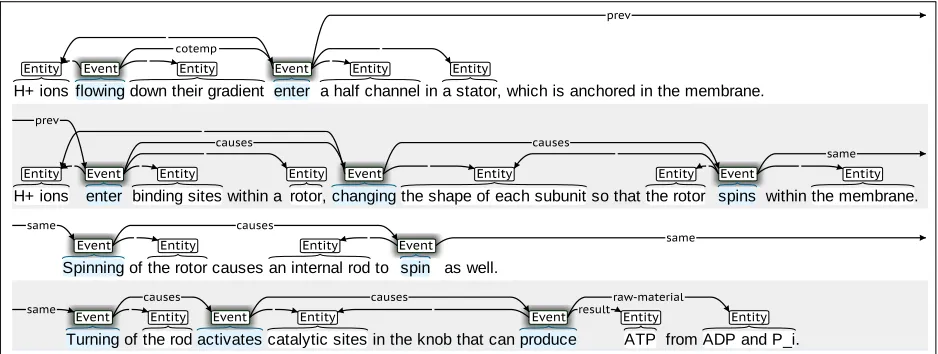
A process is defined as a series of inter-related events that involve multiple entities and lead to an end result. Product manufacturing, economical de-velopments, and various phenomena in life and so-cial sciences can all be viewed as types of processes. Processes are complicated objects; consider for ex-ample the biological process of ATP synthesis de-scribed in Figure 1. This process involves 12 en-tities and 8 events. Additionally, it describes rela-tions between events and entities, and the relation-ship between events (e.g., the second occurrence of the event‘enter’, causes the event‘changing’).
∗
Both authors equally contributed to the paper
Automatically extracting the structure of pro-cesses from text is crucial for applications that re-quire reasoning, such as non-factoid QA. For in-stance, answering a question on ATP synthesis, such as “How do H+ ions contribute to the production of ATP?” requires a structure that links H+ ions (Figure 1, sentence 1) to ATP (Figure 1, sentence 4) through a sequence of intermediate events. Such “How?” questions are common on FAQ websites (Surdeanu et al., 2011), which further supports the importance of process extraction.
Process extraction is related to two recent lines of work in Information Extraction – event extrac-tion and timeline construcextrac-tion. Tradiextrac-tional event ex-traction focuses on identifying a closed set of events within a single sentence. For example, the BioNLP 2009 and 2011 shared tasks (Kim et al., 2009; Kim et al., 2011) consider nine events types related to proteins. In practice, events are currently almost al-ways extracted from a single sentence. Process ex-traction, on the other hand, is centered around dis-coveringrelationsbetween events that spanmultiple sentences. The set of possible event types in process extraction is also much larger.
Timeline construction involves identifying tem-poral relations between events (Do et al., 2012; Mc-Closky and Manning, 2012; D’Souza and Ng, 2013), and is thus related to process extraction as both fo-cus on event-event relations spanning multiple sen-tences. However, events in processes are tightly cou-pled in ways that go beyond simple temporal order-ing, and these dependencies are central for the pro-cess extraction task. Hence, capturing propro-cess struc-ture requires modeling a larger set of relations that includes temporal, causal and co-reference relations.
In this paper, we formally define the task of process extraction and present automatic extraction methods. Our approach handles an open set of event types and works over multiple sentences, extract-ing a rich set of event-event relations. Furthermore,
7/5/13 7:01 PM brat
Page 1 of 1 http://127.0.0.1:8001/index.xhtml#/examples/emnlp2013/p66
H+ ions flowing down their gradient enter a half channel in a stator, which is anchored in the membrane.
H+ ions enter binding sites within a rotor, changing the shape of each subunit so that the rotor spins within the membrane.
Spinning of the rotor causes an internal rod to spin as well.
Turning of the rod activates catalytic sites in the knob that can produce ATP from ADP and P_i.
Entity Event Entity Event Entity Entity
cotemp
prev
Entity Event Entity Entity Event Entity Entity Event Entity
same
causes causes
prev
Event Entity Entity Event same
same causes
Event Entity Event Entity Event result Entity Entity
same causes causes raw-material
1
2
3
[image:2.612.72.541.60.237.2]4
Figure 1: Partial annotation of the ATP synthesis process. Most of the semantic roles have been removed for simplicity.
we characterize a set of global properties of process structure that can be utilized during process extrac-tion. For example, all events in a process are some-how connected to one another. Also, processes usu-ally exhibit a “chain-like” structure reflecting pro-cess progression over time. We show that incor-porating such global properties into our model and performing joint inference over the extracted rela-tions significantly improves the quality of process structures predicted. We conduct experiments on a novel dataset of process descriptions from the text-book “Biology” (Campbell and Reece, 2005) that were annotated by trained biologists. Our method does not require any domain-specific knowledge and can be easily adapted to non-biology domains.
The main contributions of this paper are:
1. We define process extraction and characterize processes’ structural properties.
2. We model global structural properties in pro-cesses and demonstrate significant improve-ment in extraction accuracy.
3. We publicly release a novel data set of 148 fully annotated biological process descrip-tions along with the source code for our sys-tem. The dataset and code can be down-loaded from http://nlp.stanford.edu/ software/bioprocess/.
2 Process Definition and Dataset
We define a process description as a paragraph or sequence of tokensx={x1, . . . x|x|}that describes
a series of events related by temporal and/or causal relations. For example, in ATP synthesis (Figure 1), the event of rotor spinning causesthe event where an internal rod spins.
We model the events within a process and their relations by a directed graph P = (V, E), where the nodes V = {1, . . . ,|V|} represent event men-tions and labeled edgesEcorrespond to event-event relations. An event mentionv ∈ V is defined by a triggertv, which is a span of wordsxi, xi+1, . . . , xj;
and by a set of argument mentionsAv, where each
argument mentionav ∈Av is also a span of words
labeled by a semantic roleltaken from a setL. For example, in the last event mention of ATP synthesis,
tv =produce, and one of the argument mentions is
av =(ATP,RESULT). A labeled edge(u, v, r)in the
graph describes a relationr ∈ Rbetween the event mentionsuandv. The task of process extraction is to extract the graphP from the textx.1
A natural way to break down process extraction into sub-parts is to first perform semantic role label-ing (SRL), that is, identify triggers and predict ar-gument mentions with their semantic role, and then extract event-event relations between pairs of event mentions. In this paper, we focus on the second step, where given a set of event triggersT, we find all event-event relations, where a trigger represents the entire event. For completeness, we now describe the semantic rolesL used in our dataset, and then
1Argument mentions are also related by coreference
present the set of event-event relationsR.
The setLcontains standard semantic roles such as AGENT, THEME, ORIGIN, DESTINATIONand LO -CATION. Two additional semantic roles were em-ployed that are relevant for biological text: RESULT corresponds to an entity that is the result of an event, and RAW-MATERIALdescribes an entity that is used or consumed during an event. For example, the last event ‘produce’in Figure 1, has ‘ATP’ as the RE -SULT, and‘ADP’as the RAW-MATERIAL.
The event-event relation set R contains the fol-lowing (assuming a labeled edge(u, v, r)):
1. PREV denotes that u is an event immediately before v. Thus, the edges (u, v,PREV) and
(v, w,PREV), preclude the edge(u, w,PREV). For example, in “When a photon strikes . . . energy is passed . . . until it reaches . . . ”, there is no edge (strikes, reaches, PREV) due to the intervening event‘passed’.
2. COTEMPdenotes that eventsuandvoverlap in time (e.g., the first two event mentionsflowing andenterin Figure 1).
3. SUPER denotes that event u includes event
v. For instance, in “During DNA replica-tion, DNA polymerases proofread each nu-cleotide. . . ” there is an edge (DNA replication, proofread, SUPER).
4. CAUSES denotes that event u causes event v
(e.g., the relation betweenchangingandspins in sentence 2 of Figure 1).
5. ENABLESdenotes that eventucreates precon-ditions that allow event v to take place. For example, the description “. . . cause cancer cells toloseattachments to neighboring cells. . . , al-lowing them tospreadinto nearby tissues” has the edge (lose, spread, ENABLES). An in-tuitive way to think about the difference be-tweenCausesandEnablesis the following: if
u causesv this means that if u happens, then
v happens. If u enables v, then if u does not happen, thenvdoes not happen.
6. SAME denotes that u and v both refer to the same event (spinsandSpinningin Figure 1).
Early work on temporal logic (Allen, 1983) con-tained more temporal relations than are used in our
Avg Min Max
# of sentences 3.80 1 15
# of tokens 89.98 19 319
# of events 6.20 2 15
[image:3.612.325.532.61.120.2]# of non-NONErelations 5.64 1 24
Table 1: Process statistics over 148 process descriptions. NONEis used to indicate no relation.
relation setR. We chose a relation setRthat cap-tures the essential aspects of temporal relations be-tween events in a process, while keeping the annota-tion as simple as possible. For instance, we include the SUPER relation that appears in temporal anno-tations such as the Timebank corpus (Pustejovsky et al., 2003) and Allen’s work, but in practice was not considered by many temporal ordering systems (Chambers and Jurafsky, 2008; Yoshikawa et al., 2009; Do et al., 2012). Importantly, our relation set also includes the relations CAUSES and ENABLES, which are fundamental to modeling processes and go beyond simple temporal ordering.
We also added event coreference (SAME) to R. Do et al. (2012) used event coreference information in a temporal ordering task to modify probabilities provided by pairwise classifiers prior to joint infer-ence. In this paper, we simply treat SAME as an-other event-event relation, which allows us to easily perform joint inference and employ structural con-straints that combine both coreference and temporal relations simultaneously. For example, ifuandvare the same event, then there can exist now, such that
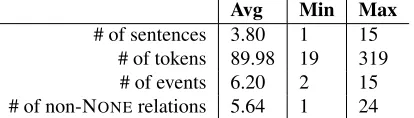
uis beforew, butvis afterw(see Section 3.3) We annotated 148 process descriptions based on the aforementioned definitions. Further details on annotation and data set statistics are provided in Sec-tion 4 and Table 1.
Deg. Gold Local Global
0 0 29 0
1 219 274 224
2 369 337 408
3 46 14 17
[image:4.612.314.541.58.186.2]≥4 22 2 7
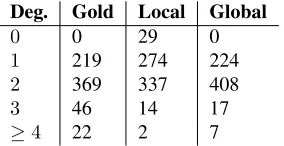
Table 2: Node degree distribution for event mentions on the training set. Predictions for the Local and Global models were obtained using 10-fold cross validation.
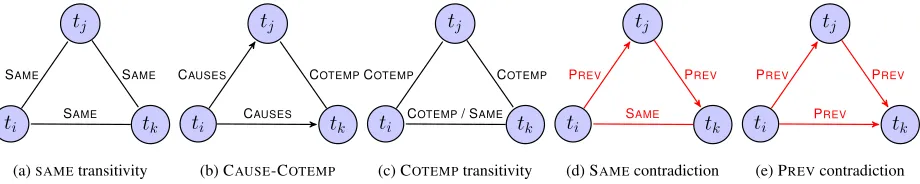
nodes’ degree to generally be≤ 2. Indeed, 90% of event mentions have degree ≤ 2, as demonstrated by theGoldcolumn of Table 2. Last, if we consider relations between all possible triples of events in a process, clearly some configurations are impossible, while others are common (illustrated in Figure 2). In Section 3.3, we show that modeling these proper-ties using a joint inference framework improves the quality of process extraction significantly.
3 Joint Model for Process Extraction
Given a paragraphx and a trigger set T, we wish to extract all event-event relationsE. Similar to Do et al. (2012), our model consists of a local pairwise classifier and global constraints. We first introduce a classifier that is based on features from previous work. Next, we describe novel features specific for process extraction. Last, we incorporate global con-straints into our model using an ILP formulation.
3.1 Local pairwise classifier
The local pairwise classifier predicts relations be-tween all event mention pairs. In order to model the direction of relations, we expand the set R to include the reverse of four directed relations: PREV -NEXT, SUPER- SUB, CAUSES-CAUSED, ENABLES -ENABLED. After adding NONEto indicate no rela-tion, and including the undirected relations COTEMP and SAME,Rcontains 11 relations. The classifier is hence a functionf :T × T → R. As an example,
f(ti, tj) =PREVifff(tj, ti) =NEXT. Letnbe the
number of triggers in a process, and ti be the i-th
trigger in its description. Sincef(ti, tj)completely
determinesf(tj, ti), it suffices to consider only pairs
withi < j. Note that the process graphP is undi-rected under the new definition ofR.
Table 3 describes features from previous
Feature Description POS Pair of POS tags Lemma Pair of lemmas
Prep∗ Preposition lexeme, if in a prepositional phrase Sent. count Quantized number of sentences between triggers Word count Quantized number of words between triggers LCA Least common ancestor on constituency tree, if exists Dominates∗ Whether one trigger dominates other
Share Whether triggers share a child on dependency tree Adjacency Whether two triggers are adjacent
Words btw. For adjacent triggers, content words between triggers Temp. btw. For adjacent triggers, temporal connectives (from a
[image:4.612.116.258.60.133.2]small list) between triggers
Table 3: Features extracted for a trigger pair(ti, tj). As-teriks (*) indicate features that are duplicated, once for each trigger.
work (Chambers and Jurafsky, 2008; Do et al., 2012) extracted for a trigger pair (ti, tj). Some
features were omitted since they did not yield improvement in performance on a development set (e.g., lemmas and part-of-speech tags of context words surrounding ti and tj), or they require gold
annotations provided in TimeBank, which we do not have (e.g., tense and aspect of triggers). To reduce sparseness, we convert nominalizations into their verbal forms when computing word lemmas, using WordNet’s (Fellbaum, 1998) derivation links.
3.2 Classifier extensions
A central source of information to extract event-event relations from text areconnectivessuch as af-ter,during, etc. However, there is variability in the occurrence of these connectives as demonstrated by the following two sentences (connectives in bold-face, triggers in italics):
1. Becausealleles areexchangedduringgene flow, ge-netic differences arereduced.
2. Duringgene flow, alleles areexchanged, and genetic differences arehencereduced.
tj
ti tk
(a)SAMEtransitivity
SAME
SAME
SAME
tj
ti tk
(b) CAUSE-COTEMP CAUSES
CAUSES COTEMP
tj
ti tk
(c) COTEMPtransitivity
COTEMP
COTEMP
COTEMP/ SAME
tj
ti tk
(d) SAMEcontradiction PREV PREV
SAME
tj
ti tk
(e) PREVcontradiction PREV PREV
[image:5.612.78.538.59.151.2]PREV
Figure 2: Relation triangles (a)-(c) are common in the gold standard while (d)-(e) are impossible.
Sentence 1 presents a typical case where by walk-ing up the dependency tree from the markerbecause, we can find the triggers related by this marker: because ←−−−mark exchanged ←−−−advcl reduced. When-ever a trigger is the head of an adverbial clause and marked by amarkdependency label, we walk on the dependency tree and look for a trigger in the main clause that is closest to the root (or the root itself in this example). By utilizing the syntactic struc-ture, we can correctly spot that the triggergene flow is not related to the trigger exchanged through the connective because, even though they are linearly closer. In order to reduce sparseness of connectives, we created a hand-made clustering of 30 connectives that maps words into clusters2 (e.g., because, since andhence to a “causality” cluster). After locating the relevant pair of triggers, we use these clusters to fire the same feature for connectives belonging to the same cluster. We perform a similar procedure whenever a trigger is part of a prepositional phrase (imagine sentence 1 starting with“due to allele ex-change during gene flow . . . ”) by walking up the constituency tree, but details are omitted for brevity. In sentence 2, the connectivehence is an adverbial modifier of the triggerreduced. We look up the clus-ter for the connectivehenceand fire the same feature for the adjacent triggersexchangedandreduced.
We further extend our features to handle the rich relation set necessary for process extraction. The first event of a process is often expressed as a nom-inalization and includes subsequent events (SUPER relation), e.g., “The Calvin cycle begins by incor-porating...”. To capture this, we add a feature that fires when the first event of the process description is a noun. We also add two features targeted at the
2The full set of connectives and their clustering are provided
as part of our publicly released package.
SAME relation: one indicating if the lemmas of ti
andtj are the same, and another specifying the
de-terminer oftj, if it exists. Certain determiners
in-dicate that an event trigger has already been men-tioned, e.g., the determinerthishints a SAME rela-tion in “The next steps decompose citrate back to oxaloacetate. This regenerationmakes . . . ”. Last, we add as a feature the dependency path betweenti
andtj, if it exists, e.g., in “meiosis produces cells
that divide . . . ”, the feature−−→dobj −−−→rcmod is fired for the trigger pairproducesanddivide. In Section 4.1 we empirically show that our extensions to the local classifier substantially improve performance.
For our pairwise classifier, we train a maximum entropy classifier that computes a probability pijr
for every trigger pair(ti, tj)and relation r. Hence,
f(ti, tj) = arg maxrpijr.
3.3 Global Constraints
Naturally, pairwise classifiers are local models that can violate global properties in the process structure. Figure 3 (left) presents an example for predictions made by the pairwise classifier, which result in two triggers (deleted and dupcliated) that are isolated from the rest of the triggers. In this section, we dis-cuss how we incorporate constraints into our model to generate coherent global process structures.
Letθijrbe the score for a relationr between the
trigger pair(ti, tj)(e.g.,θijr= logpijr), andyijrbe
the corresponding indicator variable. Our goal is to find an assignment for the indicatorsy={yijr|1≤
arg max
y
X
ijr
θijryijr (1)
s.t.∀i,j
X
r
yijr= 1
where the constraint ensures exactly one relation be-tween each event pair. We now describe constraints that result in a coherent global process structure.
Connectivity Our ILP formulation for enforcing connectivity is a minor variation of the one sug-gested by Martins et al. (2009) for dependency pars-ing. In our setup, we wantPto be a connected undi-rected graph, and not a diundi-rected tree. However, an undirected graph P is connected iff there exists a directed tree that is a subgraph ofP when edge di-rections are ignored. Thus the resulting formulation is almost identical and is based on flow constraints which ensure that there is a path from a designated root in the graph to all other nodes.
Let R¯ be the set R \NONE. An edge(ti, tj)is
inE iff there is some non-NONErelation between
ti and tj, i.e. iff yij := Pr∈R¯yijr is equal to 1.
For each variableyij we define two auxiliary binary
variableszij andzjithat correspond to edges of the
directed tree that is a subgraph ofP. We ensure that the edges in the tree exist also in P by tying each auxiliary variable to its corresponding ILP variable:
∀i<j zij ≤yij, zji ≤yij (2)
Next, we add constraints that ensure that the graph structure induced by the auxiliary variables is a tree rooted in an arbitrary node 1 (The choice of root does not affect connectivity). We add for everyi6=j
a flow variable φij which specifies the amount of
flow on the directed edgezij.
X
i
zi1= 0,∀j6=1
X
i
zij = 1 (3)
X
i
φ1i=n−1 (4)
∀j6=1
X
i
φij −
X
k
φjk = 1 (5)
∀i6=j φij ≤n·zij (6)
Equation 3 says that all nodes in the graph have exactly one parent, except for the root that has no parents. Equation 4 ensures that the outgoing flow from the root isn−1, and Equation 5 states that each of the othern−1nodes consume exactly one unit of flow. Last, Equation 6 ties the auxiliary variables to the flow variables, making sure that flow occurs only on edges. The combination of these constraints guarantees that the graph induced by the variables
zij is a directed tree and consequently the graph
in-duced by the objective variablesyis connected.
Chain structure A chain is a connected graph where the degree of all nodes is ≤ 2. Table 2 presents nodes’ degree and demonstrates that indeed process graphs are close to being chains. The fol-lowing constraint bounds nodes’ degree by 2:
∀j(X
i<j
yij+
X
j<k
yjk ≤2) (7)
Since graph structures are not always chains, we add this as a soft constraint, that is, we penalize the objective for each node with degree>2. The chain structure is one of the several soft constraints we enforce. Thus, our modified objective function is
P
ijrθijryijr +
P
k∈KαkCk, whereK is the set of
soft constraints,αkis the penalty (or reward for
de-sirable structures), andCk indicates whether a
con-straint is violated (or satisfied). Note that under this formulation our model is simply a constrained con-ditional model (wei Chang et al., 2012). The param-eters αk are tuned on a development set (see
Sec-tion 4).
Relation triads A relation triad (or a
re-lation triangle) for any three triggers ti, tj
and tk in a process is a 3-tuple of relations
(f(ti, tj), f(tj, tk), f(ti, tk)). Clearly, some triads
Equa-tions 8-12 provide the corresponding ILP formula-tions. Equations 8-10 were formulated as soft con-straints (expanding the setK) and were incorporated by defining a reward αk for each triad type.3 On
the other hand, Equations 11-12 were formulated as hard constraints to prevent certain structures.
1. SAME transitivity (Figure 2a, Eqn. 8): Co-reference transitivity has been used in past work (Finkel and Manning, 2008) and we in-corporate it by a constraint that encourages tri-ads that respect transitivity.
2. CAUSE-COTEMP (Figure 2b, Eqn. 9): If ti
causes bothtj andtk, then oftentj andtkare
co-temporal. E.g, in “genetic drift has led to a loss of genetic variation and an increase in the frequency of. . .”, a single event causes two subsequent events that occur simultaneously.
3. COTEMP transitivity (Figure 2c, Eqn. 10): If
ti is co-temporal withtj andtj is co-temporal
with tk, then usually ti and tk are either
co-temporal or denote the same event.
4. SAME contradiction (Figure 2d, Eqn. 11): If
ti is the same event as tk, then their
tempo-ral ordering with respect to a third trigger tj
may result in a contradiction, e.g., if tj is
af-ter ti, but before tk. We define 5 temporal
categories that generate 52
possible contradic-tions, but for brevity present just one represen-tative hard constraint. This constraint depends on prediction of temporal and co-reference re-lations jointly.
5. PREV contradiction (Figure 2e, Eqn. 12): As mentioned (Section 3.3), if ti is immediately
beforetj, andtj is immediately beforetk, then
ticannot be immediately beforetk.
yijSAME+yjkSAME+yikSAME ≥3 (8)
yijCAUSES+yikCAUSES+yjkCOTEMP ≥3 (9) yijCOTEMP+yjkCOTEMP+yikCOTEMP+
yikSAME ≥3 (10)
yijPREV+yjkPREV+yikSAME ≤2 (11)
yijPREV+yjkPREV−yikNONE≤1 (12)
3
We experimented with a reward for certain triads or a penalty for others and empirically found that using rewards re-sults in better performance on the development set.
We used the Gurobi optimization package4 to find an exact solution for our ILP, which contains
O(n2|R|)variables andO(n3)constraints. We also developed an equivalent formulation amenable to dual decomposition (Sontag et al., 2011), which is a faster approximation method. But practically, solv-ing the ILP exactly with Gurobi was quite fast (av-erage/median time per process: 0.294 sec/0.152 sec on a standard laptop).
4 Experimental Evaluation
We extracted 148 process descriptions by going through chapters from the textbook ”Biology” and marking any contiguous sequence of sentences that describes a process, i.e., a series of events that lead towards some objective. Then, each process descrip-tion was annotated by a biologist. The annotator was first presented with annotation guidelines and anno-tated 20 descriptions. The annotations were then discussed with the authors, after which all process descriptions were annotated. After training a sec-ond biologist, we measured inter-annotator agree-mentκ= 0.69, on 30 random process descriptions.
Process descriptions were parsed with Stanford constituency and dependency parsers (Klein and Manning, 2003; de Marneffe et al., 2006), and 35 process descriptions were set aside as a test set (number of training set trigger pairs: 1932, number of test set trigger pairs: 906). We performed 10-fold cross validation over the training set for feature selection and tuning of constraint parameters. For each constraint type (connectivity, chain-structure, and five triad constraints) we introduced a param-eter and tuned the seven paramparam-eters by coordinate-wise ascent, where for hard constraints a binary pa-rameter controls whether the constraint is used, and for soft constraints we attempted 10 different re-ward/penalty values. For our global model we de-finedθijr = logpijr, wherepijris the probability at
edge(ti, tj)for labelr, given by the pairwise
clas-sifier.
We test the following systems: (a)All-Prev: Since the most common process structure was chain-like, we simply predict PREVfor every two adjacent trig-gers in text. (b)Localbase: A pairwise classifier with
features from previous work (Section 3.1) (c)Local:
4
Temporal Full
P R F1 P R F1
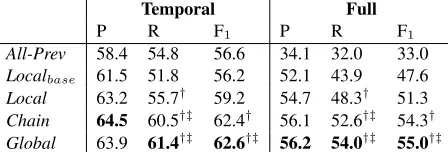
[image:8.612.74.298.61.137.2]All-Prev 58.4 54.8 56.6 34.1 32.0 33.0 Localbase 61.5 51.8 56.2 52.1 43.9 47.6 Local 63.2 55.7† 59.2 54.7 48.3† 51.3 Chain 64.5 60.5†‡ 62.4† 56.1 52.6†‡ 54.3† Global 63.9 61.4†‡ 62.6†‡ 56.2 54.0†‡ 55.0†‡ Table 4: Test set results on all experiments. Best number in each column is bolded.†and‡denote statistical signif-icance (p <0.01) againstLocalbaseandLocalbaselines, respectively.
A pairwise classifier with all features (Section 3.2) (d)Chain: For every two adjacent triggers, choose the non-NONErelation with highest probability ac-cording to Local. This baseline heuristically com-bines our structural assumptions with the pairwise classifier. We deterministically choose a connected chain structure, and then use the classifier to label the edges. (e)Global: Our full model that uses ILP inference.
To evaluate system performance we compare the set of predictions on all trigger pairs to the gold stan-dard annotations and compute micro-averaged pre-cision, recall and F1. We perform two types of
eval-uations: (a) Full: evaluation on our full set of 11 relations (b)Temporal: Evaluation on temporal re-lations only, by collapsing PREV, CAUSES, and EN -ABLESto a single category and similarly for NEXT, CAUSED, and ENABLED(inter-annotator agreement
κ = 0.75). We computed statistical significance of our results with the paired bootstrap resampling method of 2000 iterations (Efron and Tibshirani, 1993), where the units resampled are trigger-trigger-relation triples.
4.1 Results
Table 4 presents performance of all systems. We see that using global constraints improves performance almost invariably on all measures in both full and temporal evaluations. Particularly, in the full eval-uation Global improves recall by 12% and overall F1 improves significantly by 3.7 points against
Lo-cal (p < 0.01). Recall improvement suggests that modeling connectivity allowed Global to add cor-rect relations in cases where some events were not connected to one another.
The Local classifier substantially outperforms
Localbase. This indicates that our novel features (Section 3.2) are important for discriminating be-tween process relations. Specifically, in the full eval-uation Local improves precision more than in the temporal evaluation, suggesting that designing syn-tactic and semantic features for connectives is useful for distinguishing PREV, CAUSES, and ENABLES when the amount of training data is small.
TheChainbaseline performs only slightly worse than our global model. This demonstrates the strong tendency of processes to proceed linearly from one event to the other, which is a known property of dis-course structure (Schegloff and Sacks, 1973). How-ever, since the structure is deterministically fixed, Chain is highly inflexible and does not allow any extensions or incorporation of other structural con-straints or domain knowledge. Thus, it can be used as a simple and efficient approximation but is not a good candidate for a real system. Further support for the linear nature of process structure is provided by theAll-Prevbaseline, which performs poorly in the full evaluation, but in temporal evaluation works reasonably well.
Table 2 presents the degree distribution of Local andGlobalon the development set comparing to the gold standard. The degree distribution ofGlobalis more similar to the gold standard thanLocal. In par-ticular, the connectivity constraint ensures that there are no isolated nodes and shifts mass from nodes with degree0and1to nodes with degree2.
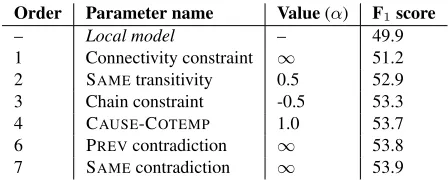
Table 5 presents the order in which constraints were introduced into the global model using coor-dinate ascent on the development set. Connectivity is the first constraint to be introduced, and improves performance considerably. The chain constraint, on the other hand, is included third and the improve-ment in F1 score is relatively smaller. This can be
explained by the distribution of degrees in Table 2 which shows that the predictions ofLocaldoes not have many nodes with degree>2. As for triad con-straints, we see that four constraints are important and are included in the model, but one is discarded.
Last, we examined the results of Global when macro-averaging over processes, i.e., assigning each process the same weight by computing recall, pre-cision and F1 for each process and averaging those
evalua-Order Parameter name Value(α) F1score
– Local model – 49.9
1 Connectivity constraint ∞ 51.2
2 SAMEtransitivity 0.5 52.9
3 Chain constraint -0.5 53.3
4 CAUSE-COTEMP 1.0 53.7
6 PREVcontradiction ∞ 53.8
[image:9.612.71.295.59.149.2]7 SAMEcontradiction ∞ 53.9
Table 5: Order by which constraint parameters were set using coordinate ascent on the development set. For each parameter, the value chosen and F1score after including the constraint are provided. Negative values correspond to penalties, positive values to rewards, and a value of∞
indicates a hard constraint.
tion Global obtains R/P/F1 of 56.4/55.0/55.7, and
in the temporal evaluationGlobalobtains R/P/F1 of
63.8/62.3/63.1.
4.2 Qualitative Analysis
Figure 3 shows two examples where global con-straints corrected the predictions of Local. In Fig-ure 3, left, Local failed to predict the causal rela-tionsskipped-deletedandused-duplicated, possibly because they are not in the same sentence and are not adjacent to one another. By enforcing the connectiv-ity constraint, Globalcorrectly adds the correct re-lations and connects deleted and duplicated to the other triggers in the process.
In Figure 3, right, Local predicts a structure that results in a “SAME contradiction” structure. The triggersbindandbindscannot denote the same event if a third triggersecreteis temporally between them. However,Localpredicts they are the same event, as they share a lemma. Globalprohibits this structure and correctly predicts the relation as NONE.
To better understand the performance of Local, we analyzed the confusion matrix generated based on its predictions. Although this is a challenging 11-class classification task, most of the mass is con-centrated on the matrix diagonal, as desired. Error analysis reveals that 17.5% of all errors are con-fusions between NONEand PREV, 11.1% between PREV and CAUSES, and 8.6% between PREV and COTEMP. This demonstrates that distinguishing the classes PREV, CAUSESand COTEMPis challenging forLocal. Our current global constraints do not ad-dress this type of error, and thus an important direc-tion for future work is to improve the local model.
The global model depends on the predictions of the local classifier, and so enforcing global con-straints does not guarantee improvement in perfor-mance. For instance, ifLocalproduces a graph that is disconnected (e.g.,deletedin Figure 3, left), then Globalwill add an edge. However, the label of the edge is determined by scores computed based on the local classifier, and if this prediction is wrong, we will now be penalized for both the false nega-tive of the correct class (just as before), and also for the false positive of the predicted class. Despite that we see thatGlobalimproves overall performance by 3.7 F1 points on the test set.
5 Related Work
A related line of work is biomedical event extrac-tion in recent BioNLP shared tasks (Kim et al., 2009; Kim et al., 2011). Earlier work employed a pipeline architecture where first events are found, and then their arguments are identified (Miwa et al., 2010; Bj¨orne et al., 2011). Subsequent methods pre-dicted events and arguments jointly using Markov logic (Poon and Vanderwende, 2010) and depen-dency parsing algorithms (McClosky et al., 2011). Riedel and McCallum (2011) further improved per-formance by capturing correlations between events and enforcing consistency across arguments.
Temporal event-event relations have been ex-tensively studied (Chambers and Jurafsky, 2008; Yoshikawa et al., 2009; Denis and Muller, 2011; Do et al., 2012; McClosky and Manning, 2012; D’Souza and Ng, 2013), and we leverage such techniques in our work (Section 3.1). However, we extend beyond temporal relations alone, and strongly rely on dependencies between process events. Chambers and Jurafsky (2011) learned event templates (or frames), where events that are related to one another and their semantic roles are extracted. Recently, Cheung et al. (2013) proposed an unsuper-vised generative model for inducing such templates. A major difference in our work is that we do not learn typical event relations from a large and redun-dant corpus, but are given a paragraph and have a “one-shot” chance to extract the process structure.
shifts
skipped CAUSES
CAUSES
used CAUSES
CAUSES
deleted CAUSES
CAUSES
duplicated CAUSES
CAUSES
bind
secrete COTEMP
PREV
binds SAME
NONE
PREV
[image:10.612.66.551.60.137.2]ENABLES
Figure 3: Process graph fragments. Black edges (dotted) are predictions ofLocal, green (solid) are predictions of Global, and gold (dashed) are gold standard edges. To reduce clutter, we present the predictions ofGlobalonly when it disagrees withLocal. In all other cases, the predictions ofGlobalandLocalare identical. Original text, Left: “... the templateshifts. . . , and a part of the template strand is eitherskippedby the replication machinery orusedtwice as a template. As a result, a segment of DNA isdeletedorduplicated.” Right: “Cells of mating type A secrete a signaling molecule, which canbindto specific receptor proteins on nearby cells. At the same time, cellssecretefactor, which bindsto receptors on A cells.”
for modeling global constraints. Similar observa-tions and techniques have been proposed in other information extraction tasks. Reichart and Barzi-lay (2012) tied information from multiple sequence models that describe the same event by using global higher-order potentials. Berant et al. (2011) pro-posed a global inference algorithm to identify entail-ment relations. There is an abundance of examples of enforcing global constraints in other NLP tasks, such as in coreference resolution (Finkel and Man-ning, 2008), parsing (Rush et al., 2012) and named entity recognition (Wang et al., 2013).
6 Conclusion
Developing systems that understand process de-scriptions is an important step towards building ap-plications that require deeper reasoning, such as bi-ological process models from text, intelligent tutor-ing systems, and non-factoid QA systems. In this paper we have presented the task of process extrac-tion, and developed methods for extracting relations between process events. Processes contain events that are tightly coupled through strong dependen-cies. We have shown that exploiting these structural dependencies and performing joint inference over all event mentions can significantly improve accuracy over several baselines. We have also released a new dataset containing 148 fully annotated descriptions of biological processes. Though the models we built were trained on biological processes, they do not en-code domain specific information, and hence should be extensible to other domains.
In this paper we assumed that event triggers are
given as input. In future work, we want to perform trigger identification jointly with extraction of event-event relations. As explained in Section 4.2, the performance of our system is confined by the per-formance of the local classifier, which is trained on relatively small amounts of data. Since data annota-tion is expensive, it is important to improve the lo-cal classifier without increasing the annotation bur-den. For example, one can use unsupervised meth-ods that learn narrative chains (Chambers and Ju-rafsky, 2011) to provide some prior on the typical order of events. Alternatively, we can search on the web for redundant descriptions of the same process and use this redundancy to improve classification. Last, we would like to integrate our method into QA systems and allow non-factoid questions that require deeper reasoning to be answered by matching the questions against the learned process structures.
Acknowledgments
The authors would like to thank Roi Reichart for fruitful discussion and the anonymous reviewers for their constructive feedback. This work was partially funded by Vulcan Inc. The second author was spon-sored by a Rothschild fellowship.
References
James F. Allen. 1983. Maintaining knowledge about temporal intervals.Commun. ACM, 26(11):832–843. Jonathan Berant, Ido Dagan, and Jacob Goldberger.
Jari Bj¨orne, Juho Heimonen, Filip Ginter, Antti Airola, Tapio Pahikkala, and Tapio Salakoski. 2011. Extract-ing contextualized complex biological events with rich graph-based feature sets. Computational Intelligence, 27(4):541–557.
Neil Campbell and Jane Reece. 2005. Biology. Ben-jamin Cummings.
Nathanael Chambers and Daniel Jurafsky. 2008. Jointly combining implicit constraints improves temporal or-dering. InProceedings of EMNLP.
Nathanael Chambers and Dan Jurafsky. 2011. Template-based information extraction without the templates. In ACL, pages 976–986.
Jackie Chi Kit Cheung, Hoifung Poon, and Lucy Van-derwende. 2013. Probabilistic frame induction. In Proceedings of NAACL-HLT.
Marie-Catherine de Marneffe, Bill MacCartney, and Christopher D. Manning. 2006. Generating typed de-pendency parses from phrase structure parses. In Pro-ceedings of LREC.
Pascal Denis and Philippe Muller. 2011. Predicting globally-coherent temporal structures from texts via endpoint inference and graph decomposition. In Pro-ceedings of IJCAI.
Quang Do, Wei Lu, and Dan Roth. 2012. Joint infer-ence for event timeline construction. InProceedings of EMNLP-CoNLL.
Jennifer D’Souza and Vincent Ng. 2013. Classifying temporal relations with rich linguistic knowledge. In Proceedings of NAACL-HLT.
Bradley Efron and Robert Tibshirani. 1993.An introduc-tion to the bootstrap, volume 57. CRC press.
Christiane Fellbaum, editor. 1998. WordNet: An elec-tronic lexical database. MIT Press.
Jenny Rose Finkel and Christopher D. Manning. 2008. Enforcing transitivity in coreference resolution. In Proceedings of ACL.
Jin-Dong Kim, Tomoko Ohta, Sampo Pyysalo, Yoshi-nobu Kano, and Junichi Tsujii. 2009. Overview of BioNLP 09 shared task on event extraction. In Pro-ceedings of BioNLP.
Jin-Dong Kim, Sampo Pyysalo, Tomoko Ohta, Robert Bossy, and Junichi Tsujii. 2011. Overview of BioNLP shared task 2011. InProceedings of BioNLP.
Dan Klein and Christopher D. Manning. 2003. Accurate unlexicalized parsing. InProceedings of ACL. Andr´e L. Martins, Noah A. Smith, and Eric P. Xing.
2009. Concise integer linear programming formu-lations for dependency parsing. In Proceedings of ACL/IJCNLP.
David McClosky and Christopher D. Manning. 2012. Learning constraints for consistent timeline extraction. InProceedings of EMNLP-CoNLL, pages 873–882.
David McClosky, Mihai Surdeanu, and Christopher D. Manning. 2011. Event extraction as dependency pars-ing. InProceedings of ACL, pages 1626–1635. Makoto Miwa, Rune Sætre, Jin-Dong Kim, and Jun’ichi
Tsujii. 2010. Event extraction with complex event classification using rich features. J. Bioinformatics and Computational Biology, 8(1).
Hoifung Poon and Lucy Vanderwende. 2010. Joint in-ference for knowledge extraction from biomedical lit-erature. InProceedings of HLT-NAACL.
James Pustejovsky, Jos´e M. Casta˜no, Robert Ingria, Roser Sauri, Robert J. Gaizauskas, Andrea Setzer, Graham Katz, and Dragomir R. Radev. 2003. TimeML: Robust specification of event and temporal expressions in text. InNew Directions in Question An-swering.
Roi Reichart and Regina Barzilay. 2012. Multi-event ex-traction guided by global constraints. InProceedings of HLT-NAACL.
Sebastian Riedel and Andrew McCallum. 2011. Fast and robust joint models for biomedical event extraction. In Proceedings of EMNLP.
Alexander M. Rush, Roi Reichert, Michael Collins, and Amir Globerson. 2012. Improved parsing and POS tagging using inter-sentence consistency constraints. InProceedings of EMNLP.
Emanuel A Schegloff and Harvey Sacks. 1973. Opening up closings. Semiotica, 8(4):289–327.
David Sontag, Amir Globerson, and Tommi Jaakkola. 2011. Introduction to dual decomposition for in-ference. In Suvrit Sra, Sebastian Nowozin, and Stephen J. Wright, editors,Optimization for Machine Learning. MIT Press.
Mihai Surdeanu, Massimiliano Ciaramita, and Hugo Zaragoza. 2011. Learning to rank answers to non-factoid questions from web collections. Computa-tional Linguistics, 37(2).
Kristina Toutanova, Aria Haghighi, and Christopher D. Manning. 2008. A global joint model for semantic role labeling. Computational Linguistics, 34(2):161– 191.
Mengqiu Wang, Wanxiang Che, and Christopher D. Man-ning. 2013. Effective bilingual constraints for semi-supervised learning of named entity recognizers. In Proceedings of AAAI.
Ming wei Chang, Lev Ratinov, and Dan Roth. 2012. Structured learning with constrained conditional mod-els. Machine Learning, 88(3):399–431, 6.