Deep Learning for Chinese Word Segmentation and POS Tagging
Xiaoqing Zheng
Fudan University 220 Handan Road Shanghai, 200433, China
Hanyang Chen
Fudan University 220 Handan Road Shanghai, 200433, China
Tianyu Xu
Fudan University 220 Handan Road Shanghai, 200433, China
Abstract
This study explores the feasibility of perform-ing Chinese word segmentation (CWS) and POS tagging by deep learning. We try to avoid task-specific feature engineering, and use deep layers of neural networks to discover relevant features to the tasks. We leverage large-scale unlabeled data to improve internal representa-tion of Chinese characters, and use these im-proved representations to enhance supervised word segmentation and POS tagging models. Our networks achieved close to state-of-the-art performance with minimal computational cost. We also describe a perceptron-style al-gorithm for training the neural networks, as an alternative to maximum-likelihood method, to speed up the training process and make the learning algorithm easier to be implemented.
1 Introduction
Word segmentation has been a long-standing chal-lenge for the Chinese NLP community. It has re-ceived steady attention over the past two decades. Previous studies show that joint solutions usually lead to the improvement in accuracy over pipelined systems by exploiting POS information to help word segmentation and avoiding error propagation. How-ever, traditional joint approaches usually involve a great number of features, which arises four limita-tions. First, the size of the result models is too large for practical use due to the storage and computing constraints of certain real-world applications. Sec-ond, the number of parameters is so large that the trained model is apt to overfit on training corpus.
Third, a longer training time is required. Last but not the least, the decoding by dynamic programming technique might be intractable since a large search space is faced by the decoder.
The choice of features, therefore, is a critical suc-cess factor for these systems. Most of the state-of-the-art systems address their tasks by applying linear statistical models to the features carefully optimized for the tasks. This approach is effective because re-searchers can incorporate a large body of linguistic knowledge into the models. However, the approach does not scale well when it is used to perform more complex joint tasks, for example, the task of joint word segmentation, POS tagging, parsing, and se-mantic role labeling. A challenge for such a joint model is the large combined search space, which makes engineering effective task-specific features and structured learning of parameters very hard. In-stead, we use multilayer neural networks to discover the useful features from the input sentences.
There are two main contributions in this paper. (1) We describe a perceptron-style algorithm for train-ing the neural networks, which not only speeds up the training of the networks with negligible loss in performance, but also can be implemented more eas-ily; (2) We show that the tasks of Chinese word seg-mentation and POS tagging can be effectively per-formed by the deep learning. Our networks achieved close to state-of-the-art performance by transferring the unsupervised internal representations of Chinese characters into the supervised models.
Section 2 presents the general architecture of neural networks, and our perceptron-style training algorithm for tagging. Section 3 describes how to
leverage large unlabeled data to obtain more useful character embeddings, and reports the experimental results of our systems. Section 4 presents a brief overview of related work. The conclusions are given in section 5.
2 The Neural Network Architecture
Chinese word segmentation and part-of-speech tag-ging tasks can be formulated as assigning labels to characters of an input sentence. The performance of the traditional tagging approaches is heavily de-pendent on the choice of features, for example, con-ditional random fields (CRFs), often with a set of feature templates. For that reason, much of the ef-fort in designing such systems goes into the feature engineering, which is important but labor-intensive, mainly based on human ingenuity and linguistic in-tuition.
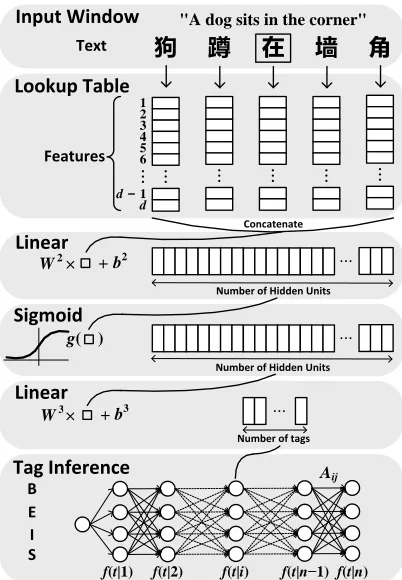
In order to make learning algorithms less depen-dent on the feature engineering, we chose to use a variant of the neural network architecture first pro-posed by (Bengio et al., 2003) for probabilistic lan-guage model, and reintroduced later by (Collobert et al., 2011) for multiple NLP tasks. The network takes the input sentence and discovers multiple lev-els of feature extraction from the inputs, with higher levels representing more abstract aspects of the in-puts. The architecture is shown in Figure 1. The first layer extracts features for each Chinese character. The next layer extracts features from a window of characters. The following layers are classical neural network layers. The output of the network is a graph over which tag inference is achieved with a Viterbi algorithm.
2.1 Mapping Characters into Feature Vectors
The characters are fed into the network as indices that are used by a lookup operation to transform characters into their feature vectors. We consider a fixed-sized character dictionary D1. The vector
representations are stored in a character embedding matrixM ∈ Rd×|D|, wheredis the dimensionality of the vector space (a hyper-parameter to be chosen) and|D|is the size of the dictionary.
1Unless otherwise specified, the character dictionary is ex-tracted from the training set. Unknown characters are mapped to a special symbol that is not used elsewhere.
..
.
蹲 在 墙 角
1
"A dog sits in the corner"
2 3 4 5
d− 1
d
.. . .. . 6
狗
..
. ... ... ...
Text Input Window
Features Lookup Table
Concatenate
..
.
..
.
Number of Hidden Units
Linear
b2
× +
Sigmoid
W3 b3
× +
g( )
Number of tags
W2
Linear
Tag Inference B
E
S I
f(t|1) f(t|2) f(t|i) f(t|n−1) f(t|n)
Aij
[image:2.612.318.519.59.349.2]Number of Hidden Units
Figure 1: The neural network architecture.
Formally, assume we are given a Chinese sen-tencec[1:n] that is a sequence ofncharactersci,1≤
i≤n. For each characterci ∈ Dthat has an associ-ated indexkiinto the column of the embedding ma-trix, and-dimensional feature vector representation is retrieved by the lookup table layerZD(·)∈Rd:
ZD(ci) =Meki (1)
where we use a binary vectoreki ∈R|D|×1which is
zero in all positions except at the ki-th index. The lookup operation can be seen as a simple projection layer. The feature vector of each character, starting from a random initialization, can be automatically trained by back propagation to be relevant to the task of interest.
as boundary entropy (Jin and Tanaka-Ishii, 2006)
andaccessor variety (Feng et al., 2004), which are
commonly used in unsupervised CWS models. We associate a lookup table to each additional feature, and the character feature vector becomes the con-catenation of the outputs of all these lookup tables.
2.2 Tag scoring
A neural network can be considered as a function
fθ(·) with parameters θ. Any feed-forward neural network withLlayers can be seen as a composition of functionsfl
θ(·)defined for each layerl:
fθ(·) =fθL(fθL−1(. . . fθ1(·). . .)) (2)
For each character in a sentence, a score is pro-duced for every tag by applying several layers of the neural network over the feature vectors produced by the lookup table layer. We use a window approach to handle the sequences of variable sentence length. The window approach assumes that the tag of a char-acter depends mainly on its neighboring charchar-acters. More precisely, given an input sentence c[1:n], we consider all successive windows of sizew(a hyper-parameter), siding over the sentence, from character
c1 tocn. At positionci, the character feature win-dow produced by the first lookup table layer can be written as:
fθ1(ci) =
ZD(ci−w/2)
.. . ZD(ci)
.. . ZD(ci+w/2)
(3)
The characters with indices exceeding the sentence boundaries are mapped to one of two special sym-bols, namely“start”and“stop”symbols.
The fixed-sized vector fθ1 is fed to two
stan-dardLinear Layersthat successively perform affine
transformations overfθ1, interleaved with some non-linearity function g(·), to extract highly non-linear features. Given a set of tagsT for the task of inter-est, the network outputs a vector of size|T |for each character at positioni, interpreted as a score for each tag inT and each characterciin the sentence:
fθ(ci) =fθ3(g(fθ2(fθ1(ci))))
=W3g(W2fθ1(ci) +b2) +b3 (4)
where the matrices W2 ∈ RH×(wd), b2 ∈ RH, W3 ∈R|T |×H andb3 ∈R|T |are the parameters to
be trained. The hyper-parameterH is usually called
thenumber of hidden units. As non-linear function,
we chose a sigmoidal function2:
g(x) = 1/(1 +e−x) (5)
2.3 Tag Inference
There are strong dependencies between character tags in a sentence for the tasks like word segmen-tation and POS tagging. The tags are organized in chunks, and it is impossible for some tags to fol-low other tags. We introduce a transition scoreAij for jumping from i ∈ T toj ∈ T tags in succes-sive characters, and an initial scoresA0i for starting from thei-th tag for taking into account the sentence structure. We want the valid paths of tags to be en-couraged, while discouraging all other paths.
Given an input sentence c[1:n], the network out-puts the matrix of scoresfθ(c[1:n]). We use a nota-tion fθ(t|i) to indicate the score output by the net-work with parameters θ, for the sentence c[1:n] and for thet-th tag, at thei-th character. The score of a sentencec[1:n]along a path of tagst[1:n]is then given by the sum of transition and network scores:
s(c[1:n], t[1:n], θ) =
n
X
i=1
(Ati−1ti+fθ(ti|i)) (6)
Given a sentencec[1:n], we can find the best tag path
t∗[1:n]by maximizing the sentence score:
t∗[1:n] = arg max
∀t0 [1:n]
s(c[1:n], t0[1:n], θ) (7)
The Viterbi algorithm can be used for this inference. Now we are prepared to show how to train the para-meters of the network in an end-to-end fashion.
2.4 Training
The training problem is to determine all the para-meters of the networkθ = (M, W2, b2, W3, b3, A)
from training data. The network generally is trained
by maximizing a likelihood over all the sentences in the training setRwith respect toθ:
θ7→ X
∀(c,t)∈R
logp(t|c, θ) (8)
wherecrepresents a sentence and its associated fea-tures, andtdenotes the corresponding tag sequence. We drop the subscript [1 :n] from now for nota-tion simplificanota-tion. The probability p(·) is calcu-lated from the outputs of the neural network. We will present in the following section how to interpret neural network outputs as probabilities.
Maximizing the log-likelihood (8) with the gradi-ent ascgradi-ent algorithm3 is achieved by iteratively se-lecting a example(c, t)and applying the following gradient update rule:
θ←θ+λ∂logp(t|c, θ)
∂θ (9)
where λ is the learning rate (a hyper-parameter). The gradient in (9) can be computed by a classical back propagation: the differentiation chain rule is applied through the network, until the character em-bedding layer.
2.4.1 Sentence-Level Log-Likelihood
The score of a sentence (6) is interpreted as a con-ditional tag path probability by taking it to the expo-nential (making the score positive) and normalizing it over all possible tag paths (summing to 1 over all paths). Taking the log, the conditional probability of the true pathtis given by4:
logp(t|c, θ) =s(c, t, θ)−logX
∀t0
exp{s(c, t0, θ)}
(10)
3We did not use the stochastic gradient ascent algorithm (Bottou, 1991) to train the network as (Collobert et al., 2011). The gradient ascent algorithm was used instead for fairly comparing our algorithm with the sentence-level maximum-likelihood method (see Section 2.4.1). The gradient ascent al-gorithm requires a loop over all the examples to compute the gradient of the cost function, which will not cause a problem since all the training sets used in this article are finite.
4
The cost functions are differentiable everywhere thanks to the differentiability of sigmoidal function chosen as non-linearity instead of a “hard” version of the hyperbolic tangent. For details about gradient computations, see Appendix A of (Collobert et al., 2011).
The number of terms in (10) grows exponentially with the length of the input sentence. Although one can compute it in linear time with the Viterbi algo-rithm, it is quite computationally expensive to com-pute the conditional probability of the true path, and its derivatives with respect to fθ(t|i) andAij. The gradients with respect to the trainable parameters other thanfθ(t|i)andAij can all be computed using the derivatives with respect to fθ(t|i) by applying the differentiation chain rule. We will see in the next section our training algorithm that has the advantage of being much cheaper to compute the gradients.
2.5 A New Training Method
The log-likelihood (10) can be seen as the difference between the forward score constrained over the valid path and the sum of the scores of all possible paths. While this training criterion is used, the neural net-works are trained by maximizing the likelihood of training data. In fact, a CRF maximizes the same log-likelihood (Lafferty et al., 2001) by using a lin-ear model in stead of a nonlinlin-ear neural network.
As an alternative to maximum-likelihood method, we propose the following training algorithm inspired by the work of (Collins, 2002). Given a training example (c, t), the network outputs the matrix of scores fθ(c) under the current parameter settings. The highest scoring sequence of tags for the input sentence c then can be found using the Viterbi al-gorithm: this tagged sequence is denoted byt0. For every characterciwhereti6=t0i, we simply set
∂Lθ(t, t0|c)
∂fθ(ti|i)
++, ∂Lθ(t, t
0|c)
∂fθ(t0i|i)
−− (11)
and for every transition whereti−1 6=t0i−1orti6=t0i, we set
∂Lθ(t, t0|c) ∂Ati−1ti
++, ∂Lθ(t, t
0|c)
∂At0
i−1t0i
−− (12)
As an example, say the correct tag sequence of the sentenceì3p ‘A dog sits in the corner’ is
/S ì/S 3/S p/B /E
and under the current parameter settings the highest scoring tag sequence is
/S ì/B 3/E p/B /E
Then the derivatives with respect to fθ(S|ì), and
fθ(S|3)will be set to1, that with respect toASB,
ABE,AEB,fθ(B|ì), andfθ(E|3)to−1, and that with respect to ASS to 2 respectively5. Intuitively these assignments have the effect of updating the pa-rameter values in a way that increases the score of the correct tag sequence and decreases the score of the incorrect one output by the network with the cur-rent parameter settings. If the tag sequence produced by the network is correct, no changes are made to the values of parameters.
Inputs:
R: a training set.
N: a specified maximum number of iterations. E: a desired tagging precision.
Initialization:set the initial parameters of the network with small random values.
Output:the trained parametersθ˜
Algorithm: do
foreach example(c, t)∈ R
get the matrixfθ(c)by the neural network under the current parametersθ
find the highest scoring sequence of tagst0forcwith fθ(c)andAijby using the Viterbi algorithm
if(t6=t0)
compute the gradients with respect to fθ(c) and
Aijas (11) and (12)
compute the gradients with respect to the weights from output layer to character embedding layer update the parameters of the network by (9)
untilthe desired precisionEachieved or maximum num-ber of iterationsNreached
returnθ˜
Figure 2: The training algorithm for tagging.
We propose the training algorithm in Figure 2. Note that the perceptron algorithm of (Collins, 2002) was designed for discriminatively training an
5
The derivatives with respect toASB will be set to 0,
be-cause it is increased first and decreased afterwards.
HMM-style tagger, while our algorithm is used to calculate the “direction” in which the parameters are updated (i.e. the gradient of the function we want to maximize). Due to space limitations, we do not give convergence theorems justifying the training algo-rithm in this paper. Intuitively it can be achieved by combining the theorems of convergence for the per-ceptron applied to tagging problem from (Collins, 2002) with the convergence results of backpropaga-tion algorithm from (Rumelhart et al., 1986).
3 Experiments
We conducted three sets of experiments. The goal of the first one is to test several variants for each training algorithm on the development set, to gain some understanding of how the choice of hyper-parameters impacts upon the performance. We ap-plied the network both with the sentence-level log-likelihood (SLL) and our perceptron-style training algorithm (PSA) to the two Chinese NLP problems: word segmentation, and joint CWS and POS tag-ging. We ran this set of experiments on the part of Chinese Treebank 4 (CTB-4)6. Ninety percent of the sentences (1529) were randomly chosen for training and the rest (168) were used as development set.
The second set of experiments was run on the Chinese Treebank (CTB) data sets from Bakeoff-3 (Levow, 2006), which contains a training and a test corpus for supervised word segmentation and POS tagging tasks. The results were obtained without us-ing any extra knowledge (i.e. the closed test), and are comparable with other models in the literature.
In the third experiment, we study to see how well large unlabeled texts can be used to enhance the supervised learning. Following (Collobert et al., 2011), we first use large unlabeled data set to ob-tain character embeddings carrying more syntactic and semantic information, and then use these im-proved embeddings to initialize the character lookup tables of the networks instead of previous random values. Our corpus is the Sina news7 that contains about 325MB data.
6
The data set was sections 1–43, 144–169, and 900–931 of the treebank, containing 78,023 characters, 45,135 words and 1,697 sentences. These files are double-annotated and can be regarded as golden standard files.
7
We implemented two versions of the network: one for the sentence-level log-likelihood and one for our perceptron-style training algorithm. Both are written in Java language. All experiments were run on a computer equipped with an Intel Core i3 processor working at 2.13GHz, with 2GB RAM, running Linux and Java Development Kit 1.6. The standard F-score was used to evaluate the perfor-mance of both word segmentation and joint word segmentation and POS tagging tasks. F-score is the harmonic mean of precisionpand recallr, which is defined as2pr/(p+r).
90
80
70
60
1 3 5 7 9
Window Size
F
-sc
o
re
100
Fword: SEG (PSA)
Fword: SEG (SLL)
Foov: SEG (PSA)
Foov: SEG (SSL)
Fword: JWP (PSA)
Fword: JWP (SLL)
Foov: JWP (PSA)
Foov: JWP (SSL)
Fpos: JWP (PSA)
[image:6.612.313.529.62.277.2]Fpos: JWP (SSL)
Figure 3: Average F-score versus window size.
3.1 Tagging Schemes
The network will output the scores for all the possi-ble tags for the task of interest. For word segmen-tation, each character will be assigned one of four possible boundary tags: “B” for a character located at the beginning of a word, “I” for that inside of a word, “E” for that at the end of a word, and “S” for a character that is a word by itself.
Following Ng and Lou (2004) we perform joint word segmentation and POS tagging task in a la-beling fashion by expanding boundary labels to in-clude POS tags. For instance, we describe verb phases using four different tags. Tag “S VP” is used to mark a verb phase containing a single character. Other tags “B VP”, “I VP”, and “E VP” are used to
90
80
70
60
100 300 500 700 900 100
F
-sc
o
re
Number of Hidden Units
Fword: SEG (PSA)
Fword: SEG (SLL)
Foov: SEG (PSA)
Foov: SEG (SSL)
Fword: JWP (PSA)
Fword: JWP (SLL)
Foov: JWP (PSA)
Foov: JWP (SSL)
Fpos: JWP (PSA)
Fpos: JWP (SSL)
Figure 4: Average F-score versus number of hidden units.
mark the first, in-between and last characters of the verb phrase. In fact, we used the “IOBES” tagging scheme, and tag “O” is not applicable to Chinese word segmentation and POS tagging tasks.
3.2 The Choice of Hyper-parameters
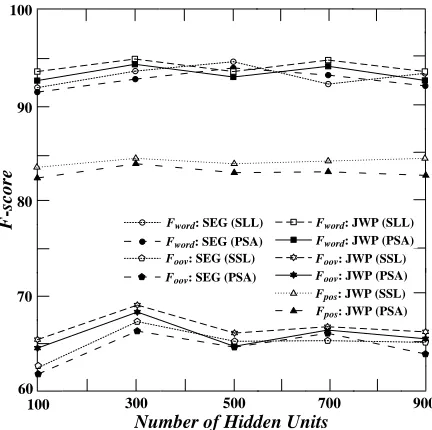
We tuned the hyper-parameters by trying only a few different networks. We report in Figure 3 the F-scores on the development set versus win-dow size for word segmentation (SEG) and joint word segmentation and POS tagging (JWP) tasks with the sentence-level log-likelihood (SLL) and our perceptron-style training algorithm (PSA), and re-port in Figure 4 the F-scores on the same data set versus number of hidden units. The average F-scores were obtained over 5 runs with different ran-dom initialization for each setting of the network. The F-scores of the word segmentation, out-of-vocabulary, and POS tagging are denoted byFword,
FoovandFposrespectively.
[image:6.612.75.295.237.450.2]that the size of window (and the number of parame-ters) is too large that the trained network has over-fitted on training data. An explanation for this result is that most Chinese words are less than 3 charac-ters, and the neighboring characters outside of the window (size 5) become “noise” when we perform word segmentation.
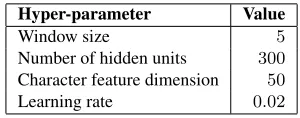
The hyper-parameters of the network used in all the following experiments are shown in Table 1. Al-though the top performance was obtained by the net-work with window size 3, we chose the architecture with window size 5 because a larger training corpus will be used in the following experiments, and the sparseness problem would be alleviated. Further-more, in order to obtain character embeddings by using large unlabeled data, we prefer to “observe” a character within a slightly larger window to better discover its syntactic and semantic information.
Hyper-parameter Value
Window size 5
Number of hidden units 300
Character feature dimension 50
[image:7.612.108.258.317.376.2]Learning rate 0.02
Table 1: Hyper-parameters of the network.
We report in Table 2 the F-score of the first five iterations on the development set for word segmen-tation with SLL and PSA. The data in the fourth and fifth rows of the table shows the convergence of PSA. The difference of the F-scores between the networks with SLL and PSA can be negligible after the number of iteration is greater than 5. In our im-plementation, for each iteration the training time is reduced at least 10% by using PSA, compared with SLL. The training time can be reduced further for more complex tasks like POS tagging and semantic role labeling in which a larger tag set is used.
Iteration 1 2 3 4 5
SSL
Fword 49.89 69.56 88.91 90.19 91.24
Foov 15.92 27.54 54.37 55.89 59.74
Time (s) 209 398 586 737 886
PSA
Fword 49.04 68.54 87.79 89.07 91.19
Foov 13.61 25.79 52.30 55.15 60.49
Time (s) 184 343 497 610 754
Table 2: Word segmentation results with SLL and PSA for the first five iterations.
Many exponential sums (P
iexp(xi)) are re-quired for training the networks with SLL, and in most cases the values of exponential sums will ex-ceed the range of double-precision floating-point arithmetic defined in popular programming lguages. These sums need to be estimated by an-alytic number theory. In comparison, a lot of the computation-intensive exponential sums are avoided in our training algorithm, which not only speed up the training of the networks but also make it easier to be implemented.
3.3 Closed Test on the SIGHAN Bakeoff
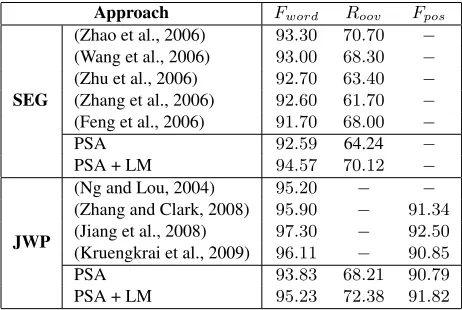
We trained the networks with PSA on the Chinese Treebank (CTB) data set from Bakeoff-3 for both SEG and JWP tasks. The results are reported in Ta-ble 3. The hyper-parameters of our networks are re-ported in Table 1. Although results show that our networks with PSA are behind the state-of-the-art systems, the networks perform comparatively well, considering we did not use any extra information. Many other systems used some extra heuristics or re-sources to improve their performance. For example, a key parameter in the system of (Wang et al., 2006) was optimized in advance by using an external seg-mented corpus, and a manually prepared list of char-acters as well as their types was used in (Zhao et al., 2006; Zhu et al., 2006; Kruengkrai et al., 2009).
[image:7.612.70.306.589.669.2]Approach Fword Roov Fpos
SEG
(Zhao et al., 2006) 93.30 70.70 − (Wang et al., 2006) 93.00 68.30 − (Zhu et al., 2006) 92.70 63.40 − (Zhang et al., 2006) 92.60 61.70 − (Feng et al., 2006) 91.70 68.00 −
PSA 92.59 64.24 −
PSA + LM 94.57 70.12 −
JWP
(Ng and Lou, 2004) 95.20 − − (Zhang and Clark, 2008) 95.90 − 91.34
(Jiang et al., 2008) 97.30 − 92.50
(Kruengkrai et al., 2009) 96.11 − 90.85
PSA 93.83 68.21 90.79
PSA + LM 95.23 72.38 91.82
Table 3: Comparison of the F-scores on the Penn Chinese Treebank
3.4 Combined Approach
We used the corpus of Sina news to obtain charac-ter embeddings carrying more semantic and syntac-tic information by training a language model that evaluates the acceptability of a piece of text. This language model is again the neural network, and we also use PSA to train the language model. Following (Collobert et al., 2011), we minimize the following criterion with respect to the parametersθ:
θ7→ X
∀h∈H
X
∀c0∈D
max{0,1−fθ(c|h) +fθ(c0|h)}
(13) where the scorefθ(c|h)is the output of the network with parameters θfor a charactercat the center of a windowh,D is the dictionary of characters,His the set of all possible text windows (i.e. character se-quences) from the training data, andc0|hdenotes the window obtained by replacing the central character of the windowhby the characterc0.
We used a dictionary consisting of the charac-ters extracted from all the data sets in Bakeoff-3, which contains about eight thousand characters. The total unsupervised training time was about two weeks. Our combined approach works as initializing the lookup tables of the supervised networks with the character embeddings obtained by unsupervised learning, and then performing supervised training on CTB-3. The lookup tables will not be modified at the supervised training stage.
We reported the results in Table 3, in which our combined approach is indicated by “PSA + LM”.
[image:8.612.71.302.61.216.2]It can be seen from Table 3 that this approach re-sults in a performance boost for both SEG and JWP tasks. The POS tagging F-score of our approach was comparable to but still less than the model of (Jiang et al., 2008). They achieved the best score by first separately training multiple word-, character-, and POS n-gram based models, and then integrat-ing them by cascadintegrat-ing method. In comparison, our networks achieve the performance by automatically discovering useful features by itself and avoiding the task-specific engineering.
Table 4 compares the decoding speeds on the test data from CTB-3 for our system and for two CRFs-based word segmentation systems. Regardless of the differences in implementation, the neural net-works clearly run considerably faster than the sys-tems based on the CRFs model. They also require much more memory than our neural networks.
System Number of parameters Time (s)
(Tsai et al., 2006) 3.1×10⁶ 1669
(Zhao et al., 2006) 3.8×10⁶ 2382
Neural network 4.7×10⁵ 138
Table 4: Comparison of computational cost.
4 Related Work
Word segmentation has been pursued with consid-erable efforts in the Chinese NLP community, and statistical approaches are clearly dominant in the last decade. A popular statistical approach is the character-based tagging solution that treats word segmentation as a sequence tagging problem, as-signing labels to the characters indicating whether a character locates at the beginning of, inside, or at the end of a word. The character-based tagging solution was first proposed in (Xue, 2003). This work caused quite a number of character position tagging based CWS studies because known and unknown words can be treated in the same way. Peng, Feng and Mc-Callum (2004) first introduced a linear-chain CRFs model to the character tagging based word segmen-tation. Zhang and Clark (2007) proposed a word-based CWS approach using a discriminative percep-tron learning algorithm, which allows word-level in-formation to be added as features.
the accuracies of both tasks and does not suffer from the error propagation. Ng and Lou (2004) perform such joint task in a labeling fashion by expanding boundary labels to include POS tags. Zhang and Clark (2008) proposed a linear model for the same joint task, which overcomed the disadvantage of (Ng and Lou, 2004), in which it was unable to incor-porate “whole word + POS tag” features. Sun (2011) described a sub-word model using stacked learn-ing technique for the joint task, which explored the complementary strength of different character- and word-based segmenters with different views.
The majority of the state-of-the-art systems ad-dress their tasks by applying linear statistical mod-els to ad-hoc features. The researchers first chose task-specific features which are then fed to a classi-fication algorithm. The selected features may vary greatly because they are usually chosen in a empir-ical process, mainly based first on linguistic intu-ition, and then trial and error. It seems reasonable to assume that the number and effectiveness of fea-tures constitutes a major factor in the performance of the various systems, and might even more impor-tant than the particular statistical models they used. In comparison, we try to avoid task-specific feature engineering, and use the neural network to learn sev-eral layers of feature extraction from the inputs. To the best of our knowledge, this study is among the first ones to perform Chinese word segmentation and POS tagging by deep learning.
It was reported that supervised and unsupervised approaches can be integrated to improve on the over-all performance of word segmentation by combin-ing the strengths of both. Zhao and Kit (2011) ex-plored the feasibility of enhancing supervised seg-mentation by informing the supervised learner of goodness scores obtained from large unlabeled cor-pus. Sun and Xu (2011) investigated how to improve on the accuracy of supervised word segmentation by leveraging the statistics-based features derived from large unlabeled in-domain corpus and the document to be segmented. The basic idea of these integration solutions is to incorporate a set of statistics-based measures into a CRFs model after these measures are derived from unlabeled data and discretized into feature values. In comparison, we use large unla-beled data to obtain the character embeddings with more syntactic and semantic information.
Several works have investigated how to use deep learning for NLP applications (Bengio et al., 2003; Collobert et al., 2011; Collobert, 2011; Socher et al., 2011). In most cases, words are fed to the neural networks as inputs, and the lookup tables map each word to a vector representation. Our network is dif-ferent in that the inputs to the network are charac-ters, more raw units than words. In many Asian languages, such as Chinese and Japanese, they are written without using whitespace to delimit words. For these languages, the character becomes a more natural form of input. Furthermore, a perceptron-style algorithm for tagging is proposed for training the networks.
5 Conclusion
We have described a perceptron-style algorithm for training the neural networks, which is much easier to be implemented, and has speed advantage over the maximum-likelihood scheme, while the loss in per-formance is negligible. The neural networks trained with PSA have been applied to Chinese word seg-mentation and POS tagging tasks, and the networks achieved close to state-of-the-art performance by us-ing the character representations learned from large unlabeled corpus.
Although we focus on the question of how far we can go for Chinese word segmentation and POS tag-ging without using the extra task-specific features in this study, there are at least three ways to further im-prove the performance of the networks, which are worthy to be explored in the future: (1) introduce specific linguistic features (e.g. gazetteer features) that are helpful for the tasks; (2) incorporate some common techniques, such as cascading, voting, and ensemble; and (3) use the special network architec-ture tailored for the tasks of interest.
Acknowledgments
References
Yoshua Bengio, R´ejean Ducharme, Pascal Vincent, and Christian Jauvin. 2003. A neural probabilistic langu-gage model. Journal of Machine Learning Research, 3: 1137–1155.
L´eon Bottou. 1991. Stochastic gradient learning in neural networks. In Proceedings of the Neuro-Nˆımes. Michael Collins. 2002. Discriminative training methods
for hidden Markov models: Theory and experiments with perceptron algorithms. In Proceedings of the In-ternational Conference on Empirical Methods in Nat-ural Language Processing (EMNLP’02).
Ronan Collobert. 2011. Deep learning for efficient dis-criminative parsing. In Proceedings of the 14th In-ternational Conference on Artificial Intelligence and Statistics (AISTATS’11).
Ronan Collobert, Jason Weston, L´eon Bottou, Michael Karlen, Koray Kavukcuoglu, and Pavel Kuksa. 2011. Natural language processing (almost) from scratch. Journal of Machine Learning Research, 12: 2493– 2537.
Haodi Feng, Kang Chen, Xiaotie Deng, and Weimin Zheng. 2004. Accessor variety criteria for Chinese word extraction. Computational Linguistics, 30(1): 75–93.
Yuanyong Feng, Sun Le, and Yuanhua Lv. 2006. Chi-nese word segmentation and name entity recognition based on conditional random fields models. In Pro-ceedings of the Fifth SIGHAN Workshop on Chinese Language Processing (SIGHAN’06).
Wenbin Jiang, Liang Huang, Qun Liu, Yajuan Lu. 2008. A cascaded linear model for joint Chinese word seg-mentation and part-of-speech tagging. In Proceed-ings of the 46th Annual Meeting of the Association for Computational Linguistics (ACL’08).
Zhihui Jin, and Kumiko Tanaka-Ishii. 2006. Unsuper-vised segmentation of Chinese text by use of branch-ing entropy. In Proceedings of the International Con-ference on Computational Linguistics and the Annual Meeting of the Association for Computational Linguis-tics (COLING/ACL’06).
Canasai Kruengkrai, Kiyotaka Uchimoto, Jun’ichi
Kazama, Yiou Wang, Kentaro Torisawa, and Hitoshi Isahara. 2009. An error-driven word-character hy-brid model for joint Chinese word segmentation and pos tagging. In Proceedings of the 47th Annual Meet-ing of the Association for Computational LMeet-inguistics (ACL’09).
John Lafferty, Andrew McCallum, and Fernando Pereira. 2001. Conditional random fields: Probabilistic mod-els for segmenting and labeling sequence data. In Pro-ceedings of the International Conference on Machine learning (ICML’01).
Gina A. Levow. 2006. The third international
Chi-nese language processing bakeoff: Word segmentation and named entity recognition. In Proceedings of the SIGHAN Workshop on Chinese Language Processing (SIGHAN’06).
Hwee T. Ng and Jin K. Lou. 2004. Chinese part-of-speech tagging: one-at-atime or all-at-once? word-based or character-word-based? In Proceedings of the Inter-national Conference on Empirical Methods in Natural Language Processing (EMNLP’04).
Fuchun Peng, Fangfang Feng, and Andrew McCallum. 2004. Chinese segmentation and new word detection using conditional random fields.In Proceedings of the 20th International Conference on Computational Lin-guistics (COLING’04).
David E. Rumelhart, Geoffrey E. Hinton, and Ronald J. Williams. 1986. Learning internal representations by backpropagating errors. Parallel Distributed Process-ing: Explorations in the Microstructure of Cognition, 1: 318–362. MIT Press.
Richard Socher, Cliff C-Y. Lin, Andrew Y. Ng, and
Christopher D. Manning 2011. Parsing Natural
Scenes and Natural Language with Recursive Neural Networks. In Proceedings of the International Con-ference on Machine learning (ICML’11).
Weiwei Sun. 2011. A stacked sub-word model for joint Chinese word segmentation and part-of-speech tag-ging.In Proceedings of the 49th Annual Meeting of the Association for Computational Linguistics (ACL’11). Weiwei Sun and Jia Xu. 2011. Enhancing Chinese word
segmentation using unlabeled data. In Proceedings of the International Conference on Empirical Methods in Natural Language Processing (EMNLP’11).
Richard T.-H. Tsai, Hsieh C. Hung, Chenglung Sung,
Hongjie Dai, and Wenlian Hsu. 2006. On closed
task of Chinese word segmentation: An improved CRF model coupled with character clustering and automat-ically generated template matching. In Proceedings of the Fifth SIGHAN Workshop on Chinese Language Processing (SIGHAN’06).
Xinhao Wang, Xiaojun Lin, Dianhai Yu, Hao Tian, and Xihong Wu. 2006. Chinese word segmentation with
maximum entropy andn-gram language model. In
Proceedings of the Fifth SIGHAN Workshop on Chi-nese Language Processing (SIGHAN’06).
Nianwen Xue. 2003. Chinese word segmentation as
character tagging. Computational Linguistics and Chinese Language Processing, 8(1): 29–48.
Min Zhang, GuoDong Zhou, LingPeng Yang, and
DongHong Ji. 2006. Chinese word segmentation
Yue Zhang and Stephen Clark. 2007. Chinese segmen-tation with a word-base perceptron algorithm. In Pro-ceedings of the 45th Annual Meeting of the Association for Computational Linguistics (ACL’07).
Yue Zhang and Stephen Clark. 2008. Joint word seg-mentation and pos tagging using a single perceptron. In Proceedings of the 46th Annual Meeting of the As-sociation for Computational Linguistics (ACL’08). Hai Zhao, Chang N. Huang, and Mu Li. 2006. An
im-proved Chinese word segmentation system with con-ditional random field. In Proceedings of the Fifth SIGHAN Workshop on Chinese Language Processing (SIGHAN’06).
Hai Zhao and Chunyu Kit. 2011. Integrating
unsu-pervised and suunsu-pervised word segmentation: The role of goodness measures. Information Sciences, 181(1): 163–183.