A temporal model of text periodicities using Gaussian Processes
Daniel Preot¸iuc-Pietro, Trevor Cohn
Department of Computer Science University of Sheffield Regent Court, 211 Portobello Street Sheffield, S1 4DP, United Kingdom {daniel,t.cohn}@dcs.shef.ac.uk
Abstract
Temporal variations of text are usually ig-nored in NLP applications. However, text use changes with time, which can affect many applications. In this paper we model peri-odic distributions of words over time. Focus-ing on hashtag frequency in Twitter, we first automatically identify the periodic patterns. We use this for regression in order to fore-cast the volume of a hashtag based on past data. We use Gaussian Processes, a state-of-the-art bayesian non-parametric model, with a novel periodic kernel. We demonstrate this in a text classification setting, assigning the tweet hashtag based on the rest of its text. This method shows significant improvements over competitive baselines.
1 Introduction
Temporal changes in text corpora are central to our understanding of many linguistic and social phe-nomena. Social Media platforms and the digital-ization of libraries provides a vast body of times-tamped data. This allows studying of the complex temporal patterns exhibited by text usage includ-ing highly non-stationary distributions and period-icities. However, temporal effects have been mostly ignored by previous work on text analysis or at best dealt with by making strong assumptions such as smoothly varying parameters with time (Yogatama et al., 2011) or modelled using a simple uni-modal distri bution (Wang and McCallum, 2006). This pa-per develops a temporal model for classifying mi-croblog posts which explicitly incorporates mul-timodal periodic behaviours using Gaussian Pro-cesses (GPs).
We expect text usage to follow multiple period-icities at different scales. For example, people on Social Media might talk about different topics dur-ing and after work on weekdays, talk every Friday about the weekend ahead, or comment about their favorite weekly TV show during its air time. Given this, text frequencies will display periodic patterns. This applies to other text related quantities like co-occurrence values or topic distributions over time, as well as applications outside NLP like user be-haviour (Preot¸iuc-Pietro and Cohn, 2013).
Modelling temporal patterns and periodicities can be useful to tasks like text classification. For exam-ple a tweet containing ‘music’ is normally attributed to a general hashtag about music like #np (now play-ing). However, knowing time, if it occurs during the (weekly periodic) air time of ‘American Idol’ it is more likely for it to belong to #americanidol or if its mentioned in the days building up to the Video Music Awards to be assigned to #VMA.
In NLP, temporal models have treated time in overly simplistic ways and without regard to period-icities. We propose a model that first broadly iden-tifies several types of temporal patterns: a) periodic, b) constant in time, c) falling out of use after enjoy-ing a brief spell of popularity (e.g. internet memes, news). This is performed automatically only using training data and makes no assumptions on the exis-tence or the length of the periods we aim to model. We demonstrate the approach by modelling frequen-cies of hashtag occurrences in Twitter. Hashtags are user-generated labels included in tweets by their au-thors in order to assign them to a conversation and can be considered as a proxy for topics.
To this end, we make use of Gaussian Pro-cesses (GP) (Rasmussen and Williams, 2005), a
Bayesian non-parametric model for regression. Us-ing theBayesian evidencewe automatically perform model selection to classify temporal patterns. We aim to use the most suitable model for extrapolation, i.e. predicting future values from past observations. The GP is fully defined by the covariance structure assumed between the observed points, and its hy-perparameters, which can be automatically learned from data. We also introduce a new kernel suitable to model the periodic behaviour we observe in text: periods of low frequency followed by bursts at reg-ular time intervals. We demonstrate that the GP ap-proach is more general and gives better results than frequentist models (e.g. autoregressive models) be-cause it incorporates uncertainty explicitly and ele-gantly, in addition to automatic model selection and parameter fitting.
To demonstrate the practical importance of our approach, we use our GP prediction as a prior in a Na¨ıve Bayes model for text classification showing improvements over baselines which do not account for temporal periodicities. Our approach extends to more general uses, e.g. to discriminative text regrsion and classification. More broadly, we aim to es-tablish GPs as a state-of-the-art model for regression and classification in NLP. To our knowledge, this is the first paper to use GP regression for forecasting and model selection within a NLP task.
All the hashtag time series data and the imple-mentation of the PS kernel in the popular open-source Gaussian Processes packages GPML1 and GPy2are available on the author’s website3.
2 Related Work
Time varying text patterns have been of particular interest in topic modelling. Griffiths and Steyvers (2004) analyse evolution of topics over time, but without modelling time explicitly. Extensions that model time make different assumptions, usually re-garding smoothing proprieties in (Wang and McCal-lum, 2006; Blei and Lafferty, 2006; Wang et al., 2008; Hennig et al., 2012). Yogatama et al. (2011) proposed a regulariser for generalised linear models that encourages local temporal smoothness.
1http://www.gaussianprocess.org/gpml/
code
2https://github.com/SheffieldML/GPy 3http://www.preotiuc.ro
Modelling periodicities is one of the standard ap-plications of Gaussian Processes (Rasmussen and Williams, 2005). Recent work by Wilson and Adams (2013) and Durrande et al. (2013) show how differ-ent periods can be iddiffer-entified from data. In general, methods that assume certain periodicities at daily or weekly levels were proposed e.g. in (McInerney et al., 2013). GPs were used with text by Polajnar et al. (2011) and for Quality Estimation regression in (Cohn and Specia, 2013; Shah et al., 2013).
Temporal patterns for short, distinctive lexical items such as hashtags and memes were quanti-tatively studied (Leskovec et al., 2009) and clus-tered (Yang and Leskovec, 2011) in Social Media. (Yang et al., 2012) studies the dual role of hashtags, of bookmarks of content and symbols of commu-nity membership, in the context of hashtag adoption. (Romero et al., 2011) analyses the patterns of tem-poral diffusion in Social Media finding that hashtags have also a persistence factor.
For predicting future popularity of hashtags, Tsur and Rappoport (2012) use linear regression with a wide range of features. (Ma et al., 2012; Ma et al., 2013) frame the problem as classification into a number of fixed intervals and applies all the stan-dard classifiers. None of these studies model period-icities, although the former stresses their importance for accurate predictions. For predicting the hashtag given the tweet text, Mazzia and Juett (2011) uses the Na¨ıve Bayes classifier with the uniform and em-pirical prior or TF-IDF weighting.
3 Gaussian Processes
In this paper we consider Gaussian Process (GP) models of regression (Rasmussen and Williams, 2005). GP is a probabilistic machine learning framework incorporating kernels and Bayesian non-parametrics which is widely considered as state-of-the-art for regression. The GP defines a prior over functions which applied at each input point gives a response value. Given data, we can analytically infer the posterior distribution of these functions assum-ing Gaussian noise. The kernel of the GP defines the covariance in response values as a function of its in-puts.
lieswithinthe bounds of the training set we call the prediction task as interpolation. If the range of the prediction is outside the bounds, then our problem that of extrapolation. In this respect, extrapolation is considered a more difficult task and the covariance kernel which incorporates our prior knowledge plays a major role in the prediction.
There is the case when multiple covariance ker-nels can describe our data. For choosing the right kernel and its hyperparameters only using the train-ing data we employ Bayesian model selection which makes a trade-off between the fit of the training data and model complexity. We now briefly give an overview of GP regression, kernel choice and model selection. We refer the interested reader to (Ras-mussen and Williams, 2005) for a detailed introduc-tion to GPs.
3.1 Gaussian Process Regression
Consider a time series regression task where we only have one feature, the valuextat timet. Our training data consists ofnpairs D = {(t, xt)}. The model will need to predict valuesxtfor values oftgreater than those in the dataset.
GP regression assumes a latent function f that is drawn from a GP prior f(t) ∼ GP(m, k(t, t0))
where m is the mean and k a kernel. The predic-tion value is obtained by the funcpredic-tion evaluated at the corresponding data point,xt = f(t) +, where ∼ N(0, σ2) is white-noise. The GP is defined by the meanm, here 0, and the covariance kernel func-tion,k(t, t0).
The posterior at a test pointt∗is given by:
p(x∗|t∗,D) =
Z
f
p(x∗|t∗, f)·p(f|D) (1)
wherex∗andt∗are the test value and time. The pos-terior p(f|D) shows our belief over possible func-tions after observing the training setD. The predic-tive posterior can be solved analytically with solu-tion:
x∗ ∼ N(kT∗(K+σn2I)−1t,
k(t∗, t∗)−kT∗(K+σn2I)−1k∗) (2)
where k∗ = [k(t∗, t1)...k(t∗, tn)]T are the kernel evaluations between the test point and all the train-ing points,K ={k(ti, tj)}ij=1=1..n..nis the Gram matrix
3/1 4/1 5/1 6/1
[image:3.612.324.522.51.215.2]Gold SE PS(24)
Figure 1: Interpolation for #goodmorning over 3 days with SE and PS(p=24,s=3) kernels. Prediction variance shown in grey for PS(24). Crosses represent training points.
over the training points andt is the vector of train-ing points. The posterior of x∗ includes the mean response as well as its variance, thus expressing the uncertainty of the prediction. In this paper, we will consider the forecast as the expected value. Due to the matrix inversion in 2, inference takesO(n3)time wherenis the number of training points.
3.2 Kernels
The covariance kernel together with its parameters fully define the GP (we assume 0 mean). The kernel induces similarities in the response between pairs of data points. Intuitively, if we want a smooth func-tion, closer points should have high covariance com-pared to points that are further apart. If we want a periodic behaviour points at period length intervals should have the highest covariance. Usually, this is defined by an isotropic kernel, which means its in-variant to all rigid motions.
For interpolation, a standard kernel (e.g. squared exponential) that encourages smooth functions is normally used. Figure 1 shows regression over 3 days for #goodmorning when only a random third of the values of the function are observed. We see that both the SE kernel and a periodic kernel (PS, see below) give good results.
future week learned by using different kernels. In this study we will use multiple kernels, each most suitable for a specific category of temporal pat-terns in our data. This includes a new kernel inspired by observed word occurrence patterns. The kernels we use are:
Constant (C):The constant kernel iskC(t, t0) = c. Its mean prediction will always be the valuecand its assumption is that the signal is modeled only by Gaussian noise centred around this value. This de-scribes the data best when we have a noisy signal around a stationary mean value.
Squared exponential (SE):The SE kernel or the Radial Basis Function (RBF) is the standard kernel used in most interpolation settings.
kSE(t, t0) =s2·exp−
(t−t0)2
2l2 (3)
This gives a smooth transition between neighbour-ing points and best describes time series with a smooth shape e.g. a uni-modal burst with a steady decrease. However, its uncertainty grows with for predictions well into the future. Its two parameters sandl are the characteristic lengthscales along the two axes. Intuitively, they control the distance of in-puts on a particular axis from which the function values become uncorrelated. Using the SE kernel corresponds to Bayesian linear regression with an infinite number of basis functions (Rasmussen and Williams, 2005).
Linear (Lin):The linear kernel describes a linear relationship between outputs.
kLin(t, t0) =s2+kt·t0k (4)
This can be obtained from linear regression by hav-ingN(0,1)priors on the corresponding regression weights and a prior ofN(0, s2)on the bias.
Periodic (PER):The periodic kernel represents a SE kernel in polar coordinates.
kP ER(t, t0) =s2·exp−2·
sin2(2π(t−t0)2/p)
l2
!
(5)
It has a sinusoidal shape and is good at modelling periodically patterns that oscillate between low and high frequency. s and l are characteristic length-scales as in the SE kernel andpis the period.
25 50 75 100 125
0 0.2 0.4 0.6 0.8 1
[image:4.612.322.534.59.216.2]s=1 s=5 s=50
Figure 2: Behaviour of the PS kernel (p=50) with varying s. Values normalized in [0,1] interval.
Periodic spikes (PS):For textual time series, like word frequencies, we identify the following periodic behaviour: abrupt rise in usage, usually with a peak, followed by periods of low occurrence, which can be short (e.g. during the night) or long lived (e.g. the entire week except for a few hours). For modelling we introduce the following kernel:
kP S(t, t0) = cos sin
2π·(t−t0)2
p
!!
·exp scos(2π·(t−t
0)2 )
p −s
!
(6)
The kernel is parameterised by its period p and a shape parameters. The period indicates the time in-terval between the peaks of the function, while the shape parameter controls thewidthof the spike. The behaviour of the kernel is illustrated in Figure 2. We constrains≥1.
[image:4.612.320.542.364.448.2]03/10 10/1 17/1 0.2
0.4 0.6 0.8 1
#goodmorning
[image:5.612.83.539.51.184.2]Gold Const Linear SE Per(168) PS(168)
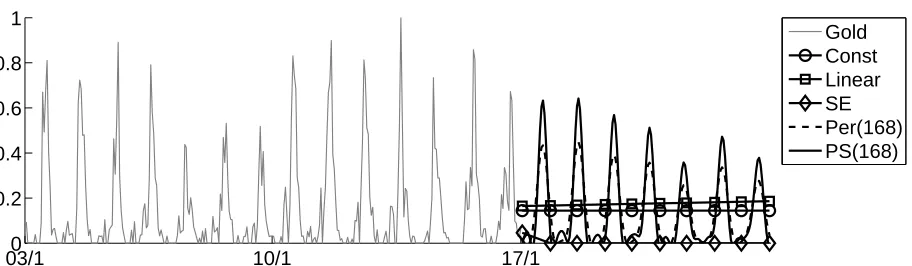
Figure 3: Extrapolation for #goodmorning over 3 weeks with GPs using different kernels.
Const Lin SE PER PS
NLML -41 -34 -176 -180 -192
NRMSE 0.213 0.214 0.262 0.119 0.107
Table 1: Negative Log Marginal Likelihood (NLML) shows the best fitted model for the time series in Figure 3. NRMSE computed on the third unobserved week. Lower values are better in both cases.
3.3 Model selection and optimisation
We now briefly discuss the concepts of model se-lection in the GP framework, by which we refer to choosing the model (kernel) from a setHi and op-timising the model hyperparameters θ. In our GP Bayesian inference scheme, we can compute the probability of the data given the model which in-volves the integral over the parameter space. This is called themarginal likelihoodorevidenceand is useful for model selection using only the training set:
p(x|D, θ,Hi) =
Z
f
p(x|D, f,Hi)p(f|θ,Hi) (7)
Our first goal is to fit the kernel by minimizing the negative log marginal likelihood (NLML) with respect to the kernel parametersθ. This approxima-tion is also known as type II maximum likelihood (ML-II). Conditioned on kernel parameters, the evi-dence of a GP can be computed analytically.
Our second goal is to use the evidence for model selection because it balances the data fit and the model complexity by automatically incorporat-ing Occam’s Razor (Rasmussen and Ghahramani, 2000). Because the evidence must normalise, com-plex models which can account for many datasets achieve low evidence. One can think of the evidence as the probability that a random draw of the param-eter values from the model class would generate the
datasetD. This way, complex models are penalised because they can describe many datasets, while the simple models can describe only a few datasets, thus the chance of a good data fit being very low. This is for example the case of the periodic bursts in Fig-ure 3. Although the periodic kernel can fit the data, it will incur a high model complexity penalty. The PS kernel in this respect is a simpler model and can fit the data and is thus chosen as the right model.
When the dataset is observed, the evidence can se-lect between the models. More generally, the model choice actually gives us animplicit classificationof the temporal patterns into classes: a steady signal with noise (C kernel), a signal with local temporal patterns (SE kernel), an oscilating periodic pattern (PER kernel) or a pattern with abrupt periodic peaks (PS kernel).
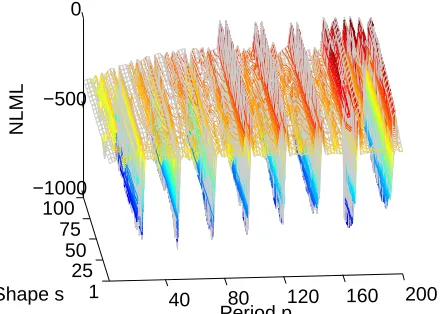
We use the NLML for optimising the hyperpa-rameters only using training data. For optimising the hyperparameters of the kernel defined in Equation 6, it is important to first identify the right period. We consider as possible periods all integer values less than half the size of the training set, and then tune the shape parameter using gradient descent to min-imise NLML. We then take the argmin value of those considered. We show the NLML for a sample regression in Figure 4.
40 80 120 160 200 1
25 50 75 100 −1000
−500 0
Period p Shape s
[image:6.612.76.296.59.216.2]NLML
Figure 4: NLML for #goodmorning on the training set as a function of the 2 kernel parameters.
is a relatively standard technique for fitting periodic kernels (Duvenaud et al., 2013).
The flexibility of the GP framework allows us to combine kernels (e.g.SE·P SorP S+Lin) in order to identify a combination of trends (Duvenaud et al., 2013; G¨onen and Alpaydin, 2011). Experiments on a subset of data showed no major benefits of combin-ing kernels, but the computational time and model complexity increased drastically due to the extra hy-perparameters. Because we will model a proportion of words within a limited time frame, there are few linear trends in the data. It might seem limiting that we only learn a single period, although we could combine periodic kernels with different periods to-gether. But, as we have seen in the #goodmorning example (with overlapping weekly and daily pat-terns), if there is a combination of periods the model will select a single period which is the least common multiple.
4 Data
For our experiments we used data collected from Twitter using the public Gardenhose stream (10% representative sample of the entire Twitter stream). The data collection interval was 1 January – 28 February 2011. For simplicity in the classification task, we filtered the stream to include only tweets that have exactly one hashtag. These represent ap-proximately 7.8% of our stream.
As text processing steps, we have tokenised all the tweets and filtered them to be written in English us-ing the Trendminer pipeline (Preot¸iuc-Pietro et al., 2012). We also remove duplicate tweets (retweets
and tweets that had the same first 6 content tokens) because they likely represent duplicate content, au-tomated messages or spam which would bias the dataset, as also stated by Tsur and Rappoport (2012). In our experiments we use the first month of data as training and the second month as testing. Note the challenging nature of this testing configuration where predictions must be made for up to 28 days into the future. We keep a total 1176 of hashtags which appear at least 500 times in both splits of the data. The vocabulary consists of all the tokens that occur more than 100 times in the dataset and start with an alphabetic letter. After processing, our dataset consists of 6,416,591 tweets with each hav-ing on average 9.55 tokens.
5 Forecasting hashtag frequency
We treat our task of forecasting the volume of a Twitter hashtag as a regression problem. Because the total number of tweets varies depending on the day and hour of day, we chose to model the proportion of tweets with the given tag in that hour. Given a time series of these values as the training set for a hash-tag, we aim to predict the values in the testing set, extrapolating to the subsequent month.
Hashtags represent free-form text labels that au-thors add to a tweet in order to enable other users to search them to participate in a conversation. Some users use hashtags as regular words that are integral to the tweet text, some hashtags are general and re-fer to the same thing or emotion (#news, #usa, #fail), others are Twitter games or memes (#2010diss-apointments, #musicmonday). Other hashtags re-fer to events which might be short lived (#world-cup2022), long lived (#25jan) or periodic (#raw, #americanidol). We chose to model hashtags be-cause they group similar tweets (like topics), reflect real world events (some of which are periodic) and present direct means of evaluation. Note that this approach could be applied to many other temporal problems in NLP or other domains. We treat each regression problem independently, learning for each hashtag its specific model and set of parameters.
5.1 Methods
ap-03/1 10/1 17/1 24/1 31/1 07/2 14/2 21/2 28/2 0
0.5 1
#fyi
Gold PS Const
#fyi
03/1 10/1 17/1 24/1 31/1 07/2 14/2 21/2 28/2
0 0.5 1
#confessionhour
Gold PS SE
#confessionhour
03/1 10/1 17/1 24/1 31/1 07/2 14/2 21/2 28/2
0 0.5 1
#fail
Gold PER Const
#fail
03/1 10/1 17/1 24/1 31/1 07/2 14/2 21/2 28/2
0 0.5 1
#breakfast
Gold PS Const
#breakfast
03/1 10/1 17/1 24/1 31/1 07/2 14/2 21/2 28/2
0 0.5 1
#raw
Gold PS Const
[image:7.612.81.540.49.481.2]#raw
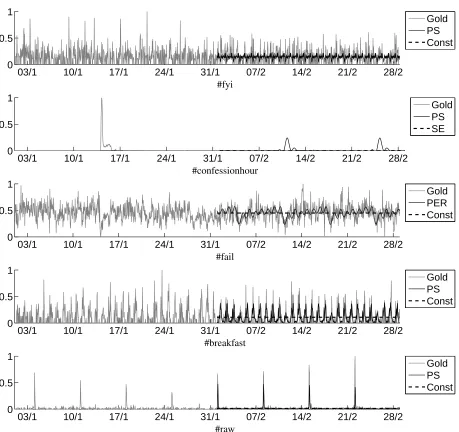
Figure 5: Sample regressions and their fit using different methods.
proach. These are:
Mean value (M):We use as prediction the mean of the values in the training set. Note that this is the same as using a GP model with a constant kernel (+ noise) with a mean equal to the training set mean.
Lag model with GP determined period (Lag+):
The prediction is the mean value in the training set of the values at lag∆where∆is the period rounded to the closest integer as determined by our GP model. This is somewhat similar to an autoregressive (AR) model with all the coefficients except ∆ set to 0. We highlight that given the period ∆this is a very strong model as it gives a mean estimate at each
point. Comparing to this model we can see if the GP model can recover the underlying function that de-scribed the periodic variation and filter out the noise in the observations. Correctly identifying the period is very challenging as we discuss below.
GP regression: Gaussian Process regression us-ing only the SE kernel (GP-SE), the periodic ker-nel (GP-PER), the PS kernel (GP-PS). The method that chooses between kernels using model selection as described in Section 3.3 is denoted asGP+. We will also compare to GP regression the linear kernel
Hashtag Lag(p) Const SE PER PS NRMSE NLML NRMSE NLML NRMSE NLML NRMSE NLML NRMSE
#fyi 0.1578 -322 0.1404 -320 0.1898 -321 0.1405 -293 0.1456
#confessionhour 0.0404 -85 0.0107 -186 0.0012 -90 0.0327 -88 0.0440
#fail 0.1431 -376 0.1473 -395 0.4695 -444 0.1387 -424 0.1390
#breakfast 0.1363 -293 0.1508 -333 0.1773 -293 0.1514 -367 0.1276
[image:8.612.64.549.53.139.2]#raw 0.0464 -1208 0.0863 -1208 0.0863 -1323 0.0668 -1412 0.0454
Table 2: NRMSE shows the best performance for forecasting and NLML shows the best model for all the regressions in Figure 5. Lower is better.
5.2 Results
We start by qualitatively analysing a few sample re-gressions that are representative of each category of time series under study. These are shown in Figure 5. For clarity, we only plotted a few kernels on each fig-ure. The full evaluation statistics in NRMSE and the Bayesian evidence are show in Table 2.
For the hashtag #fyi there is no clear pattern. For this reason the model that uses the constant kernel performs best, being the simplest one that can de-scribe the data, although the others give similar re-sults in terms of NRMSE on the held-out testing set. While functions learned using this kernel never clearly outperform others on NRMSE on held-out data, this is very useful for interpretation of the time series, separating noisy time series from those that have an underlying periodic behaviour.
The #confessionhour example illustrates a be-haviour best suited for modelling using the SE ker-nel. We notice a sudden burst in volume which decays over the next 2 days. This is actually the behaviour typical of ‘internet memes’ (this hashtag tags tweets of people posting things they would never tell anyone) as presented in Yang and Leskovec (2011). These cannot be modelled with a constant kernel or a periodic one as shown by the re-sults on held-out data and the time series plot. The periodic kernels will fail in trying to match the large burst with others in the training data and will at-tribute to noise the lack of a similar peak, thus dis-covering wrong periods and making bad predictions. In this example, forecasts will be very close to 0 un-der the SE kernel, which is what we would desire from the model.
The periodic kernel best models hashtags that ex-hibit an oscillating pattern. For example, this best fits words that are used frequently during the day and less so during the night, like #fail. Here, the
pe-riod is chosen to be one week (168) rather than one day (24) because of the weekly effect superimposed on the daily one. Our model recovers that there is a daily pattern with people tweeting about their or others’ failures during the day. On weekends how-ever, and especially on Friday evenings, people have better things to do.
The PS kernel introduced in this paper models best hashtags that have a large and short lived burst in usage. We show this by two examples. First, we choose #breakfast which has a daily and weekly pat-tern. As we would expect, a big rise in usage oc-curs during the early hours of the day, with very few occurrences at other times. Our model discov-ers a weekly pattern as well. This is used mainly for modelling the difference between weekends and weekdays. On weekends, the breakfast tag is more evenly spread during the hours of the morning, be-cause people do not have to wake up for work and can have breakfast at a more flexible time than dur-ing the week. In the second example, we present a hashtag that is associated to a weekly event: #raw is used to discuss a wrestling show that airs ev-ery week for 2 hours on Monday evenings in the U.S.. With the exception of these 2 hours and the hour building up to it, the hashtag is rarely used. This behaviour is modelled very well using our ker-nel, with a very high value for the shape parame-ter (s = 200) compared to the previous example (s= 11) which captures the abrupt trend in usage. In all cases, our GP model chosen by the evidence per-forms better than the Lag+ model, which is a very strong method if presented with the correct period. This further demonstrates the power of the Gaussian Process framework to deal with noise in the training data and to find the underlying function of the time variation of words.
Const SE PER PS
#funny #2011 #brb #ff #lego #backintheday #coffee #followfriday #likeaboss #confessionhour #facebook #goodnight
#money #februarywish #facepalm #jobs #nbd #haiti #funny #news
#nf #makeachange #love #nowplaying #notetoself #questionsidontlike #rock #tgif
#priorities #savelibraries #running #twitterafterdark #social #snow #xbox #twitteroff
#true #snowday #youtube #ww
[image:9.612.73.299.53.177.2]49 268 493 366
Table 3: Sample hashtags for each category. The last line shows the total number of hashtags of each type.
Lag+ GP-Lin GP-SE GP-PER GP-PS GP+
[image:9.612.327.515.56.200.2]7.29% -3.99% -34.5% 0.22% 7.37% 9.22%
Table 4: Average relative gain over mean (M) prediction for forecasting on the entire month using the different models
being part of the 4 hashtag categories, and the total number of hashtags in each.
As a means of quantitative evaluation we com-pute the relative NRMSE compared to the Mean (M) method for forecasting. We choose this, because we consider that NRMSE is not comparable between re-gression tasks due to the presence of large peaks in many time series, which distort the NRMSE values. The results are presented in Table 4 and show that our Gaussian Process model using model selection is best. Remarkably, it consistently outperforms the Lag+ model, which shows the effectiveness of the GP models to incorporate uncertainty. The GP-PS model does very well on its own. Although chosen in the model selection phase in only a third of the tasks, it performs consistently well across tasks because of its ability to model well all the periodic hashtags, be they smooth or abrupt. The GP-Lin model does worse than the average, mostly due to uni-modal time series which don’t have high occurrences in the testing part of the data.
5.3 Discussion
Let us now turn to why the GP model is better for discovering periodicities than classic time series modelling methods. Measuring autocorrelation be-tween points in the time series is used to discover the hidden periodicities in the data and in building AR models. However, the downsides of this method are: a) the incapacity of accurately finding the rect periods, because all integer multiples of the
cor-0 100 200 300
−0.2 0 0.2 0.4 0.6 0.8
Lag
Sample Autocorrelation
Sample Autocorrelation Function
Figure 6: Sample autocorrelation for #confessionhour
0 0.1 0.2 0.3 0.4 0.5 0.6 0.7 0.8 0.9 1 −70
−60 −50 −40 −30 −20 −10
Normalized Frequency (×π rad/sample)
Power/frequency (dB/rad/sample)
Periodogram Power Spectral Density Estimate
Figure 7: Power spectral density for #raw
[image:9.612.334.510.237.379.2]Tweet Time Prior Rank Prediction
Bruins Goal!!! Patrice Bergeron makes it 3-1 Boston 2-3am, 2 Feb 2011 E: 0.00017 7 #fb P: 0.00086 1 #bruins
i need some of Malik people 3-4am, 2 Feb 2011 E: 0.00021 7 #ff P: 0.00420 1 #thegame
[image:10.612.74.541.53.139.2]Alfie u doughnut! U didn’t confront Kay? SMH 7-8pm, 3 Feb 2011 E: 0.00027 8 #nowplaying P: 0.00360 1 #eastenders Table 5: Example of tweet classification using the Na¨ıve Bayes model with the two different priors (E empirical, P -GP forecast). Rank shows the rank in probability of the correct class (hashtag) under the model. Time is G.M.T.
6 Text based prediction
In this section we demonstrate the usefulness of our method of modelling in an NLP task: predict-ing the hashtag of a tweet based on its text. In con-trast to this classification approach for suggesting a tweet’s hashtag, information retrieval methods based on computing similarities between tweets are very hard to scale to large data (Zangerle et al., 2011).
We choose a simple model for prediction, the Na¨ıve Bayes Classifier. This method provides us with a straightforward way to incorporate our prior knowledge of how frequent a hashtag is in a certain time frame. This Na¨ıve Bayes model (NB-P) uses the forecasted values for the respective hour as the prior on the hashtags.
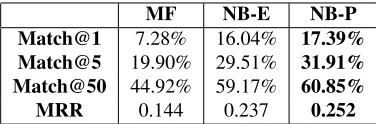
For comparison we use the Most Frequent (MF) baseline and the Na¨ıve Bayes with empirical prior (NB-E) which doesn’t use any temporal forecasting information. Because there are more than 1000 pos-sible classes we show the accuracy of the correct hashtag being amongst the top 1,5 or 50 hashtags as well as the Mean Reciprocal Rank (MRR). The results are shown in Table 6.
The results show that incorporating the forecasted values as a more informative prior for classification we obtain better predictions. The improvements are consistent in all the Match values. Also, we high-light that a 9% improvement in the forecasting task carries over to about a 2% improvement in classifi-cation. We show a few examples in which the GP learned prior makes a difference in classification in Table 5 together with the values for both priors.
With these experiments, we highlighted that there are performance gains even with only adding a more informative prior that uses periodicity information. This motivates future work to add this information to discriminative classifiers thus avoiding the need
MF NB-E NB-P
Match@1 7.28% 16.04% 17.39%
Match@5 19.90% 29.51% 31.91%
Match@50 44.92% 59.17% 60.85%
[image:10.612.332.520.186.248.2]MRR 0.144 0.237 0.252
Table 6: Results for hashtag classification.
for the Na¨ıve Bayes decomposition. The modelling framework offered by the GPs can accommodate classification, although scaling issues arise when us-ing a large number of features or output classes. Ef-forts to scale GPs to a large number of variables are well understood (Candela and Rasmussen, 2005) and we will try to incorporate this in future work.
7 Conclusion
Periodicities play an important role when analysing the temporal dimension of text. We have presented a framework based on Gaussian Process regression for identifying periodic patterns and their parame-ters using only training data. We divided the periodic patterns into 2 categories: oscillating and periodic bursts by performing model selection using bayesian evidence. The periodicities we have discovered have proven useful in an NLP classification task.
In future work, we aim to model time continu-ously and to perform discriminative clustering in or-der to make better use of the learned periodicites. We will consider incorporating periodicities in other applications, such as topic models.
Acknowledgements
References
David Blei and John Lafferty. 2006. Dynamic topic models. InProceedings of the 23rd International con-ference on Machine learning, ICML ’06.
Joaquin Qui˜nonero Candela and Carl Edward Ras-mussen. 2005. A Unifying View of Sparse Approx-imate Gaussian Process Regression. Journal of Ma-chine Learning Research (JMLR), 6:1939–1959, De-cember.
Trevor Cohn and Lucia Specia. 2013. Modelling An-notator Bias with Multi-task Gaussian Processes: An Application to Machine Translation Quality Estima-tion. InProceedings of the Association of Computa-tional Linguistics, ACL ’13.
Nicolas Durrande, James Hensman, Magnus Rattray, and Neil Lawrence. 2013. Gaussian Process models for periodicity detection. In Submitted to JRSSb, http://arxiv.org/abs/1303.7090.
David Duvenaud, James Robert Lloyd, Roger Grosse, Joshua B. Tenenbaum, and Zoubin Ghahramani. 2013. Structure discovery in nonparametric regression through compositional kernel search. InProceedings of the International Conference on Machine Learning, ICML ’13.
Mehmet G¨onen and Ethem Alpaydin. 2011. Multi-ple Kernel Learning Algorithms. Journal of Machine Learning Research (JMLR), 12:2211–2268, July. Thomas L. Griffiths and Mark Steyvers. 2004.
Find-ing scientific topics. Proceedings of the National Academy of Sciences of the United States of America, (Suppl 1):5228–5235, April.
Philipp Hennig, David H. Stern, Ralf Herbrich, and Thore Graepel. 2012. Kernel topic models. Journal of Ma-chine Learning Research (JMLR) - Proceedings Track, 22:511–519.
Jure Leskovec, Lars Backstrom, and Jon Kleinberg. 2009. Meme-tracking and the dynamics of the news cycle. InProceedings of the 15th ACM SIGKDD Inter-national conference on Knowledge discovery and data mining, KDD ’09.
Zongyang Ma, Aixin Sun, and Gao Cong. 2012. Will this #hashtag be popular tomorrow? InProceedings of the 35th International ACM SIGIR conference on Re-search and development in information retrieval, SI-GIR ’12.
Zongyang Ma, Aixin Sun, and Gao Cong. 2013. On pre-dicting the popularity of newly emerging hashtags in Twitter. Journal of the American Society for Informa-tion Science and Technology, 64(7):1399–1410. Allie Mazzia and James Juett. 2011.
Sug-gesting hashtags on Twitter. In http://www-personal.umich.edu/ amazzia/pubs/545-final.pdf.
James McInerney, Alex Rogers, and Nicholas R Jennings. 2013. Learning periodic human behaviour models from sparse data for crowdsourcing aid delivery in developing countries. InProceedings of the Twenty-Ninth Conference on Uncertainty in Artificial Intelli-gence, UAI ’13.
Tamara Polajnar, Simon Rogers, and Mark Girolami. 2011. Protein interaction detection in sentences via Gaussian Processes: a preliminary evaluation. In-ternational Journal Data Mining and Bioinformatics, 5(1):52–72, February.
Daniel Preot¸iuc-Pietro and Trevor Cohn. 2013. Mining User Behaviours: A Study of Check-in Patterns in Lo-cation Based Social Networks. InProceedings of the ACM Web Science Conference, Web Science ’13. Daniel Preot¸iuc-Pietro, Sina Samangooei, Trevor Cohn,
Nicholas Gibbins, and Mahesan Niranjan. 2012. Trendminer: An architecture for real time analysis of social media text. Proceedings of the Sixth Interna-tional AAAI Conference on Weblogs and Social Media, Workshop on Real-Time Analysis and Mining of Social Streams.
Carl Edward Rasmussen and Zoubin Ghahramani. 2000. Occam’s razor. In Advances in Neural Information Processing Systems, NIPS 13.
Carl Edward Rasmussen and Christopher K. I. Williams. 2005. Gaussian Processes for Machine Learning. MIT Press.
Daniel M. Romero, Brendan Meeder, and Jon Klein-berg. 2011. Differences in the mechanics of informa-tion diffusion across topics: idioms, political hashtags, and complex contagion on Twitter. InProceedings of the 20th International conference on World wide web, WWW ’11.
Kashif Shah, Trevor Cohn, and Lucia Specia. 2013. An Investigation on the Effectiveness of Features for Translation Quality Estimation. InMT Summit ’13. Oren Tsur and Ari Rappoport. 2012. What’s in a
hash-tag? Content based prediction of the spread of ideas in microblogging communities. InProceedings of the fifth ACM International conference on Web search and data mining, WSDM ’12.
Xuerui Wang and Andrew McCallum. 2006. Topics over time: a non-Markov continuous-time model of topi-cal trends. InProceedings of the 12th ACM SIGKDD International conference on Knowledge discovery and data mining, KDD ’06.
Chong Wang, David M. Blei, and David Heckerman. 2008. Continuous time Dynamic topic models. In
Proceedings of the Twenty-Fourth Conference on Un-certainty in Artificial Intelligence, UAI ’08.
dis-covery and extrapolation. InProceedings of the Inter-national Conference on Machine Learning, ICML ’13. Jaewon Yang and Jure Leskovec. 2011. Patterns of tem-poral variation in online media. InProceedings of the fourth ACM International conference on Web search and data mining, WSDM ’11.
Lei Yang, Tao Sun, Ming Zhang, and Qiaozhu Mei. 2012. We know what @you #tag: does the dual role affect hashtag adoption? InProceedings of the 21st Interna-tional conference on World Wide Web, WWW ’12. Dani Yogatama, Michael Heilman, Brendan O’Connor,
Chris Dyer, Bryan R. Routledge, and Noah A. Smith. 2011. Predicting a scientific community’s response to an article. In Proceedings of the Conference on Empirical Methods in Natural Language Processing, EMNLP ’11.

![Figure 2: Behaviour of the PS kernel (p=50) with varyings. Values normalized in [0,1] interval.](https://thumb-us.123doks.com/thumbv2/123dok_us/1368254.670031/4.612.322.534.59.216/figure-behaviour-ps-kernel-varyings-values-normalized-interval.webp)