Using Encyclopedic Knowledge for Automatic Topic Identification
Kino Coursey
University of North Texas and Daxtron Laboratories, Inc. [email protected]
Rada Mihalcea and William Moen
University of North Texas rada,[email protected]
Abstract
This paper presents a method for automatic topic identification using an encyclopedic
graph derived from Wikipedia. The
sys-tem is found to exceed the performance of previously proposed machine learning algo-rithms for topic identification, with an annota-tion consistency comparable to human anno-tations.
1 Introduction
With exponentially increasing amounts of text be-ing generated, it is important to find methods that can annotate and organize documents in meaning-ful ways. In addition to the content of the document itself, other relevant information about a document such as related topics can often enable a faster and more effective search or classification. Document topics have been used for a long time by librarians to improve the retrieval of a document, and to provide background or associated information for browsing by human users. They can also assist search, back-ground information gathering and contextualization tasks, and enhanced relevancy measures.
The goal of the work described in this paper is to automatically find topics that are relevant to an input document. We refer to this task as “topic identifica-tion” (Medelyan and Witten, 2008). For instance, starting with a document on “United States in the Cold War,” we want to identify relevant topics such as “history,” “Global Conflicts,” “Soviet Union,” and so forth. We propose an unsupervised method for topic identification, based on a biased graph cen-trality algorithm applied to a large knowledge graph built from Wikipedia.
The task of topic identification goes beyond key-word extraction (Mihalcea and Csomai, 2007), since
relevant topics may not be necessarily mentioned in the document, and instead have to be obtained from some repositories of external knowledge. The task is also different from text classification (Gabrilovich and Markovitch, 2006), since the topics are either not known in advance or are provided in the form of a controlled vocabulary with thousands of entries, and thus no classification can be performed. In-stead, with topic identification, we aim to find topics (or categories1) that are relevant to the document at hand, which can be used to enrich the content of the document with relevant external knowledge.
2 Dynamic Ranking of Topic Relevance
Our method is based on the premise that external encyclopedic knowledge can be used to identify rel-evant topics for a given document.
The method consists of two main steps. In the first step, we build a knowledge graph of encyclopedic concepts based on Wikipedia, where the nodes in the graph are represented by the entities and categories that are defined in this encyclopedia. The edges be-tween the nodes are represented by their relation of proximity inside the Wikipedia articles. The graph is built once and then it is stored offline, so that it can be efficiently use for the identification of topics in new documents.
In the second step, for each input document, we first identify the important encyclopedic concepts in the text, and thus create links between the content of the document and the external encyclopedic graph. Next, we run a biased graph centrality algorithm on the entire graph, so that all the nodes in the exter-nal knowledge repository are ranked based on their relevance to the input document. We use a variation
of the PageRank (Brin and Page, 1998) algorithm, which accounts for both the relation between the nodes in the document and the encyclopedic graph, as well as the relation between the nodes in the en-cyclopedic graph itself.
In the following, we first describe the structure of Wikipedia, followed by a brief description of the Wikify! system that automatically identifies the en-cyclopedic concepts in a text, and finally a descrip-tion of the dynamic ranking process on the encyclo-pedic graph.
2.1 Wikipedia
Wikipedia (http://wikipedia.org) is a free online en-cyclopedia, representing the outcome of a continu-ous collaborative effort of a large number of vol-unteer contributors. Virtually any Internet user can create or edit a Wikipedia webpage, and this “free-dom of contribution” has a positive impact on both the quantity (fast-growing number of articles) and the quality (potential mistakes are quickly corrected within the collaborative environment) of this re-source.
Wikipedia has grown to become one of the largest online repositories of encyclopedic knowledge, with millions of articles available for a large number of languages. In fact, Wikipedia editions are available for more than 250 languages, with a number of en-tries varying from a few pages to close to three mil-lion articles per language.
The basic entry in Wikipedia is an article (or
page), which defines an entity or an event, and
con-sists of a hypertext document with hyperlinks to other pages within or outside Wikipedia. The role of the hyperlinks is to guide the reader to pages that provide additional information about the enti-ties or events mentioned in an article. Each article in Wikipedia is uniquely referenced by an identifier, which consists of one or more words separated by spaces or underscores, and occasionally a parenthet-ical explanation. The current version of the English Wikipedia consists of about 2.75 million articles.
[image:2.612.326.526.61.245.2]In addition to articles, Wikipedia also includes a large number of categories, which represent topics that are relevant to a given article (the July 2008 ver-sion of Wikipedia includes about 390,000 such cate-gories). The category links are organized hierarchi-cally, and vary from broad topics such as “history” or “games” to highly focused topics such as “mili-tary history of South Africa during World War II” or
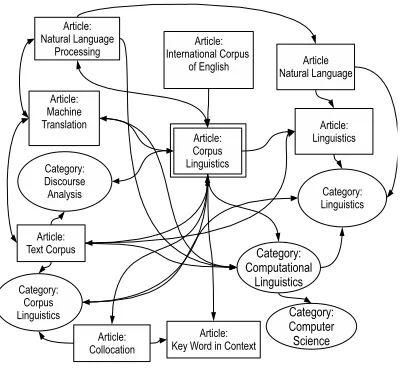
Figure 1: A snapshot from the encyclopedic graph.
“role-playing game publishing companies.”
We use the entire English Wikipedia to build an encyclopedic graph for use in the topic identifica-tion process. The nodes in the graph are represented by all the article and category pages in Wikipedia, and the edges between the nodes are represented by their relation of proximity inside the articles. The graph contains 5.8 million nodes, and 65.5 million edges. Figure 1 shows a small section of the knowl-edge graph, as built starting with the article on “Cor-pus Linguistics”.
2.2 Wikify!
In order to automatically identify the important en-cyclopedic concepts in an input text, we use the un-supervised system Wikify! (Mihalcea and Csomai, 2007), which identifies the concepts in the text that are likely to be highly relevant (i.e., “keywords”) for the input document, and links them to Wikipedia concepts.
Wikify! works in three steps, namely: (1) candi-date extraction, (2) keyword ranking, and (3) word sense disambiguation. The candidate extraction step parses the input document and extracts all the pos-sible n-grams that are also present in the vocabulary used in the encyclopedic graph (i.e., anchor texts for links inside Wikipedia or article or category titles).
document, by counting the number of documents where the term was already selected as a keyword
count(Dkey) divided by the total number of docu-ments where the term appearedcount(DW). These counts are collected from all the Wikipedia articles.
P(keyword|W)≈ count(Dkey) count(DW)
(1)
This probability can be interpreted as “the more often a term was selected as a keyword among its total number of occurrences, the more likely it is that it will be selected again.”
Finally, a simple word sense disambiguation method is applied, which identifies the most likely article in Wikipedia to which a concept should be linked to. This step is trivial for words or phrases that have only one corresponding article in Wikipedia, but it requires an explicit disambiguation step for those words or phrases that have multiple meanings (e.g., “plant”) and thus multiple candidate pages to link to. The algorithm is based on statistical methods that identify the frequency of meanings in text, combined with symbolic methods that attempt to maximize the overlap between the current docu-ment and the candidate Wikipedia articles. See (Mi-halcea and Csomai, 2007) for more details.
2.3 Biased Ranking of the Wikipedia Graph
Starting with the graph of encyclopedic knowledge, and knowing the nodes that belong to the input doc-ument, we want to rank all the nodes in the graph so that we obtain a score that indicates their impor-tance relative to the given document. We can do this by using a graph-ranking algorithm biased toward the nodes belonging to the input document.
Graph-based ranking algorithms such as PageR-ank are a way of deciding the importance of a vertex within a graph, based on global information recur-sively drawn from the entire graph. One formula-tion is in terms of a random walk through a directed graph. A “random surfer” visits nodes of the graph, and has some probability of jumping to some other random node of the graph, and the remaining proba-bility of continuing their walk from the current node to one in its outdegree list. The rank of a node is an indication of the probability that the surfer would be found at that node at any given time.
Formally, letG= (V, E)be a directed graph with the set of verticesV and set of edgesE, whereEis a subset ofV ×V. For a given vertexVi, letIn(Vi) be the set of vertices that point to it (predecessors),
and letOut(Vi) be the set of vertices that vertexVi points to (successors). The score of a vertex Vi is defined as follows (Brin and Page, 1998):
S(Vi) = (1−d) +d∗ X
j∈In(Vi)
1
|Out(Vj)|
S(Vj) (2)
where d is a damping factor usually set to 0.85. Given the ”random surfer” interpretation of the ranking process, the(1−d) portion represents the probability that a surfer will jump to a given node from any other node at random, and the summation portion indicates that the process will enter the node via edges directly connected to it.
We introduce a bias in this graph-based rank-ing algorithm by extendrank-ing the framework of per-sonalization of PageRank proposed by (Haveliwala, 2002). We modify the formula so that the (1−d)
component also accounts for the importance of the concepts found in the input document, and it is sup-pressed for all the nodes that are not found in the input document.
S(Vi) = (1−d)∗Bias(Vi)+d∗ X
j∈In(Vi)
1
|Out(Vj)|
S(Vj)
(3)
whereBias(Vi)is only defined for those nodes ini-tially identified in the input document:
Bias(Vi) = Pf(Vi)
j∈InitalN odeSet
f(Vj)
and 0 for all other nodes in the graph.
InitalN odeSet is the set of nodes belonging to the input document.
Note thatf(Vi)can vary in complexity from a de-fault value of 1 to a complex knowledge-based es-timation. In our implementation, we use a combi-nation of the “keyphraseness” score assigned to the node Vi and its distance from the “Fundamental” category in Wikipedia.
3 Illustration
To illustrate the ranking process, consider as an ex-ample the following sentence “The United States was involved in the Cold War.”
First the text is passed through the Wikify! sys-tem, which returns the articles “United States” and “Cold War.” Taking into account their “keyphrase-ness” as calculated by Wikify!, the selections are given an initial bias of 0.5492 (“United States”) and 0.4508 (“Cold War”).
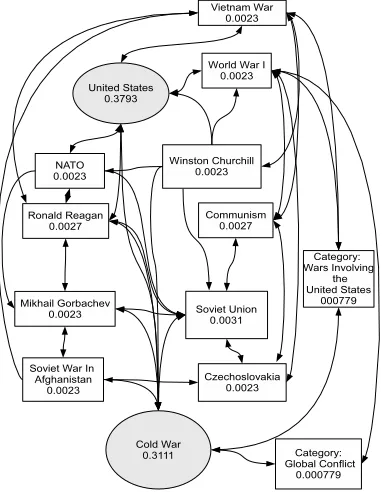
After the first iteration the initial activation spreads out into the encyclopedic graph, the nodes find a direct connection to one another, and cor-respondingly their scores are changed to 0.3786 (“United States”) and 0.3107 (“Cold War”). After the second iteration, new nodes are identified from the encyclopedic graph, a subset of which is shown in Figure2. The process will eventually continue for several iterations until the scores of the nodes do not change. The nodes with the highest scores in the final graph are considered to be the most closely re-lated to the input sentence, and thus selected as rel-evant topics.
Figure 2: Sub-graph between ”United States” and ”Cold War”
In order to see the effect of the initial bias, con-sider as an example the ranking of the nodes in the encyclopedic graph when biased with the sen-tence “The United States was involved in the Cold
War,” versus the sentence “Microsoft applies Com-puter Science.” A comparison between the scores of the nodes when activated by each of these sentences is shown in Table 1.
[image:4.612.93.284.372.618.2]Wikipedia entry US/CW MS/CS Diff. A: United States 0.393636 0.006578 0.387058 C: Computer Science 0.000004 0.003576 -0.003571 A: World War II 0.007102 0.003674 0.003428 A: United Kingdom 0.005346 0.002670 0.002676 C: Microsoft 0.000001 0.001839 -0.001837 C: Cold War 0.001695 0.000006 0.001689 C: Living People 0.000835 0.002223 -0.001387 C: Mathematics 0.000029 0.001337 -0.001307 C: Computing 0.000008 0.001289 -0.001280 C: Computer Pioneers 0.000002 0.001238 -0.001235
Table 1: Node ranking differences when the encyclo-pedic graph is biased with different inputs: (1) “United States” and “Cold War” (US/CW) vs. (2) “Microsoft” and “Computer Science” (MS/CS). The nodes are either article pages (A) or category pages (C).
4 Experiments
In order to measure the effectiveness of the topic ranking process, we run three sets of experiments, aimed at measuring the relevancy of the automati-cally identified topics with respect to manually an-notated gold standard data sets.
In the first experiment, the identification of the important concepts in the input text (used to bias the topic ranking process) is performed manually, by the Wikipedia users. In the second and third experiment, the identification of these important concepts is done automatically, by the Wikify! system. In all the ex-periments, the ranking of the concepts from the en-cyclopedic graph is done automatically by using the dynamic ranking process described in Section 2.
preci-sion and recall.
4.1 Manual Annotation of the Input Text
In this first experiment, the articles in the gold stan-dard data set also include manual annotations of the important concepts in the text, i.e., the links to other Wikipedia articles as created by the Wikipedia users. Thus, in this experiment we only measure the accu-racy of the dynamic topic ranking process, without interference from the Wikify! system.
There are two main parameters that can be set dur-ing a system run. First, the set of initial nodes used as bias in the ranking can include: (1) the initial set of articles linked to by the original document (via the Wikipedia links); (2) the categories listed in the articles linked to by the original document2; and (3) both. Second, the dynamic ranking process can be run through propagation on an encyclopedic graph that includes (1) all the articles from Wikipedia; (2) all the categories from Wikipedia; or (3) all the arti-cles and the categories from Wikipedia.
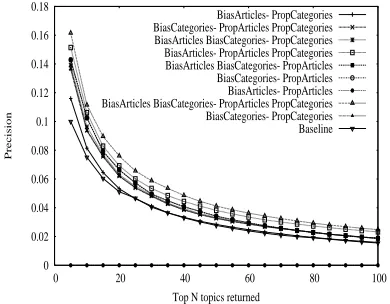
Figures 3, 4 and 5 show the precision, recall and F-measure obtained for the various settings. In the plots, BiasandP ropagate indicate the selections made for the two parameters, which can be each set to Articles, Categories, or Both. Each of these correspond to the options listed before.
0 0.02 0.04 0.06 0.08 0.1 0.12 0.14 0.16 0.18
0 20 40 60 80 100
Precision
Top N topics returned
[image:5.612.316.507.59.213.2]BiasArticles- PropCategories BiasCategories- PropArticles PropCategories BiasArticles BiasCategories- PropCategories BiasArticles- PropArticles PropCategories BiasArticles BiasCategories- PropArticles BiasCategories- PropArticles BiasArticles- PropArticles BiasArticles BiasCategories- PropArticles PropCategories BiasCategories- PropCategories Baseline
Figure 3: Precision for manual input text annotations.
As seen in the figures, the best results are obtained for a setting where both the initial bias and the prop-agation include all the available nodes, i.e., both ar-ticles and categories. Although the primary task is
2
These should not be confused with the categories included in the document itself, which represent the gold standard anno-tations and are not used at any point.
0 0.05 0.1 0.15 0.2 0.25 0.3 0.35 0.4 0.45 0.5
0 20 40 60 80 100
Recall
Top N topics returned
[image:5.612.317.509.247.399.2]BiasArticles- PropCategories BiasCategories- PropArticles PropCategories BiasArticles BiasCategories- PropCategories BiasArticles- PropArticles PropCategories BiasArticles BiasCategories- PropArticles BiasCategories- PropArticles BiasArticles- PropArticles BiasArticles BiasCategories- PropArticles PropCategories BiasCategories- PropCategories Baseline
Figure 4: Recall for manual input text annotations.
0 0.02 0.04 0.06 0.08 0.1 0.12 0.14 0.16 0.18
0 20 40 60 80 100
F-Measure
Top N topics returned
BiasArticles- PropCategories BiasCategories- PropArticles PropCategories BiasArticles BiasCategories- PropCategories BiasArticles- PropArticles PropCategories BiasArticles BiasCategories- PropArticles BiasCategories- PropArticles BiasArticles- PropArticles BiasArticles BiasCategories- PropArticles PropCategories BiasCategories- PropCategories Baseline
Figure 5: F-measure when using Wikipedia article anno-tations.
the identification of the categories, the addition of the article links improves the system performance.
To place results in perspective, we also calculate a baseline (labeled as “Baseline” in the plots), which selects by default all the categories listed in the arti-cles linked to by the original document. Each base-line article assigns 1/N to each of its N possible categories, with categories pointed to by multiple ar-ticles receiving the summation.
4.2 Automatic Annotation of the Input Text
[image:5.612.73.268.427.579.2]an additional parameter, which consists of the per-centage of links selected by Wikify! out of the total number of words in the document. We refer to this parameter as keyRatio. The higher the keyRatio, the more terms are added, but also the higher the poten-tial of noise due to mis-disambiguation.
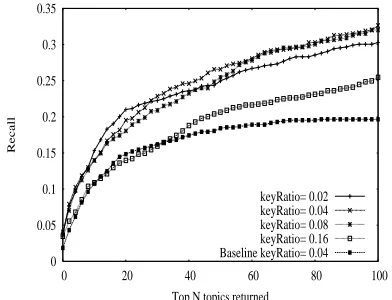
Figures 6, 7 and 8 show the effect of varying the value of the keyRatio parameter used by Wikify! has on the precision, recall and F-measure of the system. Note that in this experiment, we only use the best setting for the other two parameters as identified in the previous experiment, namely an initial bias and a propagation step that include all available nodes, i.e., both articles and categories.
0 0.05 0.1 0.15 0.2 0.25
0 20 40 60 80 100
Precision
[image:6.612.317.506.60.209.2]Top N topics returned keyRatio= 0.02 keyRatio= 0.04 keyRatio= 0.08 keyRatio= 0.16 Baseline keyRatio= 0.04
Figure 6: Precision for automatic input text annotations (Wikipedia data set)
0 0.05 0.1 0.15 0.2 0.25 0.3 0.35
0 20 40 60 80 100
Recall
Top N topics returned keyRatio= 0.02 keyRatio= 0.04 keyRatio= 0.08 keyRatio= 0.16 Baseline keyRatio= 0.04
Figure 7: Recall for automatic input text annotations (Wikipedia data set)
The system’s best performance occurs for a keyRatio of 0.04 to 0.06, which coincides with the ratio found optimal in previous experiments using the Wikify! system (Mihalcea and Csomai, 2007).
0.01 0.02 0.03 0.04 0.05 0.06 0.07 0.08 0.09 0.1 0.11
0 20 40 60 80 100
F-Measure
[image:6.612.74.270.253.404.2]Top N topics returned keyRatio= 0.02 keyRatio= 0.04 keyRatio= 0.08 keyRatio= 0.16 Baseline keyRatio= 0.04
Figure 8: F-measure for automatic input text annotations (Wikipedia data set)
As before, we also calculate a baseline, which se-lects by default all the categories listed in the articles linked to by the original document, with the links being automatically identified with the Wikify! sys-tem. The baseline is calculated for a keyRatio of 0.04, which is one of the values that were found to work well for the ranking system itself and in previ-ous Wikify! experiments.
Overall, the system manages to find many relevant topics for the documents in the evaluation data set, despite the large number of candidate topics (close to 390,000). Our system exceeds the baseline by a large margin, demonstrating the usefulness of using the biased ranking on the encyclopedic graph.
4.3 Article Selection for Computer Science Texts
In the third experiment, we use again the Wikify! system to annotate the input documents, but this time we run the evaluations on a data set consist-ing of computer science documents. We use the data set introduced in previous work on topic identifica-tion (Medelyan and Witten, 2008), where 20 doc-uments in the field of computer science were inde-pendently annotated by 15 teams of two computer science undergraduates. The teams were asked to read the texts and assign to each of them the title of the five Wikipedia articles they thought were the most relevant and the other groups would also se-lect. Thus, the consistency of the annotations was an important measure for this data set. (Medelyan and Witten, 2008) define consistency as a measure of agreement:
Consistency= 2C
[image:6.612.72.268.462.612.2]where A and B are the number of terms assigned by two indexing teams, and C is the number of terms they have in common. In the annotations ex-periments reported in (Medelyan and Witten, 2008), the human teams consistency ranged from 21.4% to 37.1%, with 30.5% being the average.3
0 0.1 0.2 0.3 0.4 0.5 0.6 0.7 0.8 0.9
0 20 40 60 80 100
Precision
Top N topics returned
[image:7.612.318.521.57.225.2]keyRatio= 0.02 keyRatio= 0.04 keyRatio= 0.08 keyRatio= 0.16 Baseline keyRatio= 0.04
Figure 9: Precision for automatic input text annotations (Waikato data set)
0 0.05 0.1 0.15 0.2 0.25 0.3 0.35 0.4 0.45
0 20 40 60 80 100
Recall
[image:7.612.74.282.152.316.2]Top N topics returned keyRatio= 0.02 keyRatio= 0.04 keyRatio= 0.08 keyRatio= 0.16 Baseline keyRatio= 0.04
Figure 10: Recall for automatic input text annotations (Waikato data set)
Figures 10, 9, 11 and 12 show the performance of our system on this data set, by using the Wikify! annotations for the initial bias, and then propagat-ing to both articles and categories. The plots also show a baseline that selects all the articles automat-ically identified in the original document by using the Wikify! system with a keyRatio set to 0.04.
3The consistency for one team is measured as the average of the consistencies with the remaining 14 teams.
0 0.05 0.1 0.15 0.2 0.25 0.3
0 20 40 60 80 100
F-Measure
Top N topics returned keyRatio= 0.02 keyRatio= 0.04 keyRatio= 0.08 keyRatio= 0.16 Baseline keyRatio= 0.04
Figure 11: F-measure for automatic input text annota-tions (Waikato data set)
0 0.1 0.2 0.3 0.4 0.5 0.6 0.7
0 20 40 60 80 100
Consistency
Top N topics returned
[image:7.612.319.521.272.436.2]keyRatio= 0.02 keyRatio= 0.04 keyRatio= 0.08 keyRatio= 0.16 Baseline keyRatio= 0.04
Figure 12: Consistency for automatic input text annota-tions (Waikato data set)
When selecting the top five topics returned by our system (the same number of topics as provided by the human teams), the average consistency with re-spect to the 15 human teams was measured at 34.5%, placing it between the 86% and 93% percentile of the human participants, with only two human teams doing better. We can compare this result with the one reported in previous work for the same data set. Using a machine learning system, (Medelyan and Witten, 2008) reported a consistency of 30.5%. Thus, our result of 34.5% is significantly better, de-spite the fact that our method is unsupervised.
[image:7.612.73.283.375.540.2]con-sistency of 66.6% for the top 25 topics returned. The system has the ability to identify possible rele-vant alternative topics using the comprehensive cata-log of Wikipedia computer science articles and their possible associations. A human team may not nec-essarily consider all of the possibilities or even be aware that some of the articles, possibly known and used by the other teams, exist.
5 Related Work
The work closest to ours is perhaps the one de-scribed in (Medelyan and Witten, 2008), where top-ics relevant to a given document are automatically selected by using a machine learning system. Unlike our unsupervised approach, (Medelyan and Witten, 2008) learn what makes a good topic by training on previously annotated data.
Also related is the Wikify! system concerned with the automatic annotation of documents with Wikipedia links (Mihalcea and Csomai, 2007). However, Wikify! is purely extractive, and thus it cannot identify important topics or articles that are not explicitly mentioned in the input text.
Explicit semantic analysis (Gabrilovich and Markovitch, 2006) was also introduced as a way to determine the relevancy of the Wikipedia articles with respect to a given input text. The resulting vector however is extremely large, and while it was found useful for the task of text classification with a relatively small number of categories, it would be difficult to adapt for topic identification when the number of possible topics grows beyond the approx-imately 390,000 under consideration. In a similar line of work, (Bodo et al., 2007) examined the use of Wikipedia and latent semantic analysis for the purposes of text categorization, but reported nega-tive results when used for the categorization of the Reuters-21578 dataset.
Others are exploring the use of graph propagation for deriving semantic information. (Hughes and Ra-mage, 2007) described the use of a biased PageRank over the WordNet graph to compute word pair se-mantic relatedness using the divergence of the prob-ability values over the graph created by each word. (Ollivier and Senellart, 2007) describes a method to determine related Wikipedia article using a Markov chain derived value called the green measure. Dif-ferences exist between the PageRank based meth-ods used as a baseline in their work and the method proposed here, since our system can use the content
of the article, multiple starting points, and tighter control of the random jump probability via the bias value. Finally, (Syed et al., 2008) reported positive results by using various methods for topic prediction including the use of text similarity and spreading ac-tivation. The method was tested by using randomly selected Wikipedia articles, where in addition to the categories listed on a Wikipedia page, nearby sub-suming categories were also included as acceptable.
6 Conclusions and Future Work
In this paper, we introduced a system for automatic topic identification, which relies on a biased graph centrality algorithm applied on a richly intercon-nected encyclopedic graph built from Wikipedia. Experiments showed that the integration of ency-clopedic knowledge consistently adds useful infor-mation when compared to baselines that rely exclu-sively on the text at hand. In particular, when tested on a data set consisting of documents manually an-notated with categories by Wikipedia users, the top-ics identified by our system were found useful as compared to the manual annotations. Moreover, in a second evaluation on a computer science data set, the system exceeded the performance of previously proposed machine learning algorithms, which is re-markable given the fact that our system is unsuper-vised. In terms of consistency with manual anno-tations, our system’s performance was found to be comparable to human annotations, with only two out of 15 teams scoring better than our system.
The system provides a means to generate a dy-namic ranking of topics in Wikipedia within a framework that has the potential to utilize knowl-edge or heuristics through additional resources (like ontologies) converted to graph form. This capabil-ity is not present in resources like search engines that provide access to a static ranking of Wikipedia. Future work will examine the integration of addi-tional knowledge sources and the application of the method for metadata document annotations.
Acknowledgments
References
Z. Bodo, Z. Minier, and L. Csato. 2007. Text categoriza-tion experiments using Wikipedia. In Proceedings of
the International Conference on Knowledge Engineer-ing ,Principles and Techniques, Cluj-Napoca
(Roma-nia).
S. Brin and L. Page. 1998. The anatomy of a large-scale hypertextual Web search engine. Computer Networks
and ISDN Systems, 30(1–7).
E. Gabrilovich and S. Markovitch. 2006. Overcoming the brittleness bottleneck using Wikipedia: Enhancing text categorization with encyclopedic knowledge. In
Proceedings of the National Conference on Artificial Intelligence (AAAI), Boston.
T. Haveliwala. 2002. Topic-sensitive PageRank. In
Proceedings of the Eleventh International World Wide Web Conference, May.
T. Hughes and D. Ramage. 2007. Lexical semantic
knowledge with random graph walks. In Proceedings
of the Conference on Empirical Methods in Natural Language Processing, Prague, Czech Republic.
O. Medelyan and I. H. Witten. 2008. Topic indexing with Wikipedia. In Proceedings of the AAAI WikiAI
workshop.
R. Mihalcea and A. Csomai. 2007. Wikify!: linking doc-uments to encyclopedic knowledge. In Proceedings
of the Sixteenth ACM Conference on Information and Knowledge Management, Lisbon, Portugal.
Y. Ollivier and P. Senellart. 2007. Finding related pages using green measures: An illustration with wikipedia. In Association for the Advancement of Artificial
In-telligence Conference on Artificial InIn-telligence (AAAI 2007).
Z. Syed, T. Finin, and A. Joshi. 2008. Wikipedia as an Ontology for Describing Documents. In Proceedings