Dependency trees and the strong generative capacity of CCG
Alexander Koller Saarland University Saarbrücken, Germany [email protected]
Marco Kuhlmann Uppsala University Uppsala, Sweden
Abstract
We propose a novel algorithm for extract-ing dependencies from the derivations of a large fragment of CCG. Unlike earlier proposals, our dependency structures are always tree-shaped. We then use these de-pendency trees to compare the strong gen-erative capacities of CCG and TAG and obtain surprising results: Both formalisms generate the same languages of derivation trees – but the mechanisms they use to bring the words in these trees into a linear order are incomparable.
1 Introduction
Combinatory Categorial Grammar (CCG; Steed-man (2001)) is an increasingly popular grammar formalism. Next to being theoretically well-mo-tivated due to its links to combinatory logic and categorial grammar, it is distinguished by the avail-ability of efficient open-source parsers (Clark and Curran, 2007), annotated corpora (Hockenmaier and Steedman, 2007; Hockenmaier, 2006), and mechanisms for wide-coverage semantic construc-tion (Bos et al., 2004).
However, there are limits to our understanding of the formal properties of CCG and its relation to other grammar formalisms. In particular, while it is well-known that CCG belongs to a family of mildly context-sensitive formalisms that all gener-ate the same string languages (Vijay-Shanker and Weir, 1994), there are few results about thestrong generative capacity of CCG. This makes it difficult to gauge the similarities and differences between CCG and other formalisms in how they model lin-guistic phenomena such as scrambling and relat-ive clauses (Hockenmaier and Young, 2008), and hampers the transfer of algorithms from one form-alism to another.
In this paper, we propose a new method for deriv-ing a dependency tree from a CCG derivation tree
for PF-CCG, a large fragment of CCG. We then explore the strong generative capacity of PF-CCG in terms of dependency trees. In particular, we cast new light on the relationship between CCG and other mildly context-sensitive formalisms such as Tree-Adjoining Grammar (TAG; Joshi and Schabes (1997)) and Linear Context-Free Rewrite Systems (LCFRS; Vijay-Shanker et al. (1987)). We show that if we only look at valencies and ignore word order, then the dependency trees induced by a PF-CCG grammar form a regular tree language, just as for TAG and LCFRS. To our knowledge, this is the first time that the regularity of CCG’s deriva-tional structures has been exposed. However, if we take the word order into account, then the classes of PF-CCG-induced and TAG-induced dependency trees are incomparable; in particular, CCG-induced dependency trees can be unboundedly non-project-ive in a way that TAG-induced dependency trees cannot.
The fact that all our dependency structures are treesbrings our approach in line with the emerging mainstream in dependency parsing (McDonald et al., 2005; Nivre et al., 2007) and TAG derivation trees. The price we pay for restricting ourselves to trees is that we derive fewer dependencies than the more powerful approach by Clark et al. (2002). In-deed, we do not claim that our dependencies are lin-guistically meaningful beyond recording the way in which syntactic valencies are filled. However, we show that our dependency trees are still informative enough to reconstruct the semantic representations.
mer np:we0 L
em Hans np:Hans0 L
es huus np:house0 L
hälfed
((s\np)\np)/vp:help0 L
aastriche vp\np:paint0 L
((s\np)\np)\np:λx.help0(paint0(x)) F (s\np)\np:help0(paint0(house0)) B
[image:2.595.101.495.63.149.2]s\np:help0(paint0(house0))Hans0 B s:help0 (paint0(house0))Hans0we0 B
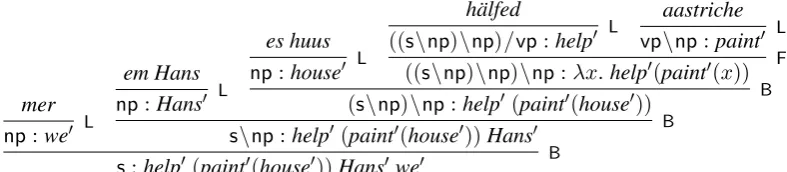
Figure 1: A PF-CCG derivation
2 Combinatory Categorial Grammars
We start by introducing the Combinatory Categorial Grammar (CCG) formalism. Then we introduce the fragment of CCG that we consider in this paper, and discuss some related work.
2.1 CCG
Combinatory Categorial Grammar (Steedman, 2001) is a grammar formalism that assigns categor-iesto substrings of an input sentence. There are atomiccategories such assandnp; and ifAandB
are categories, thenA\BandA/Barefunctional categories representing a constituent that will have categoryAonce it is combined with another con-stituent of typeBto the left or right, respectively. Each word is assigned a category by the lexicon; adjacent substrings can then be combined by com-binatory rules. As an example, Steedman and Bald-ridge’s (2009) analysis of Shieber’s (1985) Swiss German subordinate clause(das) mer em Hans es huus hälfed aastriiche(‘(that) we help Hans paint the house’) is shown in Figure 1.
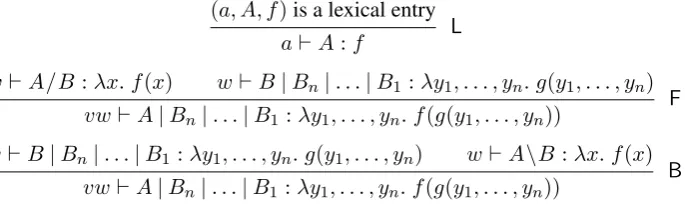
Intuitively, the arguments of a functional cat-egory can be thought of as the syntactic valencies of the lexicon entry, or as arguments of a func-tion that maps categories to categories. The core combinatory mechanism underlying CCG is the composition and application of these functions. In their most general forms, the combinatory rules of (forward and backward) application and compos-ition can be written as in Figure 2. The symbol|
stands for an arbitrary (forward or backward) slash; it is understood that the slash before eachBiabove
the line is the same as below. The rules derive state-ments about triplesw`A:f, expressing that the substringwcan be assigned the categoryAand the semantic representationf; an entire string counts as grammatical if it can be assigned the start cat-egorys. In parallel to the combination of substrings by the combinatory rules, their semantic represent-ations are combined by functional composition.
We have presented the composition rules of CCG in their most general form. In the literature, the special cases for n = 0 are called forward and backwardapplication; the cases forn >0where the slash before Bn is the same as the slash
be-fore B are called composition of degree n; and the cases wheren > 0 and the slashes have dif-ferent directions are calledcrossed composition of degreen. For instance, theFapplication that com-bineshälfedandaastrichein Figure 1 is a forward crossed composition of degree 1.
2.2 PF-CCG
In addition to the composition rules introduced above, CCG also allows rules of substitution and type-raising. Substitution is used to handle syn-tactic phenomena such as parasitic gaps; type-rais-ing allows a constituent to serve syntactically as a functor, while being used semantically as an argu-ment. Furthermore, it is possible in CCG to restrict the instances of the rule schemata in Figure 2—for instance, to say that the application rule may only be used for the caseA=s. We call a CCG gram-marpureif it does not use substitution, type-raising, or restricted rule schemata. Finally, the argument categories of a CCG category may themselves be functional categories; for instance, the category of a VP modifier likepassionatelyis(s\np)\(s\np). We call a category that is either atomic or only has atomic arguments afirst-order category, and call a CCG grammarfirst-orderif all categories that its lexicon assigns to words are first-order.
(a, A, f)is a lexical entry
a`A:f L
v`A/B:λx. f(x) w`B|Bn|. . .|B1:λy1, . . . , yn. g(y1, . . . , yn)
vw`A|Bn|. . .|B1 :λy1, . . . , yn. f(g(y1, . . . , yn))
F
v`B|Bn|. . .|B1 :λy1, . . . , yn. g(y1, . . . , yn) w`A\B:λx. f(x)
vw`A|Bn|. . .|B1:λy1, . . . , yn. f(g(y1, . . . , yn))
[image:3.595.131.474.76.178.2]B
Figure 2: The generalized combinatory rules of CCG
each string. On the other hand, the restriction to first-order grammars is indeed a limitation in prac-tice. We take the work reported here as a first step towards a full dependency-tree analysis of CCG, and discuss ideas for generalization in the conclu-sion.
2.3 Related work
The main objective of this paper is the definition of a novel way in which dependency trees can be extracted from CCG derivations. This is sim-ilar to Clark et al. (2002), who aim at capturing ‘deep’ dependencies, and encode these into
annot-ated lexical categories. For instance, they write
(npi\npi)/(s\npi)for subject relative pronouns to express that the relative pronoun, the trace of the relative clause, and the modified noun phrase are all semantically the same. This means that the rel-ative pronoun has multiple parents; in general, their dependency structures are not necessarily trees. By contrast, we aim to extract only dependencytrees, and achieve this by recording only the fillers of syn-tactic valencies, rather than the semantic dependen-cies: the relative pronoun gets two dependents and one parent (the verb whose argument the modified npis), just as the category specifies. So Clark et al.’s and our dependency approach represent two alternatives of dealing with the tradeoff between simple and expressive dependency structures.
Our paper differs from the well-known results of Vijay-Shanker and Weir (1994) in that they es-tablish theweakequivalence of different grammar formalisms, while we focus on comparing the deriv-ational structures. Hockenmaier and Young (2008) present linguistic motivations for comparing the strong generative capacities of CCG and TAG, and the beginnings of a formal comparison between CCG and spinal TAG in terms of Linear Indexed Grammars.
3 Induction of dependency trees
We now explain how to extract a dependency tree from a PF-CCG derivation. The basic idea is to associate, with every step of the derivation, a cor-responding operation on dependency trees, in much the same way as derivation steps can be associated with operations on semantic representations.
3.1 Dependency trees
When talking about a dependency tree, it is usually convenient to specify its tree structure and the lin-ear order of its nodes separately. The tree structure encodes the valency structure of the sentence (im-mediate dominance), whereas the linear precedence of the words is captured by the linear order.
For the purposes of this paper, we represent a dependency treeas a paird= (t, s), wheretis a ground term over some suitable alphabet, andsis a linearization of the nodes (term addresses) oft, where by a linearization of a setSwe mean a list of elements ofSin which each element occurs exactly once (see also Kuhlmann and Möhl (2007)). As examples, consider
(f(a, b),[1, ε,2]) and (f(g(a)),[1·1, ε,1]).
These expressions represent the dependency trees
d1 =
a f b
and d2 =
a f g
.
Notice that it is because of the separate specifica-tion of the tree and the order that dependency trees can become non-projective;d2is an example.
Apartial dependency treeis a pair(t, s)wheret
e= (a, A|Am· · · |A1)is a lexical entry
a`A|Am· · · |A1:λx1, . . . , xm.(e(x1, . . . , xm),[ε]) L
v`A|Am· · · |A1/B:λx, x1, . . . , xm. d w`B|Bn· · · |B1:λy1, . . . , yn. d0
vw`A|Am· · · |A1|Bn· · · |B1:λy1, . . . , yn, x1, . . . , xm. d[x:=d0]F
F
w`B|Bn· · · |B1:λy1, . . . , yn. d0 v`A|Am· · · |A1\B :λx, x1, . . . , xm. d
wv`A|Am· · · |A1|Bn· · · |B1:λy1, . . . , yn, x1, . . . , xm. d[x:=d0]B
[image:4.595.104.496.75.178.2]B
Figure 3: Computing dependency trees in CCG derivations
3.2 Operations on dependency trees
Lettbe a term, and letxbe a variable int. The result of the substitution of the termt0intotforx
is denoted by t[x := t0]. We extend this opera-tion to dependency trees as follows. Given a list of addressess, let xsbe the list of addresses ob-tained fromsby prefixing every address with the address of the (unique) node that is labelled withx
int. Then the operations offorward and backward concatenationare defined as
(t, s)[x:= (t0, s0) ]F = (t[x:=t0], s·xs0), (t, s)[x:= (t0, s0) ]B = (t[x:=t0], xs0·s).
The concatenation operations combine two given dependency trees(t, s)and(t0, s0)into a new tree by substitutingt0 intotfor some variable xoft, and adding the (appropriately prefixed) lists0 of nodes oft0either before or after the listsof nodes oft. Using these two operations, the dependency treesd1 andd2 from above can be written as
fol-lows. Letda= (a,[ε])anddb = (b,[ε]).
d1 = (f(x, y),[ε])[x:=da]F[y:=db]F
d2 = (f(x),[ε])[x:= (g(y),[ε]) ]F[y :=da]B
Here is an alternative graphical notation for the composition ofd2:
f g y
2
6 4y:=
a 3
7 5
B
=
a f g
In this notation, nodes that are not marked with variables are positioned (indicated by the dotted projection lines), while the (dashed) variable nodes dangle unpositioned.
3.3 Dependency trees for CCG derivations
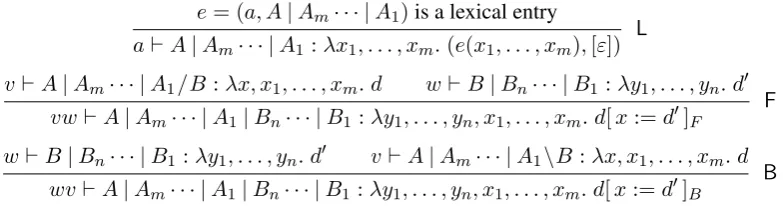
To encode CCG derivations as dependency trees, we annotate each composition rule of PF-CCG with
instructions for combining the partial dependency trees for the substrings into a partial dependency tree for the larger string. Essentially, we now com-bine partial dependency trees using forward and backward concatenation rather than combining se-mantic representations by functional composition and application. From now on, we assume that the node labels in the dependency trees are CCG lex-icon entries, and represent these by just the word in them.
The modified rules are shown in Figure 3. They derive statements about triplesw`A:p, wherew
is a substring,Ais a category, andpis a lambda expression over a partial dependency tree. Each variable ofpcorresponds to an argument category inA, and vice versa. RuleLcovers the base case: the dependency tree for a lexical entryeis a tree with one node for the item itself, labelled withe, and one node for each of its syntactic arguments, labelled with a variable. RuleFcaptures forward composition: given two dependency treesdandd0, the new dependency tree is obtained by forward concatenation, binding the outermost variable ind. RuleBis the rule for backward composition. The result of translating a complete PF-CCG derivation
δin this way is always a dependency tree without variables; we call itd(δ).
As an example, Figure 4 shows the construc-tion for the derivaconstruc-tion in Figure 1. The induced dependency tree looks like this:
mer
(mer,[ε]) L
em Hans
(Hans,[ε]) L
es huus
(huus,[ε]) L
hälfed
λx, y, z.(hälfed(x, y, z),[ε]) L
aastriiche
λw.(aastriiche(w),[ε]) L
λw, y, z.(hälfed(aastriiche(w), y, z),[ε,1]) F
λy, z.(hälfed(aastriiche(huus), y, z),[11, ε,1]) B
[image:5.595.74.535.63.152.2]λz.(hälfed(aastriiche(huus),Hans, z),[2,11, ε,1]) B (hälfed(aastriiche(huus),Hans,mer),[3,2,11, ε,1]) B
Figure 4: Computing a dependency tree for the derivation in Figure 1
variablex. This tree is inserted into the tree from hälfedby forward concatenation. The variablewis passed on into the new dependency tree, and later filled by backward concatenation tohuus. Passing the argument slot ofaastriichetohälfedto be filled on its left creates a non-projectivity; it corresponds to a crossed composition in CCG terms. Notice that the categories derived in Figure 1 mirror the functional structure of the partial dependency trees at each step of the derivation.
3.4 Semantic equivalence
The mapping from derivations to dependency trees loses some information: different derivations may induce the same dependency tree. This is illus-trated by Figure 5, which provides two possible derivations for the phrase big white rabbit, both of which induce the same dependency tree. Espe-cially in light of the fact that our dependency trees will typically contain fewer dependencies than the DAGs derived by Clark et al. (2002), one could ask whether dependency trees are an appropriate way of representing the structure of a CCG derivation.
However, at the end of the day, the most import-ant information that can be extracted from a CCG derivation is the semantic representation it com-putes; and it is possible to reconstruct the semantic representation of a derivationδfromd(δ)alone. If we forget the word order information in the depend-ency trees, the rulesFandBin Figure 3 are merely
η-expanded versions of the semantic construction rules in Figure 2. This means thatd(δ) records everything we need to know about constructing the semantic representation: We can traverse it bottom-up and apply the lexical semantic representation of each node to those of its subterms. So while the dependency trees obliterate some information in the CCG derivations (particularly its associative structure), they are indeed appropriate represent-ations because they record all syntactic valencies and encode enough information to recompute the semantics.
4 Strong generative capacity
Now that we know how to see PF-CCG derivations as dependency trees, we can ask what sets of such trees can be generated by PF-CCG grammars. This is the question about the strong generative capa-city of PF-CCG, measured in terms of dependency trees (Miller, 2000). In this section, we give a partial answer to this question: We show that the sets of PF-CCG-inducedvalency trees(dependency trees without their linear order) form regular tree languages, but that the sets of dependency trees themselves are irregular. This is in contrast to other prominent mildly context-sensitive grammar form-alisms such as Tree Adjoining Grammar (TAG; Joshi and Schabes (1997)) and Linear Context-Free Rewrite Systems (LCFRS; Vijay-Shanker et al. (1987)), in which both languages are regular.
4.1 CCG term languages
Formally, we define the language of all dependency trees generated by a PF-CCG grammarGas the set
LD(G) ={d(δ)|δis a derivation ofG}.
Furthermore, we define the set ofvalency treesto be the set of just the term parts of eachd(δ):
LV(G) ={t|(t, s)∈LD(G)}.
By our previous assumption, the node labels of a valency tree are CCG lexicon entries.
We will now show that the valency tree lan-guages of PF-CCG grammars areregular tree lan-guages(Gécseg and Steinby, 1997). Regular tree languages are sets of trees that can be generated byregular tree grammars. Formally, a regular tree grammar (RTG) is a constructΓ = (N, Σ, S, P), whereN is an alphabet of non-terminal symbols,
big np/np
white np/np np/np
rabbit np
np big white rabbit
big np/np
white np/np
[image:6.595.102.489.62.119.2]rabbit np np/np np
Figure 5: Different derivations may induce the same dependency tree
as constants. The grammarΓ generates trees from the start symbol by successively expanding occur-rences of nonterminals using production rules. For instance, the grammar that contains the productions
S → f(A, A),A → g(A), andA→ agenerates the tree language{f(gm(a), gn(a))|m, n≥0}. We now construct an RTGΓ(G)that generates the set of valency trees of a PF-CCGG. For the terminal alphabet, we choose the lexicon entries: Ife= (a, A|B1. . .|Bn, f)is a lexicon entry of
G, we takeeas ann-ary term constructor. We also take the atomic categories ofGas our nonterminal symbols; the start categorys ofG counts as the start symbol. Finally, we encode each lexicon entry as a production rule: The lexicon entry eabove encodes to the ruleA→e(Bn, . . . , B1).
Let us look at our running example to see how this works. Representing the lexicon entries as just the words for brevity, we can write the valency tree corresponding to the CCG derivation in Figure 4 ast0=hälfed(aastriiche(huus),Hans,mer); here
hälfedis a ternary constructor,aastriicheis unary, and all others are constants. Taking the lexical categories into account, we obtain the RTG with
s→hälfed(vp,np,np)
vp→aastriiche(np)
np→huus|Hans|mer
This grammar indeed generates t0, and all other
valency trees induced by the sample grammar. More generally, LV(G) ⊆ L(Γ(G)) because
the construction rules in Figure 3 ensure that if a node v becomes thei-th child of a node u in the term, then the result category of v’s lexicon entry equals thei-th argument category ofu’s lex-icon entry. This guarantees that the i-th nonter-minal child introduced by the production forucan be expanded by the production for v. The con-verse inclusion can be shown by reconstructing, for each valency treet, a CCG derivation δ that induces t. This construction can be done by ar-ranging the nodes in t into an order that allows us to combine every parent intwith its children using only forward and backward application. The
CCG derivation we obtain for the example is shown in Figure 6; it is a derivation for the sentence das mer em Hans hälfed es huus aastriiche, using the same lexicon entries. Together, this shows that
L(Γ(G)) =LV(G). Thus:
Theorem 1 The sets of valency trees generated by PF-CCG are regular tree languages. 2
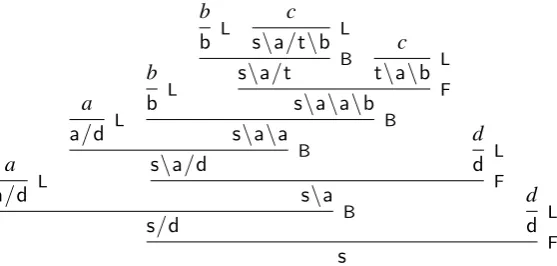
By this result, CCG falls in line with context-free grammars, TAG, and LCFRS, whose sets of deriva-tional structures are all regular (Vijay-Shanker et al., 1987). To our knowledge, this is the first time the regular structure of CCG derivations has been exposed. It is important to note that while CCG derivations themselves can be seen as trees as well, they do not always form regular tree languages (Vijay-Shanker et al., 1987). Consider for instance the CCG grammar from Vijay-Shanker and Weir’s (1994) Example 2.4, which generates the string lan-guageanbncndn; Figure 7 shows the derivation of
aabbccdd. If we follow this derivation bottom-up, starting at the firstc, the intermediate categories collect an increasingly long tail of\aarguments; for longer words from the language, this tail becomes as long as the number ofcs in the string. The in-finite set of categories this produces translates into the need for an infinite nonterminal alphabet in an RTG, which is of course not allowed.
4.2 Comparison with TAG
mer np L
em Hans np L
hälfed s\np\np/vp L
es huus np L
aastriiche vp\np L
vp B
s\np\np F
s\np B
[image:7.595.158.444.62.148.2]s B
Figure 6: CCG derivation reconstructed from the dependency tree from Figure 4 using only applications
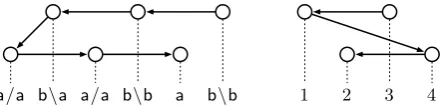
We know from the literature that those depend-ency trees that can be constructed from TAG deriva-tion trees are exactly those that are well-nested and have a block-degree of at most 2 (Kuhlmann and Möhl, 2007). The block-degree of a nodeuin a de-pendency tree is the number of ‘blocks’ into which the subtree below u is separated by intervening nodes that are not belowu, and the block-degree of a dependency tree is the maximum block-degree of its nodes. So for instance, the dependency tree on the right-hand side of Figure 8 has block-degree two. It is also well-nested, and can therefore be induced by TAG derivations.
Things are different for the dependency trees that can be induced by PF-CCG. Consider the left-hand dependency tree in Figure 8, which is induced by a PF-CCG derivation built from words with the lexical categoriesa/a, b\a, b\b, anda. While this dependency tree is well-nested, it has block-degreethree: The subtree below the leftmost node consists of three parts. More generally, we can in-sert more words with the categoriesa/aandb\b in the middle of the sentence to obtain depend-ency trees with arbitrarily high block-degrees from this grammar. This means that unlike for TAG-induced dependency trees, there is no upper bound on the block-degree of dependency trees induced by PF-CCG—as a consequence, there are CCG dependency trees that cannot be induced by TAG. On the other hand, there are also dependency trees that can be induced by TAG, but not by PF-CCG. The tree on the right-hand side of Figure 8 is an example. We have already argued that this tree can be induced by a TAG. However, it con-tains no two adjacent nodes that are connected by
a/a b\a a/a b\b a b\b 1 2 3 4
Figure 8: The divergence between CCG and TAG
an edge; and every nontrivial PF-CCG derivation must combine two adjacent words at least at one point during the derivation. Therefore, the tree cannot be induced by a PF-CCG grammar. Further-more, it is known that all dependency languages that can be generated by TAG or even, more gener-ally, by LCRFS, are regular in the sense of Kuhl-mann and Möhl (2007). One crucial property of regular dependency languages is that they have a bounded block-degree; but as we have seen, there are PF-CCG dependency languages with unboun-ded block-degree. Therefore there are PF-CCG dependency languages that are not regular. Hence: Theorem 2 The sets of dependency trees gener-ated by PF-CCG and TAG are incomparable. 2
We believe that these results will generalize to full CCG. While we have not yet worked out the induction of dependency trees from full CCG, the basic rule that CCG combines adjacent substrings should still hold; therefore, every CCG-induced dependency tree will contain at least one edge between adjacent nodes. We are thus left with a very surprising result: TAG and CCG both gener-ate the same string languages and the same sets of valency trees, but they use incomparable mechan-isms for linearizing valency trees into sentences.
4.3 A note on weak generative capacity
As a final aside, we note that the construction for extracting purely applicative derivations from the terms described by the RTG has interesting con-sequences for the weak generative capacity of PF-CCG. In particular, it has the corollary that for any PF-CCG derivationδover a stringw, there is a per-mutation ofwthat can be accepted by a PF-CCG derivation that uses only application—that is, every string languageLthat can be generated by a PF-CCG grammar has a context-free sublanguageL0
such that all words inLare permutations of words inL0.
[image:7.595.74.295.682.735.2]a a/d L
a a/d L
b b L
b b L
c s\a/t\b L s\a/t B
c t\a\b L s\a\a\b F s\a\a B s\a/d B
d d L
s\a F
s/d B
d d L
[image:8.595.161.440.62.195.2]s F
Figure 7: The CCG derivation ofaabbccddusing Example 2.4 in Vijay-Shanker and Weir (1994)
by PF-CCG. One such language isanbncndn. This language is not itself context-free, and therefore any PF-CCG grammar whose language contains it also contains permutations in which the order of the symbols is mixed up. The culprit for this among the restrictions that distinguish PF-CCG from full CCG seems to be that PF-CCG grammars must allow all instances of the application rules. This would mean that the ability of CCG to generate non-context-free languages (also linguistically relevant ones) hinges crucially on its ability to restrict the allowable instances of rule schemata, for instance, using slash types (Baldridge and Kruijff, 2003).
5 Conclusion
In this paper, we have shown how to read deriva-tions of PF-CCG as dependency trees. Unlike pre-vious proposals, our view on CCG dependencies is in line with the mainstream dependency parsing literature, which assumes tree-shaped dependency structures; while our dependency trees are less in-formative than the CCG derivations themselves, they contain sufficient information to reconstruct the semantic representation. We used our new de-pendency view to compare the strong generative capacity of PF-CCG with other mildly context-sensitive grammar formalisms. It turns out that the valency trees generated by a PF-CCG grammar form regular tree languages, as in TAG and LCFRS; however, unlike these formalisms, the sets of de-pendency trees including word order arenotregular, and in particular can be more non-projective than the other formalisms permit. Finally, we found new formal evidence for the importance of restrict-ing rule schemata for describrestrict-ing non-context-free languages in CCG.
All these results were technically restricted to the fragment of PF-CCG, and one focus of future
work will be to extend them to as large a fragment of CCG as possible. In particular, we plan to extend the lambda notation used in Figure 3 to cover type-raising and higher-order categories. We would then be set to compare the behavior of wide-coverage statistical parsers for CCG with statistical depend-ency parsers.
We anticipate that our results about the strong generative capacity of PF-CCG will be useful to transfer algorithms and linguistic insights between formalisms. For instance, the CRISP generation algorithm (Koller and Stone, 2007), while specified for TAG, could be generalized to arbitrary gram-mar formalisms that use regular tree languages— given our results, to CCG in particular. On the other hand, we find it striking that CCG and TAG generate the same string languages from the same tree languages by incomparable mechanisms for ordering the words in the tree. Indeed, the exact characterization of the class of CCG-inducable de-pendency languages is an open issue. This also has consequences for parsing complexity: We can understand why TAG and LCFRS can be parsed in polynomial time from the bounded block-degree of their dependency trees (Kuhlmann and Möhl, 2007), but CCG can be parsed in polynomial time (Vijay-Shanker and Weir, 1990) without being re-stricted in this way. This constitutes a most inter-esting avenue of future research that is opened up by our results.
References
Jason Baldridge and Geert-Jan M. Kruijff. 2003. Multi-modal Combinatory Categorial Grammar. In
Proceedings of the Tenth EACL, Budapest, Hungary.
Johan Bos, Stephen Clark, Mark Steedman, James R. Curran, and Julia Hockenmaier. 2004. Wide-coverage semantic representations from a CCG parser. InProceedings of the 20th COLING, Geneva, Switzerland.
Stephen Clark and James Curran. 2007. Wide-coverage efficient statistical parsing with CCG and log-linear models. Computational Linguistics, 33(4).
Stephen Clark, Julia Hockenmaier, and Mark Steed-man. 2002. Building deep dependency structures with a wide-coverage CCG parser. InProceedings of the 40th ACL, Philadelphia, USA.
Ferenc Gécseg and Magnus Steinby. 1997. Tree lan-guages. In Rozenberg and Salomaa (Rozenberg and Salomaa, 1997), pages 1–68.
Julia Hockenmaier and Mark Steedman. 2007. CCG-bank: a corpus of CCG derivations and dependency structures extracted from the Penn Treebank. Com-putational Linguistics, 33(3):355–396.
Julia Hockenmaier and Peter Young. 2008. Non-local scrambling: the equivalence of TAG and CCG re-visited. InProceedings of TAG+9, Tübingen, Ger-many.
Julia Hockenmaier. 2006. Creating a CCGbank and a wide-coverage CCG lexicon for German. In Pro-ceedings of COLING/ACL, Sydney, Australia.
Aravind K. Joshi and Yves Schabes. 1997. Tree-Adjoining Grammars. In Rozenberg and Salomaa (Rozenberg and Salomaa, 1997), pages 69–123.
Alexander Koller and Matthew Stone. 2007. Sentence generation as planning. InProceedings of the 45th ACL, Prague, Czech Republic.
Marco Kuhlmann and Mathias Möhl. 2007. Mildly context-sensitive dependency languages. In Pro-ceedings of the 45th ACL, Prague, Czech Republic.
Ryan McDonald, Fernando Pereira, Kiril Ribarov, and Jan Hajic. 2005. Non-projective dependency pars-ing uspars-ing spannpars-ing tree algorithms. InProceedings of HLT/EMNLP.
Philip H. Miller. 2000. Strong Generative Capacity: The Semantics of Linguistic Formalism. University of Chicago Press.
Joakim Nivre, Johan Hall, Jens Nilsson, Atanas Chanev, Gülsen Eryigit, Sandra Kübler, Svetoslav Marinov, and Erwin Marsi. 2007. MaltParser: A language-independent system for data-driven de-pendency parsing. Natural Language Engineering, 13(2):95–135.
Grzegorz Rozenberg and Arto Salomaa, editors. 1997.
Handbook of Formal Languages. Springer.
Stuart Shieber. 1985. Evidence against the context-freeness of natural language. Linguistics and Philo-sophy, 8:333–343.
Mark Steedman and Jason Baldridge. 2009. Combin-atory categorial grammar. In R. Borsley and K. Bor-jars, editors, Non-Transformational Syntax. Black-well. To appear.
Mark Steedman. 2001. The Syntactic Process. MIT Press.
K. Vijay-Shanker and David Weir. 1990. Polynomial time parsing of combinatory categorial grammars. InProceedings of the 28th ACL, Pittsburgh, USA.
K. Vijay-Shanker and David J. Weir. 1994. The equi-valence of four extensions of context-free grammars.
Mathematical Systems Theory, 27(6):511–546.