Fluency detection on communication networks
Tom Lippincott and Benjamin Van Durme Human Language Technology Center of Excellence
Johns Hopkins University
[email protected], [email protected]
Abstract
When considering a social media corpus, we often have access to structural information about how messages are flowing between peo-ple or organizations. This information is par-ticularly useful when the linguistic evidence is sparse, incomplete, or of dubious quality. In this paper we construct a simple model to leverage the structure of Twitter data to help determine the set of languages each user is flu-ent in. Our results demonstrate that imposing several intuitive constraints leads to improve-ments in performance and stability. We re-lease the first annotated data set for exploring this task, and discuss how our approach may be extended to other applications.
1 Introduction
Language identification (LID) is an important first step in many NLP pipelines since most downstream tasks need to employ language-specific resources. In many situations, LID is a trivial task that can be addressed e.g. by a simple Naive Bayes classifier trained on word and character n-gram data (Lui and Baldwin, 2012): a document of significant length will be quickly disambiguated based on its vocab-ulary (King et al., 2014). However, social media platforms like Twitter produce data sets in which individual documents are extremely short, and lan-guage use is idiosyncratic: LID performance on such data is dramatically lower than on traditional corpora (Bergsma et al., 2012; Carter et al., 2013). The widespread adoption of social media throughout the world amplifies the problem as less-studied lan-guages lack the annotated resources needed to train
the most effective NLP models (e.g. treebanks for statistical parsing, tagged corpora for part-of-speech tagging, etc). All of this motivates the research com-munity’s continued interest in LID (Zampieri et al., 2014).
Tweet #1 Êîç ýâåðèñèíã þ äó èñ ìýäæèê Tweet #2 omg favourite day of the week!
Table 1:Multilingual social media users often communicate in different languages depending on their intended audience, such as with these Russian and English tweets posted by the same Twitter account
In this paper, we consider the closely-related task of determining an actor’s fluencies, the set of lan-guages they are capable of speaking and understand-ing. The observed language data will be the same as for LID, but is now considered to indicate a latent property of the actor. This information has a num-ber of downstream uses, such as providing a strong prior on the language of the actor’s future communi-cations, constructing monolingual data sets, and rec-ommending appropriate content for display or fur-ther processing.
This paper also focuses on the situation where a very small amount of content has been observed from the particular user. While this may seem strange considering the volume of data generated by social media, this is dominated by particularly active users: for example, 30% of Twitter users post only once per month (Leetaru et al., 2013). This content-starved situation is exacerbated by certain use-cases, such as responding to emergency events where sud-den focus is directed at a particular location, or fo-cusing on new users with shallow histories.
2 Previous Work
Twitter and other social media platforms are a ma-jor area of ongoing NLP research, including dedi-cated workshops(NAA, 2015; ACL, 2014). Previ-ous work has considered macroscopic properties of the entire Twitter network (Gabielkov et al., 2014), and pondered whether it is an “information” or “so-cial” network (Myers et al., 2014). Studies have fo-cused on determining user attributes such as gender (Li et al., 2015), political allegiance (Volkova et al., 2014), brand affinity (Pennacchiotti and Popescu, 2011a), sentiment analysis (West et al., 2014), and more abstract roles (Beller et al., 2014). Such demo-graphic information is known to help downstream tasks (Hovy, 2015). Research involving social media communication networks has typically focused on homophily, the tendency of users to connect to oth-ers with similar properties (Barber´a, 2014). A num-ber of papers have employed features drawn from both the content and structure of network entities in pursuit of latent user attributes (Pennacchiotti and Popescu, 2011b; Campbell et al., 2014; Suwan et al., 2015).
3 Definitions
We refer to the entities that produce and consume communications asActors, and the communications (packets of language data) asMessages. Each mes-sage occurs in a particularLanguage, and each actor has a set ofFluencies, representing the ability to pro-duce and consume a message in a given language. We refer to a connected graph of such entities as a Communication Network. For Twitter data, mes-sages are simply associated with a single actor, who is in turn associated with other actors via the “fol-lowing” relationship, the actor’s “friends” in Twit-ter’s terminology.1 We assume each message (tweet) is written in a single language, and actors are either fluent or not in each possible language.
1Note that, confusingly, Twitter’s “friend” relationship is not symmetric: Mary’s friends are users she has decided to follow, and not necessarily vise-versa.
4 Twitter Data Set
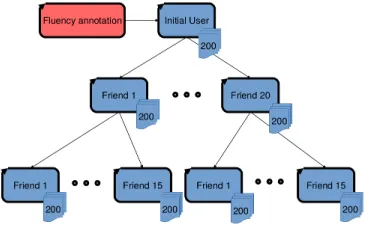
[image:2.612.315.499.467.584.2]To build a suitable data set2 for fluency detection, we first identified 1000 Twitter users who, accord-ing to the Twitter LID system, have tweeted in Rus-sian and at least one additional language. For each of these “seed” users, we gather a local context (a “snowflake”) as follows: we choose 20 of their friends at random. For each of these friends, we choose 15 of their friends (again, at random). Fi-nally, we randomly pull 200 tweets for each identi-fied user. The data set consists of 989 seed users, 165,042 friends, and 55,019,811 tweets. We pre-serve all Twitter meta-data for the users and tweets, such as location, follower count, hashtags, etc, though for the purposes of this paper we are only interested in the friendship structure and message text. We then had an annotator determine the set of languages each of the 1000 seed users is fluent in. For each seed user, the annotator was presented with their 200 tweets, grouped by Twitter language ID, and was asked to 1) flag users that appear to be bots and 2) list the languages they believe the user is fluent in. These steps are reflected in Figure 4. Over 50% (507) of the users were flagged as pos-sible bots and not used in this study. The remaining 482 were observed employing 7 different languages: Russian, Ukrainian, German, Polish, Bulgarian, Lat-vian, and English. At most, a single user was found to be fluent in three languages.
Figure 1: Structure of one snowflake in the Twitter Fluency data set.
5 Structure-Aware Fluency Model
Our goal was to explicitly model each actor’s flu-ency in different languages, using a model with sim-2The full data set is available atwww.university.edu/
ple, interpretable parameters that can be used to en-code well-motivated assumptions about the data. In particular, we want to bias the model towards the belief that actors typically speak a small number of languages, and encode the belief that all actors par-ticipating in a message are highly likely to be fluent in its language. Our basic hypothesis is that, in ad-dition to scores from traad-ditional LID modules, such a model will benefit from considering the behavior of an actor’s interlocutors. To test this, we designed a model that employs scores from an existing LID system, and compare performance with and without awareness of the communication network structure. To demonstrate the effectiveness of the model in sit-uations with sparse or unreliable linguistic content, we perform experiments where the number of mes-sages associated with each actor has been randomly down-sampled.
Linear Programming Linear Programming (LP) is a method for specifying constraints and cost func-tions in terms of linear relafunc-tionships between vari-ables, and then finding the optimal solution that re-spects the constraints. The restriction to linear equa-tions ensures that the objective function is itself lin-ear, and can be efficiently solved. If some or all variables are restricted to take discrete values, re-ferred to as (Mixed) Integer Linear Programming (ILP), finding a solution becomes NP-hard, though common special cases remain efficiently solvable. We specify our model as an ILP with the hope that it provides sufficient expressiveness for the task, while remaining intuitive and tractable. Infer-ence is performed using the Gurobi modeling toolkit (Gurobi Optimization, 2015).
Model definition Given a communication net-work with no LID information, ideally we would like to determine the language of each message, and the set of languages each actor is fluent in. Ini-tially, we assume access to a probablistic LID sys-tem that maps unicode text to a distribution over possible languages. We use the following notation:
A1:T andM1:Uare the actors and messages,
respec-tively.F(ai)is a binary vector indicating which
lan-guages we believe actorai is fluent in. L(mi) is a
one-on binary vector indicating which language we believe messagemiis written in.P(mi)is the set of
actors participating in messagemi: for Twitter data,
where messages are (usually) not directed at specific users, we treat a user and the users’ friends as par-ticipants.LID(mi)is a real vector representing the
probability of messagemi being in each language,
according to the LID system.
To build our ILP model, we iterate over actors and messages, defining constraints and the objective function as we go. There are two types of structural constraints: first, we restrict each message to have a single language assignment:
X
L(mi) = 1 (1)
Second, we ensure that all actors participating in a given message are fluent in its language:
∀a∈P(mi), L(mi)×F(a) = 1 (2)
The objective function also has two components: first, thelanguage fitencourages the model to assign each message a language that has high probability according the the LID system:
LF = X
m∈M
L(m)×LID(m) (3)
Second, the structure fit minimizes the cardinal-ity of the actors’ fluency sets (subject to the struc-tural constraints), and thus avoids the trivial solution where each actor is fluent in all languages:
SF =−X
a∈A
X
F(a) (4)
Finally, the two components of the objective func-tion are combined with an empirically-determined language weightto get the complete objective func-tion:
LW×LF + (1.0−LW)×SF (5)
Language Identification Scores and Fluency Baseline To get LID scores, we ran the VaLID sys-tem (Bergsma et al., 2012) on each message, and normalize the output into distributions over 261 pos-sible languages. VaLID is trained on Wikipedia data (i.e. out-of-domain relative to Twitter), although it does employ hand-specified rules for sanitizing tweet text, such as normalizing whitespace and re-moving URLs and user tags. VaLID uses a data-compression approach that is competitive with Twit-ter’s in-house LID, despite no consideration of geo-graphic or user priors. These language scores are used in the structure-aware model to compute the language fit.
Because VaLID makes no use of the communi-cation network structure, we also use its scores to create a baseline structure-unaware fluency model. To get structure-unaware baseline scores for the flu-ency identification task, we average the LID distri-butions for each actor’s messages and consider them fluent in a language if its probability is above an empirically-determined threshold.
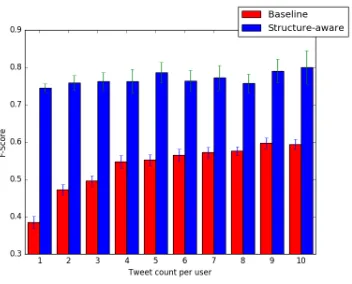
[image:4.612.324.500.57.199.2]Tuning parameters We empirically determine the thresholds for the baseline model and the language weights for the structure-aware model via a simple grid search, repeated 100 times. We randomly split the data into 20%/80% tune/test sets, and evaluate filter thresholds and language weights from 0 to 1 in .01 increments, with messages per actor ranging between 1 and 10. We expected the baseline model to have a consistent optimal threshold (though with higher performance variance with fewer messages), and this was borne out with optimal performance at a threshold of 0.06, independent of the number of messages per actor. For the structure-aware model, the optimal language weight was 0.9, although the entire range from 0.1–0.9 showed similar perfor-mance. This result was surprising, as we expect the structure-aware model to rely heavily on the struc-tural fit when the number of messages is small, and on the language fit when the number is large. This trend doesn’t emerge because the structural fit actu-ally relies on the language fit to make assignments for the seed actor’s friends and their messages.
Figure 2:Performance of baseline and structure-aware models as a function of the number of messages per actor used as ev-idence. Each bar represents the average over 100 random tun-ing/testing splits, with whiskers showing the standard deviation.
6 Results and discussion
Figure 2 compares the performance3 of the structure-aware ILP model with the baseline model as a function of the number of messages per ac-tor, using the empirically-determined threshold and language weight. At the left extreme, the models only have a single, randomly-selected message from each actor. As this number increases, the baseline model improves as it becomes more likely to have seen enough messages to reflect the actor’s full spec-trum of language use. The structure-aware model is able to make immediate use of the actor’s friends, immediately reaching high performance even when the language data is very sparse. Its most frequent type of error is over-hypothesizing fluency in both Ukrainian and Russian, when the user is in fact monolingual, followed by incorrectly hypothesizing fluency in English. This is understandable given the similarity of the languages in the former case, and the popularity of English expressions, titles, and the like in the latter.
7 Conclusion
We have presented promising results from lever-aging structural information from a communica-tion network to improve performance on fluency detection in situations where direct linguistic data is sparse. In addition to defining the task itself,
we release an annotated data set for training and evaluating future models. Planned future work in-cludes a more flexible decoupling of the language and structure fits (in light of Section 5), and mov-ing from pre-existmov-ing LID systems to joint models where LID scores are directly informed by structural information.
References
2014. ACL Joint Workshop on Social Dynamics and Per-sonal Attributes in Social Media.
Pablo Barber´a. 2014. Birds of the same feather tweet together: Bayesian ideal point estimation using twitter data.Political Analysis, 23:76–91.
Charley Beller, Rebecca Knowles, Craig Harman, Shane Bergsma, Margaret Mitchell, and Benjamin Van Durme. 2014. I’m a belieber: Social roles via self-identification and conceptual attributes. In Proceed-ings of the 52rd Annual Meeting of the Association for Computational Linguistics, pages 181–186, Balti-more, Maryland, USA.
Shane Bergsma, Paul McNamee, Mossaab Bagdouri, Clayton Fink, and Theresa Wilson. 2012. Language identification for creating language-specific Twitter collections. InProc. Second Workshop on Language in Social Media, pages 65–74.
Johannes Bisschop. 2015. Aimms optimization model-ing.
W.M. Campbell, E. Baseman, and K. Greenfield. 2014. langid.py: An off-the-shelf language identification tool. InProceedings of the Second Workshop on Natu-ral Language Processing for Social Media, pages 59– 65, Dublin, Ireland.
Simon Carter, Wouter Weerkamp, and Manos Tsagkias. 2013. Microblog language identification: Overcoming the limitations of short, unedited and idiomatic text. Lang. Resour. Eval., 47(1):195–215, March.
Maksym Gabielkov, Ashwin Rao, and Arnaud Legout. 2014. Studying social networks at scale: Macroscopic anatomy of the twitter social graph. InSIGMETRICS ’14, Austin, Texas, USA.
Inc. Gurobi Optimization. 2015. Gurobi optimizer refer-ence manual.
Dirk Hovy. 2015. Demographic factors improve clas-sification performance. In Proceedings of the 53rd Annual Meeting of the Association for Computational Linguistics, pages 752–762, Beijing, China.
Ben King, Dragomir Radev, and Steven Abney. 2014. Experiments in sentence language identification with groups of similar languages. In Proceedings of the First Workshop on Applying NLP Tools to Similar
Languages, Varieties and Dialects, pages 146–154, Dublin, Ireland.
Kalev Leetaru, Shaowen Wang, Guofeng Cao, Anand Padmanabhan, and Eric Shook. 2013. Mapping the global twitter heartbeat: The geography of twitter. First Monday, 18(5).
Shoushan Li, Jingjing Wang, Guodong Zhou, and Hanx-iao Shi. 2015. Interactive gender inference with in-teger linear programming. InProceedings of the 24th International Conference on Artificial Intelligence, IJ-CAI’15, pages 2341–2347. AAAI Press.
Marco Lui and Timothy Baldwin. 2012. langid.py: An off-the-shelf language identification tool. In Proceed-ings of the 50th Annual Meeting of the Association for Computational Linguistics, pages 25–30, Jeju, Repub-lic of Korea.
Seth A. Myers, Aneesh Sharma, Pankaj Gupta, and Jimmy Lin. 2014. Information network or social net-work? the structure of the twitter follow graph. In WWW ’14 Companion, Seoul, Korea.
2015. NAACL International Workshop on Natural Lan-guage Processing for Social Media.
Marco Pennacchiotti and Ana-Maria Popescu. 2011a. Democrats, republicans and starbucks afficionados: User classification in twitter. InKDD ’11, San Diego, California, USA.
Marco Pennacchiotti and Ana-Maria Popescu. 2011b. A machine learning approach to twitter user classifica-tion. In Proceedings of the Fifth International AAAI Conference on Weblogs and Social Media, pages 281– 288.
Shakira Suwan, Dominic Lee, and Carey Priebe. 2015. Bayesian vertex nomination using content and context. WIREs Comput Stat, 7:400–416.
Svitlana Volkova, Glen Coppersmith, and Benjamin Van Durme. 2014. Inferring user political preferences from streaming communications. In Proceedings of the 52rd Annual Meeting of the Association for Com-putational Linguistics, pages 186–196, Baltimore, Maryland, USA.
Robert West, Hristo Paskov, Jure Leskovec, and Christo-pher Potts. 2014. Exploiting social network struc-ture for person-to-person sentiment analysis. Transac-tions of the Association for Computational Linguistics, 2:297–310.