A novel method to find the neutral position of the breast
KNIGHT, Miranda, WHEAT, Jon <http://orcid.org/0000-0002-1107-6452>,
DRISCOLL, Heather and HAAKE, Steve
<http://orcid.org/0000-0002-4449-6680>
Available from Sheffield Hallam University Research Archive (SHURA) at:
http://shura.shu.ac.uk/8185/
This document is the author deposited version. You are advised to consult the
publisher's version if you wish to cite from it.
Published version
KNIGHT, Miranda, WHEAT, Jon, DRISCOLL, Heather and HAAKE, Steve (2014). A
novel method to find the neutral position of the breast. Procedia Engineering, 72,
20-25.
Copyright and re-use policy
See
http://shura.shu.ac.uk/information.html
Procedia Engineering 72 ( 2014 ) 20 – 25
1877-7058 © 2014 Elsevier Ltd. This is an open access article under the CC BY-NC-ND license
(http://creativecommons.org/licenses/by-nc-nd/3.0/).
Selection and peer-review under responsibility of the Centre for Sports Engineering Research, Sheffield Hallam University doi: 10.1016/j.proeng.2014.06.007
ScienceDirect
The 2014 conference of the International Sports Engineering Association
A novel method to find the neutral position of the breast
Miranda Knight*, Jon Wheat, Heather Driscoll, Steve Haake
Centre for Sports Engineering Research, Sheffield Hallam University, Sheffield, S10 2BP, UK
Abstract
Breast pain affects up to 70% of the female population. It is believed that stretching of the breast tissue causes discomfort and that by placing the breast into a position in which the tissue is neither in compression or tension (termed neutral position) will eliminate breast pain. The purpose of the study was to find a simple method that could be used to determine the location of the neutral position. One participant with a breast size of 34C performed three activities. The breast and torso movement were tracked using four retroreflective markers. The results suggest that the counter-movement jump was the most appropriate method as it forced the breast to oscillate from tension in the upper-side of the breast to tension in the under-side of the breast. The neutral position was found to be -129 ± 6 mm below the suprasternal notch, which was located 14 mm above the resting height of the breast. It was concluded that the first role of a bra is to lift the breast above the static position to cause more symmetrical oscillations about the neutral position.
© 2014 The Authors. Published by Elsevier Ltd.
Selection and peer-review under responsibility of the Centre for Sports Engineering Research, Sheffield Hallam University.
Keywords: Oscillations; counter-movement jump; tension; strain.
* Miranda Knight. Tel.: +44-114-225-2465. E-mail address: [email protected]
© 2014 Elsevier Ltd. This is an open access article under the CC BY-NC-ND license (http://creativecommons.org/licenses/by-nc-nd/3.0/).
21 Miranda Knight et al. / Procedia Engineering 72 ( 2014 ) 20 – 25
1.Introduction
Exercise induced breast pain affects up to 70% of the female population (Gillette 1975). It is difficult to recognize, diagnose and treat breast pain due to an unsatisfactory understanding of the condition, breast anatomy and physiology (Blichert-Toft et al. 1979; Abdel-Hadi 2000). Breast pain is typically treated pharmacologically with promising initial results, however relapse is common and many side effects have been noted (Faiz and Fentiman 2000; Pye et al. 1985). A well-fitted sports bra has been found to alleviate all symptoms of breast pain in 85% of patients (Abdel-Hadi 2000).
Mason et al. (1999) hypothesized that breast pain arises from tension of the breast tissue and that the repeated loading of the tissue can lead to breast sag. Haake and Scurr (2011) estimated strain of the breast tissue by finding a region on the torso where the breast tissue is neither in tension nor compression (termed the neutral position) and Haake et al. (2012) showed that strain and acceleration of the nipple were linked to pain scores from participants. Determination of the neutral position is critical to estimating breast strain and was found by asking the participant to lift and drop her breast and to determine when the acceleration of the nipple reached -1 g (i.e. free-fall). However, this value of acceleration was not reached consistently across a range of breast sizes. To allow strain to be used to make predictions of breast pain, a better measurement of the neutral position is required: this study aims to do that.
2.Method
2.1.Participant
Following institutional ethics approval, one female was recruited [age: 19 years; body mass: 65.4 kg; height: 1.8 m]. The participant was recreationally active, had experienced no surgical procedures to the breast, had not gone through pregnancy within the last year and was pre-menopausal.
2.2.Data collection
The participant’s breast size was measured following the methods of McGhee and Steele (2006) and was a 34C. Three 12 mm diameter retroreflective markers were attached to the left and right anterioinferior aspect of the 10th
rib and the suprasternal notch. A further marker was attached to the left nipple to represent the motion of the breast. The retroreflective markers were captured using ten calibrated three-dimensional motion capture digital cameras (Motion Analysis Corporation, USA), sampling at 200 Hz and positioned in a semi-circle around the front of the treadmill. The raw coordinate data for the five markers were exported into MS Excel (Microsoft, USA).
The participant performed a five-minute warm-up on a treadmill wearing her own sports bra at a self-selected speed. The participant was habituated to three activities, these were: - 1) running on a treadmill at 2.8 m.s-1 for 19
s; 2) lifting the left breast with the right hand and letting the breast drop due to gravity; 3) carrying out a countermovement vertical jump with arms akimbo. All tasks apart from the treadmill activity were repeated five times. The participant rated her breast discomfort on a 10 cm visual analogue scale (0 = comfort, 10 = discomfort) before and after each trial.
2.3.Data processing
The raw data in the global coordinate system was filtered using a fourth order, zero-phase Butterworth filter with cut-off frequencies between 7-10 Hz. The vertical position of the suprasternal notch and nipple were double differentiatedusing a five-point central differencing method to give acceleration. The vertical nipple displacement was also calculated relative to the suprasternal notch.
3. Results
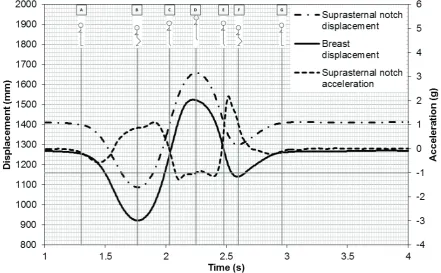
[image:4.544.50.492.162.435.2]Figure 1 shows the vertical displacement of the suprasternal notch and breast and the vertical acceleration of the suprasternal notch during the counter-movement jump. The participant is static at A, bends her knees at B, lifts off the ground between C and E before bending her knees again at F and returning to the static position at G. The body was in the air between C and E, indicated by an acceleration of -1 g. This shows that the torso was in the air for approximately 0.45 s.
Figure 1: Breast and suprasternal notch vertical displacement (left axis) and suprasternal notch vertical acceleration (right axis) during a typical counter-movement jump. (A, G = stationary; B = pre-jump knee flexion; C to D = upwards flight; D to E = downwards flight; F = knee flexion on landing).
23 Miranda Knight et al. / Procedia Engineering 72 ( 2014 ) 20 – 25
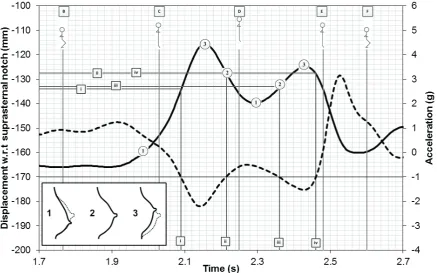
Figure 2: Vertical breast displacement with respect to the suprasternal notch (left axis - solid line) and vertical breast acceleration (right axis - dashed line) during a typical counter-movement jump. (B = pre-jump knee flexion; C to D = upwards flight; D to E = downwards flight; F = knee flexion on landing).
The oscillations of the breast during flight reached accelerations of -1 g at four instances in time (Figure 2: i to iv). This method indicated a neutral position in the region of -131.8 to -124.3 mm with respect to the suprasternal notch (Table 1).
Table 1: Neutral position where breast accelerations reached -1 g at the four points in time (Figure 2: i - iv).
Neutral position of the breast relative to the suprasternal notch (mm)
Trial i ii iii iv Mean SD
1 -134 -128 -133 -128 -131 3
2 -134 -121 -132 -127 -129 6
3 -138 -125 -128 -128 -130 6
4 -127 -114 -125 -130 -124 7
5 -134 -124 -134 -134 -132 5
[image:5.544.136.415.477.580.2]4. Discussion
The aim of the study was to identify an appropriate method to find the neutral position. The results suggest that a counter-movement jump forces the breast tissue to oscillate from tension to compression on the upper- and lower-sides of the breast. Both counter-movement jump and running produced nipple accelerations of -1 g but running was deemed unsuitable as the activity gave high discomfort scores. The mean and standard deviation of all measurements in Table 1 is -129 ± 6 mm.
[image:6.544.56.489.285.343.2]Table 2 compares the summary data from the lift and drop test and the running test with the counter-movement test. The advantage of using a counter-movement jump is that it is a simple test, causes the breast to go through -1 g by exciting 1.5 oscillations during flight. The lift and drop test for this participant achieved neither and the running test was uncomfortable. The counter-movement jump is simple enough that it could be performed in a retail outlet or in a doctor's surgery with ease (providing a suitable measurement system was available). Given that the breast is a very complex and subtle structure, and the results have not taken into consideration the breast deformation during the movement or the rotation of the torso, further testing on multiple participants will take place to ensure the results are consistent across a range of participant sizes.
Table 2: The three activities flight times, number of oscillations, whether the breast accelerations reached -1 g and the level of discomfort.
Activity Flight time (s) Number of peak-trough
cycles
Is -1 g reached? Discomfort
Counter-movement jump 0.445 1.5 Yes Low
Lift and drop 0.225 - No Low
[image:6.544.58.489.363.582.2]Running 0.380 0.5 Yes High
25 Miranda Knight et al. / Procedia Engineering 72 ( 2014 ) 20 – 25
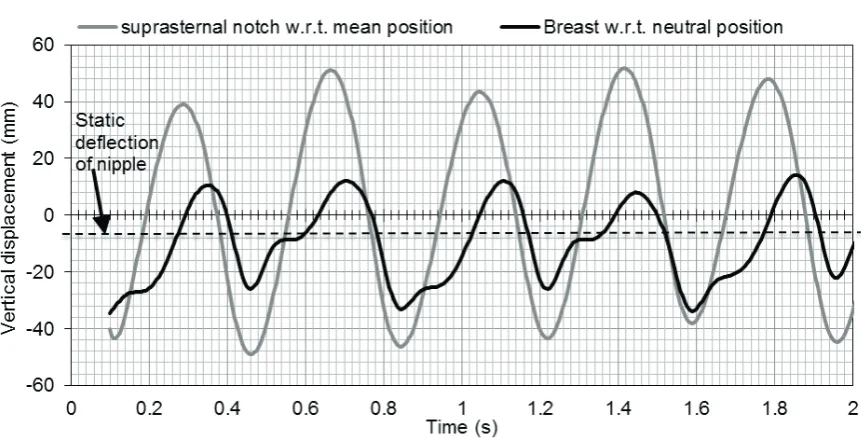
The neutral position can be used to understand the dynamics of the breast during running. The suprasternal notch oscillated approximately 40-50 mm above and below its mean position (Figure 3). This drove the oscillation of the breast causing the breast to oscillate between approximately -30 and +10 mm from the neutral position. If the neutral position was 129 mm below the suprasternal notch (Table 1) and the static position of the breast was 143 mm below the suprasternal notch, then the breast was 14 mm from the neutral position in the static position. The breast oscillated about the static position rather than the neutral position (Figure 3). Haake et al. (2012) suggested that breast pain is caused by excessive strain (indicated by excessive displacement of the breast away from the neutral position). Therefore the first role of a bra should be to lift the static position of the breast up towards its neutral position, reducing stain and ensuring a more symmetric oscillation during exercise.
5.Conclusion
A counter-movement jump was identified as a simple way of finding the neutral position of the breast. It was comfortable to the participant and forced the breast to oscillate between tension and compression. For the participant tested, it was found to be 129 ± 6 mm from the suprasternal notch in the vertical direction. It was also shown that the breast oscillated asymmetrically about the neutral position during running in the no-bra condition. It was concluded that the first role of a bra is to lift the breast from its static position to cause more symmetrical oscillations about the neutral position.
Acknowledgements
The authors gratefully acknowledge the participant for willingly taking part in the experiment. The authors also acknowledge the assistance of Alice Bullas during the testing and Andy Hext and John Hart for their illustration in Figure 2.
References
Abdel-Hadi, MSSA., 2000. Sports brassiere: is it a solution for mastalgia? The Breast Journal 6, 407-409.
Blichert-Toft, M., Andersen, AN., Henriksen, OB., Mygind, T., 1979. Treatment of mastalgia with bromocriptine: a double-blind crossover study. British Medical Journal 1, 237.
Faiz, O., Fentiman, IS., 2000. Management of breast pain. International Journal of Clinical Practice 54, 228-232. Gillette, J., 1975. When and where women are injured in sports. Physician Sports Medicine 3, 61-70.
Haake, S., Milligan, A., Scurr, J., 2012. Can measures of strain and acceleration be used to predict breast discomfort during running? Proceedings of IMechE part P: Journal of Sports Engineering and Technology 0, 1-9.
Haake, S., Scurr, J., 2011. A method to estimate strain in the breast during exercise. Sports Engineering 14, 49-56.
Mason, BR., Page, KA., Fallon, K., 1999. An analysis of movement and discomfort of the female breast during exercise and the effects of breast support in three cases. Journal of Science and Medicine in Sport 2, 134-144.
McGhee, DE., Steele, JR., 2006. How do respiratory state and measurement method affect bra size calculations? British Journal of Sports Medicine 40, 970-975.