Study 3
Transference to Practice (TOP): a
study of collaborative learning and
working in placement settings
The student voice
Interprofessional Learning Research Programme:
Pre-qualifying curriculum evaluation
Centre for Learning and Workforce Research
in Health and Social Care
Acknowledgements
This project was part of a larger multi-study research programme, three studies in which were funded by the Avon, Gloucestershire and Wiltshire Workforce Development
Confederation (AGW WDC). We would like to thank all the students, health
professionals and service users who facilitated and/or participated in this study, without whose co-operation its successful completion would not have been possible. We would also like to thank our colleagues from the Faculty of Health and Social Care (FHSC), University of the West of England, Bristol (UWE) for their support for the wider programme.
Steering Group for the Research Programme
Professor Harry Ferguson, HSC, UWE
Professor David James, Faculty of Education, UWE Professor Robin Means, FHSC, UWE
Professor Margaret Miers (Project Manager), FHSC, UWE Katherine Pollard, FHSC, UWE
Di Rees, FHSC, UWE
Caroline Rickaby, FHSC, UWE Professor Kath Ross, FHSC, UWE
TOP research team (FHSC, UWE)
Dr David Evans Jane Goodman Diane Hawes
Katherine Pollard (Study Manager) Professor Kath Ross (Study Lead) Pat Taylor
Susie Ventura
April 2007
Contents
Page no
Acknowledgements
1Introduction
3Methods
5Ethical approval 5
Instrument 5
Sample 6
Data collection 6
Data analysis 7
Findings
8Experience of interprofessional working in placement settings 8 Range of professionals in placement settings 9 Nature of interprofessional interaction 10 Quality of interprofessional interaction 10 Involvement in interprofessional working 12 Mentor support for involvement in interprofessional interaction 19 Factors influencing collaborative working 22 Channels of communication 26
Experience of interprofessional learning in the academic context 30 Professional mix 30 Group facilitation 32 Learning about others’ professional roles 33 Development of skills necessary for interprofessional working 34 On-line delivery of the third module 36 Module assessment 36 Structure and purpose of the modules 36 Integration of interprofessional learning into the wider curriculum 39
Summary
42Experience of interprofessional working in placement settings 42
Experience of interprofessional learning in the academic context 44
Introduction
This report details some of the findings from a study exploring health and social care students’ experience of collaborative learning and working in placement settings (the TOP study). The study was a component of a wider research programme, started in 2001. The programme’s overall aim was to gain an understanding of the effects of FHSC’s pre-qualifying interprofessional curriculum on the collaborative learning and collaborative working of health and social care students (Miers et al 2005a). The curriculum, implemented in 2000, comprises three complementary strands (Barrett et al 2003):
• Dedicated interprofessional modules in each year, in which students work in small mixed-profession groups. In years 1 and 2, the groups met face to face (Miers et al 2005b). Since 2002, the second module has been delivered in a conference format, which includes small group work experience. In year 3, the module is delivered on-line (Miers et al 2005c).
• Interprofessional outcomes within uniprofessional modules.
• Interprofessional working as an element of supervised practice while students are out in placement settings.
FHSC’s interprofessional curriculum was developed in response to a continuing emphasis on the need to improve service delivery in health and social care in the UK, and the belief that effective interprofessional working is key to service enhancement (Department of Health 1999, Freeth et al 2005). It has been widely assumed that interprofessional learning will facilitate interprofessional working, although the evidence to support this assumption is still being amassed. FHSC’s research programme was conducted in order to contribute to the evidence base in this regard.
The programme included the following two objectives:
• To document and describe the context and process of delivery of the interprofessional curriculum and relevant variations.
• To identify processual and contextual factors which influence the effectiveness of the interprofessional curriculum.
Methods
In order to obtain a comprehensive picture of the student experience, a multi-method approach was chosen for the TOP study. In view of the complexity of the issues being investigated, a pilot study was conducted to test and refine the methods of data
collection and analysis before commencing the main study (Pollard et al 2003).
Following the completion of the pilot, it was decided to conduct in-depth interviews with a wide range of students, and also to conduct case studies in a number of placement settings.
Ethical approval
Ethical approval for the TOP study was gained from three Local Regional Ethics Committees and the UWE Ethics Committee. The Research and Development Committee in each selected NHS Trust supported the study.
Instrument
Semi-structured interviews were conducted with individual students, in order to allow them to provide in-depth information about their experiences, while at the same time facilitating a focus on issues known to be relevant to the topic. The interview guide was constructed based on a literature review and on findings from the pilot study (Pollard et al 2003). Questions focused on details of the student’s current placement setting, including the professional composition of the staff complement, communication mechanisms and decision-making processes. Students were also asked to talk about the opportunities and support available to them for engagement in interprofessional working, and whether or not any such opportunities involved service users. Researchers were particularly interested to discover to what extent students were able to participate in interprofessional interaction, and what skills they thought they required in order to do this. The guide also included questions about students’ experiences of interprofessional learning in the academic environment.
Sample
In order to represent all ten professional programmes in the Faculty, the researchers aimed to recruit a quota sample of students for interview. All the students were on placement at the time of interview, so participants were recruited from within a defined geographical area, incorporating upwards of 200 different placement settings. Other criteria also influenced recruitment:
• Where possible, participants belonged to the cohorts involved in the wider research programme, as its aims include meta-analysis of data across the component studies (Miers et al. 2005a).
• Students in the case study sites were recruited regardless of cohort, in order to contribute to the depth of data collected concerning these settings.
Six case study sites were selected to capture data concerning placement experience across the full range of students in the Faculty, in both acute and primary care settings:
• Acute medical ward for older people
• Coronary care ward
• Maternity unit
• Paediatric unit
• Community learning difficulties team
• Residential facility for adults with challenging behaviour
Data collection
Interview data were collected by six researchers, with backgrounds in adult nursing, children’s nursing, midwifery, occupational therapy, physiotherapy and social work. To minimise the possibility of ‘insider’ bias, researchers did not interview students from their own profession (Sim & Wright 2000). No researchers interviewed students for whom they had any direct educational responsibility. Interviews took place either in students’ placement settings or on UWE premises. Interviews were audio-recorded, with the participants’ permission. Where audio-recording was not possible, researchers took notes instead.
Interviews were also conducted with staff, as well as with service users in selected areas.
Data analysis
The research team devised a realistic evaluation framework based on the work of Pawson and Tilley (1997). This framework was developed following findings from the pilot study (Pollard et al 2003), those from another study in the research programme (Miers et al 2005b) and the wider literature. Themes from these studies were identified and categorised in terms of the contexts, mechanisms and outcomes (cmo) of the interprofessional curriculum delivery (Pawson and Tilley 1997). Student interview data were then analysed with reference to the identified themes relating to the framework. Following this initial analysis, additional thematic analysed was conducted (Burnard 1991), in order to capture additional information from the student interviews. Duplicate analysis of a selection of transcripts served to establish inter-researcher reliability. Case study data analysis is ongoing.
Findings
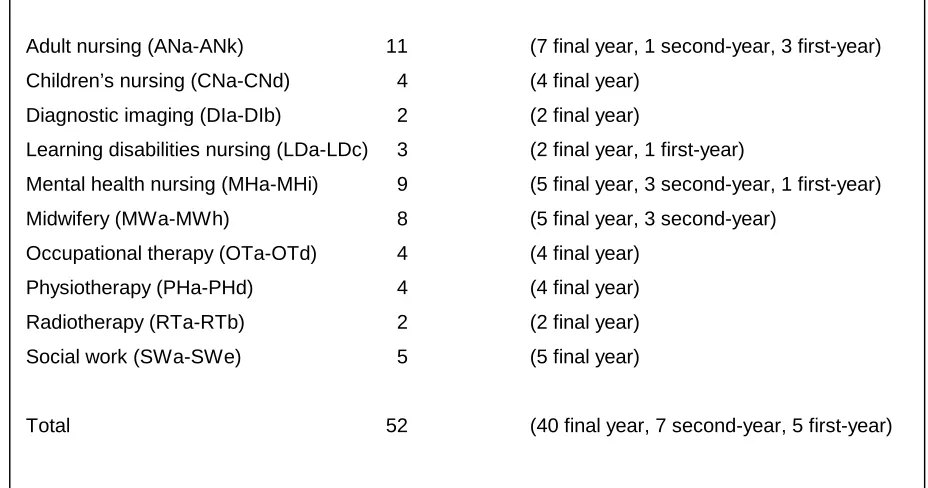
[image:9.612.85.549.304.548.2]Of the 52 students who participated in the study, 40 were in the final year of their education. All the programmes were of three years’ duration, except for social work, which comprised a two-year diploma, and occupational therapy, for which the part-time course extended over four years. Seven second-year and five first-year students from three-year programmes were also interviewed. Due to some logistical difficulties, fewer physiotherapy students were interviewed than was anticipated; mental health nursing and midwifery were slightly over-represented. Each student was allocated a code, comprising two capital letters denoting their profession, followed by another lower-case letter (Table 1).
Table 1. Students interviewed by programme
Experience of interprofessional working in placement settings
Students came from across 41 placement settings. Acute settings included a cardiac unit, a critical care unit, a delivery suite in a maternity unit, a unit for people with eating disorders, four general medical wards, a general radiography unit, a gynaecological
Adult nursing (ANa-ANk) 11 (7 final year, 1 second-year, 3 first-year)
Children’s nursing (CNa-CNd) 4 (4 final year)
Diagnostic imaging (DIa-DIb) 2 (2 final year)
Learning disabilities nursing (LDa-LDc) 3 (2 final year, 1 first-year)
Mental health nursing (MHa-MHi) 9 (5 final year, 3 second-year, 1 first-year)
Midwifery (MWa-MWh) 8 (5 final year, 3 second-year)
Occupational therapy (OTa-OTd) 4 (4 final year)
Physiotherapy (PHa-PHd) 4 (4 final year)
Radiotherapy (RTa-RTb) 2 (2 final year)
Social work (SWa-SWe) 5 (5 final year)
people, a mental health crisis team, three mental health wards for older people, an oncology unit, an orthopaedic ward, a paediatric radiography unit, two postnatal wards, a private medical unit, a secure mental health unit and two specialist paediatric units.
Community settings included two health centres, two integrated learning disabilities teams, three mental health teams, a project for young people with drug problems, two residential settings for people with learning disabilities, a social services child case-holding team, a specialist alcohol service and two voluntary organisations.
Range of professionals in placement settings
The range of professionals working in different placement settings varied considerably. Students in community and social work settings were generally involved with a wider range of professions and agencies than those within acute healthcare settings:
If they’ve had a housing incident, the housing officers will put them in touch with us and also the police do as well . . . other
professionals are housing, police, counselling services, other voluntary organisations - domestic violence organisation, Shelter . . . case workers for schools.
SWd, voluntary organisation supporting victims of racial harassment
Physios and OTs, social workers, some of the link nurses – not all of them, but most of them. I know a few of the doctors, but the majority I don’t . . . it’s all orthopaedics, trauma and orthopaedics, there are different consultants.
ANc, orthopaedic ward
Despite the variability in the professions represented across the different placements, similar themes emerged from the students’ reports about their interprofessional experiences on placement. These were:
• quality of interprofessional interaction;
• involvement in interprofessional working;
• mentor support for involvement in interprofessional interaction (the term ‘mentor’ was adopted as a generic term to embrace the variety of titles utilised across the professions, e.g. supervisor, practice teacher, assessor);
• factors influencing collaborative working;
• channels of communication.
Nature of interprofessional interaction
All the students reported instances of informal interprofessional working in their placement settings. However, the occurrence of formal interprofessional working was less widespread. In some placements, students reported regular multidisciplinary team (MDT) meetings and/or specific events designed for interprofessional communication and planning. In others, however, there were no formal interprofessional events at all.
MHa: There’s a fortnightly team meeting . . . Researcher: And everybody goes to that?
MHa: Yeah . . . they’ll talk about the ICPA forms which are the new forms and all the paperwork kind of things, discharges and stuff . . . it’s coming up for a team meeting, so the last one was two weeks ago, but it is more of a general discussion about the team and the way we’re working. MHa, community mental health team
On the other wards I worked, there were multi-disciplinary meetings, but here, no. Like I said this is the worst interprofessional working that I’ve seen on, this is my fifth placement.
ANd, gynaecology ward
Quality of interprofessional interaction
The consultants do tend to have problems communicating with the nursing staff, I’ve seen a couple of arguments between the sister and the consultant, shouting matches because he’s been in a bad mood, and why’s his patient here, and all those types of things; so they do seem to have difficulty communicating with each other. Lots of the nursing staff have said, ‘I don’t like that doctor she speaks down to me.’ ANd, gynaecology ward
The CT (CAT scan) associated staff sit in one corner of the staff room and don’t talk to all the other people . . . the radiography nurses sit in one corner, don’t talk to anyone.
DIa, general radiography unit
The remaining 35 students characterised the interprofessional working in their
placement settings as ‘good’, although 23 subsequently revealed that its quality varied at times, depending on circumstances:
I think it depends on the worker. We have some professions that work really well, an integrated service, and there are others who don’t exchange information as well. They’re sort of protective of their area.
SWc, social services child case-holding team
I think everybody works really well together. Sometimes there is a bit of a break down in communication, occasionally, and the doctors might say some kind of care for a patient and not tell the nurses for example, which can cause problems sometimes.
ANk, Critical Care Unit
Where situations involving poor collaboration were identified, they often highlighted issues involving medical staff in both acute and community settings:
problems are not appreciated nor the professionals with skills in those areas. PHd, general medical ward
I’ve had a lot to do with a doctor, who I find very, very difficult, the way he’s talked to me, how he’s talked to his patients, you know, I’ve found it quite disturbing . . .
SWe, voluntary organisation
However, with the exception of the six who reported poor experiences, most students were able to give examples of effective interprofessional working in their placement settings:
In this unit communication is very good, a lot of respect amongst the professionals, probably because it is a good team, good working environment . . . we care about each other, will help and support each other, this includes registrars and midwives. The registrars document well, seek out midwives, are very approachable,
MWg (interview notes), low risk birthing unit
They’re very, very good as a team at doing it (making decisions). They have a meeting every two weeks . . . new referrals are discussed and some of them are discussed just in the sense, that yeah, that’s appropriate referral, take that out. People who are referred to the whole team, who are referred as a general case, not for specific OT or physio, tend to be discussed by a whole team, and everybody has an input and quite often now ask whoever’s referred them to come and speak at the meeting so that they can discuss it with them.
OTd, integrated community learning disabilities team
Involvement in interprofessional working
conversations/discussions with other professionals (face-to-face/telephone), referrals to other professionals (verbal/written) and shadowing/observation of other professionals.
As would be expected, second and third year students tended to be more involved in interprofessional working than those in their first year of study:
LDc: I attended a couple of meetings with a social worker and like one with a speech therapist.
Researcher: What was your role in those meetings?
LDc: I just observed. LDc, residential setting for people with learning disabilities (first-year)
We have our own patients, so they (other professionals) get involved with whoever we’re looking after that day, and they all communicate with us like they do with the staff nurses . . .
CNb, specialist paediatric unit (final year)
The nature of some students’ placement settings appeared to limit their involvement in interprofessional working:
I suppose in rare circumstances you would talk to other areas of the hospital. So if a mother had a heart problem or had to go over to intensive care then you’d communicate with them, but that’s only sort of rarely. We’re generally quite secluded I think over here.
MWe, maternity unit delivery suite
‘Kept away to ourselves in the basement, occasionally we contact GPs, etc’. No community involvement.
RTb (interview notes),oncology unit
Support/encouragement from practice mentors/supervisors had a significant impact on the extent to which students were able to access/engage in opportunities for
interprofessional interaction’ below). Similarly, the attitudes, awareness and involvement of other members of placement staff could also have a positive/negative effect:
The nurses that you do work with, that kind of impacts on the amount of interprofessional working that you as a student experience,
because they as individual nurses will have different levels of sort of interprofessional collaboration, regardless if it’s the same patients each day you’re with, but under different nurses they’d have different levels of interprofessional collaborative practice…
CNd, specialist paediatric unit
I have had a lot better experiences on other wards . . . on ITU I felt more part of the team, and doctors would come round and talk and have a joke with the nurses, and I would chat away to physios and have a good conversation with the OTs . . . And the doctors would say oh we’re watching procedures such as I’ve seen a line put in, and they’re like this is what you do, and what’s that part of the body, they kind of included more, and made me feel more part of the team.
ANd, gynaecology ward
ANj: It was a rehabilitation ward . . . I was talking to one of the physios, and they actually turned round and said they preferred working with student nurses than staff nurses.
Researcher: Because?
ANj: Because they understood their roles a lot more. And that we carried on . . . they put into place the rehabilitation care to carry on going with the physiotherapy and the student nurses always followed that care, and then we communicated with them a lot more about the physical side, or if something had happened during the night.
ANj, community health centre
(including those for interprofessional working) whilst on placement. However, (s)he did acknowledge that his/her own assertiveness may also have played a part:
It feels as though things are building up, I’m becoming more confident and clearer about what I can be asking and what I should be doing and, so I feel as if that’s partly a problem with the university for not preparing me as much and partly my own assertiveness exactly how much I should be talking to other professions and how much I should be . . . and what I should be doing as a nurse or learning to be a nurse. MHi, mental health ward for older people
Multi-disciplinary team (MDT) meetings were not held in all practice settings and, where they did operate, students were not always able to attend. The majority of students were hopeful that, if they had not done so already, they would be able to attend at least one MDT meeting during the course of their placement:
There are a lot of students so we’re in a strict rotation to attend they . . . they go on a couple of times a week because there are a lot of children with long-term problems, so I will get to go to one of those at home point. CNa, specialised paediatric unit
Once at the meetings, students varied as to the role they were expected/chose to adopt. Whereas some students played an active role, others indicated that they had not felt able or inclined to speak. The length of time they had been on their placement, the extent to which they knew about, or had experience of, the topic or service user/client being discussed and the level of the meeting/professionals involved, were all identified as factors affecting whether or not students felt able to speak out:
Well, the last one that I sat in on, I’d just started my placement, so I didn’t know the service users that much to contribute much
meaningful information.
One of the SHOs and the social workers were talking about someone who had learning difficulties and 'cos I’ve got previous experience in that I felt comfortable to offer an opinion of what they were talking about. MHa, community mental health team
I just listened . . . I was the only student there . . . it was more like a higher management meeting, but it was nice that they let me go.
MWa, postnatal ward
The issue of student status was clearly a problem for some, as they reported feeling unsure as to whether or not they were expected to contribute to the meetings, and if so, to what extent:
Sometimes . . . I don’t know exactly how much to say or how much to hold back . . . I think because I still don’t feel like I’m part of the team. It’s a bit odd to be just a student, and I’m expecting to be asked my views rather than launch in and say ‘oh yes and let me tell you about . . .’. SWa, mental health crisis team
Some of the students who had managed to speak out felt positive that their opinions had been listened to and valued by the other participants:
I think it was quite a controversial issue within the group . . .and the Area Manager actually came to me and said, ‘What do you think? What’s your view on this? You’re a new person coming in and seeing things quite fresh’ and I found that, I was a bit taken aback at that . . . I liked that I had obviously been noticed and not just forgotten, not that I was just observing, I was actually, they did involve me . . .
LDa, residential setting for people with learning disabilities
Others, however, were less sure:
Similar factors were identified with regards to whether or not students felt able to air their opinions in interprofessional contexts other than MDT meetings. Student status was again raised as an issue, particularly concerning communication with medics:
I suppose there is an element of power and authority . . . especially with doctors . . . And I think you do tend to feel a little bit inferior to them . . . I sometimes do feel that they think because I’m a student I don’t know anything a lot of the time. ANk, critical care unit
I think sometimes as a student you’re a bit overlooked by the doctors. MWe, maternity unit delivery suite
However, this was not always the case. Indeed several students reported good working relationships with medical staff:
The doctors are very pleasant, and they involve the nurses and students in discussions about patients, and use opportunities for teaching. ANb, cardiac unit
Here they involve you in everything . . . for example yesterday I went out with my mentor, another CPN and the consultant to see a client, and then after(wards) when the consultant was talking, she was looking at me so I knew I was involved, I wasn’t just a spare part or an extra person. MHa, community mental health team
Confidence was a key factor affecting whether or not students felt able to air their views in interprofessional contexts. Students often linked increased confidence to year/level of study and the length of time they had been on their current placement:
Researcher:: Do you feel able to offer your views?
up the confidence . . . to be able to speak to them, that’s what it’s about right now really. MWd, maternity unit delivery suite
The more I get to know the other staff, then the more I’ll have the confidence and be able to sort of interact I think.
CNd, specialist paediatric unit
One student highlighted the role that body language could play in facilitating/hindering interprofessional collaboration:
I think it’s how you come across as well. If you are quite timid and quite shy with your body language it shows that and they are not going to find it easy to find you approachable, so that does have an effect. OTa, general medical ward
In terms of actually initiating interprofessional collaboration, a number of students indicated that they would usually discuss issues with their supervisor/mentor before contacting another professional. This was particularly true if the desired/required collaboration involved contacting a member of the medical profession. In these circumstances the majority of students reported checking with a member of qualified staff before taking action:
I’d go through the nursing staff to the doctors; I’d tell any concerns to an RGN, say why I want to go to the doctor, and then I’d contact/ bleep the doctor. ANb, cardiac unit
Researcher:: So if you have a concern about one of your patients, who do you go to?
CNb: First to the nurse who’s shadowing me, and then we’ll go to a doctor if it’s necessary.
CNb, specialist paediatric unit
mentor/supervisor appeared to be based on the student’s understanding of the issue in question, as well as an assessment of the nature/severity of the problem:
I had one the other day, a temperature of 38 point something and sky high pulse and blood pressure was worrying as well, and I just
thought, well no I’m just going to go straight to the doctors with this one because it’s obvious something’s wrong, and I went to them and they were like OK, in that case we just need to get an ECG, we need to do this, this, this and this, and I just got it all arranged and went off and did it. ANg, medical ward for older people (first year)
MWc: If it’s a medical problem, I would refer them on to doctor. Researcher: Would you go through a midwife first?
MWc: Not necessarily. If there was somebody that I knew needed medical attention, I would not necessarily. I would go and inform the co-ordinator or my mentor what I had done. I would have informed them of actions just out of courtesy really to keep them up to date with what’s going on in that room.
MWc, maternity unit delivery suite (final year)
Mentor support for involvement in interprofessional interaction
Unless they were directly questioned about their mentors, students seldom mentioned them in relation to their own involvement in interprofessional interaction. However, where their influence was considered, their support was noted as a positive feature for the growth of students’ confidence in their own communicative abilities. This sometimes took the form of enabling reflection on practice and rehearsal of communication with others:
At the meeting I fed that back, after I had run it over with my mentor, I fed that back to the team and the team were quite comfortable with me being there. MHe, unit for people with eating disorders
I usually use the supervision time with my mentor to air out how I feel about certain situations and then it is up to him to maybe assist me on how to go about actually feeding back to the team. It is quite good, you know you see it happening and it’s quite rewarding because you know it is your contribution.
LDc, residential setting for people with learning disabilities
Mentors could impact significantly on students’ opportunities to interact with other professionals:
My mentor, because it was the first time I was really dealing with physiotherapists, she said had I seen what they do, so I said no I hadn’t really been around with anybody, so she asked them if it was OK I could go round, and they were really good.
MWa, postnatal ward
I was given a two week induction timetable, and I got to work with all the professionals here . . . at the beginning of the induction he sort of outlined places I could visit where I could go and spend time.
MHd, specialist alcohol service
My mentor is always asking what my thoughts are. I can go ‘what do you think? I feel that this could happen’, and they do value that. I think I’m able to contribute. It was a good experience trying to get that person home, I had lots of input into the communication for the discharge process. ANb, cardiac unit
My supervisor’s brilliant on this placement . . . she works in a way that I would like to work.
OTd, integrated community learning disabilities team
However, mentors did not always provide positive role models in this regard, and students sometimes sought other members of staff to emulate:
My mentor, she said she lacks assertiveness . . . I’m giving her all my articles once I’ve finished with them, and then she’s going to use them. ANj, community health centre
There are different people you can attach yourself to and you learn things from them. Your mentor isn’t always the best person to get that from. CNd, specialist paediatric unit
Students highlighted the importance of developing sound relationships with their mentors, a process sometimes facilitated through shared values and beliefs:
The first few days are quite hard because you don’t know the person . . . but I’ve been here five weeks now and I think I’ve established a good relationship with her. MWd, maternity unit delivery suite
I feel it is important to have an educator who can let you get on with things but also knows that you’re going to be constantly coming up to them and questioning them . . . I had a fantastic relationship with my last educator. PHd, general medical ward
There are a lot of ethical and moral things that go on when you’re talking about people with learning difficulties and issues that affect them and we seem quite similar in our views on things, so I have found it quite easy to just say what I think.
For some students, this process was not possible, as they were not able to work often with their designated mentor(s):
Mine’s on holiday . . . you get left to your own devices really . . . I don’t think we’ve really learnt anything on this ward.
ANg, acute medical ward for older people
I have four, but I haven’t worked much with them, one of them is off sick, another is part time and one is on permanent nights.
ANk, critical care unit
Factors influencing collaborative working
The quality of interpersonal relationships and/or communication was seen by many students as the most important factor determining the quality of collaborative working:
This particular hospital I think is absolutely wonderful . . . the communication is really, really good.
DIa, paediatric radiography unit
The physios and OTs come in and say hello, there’s not much of a personal relation, but there’s a professional relationship and they communicate quite well with each other I think.
ANd, gynaecology ward
Researcher: Which other professions do your work with?
MHf: GPs, but a ‘different kettle of fish’. Invited to discuss at care planning meetings, but seem to have a blasé attitude to mental health clients, don’t attend, attitudes to staff very stilted, difficult relationship, plus GP receptionists often frosty.
MHf (interview notes), mental health ward for older people
LDc: I think it goes very well. There’s an understanding of your role as part of the team, and people seem to know their roles within the team. So far it works very well, because when people need some clarification or some help, they always know who to contact.
LDc, residential setting for people with learning disabilities
Everyone has a very good understanding of what each other’s job is, for example in theatre we’ve got a lot of different staff members in there, different professions, and they all just communicate so well, they all know what each other’s role is, what their job is, I was blown away really. DIa, paediatric radiography unit
The use of humour and informal styles of interaction were also perceived as enhancing interprofessional collaboration:
There’s a nice atmosphere in there, it’s friendly, and everyone has a laugh and feels they can have a laugh and a joke when it’s
appropriate, so I think that makes a difference for people feeling more comfortable to ask when it comes to serious matters.
MHa, community mental health team
Physical proximity and regular contact were identified as contributing to effective interprofessional working, particularly where members of different professions were located in the same building/office:
I found it quite amazing how they do walk in to each other’s offices and discuss the clients that they have been to see and ‘what do you think about this’ and ‘what do you think about that’… they all just really do, its amazing.
OTb, integrated community learning disabilities team
themselves to that happening rather than everyone being in separate offices. SWb, community project for young people with drug problems
I think it’s really good . . . they all work easily together, and everybody knows each other, so it’s quite good. And they’re usually on the ward all day, as well. CNb, specialist paediatric unit
It was apparent that in some placement settings, structures were in place which actively supported interprofessional collaboration. These included dedicated interprofessional co-ordinator posts, shared social spaces such as coffee rooms, dedicated
collaborative/teambuilding events, and MDT meetings where inclusive participation was encouraged:
It works very, very well. They’ve set up a new post of trauma co-ordinator, so the F grades take it in turns, they do a 2 week stint each. It’s basically discharge planning, full-time, so they will have
responsibility for tracking outliers, making sure that things are in place for them, and they will do all the liaison with all the other professions, and with families, care homes, nursing homes, finding beds, that kind of thing. So to an extent the discharge planning is not so much a staff nurse’s role as it used to be, but it’s much more efficient, and I think they have much stronger relationships with the other professionals as a result of that. ANc, orthopaedic ward
I did nights the other day and there were a few doctors around and they were just lovely you know, they sat with us in the coffee room, which I think is very important as well, so that they can interact in that way with the midwives, not just on the professional level.
MWd, maternity unit delivery suite
everybody here seems really friendly. It’s like a big crowd of your mates. MHc, community mental health team
There is a multi disciplinary team meeting everyday for 45mins . . . the meeting is chaired by the nurse co-ordinator and she does a good job – she is firm and organised and lets everyone speak . . . on the whole the meeting is an open and positive environment.
PHb (interview notes), medical respiratory unit
The effects of hierarchy were often implicated in the acute settings when
interprofessional was perceived to be problematic, as could be seen in a student’s description of a medical-led MDT meeting:
I felt the dynamics of it were a little bit difficult . . . it’s in a huge room with a horseshoe shape set of chairs and tables. Massive, and there must have been twenty-five people there, I’m guessing . . . they tended to have one lead guy and I don’t know who he was, who just went through the list . . . there wasn’t much open forum, I don’t think it was very free-for-all. People did say things, I think the physios did a couple of times when they felt there was an issue that needed to be arisen from it, they did make comments, and a couple of the sisters did as well. But it wasn’t what I would call a go round the room ‘do you have any issues?’ Yes, no, ‘do you have any issues?’ yes, no You know go to the OTs, to the physio, to the nurse or whatever. I’m not entirely sure what the aims of them (the meetings) are.
CNc, specialist paediatric unit
Difficulties with staffing issues were also seen to hinder collaboration:
There are no IP meetings on the unit. The OTs, physios and social workers have asked for them at least once a week . . . but they
There is a multi disciplinary meeting every Wednesday pm, but nobody comes. The OT is overstretched because of staff shortages, the Social Worker is ill and no one else seems to bother.
PHc, medical respiratory unit
One student identified a communication “barrier” between nurses and social workers and felt that this was due to confusion over what information could be legally and ethically conveyed between the two professions:
The social workers feel they don’t get told about the medical side of what’s going on . . . it is a very, very fine line . . . very much a grey area where, its like we have a patient you know, confidentiality when we see them and how we support them here, but then on the other side you think well, do we have a right to tell the social worker, and then you think to yourself, well, it is to do with them, but then again it’s not . . . the patient hasn’t specified that they want us to tell the social worker, which nine times out of ten they probably won’t . . . I know it’s all part of you’re all supposed to be working together, but there’s still no . . . there’s no guidelines set out to say, what covers you legally really. ANj, community health centre
Channels of communication
When asked about how individuals communicated with each other in their current placement setting, students described a variety of mechanisms which were used between the various professionals and agencies involved in service delivery. With regards to gaining access to advice/input from other professionals/agencies, bleeping, telephone conversations/messages and face to face discussions were the most commonly cited methods of communication. White boards, written notes and communication books were also used:
On a daily basis they had a diary and everything was written in, like appointments for that day or visitors . . . there was also a
messages for the whole staff either about appointments that had to be made or things that had happened that day and . . . when you started your shift you looked in the diary . . . look at the Communication Book, see if they were any messages and there was a sheet you signed in and out of. There was a little book for activities, where people were when they were out, when they were at home and then some more essential communications like anyone feeling unwell or . . . things like that. LDa, residential setting for people with learning disabilities
More formal methods of communication included completion of referral forms/letters, medical/nursing/profession-specific notes, patient/service-user files/notes, cardex
records and care plans. These written communications were supplemented/informed by team/multidisciplinary meetings, ward rounds, nursing handovers and case conferences:
For example with burns patients, there’s a particular protocol and pathway that they take called the Integrated Care Pathway . . . there’s one sheet for a particular stage of the pathway, so whether they’re acutely unwell or if they’re in rehab, there’s this one page for each day and it’s communicated on that one page, and everybody
communicates on it, the nurses as well . . . there’s multi-professional weekly meetings that they have . . . basically the whole team sit round and go through each patient. CNd, specialist paediatric unit
Levels of electronic communication varied considerably between placement settings. Whilst some did not even have access to e-mail, others kept electronic patient/service-user records:
The system is used by the City Council . . . it’s for recording all the contacts you make with the young person or the professionals. So that can be accessed by all the other City Council workers, so they might go in to a file, and they can check and say ‘yes, [name] actually had a meeting with young person X on Wednesday at 3 o’clock’. And everyone can see that that happened.
SWb, community project for young people with drug problems
The majority of students appeared satisfied that the use of a combination of different mechanisms resulted in reasonably effective interprofessional communication, although some did acknowledge occasional breakdowns:
If particular changes take place, for example, changing say drug therapy or something, then the doctors will often let the nurses know, but not always. CNd, specialist paediatric unit
Sometimes we’ll leave messages and they don’t get picked up, sometimes the doctors get called away and you’re waiting for a plan to be checked so it can be sent up to be verified and it can hold up (treatment). RTa, oncology unit
A variety of different note systems were often used within the same placement setting (e.g. different notes for different professionals). Some students were clear about the way in which these systems worked and how issues could be communicated outside of these mechanisms:
Others, however, were less clear and there appeared to be a degree of confusion over which professionals wrote in which notes. Some of these students went on to express concerns as to whether or not the various sets of notes were ever read by other professionals:
I’ve written in the cardex but I don’t know who else looks at the cardex apart from the nurses. I know that sometimes physio and dietician and social work do because they then write in it, as do occupational therapy, but I don’t know how often the doctors read the nurses notes . . . they’re separate folders, and I’m not sure how the cross over works. ANg, acute medical ward for older people
The physio notes are kept at the back of the medical notes. In this team concerned with trauma ‘I am not convinced that anyone else reads them as they are perceived as less important to patient care’. The social worker keeps separate notes which are not available to the rest of the team. PHb (interview notes), medical respiratory unit
Presumably in an attempt to overcome some of these problems, a number of placement settings utilised a single set of multiprofessional notes:
We have MDT notes, no separate nursing notes.
PHd, general medical ward
Others kept all notes relating to a particular patient together in one place:
Each patient also has an individual folder, which contains all their obs charts, pain charts, things like that, and has another section which is purely devoted to this admission. So everything that happens in this admission – so that’s the doctors’ notes, x-rays, any input from any other professional, it’s all in there. And it’s at the nurses’ station, so any individual who needs to read it can go and see it there . . . so you don’t have to chase around looking for different files.
Regardless of which note keeping mechanism(s) were in place, students stressed the need for both verbal and written communication:
I still think it’s important, even if someone writes it, that they actually speak to say the nurse or the doctor or whoever is looking after the child to clarify the information that they’re trying to (convey).
CNd, specialist paediatric unit
I would never feed back something and not have it documented, because if I am feeding back something it’s clinical and it’s part of the clinical governance and my code of ethics, I need to be recording all appropriate information including communication with other members of staff . . . I guess that could happen sometimes, you could be chatting to somebody about something and you should actually be documenting that, because if there is a change in shift, say with the nurses, then they are not going to pick it up and something could go adrift. OTa, general medical ward
Experience of interprofessional learning in the academic context
Students were asked about their experience in both the face-to-face and on-line interprofessional modules. Topics discussed included the professional mix within the small groups, group facilitation, learning about other professional roles, the development of skills necessary for effective collaborative working, the module assessment, the on-line delivery of the third module, the structure and purpose of the modules and the integration of interprofessional learning into the wider curriculum.Professional mix
A number of students were disappointed by the range of professions represented in their IP groups:
Several students identified specific professions that were missing from their groups, and whom they perceived to be particularly important to their day-to-day work. For example, one occupational therapy student would have liked a student from speech and language therapy, while for another the lack of social work representation was a major concern:
Researcher: You haven’t had any social workers in either of your module groups?
OTa: No . . . for me as an occupational therapist, that’s a very
important member of the team, especially when you are talking about facilitation of discharge and if you want to set up a care package or there’s other issues that need to be addressed which they specialise in. OTa, final year
A social work student highlighted the fact that in practice social workers work with a wider range of professionals than just those from health and felt that it would have been beneficial for all students to have worked with a wider range of professionals during the modules:
As a social work student, I think as an inter-professional group, they should have had more outside agencies, and I don’t think it would have done any harm for some of the nurses, especially the children’s nurses, to be involved with police officers, especially with the child protection thing. Housing is another, even for elderly people.
SWc, final year
The profession that attracted the most attention, however, was the medical profession. Students from five professions (adult nursing, learning disabilities nursing, midwifery, occupational therapy, radiotherapy) identified the lack of medical representation as an area that needed to be addressed in future module runs:
I think we need to work with doctors. I think we need to actually learn with doctors. So that they can appreciate our role and we could appreciate their role. I think that would help a lot, in practice.
A few students commented on the fact that within the IP groups, everyone tended to sit with members of their own professional groups:
I mean one thing I did find being in the groups, (was) that we did all stick to our own professions. ANj, final year
Group facilitation
Students expressed a range of different views about the facilitation of the modules. It is clear, however, that facilitation had a huge impact on students’ assessment of the overall module experience. Those who rated their facilitator positively also tended to see the overall module experience as positive:
My best period was in my second year when we did a lot of group work and had a really good facilitator and he got the group together mixed with other professionals better than in the first year.
MWh, final year
There must have been about thirteen in the first one, but it was a great skill mix – we had physios and nurses, mental health nurses, it was just brilliant . . . and yes it got a bit heated now and again but the facilitator drew us back on what we were talking about and kept us on track and it felt purposeful. OTb, final year
Those who were negative about their facilitators would have appreciated more input with regards to initial ‘getting to know each other’ exercises and provision of more
structure/guidelines:
He would just sit there in silence and expect us to have a discussion, but we didn’t really know what we were discussing and a few times we’d just sit there in absolute silence for ten minutes . . . I could see how he was, how we could start discussing things, but it just didn’t work and the longer the silence went on . . . the harder it got for you to say something anyway. So, it just wasn’t working and he failed to see that. LDa, final year
One student who had had both positive and negative experiences felt that (s)he had learnt about the importance of facilitation as a result:
We had two extremes. One that just didn’t facilitate at all in the first year, it was absolutely terrible. There was no communication going on at all, which I guess we all learnt from . . . how facilitation is so important, especially for new groups. In the second year we had someone who had been brought in specifically because they’re a group work facilitator, and . . . you could see the two extremes.
CNd, final year
Learning about others’ professional roles
Again students expressed a range of views about the extent to which they felt the
modules had helped them to learn about different professional roles. Some felt that they had learnt a lot:
I think this is something I’ve picked up from our course over the last three years because we do the interprofessional studies now, where you work with . . . obviously learning with other professions, and its been good because . . . we’re discussing what we do and they’re discussing what they do. So you’re finding out things about each other’s professions that you didn’t really know.
DIa, final year
I think its really helpful because it does make you realise how much you need to know about what other people do . . . it also has meant that every placement I’ve gone on I’ve made a real effort to make sure I’d go out and visit people who aren’t necessarily within the insular team . . . and it always amazes me because when I’ve done that they’re usually quite shocked and don’t really know why you’ve done it, and then when you explain and it’s ‘well if I’m going to work in the service then I need to know what everybody does and it just means that I wouldn’t send you inappropriate referrals’, then they all seem to go ‘oh isn’t that a good idea’. OTd, final year
Others felt that they would have liked more of a focus on learning about different professional roles:
I think it has helped, but maybe I think it should be done a different way, like getting you more involved with other professionals and learning about their roles. MWd, second-year
Some went on to suggest how they thought this could be done:
Even though we’ve done IP we still don’t understand other people’s roles . . . what I thought it is, why not have . . . a kind of seminar day where you go to lectures on other peoples professions, and then at the end you are given a case and you have to say how each profession would contribute, and to do that you would have to
understand all of them. MHh, second-year
Development of skills necessary for interprofessional working
We did a lot on interpersonal skills. I learned a lot about
communication . . . ANb, final year
I think for me the second year kind of really opened my eyes to group work and how important it was to actually build up these relationships with people, and how to kind of, as much as you can, try to initiate, not initiate, but kind of make things work, make the dynamics work, within a group. CNd, final year
Several students felt that the module had helped to build their confidence:
I used to hate sort of confrontation, and I hated IP in the first year because I just hated that having to speak out, but I think that sort of helped my confidence. MWe, final year
Others commented that they had learnt a lot about themselves:
I’ve learned a lot about how I work within a team. I found out that I’m quite different from what I thought I was, I’ve come to a very different understanding of myself. ANc, final year
A few students, however, felt that there needed to be more of an emphasis on communication skills during the modules:
I think teaching us how to develop communication skills and things would be good because I think there are lots of people, me for myself, when I started this course, I was quite young, and lots of people on my course were older and they had experience from life . . . they came from managerial posts and stuff like that and they’re used to dealing with people, whereas I’d just come straight from school.
On-line delivery of the third module
Students expressed mixed views about the third module. Those who were positive about the module appreciated the flexibility of the on-line approach, the chance to develop their IT skills and thought that it had helped quieter students to contribute to group
discussions:
With the Internet, I think it’s fantastic. Like some people, most
students, tend to be shy about communicating. But on the Internet . . . nobody wants to just keep quiet. ANa, final year
Those who were negative did not perceive on-line communication to be particularly relevant or helpful to their future professional practice:
I’m unsure about communicating by e-mail because OK we are in a modern edge and IT is the way things are going but on the wards you are communicating most of the time, especially on my placements, verbally . . . so I’m not quite sure the rationale behind the last one, how it really benefits, you know myself as a member of the MDT . . . yes, include it within the last module but not make it a predominant part of it. OTa, final year
Module assessment
A couple of students indicated that they had been unsure of the purpose of the module assignments as they had found it hard to identify a link between the assessment and the content/purpose of the module sessions:
more explanation and insight into what the aims of this are because I don’t believe that the aims of what was going on were set to us.
CNc, final year
Others felt that the short duration of the modules, coupled with the various assessment tasks, had resulted in reduced opportunities for discussion/learning. Two students commented specifically on the assessment pressures during the second-year module conference:
Everyone was really worried about collecting the tags and getting the right statements, so we didn’t have time to sit down and say well, ‘I’m a psychiatric nurse’ . . . because everyone was really worried about not having enough time to get all the information they needed to complete the assignment. MHd, second-year
Structure and purpose of the modules
Some students in the early stages of their education felt that the module sessions needed more structure. This was often linked to comments about not understanding the purpose of the modules:
Give it structure. It’s not got any structure I feel . . . rather than letting us all jibber jabber around. ANh, first-year
Sometimes . . . I didn’t understand the point of doing certain things . . . maybe if there was a bit more direction. LDc, first-year
A number of students would have liked the modules to run over a longer time period to enable them to get to know each other better:
I think it would be way better if they just did one really good module of a decent length of time . . . or two maybe, rather than three modules that people are generally dissatisfied with . . . I mean for IP 1 we worked in a group for . . . six weeks or something, and for IP2 we had these two conference days but you don’t really get to know that group and I think . . . certainly for IP1, once we actually started . . . had started to bond as a group we started working really well, but then it was like the end of the module and similar for IP2 . . . I think it would be better if you had a longer time together. MHb, second-year
One student suggested running interprofessional modules throughout the duration of the professional curriculum, although (s)he recognised that this was probably impossible for logistical reasons:
Interprofessional is only about, what, 7 weeks? I suppose . . . it might be a good idea to perhaps . . . rather than having one great big
interprofessional, plonking you into it and taking about 5 weeks to understand why you are going and what it’s all about, it might be better to have as you are going through your course, that when you have case studies, we have case studies every module, is to have, I know it would be impossible to do, but to have nurses, everybody working as a team so you would be part of the team working to resolve that. OTb, final year
Several students questioned the timing of the first module, feeling that it should have come later in the curriculum after all students had gained some placement experience:
The theory from the IP was good, covering the Victoria Climbie enquiry was fascinating . . . but being on the ward and seeing it actually in practice, if I was to write my essay on interprofessionalism now, I would have far more insight into it than when I wrote it
previously. ANg, first-year
Some students felt that having three interprofessional modules was just too much, and that their time could have been more usefully spent learning other (uniprofessional) things:
Well, with the IP, it’s been one of those subjects that I feel that I haven’t really taken that seriously. The work side of it was always left to the last minute and something I felt I had to do rather than that I wanted to do and I wasn’t really that sort of worried about, you know, there were other assessments and other exams . . . and I focused on that rather than the IP. So, in my life, it’s always been like, I wouldn’t say second-rate, but it’s been far below priority to the other sort of modules I’ve taken. SWe, final year
I suppose I slightly felt that there is so much to learn with Mental Health, and yet we were having two whole sort of modules on IP . . . and I feel that I understand about IP . . . so I feel that really I don’t need to do yet another one . . . a part of me feels that there’s nothing else that we have done three whole modules on. We haven’t done it on mental illness even. MHc, final year
Integration of interprofessional learning into the wider curriculum
Students were fairly evenly divided in their opinions about the degree to which interprofessional issues were emphasised in their uniprofessional modules:
suppose the differences in legislation, you know, all the different guidelines that are around at the moment, how they come together, health and housing coming together in social work.
SWe, final year
Researcher: How much emphasis on interprofessional has there been (on interprofessional issues) in the rest of your curriculum?
DIb: Very, very little . . . and I think that’s perhaps generated my self-obsessed radiography attitude. So we might have helped generate it, you know, thinking that we’re special. DIb, final year
It was interesting to note, however, that students from the same programme had conflicting views about this issue:
I don’t think there’s much emphasis on IP. In our essays, we have to look at the psychological and social aspects, and anatomy and physiology, but not much about IP really. ANb, final year
It has linked up quite well throughout I think . . . we had to write . . . about the delivery of health and social care within the community or whatever setting it was, within a specific setting, so that very much involved interprofessional working and what have you, so it all seems to tie together sort of quite well, yeah. ANe, final year
Researcher: How much emphasis on IP working would you say is made in the rest of your curriculum?
RTa:None. RTa, final year
Highly linked, marks awarded for IP integration into assessments. RTb (interview notes), final year
I think the only way you can learn about working with professionals is to be working in a team and practice because otherwise you don’t know what other people do or how they interact with, like roles people play providing care, and work together. MHd, second-year
Others recognised the benefit of the modules but felt that stronger links between the modules and practice needed to be developed:
I wanted to mainly emphasis the point that I do feel IP works when you are on your placement. The academic side is good, but
sometimes you really need to have the two put together.
SWb, final year
When asked for suggestions as to how this could be done, several students suggested shadowing other professionals in practice:
I think possibly . . . spend time with a professional, so going out and spending an afternoon with a midwife, an afternoon with a social worker, so you know they’re expert in their field so you get more knowledge. MHd, second-year
In addition, radiotherapy and midwifery students expressed a desire for scenarios which were more relevant to their chosen professions:
Summary
Experience of interprofessional working in placement settings
Range of professional in placement settings
• Students were on placement across a broad variety of placement settings and as such worked with many different professionals. Those in community or social work settings tended to be involved with a wider range of professionals/agencies than those in acute healthcare settings.
Nature of interprofessional interaction
• Informal interprofessional interaction was reported in all placement settings, however formal mechanisms/events were less widespread.
Quality of interprofessional interaction
• The majority of students characterised interprofessional working in their placement settings as ‘good’, although there was a recognition that its quality varied depending on the circumstances and professionals involved.
Involvement in interprofessional working
• Year of study, nature of placement setting and support/encouragement from practice mentors/supervisors could all have an impact on student involvement in
interprofessional working. The attitudes, awareness and involvement of other members of placement staff could also have a positive/negative effect.
• MDT meetings did not take place in all settings, however in those that did, students were hopeful that, if they had not done so already, they would be able to attend at least one meeting during the course of their placement.
• The majority of students indicated that they would discuss issues with their mentor/supervisor before contacting a member of another profession.
Knowledge/understanding of the issue in question along with an assessment of the nature/severity of the problem determined whether or not students initiated
interprofessional interaction directly.
Mentor support for involvement in interprofessional interaction
• Mentor support was identified as helping students to develop confidence in their own communication skills and had a significant impact on students’ ability to
access/engage in opportunities for interprofessional working.
• Mentors could represent either positive or negative role models for interprofessional working. As a result, students sometimes sought other members of staff to emulate.
• Students recognised the importance of developing sound relationships with their mentors, although this was not always possible due to logistical reasons.
Factors influencing collaborative working
• Interpersonal and communication skills were considered key to determining the quality of collaborative working. An understanding of other professionals’ roles, a sense of humour and physical proximity were also perceived to be important.
• In some placement settings structures such as dedicated interprofessional
co-ordinator posts, shared social spaces, MDT meetings and collaborative/teambuilding events helped to support interprofessional working. Staffing issues, hierarchies and confusion over legal/ethical communication boundaries could hinder interprofessional working.
Channels of communication
• A variety of formal and informal communication mechanisms were used to facilitate interprofessional working in placement settings. The majority of students felt that the combination of these different methods resulted in reasonably effective
interprofessional communication.