This document is the author deposited version. You are advised to consult the
publisher's version if you wish to cite from it.
Published version
BREESE, Richard, JENNER, Stephen, SERRA, Carlos, THORP, John, BADEMI,
Amgad and CHARLTON, Michael (2018). Measures for benefits realization. Project
Report. Report produced by Sheffield Hallam University for the Project Management
Institute.. (Unpublished)
Copyright and re-use policy
See
http://shura.shu.ac.uk/information.html
Sheffield Hallam University Research Archive
customer? 1.
Ahlema nn et al
2013 ECIS
Exploiting Is/It Projects' Potential-Towards A Design Theory For Benefits Management .
Proposes a set of "meta-requirements" which lead to 8 design
principles aimed to tackle challenges associated with benefits management. "Core principles" drive successful benefits realisation / management. Very little addressing actual measurement, save for recommendatio ns on who is responsible and that metrics are highly important as they will support decisions about (personal) reward for BR.
(d)
(empirical) with a view to formulate (n)
recommend ations
(po)
Beyond single projects but limited to organisations (formal) that host projects.
Project Portfolio Management, goal setting and budgeting processes lead to defined benefits. No advice on actual measures.
Not specified
Not specified But complex causal chains that span organisational units create accountabilityis sues.
Distinction between 1st and 2nd Order ownership,t he latter more prevalent where benefits are realized through complex causal chains that span organisatio nal units
Realisation has to be measured "regularly". Continuous ly refine and optimise benefits analysis and measurem ent. Post- benefit-implementa tion work aids continuous learning.
Not specified Ongoing benefits "exploitation" is emphasised after project closure
IS/IT generally in numerous industries: Banking, Insurance, Logistics, Retail, Energy and Chemical etc.
Not specified Not specified
2. Almeida and Romão
2010
Portuguese Journal of Managemen t Studies
Benefits management for an e-invoice process
Applies the benefits management methodology created by Ward & Daniel (2006) to ANA- Aeroportos de Portugal.
Advocates realistic business case built on a range of benefit measures which go beyond ROI and incorporate "soft metrics" and delayed
(d) and (n) (Po) including pt and pm
Defined and measured as part of the BM approach which supports the business case
Not specified
Not specified. Not interim and outcome benefits, but benefits dependency network essential so that business changes and "IT capability" can support the achievement of benefits.
None mentioned No single group has all the knowledge necessary to identify all the benefits, changes and IS/IT enablers". BM methodolog y supports this through mixed teams.
Managers /Investors monitor the progress and business benefits previously planned.
Implied. The process of evaluating benefits can trigger "actions to achieve more efficiency in the invoicing related processes".
Not specified IS/IT in airport Cost reduction Waste reduction (paper)
Speed – faster payments Less disputes Customer preference Customer satisfaction Supplier preferences and satisfaction Surveys to estimate cost of as-is system, Accuracy, Staff reduction, Improved security,
customer? realisation
because some projects create a platform or "intellectual property" first which allows benefits to be realised in later projects that exploit the platform. Systematic reviews should be performed.
Tax efficiency, Improved security
3. Al-Tamee m and Wheeler
2000
Americas Conference on
Information Systems (AMCIS)
A process view of information system benef its
management and evaluation
Article merely describes how BM is part of 7 core processes in IS delivery.
(n) (Pt) Identified at the investment justification stage and reviewed at project completion, "to determine whether benefits have been delivered"
No No Not
specified
Not specified
No Not specified IS/IT generally Not specified Not specified
4. Ashurst
2012
Palgrave Macmillan
Benefits Realization from Information Technology
The book covers a wide range of tools for benefits realisation, summarising many research projects which Ashurst has participated in. A key focus is benefits realisation capability, explicitly based on RBV, and dynamic capabilities.
Metrics are related to competences, and include metrics on maturity, as well as direct measures of P3M success.
d followed by n
Mainly pt and po.
At the Portfolio level,
reference is made to the difficulty in getting approval for innovation projects, with business cases being adapted to fit existing investment appraisal criteria, for example estimates of financial impact of non-financial benefits. (P67).
Framework of practices – In Benefits Planning (BP3, BP8) P182-183.
Not specified
Not specified General focus on stakeholder requirement s in identifying target benefits BP3, P182
Framework of practices – In Benefits Planning (BP3, BP8), Benefits Delivery (BD5), Benefits Review(BR 3) benefits Exploitation (BE3) P182-186.
Yes, see Qu. 3 Tensions between shorter timescales for business investment compared to IT strategy for 3-5 years hence (P69-70)
Mainly IS/IT, often in public sector, including universities.
Refers to pressures to force non-financial benefits of strategic innovation projects to be translated into financial impacts (P67).
Support IT projects where a financial case is easier to construct are being funded. (P68)
Action research with benefits toolkit – consideration of non-financial benefits helpful (P127).
customer? 5.
Ashurst et al
2012
International Journal of Information Managemen t
Exploring IT-enabled innovation: A new
paradigm?
This article extends previous research on benefits-led approaches to IT, to research the implications for IT-enabled innovation. It is suggested that a benefits-led approach to IT-enabled innovation represents a new (third) paradigm different from the previous paradigms of technology implementation and a planned approach to benefits realisation. Base d on 10 case studies.
d Pt, po At any time – see Q3a
Not specific Not specific Not specific Not specific, but ‘owners of
innovation’ usually innovation or IT teams
The article suggests that benefits in design/delivery approaches emerge based on work to solve a problem or achieve a vision. Contrast with top-down approach to benefits. Agile rather than waterfall.
Not specific IS/IT innovation in private sector
Not specific Not specific
6. Ashurst, C., Doherty, N., Peppard , J
2008
European Journal of Information Systems, 17 (4), 352-370.
Improving the impact of IT
development projects: the benefits realization capability model.
This article develops a benefits realisation capability model, following research into the benefits realisation practices of 25 organisations. Four
competences are identified, benefits planning, benefits delivery, benefits review and benefits exploitation. Measuring benefits is included in the
d followed by n
Mainly pt, also some
referecnes to po
The empirical research identifies neglect of benefits metrics.
By and large, the need to articulate benefits, during a project’s planning phase, had been recognized across projects, but all too often these benefits were either articulated in a very general business sense, or in terms of the system’s functionality and
No No No
However, in the vast majority of cases, these analyses focused on the manner in which stakeholder s would interact with the system, rather than explicitly detailing how their roles and responsibilit ies should be modified to facilitate
Little evidence of ownership.
Moreover, there was absolutely no
evidence of organizatio ns explicitly identifying owners for these benefits, to help facilitate their ultimate realization. The difficulty of getting organizatio
No Not specific.
Because project teams tended to be disbanded very soon after the go-live date, there was very little evidence to suggest that on-going benefits exploitation was explicitly practiced in any of the case organizations. However, in two cases
managers were appointed to have responsibility for the long-term
Mainly IS/IT. Having established the strategic drivers, most
organizations had broken these down into a number of lower level benefits [BP3: identify and define benefits]. For the most part these were also fairly ill-defined, such as: ‘reduce the operational costs for maintaining the web-site’ {Vision and Scope: P8}; ‘to provide searchable
customer? analysis of
competences
features or its intended usage, rather than clearly measurable business terms. P.363.
The normative element in the paper indicates that benefits should be identified in the ‘benefits planning’ stage (BP3, BP4) P358.
the realization of
benefits.P3 63
ns to provide clear measures for benefits was highlighted by a project manager {P21} who lamented: ‘At the start of the project we asked about success criteria and how they (the customer) would measure return on investment. All we could get out of them was that other players in the market already had similar technologie s, and they wanted to eliminate all paper from their sales cycle’. P 363
management and
performance of the operational software P365
indexing for web-site’ {Vision and Scope: P20}; ‘to make the work of representatives more effective’ {Vision and Scope: P21}; ‘to provide users with easy-to-use online e-procurement for ordering office supplies’ {Vision and Scope: P24}. Improving the impact of IT development projects In a small number of cases, there were examples of benefits that were articulated in a more measurable, but not necessarily a business-oriented form, such as: ‘generate 1 million visitors per month’ {Vision and Scope: P14}.
P362-363
7. Ashurst, C., Hodges, J.,
2010
Journal of Change Managemen t, 10 (2), 217-237.
Exploring Business Transformati on: The Challenges of
Developing a Benefits Realisation Capability
This article develops a maturity model for benefits realisation capability for investment in change, based on dynamic capability theory.
d followed by n
pt, pm, po One of the maturity factors is ‘measuring success (p233).
Level 1: Basic Including all relevant costs/ benefits in the business case.
No No No Not
specified who. Assesed throughout benefits life-cycle
Emergence is implicit.
Under ‘benefits exploitation it is suggested that
The knowledge of what is possible and how to use the full potential of the new technology is
customer? Measuring
benefits is therefore related to competences, and is part of ‘practices’ in the competence model (p234).
Level 2: Improving Carrying out benefits realization reviews.
Level 3: Enhanced Focus on ‘measuring the right things’ as drivers of change
Level4: Avanced Measures of the benefits realization capability
quickly
fragmented and lost. When many organizations are still using systems 20 years old or more, retention of knowledge to enable
continued benefits exploitation is important.
8. Baccari ni and Bateup
2008 Facilities
Benefits management in office fit-out projects
There is no "coherent" and "holistic" approach to benefits management in three case studies of office fit-out projects. But projects could be improved with KPIs for benefits and more formal control of benefits processes.
Speculation that only if benefits are tangible are they recorded. Also that confounder variables are known to exist which may discourage managers from making claims for benefits achieved.
Some evidence
(d) followed by (n)
(pt) In business cases and business briefs, benefits were identified "but not in a coherent, structured manner".
Not specified
Not specified "key stakeholder s" informally make mention of the project six months following completion( uninitiated)
Assessed informally on an ad-hoc basis. One case used weekly meetings during the project. But achieveme nt "with overall concept" was the main reason for meetings not a systematic appraisal of benefits.
Some post-occupancy evaluation (POE). Six months after delivery with random interviews with staff
None of the case studies identified new benefits during the fit-out period.
6 months after completion (implies a single review)
Construction Office fit-out projects.
Efficiency benefits measured by increase in occupancy density. Reduction in floor space per person. Collocation benefits; occupant productivity; flexibility for business growth; image benefits; desired corporate look; impact on environment; impact on behaviour e.g. collaboration. Staff retention. KPIs were ONLY set for efficiency measures.
customer? that the
business brief trumps any benefit approach: consistency with project brief is therefore very important.
More formal and rigorous application is recommended with together with more monitoring during project, more KPIs and rigorous appraisal at project end.
and informal feedback from manageme nt.
Efficiency and flexibility were reviewed (nothing else) after 6 months.
9. Badewi
2015
Strategic Project Managemen t:
Contemporar y Issues and Strategies for Developing Economies
Project Management , Benefits Management , and Program Management
Quantifying and planning for benefits influencing project success. But business case in itself without planning for the benefits has a weak correlation with project
investment success
empirical with a view to formulate recommend ation
Benefits management is part of programme management. Project management is a phase in the benefits delivery process
At the starting of the programmes
Yes The
psychological factors are mediating the benefits realisation process. I.e. if there is no quick wins, the change process may stuck.
Benefits owner is the final user of the
delivered capability. The senior responsible owner is the head of the department which is doing the change.
portfolio manageme nt is the department responsible for that through its independen t reviewers. (section 6.4.3).
benefits are identified before the project as part of the
programme vision and mission statement
Rolling wave.I.e. programmes shall be thought as a continuous process but with setting tranches for controlling the benefits. I.e. after closing the implementation phase, the workshops shall think of new benefits to start a new tranche (section 6.4.3)
IT Projects productivity, satisfaction, and users
performance Are these
examples? all
10. Badewi
2016
International Journal of Project Managemen t
The impact of project management (PM) and benefits management (BM) practices on project success: Towards
this article focuses on the relationship between project managers and benefits owners. The benefits profile is developed by the benefits owners. Benefits
empirical with a view to formulate recommend ation
Benefits management lifecycle is broader than the project management lifecycle. PM is a sub of BM lifecycle. it does not examine the
Benefits are identified before the project. Based on the definition of the benefits profile, project charter is developed to fulfil the needs for recouping the benefits. In
not none Benefits owner is the final user of the
delivered capability. The senior responsible owner is the head of the department
Benefits auditors (be part of HR manageme nt which is integrated in the KPIs used in measuring the
none the benefits need 3 years to mature and being integrated in the new Business As Usual (BAU). (Literature review and discussion)
IT Projects (global study)
Efficiency and effectiveness - satisfaction and ROI
customer? developing a
project benefits governance framework
profile is the contract between the benefits owner and senior responsble owner while project charter is the contract between project manager and SRO. (Section 2.3). Both the existence of business case (as written by SRO), Project charter and benefits profiles are critical for project investment success. the use of BM with conjunction of PM, the Project success improves additionally by 35% than being by PM only.
role of Po or Pm
the discussion section, the benefits are owned in such a way the
sustainability of delivering the benefit is argued. Also, delivering benefits shall be integrated in the KPI system and compensation system.
which is doing the change.
employees' (i.e. benefits owners) performanc e). The benefits auditor reports the performanc e to the SRO. (Discussion section)
11. Badewi
2016
PhD Thesis - Cranfield University
Investigating benefits realisation process for enterprise resource planning systems
Business case design to include the quantification of benefits, benefits modelling, benefits ownership, and the expected behaviour of benefits trends over time under certain
assumptions.
Benefits are classified into IT benefits, automating benefits, planning benefits, and
(n) and (d) All
Pt strategic Pm the benefits Pt the implementatio n mechanism
Benefits are identified before the project starts. the first step after defining the vision and mission of the change
Yes IT benefits are necessary for Automating benefits (AB). AB are necessary for PB
PB necessary for Innovating benefits
AB are not necessary for Innovating Benefits
Users, SROs, Project Managers, and Programme Managers
Portfolio Manager, or SRO, is accountabl e for the process of ensuring the benefits are self-realizable. HR department is
responsible for
integrating new benefits to current performanc e appraisal system
Responsibility of benefits realization in the post-implementatio n stage is the business change manager, whose responsibility is to manage the readiness to change before implementatio n, ensuring that the smoothing process of transitioning the project (Chapter 4)
Usually a benefits audit is conducted 6–12 months after delivering the project output
IT Projects (ERP systems)
Investment success (ROI, Satisfaction, and benefits)
customer? Innovating
benefits
Automating benefits come from Pt Planning benefits come from Po Innovating benefits come from portfolio mgmt. 12.
Badewi and Shehab
2016
International Journal of Project Managemen t
The impact of
organizationa l
project benefi ts
management governance on ERP project success: Neo-institutional theory perspective
Comparison between benefits management logics (i.e. tools, concepts, and principles) and project management logics. The institutionalisatio n of PM and BM logics improves the possibility of successful transformational projects in an organisation . The use of PM and BM in normal projects improves the probability of success of transformational projects.
both (transformatio nal) projects
Continuous (before, with, after but within stabilisation , and after stabilization process )
No none SRO,
Project managers, Benefits owners
During the project implementa tion is the business change manager. but after closing the project (i.e. transition). the SRO (the department head) is responsble for integrating the benefits into KPIs with HR department .
(Literature review)
Responsibility of benefits realization in the post-implementatio n stage is the business change manager, whose responsibility is to manage the readiness to change before implementatio n, ensuring that the smoothing process of transitioning the project (Literature Review)
Usually a benefits audit is conducted 6–12 months after delivering the project output (Section 2.2.2)
ERP Projects Investment success (ROI, Satisfaction, and benefits)
All except qualitative benefits.
13. Badewi et al
2013
Advances in Manufacturi ng
Technology XXVII - Proceedings of
International Conference on
Manufacturi ng Research (ICMR 2013)
Benefit Realisation Modelling for ERP systems using System Dynamics
Before realising the benefits, the benefits owners shall be psychologically ready for the change (in the discussion section). Benefits realisation is a continuous process fueled by benefits owners
both (transformatio nal) project
transformational change project
Psychologi cal returns are the fuel to keep on generating extra benefits
quick wins (Literature)
users,proje ct
managers, head of department s (SROs)
the perception of benefits shall be measured. But this paper does not cover the process of
quanitificati on of the benefits
customer? psychological
factors (i.e. intentions, perceptions, attitudes, and motivations)
14. Barclay and Osei-Bryson
2009
Project Managemen t Journal
Toward a more practical approach to evaluating programs: The Multi-Objective Realization approach
The
development of Multi-Objective Realisation Method (MORE) to help measure strategic contributions of programs. (Abstract)
d Pm Pm (P.80-82) 1-Identification (Defining stakeholders) 2-Definition (Benefits are identified) 3- Analyss (measuring the benefits to take corrective actions) 4- Realisation (to confirm the strategic contribution has been delivered)
Yes Use of Means-ends network to depict the relationship between IB and OB
Yes. . the stakeholder s identified are program sponsor, program executive, program manager, external consultant, contractor, program team and staff (P85)
None None None Software Company
Quality, process, innovation and learning, psychological benefits (e.g. perceieved usefulness, ease of use), transaction cost, etc. (Table2. P 83 and Table 4 P 87)
They can be summarised into People, process, customer, financial, and programme management
All (including improved operational efficiency, increase market share, and maxinimizing ROI).
Qualitative benefits are quantified to be
measured.
15. Benning ton and Baccari ni
2004
Project Managemen t Journal
Project Benefits Management in it Projects--an
Australian Perspective
"Significant room for improvement" in formal project benefit management exists among project managers p1. Research suggests that PMs
concentrate on deliverables and measures of efficiency rather than
effectiveness. Insufficient use of KPIs found.
Interesting remarks about
(d) followed by (n)
pt Pt
Research title is a little
ambiguous because the heading suggests "benefits identification" but the text refers to "establishment" of benefits p24.
Some surveyed consult their stakeholders in workshops with key
stakeholders, presumably where benefits are defined and
No No
Complexity of benefits generally and difficulty in identifying [sic] intangible benefits and benefits change over time p.25 are obstacles to OB let alone IB
None save that the survey respondent s
emphasised executive manageme nt as a stakeholder frequently (possibly because of the status of those surveyed MC)
Executives (implied) but where assess = monitor this falls to the pt.
The benefits are assessed throughout the "project lifecycle" p24.
No, save for a reason to suggest why "establishing benefits" is difficult.
Not specified IT Projects Generic measures include Employee productivity and business efficiency, saving money/cost, accuracy and reliability, comply with regulations, etc. (table 3, p23.)
customer? "over-stating"
project benefits in order to get project approval p26. This has implications for who assesses? More than half of the
respondents in this survey "inherited" the benefits (p26 and throughout) and so had no say in their appropriateness .
selected etc.
For other pt managers the benefits are merely given by the executives p.24
16. Berghou t et al
2011
Computers in Industry
Management of lifecycle costs and benefits: Lessons from information systems practice
Benefit management practices are inconsistent among 8 financial services companies in NL. Operational costs are not always
recognised and project goals are not easily verified/measure d p1. Benefits (and costs) appear to be managed according to context and are "incident driven" p1.
Research indicates that senior managers are becoming more involved in cost and benefit management but authors bemoan senior management evaluation of
(d) Pt Some reference to Po level
Tendency for costs to be analysed in detail but "benefits are hardly measured" - Authors quote from one of their research subjects (section 5.2)
"During development new insights emerge and perspectives change" Costs and benefits are to remain "balanced" Section 5.3 on realisation.
Authors emphasise that benefits and costs need to be managed throughout the systems development lifecycle.
Not specified
Not mentioned Generic stakeholder s; no specific stakeholder mentioned
Implies senior manageme nt identify, monitor and manage
Not specified Not specified Financial Services
Authors find a tendency to emphasise qualitative measures e.g. "'better than the current
situation'" rather than quantitative goals (see section 5.2). ""commercial benefits remain tricky" (section 5.2).
But all of the projects analysed in the research do make mention of tangible and intangible costs and benefits
customer? projects and the
absence of a "coherent set of methods" 17.
Braun et al
2009
9.
International e Tagung Wirtschaftsin formatik Wien, 25. – 27. Februar 2009
Benefits Management -A Literature Review and Elements of a Research Agenda.
A literature review of benefits management that describes the "state of science" and the areas for future research". There is no consensus on benefits classification but general
acceptance that "tangible benefits" can be measured according to an objective, quantifiable, financial measure and "intangible benefits can be measured using subjective and qualitative measures p557.
Companies can no longer rely wholly on traditional ROI measures for IS/IT projects that seek to reduce business cost.
"Interpretive methods are enjoying increased interest as they capture benefits in greater variety p558.
Opportunities for research in combining
(d) Not specified Not specified Not specified
Not specified Not specified
Not specified
Not specified Not specified theoretical paper
General reference to intangible and tangible benefits; quant and qual but no specifics
customer? quantitative and
interpretive approaches and industry based approaches to evaluation p559.
Unlocking benefits will require "conversion effectiveness"… "to transform IS resources into actual benefits" p559
18. Braun et al
2010 ECIS
Understandin g Benefits Management Success: Results of a Field Study.
On benefits management capability from an RBV/ perspective.
According to authors "increased interest in interpretive methods" to complement traditional ROI, IRR. However insufficient "resource" devoted to intangible benefit or where benefits too "complex" and cannot be captured in monetary terms p8.
(d) leading to some (n)
pt Not specified develop Not specified Not specified
Generic stakeholder . Some reference to "top manageme nt"
Paper is about the
competencies required for successful benefits measurement but it does not address in whom these typically reside. Because the authors interview"BM stakeholders, top
management, middle management and project management levels" p6 it suggests that knowledge of the
competencies is distributed throughout the organisation.
Not specified Field research Not specified Reference to generic Qnf, Qnnf and Ql
19. Braun et al
2010 ICIS
How Benefits from is/IT Investments are
Successfully Realized: the Role of Business
"Benefits are more likely to be realised with proper analysis, planning and reviewing"p9. Business process
d Pt po. Data generated from projects and portfolios
Not specified No. Some mention of intermediat e business processes in the context of business
Not specified Generic Not specified
Not specified Not specified Data comes from IT and non-IT projects. But not
guidance, a theoretical construct.
customer? Process Know How and Benefits Management Practices. knowledge and communication are skills are important too in this explanatory study.
Conceptual model
developed and tested against a range of projects processkno wledge (BPK) which ultimately leads to benefits 20. Breese 2012 International Journal of Production management Benefits realisation management : Panacea or false dawn?
The article was concerned with the development of BRM and used insights from the performance management and evaluation of regeneration programmes, coupled with a critical perspective, to illustrate the difficulties in benefits measurement and management. The assumption made was that the outputs and outcomes in regeneration were analogous with benefits.
From my own perspective as a local programme manager, the benefits management framework provided a clear rationale for investment, ensured that
n and d pt, pm po.
Linked rise of BRM with pm and po. Focus of attention on project benefits in regeneration. In regeneration, targets for outputs and outcomes were set at initiation, with approval by central
government.
‘Targets for regeneration programmes were usually set at the bid stage, which
was often a very intensive and stressful time’ P. 347
No, but see Qu. 3b
No, but see Qu. 3b ‘Different stakeholder s have different interests, and local communitie s often had a different perspective from those who focussed on what is required for the town or city as a whole (Diamond and Liddle, 2005). This demonstrat es how the ‘logic’ built into the benefits manageme nt framework was orientated to the requirement s of the dominant stakeholder s’. P.348
In regeneratio n, the benefits are for local communitie s, but the article is written from the point of view of a programme manager with a responsibili ty for programme level targets. Responsibil ities varied across the project stages, ‘Within the officer team, the division of tasks meant that the bid writer was sometimes a ‘strategy’ specialist, separate from the team overseeing delivery, The main focus was on the attainability of targets ‘Inevitably, there were times when key elements of the programmes turned out to be impossible to deliver. In one
programme I was involved in, the main flagship project, due to open up development sites leading to 700 new jobs and 160 new houses, failed to happen, because of local opposition to the scheme. Renegotiation of the content of the programme had to be undertaken. It was still possible to put together a range of other projects using
Most of the regeneration programmes I was involved with lasted between four and seven years. They were generally expected to achieve their outputs within that timescale, and there was a final evaluation at around the time that the funding for the programme ended. This was because the programme infrastructure was wound down at the end of the funding period, so if it was left until a year or more after the programme ended there would be no funding for the evaluation, or staff to liaise with the evaluators. Of course, the impact of a regeneration programme
Regeneration programmes
customer? there was a
focus on beneficiaries and
complemented the financial audit process to provide a basis for
accountability which was not only concerned with
expenditure. On the other hand, the benefits management framework tended to dominate delivery of the programme, so that
implementation was skewed to meet the requirements of the system, to the
disadvantage of those less adept at ‘playing the game’. P348
and the compresse d
timescales in putting the bid together meant that liaison was not always as smooth as it might have been’. P347
the spare funds to broadly compensate for the lost outputs, although the longer term regeneration impact was reduced’. P347
cannot be properly assessed until the shortterm funding has gone, and it can be seen whether the area can continue to improve without that support. P348.
21. Breese et al
2015
International Journal of Project Managemen t
Benefits management : Lost or found in translation
Development of BM as a management idea over the first 25 years reviewed, with geographical spread. Research agenda on the translation of BM promoted. As such, the subject matter was high level and did not discuss metrics in any detail.
customer?
22. Caldeira et al
2012
International Journal of Information Managemen t
Information and communicati on
technology adoption for business benefits: A case analysis of an
integrated paperless system
Application of BM to a hospital project - useful detailed case study. It analyses the benefits of implementing a paperless software solution (Alert®pfh–Alert Paperfree Hospital, developed by Alert Life Sciences Computing) in a Portuguese Hospital, the Espírito Santo Hospital, in the city of Évora.
d Pt only This was a ‘before and after’ case
study. Data
were collected
between 2006
and 2011,
covering periods
before, during
and after the
implementation
of Alert®pfh. The
following
techniques for
data collection
were used:
Semi-structured
interviews;Real-time
quantitative
data in the
emergency
services;
Participant
observation;
and Document
analysis.
54 benefits
were initially
identified,
although some
were
No No Data
collection was based on
stakeholder s in the hospital identifying benefits but ‘Neither the sources of nor the stakeholder s
associated with each benefit are given in order to maintain their anonymity.’ P. 198.
Thirty-nine semi-structured interviews were conducted with members of the board of directors, doctors, nurses, IT staff, and IT
consultants . The interviews provide for a detailed perspective of the clinical and administrati ve
processes of the hospital and potential benefits. (P197)
The article is not specific on which benefits and macro-benefits are owned by which stakeholder s in the hospital.
It appears that the benefits were identified during the ‘before’ data collection exercise
In order that the
above-mentioned benefits might be attained, appropriate and effective management of the process of organizational change to a digital system is essential. During the process both the system supplier and the Hospital directors were clearly concerned about this aspect, so it is expected that the
organizational changeover will not constitute an obstacle to realizing the afore-mentioned benefits in the medium/long term. (P201)
ICT in hospital Some of these benefits are immediately apparent from a financial perspective. Other benefits do not show a clear financial value, and have been classed as measurable, quantifiable or observable in accordance with the methodology adopted. There are still others that are potentially financial, but it is not yet possible to identify or estimate their monetary value accurately. Nonetheless, the benefits deriving from implementing ALERT makes it possible to estimate an annual reduction in costs or gains achieved of 3,869,896 euros. P199-201.
The macro-benefits include greater precision in diagnoses and clinical prescriptions; reduction in costs for tests and clinical analyses; greater
customer? subsequently
discarded,
grouped into 7 ‘macro-benefits.
The
macro-benefits were
represented as ‘benefits (main)’
in the BDN
(P198-200)
systematicity in information for management purposes; reduced personnel costs; reductions in costs for facilities, equipment and material supplies; improved service for patients; improved working conditions for health workers; and the capacity to increase the volume of activity, especially in outpatient appointments, with no extra expenditure. (P202)
23. Cha et al
2015 ICIS
Owner Dynamic Capabilities and Benefits Management in Public Information Systems Projects: A Qualitative Content Analysis
Analysis of 'owner dynamic capabilities' in benefits management using analysis of 31 IS public sector case studies. based on doctoral thesis. Abstract only is available
d pt Not specified Not specified
Not specified Not specified
The aim of paper is to examine the concept of owner dynamic capability, and how their post-implementa tion benefits can be realised within the context of IS project and its continuousl y
changeable transformat ion
Not specified in the abstract
Based on the empirical data, the findings demonstrate the significance of project back-end capabilities as one type of owner dynamic capability in managing post-implementation benefits from
IS/IT Government projects
Not specified in the abstract
customer? 24. Chih and Zwikael 2015 International Journal of Project Managemen t Project benefit management : A conceptual framework of target benefit formulation The article extends the literature on project benefit management by providing a holistic view on how project target benefits should be formulated and appraised. Our findings highlight the important role of project target benefits in funding
decision-making and suggest seven criteria for their appraisal (strategic fit, target value, measurability, realism, target date, accountability and comprehensiven ess) and four constructs which improve the formulated target benefits (a formal benefit formulation process, senior executive leadership, senior executive supports, and public service motivation). Abstract D leading to n
Mainly pt The research concerned the development of project benefit targets for incorporation into business cases. It was concerned with criteria for deriving benefit targets, rather than the targetsthemselv es. No But under ‘comprehen siveness’ refers to Unfortunate ly, there is no universal answer as to what can be considered “comprehe nsive,” because it varies from one case to another. As a guideline, Henderson and Ruikar (2010) suggested different categories of target benefits including direct/indire ct, short/long term, internal/inte r-organizatio nal and economical /cultural benefits’. P358
No The first critical factor suggested by our participants is stakeholder engagemen t in formulating target benefits, which is in line with Breese (2012). Public project stakeholder s who need to be engaged in target benefit formulation may include governing stakeholder s (e.g., senior executives), supporting stakeholder s (e.g., IT department s) and end users. It is essential to engage the “Right stakeholder for the right reason at the right time” P358. In the governmen t context, multiple agencies may have collaborativ e ownership of the ultimate benefits. Our participants thus highlighted the need to establish clear lines of accountabil ity for benefit realization. Assigning a project owner – the person held accountabl e for securing the project's target benefits (Zwikael and Smyrk, 2011) – is considered an effective way of addressing this accountabil ity issue (Olsson et al., 2008). P358
Not specified – the research concerned the front end.
Not specified Australian government agencies - project and program managers Proposition 1 Project target benefits can be appraised based on whether they fit into
organizational strategic goals, whether they have a target value, target date and assigned accountability for their realization, and whether they are measurable, realistic and comprehensive. P358
Qnf Qnnf no mention of qualitative 25. Coombs . 2015 International Journal of Project Managemen t When planned IS/IT project benefits are not realized: a study of
The article describes a study of inhibitors and facilitators of benefits D leading to n
pt In this case, outcome benefit measures were poorly defined, but were developed Using the Cranfield BDN, buisness benefit were Through the BDN structure Targets for the FMS that were stated in general terms with However, Ashurst et al. (2008) report that although benefits are
This was a post-hoc analysis
Not specific, but point made that benefits achieved long after costs incurred IS/IT Financial Management System project Unfortunately, this emphasis on organizational transformation is not reflected in
customer? inhibitors and
facilitators to benefits realization
realization, using Cranfield BDN as diagnostic tool.
It identified a lack of measurable targets for the project, but more important than this in the problems encountered in the project was the technical emphasis, as opposed to the change management organisational dimension
during the research, to obtain the views of participants.
indentified, linked to investment objectives. P370
no obvious association with a particular stakeholder or group of stakeholder s were categorized as
investment objectives e.g. the council wide standardiza tion of processes. More specific advantages that could be associated with a particular stakeholder or group of stakeholder s were categorized as business benefits e.g. improving the speed and accuracy of month-end and year-end reporting. However, although these advantages were labeled as benefits in the documentat ion from the case study site, the
regularly considered during the developme nt of a business case, once approval had been granted, the benefits focus rapidly disappears. As a result many IS/IT projects still end with the project being technically completed, but with the delivery of desired benefits lacking (Barker and Frolick, 2003; P366.
Q6
IS/IT project evaluation methods, with many adopting a narrow
quantitative focus on costs and benefits and treating
evaluation as a technical problem (Stockdale and Standing, 2006). Common IS/IT appraisal techniques used by managers include return on investment, internal rate of return and net present value (Lin and Pervan, 2003). These techniques work on the premise that the cost of an investment is directly related to the benefits. However, the problem with this rationale is the significant gap between costs being incurred and the actual
realization of benefits P364
customer? explicit
association with particular stakeholder s was rarely stated. P369 26.
Crawfor d and Nahmia s
2010
International Journal of Project Managemen t
Competencie s for managing change
Competitive rivalry among change managers, program managers, project managers and corporate executives. Who is best placed to effectively manage change?
Paper not relevant to benefits measures.
d s Not specified Not specified
Not specified Not specified
Not specified
Not specified Not specified Project
management/ch ange
management - generic
Not specified Not specified
27. Dhillon
2005
International Journal of Information Managemen t
Gaining benefits from IS/IT implementati on:
Interpretation s from case studies
A two case study inquiry which shows (unsurprisingly) that real benefits reside not in the "IT domain" but in the changes to organisational activities.
Quotes various sources indicating that benefits are important for "project approval" but post-approval "little further
d pt Pt
benefits are important at "project approval" stage p503
No No Generic
Stakeholder s
"Success... is defined by the stakeholder s within the wider (informal) environmen t of the system"
Not specified Not specified IS/IT in hospital and computer manufacturing company (Customer service information system)
General reference to some efficiency measurement but "cost containment" was overlooked in the ESL project p512.
customer? attention is paid
to benefits" p503.
28. Dhillon
2008
Information &
Managemen t
Organization al
competence for
harnessing IT: A case study
Author explains three "broad categories for harnessing IT" - "strategic competence"; "exploitation competence" and "supply competence" p301. A single case study – John Brown Engineering – is used to illustrate the author's argument. Very little connection with metrics for benefit
realisation, but claims made for how benefit realisation is more likely if all staff are "involved and committed to the new way of working for full benefits to be realised" p300.
d Not specified Not specified Not specified
Not specified Not specified
Not specified
Not specified Not specified Engineering company forms the basis of the case study
Not specified Not specified
29. Dhillon
2000
System Sciences, 2000. Proceedings of the 33rd
Interpreting key issues in IS/IT benefits management
Thrust of article is the same as above article - Gaining benefits from IS/IT implementation: Interpretations from case studies
SAME ARTICLE AS ABOVE – SEE "GAINING BENEFITS
30. Divenda l
2011
PhD Thesis - Twente University
Selecting and
evaluating a benefits management
Comparison of 17 methods, evaluated for use at Heineken - chose
D in analysis of methods, n in choice of method, d
Pt, po Assumption that this is
undertaken in the Business Case.
Terms not used, but feature in the method evaluated,
No No General
requiremen t for responsibili ties to be
In corporate ‘establishing the potential for further benefits’ from
No specified, but on a related issue, the use of the extended Cranfield model
IS/IT, Heineken and Philips
Quantification is a key criterion, but in use of the BDN
Qnf, Qnnf.
Incorporates the
customer? method for IT
projects
Cranfield model, from a short-list of 4. Also interviews at Philips.
The criteria for evaluating the 17 methods included quantification of benefits, the measurement of benefits and responsibilities clearly defined (P29).
An extension of the Cranfield method, by Eckartz et al., 2011) is also evaluated P45
in the use of that method.
However,
Third, in contrary to results from the Philips case study, the workshop participants express the need to use the benefit
information in regular project meetings during project
execution. Philips focuses at identification upfront and confirmation after a project, not at benefits management during project execution. However, the benefit ‘thinking’ process during project execution is greatly appreciated by all workshop participants
P48
eg in BDN of Cranfield model.
clearly defined.
In Cranfield model ‘benefit owners’ are assigned. For example,
The workshop is
concluded and the identified benefit owners are asked to think of methods to quantify ‘their’ benefits. The author of this study visits the benefit owners shortly after the
workshop and at this point they are able to quickly provide quantificati on for the benefits.
P44
Ward and Daniel. P39
found
individual benefits are more useful to guide the project execution than to evaluate project success with. Benefit owners can often easily influence realization of individual benefit targets, but with negative consequences for other projects or daily activities. Benefits realization of specific benefits is a bad KPI to evaluate the owner’s performance, because it can easily be influenced and may impede negative side effects. Evaluating the combination of all benefits in a project limits these negative consequences, making it a good indication of project performance. P48
Adding benefit details in the benefit
templates is an easy task for the participants, until the benefits need to be quantified. Quantification is a difficult task and after more than two hours in the workshop, only some ideas on how one could quantify every benefit are provided. It becomes obvious that identification of benefits and quantification of benefits could better be split into two separate workshops for complex projects.P44
of the contribution, from Ward and Daniel, 2006.
P37
Incorporates a typology from Oude maatman and Eckartz, 2010, of suggested areas to look for potential benefits P36.
31. Doherty
2014
Applied Ergonomics
The role of socio-technical principles in leveraging meaningful benefits from
Conceptual paper
comparing BRM with the socio-technical systems work of Ken Eason, eg
n Mainly pt, but some reference to pm and po. Concerned about organisational
Assumption of early
identification of benefits as arising from activities and outcomes P184.
No No End user
benefits stressed in S-T S literature.
‘Active BM’ and ‘It’s a journey, not a
destination’ and ‘shared responsibili
Emergence of benefits from IT investment is common ground (also quotes Orlikowski
Not specific, but stresses post-implementation phase (Its a journey, not a destination)
IS/IT
investments in change
customer? IT
investments
1988 book 'information technology and organisational change', and suggesting that BM owes much to Easen and fellow writers.
change and IT investment
Main focus on later stages
ty’ but not specific on roles.P183
P184-185)
32. Doherty et al
2008
The Electronic Journal Information Systems Evaluation
Towards an Integrated Approach to Benefits Realisation Management –Reflections from the Development of a Clinical Trials Support System
Development of BRM for a clinical trials support system, based on the Cranfield model.
The article identifies a way of linking software development to end-user benefits
N, d pt Not prescriptive Focus on BDN
Through BDN Benefits for end users.
The article develops a means of linking software developme nt to benefits for users, taking account of organisatio nal change, through ‘use cases’
The
implication is that benefits are emergent in software development projects in health.
Not specified IT in health Unfortunately, there is very significant gap between simply specifying the desired outcomes of a prospective software development project, in financial terms, and ultimately establishing the veracity of such cost savings or improvements to revenue, once the system is operational. This is partially because it is far less easy to effectively measure the outcomes of a system’s project, in financial terms, than it is to make pre-investment predictions. However, probably, the more significant reason that anticipated benefits, whether financial or otherwise, rarely translate into actual benefits is that project
customer?
teams typically fail to recognise the critical role of organisational change.
33. Dupont et al
2016
International Journal of Project Managemen t
Enhancing project benefit realization through integration of line
managers as project benefit managers
Line managers and
subordinates as "project benefit managers" "enhances compliance in project
implementation"
The article is concerned with process of ensuring benefits will be realised by thinking deeply about "correct" ownership by respected line managers who have (1) day-to-day knowledge of operations (2) have the "correct" network attributes to deliver small or large changes and (3) Are mutually trusted by those who will be affected by the change.
Authors recommend carefully chosen "project benefit managers" but the article says nothing about metrics.
(d) in case study (n) in interpretatio n
pt Not specified but it is apparent in the case that theoretical benefits are defined by senior management but are subject to distortion if implementation is not achieved and compliance is low
None specified
None specified None specified (generic only)
Not specified but see column 6
None specified Not specified Banking None specified None specified
34. Eckartz et al
2012
System Science (HICSS), 2012 45th Hawaii
A Design Proposal for a Benefits Management Method for
An attempt to improve and develop the Ward & Daniel 2006 BM
n Pt, pm "In order to realize the expected benefits it is important to
Not specifically but benefits dependenc y network
Proposed improved approach "assigns a sequence in
Not specified save generic reference
Proposed method can be initiated in
"collaborati
Some evidence that practitioners – e.g. ES vendors
Yes "Another important issue to consider is that only during the onward and
IT enterprise systems
Recommendatio ns to improve benefit specificity by adding
customer?
International Conference on
Enterprise System Implementati ons
method.
Authors outline 4 characteristics of BM which experts consider most important: (1) "Ability of any method to quickly quantify benefits" (2) Avoidance of abstraction and preference for practicality (3) Ability to clearly assign
responsibility for benefit
"identification, measurement and realization" (4) "Ability to integrate the method with existing business processes and KPIs" p4646.
specify them early in the process and also explicate the necessary business - and organisational changes during the ES
implementation" P4644-4645.
Business case is focused on the project chartering phase "whereas extensive implementation research shows the project stage to be of
substantial influence on the implementation outcomes and thus the costs and benefits" p4645.
mentioned. Cranfield model "perceived as
complex""A more straightforw ard connection between the benefits, goals and drivers of the project is
demanded" 4647
s
achieving the benefits" p4649
"assigning the amount of coupling"
and senior manageme nt
ve
workshop". "Update benefits during the implementa tion stage
Microsoft and SAP – recognise the "iterative BC (Business Case) approach" p4645.
Authors improved BM method recommends "specifying benefit realization time span" p4648
upward phase when the ES system is in operation most benefits get actually realised". A "larger investment horizon" is important when specifying benefits.
probability, frequency, dependency between benefits and making measurements explicit.
35. Eskerod and Riis
2009
Project Managemen t Journal
Project management models as value creators
Building on earlier work the authors contend that "a common project
management model" is the "most significant" in bringing value to a company p5.
Value in this context does not mean benefit
It means "efficiency, legitimacy, power and control or stakeholder
(d) Pt, po Not specified Not specified
Not specified Not specified Generic
Not specified
Not specified Only one of the project
management models "concerns itself with life after project completion" p14.
IT; financial services; manufacturing; consulting engineers; pharmaceutical
customer? satisfaction" p6.
Reviews five companies in DK, all have adopted their own project management model which helps to "harvest value" on condition that "there is substantial investment in both the human and technical dimensions"
P17.
Of the five companies, three "indicated that they ought to be better in measuring and following up on benefits"p13.
36. Fearon and Philip,
2005
Journal of Information Technology (Palgrave Macmillan)
Managing expectations and benefits: a model for electronic trading and EDI in the insurance industry
Classification of benefits and motivation for electronic trading (defined as inter-organisational systems and including EDI) is well
documented in the literature. Benefits are
D followed by n
pt Before pt for definition
Article approach is to say less about development, definition and selection as a formal process and more about how
expectations
Implied
The opposite is the case for this study. Benefits are realised early for brokers, nut as adoption of EDI becomes
Implied (see left)
External stakeholder s that influence and drive expectation s are emphasised . For this study they include the insurance industry
Not specified
Recognition that benefits are achieved differently to how they were planned. Also the benefits expected by different organisations will vary through time according to
Not specified precisely but recognition that distribution of benefit changes.
Insurance Not specified but commercial measures – commission, cost savings (labour), storage costs. Accuracy, speed. Supplier –buyer
relationship improvement
Qnf
Qnnf
customer? direct and
indirect. The former referring to operational benefits such as improved speed of
communications , increased control and reduced cost of error/admin. The latter (indirect) referring to better customer service, improved vendor relationship, competitive advantage, customer loyalty,
increased sales, "increased technology leadership", "improved data sharing" p178
Authors suggest less is known about the inter and intra organisational realisation of the more "indirect" and strategic benefits.
Authors approach is to examine the factors that influence expectations and actual realisation of benefits. The
about benefits are subject to external influences including software vendors, technologists and the partner with most power. So this is prior to project sign-off.
commonpla ce benefits (from the persepctive of the broker) are eroded.
itself, the technology providers and the brokers who want to show willing to their insurer partners. Consultants as
"stakeholde rs" "over-inflated expectation s" p183.
customer? process of
formulating and communicating expectations among organisations that adopt electronic trading is an intangible process but one worth
understanding to see if reconciliation of such differences will lead to improved commercial success.
37. Flak et al
2008
Hawaii International Conference on System Sciences, Proceedings of the 41st Annual
An
exploratory approach for benefits management in e-government: insights from 48
Norwegian Government funded projects
Development of a Norwegian method for BM, HOYKOM, and its use by 48 Norwegian eGovernment projects.
Projects managers were asked about their quantitative and qualitative benefits measures
D leading on to n
pt The HOYKOM process involves 4 stages
1. Before project start-up: initial
cost/benefit analysis to accompany the project proposal when applying for financial support from HOYKOM, 2. during the project phase: a specific, detailed plan of expected benefits from the project. The plan is seen as an instrument for the project
No No Also, the
Norwegian approach seems to provide less explicit focus on stakeholder involvement compared to existing approaches such as the Cranfield Process Model and the ABR model. P10
These plans are suggested as an instrument for the project owner, enabling him or her to develop a roadmap outlining how particular benefits will be realized and when. Hence, this plan is a key ingredient in a benefits manageme
This does not feature as a theme in HOYKOM
Not specified eGovernment in Norway
The HOYKOM approach includes lists of pre-defined quantitative and qualitative benefits P5-6.
In conclusion....
Two issues stand out when looking at the data from the HOYKOM projects. First, the estimates concerning the actual figures of quantitative benefits were of surprisingly poor quality.
customer? manager,
3. by project sign-off: When the project manager hands over the results of the project, the project owner should develop a benefits realization plan that clearly states which benefits the organization will pursue (based on the plan of expected benefits from the project manager) and how the organization intends to act to ensure that specific benefits are actually realized and 4. during the operative phase: Roughly a year into the
operative phase, the project owner should assess the effects of the project and account for which and how eventual benefits were actually realized.
nt approach and the generally poorly developed plans from the HOYKOM projects does represent a concern.P9
The other issue that stands out from the data material produced in the 48 projects is the generally poor quality of the contents of the benefits realization plans.
Explanations are posited for these issues.
P9
38. Gomes and Romao
2013
Tourism and Managemen t Studies
How benefits management helps balanced scorecard to deal with business dynamic
Recommends a BM approach (Ward & Daniel's) to overcome some of the issues associated with performance
n Po, Pm
Strategic projects portfolio emphasised
Not specified. The authors concentrate on characteristics of good measurement rather than explain when
Not specified
Not specified but emphasis on benefit dependency network and validating the links between measures
Generic use of
stakeholder s.
Importance of ensuring value is created for
Not specified WHO, but "any organizatio n operating in a dynamic
Post
implementatio n review is an "important component of the project" and would seek to
"benefits management considers both short and long-term business benefits" "Long term benefits may not appear
IS/IT, Customer satsifcation and loyalty
considered "relatively new" [sic]. "Few have realised the potential benefit"
Qnf
Qnnf
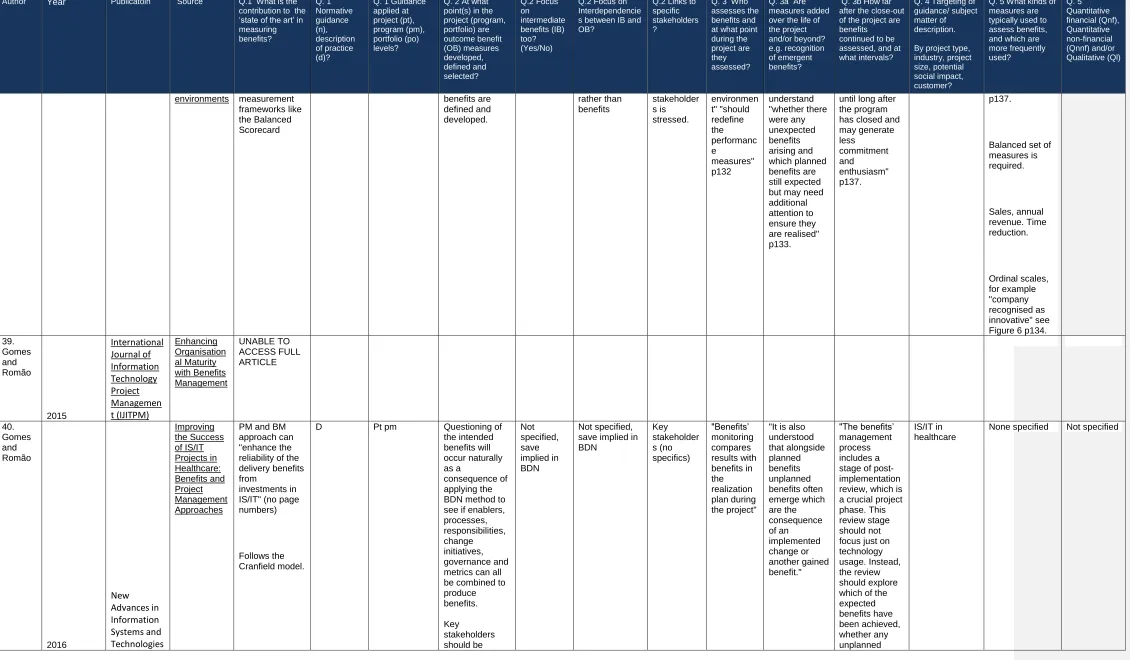
customer? environments measurement
frameworks like the Balanced Scorecard
benefits are defined and developed.
rather than benefits
stakeholder s is stressed.
environmen t" "should redefine the performanc e
measures" p132
understand "whether there were any unexpected benefits arising and which planned benefits are still expected but may need additional attention to ensure they are realised" p133.
until long after the program has closed and may generate less
commitment and
enthusiasm" p137.
p137.
Balanced set of measures is required.
Sales, annual revenue. Time reduction.
[image:30.1191.17.1147.96.756.2]Ordinal scales, for example "company recognised as innovative" see Figure 6 p134. 39.
Gomes and Romão
2015
International Journal of Information Technology Project Managemen t (IJITPM)
Enhancing Organisation al Maturity with Benefits Management
UNABLE TO ACCESS FULL ARTICLE
40. Gomes and Romão
2016
New Advances in Information Systems and Technologies
Improving the Success of IS/IT Projects in Healthcare: Benefits and Project Management Approaches
PM and BM approach can "enhance the reliability of the delivery benefits from
investments in IS/IT" (no page numbers)
Follows the Cranfield model.
D Pt pm Questioning of the intended benefits will occur naturally as a
consequence of applying the BDN method to see if enablers, processes, responsibilities, change initiatives, governance and metrics can all be combined to produce benefits.
Key
stakeholders should be
Not specified, save implied in BDN
Not specified, save implied in BDN
Key stakeholder s (no specifics)
"Benefits’ monitoring compares results with benefits in the realization plan during the project"
"It is also understood that alongside planned benefits unplanned benefits often emerge which are the consequence of an implemented change or another gained benefit."
"The benefits’ management process includes a stage of post-implementation review, which is a crucial project phase. This review stage should not focus just on technology usage. Instead, the review should explore which of the expected benefits have been achieved, whether any unplanned
IS/IT in healthcare