Vision Based Environment Mapping By Network
Connected Multi-Robotic System.
AHMED, M Shuja, SAATCHI, Reza <http://orcid.org/0000-0002-2266-0187>
and CAPARRELLI, Fabio
Available from Sheffield Hallam University Research Archive (SHURA) at:
http://shura.shu.ac.uk/13710/
This document is the author deposited version. You are advised to consult the
publisher's version if you wish to cite from it.
Published version
AHMED, M Shuja, SAATCHI, Reza and CAPARRELLI, Fabio (2013). Vision Based
Environment Mapping By Network Connected Multi-Robotic System. In: Proceedings
of the 3rd International Conference on Pervasive Embedded Computing and
Communication Systems - Volume 1: PECCS. SCITEPRESS, 49-54.
Copyright and re-use policy
See
http://shura.shu.ac.uk/information.html
VISION BASED ENVIRONMENT MAPPING BY NETWORK
CONNECTED MULTI-ROBOTIC SYSTEM
M Shuja Ahmed, Reza Saatchi and Fabio Caparrelli
Materials and Engineering Research Institute, Sheffield Hallam University, Sheffield, United Kingdom m [email protected], [email protected], [email protected]
Keywords: Environment mapping, Object detection, Computer vision
Abstract: The conventional environment mapping solutions are computationally very expensive and cannot effectively be used in multi-robotic environment, where small size robots with limited memory and processing resources are used. This study provides an environment mapping solution in which a group of small size robots extract simple distance vector features from the on-board camera images. The robots share these features between them using a wireless communication network setup in infrastructure mode. For mapping the distance vector features on a global map and to show a collective map building operation, the robots needed their accurate location and heading information. The robots location and heading information is computed using two ceiling mounted cameras, which collective localises the robots. Experimental results show that the proposed method provides the required environmental map which can facilitate the robot navigation operation in the environ-ment. It was observed that, using the proposed approach, the near by object boundaries can be mapped with higher accuracy comparatively the far lying objects.
1
INTRODUCTION
Environment mapping is a process in which a robot sense its surrounding using onboard perception sen-sors and tries to obtain a global map. The generated global map essentially helps the robots to navigate au-tonomously in the environment. Environment map-ping is a challenging problem to address and in most cases, the robots require human assistance if they are exploring the place first time. The main difficulty in environment mapping is that the robots cannot know their locations without having an environment map and at the same time, the robots cannot build the en-vironment map without knowing their locations. In environment mapping problem, in the beginning, the robots go around the environment while localising themselves, keeps on building a map of what they sense in the environment and this way, when they re-visit a place, from the already generated map they get some awareness of their surrounding. Once the full map is obtained, then the robots can perform the path planning efficiently, for example to determine a path to reach some specific location. Some researchers have worked around this problem in which the robots keep on localising themselves and at the same time, they also build the environment map. This is called Simultaneous localisation And Mapping (SLAM) in
approaches adopted by (Wolf and Hata, 2009)(Kwon and Lee, 1999), it can be seen that due to the phys-ical size, high power and processing requirement of the laser range finders, they are used with large size robots. Moreover, a single laser range finder can cost from £800 to £3000 which makes it unsuitable to be used in multi-robotic environment where the objec-tive is also to keep the cost of each robot unit low. In (Biber et al., 2004), the information from the laser scanner is fused with the vision sensor to provide a more accurate map of the environment. But this further increases the computational demands of the approach. In (Howard, 2004)(Latecki et al., 2007) a multi-robot environment mapping problem is ad-dressed. But the results are limited to simulations only. In (Leon et al., 2009), a grid based mapping solution using multiple robots is addressed, but it also utilised high performance systems.
When using a group of small size robots, it is pre-ferred to use simple and computationally less expen-sive algorithms such that, the task can be achieved with limited processing resources. In this research, a distributed vision based multi-robot environment mapping problem is addressed in which a group of robots collectively try to obtain a common global map of the environment using the visual clues they ob-tain from their surrounding. The generated map is intended to facilitate the multi-robot mission planning as the environmental map together with the robots po-sition on the map will be available. The problem ad-dressed here is different from SLAM as in this case, the robots are provided the localisation information from the ceiling mounted camera system. The robots can share information through a wireless communica-tion medium. This medium is usually prone to noise and act as a bottle neck for information distribution. So in this research, it is aimed that the robot relies on simple visual features from the images such that it does not overload the network and at the same time, it is sufficient to map the environment collectively. These visual features are represented in the form of a vector which are extracted by determining the dis-tance to the neighbouring object using vision informa-tion. Knowing the robot camera field of view, this dis-tance vector feature can be used to map the environ-ment if precise robot location and orientation are pro-vided. In the following sections, the complete multi-robot environment mapping approach is presented.
2
METHODOLOGY
To address the multi-robot environment mapping problem, two Surveyor SRV1 robots equipped with
the vision sensor were used. The Surveyor robot (Surveyor-Corporation, 2012) is shown in Figure 1a. For obtaining the robot localisation information, a ceiling cameras based robot localisation system was used. This system comprises of two ceiling mounted cameras and a server system. Using the visual infor-mation from the two ceiling mounted cameras, this system is responsible to determine the robots’ posi-tions, track them and pass them to the robots. Each robot creates an environmental map in its memory. This map is also updated by all the other robots work-ing in the environment. For this purpose, each robot gets its location and orientation information from the localisation system. Once a robot knows its location and orientation (as explained in Section 2.2), then in the direction of its heading, it utilizes the visual clues it obtained from its vision sensor and deter-mines the surrounding objects boundaries. The robot uses these detected boundary information to update its own map. Apart from updating its own map, the robot also broadcasts this map update information to the other members in the environment. On receiving this map update information, each robot in the envi-ronment also updates their map. This way, each robot in the environment not only knows the other robot’s positions but at the same time, it also keeps on main-taining a common map which is built by the contribu-tion of all the robots in the environment. Each robot also passes the map update information to the server, which is running the ceiling cameras based locali-sation system. This way, the map building process can be seen on the server side. As the robots being used have limited on-board memory and processing resources, so it was decided to use a very light weight vision algorithm to solve this problem. This problem was divided into two parts, that is Objects’ Boundary Detection, Robot Localisation and Mapping. These are explained in the following sections.
2.1
Objects’ Boundary Detection
algorithm, an example image in Figure 1b is consid-ered. After performing the segmentation of this im-age, the resultant image is shown in Figure 1c. To determine the distance to near by obstacles or to de-termine the boundaries of the obstacles in the field of view, the region covering the middle bottom of the segmented image was considered for further process-ing. After processing this region, the distance to the boundaries of the objects, in the robot field of view, were determined in pixels. The boundary information was obtained in the form of a distance vector feature. This feature vector provided the distance (in pixels) to all the objects in robot’s field of view and is shown in the Red colour in Figure 1d.
Figure 1: (a) Surveyor SRV1 robot. (b) Input image. (c) Segmented image. (d) Distance vector feature.
2.2
Robot Localisation
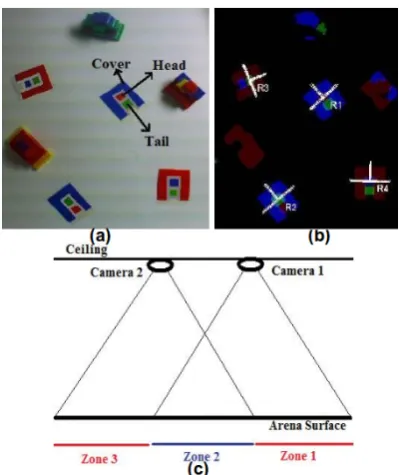
Once the robots have computed the distance vector, then to use this distance vector on the global map, robots required their accurate location and heading (orientation) information. For this purpose, a multi-camera based robot localisation system, comprising of two ceiling mounted cameras, was used. For robot localisation, the system was programmed to recognise coloured passive markers mounted on the top of the robots. The passive markers recognition technique is presented in detail in (Ahmed et al., 2012a). The template used for the markers is shown in Figure 2a. The localisation system identifies the Cover, Tail and Head regions of the markers as identified in Figure 2a and determines the robot location and heading in-formation as shown in Figure 2b (Four robots using different colour markers are identified).
To provide robot localisation over the test arena, the use of single camera was not sufficient as it does not cover the entire arena. For this purpose, two ceil-ing cameras were used. The entire arena was divided
into three zones and each ceiling camera was respon-sible to localise the robots in different zones, as shown in Figure 2c. Camera 1 covers zone 1 and 2, whereas, camera 2 covers zone 2 and 3. As zone 2 is visi-ble to both the ceiling cameras, so the robot local-isation information in zone 2 is provided by fusing the information from both the cameras. Both ceil-ing cameras collectively localised the robots and pro-vided this localisation information to the robots over a wireless communication medium setup in the in-frastructure mode. The localisation system provided each individual robot the location information of all the robots identified in the arena. This way, when the robots generated the map using the distance vec-tor information, they created a window around the de-tected positions of other robots and avoided generat-ing maps in those windowed regions. This helps to avoid erroneous mapping of the boundaries detected in the distance vector from the surfaces of the other robots. This way, the boundaries detected from only obstacles and arena walls are considered for mapping.
Figure 2: (a) Markers template. (b) Robots localisation and heading. (c) Localisation system (Ahmed et al., 2012a).
2.3
Mapping
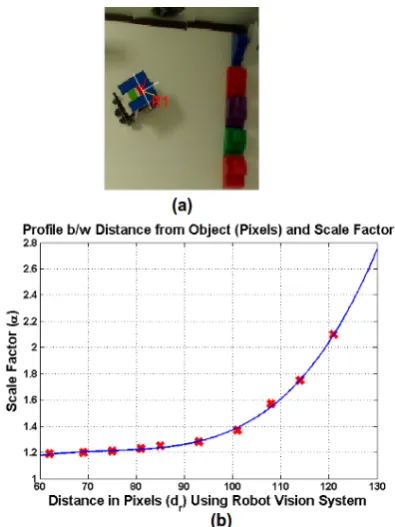
[image:4.595.93.271.265.420.2] [image:4.595.315.515.345.583.2]robot field of view (i.e. 90 deg) is shown by the Red and Yellow coloured lines. To map vector feature on the global map, an equation is derived which trans-lates the distance (in pixels) detected by the robot, to the distance in image space of the ceiling cameras. This is carried out because the robot is localised in the image space of the ceiling cameras. To obtain this equation, an object was placed at some distance from the robot. Then the distances to the object, detected by the robot and also by the ceiling camera, were recorded. Ten experiments were performed while in-creasing the object distance from the robot camera. The data recorded are shown in Table 1.
Table 1: Scale factor: From robot to ceiling camera.
dr(Robot) dc(ceiling camera) Scale Factor(α) (in pixels) (in pixels)
62 74 1.19
69 83 1.20
75 91 1.21
81 100 1.23
85 106 1.25
93 119 1.28
101 138 1.37
108 170 1.57
114 199 1.75
121 254 2.10
In Table 1, the first and the second columns show the distancedranddcdetected by a robot and the ceil-ing camera, respectively. The third column shows the scale factorαbetweendr anddc. The scale factor is obtained whendc is divided by dr and it is used to translate the distance detected by the robot to the dis-tance detected by the ceiling camera. In Figure 3b,
αis plotted against dr in Red colour and the fitting equation (Eq 1) for this profile is obtained. The pro-file generated using Eq 1 is also shown in the Blue colour. From Figure 3b, it can be seen that the value of scale factor varies depending upon the distance de-tected by the robot. This shows that, objects dede-tected near the robot, will be mapped with higher accuracy compared to far lying objects. Note that, as the vec-tor of distance feature is generated, a vecvec-tor of corre-sponding values ofαialso generated.
αi=4.4e−8dri4−7e
−6d3
ri+0.00011dri2+0.028dri+0.0051 (1)
Wherei=1→320(Image width). Whenαiis multi-plied withdri, then the corresponding values in ceiling camera coordinatesdciis shown in Eq 2.
dci=driαi (2)
From Figure 4a, dci can also be described (Eq3) in terms of the robot localisation (i.e. the
coordi-Figure 3: (a) Robot field of view. (b) Fitting curve and Profile b/wdrandα.
nates of robot position (x,y)) and the final coordi-nates (xmi,ymi) where the object boundaries will be mapped.
dci=
q
(xmi−x)2+ (ymi−y)2 (3)
Similarly, the slope valuessi (Eq4) for everydci can be computed using(xki,yki)(i.e. coordinates spanning the robot field of view - see Figure 4a).
si= yki−y xki−x
=ymi−y xmi−x
(4)
Now using the values of dci along with the corre-sponding slope valuessiand the position coordinates (i.e.(x,y)), the coordinates(xmi,ymi)can be computed for mapping the object boundaries. The equation used to computexmiandymiis shown in Eq5.
xmi ymi =
h d
ci √
1+s2 i
+x √sidci
1+s2 i
+y i (5)
Figure 4: (a) Mapping process (b) Distance vector. (c) Map.
3
RESULTS
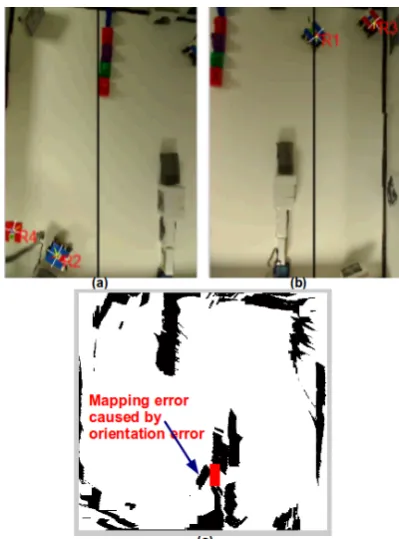
For experimentation, a test platform was designed with obstacles placed in predefined forms and all the robots were programmed to follow the boundaries in the environment and map them. For robot localisa-tion, the environment images provided by the left and right ceiling cameras are shown in Figures 5a and 5b, respectively. Four robots (labelled as R1, R2, R3 and R4) were detected by the cameras. Robots R3 and R4 are not participating in the map building. They are static, but as they are tagged with the passive mark-ers, so they are detected as robots R3 and R4 by the ceiling mounted cameras. Whereas, robots R1 and R2 are working collectively to map the environment. In these images, some blocks and boxes are placed in the vertical direction to generate an environment. The two robots R1 and R2 are expected to go around in the environment and they will use the visual clues from their vision sensor together with the information from the ceiling cameras. This way they will map the test arena boundary and walls made by the blocks.
The environment mapping process was a slow op-eration because after every move, the robots needed to wait so that the tracking system locks their current position and provide them their location information. This was done so that the robots are provided their location and orientation information which precisely represent their current position. This was important as robots had to use this vision based location and orientation information as the basis for mapping the objects boundaries detected in the field of view of their vision system. If this information corresponds to the robot’s earlier position, then inaccuracies in the map are expected. For example, a small error in the orientation information can generate considerable er-ror in the mapped boundaries. The two robots were
Figure 5: (a) Left ceiling camera image. (b) Right ceiling camera image. (c) Map.
kept operative for 4 minutes and 21 seconds. After the experiment finished, the generated map is shown in Figure 5c. As mentioned before, a mapping error caused by a small error in the detected robot orienta-tion is also pointed out by the Blue coloured arrow in Figure 5c. The actual location where this boundary should be mapped is drawn in Red colour.
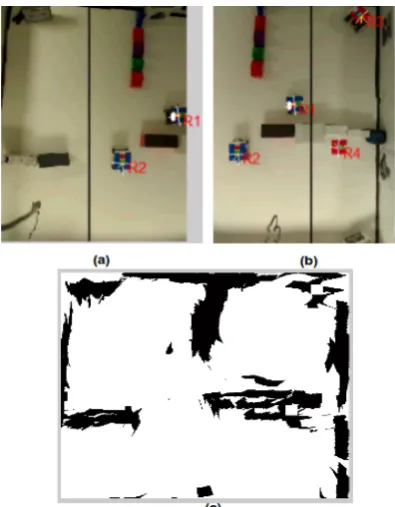
In another experiment, the environment was al-tered by placing the objects in different order such that they contribute to a different map. The place-ment of objects for the generation of the new envi-ronment is shown in Figures 6a and 6b. As the ob-jective of this scenario was to demonstrate the collec-tive vision based map building operation by a team of robots rather than the efficient robotic control, so the robot control algorithm performs simple vision based boundary following operation. At the end of the test, the robots have generated sufficient environ-mental map as shown in Figure 6c.
[image:6.595.314.514.91.361.2] [image:6.595.74.305.93.265.2]used does not have a square shape (i.e., their length and width is not same). As it was difficult to recognise the pose of the robots (i.e., the robots detected in the distance vector), so some of the boundaries detected from their surfaces, got mapped erroneously. It was also observed that, in both the experiments, some of the regions remained un-mapped. This was expected as the robots were not using any strategy to determine which regions of the arena are mapped. To overcome this, a path planning strategy can be used which in-forms robots about the regions which needed to be explored and mapped. This will also reduce the time taken by the robots to map the environment.
Figure 6: (a) Left ceiling camera image. (b) Right ceiling camera image. (c) Map.
4
CONCLUSION
We have proposed a method in which a simple vi-sion based distance feature vector is computed and is shared between the small size robots to generate en-vironment map collectively. The accurate generation of the map also depends on the precise robot location and orientation information which is provided by the ceiling mounted cameras. However, the use of simple distance vector features not only facilitates the multi-robot map building process, but it also does not over-load the communication network between the robots. The generated map can facilitate the robots to
navi-gate and solve the mission planning task in which the detail environmental map is required.
ACKNOWLEDGEMENTS
Funded by EU-FP7 research project REPLICATOR.
REFERENCES
Ahmed, M., Saatchi, R., and Caparrelli, F. (2012a). Vision based object recognition and localisation by a wire-less connected distributed robotic systems. In Elec-tronic Letters on Computer Vision and Image Analy-sis, Vol.11, No.1, Pages 54-67.
Ahmed, M., Saatchi, R., and Caparrelli, F. (2012b). Vision based obstacle avoidance and odometery for swarms of small size robots. InProceedings of 2nd Interna-tional Conference on Pervasive and Embedded Com-puting and Communication Systems, Pages 115-122. Biber, P., Andreasson, H., Duckett, T., and Schilling, A.
(2004). 3d modeling of indoor environments by a mo-bile robot with a laser scanner and panoramic camera. InIEEE/RSJ International Conference on Intelligent Robots and Systems (IROS). Vol.4, Pages 3430-3435. Howard, A. (2004). Multi-robot mapping using manifold
representations. InIEEE International Conference on Robotics and Automation(ICRA), Vol.4, Pages 4198-4203.
Kwon, Y. and Lee, J. (1999). A stochastic map building method for mobile robot using 2-d laser range finder. InJournal of Autonomous Robots, Vol.7 No.2, Pages 187-200.
Latecki, L., Lakaemper, R., and Adluru, N. (2007). Multi robot mapping using force field simulation. InJournal of Field Robotics, Vol.24, Pages 747-762.
Leon, A., Barea, R., Bergasa, L., Lopez, E., Ocana, E., and Schleicher, D. (2009). Multi-robot slam and map merging. InJournal of Phyical Agents, Vol.3, Pages 171-176.
REPLICATOR (2008). Robotic evolutionary self-programming and self-assembling organisms. In
EU-FP7 Research Project REPLICATOR. URL: http://symbrion.org/.
Shen, Y., Liu, J., and Xin, D. (2008). Environment map building and localization for robot navigation based on image sequences. InJournal of Zhejiang Univer-sity ScienceA, Vol.9, No.4, Pages 489-499.
Surveyor-Corporation (2012). Surveyor srv-1 open source mobile robot. Inwww.surveyor.com/.
SYMBRION (2008). Symbiotic evolutionary robot or-ganisms. InEuropean Communities 7th Framework Programme Project No FP7-ICT-2007.8.2. URL: http://symbrion.org/.
[image:7.595.81.279.254.508.2]