DIMELOW, Nicola, WALKER, Ann and HEAVEY, Lisa
Available from Sheffield Hallam University Research Archive (SHURA) at: http://shura.shu.ac.uk/7607/
This document is the author deposited version. You are advised to consult the publisher's version if you wish to cite from it.
Published version
DIMELOW, Nicola, WALKER, Ann and HEAVEY, Lisa (2013). Group work experiences. Student Engagement and Experience Journal, 2 (1).
Copyright and re-use policy
See http://shura.shu.ac.uk/information.html
Sheffield Hallam University Research Archive
Research Article
Group Work Experiences
Nicola Dimelow
1, Ann Walker and Lisa Heavey
Department of Psychology, Faculty of Development and Society, Sheffield Hallam
University, Sheffield, United Kingdom
Copyright © 2013 Nicola Dimelow, Ann Walker and Lisa Heavey. This is an open access journal article
distributed under the Creative Commons Attribution License, which permits the unrestricted use,
distribution, and reproduction in any medium, provided the original work is properly cited.
Abstract
Research suggests that the majority of students in HE derive a positive
experience of group work during their studies (Burdett 2003; Orr 2010; Payne et al. 2006; Maiden and Perry 2012; Walker 2001), although there are differences between students in the individual time and effort they invest. The perceptions of higher-contributing students have been documented (Orr 2010), although the experience of students who contribute less has yet to be systematically explored. An on-line questionnaire, developed to assess students’ experience of group work, was administered to 58 undergraduate and postgraduate social science students. The questionnaire explored the following in relation to group work: (1) positive aspects and skill development; (2) negative experiences; (3) extent of students’ own contribution; (4) experience of bullying and harassment
behaviours. Open-ended, qualitative items were also included to supplement the questionnaire data. In line with previous research, the majority of the sample rated their group work experience positively, identifying a range of benefits from this process. Students’ explanations for reduced input to group work ranged from a preference for independent work to the experience of negative interactions between group members, including bullying behaviour. Implications of the findings are discussed, including the need for strategies to safeguard against bullying behaviour in group work.
1 Corresponding author Nicola Dimelow [email protected]
Dimelow, N., Walker, A. and Heavey, L. (2013). Group Work Experiences. Student Engagement and Experience Journal, 2(1), http://dx.doi.org/10.7190/seej.v1i1.63
2 Introduction
A review of the literature on students’ perceptions and experiences of group work in
higher education suggests that for the majority of students these experiences are
perceived as positive (Burdett 2003; Orr 2010; Payne et al. 2006; Maiden and Perry
2012; Walker 2001). Students view group work as enhancing their learning experience
by providing preparation for work (Maiden and Perry 2012), experience of team and
collaborative working (Orr 2010; Burdett 2003) and occasionally culturally diverse
interactions (Montgomery, ND). However, there is also a large minority of students
who express negative feelings towards group work. For example, after investigating the
group work experiences of 105 final year business students attending an Australian
University, Burdett (2003) reported that 36% of the students had not enjoyed their
group work experience. Reasons for non-enjoyment included preferring to work alone,
perceiving that they did most of the work with the workload being shared unfairly, and
feeling disgruntled over the way in which marks were awarded. Similar reasons for not
enjoying group-work were also found with a sample of first and second year
undergraduate students taking a psychology course in an English university. The
study's authors, Pauli et al. (2008), identified four factors associated with dysfunctional
group work experience. These factors include unequal contribution, disorganisation,
storming (a stage of group formation) and the emergence of fractionalised groups. The
fractionalised group factor was characterized by excluding or isolating a member or
picking on one person and the storming factor included intra-group gossiping and
arguments, both of which are considered to be forms of bullying behaviour(Cooper and
Curzio 2012). This is concerning considering that experiencing bullying behaviour can
lead to the individual adopting coping strategies which include group avoidance
(Schenk, and Fremouw 2012). It is worrying that this type of behaviour can and does
occur, although in many respects it is not surprising considering that bullying behaviour
is frequently reported amongst school-aged pupils (e.g., Horne, Stoddard and Bell 2007)
and in the workplace (e.g., Hoel et al. 2010).
Both in the UK and abroad, there are very few studies which have examined
bullying behaviour amongst university students. However, in 2008 the National Union
of Students (NUS 2008), as part of a questionnaire survey into student experiences,
3
results showed that whilst 7 per cent of their 3,135 student participants had experienced
bullying, either by fellow students or members of staff, only 29 per cent of these
students had reported it to someone at their university. More recently, Cooper and
Curzio (2012) reported on pre-registration student nurses experiences and perceptions
of peer bullying whilst studying at a London university. Their results showed that both
at foundation and branch level, approximately 8% of students reported experiencing
physical forms of bullying (i.e., striking the person or their property) whilst
approximately 25% reported experiencing verbal (i.e., verbal abuse and name calling)
and non-verbal (i.e., exclusion and the withholding of information) forms of bullying.
What was also concerning about Cooper and Curzio's results was that a lot of the
participants did not identify as bullying the types of behaviours which are considered to
constitute bullying, e.g., striking another person, withholding information, intentionally
lowering someone's self-esteem through making fun of them, ignoring or excluding
behaviours. This latter result suggests that incidences of bullying amongst university
students may therefore be higher than those reported by either the NUS (2008) or
Cooper and Curzio (2012). A possible explanation for why students fail to identify
some behaviour as bullying can be found in the work of Monks and Coyne (2011). In
their book "Bullying in different contexts", Monks and Coyne (2011) discuss how in the
UK the term "bullying" has historically been reserved for school bullying with other
classifications been used to describe similar behaviours which occurs in specific
situations and/or at specific stages of the lifespan. Examples include: domestic
violence, peer victimization, elder abuse, systemic institutional abuse and harassment.
Also, currently in the UK, there is no anti-bullying legislation, therefore if an individual
or group wants legal address due to having experienced bullying they have to make
their case based on legislation usually related to discrimination and/or harassment. The
fact that in the UK the term bullying is primarily associated with school aged pupils
may possibly be a reason for why some of the nursing students in Cooper and Curzio's
(2012) study failed to identify some of the behaviours as bullying because they
associate these behaviours with more adult classifications, for example, harassment, for
which there is the opportunity for legal address. Because of differences in
understanding about what constitutes bullying, and also because there is no universally
accepted definition for bullying (Smith 2011), researchers have tended to provide their
4
Newman, Horne and Bartolomucci (2000) referred to as the double I-R rule of bullying.
The first “I” refers to the behaviour as being intentional implying that harm was meant to come from the behaviour. The second “I” stands for imbalance of power in that the
victim is of a lower standing and the R for insinuates that bullying behaviour is not a
one off incident but a repeated act. However, as discussed by Smith (2011), whilst
historically these definitions have included the need for the act to be repeated and for a
power imbalance between the bully and victim, since the onset of cyber bullying this is
no longer so clear cut.
As reported by both Burdett (2003) and Pauli et al. (2008) as well as other
researchers (e.g., Maiden and Perry 2012; Myers et al. 2009; Orr 2010; Walker 2001),
students perceiving inequalities in the contributions made between the different group
members is one of the main reasons that students give for not enjoying group work.
This is often because the student making the report perceives that s/he has made a
greater contribution compared to other group members who, when the group work is
contributing to a group assessment task, unfairly benefit by receiving the same or a
similar mark to the other team members. Those students who make a much smaller
contribution are commonly referred to as “freeloaders” or “social loafers” (Daly and
Worrel 1993; Karau and Williams 1993; Orr 2010) because they are perceived as riding
on the backs of the other group members.
Due to the previous literature demonstrating that not all HE students find
group-work to be a positive experience and the possibility that some students may be
experiencing bullying due to group-work participation, the following study was
undertaken with the aim of identifying where improvements to practice are required.
An online questionnaire was used as a private, convenient and non-pressured method of
data collection. The survey was designed to assess both positive and negative
experiences of group work in undergraduate and postgraduate students, including the
5 Method
Participants
All students taking courses in psychology, sociology and politics at a northern UK
university were emailed invitations to participate in the study (N=1046 registered
students). Fifty-eight (9 male, age range 18-55, mean = 26.37 [9.33] years) students
returned completed questionnaires. Four had English as an additional language and 14
had previously attended a different university. A similar number of students participated
from each of the degree levels, from first year (level 4) undergraduates up to and
including Master's degree students(level 7) (level 4 25%; level 5 23.4%; level 6 32.8%
and level 7 18.8%).
Context
The students were responding to questions regarding various forms of group work. The
majority of students had experience of both assessed and non-assessed group work, with
only 7 participants having no experience of assessed group work and 3 with no
experience of non- assessed group work. Group work was also considered when
students had volunteered to work as a group rather than individually with 17 of the
participants occasionally self-selecting group work (on 1-4 different occasions) and 5
reporting regular practice of self-selected group work (7 or more times). Group
formation was either tutor led or self-selected. Examples of assessed group work typical
to Psychology degree courses include; designing and exhibiting an academic style
poster, writing a research proforma on a live wiki style document and collecting,
analysing and reporting data which is written up as a group report. Examples of
non-assessed group work projects are; completing a Problem-Based Learning activity which
forms the base for individually written and assessed reports, designing a study and
collecting data which is then written up and assessed as individual reports, presenting a
non-assessed paper or theory to peers using PowerPoint. Normally the duration period
for an assessed group work task would be longer than non-assessed projects with the
6 Materials
An online survey was developed using Survey Monkey to assess students' perceptions
of group work and observations of bullying and harassment in group work activities.
The survey consisted of two main sections. Section A measured demographics using
twelve questions including age, sex, level of study and responsibilities (including paid
and voluntary work and caring for others such as children, partner, sibling or parent).
Section B, which consisted of 4 subsections, focussed on the students' experiences of
group work. Subsection 1 explored general experiences of group work including skills
development. The items were derived from Burdett (2003) and students answered on a
4-point Likert scale, anchored strongly agree to strongly disagree. Examples of items
are: "My experience of group work has been positive", "I found that I did most of the
work during group work"," Group work had enabled me to develop important skills
including negotiation skills with group members". Subsection 2 asked the students to
rate the degree to which they had experienced negative aspects of group work, with the
items adapted from Pauli et al. (2008). Students were required to rate the level of their
previous experience on a 4-point Likert scale anchored from no experience to constant
experience. Examples of items are: "Group problems seem to arise as deadlines
approach", "Group member not completing their allocated work", "Other group
members falling out with each other". Subsection 3 required the students to rate their
own contribution to a group work task using a 4-point Likert scale again anchored from
no experience to constant experience. Furthermore, students confirmed if they reported
their contribution to be less than others in the group (i.e., freeloading) and to provide
reasons for their lesser contribution from a range of 9 options including " I did not
understand the task", "I did not like the group members", There was also an "other"
option which could be elaborated upon by providing a written description. The final
segment (Subsection 4) asked the students to report on their experiences of
bullying/harassment behaviours, using a 5-point Likert scale anchored from never to
constantly, based on Chapell et al. (2004). An opportunity was given for students to
provide details of witnessed bullying or negative behaviours related to group work. The
students were provided with the following definitions:
7
Harassment is when a person engages in unwanted conduct related to one or more of the following protected characteristics: disability, gender reassignment, marriage or civil partnership, pregnancy and maternity, race, religion or belief, sex or sexual orientation, and the conduct has the effect of violating another person’s dignity or creating an intimidating, hostile, degrading, humiliating or offensive environment for them (Equality Act 2010, 13).
Qualitative questions were included to elicit more detail in areas of negative behaviours.
Procedure
An invitation email sent to the students informed them of the purpose of the study, their
ethical rights and provided a link to SurveyMonkey. Consent to use the data was sought
using the final survey item "Are you happy for your responses to this survey to be used
in our report?" This question had to be answered positively to complete the survey.
Results
The majority of students (63.8%) reported positive experiences of group work, either
agreeing (51.7%) or strongly agreeing (12.1%) with the statement "My experience of
group work has been positive". As demonstrated in Figure 1, the majority of students
acknowledged that group work was beneficial for developing a range of related skills.
68.9 70.7
61.4 60.3
84.5
77.2 84.5
[image:8.595.128.427.464.757.2]0 10 20 30 40 50 60 70 80 90
Figure 1. Percentage of participants reporting particular skills developed during group work
8
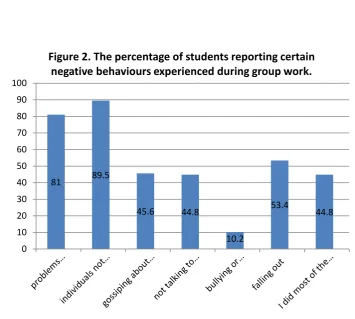
Figure 2 shows that students experienced a number of problems in their groups
ranging from a very high response rate for “group members not completing their share of the work” and “problems as deadline approached” to a medium response rate for “falling out”, “gossiping”, “not talking to each other” and “I did most of the work”, to a low response rate for “bullying or harassment.”
Whist over 40% of the students reported having done most of the work (Figure
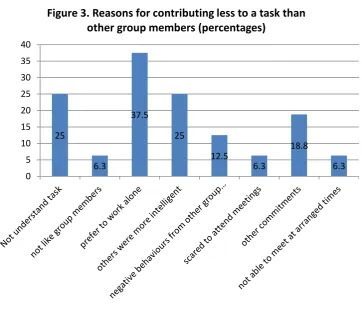
2) just over a quarter (28.1%) of students reported that they personally had contributed
less than other members of their group. The reasons that were given for this lesser
contribution are presented in Figure 3. The most frequent responses were “preferring to work alone”, “not understanding the task” and “others were more intelligent than me” whilst the least frequent responses were “negative behaviours from other group members”, “not liking other group members” and “being scared to attend meetings”.
Details provided in the "other" response option suggested that for some students, social
anxiety led to reduced contribution to a group task or that their contribution was
perceived as less because other group members completed more work than had been
delegated to them. Therefore, those who only submitted the work that had been
81 89.5
45.6 44.8
10.2
53.4
44.8
[image:9.595.122.478.190.509.2]0 10 20 30 40 50 60 70 80 90 100
9
allocated to them contributed less by default. The qualitative responses demonstrated
frustration leading to sub-factions and negative behaviours. For example, one student
described how other students in her group made negative comments about her work on
Facebook but were very pleasant to her face. Another comment suggested that group
members were excluded as another member failed to communicate with them. Others
indicated their frustration and unfairness of the group work process, which was related
to freeloading: for example, the "group work" that was submitted was the work of one
member of the group but was attributed to all group members.
Just over 10% (n=6) of the students responded to the final question, which asked
them to report on their experiences of bullying/harassment behaviours during
group-work activities. Their written responses included examples of exclusion practices
including group members being ostracised by other members who refused to work with
them and group members making negative comments about other members in front of
them. All of the written responses suggested that the behaviour constituted bullying
rather than harassment. However, as the reasons why students were treated in this
manner were inferred rather than made explicit, for example, in the above quotes the
25
6.3
37.5
25
12.5
6.3
18.8
6.3 0
[image:10.595.123.486.248.561.2]5 10 15 20 25 30 35 40
10
excluding behaviour does not appear to be due to any of the criteria covered by the
Equality Act (2010).
Discussion
In line with previous studies, e.g., Burdett (2003), the majority of the students agreed
that their previous experience of group work had been positive. However, there was a
large minority who disagreed. What is of interest here, is that many of the students who
reported negative experiences still regarded group work as important for developing
work-related abilities including communication (assertiveness, listening to other
people's views, and conflict resolution); and project management skills (learning to
share the work load and to work as a team). This suggests that students who perceive
their personal experience of group work negatively still recognise the value of group
work for skill development.
Over 40% of the students reported doing most of the work for their group whilst
just over 25% reported making a lesser contribution than other group members. This
indicated that a large proportion of participants felt that they contributed more than
other members to the task which is slightly contradictorily and presents a challenge for
interpretation as in reality it is unlikely that 40% of group members deliver most of the
work. There are two explanations for this finding; firstly it may reflect a response bias
in that the respondents did feel that they contributed most of the work and this perceived
lack of fairness in the group work process motivated them to respond to the survey.
Secondly, it is conceivable, given the large number of students reporting to have
contributed the most to a group work project, that the feeling of contributing more than
other group members may not reflect the reality with students under valuing the
contribution of other group members. The finding that 25% of participants made a
lower contribution suggests that some group members who make a lesser contribution
are prepared to acknowledge this, so therefore they may not view this behaviour as
negatively as high contributing students do. In addition, it demonstrates that unequal
contribution to group work is a genuine phenomenon as it is evidenced by both students
who make a greater and a lesser contribution. One of the strengths of the present study
design is that it asked those group members who made a lesser contributions the reasons
11
In the previous literature (e.g., Daly and Worrel, 1993; Karau and Williams,
1993; Orr, 2010), it is the students who perceive themselves to be making the largest
contribution to the group work who are asked to give their reasons for why other
students make a lesser contribution. Their explanations paint a negative picture of these
students as "freeloaders" or "social loafers". However, in the present study it was the
students who made the smaller contribution who were asked for their reasons for doing
so. Whilst the most frequently given reasons were “preferring to work alone”,
“perceiving others as more capable” and “not understanding the task”, a small number of students cited “negative behaviours from other group members”, “being scared to attend meetings” “not liking other group members”. Each of these responses is now
considered in turn.
In regards to working alone, this was a reason given in Burdett’s (2003) study,
and suggests that some students do not fully participate in group work because they
have a preference for working independently. This preference for independent work
may be in part due to individual difference factors including mental health (Honey and
Mumford 2001) and personality (Walker 2006). However, due to the design of the
current study it is not possible to say why the students preferred to work alone but the
afore-mentioned reasons are worthy of future investigation.
The responses, “perceiving others as more capable” and “not understanding the task” are considered together. Both of these responses suggest that these students may
be lacking in confidence about their ability to make a satisfactory contribution to the
group. When planning group activities tutors need to build in processes which enable
less confident students to obtain clarification and/or assistance without it being brought
to the notice of other group members as this could lead to bullying, victimization or
harassment. One way this can be done is by the tutor having a system through which
students can book a private appointment to discuss anything that they are concerned
about with their course. If this is standard practice, then if students who require the task
clarifying or who feel overpowered by their other group members attend, it is unlikely
to be noticed or commented on by the other group members.
The responses “negative behaviours from other group members”, “being scared to attend meetings” and “not liking other group members” are also considered together
12
behaviour by the other group members or to the student being concerned that they may
experience these behaviours. Again, there is a need for further research here to identify
the reasons why students provided these responses, but the written responses provided
in the current questionnaire demonstrate that some students were experiencing bullying
behaviour from other members of their group and that this was stopping them from
making a full contribution.
There is virtually no previous research on the topic of bullying during group
work in higher education, although Pauli et al. (2008) did identify fractionalised group
behaviour, which has similar characteristics to the bullying behaviours described by
Cooper and Curzio (2012). In the current study 10 percent of students reported that
they had experienced bullying behaviour whilst engaged in group work. Although this
figure is considerably lower than the rates reported by Cooper and Curzio (2012) it is
higher that the rates reported by the NUS (2008). As discussed in the introduction,
students vary in the specific behaviours that they classify as bullying. This variation
could have been intensified in the current study as the measure that was used provided
separate responses for bullying, gossiping about other members, not talking to each
other and falling out. Interestingly, the latter three behaviours share similar
characteristics to the bullying behaviours described by Cooper and Curzio (2012).
Therefore, as the percentage of students who reported these three behaviours was much
greater than those who reported experiencing bullying, future research needs to include
a much clearer description of these behaviours, especially in regards as to whether or
not they constitute bullying. After recognizing that bullying behaviour was a serious
problem for many nursing teams, The Royal College of Nursing (Beale and Leather
2005) introduced a series of self-assessment tools. They encouraged nursing teams to
use these tools with the aim of educating nursing staff as to the nature and prevalence of
bullying behaviour within their team and to promote a culture change so that bullying
was less likely to happen in the future. It could be that a tool of this nature needs to be
used when students are working in groups in university settings.
As noted in the results section, it was also not clear from the written responses
of the students who reported that they had been bullied, whether the behaviour
constituted bullying or harassment. In the UK, this is an important consideration, as
13
it has to contain an element of harassment and/or discrimination as defined by law. It is
possible that in the current study students avoided describing the behaviour that they
experienced as harassment as they wanted to avoid any repercussion that might have
arisen if they had reported being the recipient of illegal behaviour. Alternatively, it
could be that many students do not have a clear understanding of what constitutes
bullying or harassment or the differences between the two classifications.
There were a number of limitations to this study. The sample size was small and
may present a response bias from those students who have had negative experiences, as
they may have been more motivated to report these compared to those students who had
only had positive experiences of group work. Furthermore, the students represented
particular courses and their experiences may not reflect those on other courses, although
some of the findings are in line with performing arts students (Orr 2010) and business
students (Burdett 2003). Due to the design of the study it was impossible to gauge if
positive or negative perceptions and experiences were related to how the group was
formed. For example, if the students were allowed to choose who they worked with as
opposed to having to work with students who they did know or who they had already
formed a negative opinion of. Previous research has suggested that negative group
experiences are perceived to be more common in tutor allocated groups than
self-selected group (Mahenthiran and Rouse 2000) but others suggest that whilst students
may prefer self-select groups (Burdett, 2003) in practice these groups still encounter
negative group work issues (Maiden and Perry 2011). Due to the study design it was
also not possible to fully establish the explanation behind the reason students gave for
making a lesser contribution to the group work. Future studies could use interviews
rather than questionnaires which would allow for deeper probing. Furthermore, since
this survey was conducted at the end of the academic year it is reasonable to assume
that the reporting was retrospective and memory of events may have been
misrepresented. Future research is required in which perceptions towards group work
are measured immediately after a group task is completed and at the start of a new
group work task to investigate whether respondents maintain a consistent perception or
if there are other factors besides previous experience which influence their perception of
14
It is also notable that many of the students who reported their group work
experience had been positive, still reported having experienced some of what are
considered to be the more negative group work behaviours, for example, other members
of the group not completing their share of the work, problems with approaching
deadline and falling out within the group. As group work participation is important for
skill development it would be beneficial if further research was carried out using
regression or path analysis to establish the relationship between students' perceptions of
group work, either positive or negative, and the type of experiences that they have had.
This research could also examine if there are individual difference factors, for example,
personality, learning styles, self-efficacy beliefs, coping styles and motivation, which
mediate the relationship between experiences, and attitudes towards group work.
Conclusion
The results of the present study and those of others (e.g. Pauli et al. 2008; Burdett
2003), suggest that for the majority of students higher education is providing a suitable
environment to develop group working skills. However, universities are under
increasing pressure to ensure that all students, not just the majority, receive a positive
educational experience with good outcomes. The current study has demonstrated that
for some students their experience of group work can include bullying and other
negative behaviours, which can lead to students being unable to take a full active role
within their groups. As with the Royal College of Nursing (Beale and Leather 2005),
universities need to develop a culture where bullying is dealt with before rather than
after it has happened. It is therefore suggested that further research needs to be carried
out in this area and that measures need to be put into place so that the potential for
bullying and other negative behaviour is identified and mitigated against before it
happens.
15 References
Beale, D. and Leather, P. (2005). Working well initiative: Improving working
relationships in health care: self-assessment tools. The Royal College of
Nursing.
Belbin, R.M. (2010). Management Teams: Why They Succeed or Fail, 3rd ed.
Amsterdam: Butterworth Heinemann.
Burdett, J. (2003). Making Groups Work: University Students' Perceptions.
International Educational Journal, 4, 177-191.
Chapell, M., Casey, D., De La Cruz, C., Ferrell, J., Forman, J., Lipkin, R., Newsham,
M., Sterling and M., Whittaker, S. (2004). Bullying in college by students and
teachers. Adolescence, 39 (153), 53-64.
Cooper, B. and Curzio, J. (2012). Peer bullying in a pre-registration student nursing
population. Nurse Education Today, 32, 939-944. CrossRef
Daly, J.P. and Worrel, D.L. (1993). Structuring group projects as miniature
organizations. Management Education, 17, 236-242. CrossRef
Equality Act. (2010). The National Archives. [Online] Last accessed 24 March, 2013 at:
http://www.legislation.gov.uk/all?title=harassment
Hoel, H., Glaso, L., Hetland, J., Cooper, C.L. and Einarsen, S. (2010). Leadership styles
as predictors of self-reported and observed workplace bullying. British Journal
of Management, 21, 453-468.
Horne, A.M., Stoddard, J.L. and Bell, C. (2007). Group approaches to reducing
aggression and bullying in school. Group Dynamics: Theory, Research, and
Practice, 11, 262-271. CrossRef
Honey, P. and Mumford, A. (2001). The learning styles questionnaire. London: Peter
Honey Publications.
Karau, S. J., and Williams, K.D. (1993). Social Loafing: A meta-analytic review and
theoretical integration. Journal of Personality and Individual Differences, 65,
681-706.
Maiden, B. and Perry, B. (2012). Dealing with free riders in assessed group work:
results from a study at a UK university. Assessment & Evaluation in Higher
16
Manenthiran, S. and Rouse, P.J. (2000). The impact of group selection on student
performance and satisfaction. The International Journal of Educational
Management, 14, 255-264. CrossRef
Monks, C.P. and Coyne, I. (eds.) (2011). Bullying in Different Contexts. Cambridge,
UK: Cambridge University Press. CrossRef
Montgomery, C. (ND). A decade of internationalisation. Has it influenced students
views of cross cultural group work at university? [Online] Last accessed 5
March, 2012 at: http://nrl.northumbria.ac.uk/2772/
Newman, D.A., Horne, A.M. and Bartolomucci, C.L. (2000). Bully Busters: A Teachers
Manual for Helping Bullies, Victims, and Bystanders. Champaign, Il: Research
Press.
National Union of Students (2008). NUS Student Experience Report. [Online] Last
accessed 22 April 2013 at:
http://www.nus.org.uk/PageFiles/4017/NUS_StudentExperienceReport.pdf
Orr, S. (2010). Collaborating or fighting for the marks? Students' experiences of group
work assessment in the creative arts. Assessment and Evaluation in Higher
Education, 35, 301-313. CrossRef
Pauli, R., Mohiyeddini, C., Bray, D., Michie, F. and Street, B. (2008). Individual
differences in group work. Experiences in collaborative student learning.
Educational Psychology, 28, 47-58. CrossRef
Payne, B.K., Monk-Turner, E., Smith, D., and Sumtar, M. (2006). Improving group
work: Voices of students. Education, 126, 441-448.
Schenk, A. M., and W. J. Fremouw. (2012). Prevalence, psychological impact, and
coping of cyber bully victims among college students. Journal of School
Violence, 11, 21-37. CrossRef
Smith, P.K. (2011) Bullying in schools. In C.P. Monks and I. Coyne, I. (eds.) (2011).
Bullying in Different Contexts. Cambridge, UK: Cambridge University Press.
Volet, S., and Mansfield, C. (2006). Group work at university: significance of personal
goals in the regulation strategies of students with positive and negative
appraisals. Higher Education Research & Development, 25, 341-356. CrossRef
Walker, A. (2001). British psychology students' perceptions of group-work and peer
17
Walker, A. (2006). Group work in higher education: are introverted students