Thermal characterisation of Composite Insulation Panels
using a vacuum insulated core
ALAM, Mahmood and O'FLAHERTY, Fin <http://orcid.org/0000-0003-3121-0492>
Available from Sheffield Hallam University Research Archive (SHURA) at:
http://shura.shu.ac.uk/16669/
This document is the author deposited version. You are advised to consult the publisher's version if you wish to cite from it.
Published version
ALAM, Mahmood and O'FLAHERTY, Fin (2017). Thermal characterisation of Composite Insulation Panels using a vacuum insulated core. In: SOLARIS Conference 2017, Brunel University, London, 27-28 July 2017. (Unpublished)
Copyright and re-use policy
See http://shura.shu.ac.uk/information.html
Materials and Engineering Research Institute, Sheffield Hallam University,Howard Street, Sheffield, UK, S1 1WB
* Corresponding author Email:[email protected]
Abstract
Composite Insulation Panels (CIPs) are used in building envelopes due to their thermal insulation properties, lightweight, aesthetics and ease of production and installation. In this paper, an advanced thermal insulation core material (vacuum insulation) with a thermal conductivity of 5-8 mWm-1K-1 has been investigated as core material for enhancing the thermal insulation performance of CIPs. Results revealed a significant reduction in heat loss and improvement in thermal performance of the vacuum insulation compared to that of the conventional extruded polystyrene (XPS) core material. It was determined that the CIP with a vacuum insulation core had a thermal transmission of 0.38 Wm-2K-1 compared to 0.78 Wm
-2
K-1 for XPS core of equivalent thickness at the centre of the panel. This represents a 51% reduction in heat loss through the vacuum insulated CIP.
Key words: Composite Insulation Panel, Vacuum Insulation, Extruded polystyrene thermal insulation, thermal transmission
1. Introduction
energy efficiency targets in buildings, it is required that CIPs with enhanced thermal insulation performance are developed. Currently, increasing the thickness of conventional core insulation materials is used to improve the thermal transmission values of CIPs. However, this approach may be not be suitable for achieving smart building envelope design. Within this context, this paper describes the development and characterising of CIPs made of evacuated core (vacuum insulation) to achieve higher thermal insulation. Thermal transmission through the CIP made with vacuum insulation as a core material has been experimentally measured in the laboratory and compared to that of a panel made with conventional extruded polystyrene (XPS) core.
2. Details of Composite Insulation Test Panels
The investigated CIPs were manufactured by sandwiching the core material between two outer aluminium facing layers. Two composite insulation panels of size 790 mm x 495 mm were manufactured with a core thickness of 26 mm. In one CIP, XPS core material was used while a second CIP was manufactured with vacuum insulation as the core material. The overall size of both CIPs was the same. However, to protect the vacuum insulation from puncture along the sides, XPS borders of 95 mm (width side) and 97.5 mm (length side) were placed around the vacuum insulation meaning none of it was visible once the aluminium facings were attached (the vacuum insulation measured 600 mm x 300 mm with a thickness of 20 mm). Thermal conductivity of the vacuum insulation was also measured before using it in the CIPs.
3. Methodology
3.1 Thermal conductivity measurement of vacuum insulation
Thermal conductivity (�) in one dimension can be described by the simplified form of the Fourier's law:
�� = −�� ∆ �⁄
where �� is the heat flux in direction �, (wm-2) � is area of the sample (m2),
� is the thickness of the sample (m)
∆ is the temperature difference between hot and cold surfaces of sample (K)
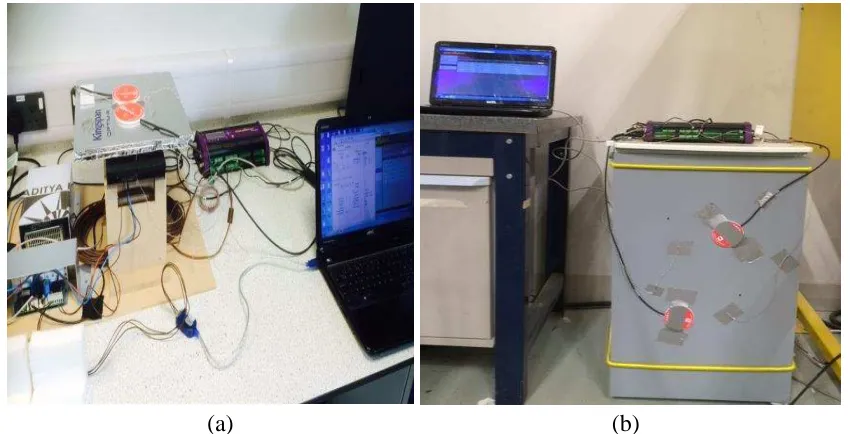
(a) (b)
Figure 1. (a) Thermal conductivity measurement equipment (b) -value measurement setup
Heat flux plates have been attached to the specimen on the top surface to measure the heat flux across the specimen surfaces. Performance of the apparatus has been analysed by measuring the thermal conductivity of a 25 mm thick sample XPS (180mm×130mm) of known thermal conductivity (33 mWm-1K-1). Thermal conductivity of the reference sample
has been measured to be 31.91(mW m-1K-1). This shows that the apparatus can measure
thermal conductivity with good accuracy.
3.2 Thermal transmittance measurement of CIPs
Thermal resistance, �, is the inverse of thermal transmittance ( -value, Wm-2K-1). It is the ratio of the mean temperature difference measured between the two sides of the sandwich panel and can be written as:
� = 1 = − ��
[image:4.595.86.511.71.288.2]4. Results
4.1 Thermal conductivity of vacuum insulation
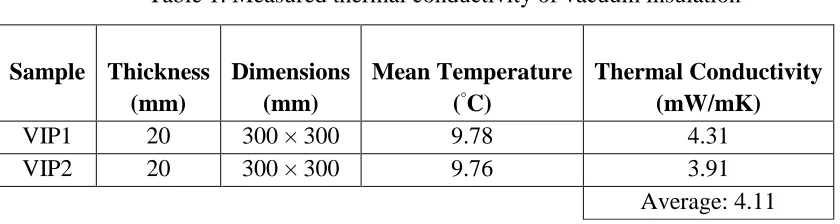
[image:5.595.90.510.300.412.2]The thermal conductivities of two commercially available vacuum insulation specimens (VIP1 and VIP2) with same composition have been measured using the cold/hot plate apparatus method. The results of thermal conductivity (taken at the centre of the panel) of the tested VIP specimens are presented in Table 1. Thermal conductivity values of 4.31 and 3.91 mWm-1K-1 were measured for specimens VIP1 and VIP2 respectively. The manufacturer’s thermal conductivity value was given as 4.7 mWm-1K-1 in the data sheet hence the specimens VIP1 and VIP2 performed better in the laboratory test. Furthermore, it shows that the vacuum insulation used in the CIP manufacturing were intact and not damaged during transportation and handling. Taking an average value of 4.11 mWm-1K-1, � for the vacuum insulation is 7.8 times lower than the equivalent value for XPS (31.91 mWm-1K-1).
Table 1. Measured thermal conductivity of vacuum insulation
Sample Thickness (mm)
Dimensions (mm)
Mean Temperature (◦C)
Thermal Conductivity (mW/mK)
VIP1 20 300 × 300 9.78 4.31
VIP2 20 300 × 300 9.76 3.91
Average: 4.11
4.2 Effect of vacuum insulation on thermal performance of CIPs
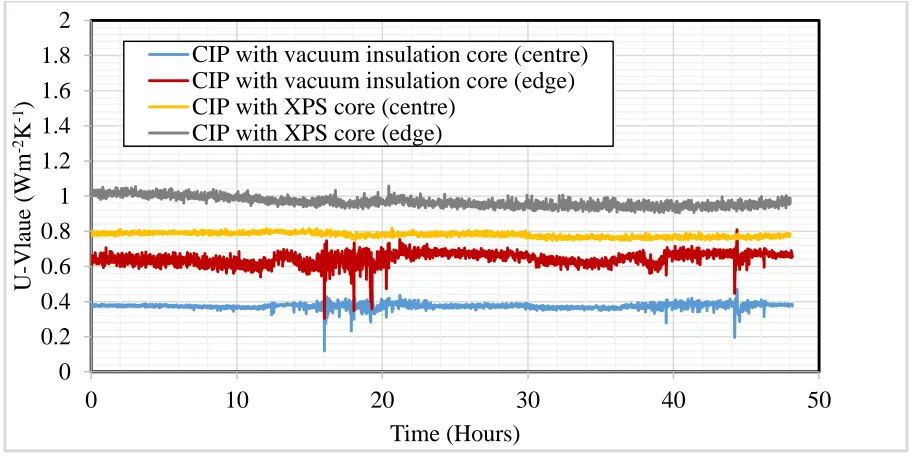
The CIP included 3 mm XPS on either side of 20 mm vacuum insulation to protect the vacuum insulation envelope surface and achieve better bonding with the outer aluminium layers. The -value was measured at the edge and centre of the panel as shown in the Figure 2. CIP panels made with XPS core at the centre had the average U-value of 0.38 Wm-2K-1 compared to that of 0.78 Wm-2K-1 for the XPS panel. This shows that the presence of vacuum insulation has improved the thermal performance of CIPs by reducing the U-value by 0.40 Wm-2K-1, a 51% improvement in thermal performance compared to that of CIP with XPS core. Therefore, the thickness of XPS would have to be more or less doubled to achieve a similar performance to that of the vacuum insulation in the centre of the panel.
Figure 2. Measured U-value of CIPs with vacuum insulation and XPS core
Table 2. Average measured U-value at centre and edge of CIP samples
Sample Centre U-value (Wm-2K-1)
Edge U-value (Wm-2K-1)
Difference between Edge and centre (Wm-2K-1)
CIP with vacuum insulation
0.38 0.64 0.26 (+68%)
CIP with XPS 0.78 0.97 0.19 (+24%)
The significantly higher -value at the edges of the CIP with vacuum insulation requires that the overall size of these panels and edges should be designed very carefully in order to effectively utilise the enhanced thermal performance of the vacuum insulation in the CIP. This could potentially be achieved by increasing the vacuum insulate core area and the overall panel dimensions and reducing edge width or using low thermal conductivity foams such as phenolic foam or polyurethane foam instead of XPS at edge.
5. Conclusion
In this paper, thermal properties of composite insulation panels composed of vacuum insulation and XPS were investigated. The thermal insulation performance of sandwich panels was evaluated by measuring thermal transmission (U-value) in a small scale laboratory facility. The panels with evacuated core (vacuum insulated) were found to have the lowest U-value of 0.38 Wm-2K-1 compared to that of 0.78 Wm-2K-1 for XPS core. This enhanced thermal insulation was achieved without an increase in the overall thickness of the CIP. Results also showed that the panel edge -value was higher compared to that of at centre of the CIP. For the vacuum insulated CIPs, the difference between the edge and centre of panel -value was 0.26 Wm2k-1 (an increase of 68%). This edge effect can possibly be reduced by carefully designing and or using alternative low thermal conductivity materials at
0 0.2 0.4 0.6 0.8 1 1.2 1.4 1.6 1.8 2
0 10 20 30 40 50
U -Vla ue (W m -2K -1) Time (Hours) CIP with vacuum insulation core (centre) CIP with vacuum insulation core (edge) CIP with XPS core (centre)
[image:6.595.66.531.361.477.2]edges e.g. replacing XPS with low thermal conductivity phenolic foam or polyurethane foam in order to effectively exploit the better thermal performance of the vacuum insulation in the CIP.
6. Acknowledgement
The Authors acknowledge the financial and technical support provided by Innovate UK and Panel Systems Limited, Sheffield, UK under a Knowledge Transfer Partnership (KTP) Programme, No. 009433, 2014-2016
7. References
Department of Energy and Climate Change (DECC), (2012). The Future of Heating: A strategic framework for low carbon heat in the UK,
www.gov.uk/government/uploads/system/uploads/attachment_data/file/48574/4805-future-heating-strategic-framework.pdf [Accessed on 10 May 2017].
United Nations Framework Convention on Climate Change UNFCCC (2016). Adoption of the Paris Agreement- Proposal by the President (Draft decision -/CP.21), Conference of the Parties, Twenty-first session Paris, 30 November to 11 December 2015. Available from https://unfccc.int/resource/docs/2015/cop21/eng/l09.pdf [Accessed on 10 May 2017]
Brunner S. and Simmler H. (2008). In situ performance assessment of vacuum insulation panels in a flat roof construction. Vacuum, 82, 700-707.
Alam M., Singh H. and Limbachiya M.C. (2011). Vacuum Insulation Panels (VIPs) for building construction industry - A review of the contemporary developments and future directions, Applied Energy, 88, 3592 - 3602.
Hayez V. and Kragh M. (2013). Next generation curtain walling: Using vacuum insulation panels - energy performance and design freedom. Façade Tectonics Journal, 17, 19-30.
Mandilaras I., Atsonios I., Zannis G., Founti M., (2014).Thermal performance of a building envelope incorporating ETICS with vacuum insulation panels and EPS. Energy and
Buildings, 85, 666-671.
Voellinger, T., Bassi A., Heitel M., (2014). Facilitating the incorporation of VIP into precast concrete sandwich panels. Energy and Buildings, 85, 666-671.
Davies J.M., (2001). Lightweight sandwich construction. Oxford: Blackwell Science, 2001.