TOPIC AREA:B2 PAPER NO.142
INTERNET TRAVELLER INFORMATION SYSTEMS: A CASE STUDY OF USER RESPONSE
Dr Glenn D. Lyons and Professor Mike McDonald
Transportation Research Group, Department of Civil and Environmental Engineering, University of Southampton, SOUTHAMPTON SO17 1BJ. UNITED KINGDOM
http://www.soton.ac.uk/~trgwww/
Mr Jeremy Bunford
1 INTRODUCTION
The effective provision of appropriate, timely and accurate information to travellers is a key component of many transport policies because of its impact on travel efficiency and modal choice. Considerable effort has been expended in developing information systems to support both car drivers and public transport users (Lauer and McDonald, 1994). A variety of media have been used to this end including radio, telephone, television, roadside variable message signs (VMS) and public display terminals. In the last two years the Internet has emerged as an alternative medium with considerable potential. This paper describes the design and implementation of an Internet-based Advanced Traveller Information System (ATIS) in the United Kingdom and the evaluation of user response. The system forms part of the continuing development in the ROMANSE project which is centred on Southern Hampshire and the city of Southampton. The project is lead by Hampshire County Council who have funded the work detailed in this paper. As a growing number of similar systems are being developed, the results of the study of user requirements described in this paper are particularly significant.
2 BACKGROUND 2.1 ROMANSE
The ROMANSE project (a ROad MANagement System for Europe) is led by Hampshire County Council and is based on the Southampton Region in the U.K. (McDonald and Tarrant, 1994) , (Wren and Jones, 1996). It has formed part of consortia in large European Union funded programmes into the research, development and application of transport telematics. The project is aimed at using new technology to increase transport efficiency and to enhance the attractiveness of non-car modes for tripmaking. The three main elements of the project relate to the collection of accurate and timely information on transport conditions, the interpretation of the information and the initiation of actions to control traffic and inform travellers.
During its first phase of activity the ROMANSE project evolved an extensive communications infrastructure for the road network in Southampton and a traffic and travel information centre (TTIC) was established to act as an integrated information hub. A SCOOT traffic control system controls the majority of signalised junctions in the city and generates real-time traffic delay information. This is supplemented by novel detection systems and CCTV cameras with new image processing techniques which provide operators and systems with up-to-date traffic network status information. Automatic Vehicle Location (AVL) technology supports provision of a real-time bus-stop information system. A series of parking guidance information (PGI) VMS inform drivers in real-time of car parks’ occupancy status. Route information VMS inform drivers of current network conditions. During the morning and evening peaks, radio traffic reports are broadcast every 15 minutes. At key locations in the city (including the central train station), trip-planning terminals allow travellers to plan journeys by car or public transport.
The project is now in its second phase, one of the principal objectives of which is to deliver traffic and travel information into the workplace and home. The entry of the Internet into mainstream media presented an ideal opportunity to develop a World Wide Web (WWW) service based on the established integrated information database.
2.2 The Internet and World Wide Web
There are a number of papers and articles that provide an introduction to the use of the WWW for both general information concerning Intelligent Transport Systems (ITS) and sites that specifically provide traveller information (Messick, 1996), (Walters, 1996), (Guensler and Bernstein, 1996), (Werner, 1996). Lyons and McDonald (1998) provide a review of exemplary ATIS on the WWW and highlight a number of research needs associated with the continued development and improvement of such sites.
The Internet is the largest set of interconnected networks in the world and represents the communications infrastructure which allows the transfer of information to take place between millions of interconnected computers. The two most widely used forms of information exchange using the Internet are electronic mail (email) and the WWW. The WWW is an information retrieval system that provides users with straightforward access to information (in the form of text, graphics, sound etc.) via the Internet through the use of WWW browsers such a Netscape Navigator and Microsoft Internet Explorer. WWW servers provide WWW pages of information that can be viewed by browsers. Typically a server will provide a WWW site containing a structured set of pages. Items of text or graphics within pages can be defined as links to other pages or sites. Through the use of these links a user can easily navigate between pages. Further WWW software developments (CGI scripts, plug-ins, applets etc. (Lyons and McDonald, 1998)) allow more sophisticated functionality to be introduced to WWW pages. The WWW now represents a powerful platform for quick and effective design and production of graphical user interfaces (GUIs) which enable users to conveniently achieve one-way or two-way communication with associated databases.
Many of the current methods used to provide traffic and travel information (TTI) demand high start-up costs and are limited in the amount or nature of the data they can provide. The Internet provides one convenient means of supplying up-to-date information in a variety of ways to a large number of people at a minimal cost. The number of computers connected to the Internet is increasing rapidly providing a growing population of users with a rich source of easily accessible information. In the not too distant future, the Internet may provide a means of delivering information to the majority of the population. Access to the Internet from the workplace is now increasingly common and access from the home is growing. Access may also become increasingly available at community sites such as libraries.
2.3 Advanced Traveller Information Systems
capacity of the Internet to transfer information. The second issue concerns the data that the system is designed to manage. Data items sufficient to support an information system at an acceptable level of accuracy, transport system coverage and reliability must be available. Such information must be timely and relevant. The final issue concerns the user requirements of such systems. ATIS should offer user-friendly interfaces to enable appropriate access to information relevant to the travellers’ needs. A sound understanding of how to satisfy user requirements is essential.
The Internet as a new communications medium for ATIS will enhance the provision of enroute information with the emergence of Internet access via mobile phones/palm-top computers (referred to as Personal Digital Assistants (PDAs)) (Wollenberg, 1996), (Padmos and Bernstein, 1997). However the notable significance of the Internet for ATIS is the widespread opportunity it provides to deliver pre-trip information into the home and office. Such information has the capacity to directly affect public/private mode choice and trip generation/suppression (Polak and Jones, 1993). Studies have reported that pre-trip information could cause a significant proportion of private travellers to alter their destination, mode or departure time, especially for non-commuting trips (Jones, 1993).
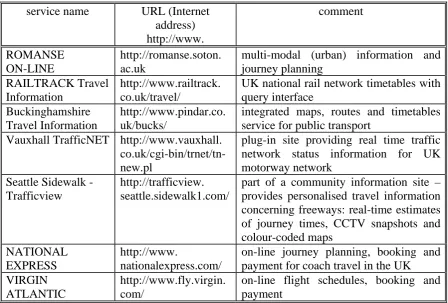
[image:4.595.81.530.401.704.2]A 1988 survey of motorist commuters (Spyridakis et al, 1991) found that future information media that would be useful were, in order of preference: highway advisory radio; phone hot-lines; and dedicated cable TV channels. It is interesting to note that a decade ago the Internet was absent from this list.
Table 1. Examples of Internet-based ATIS
service name URL (Internet address) http://www. comment ROMANSE ON-LINE http://romanse.soton. ac.uk
multi-modal (urban) information and journey planning
RAILTRACK Travel Information
http://www.railtrack. co.uk/travel/
UK national rail network timetables with query interface
Buckinghamshire Travel Information
http://www.pindar.co. uk/bucks/
integrated maps, routes and timetables service for public transport
Vauxhall TrafficNET http://www.vauxhall. co.uk/cgi-bin/trnet/tn-new.pl
plug-in site providing real time traffic network status information for UK motorway network
Seattle Sidewalk - Trafficview
http://trafficview. seattle.sidewalk1.com/
part of a community information site – provides personalised travel information concerning freeways: real-time estimates of journey times, CCTV snapshots and colour-coded maps
NATIONAL EXPRESS
http://www.
nationalexpress.com/
on-line journey planning, booking and payment for coach travel in the UK VIRGIN
ATLANTIC
http://www.fly.virgin. com/
on-line flight schedules, booking and payment
Internet. More extensive listings of ATIS sites on the WWW can be found at
http://www.transportweb.com/ or http://dragon.princeton.edu/~dhb/.
3 OBJECTIVES
The development of a prototype WWW traveller information system in this study (which was named ‘ROMANSE ON-LINE’) had two principal objectives:
(i) to determine the technical feasibility of implementing such a system, and
(ii) to gain an informed understanding of user reactions and requirements while maintaining the integrity of the longer term development of the service.
4 SERVICE DEVELOPMENT 4.1 Site content
The service was not intended to provide inherently new information but to relay information currently available via other media using the WWW. By virtue of the status as a prototype, some elements of the service were illustrative of fully developed components that could in future be made available.
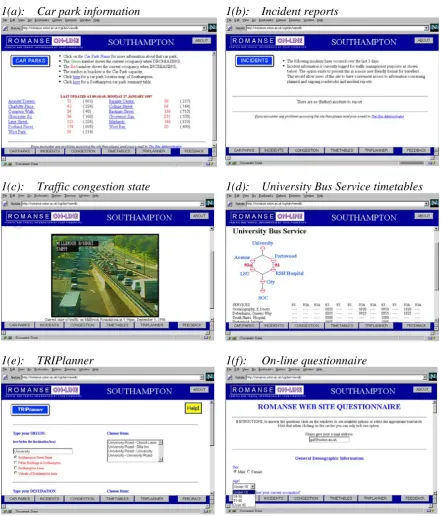
The structure of the site was designed to be straightforward for users to gain access to information appropriate to their needs. The site was designed using frames allowing users to have the same header and footer regardless of the page they were viewing. The footer was set to contain buttons that take the user to any of the elements of the service. A welcome screen (the ‘Home’ page) established whether the user was using a graphical or text-only browser. Text only equivalent pages were then made available if and when appropriate. The user was able to proceed from the homepage to an 'About' page which provided an introduction to the site and also, if the user chose, an on-line ROMANSE brochure outlining the project and setting the WWW service in context. Beyond this page the button set in the footer frame was used to navigate through the site. The site had six elements as outlined below and shown in Figure 1.
Car Park Information – This element consisted primarily of a table of regularly updated car park occupancies for all car parks in Southampton that have count detectors linked to the TTIC. Occupancies were colour coded to provide an indication of whether occupancy was increasing or decreasing. A car parks’ location map was also provided with linked information concerning charges, opening times etc. for each car park.
Incident Reports – Descriptive records of traffic conditions and incidents are manually entered into the ITMC’s database as they occur. A list of regularly updated recent entries was provided on the WWW.
Bus Timetables – The prototype WWW service was evaluated by users and potential users within the University of Southampton. Therefore, timetables and a route map for the University Bus Service were included to determine whether timetable data in general would be welcomed by users.
Fig. 1. Screen images from elements of service
1(a): Car park information 1(b): Incident reports
1(c): Traffic congestion state 1(d): University Bus Service timetables
1(e): TRIPlanner 1(f): On-line questionnaire
provided with the WWW service. Users select an origin and destination and the TRIPlanner will produce a selection of journey plan options with approximate stage times.
User Questionnaire - An on-line questionnaire enabled users to submit feedback concerning themselves, their information requirements and their reactions to the service provided.
4.2 Service architecture
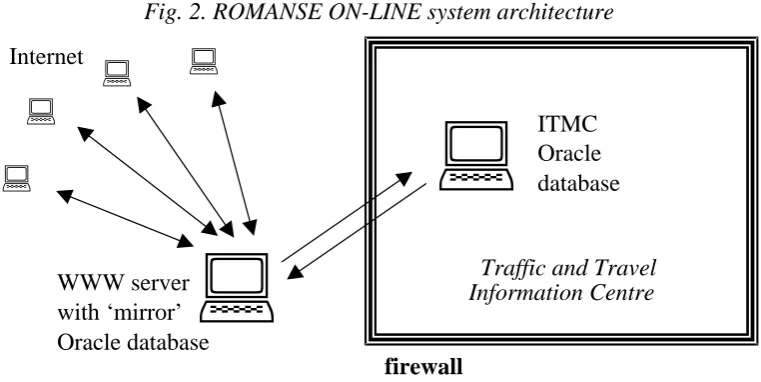
[image:7.595.115.496.355.546.2]The architecture of the system is shown in Figure 2. The ITMC Oracle database was linked to a WWW server mounted on the same workstation as a second Oracle database. This second database periodically retrieved updated data entries from the ITMC database, effectively acting as a mirror database containing selected data entries required for the WWW system. Information from this database was then assembled into WWW pages that were transmitted to users on request. The WWW server was located at the University of Southampton for development purposes and also because of the greater bandwidth of connection to the Internet (10Mb/sec). Further to completion of the prototype trial, any external links to the ITMC database must now pass through a firewall that prevents unauthorised passage of information.
Fig. 2. ROMANSE ON-LINE system architecture
firewall
ITMC Oracle database
WWW server with ‘mirror’ Oracle database
InternetTraffic and Travel Information Centre
5 SERVICE TRIAL 5.1 Sample population
the service without damaging the longer term credibility of a publicly available version of the service.
5.2 Data collection
An on-line questionnaire consists of a WWW page that enables a user to answer a series of questions using drop-down menu answer options or toggle-box answer options and comment boxes. The completed questionnaire can then be submitted by the user to the WWW server machine where the answers are automatically stored. This type of questionnaire is very attractive as it requires minimal effort to 'circulate', collect responses and automatically enter information into a database. Also, if well designed, it is easy for the user to complete. However, although questionnaires of this sort are being used increasingly on the WWW, the principal note of caution relates to the sample bias as WWW users are not representative of the whole population. However, since the questionnaire was used implicitly in this study to collect the responses from Internet users only, sample bias became less of an issue. It should, nonetheless be noted when considering any wider implications derived from the survey findings.
To attract as many responses to the questionnaire as possible, all users submitting a completed questionnaire were entered into a prize draw. In addition to collecting and storing the response data, the WWW server was set to keep a record of a series of summary statistics for the server usage. Further to the questionnaire feedback, a group of respondents participated in a ninety-minute discussion session to expand upon the findings of the questionnaire.
5.3 Advertising
A high level of publicity was used to attract as many staff and students from the University as possible to use the service. An article in the University's fortnightly internal publication for staff and students was published to coincide with the launch of the service. Posters were distributed around the University. A WWW link to the service was put on the University's WWW travel pages and also on the Department of Civil Engineering's homepage. An electronic bulletin board message was posted and a similar email message was sent to the University's internal WWW electronic discussion group.
Previous research has specifically considered the marketing of traveller information systems (Englisher et al, 1996). It was noted that most travellers are simply not information seekers. It was therefore considered essential to adopt a proactive approach to advertising for this service.
6 RESULTS 6.1 Usage statistics
trial period the search engines had found ROMANSE ON-LINE, effectively promoting access to a wider audience.
[image:9.595.124.486.274.480.2]109 users completed the questionnaire (8 responses were from outside the University). Internet-based publicity was responsible for attracting 30 per cent of respondents to the site. Paper-based publicity attracted 64 per cent with word-of-mouth attracting the remaining 6 per cent. It would appear that a multitude of publicity channels proved appropriate and that, indeed, paper-based advertising remains a necessary and effective medium despite the use of the Internet to provide the service. It was noted in the discussion group that proactive publicity of the service had definitely been necessary to attract users. None of the discussion session members were aware of the other WWW traffic and travel information sites in the UK.
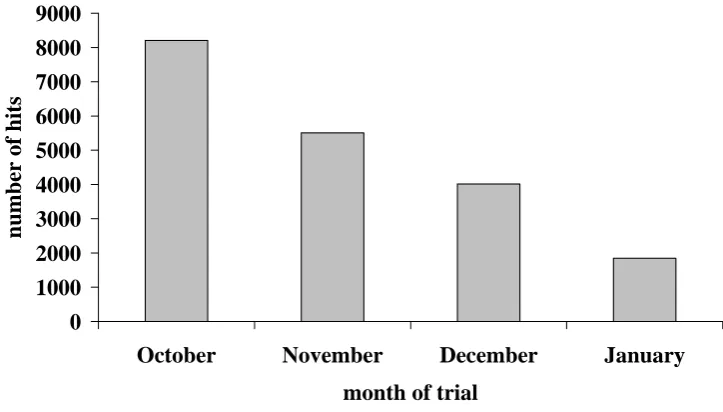
Fig. 3. Total number of pages requested during trial period
0 1000 2000 3000 4000 5000 6000 7000 8000 9000
October November December January month of trial
number of hits
The total numbers of hits (individual pages requested from the WWW server) which were recorded during the trial are shown in Figure 3. The steady decline is likely to be a consequence of several factors. The trial launch publicity attracted an initial surge of interest perhaps by many visitors likely to have been drawn by the novelty factor of the service. Novelty factor visitors would then have dwindled with a core of users remaining who wished to make use of the information provided. New visitors to the site are likely to have explored many of the pages provided to establish what information was available. On subsequent visits to the site only pages of relevance to the visitors’ needs are likely to have been accessed, contributing further to the decline in the number of hits. Some decline in usage will also have been a consequence of only providing limited or sample information for some elements of the service. It might also be argued that users who were not inherently information seekers were lost once the impact of the initial publicity drawing attention to the site disappeared.
be of diminishing importance. However, it must be noted that only catering for such browsers may compromise the quality of access offered to certain key groups (e.g. schools and libraries) who gain access from computer platforms which may not be able to support such browser software.
6.2 Demographics
The age and gender structure of the respondents is shown in Table 2. The high proportion of males is similar to that found from other studies. Results from the seventh (April/May 1997) GVU WWW survey (http://www.cc.gatech.edu/gvu/ user_surveys/) which was endorsed by the World Wide Web Consortium found the following for WWW use in Europe: 85 per cent of WWW users are male and the average age of user is 30.
Table 2. Age group of respondent set versus gender (7.3 % - gender not specified)
female (%) male (%)
under 18 0 1.8
18-30 4.6 56.0 31-40 1.8 15.6
over 40 2.8 10.1
total 9.2 83.5
Over half the respondents in the trial were aged between 18 and 30. This reflects the high proportion of students using the site. However, despite the transient nature of such a population, over 80 per cent of respondents had lived or worked in Southampton for at least a year with nearly 50 per cent having lived or worked in Southampton for more than three years. This suggests that the majority of respondents had a good knowledge of the elements of Southampton's transportation system which concerned them. Less than 10 per cent of respondents had lived or worked in Southampton for less than one year. This category will principally represent the new intake of undergraduate (and postgraduate) students. Such students are least likely to have become familiar with the Internet access facilities offered by the University. This would explain their low representation in the response set.
76 per cent of respondents had been accessing the WWW for at least a year, of which over 80 per cent spent at least 1 hour a week accessing the WWW. Therefore, it can be assumed that most respondents were fully accustomed to the nature of information interfaces available using the WWW. This reflects the specific characteristics of the sample population which would not currently be representative of the population in general.
Access to the WWW is in general highest (and increasing) in the workplace. A traffic and travel information system can serve to inform tripmakers prior to, in particular, their evening commuting trip in addition to trips taking place during the day. To serve a wider range of needs and tripmaking, such a system must be accessible outside of the workplace, be it from public access terminals or from the home. 69 per cent of respondents indicated that they had a PC at home with 26 per cent also having a link to the Internet. These figures are high. Results from a 1997 survey by the Office for National Statistics (http://www.emap.com/ons97/) indicate that nearly a third of British homes now have a PC with 5 per cent having access to the Internet. The question in this study specifically asked whether a Personal Computer was available at home. Other studies have confronted some ambiguity with this issue given that some people will class computer games machines as computers in this context. The high level of access to the Internet is likely to be attributable in part to respondents’ affiliation with the University. The University is an Internet provider. Members of the University are able to connect (via a modem) freely (excluding the price of the telephone call) to the Internet via the University. The high level of PC ownership compared to the national statistic is likely to be a consequence of the socio-economic status of the respondents and indeed the affinity with computing that access to the WWW implies. It should also be noted that it is almost certainly the case that the respondent set is not representative of the University population as a whole.
6.3 Information requirements
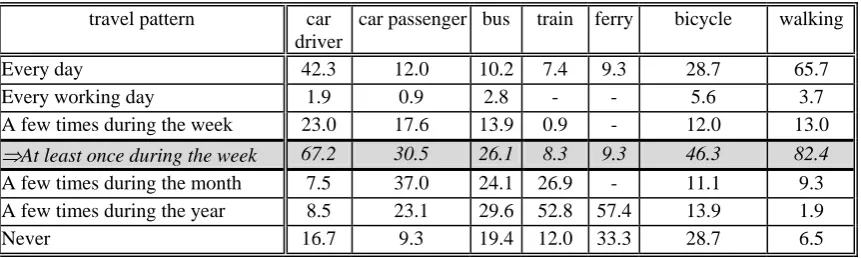
[image:11.595.91.522.443.572.2]Respondents were asked how often they travelled by each mode. The results are shown in Table 3. The figures, representing all trips made, provide some indication of the potential usefulness of various components of the ROMANSE ON-LINE service.
Table 3. 'How often do you travel by each of the following modes?' (% of respondents)
travel pattern car driver
car passenger bus train ferry bicycle walking
Every day 42.3 12.0 10.2 7.4 9.3 28.7 65.7
Every working day 1.9 0.9 2.8 - - 5.6 3.7
A few times during the week 23.0 17.6 13.9 0.9 - 12.0 13.0 At least once during the week 67.2 30.5 26.1 8.3 9.3 46.3 82.4 A few times during the month 7.5 37.0 24.1 26.9 - 11.1 9.3 A few times during the year 8.5 23.1 29.6 52.8 57.4 13.9 1.9
Never 16.7 9.3 19.4 12.0 33.3 28.7 6.5
73 per cent of respondents travelled by car (driver or passenger) at least once during the week and of those who travelled as car passengers a few times a week/month, 37.5 per cent of them also drove by car every day. Substantial proportions of the sample (greater than 25 per cent) made regular (at least once during the week) use of the car, bus, bicycle and walking to travel. If frequency of use of the traveller information service were perfectly correlated with frequency of mode-specific tripmaking then, based on these figures, a regular demand would exist for a multi-modal service.
Table 4. 'Please indicate the degree to which the following information are of use to you' (% of respondents)
usefulness of information car parking spaces
roadworks incidents and congestion
public transport timetables
journey / route planning
very important 21.3 36.1 44.4 43.5 38.9
useful 25.9 28.7 28.7 25.9 36.1
may be of use 27.8 25.0 17.6 22.2 21.3
not important 25.0 10.2 9.3 8.3 3.7
useful + very important 47.2 64.8 73.2 69.4 75.0
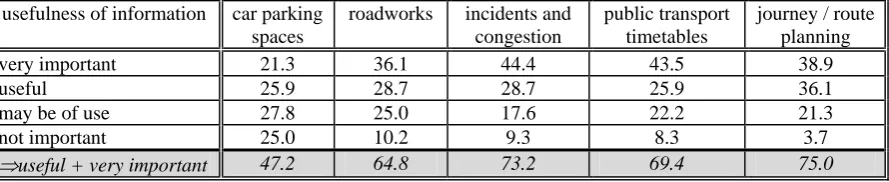
[image:12.595.95.511.353.443.2]Respondents were asked to rank the importance of various travel factors in making their travel arrangements. The results are shown in Table 5. Time and cost are the most readily measurable components of generalised travel cost (Ortúzar and Willumsen, 1994) and might be assumed to be the components with highest weighting. However, other factors (comfort, convenience and reliability) which are less tangible are ranked above time and cost by 63 per cent of respondents. This presents an interesting facet of user requirement that must be noted in the design and development of future systems, particularly if comparison between modes is to be encouraged.
Table 5. Ranked importance of travel factors (% of respondents)
chosen rank cost duration convenience comfort reliability
1 25.9 21.3 30.6 4.6 27.8
2 24.1 27.8 19.4 13.9 21.3
3 17.6 15.7 20.4 19.4 21.3
4 6.5 17.6 18.5 25.0 13.9
5 19.4 11.1 4.6 30.6 9.3
not specified 6.5 6.5 6.5 6.5 6.5
Respondents were asked to indicate how useful they found the various components of the service. The results are shown in Table 6. Given that 78 per cent of the respondents completed the questionnaire following their first visit to the site, the interpretation of 'useful' may be somewhat ambiguous. The responses for these respondents do not relate to the use that had been made of the information but rather the anticipated usefulness of the information. However, the results imply that it was worthwhile to provide users with all the existing components of the service.
Table 6. 'How useful do you consider the information pages at this site to be?' (% of respondents)
usefulness car park
page
incident page
congestion page
timetables page
TRIPlanner page
very important 16.7 39.8 49.1 53.7 49.1
useful 38.0 25.9 25.0 25.0 27.8
may be of use 28.7 25.9 19.4 17.6 20.4
not important 16.7 8.3 6.5 3.7 2.8
useful + very important 54.6 65.7 74.1 78.7 76.9 useful + very important
(from Table 4)
47.2 73.2 69.4 75.0
correlation was found for car park information and journey planning between what respondents considered would be useful to them and what they found to be useful from the service. It can therefore be inferred that the service had been appropriate in satisfying user requirements for these types of information in particular.
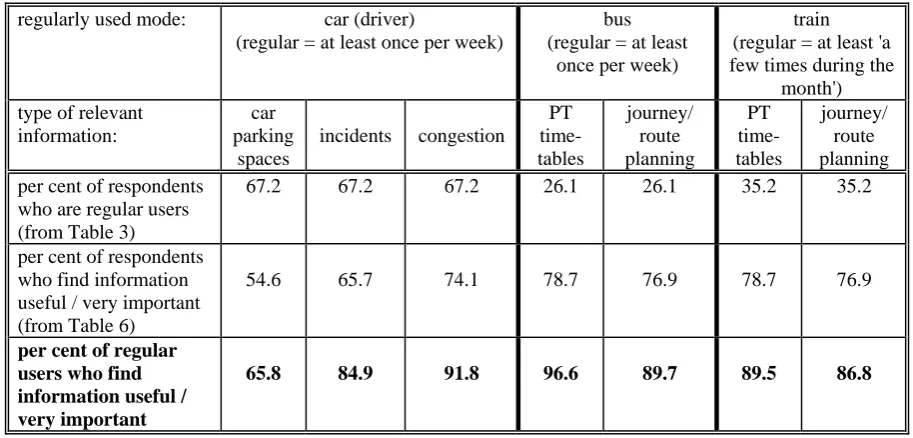
[image:13.595.76.533.279.498.2]The overall results for all the respondents, irrespective of the modes of travel that were used regularly (Table 3) are given in Table 6. Table 7 identifies sub-sets of respondents who were regular users of a given mode and were therefore potentially ably to make use of specific types of relevant information provided. This reveals an encouraging further improvement concerning the extent to which users find the information useful. For all types of information, if regular users of the mode relating to that information are considered, a higher proportion find the information useful or very important compared to the equivalent proportion for the entire set of respondents.
Table 7. Importance of information based on regular use of information-related modes
regularly used mode: car (driver)
(regular = at least once per week)
bus (regular = at least
once per week)
train (regular = at least 'a few times during the
month') type of relevant
information:
car parking
spaces
incidents congestion PT time-tables journey/ route planning PT time-tables journey/ route planning per cent of respondents
who are regular users (from Table 3)
67.2 67.2 67.2 26.1 26.1 35.2 35.2
per cent of respondents who find information useful / very important (from Table 6)
54.6 65.7 74.1 78.7 76.9 78.7 76.9
per cent of regular users who find information useful / very important
65.8 84.9 91.8 96.6 89.7 89.5 86.8
6.4 User comments
Respondents were invited to provide comments and suggestions concerning the overall service and its various components.
changes or fixes to the service. The possibility of an email-based discussion group to further develop, evaluate and improve the service appeared attractive.
The car park information produced comments concerning pre-trip information. The following comment highlighted the added value of providing pre-trip information from this service as opposed to en-route information. The former enabling the time of tripmaking to be changed in addition to the route or destination.
"In fact generally what I used to do with that was I'd just have the Web Browser going in the background and find when the car parks were emptying out and I'd get in the car and pile down town to do some shopping."
The value of pre-trip car park information has been identified by Polak et al (1993). In a study of the impact of local radio broadcast parking information in Nottingham for the Christmas period they concluded that although substantial use was made of the service en-route this had little impact on parking behaviour, while drivers who used the service at the pre-trip stage enjoyed greatly reduced search and queuing time and were more likely to divert to park-and-ride.
For the respondent set as a whole, car park information was seen to be less useful than the other sorts of information provided. This is likely to reflect the predominant use of the service from the workplace rather than the home. This was highlighted by the following comment.
"Its not often that I'm in my office with access to the web browser then I want to be in town in 20 minutes time - I either go into town in the evenings or on Saturday so knowing the car park times on Wednesday afternoon is not that useful."
The incident reports represented most closely the nature of information that is relayed in the local radio broadcasts. Users reacted with comments to the effect that descriptive information must have the ambiguity of its implication minimised to be of use:
"..the human interpretation comes in because there's nothing worse than when you tune in (to the radio) and they say 'traffic is now getting congested on all the usual routes' you think well that doesn't tell me anything, whereas if they were to say 'traffic is building very heavily already this evening and I would have thought that another 20 minutes we are going to have gridlock in the city centre' that's useful - human interpretation"
The discussion session revealed that, while CCTV snapshots would be worthwhile, they would need to be provided in conjunction with a colour coded congestion/speed/flow map of the transport network. The problem with such images in isolation is the time it will take the user to reach the location being viewed by the camera.
The bus timetables were well received and the limited scope was reflected in a number of comments requesting timetable information for all bus services in Southampton. Feedback highlighted the potential importance of Internet-based ATIS in encouraging greater use of public transport by (computer literate) young people:
A strong representation of comments was received concerning the TRIPlanner component. This presumably reflects its access to a much larger amount of data than the other components and the interrogative nature of its information provision, delivering information much more specific to the users’ needs. Comments related to a number of clear themes. When the user found that the TRIPlanner 'worked' for them then it was seen as a valuable information service, "An excellent service it has saved me time and hassle getting back home to London already." Users were exasperated when they were unable to (easily) locate their origin and destination within the gazetteer. It seems that the very potential that the service offered caused expectations to be raised with the expectation that the service would offer a comprehensive one-stop-shop triplanning service for travel in the UK. These expectations were then often dashed when the coverage of the gazetteer was found to be incomplete, "What I found with the trains was that if you're going outside the Southampton area I don't think the provision of locations within the UK is particularly good". It was suggested that the service should provide information concerning the extent of gazetteer coverage for different geographical areas.
A number of more general comments and issues emerged from the discussion. It became clear that the provision of colour coded congestion/speed/flow maps would be well received. This is a feature that is available on several existing WWW sites in the United States although the information relates to interstates as opposed to the finer mesh of roads comprising the urban road network. It was felt that this would contribute to the important role of providing users with a quick and clear indication of road conditions that were likely to affect their journey. A stated-preference survey (Haselkorn et al, 1991) of commuters determined that “screen displays that included numerical estimates of journey times and pictorial representations of dense traffic were found to most influence travel choices causing the greatest deferment in departure time and change of route and mode”.
Users are not interested in being told that there is 'heavy traffic' on their route. This may be the normal condition they expect. They want to know when abnormal conditions are likely to prevail on their route. This could be indicated as hotspots on the suggested colour coded maps, with CCTV camera positions also being indicated for further location specific assessment of the traffic situation.
7 CONCLUSION
This study has provided a unique insight into the development, implementation and evaluation of an urban multi-modal multi-media (real-time) WWW traveller information system. The technical feasibility of such systems is now well proven notably with the successful use of a distributed database system in this study. Integrating different types of information locally is essential to the provision of a multi-modal service. The current trend in development is towards integration of information shared between different traffic control centres thereby addressing national and even international tripmaking information requirements. Exchange of information between databases will be critical to such development.
Sample bias has been appropriate. The majority of respondents have been young, computer/WWW-literate individuals with access to the Internet. Current trends suggest that such characteristics will be increasingly common in the workplace and eventually in the home. Although characteristics of future WWW users will change as more people from a wider age range are afforded access, the findings from this study provide an informative insight into the future rôle of the WWW in providing traveller information.
Despite the WWW’s status as a powerful source of information, people do not in general actively seek to find new information. Traveller information can be useful when presented to an individual but may not be perceived as something necessary to seek by that individual. Consequently the importance of awareness and publicity cannot be overstated.
The ROMANSE ON-LINE service has received favourable reactions from users with a demonstrable need for multi-modal information. Overall user requirements are common to many forms of traveller information provision. Users ideally require quick and convenient access to information targeted to their needs. Two approaches can begin to address such requirements. The use of nested information in this study, guards against the increasing possibility of information overload as a growing amount and diversity of information is made available with such systems. This approach is particularly useful in providing a system for both regular and occasional users. Supplementary information for unfamiliar, occasional users can be nested behind the more immediately required information for regular users. Customised systems are likely to prevail in the future for addressing the requirements of regular users (notably commuters). The Seattle Sidewalk WWW site (see Table 1) allows users to configure the system to provide them with personalised information. Users can then be sent an email message at a particular time of day providing current journey time and route information concerning their commute trip.
A well-presented WWW traveller information system is attractive to users. Other studies have observed that the more elaborate the information provided by traveller information systems the more responsive users were (Polydoropoulou and Ben-Akiva, 1996) (Bonsall, 1995). However, it is equally important to clearly convey to users the limitations of the information being provided. Users must be explicitly informed as to the reliability and accuracy of the information. With a combination of real-time and historic information and the eventuality of system faults, data quality control is necessary with the potential use of a quality control flag for each data item.
The use of the Internet as a medium was viewed favourably against other alternatives although it was noted that the opportunity to use the Internet is not as widespread as for other media such as telephone and television. It is clear that the point of access will dictate in many instances how useful particular types of information are. Many trips, notably shopping or recreational trips into the city centre, that may require car parking information, originate from the home and as such would require WWW access from the home.
The sophistication of and range of data provided by Internet-based ATIS are steadily increasing. The potential impact of such systems on the widespread dissemination of pre-trip and enroute information is enormous. As a consequence the role of research in understanding user requirements and reactions will become increasingly important.
an evaluation of user response in due course. This development has included reappraisal of technology, data and user requirements.
ACKNOWLEDGEMENTS
The authors gratefully acknowledge the support of Hampshire County Council who as ROMANSE project leaders funded this project and provided appropriate technical support.
REFERENCES
Dailey, D.J., Loseff, D., Meyers, D. and Haselkorn, M.P. (1996). Seattle Smart Traveler. Proc. Third World Congress on Intelligent Transport Systems, Orlando, 2, 764-771.
Englisher, L.S., Bregman, S. and Pepin, S. (1996). Promoting ATIS Use: The SmarTraveler Experience. Proc. Third World Congress on Intelligent Transport Systems, Orlando, 2, 953-968.
Guensler, R. and Bernstein, D. (1996). Transportation Resources on the Internet. ITE Journal, 66(4), 42-48.
Haselkorn, M., Kanelaidis, G. and Psaraki, V. (1991). Surveying Commuters to Obtain Functional Requirements for the Design of a Graphic-Based Traffic Information System.
Proc. Vehicle Navigation and Information Systems, Michigan, 1041-1044.
Horowitz, A.D. (1996). User Needs for Automated Highway Systems: An Internet Survey. Proc. Third World Congress on Intelligent Transport Systems, Orlando, 3, 1581-1589.
Jeffrey, D. and Meekums, R. (1996). ROMANSE Triplanners: Developments, results and the future. Proc. Third World Congress on Intelligent Transport Systems, Orlando, 3, 1842-1849.
Jones, P. (1993). User Reactions to ATT Systems. Proceedings of ATT93: Making the Most of the Roads We Have, Coventry.
Lauer, A. and McDonald, M. (1994). Urban Traffic Management in DRIVE. Proc. First World Congress on Applications of Transport Telematics and Intelligent Vehicle-Highway Systems, Paris, 2, 468-476.
Lyons, G.D. and McDonald, M. (1998). Traveller Information and the Internet. Traffic Engineering + Control, 39(1).
McDonald, M. and Tarrant, D. (1994). ROMANSE (ROad MANagement System for Europe) PROJECT. Proc. Vehicle Navigation and Information Systems, Yokohama, Japan, 11-14.
Ortúzar, J. de D. and Willumsen, L.G. (1994). Modelling Transport: Chapter 5 Trip Distribution Modelling, Wiley.
Padmos, J. and Bernstein, D. (1997). Personal Travel Assistants and the World Wide Web. TRB 76th Annual Meeting, Paper No. 970621, Washington, D.C.
Polak, J. and Jones, P. (1993). The acquisition of pre-trip information: A stated preference approach. Transportation, 20, 179-198.
Polak, J., Vythoulkas, P. and Chatfield, I. (1993). Broadcast Parking Information: Behavioural Impacts and Design Requirements. Transportation Research Record, 1403, 36-44.
Spyridakis, J., Barfield, W., Conquest, L., Haselkorn, M. and Isakson, C. (1991). Surveying Commuter Behaviour: Designing Motorist Information Systems.
Transportation Research, 25A, 17-30.
Walters, R. (1996). A Down-to-Earth Guide to ITS on the Internet. ITS World, 1(4), 28-30.
Werner, J. (1996). The ITS Web tour. Traffic Technology International, April/May, 33-40.
Wollenberg, S.C. (1996). Current and Future Developments in the use of Handheld, Mobile Computers for Access to Advanced Traveler Information Services. Proc. Third World Congress on Intelligent Transport Systems, Orlando, 8, 4672-4679.