25–28 June 2018 Limerick, Ireland.
VOLUME 4
Proceedings
of DRS2018
Edited by:
Cristiano Storni
Keelin Leahy
Muireann McMahon
Erik Bohemia
Proceedings of DRS 2018
Catalyst
Volume 4
Editors
Proceedings of DRS
2018 International Conference 25–28 June 2018, Limerick, Ireland www.drs2018limerick.org
Volume 1, 2, 3, 4, 5, 6, 7
Cover and conference identity design by Piquant
Conference identity design initial concept: Tamara Stone & Selina Kindt, Limerick Institution of Technology.
Proceedings compiled by Laura Santamaria, Cristiano Storni and Erik Bohemia
Editors: Cristiano Storni, Keelin Leahy, Muireann McMahon, Peter Lloyd and Erik Bohemia Series Editors: Peter Lloyd and Erik Bohemia
Section-Editors: Nicola Morelli, Amalia de Götzen, Ingrid Mülder, Grazia Concilio, Daniel Cardoso Llach, Terry Knight, Colin M. Gray, Austin L Toombs, Ann Light, John Vines, Wouter Eggink, Steven Dorrestijn, Kristina Lindström, Laura Forlano, Ramia Maze, Åsa Ståhl, Li Jönsson, Lesley-Ann Noel, Renata M Leitão, Joon Sang Baek, Joyce Yee, Yoko Akama, Joanna Boehnert, Dan Lockton, Ingrid Mulder, Philippa Mothersill, Kim Halskov, Bo Christensen, Mikael Wiberg, Thierry Lagrange, Jo van den Berghe, Nithikul Nimkulrat, Camilla Groth, Elvin Karana, Tom Fisher, Faith Kane, Elisa Giaccardi, Farnaz
Nickpour, Hua Dong, Rhoda Trimingham, Edward Gardiner, Sarah Kettley, Lois Frankel, Thea Blackler, Emmanuel Tsekleves, Rebecca Cain, Ann Petermans, Anna Pohlmeyer, Pieter Desmet, Deger Ozkaramanli, Liv Merete Nielse, Mike Tovey, Chris
Hammond, Joyce Yee, Sabine Junginger, Sarah B Brooks, Joni Saylor, Kamil Michlewski, Rodríguez Ferradas, Nuša Fain, José
Antonio Alfaro, Rachel Cooper, and Erik Bohemia.
This work is licensed under a Creative Commons Attribution-Non Commercial 4.0 International License. http://creativecommons.org/licenses/by-nc/4.0/
Proceedings of DRS 2018 International Conference: Catalyst (2nd edition)
ISSN 2398-3132
ISBN 978-1-912294-26-8 (ebook, volume 1) ISBN 978-1-912294-27-5 (ebook, volume 2) ISBN 978-1-912294-28-2 (ebook, volume 3) ISBN 978-1-912294-29-9 (ebook, volume 4) ISBN 978-1-912294-30-5 (ebook, volume 5) ISBN 978-1-912294-31-2 (ebook, volume 6) ISBN 978-1-912294-32-9 (ebook, volume 7)
Published by the Design Research Society Loughborough University, London
3 Lesney Avenue, The Broadcast Centre, Here East London, E15 2GZ
United Kingdom
Design Research Society Secretariat email: [email protected] website: www.designresearchsociety.org
DRS Special Interest Groups Design for Behaviour Change
Design for Health, Wellbeing and Happiness Design Management
Design Pedagogy Design for Sustainability
Design for Tangible, Embedded and Networked Technologies Experiential Knowledge
Inclusive Design
Objects, Practices, Experiences, Networks
DRS International Conference Series
DRS 2018 Programme Committee
Conference Chairs
Keelin Leahy, University of Limerick, Ireland
Muireann McMahon, University of Limerick, Ireland
Conference Co-Chairs
Eamon Spelman, Limerick Institute of Technology, Ireland Adam de Eyto, University of Limerick, Ireland
Programme Committee
Cristiano Storni, University of Limerick, Ireland (Committee Co-Chair)
Peter Lloyd, Professor of Design, University of Brighton, UK (Committee Co-Chair) Simon O' Rafferty, University of Limerick, Ireland
Rebecca Cain, Loughborough University, UK Keelin Leahy, University of Limerick, Ireland
Stella Boess, Delft University of Technology, The Netherlands Muireann McMahon, University of Limerick, Ireland
Erik Bohemia, Loughborough University, UK
Conversations Committee
Sharon Prendeville, Loughborough University London, UK (Committee Chair) Nora O' Murchú, University of Limerick, Ireland
Abigail Durrant, Northumbria University, UK Keelin Leahy, University of Limerick, Ireland
Carlos Aceves-Gonzalez, University of Guadalajara, Mexico Laura Forlano, Columbia University, USA
Dan Lockton, Carnegie Mellon University, USA
Workshops Committee
Louise Kiernan, University of Limerick, Ireland (Committee Chair) Eamon Spelman, Limerick School of Art and Design, Ireland Dermot McInerney, University of Limerick, Ireland
Denise McEvoy, IADT, Ireland Trevor Hogan, CIT, Ireland
Muireann McMahon, University of Limerick, Ireland
Publicity and Public Relations Committee
Gabriela Avram, University of Limerick, Ireland (Committee Chair) Muireann McMahon, University of Limerick, Ireland
Eamon Spelman, Limerick School of Art and Design, Ireland
Conference Experience Committee
Deborah Tudge, University of Limerick, Ireland
Eamon Spelman, Limerick School of Art and Design, Ireland Diarmaid Lane, University of Limerick, Ireland
PhD by Design Committee
Trevor Hogan, Crawford College of Art & Design, CIT, Ireland (Committee Chair) Yekta Barkirlioglu, University of Limerick, Ireland
Denise McEvoy, IADT, Ireland
Alison Thomson, Goldsmiths University, UK Maria Portugal, Goldsmiths University, UK
Søren Rosenbak, Umeå Institute of Design, Sweden
DRS Special Interest Group Chairs
Erik Bohemia, Loughborough University, UK Rebecca Cain, Loughborough University, UK Hua Dong, Tongji University, China
Tom Fisher, Nottingham Trent University, UK Sarah Kettley, Nottingham Trent University, UK Kristina Niedderer, University of Wolverhampton, UK Nithikul Nimkulrat, Estonian Academy of Arts, Estonia Michael Tovey, Coventry University, UK
International Peer Review College
Sille Julie J. Abildgaard, Copenhagen Business School, Denmark Tom Ainsworth, University of Brighton, United Kingdom Yoko Akama, RMIT University, Australia
Canan Akoglu, Design School Kolding, Denmark Katerina Alexiou, The Open University, United Kingdom
Mariana Victoria Amatullo, Parsons School of Design, United States Andrea Isabells Anderson, SAP, United States
Rina Arya, Wolverhampton, United Kingdom Andrea Augsten, University of Wuppertal, Germany Stephen Awoniyi, Texas State University, United States Camilo Ayala Garcia, Politecnico di Milano, Italy Joon Sang Baek, UNIST, South Korea
Yekta Bakırlıoğlu, University of Limerick, Ireland
Bahareh Barati, Delft University of Technology, Netherlands Carolyn Barnes, Swinburne University of Technology, Australia Betsy Barnhart, Iowa State University, United States
Nigan Bayazit, Istanbul Technical University, Turkey
Taslima Begum, Cardiff Metropolitan University, United Kingdom
Cilla Thadeen Benjamin, The University of the West Indies, Trinidad and Tobago Arild Berg,Oslo Metropolitan University, Norway
Eeva Berglund, Aalto University, Finland Guillermo Bernal, MIT Media Lab, United States
Tracy Bhamra, Loughborough University, United Kingdom Richard Bibb, Loughborough University, United Kingdom Michael Mose Biskjaer, Aarhus University, Denmark Noemi Bitterman, Technion, Israel
Alethea Blackler, QUT, Australia
Joanna Boehnert, University of Surrey, United Kingdom Stella Boess, Delft University of Technology, Netherlands Erik Bohemia, Loughborough University, United Kingdom Casper Boks, NTNU, Norway
Elizabeth Boling, Indiana University, United States
Boudewijn Boon, Delft University of Technology, Netherlands Andrea Botero, Oulu University, Finland
Simon Bowen, Newcastle University, United Kingdom Stephen Boyd Davis, Royal College of Art, United Kingdom Philip Breedon, Nottingham Trent University, United Kingdom Charlie Breindahl, University of Copenhagen, Denmark Sarah BrookeBrooks, IBM, United States
Andres Burbano, Universidad de los Andes, Colombia William Burnett, Stanford, United States
Deepa Butoliya, Carnegie Mellon University, United States Jacob Buur, University of Southern Denmark, Denmark Rebecca Cain, Loughborough University, United Kingdom Serena Camere, TU Delft, Netherlands
Elena Caratti, Politecnico di Milano, Italy
Daniel Cardoso Llach, Carnegie Mellon University, United States Tom Cassidy, University of Leeds, United Kingdom
Julia Cassim, Kyoto Institute of Technology, Japan Chien-HsiungChen, Taiwan Tech, Taiwan
Chun-Chih Chen, National Kaohsiung Normal University, Taiwan Chun-Di Chen, National Taipei University of Education, Taiwan Peter Childs, Imperial College London, United Kingdom Bo Christensen, Copenhagen Business School, Denmark Henri Christiaans,UNIST, South Korea
Abdusselam Selami Cifter, Mimar Sinan Fine Arts University, Turkey Nazli Cila, Amsterdam University of Applied Sciences, Netherlands Luigina Ciolfi, Sheffield Hallam University, United Kingdom Rachel Clarke, Northumbria University, United Kingdom Violeta Clemente, University of Aveiro, Portugal Grazia Concilio, Politecnico di Milano, Italy
Ana Correia de Barros, Fraunhofer AICOS, Portugal Paul Coulton, Lancaster University, United Kingdom Alma Leora Culén, University of Oslo, Norway
Sarah Davies, Nottingham Trent University, United Kingdom Cees de Bont,Hong Kong Polytechnic University, Hong Kong Adam de Eyto, University of Limerick, Ireland
Amalia de Götzen, Aalborg Unversity Copenhagen, Denmark Jotte De Koning, TU Delft, Netherlands
Christine De Lille, Delft University of Technology, Netherlands João de Souza Leite, State University of Rio de Janeiro, Brazil Federico Del Giorgio Solfa, National University of La Plata, Argentina Claudio Dell'Era, Politecnico di Milano, Italy
Halime Demirkan, Bilkent University, Turkey
Andrew D. DeRosa, City University of New York, United States Emma Louise Dewberry, The Open University, United Kingdom
Ingvild Digranes, Western Norway University of Applied Sciences, Norway Orsalia Dimitriou, Central Saint Martins, United Kingdom
Judith Marlen Dobler, University Potsdam, Germany Hua Dong, Tongji University, China
Steven Dorrestijn, Saxion, Netherlands Kees Dorst, UTS, Australia
Michelle D. Douglas, Griffith University, Australia Emilia Duarte, Universidade Europeia, Portugal Alex Duffy, University of Strathclyde, United Kingdom Delia Dumitrescu, University of Borås, Sweden
Abigail Durrant, Northumbria University, United Kingdom Thomas Dykes, Northumbria University, United Kingdom Elizabeth Edwards, Lancaster University, United Kingdom Wouter Eggink, University of Twente, Netherlands Pirjo Elovaara, Blekinge Institute of Technology, Sweden Bianca Elzenbaumer, Leeds College of Art, United Kingdom Stuart GeraldEnglish, Northumbria University, United Kingdom Alpay Er,Ozyegin University, Turkey
Ozlem Er, Istanbul Technical University, Turkey
Carolina Escobar-Tello, Loughborough University, United Kingdom Juhyun Eune, Seoul National University, South Korea
Mark Evans, Loughborough University, United Kingdom Ignacio Farias, HU Berlin, Germany
Luke Feast, Design Researcher, New Zealand
Jonathan Joseph Felix, School of Business and Computer Science, Trinidad and Tobago Tom Fisher, Nottingham Trent University, United Kingdom
Karen Fleming, Ulster University, United Kingdom
Kate Tanya Fletcher, University of the Arts London, United Kingdom Laura Forlano, Illinois Institute of Technology, United States Lois Frankel, Carleton University, Canada
Biljana C. Fredriksen, University College of Southeast Norway, Norway Aija Freimane, Art Academy of Latvia, Latvia
Jonas Fritsch, IT University of Copenhagen, Denmark
Daniel G. Cabrero, University of West London, United Kingdom Edward Gardiner, University of Warwick, United Kingdom Philippe Gauthier, Université de Montréal, Canada Ayse Idil Gaziulusoy, Aalto University, Finland Koray Gelmez, Istanbul Technical University, Turkey Georgi V. Georgiev, University of Oulu, Finland
Elisa Giaccardi, Delft University of Technology, Netherlands Ylva Gislén, Lund University, Sweden
Colin Gray, Purdue University, United States
Camilla Groth, University of Southeast Norway, Finland Marte Sørebø Gulliksen, Telemark University College, Norway Ian Gwilt, University of South Australia, Australia
Penny Hagen, Auckland Council, New Zealand Chris Hammond, IBM, United States
Nicolai Brodersen Hansen, Eindhoven University of Technology, Netherlands Preben Hansen, Stockholm University, Sweden
Robert Harland, Loughborough University, United Kingdom Dew Harrison, University of Wolverhampton, United Kingdom Juha Hartvik, University in Vaasa, Finland
Anders Haug, University of Southern Denmark, Denmark
Tero Heikkinen, independent / University of the Arts Helsinki, Finland Tincuta Heinzel, Loughborough University, United Kingdom
Paul Hekkert, Delft University of Technology, Netherlands Ricardo Hernandez, University of the Andes, Colombia Ann Heylighen, KU Leuven, Belgium
Sue Hignett, Loughborough University, United Kingdom Clive Hilton, Coventry University, United Kingdom Trevor Hogan, Cork Institute of Technology, Ireland
Michael Hohl,Anhalt University of Applied Sciences, Germany Lara Houston, NYUAD, United Kingdom
Chung-Ching Huang, National Taiwan University, Taiwan Karl Hurn, Loughborough University, United Kingdom Salvatore Iaconesi, La Sapienza Università di Roma, Italy Elaine Marie Igoe, University of Portsmouth, United Kingdom Nanna Inie, Aarhus University, Denmark
Lilly C. Irani, UC San Diego, United States
Terry Irwin, Carnegie Mellon University, United States Deepa Iyer, SAP, United States
Jennifer Jacobs, Stanford University, United States
Robert Jerrard, Birmingham City Univ./Manchester Metropolitan Univ., United Kingdom Wolfgang Jonas, Braunschweig University of Art, Germany
Derek Jones, The Open University, United Kingdom Peter Jones, OCAD University, Canada
Rachel Jones, Instrata, United Kingdom
Li Jönsson, The Royal Danish Academy of Fine Arts, Denmark Sabine Junginger, Hertie School of Governance, Germany Faith Kane, Massey University, New Zealand
Alen Keirnan, Swinburne University of Technology, Australia Tobie Kerridge, Goldsmiths, University of London, United Kingdom Mahmoud Keshavarz, Uppsala University, Sweden
Sarah Kettley, The University of Edinburgh, United Kingdom Guy Keulemans, UNSW Art & Design, Australia
Louise Brigid Kiernan, University Limerick, Ireland Jinsook Kim, Georgian Court University, United States Holger Klapperich, University Siegen, Germany Maaike Kleinsmann, TU Delft, Netherlands
Gideon Kossoff, Carnegie Mellon University, United States
Ksenija Kuzmina, Loughborough University London, United Kingdom Tarja-Kaarina Laamanen, University of Tampere, Finland
Sotiris Lalaounis, University of Exeter Business School, United Kingdom John Z. Langrish, Salford University, United Kingdom
Keelin Leahy, University of Limerick, Ireland Ji-Hyun Lee, KAIST, South Korea
Renata Marques Leitão, OCAD University, Canada
Pierre Levy, Eindhoven University of Technology, Netherlands Rungtai Lin, National Taiwan University of Arts, Taiwan
Stephen Little, Asia Pacific Technology Network, United Kingdom Sylvia Liu, Hong Kong Polytechnic University, Hong Kong Peter Lloyd, University of Brighton, United Kingdom Dan Lockton, Carnegie Mellon University, United States Vicky Lofthouse, Loughborough University, United Kingdom Wei Leong Leon, LOH, Kyushu University, Japan
Daria A. Loi, Intel Corporation, United States Nicole Lotz, The Open University, United Kingdom Geke Ludden, University of Twente, Netherlands
Rohan Lulham, University of Technology Sydney, Australia
Eva Lutnæs, Oslo Metropolitan University, Norway
Alastair S. Macdonald, Glasgow School of Art, United Kingdom Jeremy Micheal Madden, GMIT, Ireland
Anja Maier, Technical University of Denmark, Denmark Maarit Mäkelä, Aalto University, Finland
Laura Ann Maye, Aalto University, Finland Ramia Maze, Aalto University, Finland Mike Mcauley, Griffith University, Australia
Chris McGinley, Royal College of Art, United Kingdom Seda McKilligan, Iowa State University, United States Muireann McMahon, University of Limerick, Ireland
Wellington Gomes de Medeiros, Federal University of Campina Grande, Brazil Marijke Melles, Delft University of Technology, Netherlands
Massimo Menichinelli, Aalto University, Finland Kamil Michlewski, Human Innovation, United Kingdom Paul Micklethwaite, Kingston University, United Kingdom Richie Moalosi, University of Botswana, Botswana Michael Moore, Ulster University, United Kingdom Sarah Morehead, Northumbria University, United Kingdom Nicola Morelli, Aalborg University, Denmark
Mariale Moreno, Cranfield University, United Kingdom Andrew Morris, Loughborough University, United Kingdom Jeanne-Louise Moys, Reading University, United Kingdom Ingrid Mulder, Delft University of Technology, Netherlands Tara Mullaney, Veryday, Sweden
Yukari Nagai, Japan Advanced Institute of Science and Technology, Japan Marco Neves, University of Lisbon, Portugal
Kristina Niedderer, Wolverhampton University, United Kingdom Nithikul Nimkulrat, Estonian Academy of Arts, Estonia
Natalie Nixon, Figure 8 Thinking, LLC, United States
Lesley-Ann Noel, University of the West Indies, Trinidad and Tobago Conall O. Cathain, Past Chairman DRS, Ireland
Nora O. Murchu, University of Limerick, Ireland
Simon O'Rafferty, Environmental Protection Agency, Ireland Maya Oppenheimer, Royal College of Art, Canada
Anastasia Katharine Ostrowski, Massachusetts Institute of Technology, United States Verena Paepcke-Hjeltness, Iowa State University, United States
Aditya Pawar, Umeå Institute of Design, Sweden Carlos Peralta, University of brighton, United Kingdom Oscar Person, Aalto University, Finland
Ann Petermans, Hasselt University, Belgium
Bruna Beatriz Petreca, Delft University of Technology, Netherlands
Ida Nilstad Pettersen, Norwegian University of Science and Technology, Norway Mike Phillips, Plymouth University, United Kingdom
Silvia Pizzocaro, Politecnico di Milano, Italy
Philip Plowright, Lawrence Technological University, United States Anna Pohlmeyer, Delft University of Technology, Netherlands Tiiu R. Poldma, University of Montreal, Canada
Vesna Popovic, Queensland University of Technology, Australia Mia Porko-Hudd, Åbo Akademi university, Finland
Emmi Pouta, Aalto University, Finland Douglas Powell, IBM, United States Wilson Silva, Prata, Sidia, Brazil
William Prindle, Iowa State University, United States Sebastien Proulx, The Ohio State University, United States Charlie Ranscombe, Swinburne University of Technology, Australia Muralidhar Krishna, Reddy, CMR University, India
Janne Beate Reitan, Oslo and Akershus University College, Norway Dina Riccò, Politecnico di Milano, Italy
Kirstine Riis, USN, Norway
Paul Rodgers,Lancaster University, United Kingdom
Valentina Rognoli, Politecnico di Milano, Italy Robin Roy, The Open University, United Kingdom Daniel Saakes, Kaist, South Korea
Noemi Maria Sadowska, University of the Arts London, United Kingdom Fatina Saikaly, Co-Creando, Italy
Mira Sanders, KU Leuven, Belgium Joni Elaine Saylor, IBM, United States
Laura Scherling, Columbia University Teachers College, United States Jane Scott, The University of Leeds, United Kingdom
James Self, Ulsan National Institute of Science and Technology, South Korea Nick Senske, Iowa State University, United States
Anna Seravalli, Malmö University, Sweden
Birger Sevaldson, Oslo School of Architecture and Design, Norway Sharon Prendeville, Loughborough University, United Kingdom Matt Sinclair, Loughborough University, United Kingdom Andrea Mae Siodmok, Cabinet Office, United Kingdom
Kin Wai Michael Siu, The Hong Kong Polytechnic University, Hong Kong Froukje Sleeswijk Visser, TU Delft, Netherlands
Anne Solberg, University College of Southeast Norway, Norway Ricardo Sosa, Auckland University of Technology, New Zealand Omar Sosa-Tzec, University of Michigan, United States Chris Speed, University of Edinburgh, United Kingdom Eamon Spelman, Limerick School of Art and Design, Ireland Jak Spencer, The Sound HQ, United Kingdom
Nicholas Spencer, Northumbria University, United Kingdom Gabriella Spinelli, Brunel University London, United Kingdom Kay Stables, Goldsmiths, University of London, United Kingdom Åsa Ståhl, Linnaeus University, Sweden
Liesbeth Stam, KU Leuven, Netherlands
Pieter Jan Stappers, Delft University of Technology, Netherlands Molly Steenson, Carnegie Mellon University, United States Shanti Sumartojo, RMIT University, Australia
Kärt Summatavet, Aalto University, Estonia Qian Sun, Royal College of Art, United Kingdom
Gunnar Swanson, East Carolina Unviersity, United States Richard Ben, Sweeting, University of Brighton, United Kingdom
Hsien-Hui Tang, National Taiwan University of Science and Technology, Taiwan Sarah Teasley, Royal College of Art, United Kingdom
Andris Teikmanis, Art Academy of Latvia, Latvia
Ida Telalbasic, Loughborough University London, United Kingdom Martijn ten Bhomer, Xi'an Jiaotong-Liverpool University, China Mathilda Tham, Linnaeus University, Sweden
Alison Thomson, Goldsmiths, United Kingdom
Clementine Thurgood, Swinburne University of Technology, Australia Sebnem Timur Ogut, Istanbul Technical University, Turkey
Mike Tovey, Coventry University, United Kingdom
Katherine Sarah Townsend, Nottingham Trent University, United Kingdom Rhoda Trimingham, Loughborough University, United Kingdom
Nynke Tromp, TU Delft, Netherlands
Emmanuel Tsekleves,Lancaster University, United Kingdom Helen Day Fraser,Emily Carr University of Art + Design, Canada Louise Valentine, University of Dundee, United Kingdom
Mieke van der Bijl-Brouwer, University of Technology Sydney, Australia
Johann van der Merwe, Independent Researcher (Retired Academic), South Africa Mascha Cecile van der Voort, University of Twente, Netherlands
Karel van der Waarde, Graphic Design Research, Belgium Nicholas Vanderschantz, University of Waikato, New Zealand Theodora Vardouli, McGill University, Canada
Luis Arthur Vasconcelos, Universidade Federal de Pernambuco, Brazil Arno Verhoeven, The University of Edinburgh, United Kingdom Stéphane Vial, University of Nîmes, France
Susann Vihma, Aalto University, Finland
Sue Walker, Reading University, United Kingdom
Matthew Watkins, Nottingham Trent University, United Kingdom Penelope Eugenia, Webb, Midnight Commercial, United States Renee Wever, Linköping University, Sweden
Mikael Wiberg, Umea University, Sweden Danielle Wilde, SDU, Denmark
Alex Wilkie, Goldsmiths, University of London, United Kingdom Alex Williams, Kingston University, United Kingdom
Heather Wiltse, Umeå University, Sweden Christian Woelfel, TU Dresden, Germany
Martin Woolley, Coventry University, United Kingdom Artemis Yagou, Deutsches Museum Munich, Germany Joyce S.R. Yee, Northumbria University, United Kingdom Salu Ylirisku, Aalto University, Finland
Table of Contents
Editorial ... i STORNI Cristiano; LEAHY Keelin; MCMAHON Muireann; LLOYD Peter and BOHEMIA Erik
Volume 1 Section 1.
Design, Technology and Society
Editorial: Design, Technology and Society ... 3 CARDOSO LLACH Daniel and KNIGHT Terry
The Design Laboratory. A Review of Five Design Education Programmes ... 5 HASENHÜTL Gert
Olivetti’s New Canaan Electronic Laboratory: when design meets computing ... 19 ROCHA João
Data Streams, Data Seams: Toward a seamful representation of data interoperability ... 35 INMAN Sarah and RIBES David
Regimes of Digital Quantification: making data-driven decisions? ... 50 TIRONI Martin and VALDERRAMA Matías
Digital, Analog, Discursive: knowledge practices and sense-making in design-build architecture ... 61 NICHOLAS Claire and OAK Arlene
Scenes of Writing ... 73 BURDICK Anne
Section 2.
Ethics, Values, and Designer Responsibility
Editorial: Ethics, Values, and Designer Responsibility ... 83 GRAY Colin M.; TOOMBS Austin L.; LIGHT Ann and VINES John
Ethics in Design: pluralism and the case for justice in inclusive design ... 86 BIANCHIN Matteo and HEYLIGHEN Ann
Good Design-Driven Innovation ... 98 BAHA Ehsan; DAWDY Gray; STURKENBOOM Nick; PRICE Rebeccaand SNELDRS Dirk
Ethical Issues in Designing Interventions for Behavioural Change ... 113 JUN Gyuchan Thomas; CARVALHO Fernando and SINCLAIR Neil
The Ethics and Values of Visual Communication Strategies in European Advertisements in 21st Century Western and Islamic Culture 125 LOZA Ilze
Platform Ethics in Technology: What Happens to the User? ... 145 REDDY Anuradha and REIMER Maria Hellström
Design for Profit or Prosperity? ... 159 SKJOLD Else and LARSEN Frederik
Examining the Professional Codes of Design Organisations ... 173 BUWERT Peter
Section 3.
Philosophical Tools in Design Research
Editorial: Philosophical Tools in Design Research: from empirical turn to practical turn ... 189 EGGINK Wouter and DORRESTIJN Steven
Philosophy of Technology x Design: the practical turn ... 191 EGGINK Wouter and DORRESTIJN Steven
Service Fictions Through Actant Switching ... 202 FOLEY Sarah-Marie and LOCKTON Dan
The Use of Philosophical Theories in Design: A Research-Through-Design Case of Treatment Compliance ... 220 VAN BELLE Jonne; GIESBERTS Bob and EGGINK Wouter
Turning Philosophy with a Speculative Lathe: object-oriented ontology, carpentry, and design fiction ... 230 LINDLEY Joseph; COULTON Pauland AKMAL Haider Ali
Aestheticising Change: simulations of progress ... 245 BAILEY Jocelyn and STORY Chad
Using the Product Impact Tool for Prospective Thinking ... 256 RAUB Thomas; DORRESTIJN Stevenand EGGINK Wouter
Using Heterotopias to Characterise Interactions in Physical/Digital Spaces ... 270 AKMAL Haider Ali and COULTON Paul
Section 4. Open Track
The Interconnected Process of Design and Science: a method for mapping concepts and knowledge ... 298 AZZAM Carol; STRAKER Karlaand WRIGLEY Cara
Three Arguments About the Current State of Scientific Design Process Theories ... 310 BECK Jordan and STOLTERMAN Erik
Designerly Activity Theory: toward a new ontology for design research ... 320 ZAHEDI Mithra and TESSIER Virginie
An Examination of Scholarly Critique in DRS Publications and Its Role as Catalyst for Community Building ... 335 BECK Jordan and CHIAPELLO Laureline
The Critical Design Exhibition: an epistemic space ... 345 RUSSELL Gillian
Research-Through-Design: Exploring a design-based research paradigm through its ontology, epistemology, and methodology... 358 ISLEY C. Greyand RIDER Traci
Structuring Roles in Research Through Design Collaboration ... 369 SLEESWIJK VISSER Froukje
RTD in Landscape Architecture: a first State of the Art ... 382 LENZHOLZER Sanda; NIJHUIS Steffenand CORTESÃO João
Critical Placemaking: towards a more critical engagement for participatory design in the urban environment ... 395 ALLEN Tania and QUEEN Sara Glee
A Place to Be or, at Least, a Space to See: a qualitative inquiry on the experience and appreciation of extensive green roofs ... 406 GAGNON Caroline; DAGENAIS Danielleand CÔTÉ Valérie
Design Expertise in Public and Social Innovation ... 425 VAN DER BIJL-BROUWER Miekeand MALCOLM Bridget
Design for Future Retailing: an investigation into the changing status of city-based retailers in the UK ... 438 HUANG Yujia and HANDS David
Volume 2 Section 5.
Design, Research and Feminism(s)
Editorial: Design, Research and Feminism(s) ... 455 LINDSTRÖM Kristina; MAZÉ Ramia; FORLANO Laura; JONSSON Li and STÅHL Åsa
Fostering Commonfare. Entanglements Between Participatory Design and Feminism ... 458 SCIANNAMBLO Mariacristina; LYLE Peterand TELI Maurizio
Prototyping Multispecies Environments: attentiveness and friction as modes of knowing ... 472 TIRONI Martin and HERMANSEN Pablo
Critique and Post-Critique in Social Innovation Projects: between speculation and realism ... 486 OLANDER Sissel
Heart Sense: experiments in design as a catalyst for feminist reflections on embodiment ... 497 JAFARINAIMI Nassim and POLLOCK Anne
Reframing Design Problems Within Women’s Health ... 507 HOMEWOOD Sarah
Formgiving to Feminist Futures as Design Activism ... 518 HEIDARIPOUR Maryam and FORLANO Laura
Design Justice: towards an intersectional feminist framework for design theory and practice ... 529 COSTANZA-CHOCK Sasha
“All about Love”: How would bell hooks teach fashion design? ... 541 AHMED Tanveer
Learning from Feminist Critiques of and Recommendations for Industrial Design ... 552 PROCHNER Isabel and MARCHAND Anne
Bookmaking as Critical and Feminist Practice of Design... 568 MAZÉ Ramia
Taking Care of Issues of Concern: feminist possibilities and the curation of Speculative and Critical Design ... 580 PENNINGTON Sarah
Section 6. Not Just From the Centre
Editorial: Not Just From the Centre ... 592 NOEL Lesley-Ann and LEITÃO Renata M
Challenges in Barbadian Design Education – When Graphic Design & Product Development Collide ... 595 MAYERS Shelly
Puerto Rico 2054: design pedagogy in a time of crisis ... 613 NOEL Lesley-Ann and O’NEILL María de Mater
Methods Across Borders: reflections of using design-led qualitative methods in Burkina Faso ... 629 YEMTIM Adolphe; LEBONGO ONANA Achille Sévérin; RAY Charlotte; CROSS Jamie; MARTIN Craig and VERHOEVEN G. Arno
How Consumers Read the Visual Presentation of Food Packaging Design in a Cross-cultural Context: a conceptual framework and case study ... 656
HU Linna and DONG Hua
A Case for Caribbean Design Principles ... 669 ESTWICK Debbie-Ann
Sustainable Fashion Practices in the Soviet Union? ... 689 VEILANDE Simona
Section 7.
Designing Social Innovation in Cultural Diversity and Sensitivity
Editorial: Designing Social Innovation in Cultural Diversity and with Sensitivity ... 701 BAEK Joon.S; YEE Joyce and AKAMA Yoko
Social Hierarchy in Design and Social Innovation: perspectives from Thailand ... 704 TJAHJA Cyril and YEE Joyce
The Co-archiving Toolbox – Designing conditions for diversity in public archives ... 717 NILSSON Elisabet M. and OTTSEN HANSEN Sofie Marie
Understanding Situated Energy Values in Rural Kenya ... 729 PSCHETZ Larissa; MAGILL Catherine; KLEIN Ewan; CROSS Jamie and VAN DER HORST Dan
A Survey of Prosthetic Preferences in the UK and Greece ... 747 VLACHAKI Anna; PATERSON Abby M.J.; PORTER C. Samantha and BIBB Richard J.
Culture-Orientated Food Design for Social Issue... 763 GUO Yinman and JI Tie
Section 8.
Design Innovation Management
Editorial: Design Innovation Management ... 778 BOHEMIA Erik and COOPER Rachel
Understanding How Design Action Plans Support the Strategic Use of Design ... 780 ZITKUS Emilene; NA Jea Hoo; EVANS Martin; WALTERS Andrew; WHICHER Anna and COOPER Rachel
Journey Towards an Irish Design Strategy ... 792 WHICHER Anna and MILTON Alex
Design Insights and Opportunities from a Field Study to Digitally Enhance Microcredit Practices in Brazil ... 806 CANDELLO Heloisa; MILLEN David; PINHANEZ Claudioand BIANCHI Silvia
Matching Data and Emotions for Designing Personalized Digital Experiences ... 819 MONTIJN Myrthe; CALABRETTA Giuliaand VAN ERP Jeroen
From Wicked Problem to Design Problem: developing actionable briefs and solution opportunities through a collaborative,
multidisciplinary design-led approach... 831 BAILEY Mark; SPENCER Nick; CHATZAKIS Emmanouil; LAMPITT ADEY Kate; STERLING Nate; SMITH Neil
Determinant Moments for the Design Management Occurrence in Fashion Industry ... 852 LIBÂNIO Cláudia de Souza; AMARAL Fernando Gonçalvesand MIGOWSKI Sérgio Almeida
Do Professionals with Different Backgrounds Use Distinct Thinking Styles When Designing a Product? ... 864 MANDELLI Roberta Rech; ROSA Valentina Marques; FOGLIATTO Flavio Sanson; BRUST-RENCK Priscila and TONETTO Leandro Miletto A Framework to Maximise Design Knowledge Exchange ... 875
BURNS Kathryn
Volume 3 Section 9. Designing for Transitions
Editorial: Designing for Transitions ... 892 BOEHNERT Joanna;LOCKTON Dan and MULDER Ingrid
Affective Interaction Design at the End of the World ... 896 FRITSCH Jonas
A Vocabulary for Visions in Designing for Transitions ... 908 LOCKTON Dan and CANDY Stuart
Transition-oriented Futuring: integrated design for decreased consumption amongst millennials ... 927 SRIVASTAVA Swati and CULÉN Alma Leora
Exploring Lost and Found in Future Images of Energy Transitions: towards a bridging practice of provoking and affirming design ... 941 HESSELGREN Mia; ERIKSSON Elina; WANGEL Josefin and BROMS Loove
Recognizing and Overcoming the Myths of Modernity ... 955 LEITAO Renata
The Emerging Transition Design Approach ... 968 IRWIN Terry
Transition Design: teaching and learning ... 990 ROHRBACH Stacie and STEENSON Molly
Identifying the User in an Informal Trade Ecosystem... 1010 BHAN Niti and GAJERA Rinku
Design as a Catalyst for Sustainability Transitions ... 1041
GAZİULUSOY Ayşe İdil and ERDOĞAN ÖZTEKİN Elif
Section 10. Tools of Design
Editorial: Tools of Design ... 1053 MOTHERSILL Philippa
Changes in Design Research: sources and methods of idea generation in industrial design ... 1057 SUN Ying; MÜNSTER Sanderand SOMMER Carlo Michael
Card-based Tools for Creative and Systematic Design ... 1075 ROY Robinand WARREN James
A Co-Experience Toolkit: investigating the issues of the pavement environment and the relationship with elderly pedestrians ... 1088 YIN Lulu and PEI Eujin
Mybias: A web-based Tool to Overcome Designers’ Biases in Heterogeneous Design Teams ... 1102 MATTIOLI Francesca; FERRARIS Silvia Deborah; FERRARO Venere; and RAMPINO Lucia Rosa Elena
Point of View Framework: describing the audience’s emotional connection to information design artifacts ... 1116 JUN Soojin
Discovery DiDIY. An Immersive Gamified Activity to Explore the Potentialities of Digital Technology... 1131 CANINA Maritaand BRUNO Carmen
Annotated Portfolios as a Method to Analyse Interviews ... 1148 SAUERWEIN Marita; BAKKER Connyand BALKENENDE Ruud
Developing a Design Toolkit for the Internet of Things ... 1159 VITALI Ilaria and ARQUILLA Venanzio
The Ideas Café: engaging the public in design research ... 1175 ULAHANNAN Arun; CAIN Rebecca; DHADYALLA Gunwant; JENNINGS Paul; BIRRELL Stewart and WATERS Mike
Horse, Butler or Elevator? Metaphors and enactment as a catalyst for exploring interaction with autonomous technology ... 1193 STRÖMBERG Helena; PETTERSSON Ingridand JU Wendy
A Study on the Roles of Designers Co-Evolving with Tools ... 1208 LIM Jeong-Suband JUNG Eui-Chul
Reinventing Graphic Design Software by Bridging the Gap Between Graphical User Interfaces and Programming ... 1219 MAUDET Nolwenn
Post-Series Design: a tool for catalysing the diffusion of personalisable design ... 1231 MALAKUCZI Viktor; DI LUCCHIO Loredana; COPPOLA Alex and ALAMO AVILA Ainee
Surfing for Inspiration: digital inspirational material in design practice ... 1247 KOCH Janin; LÁSZLÓ Magda; LUCERO Andrés and OULASVIRTA Antti
An Ontology of Computational Tools for Design Activities ... 1261 MOTHERSILL Philippaand BOVE V. Michael
Section 11.
Physical and Digital Materials in Creative Design Practice
Editorial: Physical and Digital Materials in Creative Design Practice ... 1279 HALSKOV Kim; CHRISTENSEN Bo T.; and WIBERG Mikael
How Materials Support Conceptual Blending in Ideation... 1281 BISKJAER Michael Mose; FISCHEL Aron; DOVE Graham and HALSKOV Kim
Co-Located Team Designing: the oscillation between individual and social processes ... 1297 CHRISTENSEN Bo T. and ABILDGAARD Sille Julie J.
Designing Idea Management Tools: three challenges ... 1314 INIE Nanna; DALSGAARD Peter and DOW Steven
How Emerging Technologies Influence Designing – The Case of Conversational Agents and Interaction Design ... 1326 WARD Connor; STOLTERMAN Erikand BECK Jordan
Volume 4 Section 12.
Designing with Data, Democratisation Through Data
Editorial: Designing with Data, Democratisation Through Data ... 1339 MORELLI Nicola; DE GÖTZEN Amalia; MULDER Ingrid and CONCILIO Grazia1339
Data Exploration for Generative Design Research ... 1342 KUN Peter; MUULDER Ingridand KORTUEM Gerd
Orienteering design through data: The data-driven design model ... 1357 QUIÑONES GÓMEZ Juan Carlos
Transformative Learning: co-design with communities’ collective imagery as data for social innovation ... 1368 CHUENG-NAINBY Priscilla and LEE John
Repurposing Digital Methods for Human-Centered Design ... 1384 RICCI Donato; BRILLI Agataand TASSI Roberta
Data Sensification: beyond representation modality, toward encoding data in experience ... 1410 HOGAN Trevor
Designing with Meaningful Data: Deep personalisation in the air travel context ... 1440 YUAN Mengqi; PRICE Rebecca;van ERP Jeroen; SOCHA Jorge Andres Osorio
Section 13. The (Act of) Drawing in Design
Editorial: Drawing as a Powerful Catalyst for Design Driven Research and Creation ... 1456 LAGRANGE Thierry and VAN DEN BERGHE Jo
The Search of the Unpredictable – the Process of Drawing ... 1458 RENNER Michael
Drawing as Notational Thinking in Architectural Design ... 1474 PAANS Otto and PASEL Ralf
Desert Drawing: from pigment to (Apple) pencil ... 1486 ST JOHN Nicola
On Connecting Form: explorations of a drawing method ... 1503 VANGRUNDERBEEK Dimitri
Drawing to See / Drawn to Seeing: Multimodal Reinterpretation in an Autonomous Drawing Machine ... 1530 PENMAN Scott
Section 14. Experiential Knowledge
Editorial: Experiential Knowledge in Collaborative Interdisciplinary Design Research ... 1548 NIMKULRAT Nithikuland GROTH Camilla
Transdisciplinary Doctorates in the Making Disciplines ... 1551 SOLBERG Anne
The Future of Heuristic Fossils ... 1567 DOWNS Simon T. and LERPINIERE Claire A.
Distinctions Between the Communication of Experiential and Academic Design Knowledge: a linguistic analysis ... 1582 KOU Yubo and GRAY Colin M.
‘One Over, One Under’: a dialogue between design and craft ... 1596 ALTAY Can and ÖZ Gizem
Combining Practices in Craft and Design ... 1610 NITSCHE Michael and ZHENG Clement
Co-creation in Professional Craft Practice ... 1624 GROTH Camilla and BERG Arild
Embodied Knowledge in a Community Adaptive Practice ... 1645 BENIWAL Sucharita
Designer’s Emotions in the Design Process ... 1658 BIAGIOLI Monica; GRIMALDI Silvia and ALI Hena
Understanding the Evaluation of New Products Through a Dual-Process Perspective ... 1668 HAUG Anders
Section 15.
Objects, Practices, Experiences and Networks
Editorial: Material-Enabled Changes in Design Research and Practice ... 1682 KARANA Elvin, FISHER Tom, KANE Faith and GIACCARDI Elisa
Experiential Characterization of Materials: toward a toolkit ... 1685 CAMERE Serenaand KARANA Elvin
Natural Materials – Nature of Materials ... 1706 TONUK Damla and FISHER Tom
Materials Liaisons: facilitating communication in Design-Driven Material Innovation (DDMI) projects ... 1717 HORNBUCKLE Rosie
Designers by Any Other Name: exploring the sociomaterial practices of vernacular garment menders ... 1731 DURRANI Marium
ICS Materials. Towards a Re-Interpretation of Material Qualities Through Interactive, Connected, and Smart Materials. ... 1747 PARISI Stefano; ROGNOLI Valentina; SPALLAZZO Davideand PETRELLI Daniela
Visual Materiality: crafting a new viscosity ... 1762 ENGBERG Maria; KOZEL Susanand LARSEN Henrik Svarrer
Textile Waste and Haptic Feedback for Wearable Robotics ... 1775 VAN REES Hellen; MADER Angelika; SMITS Merlijn; LUDDEN Geke and LAMONTAGNE Valérie
Change Matters: theories of postdigital textiles and material design ... 1787 IGOE Elaine
Responsive Knit: the evolution of a programmable material system ... 1800 SCOTT Jane
Volume 5 Section 16. Inclusive Design
Approaches for Capturing and Communicating Individual Narrative Timelines Reflecting Real Life (Retirement) ... 1816 MCGINLEY Chris; GHEERAWO Ramaand SALNOT Florie
Evaluating Inclusivity Using Quantitative Personas ... 1828 GOODMAN-DEANE Joy; WALLER Sam; DEMIN Dana; GONZÁLEZ-DE-HEREDIA Arantxa; BRADLEY Mike and CLARKSON P. John
Numeral Legibility and Visual Complexity ... 1841 BEIER Sofie; BERNARD Jean-Baptisteand CASTET Eric
Beyond Accessible Aisles? Psychosocial Inclusivity of Shopping Experience: an ethnographic investigation ... 1855 LIM Yonghun; GIACOMIN Joseph and NICKPOUR Farnaz
Seeking for Diversity among Young Users: the case of children’s photography ... 1871 SÜNER Sedefand ERBUĞ Çiğdem
Smart Citizenship: designing the interaction between citizens and smart cities ... 1884 FERRONATO Priscillaand RUECKER Stan
Responding to Diversity Including Disability ... 1894 SØRENSEN OVERBY René and RYHL Camilla
Design for Self-inclusion: supporting emotional capability ... 1908 BOESS Stella
Investigating Perceptions Related to Technology Acceptance & Stigma of Wearable Robotic Assistive Devices by Older Adults –
Preliminary Findings ... 1919 SHORE Linda; DE EYTO Adamand O’SULLIVAN Leonard
A Study of Roles and Collaboration in the Development of Assistive Devices for People with Disabilities by Clinical Experts and Design Experts ... 1938
KIM Agnes Jihae; KIM Jeonghyun; HWANG Daeun and KWEON Oseong
Designing Play Equipment for Children with Cerebral Palsy: the context and design guidelines ... 1953 BORZENKOVA Ganna; NIEDDERER Kristina and ROZSAHEGYI Tunde
Section 17. Sustainable Design
Editorial: Sustainable Design ... 1971 TRIMINGHAM Rhoda
Shifting Towards a User-Centred Approach for Resource-Efficient Building: lessons from an educational study ... 1972 BOSSEREZ Ann; VERBEECK Griet and HERSSENS Jasmien
A Design Tool to Apply Distributed Manufacturing Principles to Sustainable Product-Service System Development ... 1986 PETRULAITYTE Aine; CESCHIN Fabrizio; PEI Eujin and HARRISON David
Training the Next Generation of Designers for a Sustainable Future: Action Research on the Circular Design Internship ... 2008
BAKIRLIOĞLU Yekta; MCMAHON Muireann; DE EYTO Adam and RIO Manon
The Fashion Collection Recalibrated – a Design Tool Furthering Sustainable Strategies... 2019 RÆBILD Ulla and BANG Anne Louise
Towards a Circular Economy: exploring factors to repair broken electrical and electronics products by users with pro-environmental inclination ... 2032
LEFEBVRE Marie; LOFTHOUSE Vickyand WILSON Garrath
Re-framing Product Circularity from a User Perspective ... 2046 SELVEFORS Anneli; REXFELT Oskar; STRÖMBERG Helena and RENSTRÖM Sara
Section 18. Design for Behaviour Change
Editorial: Design for Behaviour Change ... 2059 GARDINER Edward
Tegelen: supporting individual and group reflection through a dynamic, structured and tangible tool ... 2061 ARSLAN Yasemin; MOLS Ineand HUMMELS Caroline
Ambiguity and Open-Endedness in Behavioural Design ... 2075 BOON Boudewijn; ROZENDAAL Marco C.and STAPPERS Pieter Jan
Align and Combine, Customer Journey Mapping and COM-B Analysis to Aid Decision-Making During the Design Process ... 2086 ELIZAROVA, Olga and KAHN, Paul
Co-designing Behaviour Change in Healthcare ... 2101 JOHN Kieran; FLYNN Daphneand ARMSTRONG Mark
Designing for Lifelong Sports Experience ... 2116
KARAHANOĞLU Armağan; VAN ROMPAY Thomasand LUDDEN Geke
The Beauty of Making Hot Chocolate – an inquiry on designing for everyday rituals ... 2126 LÉVY Pierre
Persona Development in the Public Domain? Challenges to tackle ... 2136 RONTELTAP Amber; BUKMAN Andrea; DE JONGE Martha and ROSCAM ABBING Erik
Heuristics for selecting and using behavioural design methods ... 2146 TROMP Nynke; RENES Reint Janand DAALHUIZEN Jaap
Section 19.
The Role of Design in Open Innovation
Editorial: The Role of Design in Open Innovation ... 2178 RODRIGUEZ-FERRADAS María Isabel; FAIN Nuša and ALFARO-TANCO, José Antonio
A Case Study to Explore Applicability of Creating Shared Value (CSV) into Design Practice ... 2181 KIM Kyulee
The Design and Social Enterprise Ecosystem: How can design be applied to a developing social enterprise ecosystem? ... 2193 HYEJIN Kwon; YOUNGOK Choi and BUSAYAWAN Lam
Exploring the Pop-up Shop for Co-design Research ... 2209 OVERDIEK Anja
Volume 6 Section 20.
Design for Tangible, Embedded and Networked Technologies
Editorial: Design for Tangible, Embedded and Networked Technologies Special Interest Group (tentSIG) ... 2224 KETTLEY Sarah; FRANKEL Lois and BLACKLER Alethea
Exploring the Interaction Between Lighting Variables and Information Transfer as a New Function of Lighting ... 2227 DAEUN Jun CHAJOONG Kim; and KWANGMIN Cho
Contemporary Automotive Infotainment Solutions to Empower Front-Seat Passengers ... 2246 SEN Guzin; SENER Bahar and JUMP Mike
Understanding Design as a Catalyst to Engage Remote Couples in Designing for Long-Distance Relationships ... 2265 LI Hong
Are Traditional NPD Processes Relevant to IoT Product and Service Development Activities? A Critical Examination ... 2280 LEE Boyeun; COOPER Racheland HANDS David
Designing In With Black Box Technologies and PD ... 2294 MANOHAR Arthi and BRIGGS Jo
Designing Machines with Autonomy: from independence to interdependence to solidarity ... 2308 LIU Yuxi and PSCHETZ Larissa
Section 21.2321 Health and Wellbeing by Design
Editorial: Health and Wellbeing by Design ... 2322 TSEKLEVES Emmanuel
Social Innovation by Design in Mobile Healthcare for Sleep Disorders ... 2324 CATOIR-BRISSON Marie-Julie
The Role of the Designer in Public Discourse – A critical discourse analysis of a medical brochure for diabetes patients ... 2334 JACOBY Julia
Building Relationships and Sustaining Dialogue Between Patients, Caregivers and Healthcare Practitioners: a design evaluation of digital platforms for ventricular assist device users ... 2346
DUNN Jessica Lea; KO Keum Hee Kimmi;NUSEM Erez; STRAKER Karla; WRIGLEY Cara; and GREGORY, Shaun
Design Research Opportunities in the Internet of Health Things: a review of reviews ... 2366 TSEKLEVES Emmanuel and COOPER Rachel
Design in Healthcare: challenges and opportunities ... 2380 NUSEM Erez
Healthy Self-Management Communities by Design ... 2390 TAN Liren; WONG Sweet Fun; LOH Zhide and LEE Wei Chung
Mentian: Developing Design Fiction for Dementia Policy ... 2407 DARBY Andyand TSEKLEVES Emmanuel
Socio-Cultural Factors in Diabetes Care in South Korea ... 2422 HAHN Young-ae
Cascading Mentorship: Designing a Support Tool for Patients with Ventricular Assist Devices ... 2441 ETHERINGTON Mackenzie Norman; KO Keum Hee Kimmi;DUNN Jessica Lea; STRAKER Karla; NUSEM Erez; WRIGLEY Cara; and GREGORY, Shaun
Design for Multi-Dimensional Stages of Lymphoedema Self-Management ... 2459 KOPANOGLU Teksin; EGGBEER Dominic and WALTERS Andrew
Toward a More Granular Management of the Calibration Process for Hearing Devices: the role of design-based knowledge translation ... 2474
SIMEONE Luca; PICINALI Lorenzoand ATVUR Alisan
Encouraging Physical Activity and Self-Enhancement in Women with Breast Cancer Through a Smart Bra ... 2487 MENHEERE Daphne; MEGENS Carl; VAN DER SPEK Erik and VOS Steven
A Qualitative Study on Turkish Medical Device Manufacturers and the Attention They Place on Human-Centred Design ... 2499 KOSE Nilay Gulfer and CIFTER Abdusselam Selami
Do-It-Yourself Medical Devices: exploring their potential futures through design fiction ... 2511 STEAD Michael; COULTON Paul and LINDLEY Joseph
Section 22. Design for Subjective Wellbeing
Editorial: Design for Subjective Wellbeing ... 2540 CAIN Rebecca; PETERMANS Ann; POHLMEYER Anna; DESMET Pieter; OZKARAMANLI Deger
Co-designing Wellbeing: the commonality of needs between co-designers and mental health service users ... 2544 WARWICK Laura; TINNING Alexandra;SMITH Neil and YOUNG Robert
Soma-Wearable Design: Integrating Somaesthetic Practice and Fashion Design for Somatic Wellbeing ... 2558 JUNG Heekyoung and STÅHL Anna
The Road to Happiness is Paved with Playful Intentions ... 2572 LEGAARD Jesper
Co-creating Happy Moments: A Case Study of Designing for People with Mental Health Challenges ... 2587 LI Hong; ZHA Yiyun and ZHAO Jie
Design Probes for People with Dementia ... 2607 GARDE Julia Anne; VAN DER VOORT Mascha Cécileand NIEDDERER Kristina
Volume 7 Section 23.
Design Education for the General Public
Editorial: Design Education for the General Public ... 2624 NIELSEN Merete Liv
‘Being Cultural’ Versus ‘Cultural Beings’ – general design education ... 2626 DIGRANES Ingvild
Being-and-Becoming a Sustainable Practice ... 2634 CODDINGTON Alicen and AYERS James
Innovation Development in Norwegian Public Schools. The relationship between innovation, creativity and imagination ... 2647 VITTERSØ Jorid and REITAN Janne Beate
Developing Chilean Teaching Capability Through Design Thinking ... 2658 CORTÉS Catalina; BRAVO Úrsula; RIVERA Maritza; HONORATO María Jesús; LLOYD Peter and JONES Derek
A Toolkit for Teaching the Design Process: A Case of Korean Elementary School Students ... 2672 TUFAIL Muhammad;LEE Seonmi and KIM KwanMyung
Combining Craft and Digital Tools in Design Education for the General Public ... 2688 STRAND Ingri and NIELSEN Liv Merete
Redesigning Migrant Children’s Education Through Service Design in Shanghai ... 2700 BO Gao and QING Deng
Design Processes and Co-Activity in Design Education ... 2714 KVELLESTAD Randi Veiteberg
Augmenting Low Investment Learning Styles ... 2727 BADNI Kevin
Section 24.
Design Education: Catalysing Design Capability
Editorial: Design Education: Catalysing Design Capability (PEDISG) ... 2743 TOVEY Michael
Engaging Qualities: factors affecting learner attention in online design studios ... 2745 LOTZ Nicole; JONES Derekand HOLDEN Georgy
Overcoming Design Fixation in Idea Generation ... 2764 LEAHY Keelin; SEIFERT Colleen M.; DALY Shanna; and MCKILLIGAN Seda
Pedagogic Power-Tools: knowing what was and what is, for what will be ... 2776
O’SULLIVAN Glen ... 2776 Have I Got a Proposition for You: Developing the capability for compelling arguments through rhetorical practice in the design studio ... 2788
KELLY Veronika and THIESSEN Myra
Why We Need Engineers to Make Art ... 2800 INNELLA Giovanni and RODGERS Paul A.
Graphic Design Research: a cause for the concerned ... 2811 HARLAND Robert George; CORAZZO James; GWILT Ian; HONNOR Alison and RIGLEY Steve
Requests from Companies and Requirements for Design Education in Brazil: where do they meet? ... 2822 DZIOBCZENSKI Paulo Roberto Nicoletti; PERSON Oscar; TONETTO Leandro Miletto and MANDELLI Roberta Rech
Pedagogical Design Research for University Police Uniforms ... 2837 BRANDEWIE Brooke; KIM Injoo; KIM Myoung-Ok; ENGEL Robin and KARPIAK Kevin
Whole-to-Part-to-Whole: Co-Evolutionary and Integrative Design Approach ... 2850 CASAKIN, Hernan and GINSBURG, Yoram
Living Labs in Co-Creation and Sustainability as Strategies for Design Education... 2863 MOUCHREK Najlaand KRUCKEN Lia
Using Design Competencies to Define Curricula and Support Learners ... 2881 FASS John; RUTGERS Job and CHUI Mo-Ling
Paradigm Shift in Design Education: An overview on issues and possibilities for change ... 2913 ROCHA Hugo; FERREIRA A. M. and JEFFERSON Manhães
I-Wonder-How: A Method for Co-designing with Children in Design Education ... 2926
UMULU Sıla and KORKUT Fatma
Section 25.
How Organisations Employ Design as Vehicle for Change
Editorial: How Organisations Employ Design as Vehicle for Change ... 2941 HAMMOND Chris; YEE Joyce; JUNGINGER Sabine, BROOKS Sarah B, SAYLOR Joni, and MICHLEWSKi Kamil
Building the Foundation for a Design-Led Ambidexterity in a Medium-Sized Tech Company ... 2945 STOIMENOVA Niya and DE LILLE Christine
Embodied Design Methods as Catalyst for Industrial Service Design ... 2962 JYLKÄS Titta and KUURE Essi
How Design Thinking Offers Strategic Value to Micro-Enterprises ... 2973 GAYNOR Lee; DEMPSEY Hilaryand WHITE P.J.
Introducing Design-Driven Innovation into Brazilian MSMEs: barriers and next challenges of design support ... 2986 FONSECA BRAGA Mariana and ZURLO Francesco
Using Dynamic Capabilities in an Actionable Tool as a Vehicle to Initiate Design-Driven Innovation ... 3006 KLITSIE Barend; PRICE Rebeccaand DE LILLE Christine
Design Capability in a Software SME: report from an embedded design innovation catalyst ... 3019 BASTIAANSEN Sjoerd J.B.M.; PRICE Rebecca Anne, GOVERS Pascalle C.M. and MACHIELSEN Tjeerd M.
The View from Within: Design’s Voyage to Get a Seat at the Strategy Table ... 3036 BOZTEPE Suzan
Entangling, Oscillating, Frilux-ing: branding the art of design ... 3047 PANDEY Sumit
The Role(s) of Process Models in Design Practice ... 3064 IVERSEN Søren; KUNØ Mads and VISTISEN Peter
Perspective: the gist of public tender for service design ... 3077 PARK-LEE Seungho and PERSON Oscar
This work is licensed under a Creative Commons Attribution-NonCommercial-Share Alike
Editorial
STORNI Cristiano; LEAHY Keelin; MCMAHON Muireann; LLOYD Peter and BOHEMIA Erik
doi: 10.21606/drs.2018.000
DRS2018, hosted by the University of Limerick and the Limerick Institute of Technology is the first international biennial conference of the Design Research Society since the 50th anniversary conference in Brighton. This represented both a challenge and an opportunity; a challenge to meet the high standards set in 2016, but an opportunity to contribute to a growing design research field. The balance between these has translated into the conference theme of Catalyst. A catalyst is something that precipitates events; it is the coming together of different entities to generate something new; it is the spark for wider change. Framed by the Catalyst theme, these proceedings explore existing and emergent areas at the intersections of design research, practice, education and policy.
The conference itself built further on innovations from the past two conferences; developing more interactive conversation and debate formats, and providing a forum for practice-based research through the increasingly popular workshops. A PhD by Design day, first initiated at DRS2016, provided a platform for PhD researchers to learn new skills, present their work, and network with other researchers. The design of the conference, however, was largely formed around the managed theme tracks which included themes relating to the Special Interest Groups of the DRS. In some cases theme tracks emerged from conversations held at previous conferences, representing a pleasing continuity.
From the initial calls for participation there was a great deal of interest in the conference. Once again we had a truly international range of work presented and published in these proceedings. The original call for theme tracks yielded 46 proposals from which 24 were selected. These formed the backbone of the conference and of these proceedings. The theme tracks represent an increasing engagement with new technologies and data but also reflect contemporary social and political concerns, and the need for different types of design research voices to be heard. In particular, the programme committee were committed to bringing diverse global perspectives into play during the conference.
Following the call for theme tracks, the call for papers resulted in 470 submissions of which, after a rigorous peer-reviewing process, 218 (46%) were finally accepted for presentation and publication. This is a slightly decrease in the acceptance rate from the previous conference indicating a
corresponding increase in the quality of the proceedings papers. Although some papers were submitted to an open call, the majority of papers were submitted to theme tracks, with each track being managed through the peer-review process by a track chair and all peer-review overseen by the Programme Committee. In total nearly 1000 paper reviews were written by 330 reviewers. The opportunity for authors to rate and comment on the reviews they received has further helped drive up the quality of peer review for future conferences.
collaboration between many people but we would especially like to thank the local organising committee comprising members from the University of Limerick (UL), The Limerick School of Art and Design (LSAD) at the Limerick Institute of Technology, as well as members of other Irish academic
institutions all of whom contributed valuable insight and experience. We’d also like to thank the
track chairs who worked tirelessly and diligently to organise their tracks, and the reviewers who have ensured the high quality of the papers within those tracks.
Lastly but not least, we need to acknowledge the system that helped shape the way we worked together and made our decisions: the ConfTool conference management system. For the uninitiated ConfTool represents an awkward and mysterious interface. For the initiated it represents an
indispensable way to manage the complexity of every stage of the conference process. In a way that echoes the conference theme, ConfTool has been a catalyst for our collective effort in bringing DRS2018 together.
In this sense Design as aCatalyst becomes a thing; a thing in the Heideggerian sense of a gathering of different entities coming together to deliberate on shared issues and reaffirming the role of DRS as a leading forum for discussing design research from multiple angles. But also a thing in the sense of something that escapes a specific definition, reflecting the impossibility and perhaps
undesirability of a specific definition of what design research is, and should be.
With this sentiment in mind, we sincerely hope that these proceedings catalyse positive change and that the changes propagate to DRS2020 and beyond.
Go raibh maith agaibh,
Cristiano Storni, Department of Computer Science & Information Systems, University of Limerick Keelin Leahy, School of Education, University of Limerick
Muireann Mcmahon, School of Design, University of Limerick Peter Lloyd, Vice Chair of the Design Research Society
Section
12.
This work is licensed under a Creative Commons Attribution-NonCommercial-Share Alike
Editorial: Designing with Data, Democratisation Through
Data
MORELLI Nicolaa; DE GÖTZEN Amaliaa; MULDER Ingridb and CONCILIO Graziac
a Aalborg University
b Delft University of Technology c Politecnico di Milano
doi: 10.21606/drs.2018.001
Economic production and distribution processes have become interconnected at an unprecedented rate and have spread across complex networks (Castells, 1996) simultaneously operating in a multiplicity of geographic, social, and cultural markets and contexts (Julien, 2007). This activated a variety of services build upon continuously flowing streams of data, which are gathered, interpreted and processed to provide an offering that is adapted and tailored to the (oftentimes presumed) needs and wants of customers.
On the one hand, this phenomenon touches upon sensitive and alarming areas such as how this massive amount of data allows for the tracking of individuals, groups and even objects at an
unprecedented level of granularity (Ciuccarelli, Lupi & Simeone 2014), or how algorithms processing
these huge quantities of data are increasingly regulating our lives (O’Neil, 2016). On the other hand,
big (and, especially, open) data are seen as an instrument to better control important functions of our life and the inner dynamics of organizations and societies (Ratti & Claudel, 2016) which can be utilized to build more inclusive services and government processes (Townsend, 2013; Dove et al, 2014).
While keeping a critical eye on these emerging issues, data can also be considered a resource, which comes with a set of already configured practices, particularly if we refer to the technical procedures that allow any user to exploit it. It opens a promising role for design enabling social innovation through more participatory and bottom up approaches. These design practices could empower a community of users not limited to public authorities, large corporations or data experts. Indeed, there are few examples that demonstrate the use of data as a new resource for empowering
citizens. Designing, however, means to enable citizens to harness opportunities coming from the use of this new resource, and offers a substantial promise for social innovation and democracy.
While analysing the reasons behind the current challenges faced by data, Kalampokis and colleagues
pointed out that “gaining access to raw data, placing it into a meaningful context, and extracting valuable information is extremely difficult” (Kalampokis, 2013, p. 99).
The paper by Kun, Mulder and Kortuem on Data Exploration for Generative Design Research presents a method that facilitates a learning curve on gaining holistic data literacy, supporting a design approach where digital data, exploration and sense-making of data is part of the process.
Next, Ricci, Brilli and Tassi in their work entitled Repurposing Digital Methods for human centered design explore a specific usage of data in the design process, providing a first methodological tool created at the intersection of Digital Methods and Human-Centered Design: data driven personas.
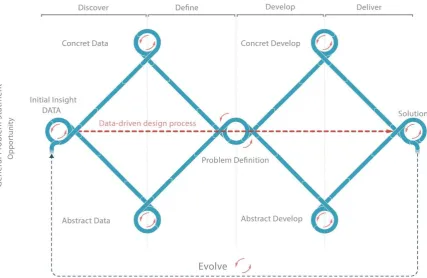
Quinones as well, in his paper Orienteering Design Through Data: the data-driven design model, argues for integrating data into the design process to allow easy access to a huge quantity of ideas
and information, supporting designers’ creativity and innovativeness.
The challenges that data poses to designers are more complex than the ones that are simply related to transforming a dataset or capturing data through scraping online resources. Prendiville et al (2017) discuss the role of design in making sense of data through processes of translation,
visualization and persuasion to turn the abstract and intangible nature of data into human-centred services with social and economic value. Furthermore, the authors claim that one of the critical aspects that should be addressed by designers concerns the transformation of data (something highly technical that we all produce every day, though allowing others exploit it) into something that can be understood and consumed by broader communities, possibly making the general public a proactive agent in data formation and use.
In this respect the paper by Chueng-Nainby and Lee on Transformative Learning: Co-design with
Communities’ Collective Imagery as Data for Social Innovation explores a co-design practice which
aims to enact social innovation by connecting local communities’ needs to global data networks. Low-fi physical tools are introduced to mediate a community shared imagery and a co-design framework within the systemic view of social innovation processes is then discussed at length.
Physical tools are also used in the paper Data Sensification: Beyond Representation Modality, Toward Encoding Data in Experience by Hogan, inwhich they present an emerging form of representation that encodes data in the behaviour, performance, affordances and resulting experience of a data representation, opening up to the new challenges we face with designing the data representations of the future.
When focusing on publicly available data, or open data, they can be regarded as a new commons (Ostrom, 1990; Bollier 2014), with new communities of users and new practices. The question of open data as a new commons (Morelli et al., 2017; Seravalli, 2014) is also currently under discussion in the design community at large. It raises questions to the next role of designers, such as
infrastructuring and collaborating to a democratic use of data, even among the non-experts, and promoting practices of service innovation in public and private institutions. Moreover, framing design and innovation policies around the use of open data and to co-create more explicit value propositions for all the different stakeholders has to be further analyzed.
The paper by Dominitz and Persov on User Empowerment by Design: A New Domestic Electricity Consumption Model. A case study of young urban tenants discusses a new domestic electricity consumption management system that deals with the democratisation of managing electricity consumption, transferring knowledge and responsibility to the users, as well as enabling conscious and efficient consumption.
To conclude, not only this track brings forward the relevance of data in the design process and in particular the value of data as a democratizing tool, but it also emphasises the role of design in supporting a democratic use of open data as a resource. The ever-growing number of
products/services that use data and/or produce data requires the definition of a new working area in which it is important to define new operative tools, methods and practices that can create a higher level of integration of data into the design process while at the same time empowering new communities around this resource.
References
Castells, M. (1996). The Rise of the Network Society. Volume 1 of The Information Age: Economy, Society and Culture. Oxford; Malden, MA: Blackwell.
Julien, P.-A. (2007). A Theory of Local Entrepreneurship in the Knowledge Economy. Cheltenham, UK; Northampton, MA: Edward Elgar Publishing.
Ciuccarelli, P., Lupi, G., & Simeone, L. 2014. Visualizing the Data City. Springer International Publishing, Cham. doi.org/10.1007/978-3-319-02195-9
O’Neil, C. (2016). Weapons of Math Destruction: How Big Data Increases Inequality and Threatens Democracy. New York: Crown.
Ratti, C., & Claudel, M. (2016). The City of Tomorrow: Sensors, Networks, Hackers, and the Future of Urban Life. New Haven; London: Yale University Press.
Townsend, A. M. (2013). Smart Cities: Big Data, Civic Hackers, and the Quest for a New Utopia. New York, NY: W. W. Norton & Company.
Dove, G., Jones, S. (2014) Using data to stimulate creative thinking in the design of new products and services. DIS 2014: 443-452.
Kalampokis, E., Tambouris, E., & Tarabanis, K. (2013). Linked open government data analytics. In: International Conference on Electronic Government (pp. 99–110). Springer.
Prendiville, A., Gwilt, I. & Mitchell, V. (2017). Making sense of data through service design – opportunities and reflections. In D. Sangiorgi (Ed.) Designing for Service. Key Issues and New Directions (pp. 225-236) London, Bloomsbury.
Ostrom, E. (1990). Governing the commons: The evolution of institutions for collective action. Cambridge: Cambridge University Press.
Bollier, D. (2014). Think like a commoner: a short introduction to the life of the commons. Gabriola Island: New Society Publishers.
Morelli, N., Mulder, I., Concilio, G., Pedersen, J. S., Jaskiewicz, T., de Götzen, A. & Arguillar, M. (2017) Open Data as a New Commons. Empowering Citizens to Make Meaningful Use of a New Resource. In: Kompatsiaris I. et al. (eds) Internet Science. INSCI 2017. Lecture Notes in Computer Science, vol 10673. Springer, Cham.
Morelli, N. Aguilar, M., Concilio, G., de Götzen, A., Mulder, I., Pedersen, J., Klitgaard Torntoft, L. (2017). Framing design to support Social Innovation: the Open4Citizens project. Proceedings of EAD12, Design for Next, 12-14 April, 2017, Rome, Italy.
This work is licensed under a Creative Commons Attribution-NonCommercial-Share Alike
Data Exploration for Generative Design Research
KUN Peter*; MUULDER Ingridand KORTUEM Gerd
Delft University of Technology
*Corresponding author e-mail: [email protected] doi: 10.21606/drs.2018.565
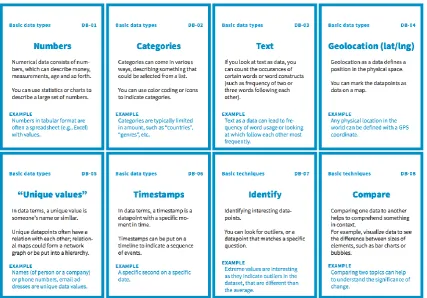
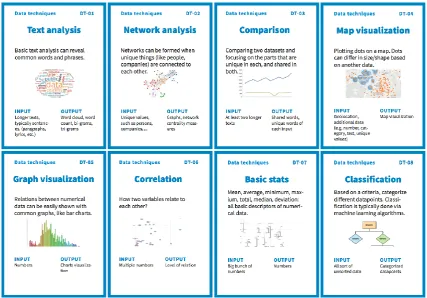
The current work elaborates upon a Generative Data Exploration method, which is a design technique aiming at supporting designers in integrating data in their design activities. Digital data offers new opportunities in all sort of professional domains, yet existing approaches and tools to manipulate data are predominantly targeted at data experts. As access to data is becoming democratised, new types of techniques are needed to leverage the agency of designers and to empower them to utilise data in the design process. Designers without prior data experience can benefit from the techniques, know-how, best practices of experts, if such expert knowledge is codified in design methods and tools. The aims of a Generative Data Exploration method are two-fold. First, the method facilitates a learning curve on gaining holistic data literacy. Second, the method supports designing where digital data, exploration of data and sense-making of data is part of the process.
design methods; data exploration; generative design; fuzzy front-end
1
Introduction
The abundance of digital data has been gaining presence in all areas of life. This datafication trend