New Kinetic Computerized Model for Multicomponent
Mass Transfer in Bi-Functional Matrix of NanoComposites
Anatoliy Kalinitchev
Institute for Physical Chemistry and Electro Chemistry, Russian Academy of Science, Moscow, Russia Email: [email protected]
Received December 27, 2012; revised January 29, 2013; accepted February 5, 2013
Copyright © 2013 Anatoliy Kalinitchev. This is an open access article distributed under the Creative Commons Attribution License, which permits unrestricted use, distribution, and reproduction in any medium, provided the original work is properly cited.
ABSTRACT
The aim of this theoretical investigation is the description of the multicomponent mass transfer process in the Nano- Composites (NC)—novel materials with the bi-functional matrix. The new theoretical NC Modelis assigned for the modern theoretical investigations of the multicomponent mass transfer kinetics in the bi-functional NC materials. This NC Model for the multicomponent mass transfer in the bi-functional NC matrix includes into the consideration the proposed key conception—two co-existing routes: I—chemical reactions onto the active NC centers-sites, and II—diffusion mass transfer inside the bi-functional NC matrix. All the results are presented in the terms of the addi-tional key concept: propagating multicomponent concentration waves (W+) in the NC matrix. The used W+ concept for
the description of the multicomponent NC mass transfer kinetics give the clear interpretation of the computerized re-sults. The mass transfer process in the NC matrix has been described theoretically by computerized simulation. The results of the calculations are new and illustrated by author’s animations showing visually the propagation of the multi-component concentration waves (W) inside the various NC matrixes: r-beads, cylindrical ro-fibers, or planar L -mem-branes. Two variants of modeling for mass transfer diffusion kinetics in the bi-functional NC matrixes with one ( Vari-ant 1), or two (Variant 2) dissociation-association reactions at the active nano-sites (R0)are considered theoretically.
Keywords: NanoComposites; Mass Transfer; Concentration Waves; Diffusion; Multicomponent Kinetics; Bi-Functional Matrix; Active Nano-Sites
1. Introduction
The created new theoretical NanoComposite (NC) Model is developed for the modern investigations of the multi-component mass transfer kinetics in the bi-functional NC materials [1,2]. The detailed description of the properties of the such type novel NC materials with the example: “NC Metal-Ion Exchangers”, including the methods of their synthesis has been published recently in the Russian recent monograph [3]. Theoretical aspects for the synthe-sis of the NC with a number of practical applications have been discussed in details in the monograph [3]. The NC includes numerious NanoParticles (NP) embedded inside the matrix-medium of the NC. The details of the NC synthesis with zero valent Metal (Me0) in the ion
exchanger matrix are presented [3]. Synthesized NC with the bi-functional matrixes, as for example: “Me0-Ion
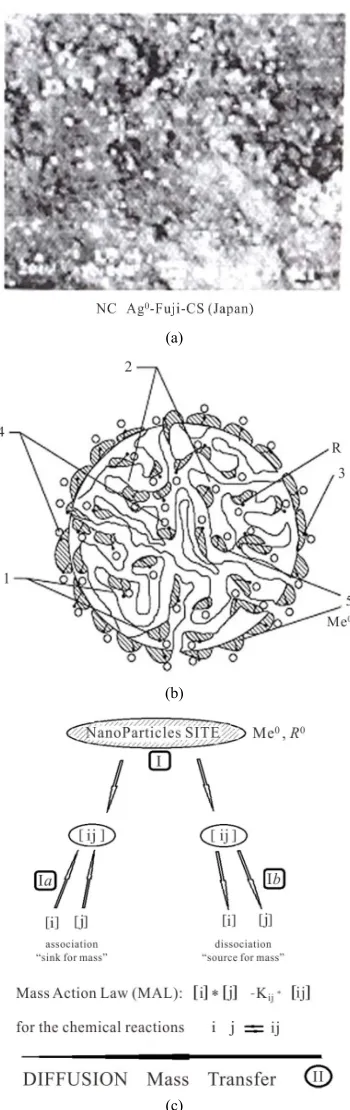
Ex-changers”, have practical advantages compared with the usual IEx materials [3,4]. Corresponding obvious ex-perimental micrography and pictures for the NC structure with the NP are presented (Figuгes1(a) and (b)) as the
illustration of the NP agglomerates embedded into the NC media [3]. Figure 1(a) shows one of the experimen-tal microphotography of the structure for the NC “Me0— Ion Exchangers” including zero valent Metal0 NP ( Fig-ures 1(b) and (c), (5), shaded) inside the bi-func- tional NC matrix. The microphotography of the experi- men-tally synthesized NC (Figure 1(a)) is obtained by prof. T. Kravchenko group from Voronezh State Univer- sity [3]. The experimental examples are presented as the illustra-tions of the NC media [2,3]. The Me0-NP ((Fig- ures 1(a)-(c)): NP—light points, (a); Me0 (shaded regions)—
(a)
(b)
(c)
Figure 1. (a)-(c)Mass transfer schemes inside the bi-func- tional NC matrix: (a)—experimental NC micropho- tography [3]; (b)—picture of NC r-bead (ro-fiber); 2—mi- cro-pores, 3—fixed groups R, 4—counter-ions, 5—Me0-NP ag glomerates ((b), (c), shaded); (c)—mass “ transforma-tions” scheme at the active nano-sites (Me0, R0): (Ia)— association stage of reactions (left); (Ib) —dissociation stage of reactions (right); (II)-diffusion mass transfer along the NC pores ((b), 2).
of the NC matrix (Figure 1(c)). Along with the diffusion mass transfer (II) the “sorption-desorption” process is realized in the NC Model via the mechanism of the “as-sociation-dissociation” reactions (Ia,b). Figure 1(c) re- presents the schemes-illustrationsof the NC bead [1,2] with all accompanying mass transfer elements [2,3]. Figure 1(c) shows the scheme of the two accompanying co-existing routes: I—active nano-sites of the NC with the “sinks” (I(a)) and “sources” (Ib) of the [ij]—mass component “transformation”: [ij]↔[i]+[j] (Ia,b), and
II—the diffusion mass transfer in the NC matrix pores [1,2].
The various components participate in the reactions (I(a), (b)) and in the diffusion mass transfer (II) inside the pores (Figure 1(b)-2) of the NC bi-functional matrix during the kinetic process. The mechanism of the “asso-ciation-dissociation” reactions (Ia, b) (Figure 1(c)) re-tards the whole kinetic process. Typical composition of the components may include: ions, complexes, neutral substances with zero charges and, in addition, the im-movable m-components (with zero diffusivity, m(R0i) Dm=0) at the fixed R0 nano-sites (Figure 1(c)) of the bi-functional NC matrix.
The created modern Model has common points with the preceding approaches published previously at the end of the last century for IEx kinetics [5-10].However, the previous kinetic models have been applied to the IEx kinetic processes, accompanied by the chemical reactions only in the usual IEx resins (and for r-beads only), but not for the new NC bi-functional materials, which are shown in Figures 1(a) and (b).
The created new multicomponent NC Model [1,2] is used for the computer simulation of the multicomponent mass transfer into the bi-functional NC matrix of the three various shapes: r-beads, cylindrical ro-fibers and planar L-membranes. There is used here the modern bi-functional NC Me0-Ion Exchanger [3], as the real
ex-ample for the new Model applications. For the generali-zation of the calculated examples (Section 4) the active nano-sites hereinafter are labeled as the k-component:
kR0 (here number of any component is represented by the
left index). So for any NC the R0 label means the nano-site and absolutely the same as Me0 for the example
“Me0-Ion Exchanger” in Figures 1(b) and (c), shaded
regions).
The modern multicomponent NC Model [1,2] with the key conception (I, II, co-routes for mass transfer, Figure 1(c)) is represented by the adequate computerized de-scription of the mass transfer in the bi-functional matrix of the novel NC materials. There are considered two real factors of the multicomponent mass transfer in the NC materials: Diffusion (Di,j) of the i,j-components, together
[image:2.595.85.260.80.635.2]R0 (Figure 1(c), dashed region) of the bi-functional NC matrix. The specific role of the reaction factor (routes Ia,
Ib) concludes in the retardation of the whole diffusion process due to the equilibrium of the association- disso-ciation reaction at the nano-sites (R0) of the NC (Figure
1(c)). It will be shown here the full similarity between the reaction influence for the retardation of the diffusion kinetics in the bi-functional NC and the sorption iso- therms factor influence in the dynamic theory of chro- matography. Such similarity will be discussed in details in Sections 6 and 7. The multicomponent mass transfer kinetics in the bi-functional NC matrix represent the process, in which the reactions (i.e. equilibrium trans- formations of various k,j-components due to the routes Ia,
Ib) must undoubtedly consider mass transport in the bi-functional NC materials.
Examples of IEx kinetics with the actual processes occurring via the mechanism of “sinks and sources” of masses are discussed in details [5-13]. Herewith, the effect of reactions on the kinetic behavior of the bi- functional NC system may be crucial: the kinetic proc-ess rate may be decreased by one or two orders of mag- nitude with the decisive dependence of the process on the solution concentration changes. Therefore, distin- ctive changes in the mechanism of the kinetic mass transport process may occur due to the reaction (Ia,Ib) factors influence.
Consideration of the active nano-sites influence in the bi-functional NC matrix (routes Ia,Ib; Figure 1(c)), at which changes of the mass for the components occur, is especially relevant in the case of the mass transport pro- cesses in the new bi-functional NC materials [1-4].
2. Modeling of Multicomponent Mass
Transfer Kinetics in Bi-functional
NC Matrix
Herewith the general phenomenological approach of the non-equilibrium thermodynamics [11] has been used for the multicomponent mass transfer in the new Model with the bi-functional NC matrix [1,2]. Postulates for the various Ion Exchange (IEx) multicomponent Models for IEx kinetics have been used during long-time period (around 50 years) starting from prof. F. Helfferich [12] with his review [13] and emphasizing STATE-of-the- ART-REPORT [8], till 80 - 90th [5-10].
Here is a short list of mathematical approaches used in the description of IEx kinetics: mass balance partial differential equations, quasi homogeneous medium, iso- thermal process, electro-neutrality, fundamental Nernst- Planck relationship for fluxes, constant diffusion coef-ficients (Di) for i-components. As usual in the theory,
the influence of the gradient of the electric field is ex-pressed via the sum of the j-concentration gradients by
using the absence of the electric current relationships [1,5-13]. In result the flux of each i-ion is described by its own gradient with addition of the multicomponent superposition of the j-concentrations gradients. Such superposition is called “diffusion potential” in the the-ory of irreversible thermodynamics (Ch. 4 in the mo- nograph [11]).
For the bi-functional NC matrix the additional mass fluxes are formed due to the transformations of the components, which are expressed by MALS relations at
the NP nano-sites (Figure 1(c), MAL). These sinks and sources of masses are considered by the corresponding fluxes of i-components and bring the redistributions of masses for various components participated. The ef-fects of mass transport for the created NC Model [1,2] by the mechanism “sinks-sources” at the nano-sites R0 (Figures 1(b) and (c)) are included in the material balance equations due to the introduction of the addi-tional terms describing decrease of a mass (with negative term for “sink”) or increase of a mass (with positive term for “source”).
For further advance of the Model the chemical reac-tions equilibrium uses the classical MALS relationships
[11] (Ch. 2). In the computerized Model they are pre-sented in the generalized form:
,
K ns ms
j i
i j
X X
s, s = 1, 2,…(MALS), (1)where expression Пi(I ≠ j) is the product of
concentra-tions (Xi)ms (i = 1,2,..); ns, ms (negative, or positive)—
are stoichiometric coefficients of the chemical s-reaction; s—is the corresponding index; KS—are equilibrium
con-stants in the MALS relationships (Equation 1), (Figure 1(c)). In principle the stoichiometric coefficients (ms, ns) for the chemical reactions equilibrium (1) might be frac-tional [7]. During the computerized simulations all the ms, ns values are assumed to be (± 1). However in need all these values may easily be used in the NC Model as fractional or larger than unity.
The modern approach with all mentioned postulates and equations of the NC Model [1,2] has been realized by modern computer modeling. The set of corresponding computer FORTRAN programs has been composed for the simulation of various multicomponent mass transfer in the NC systems, describing the kinetic behavior inside the bi-functional NC matrix. The various shapes of the NC medium: r-beads, cylindrical ro-fibers, or planar L- membranes are included into the theoretical computer simulation. Thus, the computerized investigations of the influence of the equilibrium reactions parameters in co-operation with the diffusion coefficients (Di) of the i-
trix play the decisive role in the description of the multi-component NC kinetics of the mass transfer. Therefore this well known and widely used “wave” approach [14-26] is shortly reviewed in the next Section 3.
The basic properties in the development of the created generalized NC Model accounting for the multicompo-nent character of the system are introduced. There are included the new properties of the bi-functional NC ma-trix based on the proposed key two routes concept (I & II) including “association-dissociation” mechanism onto na- no-sites: kR0 (Figure 1). For further consideration let us
simplify the generalized approach (Equation 1) to be closer to the multicomponent examples, which have been realized here by computers. The mathematical realization of the diffusion and relations for the chemical reactions inside the bi-functional NC matrix is based on the ap-proach with the application of the simple form of MAL (Figure 1(c)) in the modern NC Model for the arbitrary i, j, ij-components concentrations: [i], [j], [ij]. The corre-sponding simple scheme, as for example for the simple reactions: i + j ↔ ij may be represented by the simple MALS relations for monovalent components: Ks [i] × [j]
= [ij] (Figure 1(c))..
3. Concept of Concentration Waves (W
+) for
Multicomponent Kinetics and Dynamics
of Mass Transfer
During the mass transfer kinetics the concentration pro-files—“waves” of the components are formed inside the porous media. Figures 2, 3 and 5 represent a lot of com-puterized examples of the waves propagating during the multicomponent NC kinetics. The key concept (W+) of
“multicomponent waves” is widely used in theoretical description for many scientific fields of the multicompo-nent transport for various kinetic and dynamic systems. The “multicomponent waves” concept has wide area for applications in such research fields, as percolation proc-esses [18,19], mechanics of liquids, gas dynamics [22], theory of burning and even street traffic [19,23,24]. The term “wave” (W+ concept) has been used in all these
publications [14-26] including the mentioned excellent monograph [14] and the books [23,24] concerned with car traffic and kinematic waves.
The specific case is realized for the p-components, which are transformed into the complex—m(R0p),(mth-
component) with zero diffusivity (Dm=0). Meanwhile
such p-components may participate in the association- dissociation transformation: ip m(R0p) ip + kR0 ↔ m
(R0p) with the following change of the masses. It will be shown (Section 4) that due to this components transfor-mation at the nano-sites (kR0, Figure 1(c)), the kR0-
component concentration wave (Figures 2, 3 and 5 solids, brown curves – k = 5,6) propagates in the bi-functional NC matrix (though DkR = 0). The obtained results of the computerized simulation on the basis of the created NC Model [1,2] are presented via the well known “multi-component concentration waves” (W+) concept [14-21].
There are phenomenological concepts potentially com-mon to all filtration processes, which can also be ex-tended to a whole series of migration phenomena such as chromatography, sedimentation, electrophoresis and some others [14-26]. The review [21] and presentations [25,26] published by author in cooperation with W. Hoell (Karl- sruhe Research Center, Germany) include the application of the multicomponent wave concept with the description of the SCT (Surface Complexation Theory)-Model. The SCT-Model for the multicomponent IEx equilibrium had been elaborated by prof. W. Hoell group at the end of the last century (Refs. in the review [21]).
Concentration waves arise and propagate along the dis-tance (r-, ro-radius, or L-thickness) inside the NC matrix during multicomponent mass transfer. The multicomponent waves with their propagation in the bi-functional NC ma-
(a) CMR = 0.28; DispR = 0.18 (b) CMR = 0.41; DispR = 0.09
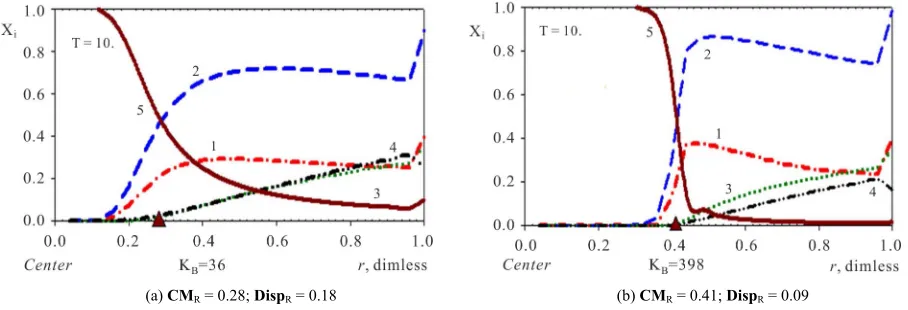
Figure 2. (a), (b) Comparison of concentration waves—Xi(r,T) inside NC matrix (r-bead). Variant 1.(5—component system, Anion ). Influence of KB value: KB = 36 ((a), left); KB = 398 ((b), right). Triangles (brown) show CMR positions for 5R0-waves (brown solids, 5) at r axis. Number of components are at curves. = 0.0085 < = 0.01 < = 0.03. T = 10.
2 4 SO
3HSO
[image:4.595.72.526.540.695.2]
Waves propagation, as well as their concurrent inter-ference-interaction should be used for the simulation and consideration of all the details of the mass transfer kinet-ics and dynamkinet-ics. The fundamental monograph [14] (in-cluding additionally a lot of chromatographic papers by prof. F. Helfferich) is devoted to the all aspects of the travelling “concentration waves” conception. There is a lot of research papers adjoined, which are included into the special issue [15]dedicated to F. Helfferich (Fest-schrift) with the detailed consideration of the travelling “multicomponent concentration waves” (W+) concept
[15-21], including some others related. A fairly detailed discussion of the wave concept, as well as many funda-mental examples and definitions, are presented in a number of books and reviews (Refs. in [15-22]). In the presence of the effects of the non-ideality of the sorption medium the travelling concentration waves propagate with their broadening, including results of their conse-quent interference [14-26].
The concept of “multicomponent concentration waves” (W+) is widely used here to consider the results of the
computer simulation of the multicomponent NC kinetics in the bi-functional matrix. The examples of the multi- component concentration waves are presented in Figures 2, 3 and 5 for the NC bi-functional matrix. Comparison of the concentration waves behavior for the kinetic and dynamic system shows compatibility and differences for the interfering waves: there is the similarity between mass balance equations for multicomponent kinetics and dynamics. The travelling multicomponent concentration waves are involved in both cases of the kinetic and dy-namic systems. However in addition, there are the differences:
1) In the dynamic IEx systems, as a rule, the travelling concentration waves used to reach the stage (named by F. Helfferich as “coherence” [14,17]), in which the linear dimensions of the system are large, while multicomponent waves achieve the so called “coherent state” [14,15,17- 19]. In this state the waves are separated by the concen-tration plateaus [14-21,25,26];
2) In the kinetic diffusion multicomponent IEx systems the behavior of the waves and its interpretation differs in the presence of the diffusion phenomenon (even in the absence of reactions). Concentration waves in the kinetic systems propagate without the formation of the concen-tration plateaus between the waves [16]. In this case, due to a limited small size of the matrix the concentration waves are unable to disperse with the formation of con-centration plateaus. Therefore, the coherent state is unat-tainable in these kinetic variants of the mass transport. However, in the case of multicomponent kinetics the effect of the interference of the diffusion kinetic concen-tration waves of the components still takes place [9,16]. Further, this behavior of the multicomponent system with
the wave interference are shown in Figures 2, 3 and 5 based on the approach with the multicomponent kinetic equations of the mass transport in the bi-functional NC matrix.
The quantitative description of the waves behavior is successfully described here by the well known two inte- gral parameters used for the characterization of any dis- tributions: “Center of Mass” (CMk) and “Dispersion”
(Dispk). The “CMk” parameter describes the integral
“Center” of k-concentration (frontal) distribution-wave
kR0. The “Dispk” parameter describes “the integral
width” of the k-wave distribution. Parameters “CM” and “Disp” are well known in the mathematical statistics as “average of distribution” and “dispersion” correspond- ingly [27]. Such types of the descriptions are used (Sec- tion 4, CMR and DispR, Figure 4) for the estimation of
the “completion Time”: Tfin of the kinetic process and
“width” of the kR0-concentration frontal k-wave in Fig- ures 2 and 3 (5R0-wave,solids, 5-brown curves). The con centration waves propagate across the various NC me-dium (L-membrane, ro-fiber, r-bead) from the boun- dary points (L0, ro0, r0 = 1) to the final “zero points”: L, ro, r = 0 correspondingly (Figures 2-4). The kinetic processes are finished at the completion moment T = Tfin ,
when the understandable relation CMR + DispR = 1 is
realized. This moment Tfin correspons to “the crossing”
(Figure 4) of solid and dashed curves correspondingly. The more detailed description and discussion of the inte-gral parameters are given below (Sections 4 and 5).
The description of the created NC Model [1,2] has been followed by the computerized simulation of the multicomponent system behavior in the bi-functional NC matrix. All the parameters of the system in the computer simulations are dimensionless (see Nomen-clature) as it is better for any modeling (and for under-standing) especially in Fundamentals. The obtained re-sults of the computerized simulation for the multicom-ponent mass transfer in the NC are original and new. The results of modeling are demonstrated and discussed in Sections 4-7.
The results of the computer simulations are presented here in the set of various pictures (Figures 2-5) where part of the images (Figures 2, 3 and 5) shows the multi-component concentration distributions-waves.
re-peatedly (including the sessions of “IEX 2004, 2008 and 2012” Conferences) [2,25,26].
4. Concentration Waves in the
Multicomponent NC Kinetics
The described postulates of the mathematical Model were realized for all relationships including multicom-ponent mass transfer kinetic partial differential equations, electro-neutrality relations, classical Nernst-Plank equa-tions for the fluxes of the components and Mass Action Laws for the chemical reactions equilibrium (Equation 1, Figure 1(c)) [1,2].
All the systems describing the multicomponent kinetic behavior in the bi-functional NC matrix of the various shapes (r-bead, ro-fiber, L-membrane) were involved in the simulation with several author’s FORTRAN com- puter programs for such NC systems. The computer cal-culations were fulfilled for a number of variants with different values of the diffusion coefficients and various constants of the MAL chemical reactions (Equations 1, Figure 1(c)). The results of the simulations for the mul-ticomponent NC systems are presented below. All the computer calculations have been obtained by using di-mensionless values, including concentrations (Xi);
diffu-sion coefficients Di; constants of chemical
associa-tion-dissociation reactions (KS). The mass transfer
kinet-ics in the NC Model include the multicomponent con-centration waves propagation along the dimensionless distance: r, ro, or L in the course of the dimensionless time (T = D0t/r02). All the author’s results of the com-
puter simulation are obtained for the first time. The re- sults of such calculations for the bi-functional NC matrix are presented in the next SubSections.
4.1. ComputerizedSimulation of
Multicomponent Diffusion Kinetics with Additional Mass Transfer at the Nanosites (kR0)
There is productive for the quantitative estimation and description of the travelling concentration k-waves be-havior to use the integral characteristics: Center of Mass —CMk(T) and Dispersion—Dispk(T). Such
characteris-tics have wide spread occurrence in mathematical statis-tics [27]. For the computer modeling these integral CMk(T), Dispk(T)—parameters may be easily calculated
during computerized simulation of the process. The CMk(T)—dependence describes the position of the k-
wave along the distance in the NC matrix: radius for r-bead (ro-fiber) or through the thickness (L) of the planar L-membrane. The Dispk(T) dependence describes
the change of the width of the Xi concentration (frontal)
wave in correspondence with its physical meaning. The illustrations are presented in Figures 2-5 for the k-wave profiles with the CMk positions. These CMk positions
are indicated by the brown triangles on abscissa r(ro or L) (Figures 2, 3 and 5). The dependences—CMk (T) are
presented by solid lines in Figure 4. The results of the computer calculations of the both integral parameters are presented in Figures 3(a)-(f) and Figure 4 (Dispk(T)—
dashed lines).
This investigation shows that the time dependences of this two parameters: CMk(T), Dispk(T) (Figure 4) are
suitable for the description of the behavior of the
kR0-component wave, where kR0are the nano-sites R0-
concentrations. Examples of such description will be presented in this Section 4.1 below for two various cases for kR0 sites: Variant 1 with the one association-disso-
ciation reaction (1B), and Variant 2 with the two reac- tions (2.2), (2.3) correspondingly. The lists of the com- ponents for each Variant1 and Variant2 in the bi-func- tional NC matrix are shown in Section 4.1.
The kR0—wave (Figures 2, 3 and 5—solids, brown
curves—5,6) is formed in the bi-functional NC matrix due to the transformation of the 4th-component (
4H+ ↔ kRH+) at kR0 nano-sites with the change of
[kR0]—concentration in the k-wave (k = 5, Variant 1, Figures 3 and 4), or k = 6 (Variant 2,Figure 5).
All the relations (1A), (1B) or (2.1) - (2.3) are pre-sented here in the simple MALS type: Ks
ij /
i j
(Figure 1(c)).
4.1.1. Kinetics of H2SO4 Acid inside the NC Matrix with One Reaction at the Nano-Sites (5R0) Variant 1. Sorption Kinetics of H2SO4 acid for 5-com-
ponent NC System. The i-components (numbers—in- dexes to the left of the Symbols) with the corresponding diffusivities Di:
2 1SO4
—anions of acid with thediffusivity ( = 0.01)
in the NC pores (2, Figure 1(b));
4
1SO
D
2RH+—immovable 2nd-component, formed by nano-sites,
protonated by acid cations (4H+) due to the association
reaction (1B), (D2RH
= 0);
3HSO4
—anions of the acid (reaction (1A)) with the
dif-fusivity (D3 = 0.008) inside NC pores;
4H+—cations of H2SO4 acid with the diffusivity ( 4H
D
= 0.03) in the NC pores;
5R0—zero valent nano-sites (D5R = 0), generated by the
NP agglomerates (Figure 1(c)).
The IEx, NC system is characterized by these 5 com-ponents, three diffusion coefficients ( 1 4; 3 4;
4
SO
D D HSO
H
D ) with two reactions: in the NC pores (Equation (1A)) and at the active nano-sites: 5R0 (Equation (1B)) correspondingly: for NC pores,
2 3HSO44H1SO4
2 3HSO4 KA 4H 1SO4
(MALA) (1A)
A
t active nano-sites,5R0 2RH 5R0 4H
T1 = 6; (a) CMLR(T) = 0.6; (b) CMroR(T) = 0.48; (c) CMrR(T) = 0.43
T2 = 10; CMLR(T) = 0.42; CMroR(T) = 0.5; CMrR(T) = 0.3
T1 = 6; (d) CMLR(T) = 0.65; (e) CMroR(T) = 0.6; (f) CMrR(T) = 0.59
T2 = 10; CMLR(T) = 0.5; CMroR(T) = 0.46; CMrR(T) = 0.4
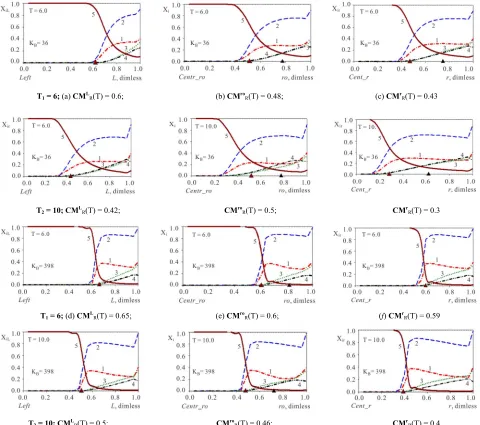
Figure 3. (a)-(f) (Variant 1. Anion ) Comparison of propagating 5R0(T)-waves (5, brown solids) inside the NC matrix for various shapes with KB values: XiL(L, T), L-membrane (left, a, d); Xi(ro, T); ro-fiber (middle, b, e); Xir(r, T); r-bead (right (c), (f). Triangles (brown) show CMR positions at L, ro, r-axes (abscissa); KB = 36 (a)-(c); KB= 398 (d)-(f). T1,2 = 6, 10. Compo-nent numbers are at curves.
1.
1 2 4 SO
acid with the sulphate anions (An− =
1 ) including
concentrations [Xi] of all five components (I = 1,2,…5;
left indexes): {[1
2 4 SO
2 4
SO ], [2RH+], [3 4], [4H+], [5R0]}. Such diffusion 5-component process in the bi-functional NC matrix is accompanied by two MALS relations: (1A),
(1B) with 1 4; 3 4; )—diffusivities of 1,3,4- components. The relationship (1C) shows that for Vari-ant 1the 5R0-wave depends on [4H+]-concentration with
the KB constant value (1B). This dependence influences
the concentration waves 5R0 behavior shown in Figures 2(a) and (b) and Figures 3(a)-(f). The results are calcu-lated on the basis of the NC Model (Section 1) with the
HSO
SO
D D HSO D4H
0 2RH KB 5R 4H
, (MALB) (1B)
The relationships (1A), (1B) are presented by MALS
with the constants: KA, KB.
It follows (Variant 1) that the expression (1C) holds in equilibrium at the nano-sites 5R0 for the [5R0] concentra-
tion, where 0 And
5R 2RH
0 0
5R KB 5R 4H
,
0
5R 1/ 1 KB H
[image:7.595.59.539.86.511.2]computerized simulation.
4.1.2. Kinetics of HCl Acid inside the NC Matrix with Two Reactions at the Nano-Sites (6R0)
Variant 2. Sorption Kinetics of HCl acid for 6-compo- nent NC System. The i-components with the diffusion coefficients Di: 6(six)-component system:
1Cl−—anions of acid with diffusivity (D1Cl =0.01) in the
NC pores (2, Figure 1(b));
2RH+—immovable 2nd-component, formed by 6R0 nano- sites protonated by acid cations (4H+) due to the
associa-tion reacassocia-tion (2.2), (D2 HR = 0);
3RHCl—immovable 3d-component, generated by the
reaction (2.3), (D3RHCl = 0);
4H+—cations of HCl acid with diffusivity ( 4H
D = 0.03) in the NC pores;
5HCl—acid in dissociation-association reaction (2.1)
with diffusivity (D5HCl = 0.008) in the NC pores; 6R0—zero valent immovable (D6R = 0) nano-sites
gener-ated by NP agglomerates (Figure 1(c)).
The NC system (2.1) - (2.3) is characterized by n = 6 components, three diffusion coefficients (D1Cl; 4H
D ;
) with three reactions: one in the NC pores (2.1) with additional two association-dissociation reactions (2.2), (2.3) at the active 6R0 nano-sites correspondingly:
HCl 5
D
for NC pores, 5HCl 4H1Cl;
5HCl
K14H 1Cl
1
(K1, MAL1), (2.1)
at active nano- sites 6R0, 1st step:
0
2RH 6R 4H
;
0 2RH K2 6R 4H
(K2, MAL2) (2.2)
at active nano-sites 6R0, 2nd step:,
3RHCl 2RH Cl
;
3RHCl
K3 2RH 1Cl
(K3, MAL3) (2.3)
The second relations in (2.1), (2.2) and (2.3) (multi-plication) are described by MALS with the corresponding
constants: K1, K2, K3.
There is described in Variant 2 the sorption of HCl acid with chloride anions (An− =
1Cl−) including
concen-trations [Xi] of all six components (i = 1,2,…6; left
in-dexes): {[1Cl−], [2RH+], [3RHCl], [4H+], [5HCl], [6R0]}. Such diffusion 6- component process in the bi-functional NC matrix is accompanied by three MALS relations
(2.1)-(2.3); ( Cl; ; HCl)-diffusivities of 1,4,5-
components: 1
D 4H
D D5
6R 1/ 1 K
2 4H K K2 3
4H Cl
1 (2.4)
The relationship (2.4) shows that the profile of the 6R0-wave for Variant 2 depends on two concentrations [4H+] and [1Cl−] together with two MALS constants K2
and K3. The 6R0-wave profile is shown in Figures 5(a)– (d).
Thus the comparison of the (1C) and (2.4) relations shows that the propagation of the 6R0-wave (Variant2, 6- components, two MALS constants: K2 and K3) is more
complex (and more variable) than for the 5R0-wave (with one K2-constant, Variant1). Taking the relationships: (1A),
(1B) and (2.1-2.4) into account with comparing Variant 1 and Variant2 it is clear that for two considered NC sys-tems—Variant 2 is more complex and has more degrees of freedom (the ability for more variations) than Variant 1.
5. Multicomponent Waves Behavior in the
Modeling of NC Kinetics
The multicomponent concentration wave behavior in the bi-functional NC matrix is described here on the basis of the considered NC Model (Figure 1(c)) with the comput- erized modeling including the wave (W+) concept. There
are considered two various different multicomponent NC kinetic systems: 5-component NC system with one asso- ciation-dissociation reaction-(1B) (Variant 1) and 6- component NC system with two association-dissociation reactions—(2.2), (2.3) (Variant 2).
5.1. Concentration Waves in 5-component NC System { SO2
1 4
,
2RH+, 3 4, 4H+, 5R0} with
One Association-Dissociation Reaction HSO
The investigation of the waves propagation with the re-sults of the computerized simulation are presented in Figures 2-4 for Variant 1 with one association-disso- ciation reaction (1B) at 5R0 nano-sites (including 5R0- wave, sorption of H2SO4 acid, 5-components).
Compari-son of the 5R0-waves (5, brown solids) in Figure 2 shows that with the small KB value (a, left) the 5R0- wave propa-gates to the Center (for r-bead) faster, than for the large KB value (b, right): CMR (left) < CMR (right). For the
dispersion the inequality is reverse: DispR(left) > DispR
(right). In other words 5R0-wave (right) propagates slower with the profile, which is sharper (Figure 2(b)) in comparison with the 5R0-wave (left) (Figure 2(a)). If KB
is increased: from (a) to (b), it means that the equilibrium of the reaction (1B) shifts to the left hand side of the re- action (1B). In this case (from (a) to (b)) such shift of the equilibrium (1B) clearly slows down the kinetic process. Figure 2 illustrate the influence of the KB value in the
reaction (1B): the increase of the KB increases the com-
pletion time (Tfin) for the kinetic process.
Figures 3(a)-(f) illustrate the influence of the three various shapes of the NC matrix:r-bead (right), ro-fiber (middle), and L-membrane (left) on the 5R0-waves behav- ior in the course of time (T1,2 = 610) for the various KB
values: KB =36 (a)-(c) or 398 (d)-(f). Comparison of
the 5R0 wave (dashed lines, Figures 4(a) and (b)) is the largest for the L-membrane—DispRL(T). The conclusions
are followed from Figures3 and 4. Matrix than in the planar L-membrane or ro-fiber:
CML
R(T)(a), (d) > CMroR(b), (e) > CMrR(T)(c), (f)
(com-pare the positions for CMR (triangles, brown) in Figures 3(a)-(c) and also in Figures 3(d)-(f).The reason of such differences in the wave velocity is geometric: for r-bead the diffusion occurs in the fewer volume in the course of time T (for ro-fiber the change in volume is smaller than for r-bead, for L-membrane the volume is permanent—no change). In Figure 4 the dependencies for the integral parameters: CMR(T), and DispR(T) are presented for 5R0 waves (Variant1)with various shapes of the bi-functional NC matrix: r-bead, ro-fiber, L-mem- brane.
5.2. Concentration Waves in 6-Component NC System {1Cl−, 2RH+, 3RHCl, 4H+, 5HCl, 6R0}
with Two Association-Dissociation Reactions
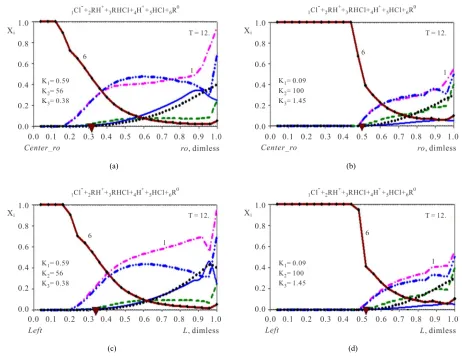
The6R0-waves (brown curve-6, Figures 5) formed during the kinetic process in 6-component system (Variant 2) have the principal characteristic feature in comparison with the 5R0-waves for 5-component system (Variant 1, Figures 2-4). The 6R0 wave is “divided” partly into two sub-waves: rather sharp part of 6R0 frontal wave (for large concentrations) and rather diffuse 6R0-frontal wave (for small ones) (Variant 2, Figures 5(a)-(d)). This is ex-plained by the influence of the two sequential effects of the two steps of the association-dissociation reactions (2.2), (2.3) with the corresponding constants -K2, K3. The
veloc-ity and profile of the 6R0-wave (Figures 5) depend on the combined influence of the K2, K3-constants including
ad-ditional effects of the [4H+], [1Cl−]-concentrations values in
relation (2.4). The point of transition from one sub-wave to the other depends mainly on the K2-value (compare Fig-ure 5 (left—(a),c) with Figure 5 (right—b,d).
Figure 4 represents the time dependent estimations of the mass transfer kinetics for the three various shapes - L,ro,r(T) of the NC matrix. The completion time (Tfin) of
the kinetic process corresponds to the criterion (see also Section 3): the amount of sum (CMR + DispR)L,ro,r= 1.0. It
means, thatthe distance covered by the [5R0]—concentra- tion wave to the moment Tfin is equal to the length of the
matrix: L0 (thickness), ro0 (radius of cylinder) or r0 (radius
of sphere). In other words the completion time Tfin corre-
sponds to the “crossing” of two curves: CMR(T), (solids)
with DispR(T), (dashed) (Figure 4). In accordance with
this criterion of “crossing” it is obvious from all Figures 3 and 4 that for any conditions the kinetic mass transfer process in the NC matrix is the fastest inside r-bead and the slowest inside L-membrane. The Dispersion (DispR(T)
—width) of the 5R0 wave (dashed lines, Figures4(a) and (b)) is the largest for the L-membrane—DispRL(T). The
conclusions are obvious and follow from Figures3 and 4.
6. Discussion
The computerized simulation of the mass transfer kinet-ics inside the NC matrix (Sections 4,5) discovers the clear analogies of the multicomponent NC kinetics with the main theoretical basis of the theory of nonlinear mul-ticomponent chromatography [14,19]. These analogies concern here the multicomponent concentration waves (Figure 4, DispR(T), dashed). In accordance with this
cri-terion of “crossing” it is obvious from all Figures 3,4 that for any conditions the kinetic mass transfer process in the NC matrix is the fastest inside r-bead and the slowest inside L-membrane. The Dispersion (width—DispR(T)) of
(a) (b)
Figure4. Variant 1. (Sulphate Anion: 1 ). Time dependence of integral parameters: CMRL,ro,r(T), (solids) & DispRL,ro,r (T), (dashed) during propagation of 5R0-wave in the NC matrix: KB =36 (a), left); 398 (b), right); L-membrane (brown), ro- fiber (grey), r-bead (green). = 0.01; = 0.0085; H = 0.03. Ordinate axis: distance from boundary (L0, r0, ro0 = 1) to “zero” points (L, r, ro = 0). Distances: 1. > L, r, ro > 0.
2 4 SO
3HSO
D
1SO4
(a) (b)
(c) (d)
Figure 5. (a)-(d) (Variant 2. Chloride: 1Cl−). Comparison of propagating 6R0(T)-waves (6, brown solids) inside the NC matrix (ro, L) with two various K1-3 values for : ro-fiber-Xi(ro, T), (up,(a), (b)); L-membrane-XiL(L, T), (down, (c),(d)). Triangles (brown) show CMR positions at ro, L-axes (abscissa); K2 = 56 (left—(a), (c)); K2 = 100 (right—(b), (d)). Component Numbers (1, 6) are at the corresponding curves: 6R0, 1Cl−. T = 12.
behavior in the bi-functional NC matrix. The physical meaning of the reasons for the explanation of the pro- pagating concentration waves behavior (Figures 2-4) is described by the joint influence of the two co-existing factors in the bi-functional NC matrix: Chemical Reac- tion (I) and Diffusion (II) (Figure 1(c)). Such type of the same joint effect (Reaction equilibrium + Diffusion effects in the NC matrix) is represented in the theory of chromatography by: multicomponent isotherms for equi-libria (I) and set of the broadening factors for the con-centration waves in columns (II), (i.e. well known effec-tive HETP parameters (see Nomenclature) for chroma-tographic columns [9,14,19,20].
The first part of the Sections 5,6 concerns mainly the Variant1: mass transfer of 5 components in the bi-func- tional NC matrix with one assocition-dissociation reac- tion (1B) at the nanosites—5R0. The influence of the first factor (I-Reaction equlibrium) is expressed by the KB
(MALB) value: the more is KB-value (1B)-the less is the Dispersion (DispR) of the 5R0-concentration wave. In
other words the width of the wave profile becomes nar- rower with the large KB value (Figure 3(b) and Figure 4(b)). The comparison of the DispR, in Figure 3a with
Figure 3b (brown solids, curve 5) shows the narrowing distinctly. The same effect is shown via comparison Figure 4(a) with Figure 4(b) (DispRL,ro,r-dashed, corre-
sponding color). The influence of the second factor (II-Diffusion) gives, as usual, the widening of the con- centration 5R0- waves with the increase of the diffusivity. It should be emphasized here the non-trivial, specific effect for the NC system: there is no diffusivity for the 5,6R0-component (D5,6R = 0), nevertheless the propagation
of the 5,6R0-waves takes place (Figures 2, 3 and 5). The physical reason of such propagation is not the diffusivity (D5,6R = 0) but the chemical reaction (1B) (or (2.2),(2.3))
influence: the transformation for the components ( ), and diffusion coefficients of other moveable components (D1SO4; D3HSO4; D4H) bring the
resulting mass transfer of the [5R0]-, (or [6R0])-concen-
+ 0
2RH 5R 4H+
[image:10.595.65.527.80.439.2]waves.
One more interesting result with the evidence of the above marked analogy can be seen from Figure 4. In this cases it takes place the typical behavior of the para- me-ter—DispR in the course of Time (T, abscissa): the
dis-persion (DispR) of 5R0-waves tends asymptotically to the permanent value at the end of T-abscissa (Figure 4, see dashed curves behavior along the abscissa T with the asymptotic tendency to the constant value). In the theory of chromatography the same effect takes place for the concentration waves in columns, when the favourable isotherm factor (I) used to compensate the unfavourable influence of the broadening HETP factors (II) for the concentration waves in columns: favourable equilibrium (I) compensate the widening of the concentration wave with the same type of the asymptotic tendency [14,19,20] There are considered these effects on the basis of the NC Model with the results of the multicomponent kinetic system for Variant 1 (k = 5) and Variant 2 (k = 6).
Variant 1. Association-dissociation reaction (1B) at the nano-sites 5R0 brings the retardation (in the NC medium) of the i-component due to the partial transformation in the association-dissociation reaction (1B): 5R2RH .
Therefore the movement and broadening of the 5R0- concentration wave (5-component system) depend on the one KB value and on [4H+] concentration (1C). The com-
parison between Figure 2(a, left) and Figure 2(b, right) shows that the width of the 5R0-wave (5, brown solids, a, left) is much larger than for the right5R0-wave (b). In addition Figure 2 shows that the 5R0-wave (curve 5, a, left) moves faster than the 5R0-wave (curve 5, b, right).
Variant 2. Association-dissociation two steps reactions (2.2), (2.3) at the nano-sites 6R0 bring also the retardation (in the NC matrix) of the i-component due to the partial transformations with both reactions: 1st step:
2RH
0
6R 4H
(2.2) and then, 2nd step:
3RHCl
2 (2.3). The total effect of the two step
reac-tions is determined by the values of the two coeffi-cients—K2, K3 with additional influence of the
concen-trations [4H+], [1Cl−] (2.4) on the [6R0]-concentration wave behavior.Therefore the movement of the 6R0-con- centration wave is influenced by the [1Cl−], [4H+]-con-
centrations with the additional influences of K2, K3
val-ues. The behavior of the 6R0-wave (6-component NC sys- tem with two association-dissociation reactions) is more complex and more variable (with more degrees of free- dom) than for the 5-component system (Variant 1), where there is only one association-dissociation reaction (1B). This difference is expressed in the combined char-acter of the 6R0 wave profile (Figure 5).
1Cl H
R
Thus more variable 6-component NC system (Variant
2) has more complex behavior. For 6-component NC system the number of the determining parameters (in-cluding concentrations) is larger than for 5-component
NC system (Variant 1). The mentioned analogies be- tween multicomponent chromatography and NC kinetics in the NC Model is not so visual and becomes more complex for the 6 component NC system (Variant 2). The main reason is the influence of the two association dissociation constants K2, K3 (2.2), (2.3) for the 6-com-
ponent system in contrast to the simple influence of one KB constant (Variant 1). The discussion of the regulari-
ties in the behavior of the integral parameters: CM6 and Disp6 for the 6R0-wave needs thorough future analyses with the multicomponent calculations of mass transfer in the 6-component NC system.
The corresponding computer animations are prepared by author for the visual demonstration of the obtained results of the modeling. The animations obtained on the basis of the computer calculations with the corresponding successive visual frames for the waves are perceived easily by any audience.
7. Conclusions
The modern kinetic NC Model for the multicomponent mass transfer in the novel NC materials is created. The computerized simulations of the nonlinear NC systems on the basis of the Model bring the new results describing the behavior of the multicomponent concentration waves (W) in the bi-functional NC matrixes for the three vari-ous shapes: r-bead, ro-fiber, L-membrane.
The results demonstrate rather comprehensive analogy between theory of nonlinear chromatography and multi- component NC kinetics in the bi-functional matrix. This analogy is used for the description of the multicompo- nent concentration waves behavior. In the interpretation of the marked analogy there are shown the decisive in- fluences of the two characteristics of the NC model: the equilibrium parameters of the Reactions (I) and Diffu- sion effects (II) on the propagation of the concentration waves inside the bi-functional NC matrix during the NC kinetic process.
The “multicomponent concentration wave” (W+) con-cept in the study of the bi-functional NC matrix with the two factors: (I) Reactions on the active nano-sites and (II) Diffusion in the NC medium is effective. It brings the clear, and understandable treatment of the multicom-ponent mass transfer kinetics in the bi-functional NC matrix. The quantitative estimations of the concentration waves behavior are obtained by using the two integral parameters of the wave distributions: “Center of Mass- CM” and “Dispersion—Disp”. The corresponding con-clusions concerning co-influence of the Reactions and Diffusion coefficients inside the bi-functional NC matrix on the kR0-concentration wave behavior are obtained.
multicompo-nent concentration waves (W) in the bi-functional NC matrix. The used W+ concept for the description of the
multicomponent NC mass transfer kinetics gives the clear interpretation of the computerized results. The ob-tained original, new results on the basis of the NC Model show the behavior of the broadening and interacting propagating concentration waves (especially concentra-tion 5,6R0-waves) inside the bi-functional NC matrix dur-ing multicomponent mass transfer NC kinetics.
8. Acknowledgements
Author is grateful for the support of part of this research, which has been fulfilled in Karlsruhe, (KIT) under the support of DFG (Deutsche Forschung Gemeindschaft, 2011, German-Russian grant N 436 RUS 113/989/9 - 1).
REFERENCES
[1] Kalinitchev, “Kinetic and Dynamic Chromatographic Sys-tems, and Models of Mass Transport: Behavior of Multi-component Concentration Waves,” Protection of Metals and PhysicalChemistry of SurfacesJournal, Vol. 47, No.
6, 2011, pp. 570-579.
[2] A. Kalinitchev, “Mass Transfer Kinetics Modeling in Bi- functional Ion Exchangers with Chemical Reactions on Active Centers,” In:M. Cox, Ed., IEX 2012 Intern. IEx Conference, Version of full Papers. S. “Fundamentals”
(Book-El.). SCI & Ext. Abstracts, 2012, pp. 1-18 & pp.
123-125.
[3] T. Kravchenko, L. Polyansky, A. Kalinitchev and D. Konev,“Nano Composites Metal-Ion Exchangers,”2009. [4] E. Kiprianova, T. Kravchenko, D. Konev, A. Kalinitchev
and W. Hoell,“Reducing Sorption of the Molecular Oxy- gen from Water by Silver-Sulpho-Cation Exchanger Nano Composite with Various Ionic Forms,” Russian Journal of Physical Chemistry, Vol. 84, No. 6, 2010, pp. 1104-
1110.
[5] F. Helfferich and Y-I. Hwang,“Kinetics of Acid Uptake by Weak Base Anion Exchangers. Mechanism of Proton Transfer,” Am. I. Ch. E. Symp. Ser.,Vol. 81, 1985, pp. 17-
27.
[6] A. I. Kalinitchev, E. V. Kolotinskaya and T. D. Semeno- vskaya, “Computerized Analyses of the Diffusion Pro- cesses in Complexing Ionites,” Journal of Chromatogra- phy, Vol. 243, No. 1, 1982, pp. 17-24.
doi:10.1016/S0021-9673(00)88159-5
[7] Y.-I. Hwang and F. Helfferich,“Generalized Model for Multispecies IEx Kinetics including Fast Chemical Reac- tions,” Reactive Polymers, Vol. 5, 1987, pp. 237-252.
[8] D. Petruzelli, F. Helfferich, L. Liberti, J. Millar, and R. Passino, “Kinetics of IEx with Intraparticle Rate Control: Models Accounting for Interaction in the Solid Phase,”
Reactive Polymers, Vol. 7, 1987, pp. 1-13.
[9] A. Kalinitchev, “Investigation of Intraparticle IEx Kinet- ics in Selective Systems,”In: J. Marinsky and Y. Mar- cus, Eds., IEx & Solv. Extr., Vol. 12, Marcel Dekker, New York, 1995, pp. 149-196.
[10] F. Helfferich, “Ion Exchange Kinetics,” In: J. I. Marinsky, Ed., Ion Exchange (A Series of Adv.), Vol. 1, St. Univer- sity of New York at Buffalo, New York, 1966.
[11] R. Haase, “Thermodynamics of Irreversible Processes,” 1967.
[12] F. Helfferich, “Ion Exchange,” Chapter 6, Mc.Graw-Hill., New York, 1962.
[13] F. Helfferich, “Ion Exchange Kinetics-Evolution of a Theory,” In: L. Liberti and F. Helfferich, Eds. Mass Tran- sfer & Kinetics of IEx, Sijthoff and Nordhoff, The Hague,
1983, pp. 157-179.doi:10.1007/978-94-009-6899-8_6 [14] F. Helfferich and G. Klein, “Multicomponent Chroma-
tography. Theory of Interference,” M. Dekker Inc., New York, 1970.
[15] F. H. Festschrift, “Industrial & Engineering Chemistry Research,” Journal of the American Chemical Society,
Vol. 34, No. 8, 1995, pp. 2551-2922.
[16] D. Tondeur and M. Bailly, “Unifying Concept in Non- Linear Unsteady Processes. PII. Multicomponent Waves, Competition and Diffusion,” Chemical Engineering and Process, Vol. 22, No. 2, 1987, pp. 91-105.
doi:10.1016/0255-2701(87)80035-1
[17] D. Tondeur, “Paradigms and Paradoxes in Modeling Ad-sorption and Chromatographic Separations,” Industrial & Engineering Chemistry Research, Vol. 34, No. 8, 1995, pp. 2782-2788.doi:10.1021/ie00047a029
[18] Y. L. Hwang, “Wave Propagation in Mass Transfer Proc- esses: From Chromatography to Distillation,” Industrial & Engineering Chemistry Research, Vol. 34, No. 8, 1995,
pp. 2849-2864. doi:10.1021/ie00047a039
[19] A. E. Rodrigues and D. Tondeur, “Percolation Process: Theory and Applications,” Sijthoff & Nordhoff, The Hague, 1981.doi:10.1007/978-94-009-8579-7
[20] A. Kalinitchev, “Nonlinear Theory of Multicomponent Sorption Dynamics and Chromatography,” Russian Che- mical Reviews, Vol. 65, No. 2, 1996, pp. 95-115.
doi:10.1070/RC1996v065n02ABEH000201
[21] W. Hoell and A. Kalinitchev, “The Theory of Formation of Surface Complexes and Its Application to the Descrip-tion of Multicomponent Dynamic SorpDescrip-tion Systems,”
Russian Chemical Reviews, Vol. 73, No. 4, 2004, pp.
351-370.doi:10.1070/RC2004v073n04ABEH000768 [22] R. Courant and K. Friedrichs, “Supersonic flow and Sho-
ck Waves,” Springer-Verlag, Berlin, 1999.
[23] I. Prigogine and R. Herman, “Kinetic Theory of Vehicu-lar Traffic,” Elsevier, New York, 1971.
[24] G. Whitham, “Linear and Nonlinear waves,” Wiley, New York, 1974.
[25] A. Kalinitchev and W. Hoell, “Multicomponent Ion Ex-change Dynamics with the Equilibria Described by Sur-face Complexation Theory,” In: M. Cox, Ed. IEX 2004, Ion Exchange Technology for Today and Tomorrow, Soc.
Chem. Ind., London, 2004, pp. 53-58.
Theory & Practice, Soc. Chem. Ind., London, 2008, pp.
85-93.
[27] G. Korn and T. Korn, “Mathematical Handbook,” Mc- Graw-Hill, New York, 1968.
Nomenclature
Symbol Meaning
T(Time) = T = D0 × t/r02, D0 × t/(ro02), D0 × t/L02
D0 [cm2/s] scale for diffusion coefficients
Di dim-less Diffusivity relative to the scale D0
KA dim-less Variant 1; constant for 1st MAL reaction (in pores) (1A)
KB dim-less Variant 1; constant for 2
nd MAL reaction (at center-sites
5R0) (1B)
K1 dim-less Variant 2; constant for 1st MAL reaction (in pores) (2.1)
K2 dim-less Variant 2; constant for 2
nd MAL reaction (at center-sites—
6R0) (2.2)
K3 dim-less Variant 2; constant for 3
d MAL reaction (at protonated sites— 2RH+) (2.3)