Munich Personal RePEc Archive
Least-Developed Countries’ Trade
During the "Super-Cycle" and the Great
Trade Collapse: Patterns and Stylized
Facts
Escaith, Hubert and Tamenu, Bekele
World Trade Organization
4 December 2013
Online at
https://mpra.ub.uni-muenchen.de/51997/
Least-Developed Countries' Trade During the "Super-Cycle" and the Great
Trade Collapse: Patterns and Stylized Facts
by Hubert Escaith ‡and Bekele Tamenu ‡
4 December 2013
Abstract
LDCs' trade patterns changed in the past decade, thanks to the rebalancing of global demand towards large emerging countries and the resulting cycle of high international commodity prices. This process led to a wider geographical diversification of LDCs' exports but contributed also to a greater reliance on those highly priced commodities. Notwithstanding some progress in market and product diversification — including services — LDCs remain particularly vulnerable to external shocks. With the exception of 2006-2008, the LDCs as a group have systematically recorded a trade deficit. The 2008-2009 global crisis and the bumpy recovery which followed illustrate the volatility of the recent trends. In such a perspective, renewed efforts towards extensive product diversification are called for. Fostering diversification has been supported for many years by preferential market access to developed countries; more recently, emerging countries have also been granting such preferences to LDCs products. Preferential market access remains relevant, but is not sufficient to improve the supply-side capabilities. The new business model related to global value chains (GVC) offers new opportunities to LDCs for export diversification. But GVC participation cannot materialize without a proper trade environment. Some of the main obstacles for joining GVCs are the high transaction costs in importing the necessary inputs and exporting the processed goods. Active trade facilitation programmes, such as those identified during the Fourth Global Review of Aid for Trade in July 2013 offer new options to LDCs for joining GVCs. For those LDCs that have already been able to join these global production network, up-grading towards higher "value-added" activities requires more encompassing horizontal policies.
Key words: Least developed countries, trade and development, 2008-2009 global crisis, preferential market access, global value chains, trade facilitation.
JEL classifications: F13, F14, F63, O19, O24
Contents
1 Introduction ... 2
2 The LDCs And The World Markets: Trends In Trade And Preferential Market Access ... 2
2.1 World Trade And Markets ... 3
2.2 Surfing On The Tide: LDCs Trends In Market Share... 6
2.3 Net Trade Balance ... 7
2.3.1 Trade Balances By Export Specialization ... 8
2.3.2 Financing The Gap: Role Of Aid And Worker Remittances ... 9
2.4 Preferential Market Access ...11
2.4.1 Tariff Policy And Market Access Conditions FacingLDC Exports In Developed Countries ...11
2.4.2 LDCs' Market Access To Developed Countries ...13
2.4.3 LDCs' Market Access To Developing Countries ...15
2.4.4 Operationalizing Market Access Preferences ...16
3 LDCs During The Great Trade Collapse ... 18
4 The Way Ahead: Export Diversification And Trade In Tasks ... 20
4.1 LDCs' Trade In Intermediates And Global Value Chains ...21
4.1.1 Network And Trade In Value Added Statistics ...22
5 Conclusions ... 26
6 Bibliography ... 27
Least-Developed Countries' Trade During the "Super-Cycle" and the Great
Trade Collapse: Patterns and Stylized Facts
1 Introduction
Least developed countries do form a specific group within the World Trade Organization. For belonging to the poorest countries in the world, they are natural beneficiaries of the special and differential treatments (S&D) in terms of market access. The Hong-Kong ministerial declaration called for developed countries to grant an extended Duty Free Quota Free treatment, and the level of preferences granted by advanced economies to this group of developing countries is closely monitored by the UN as part of the Millennium Development Goals. More recently, a growing number of emerging economies started to grant preferential market access to countries belonging to this group. For similar reasons, the LDCs are also a test case on the role of trade in promoting development, and more specifically, the contribution of S&Ds in fostering trade at the extensive and intensive margins. With respect to the latter, LDC as a group is known as being very dependent on the exports of a few primary commodities basically fuels and minerals.
Dependency on natural resources exports is usually seen as a curse for a number of reasons (from Prebish's hypothesis of long-term declining terms of trade to the high volatility of trade receipts and the Dutch Disease appreciating real exchange rates). Nevertheless, this dependency proved to be a blessing during the commodity super-cycle which coincided with the rapid emergence of large Asian developing countries, in particular China. During most of the 2000s, terms of trade became neatly in favour of commodity exporters, with the international price of most commodities rising while the price of manufacturing remained almost flat. As a result, the LDC group, known for its structural trade deficit, registered a trade surplus after 2005.
Obviously, the bonanza did not benefit all LDCs, and some of them suffered particularly from the higher cost of their imports of basic commodities, in particular fuels and foodstuff. Moreover, the global crisis which started in 2008 and the Great Trade Collapse of 2008-2009 put the super-cycle to a test. The trade surplus reverted to a deficit and the slow-down of the Chinese economy after 2012 casts a shadow on the sustainability of the high-growth pattern registered by LDCs trade in the 2000s.
The objectives of the paper are, in a first part, to review these trends, provide a series of stylised facts to better understand them while highlighting, when relevant, the heterogeneity of the LDC group. After this review of structural trend, the second part will look at the 2008-2009 Great Trade Collapse and its short-term dynamics. A third section will look more into the future prospects, in particular in relation with the possibility of LDCs of inserting themselves into the new currents of trade created by global value chains. A conclusion summarizes the main results.
A few words of caution are called for at this stage. Most of the analysis is done from the LDC group perspective; this should not minimize the fact there is a large array of individual country's characteristics that make this group quite a heterogeneous one. If we follow some indicators, such as trade balances, this heterogeneity may even have increased in the most recent years. While we are well aware of this reality, an in-depth analysis of the specificities within the LDC group would nevertheless require a more comprehensive review which is beyond the ambition of this paper.
2 The LDCs and the world markets: trends in trade and preferential market access
developed required a low per capita gross domestic product (GDP) and structural impediments to growth. The criteria have been refined over the years to take into account new insights, without diverging much from the initial ideas. Even though LDCs share similar characteristics for these main basic indicators, their structural, economic and socio-economic characteristics can be very heterogeneous (see Annex). Therefore, the identification of stylized facts and trends for the group may hide substantive country-to-country variations.
By and large, LDCs are small countries from a trade perspective and should be analyzed as "price and trend" takers. 1 Because of structural supply constraints that limit the possibility of diversifying
into new products, their exports depend greatly on the overall orientation of the world economy and the evolution of the international prices of primary commodities at the intensive margin. Diversification at the extensive margin is also important, both quantitatively (geographical diversification of traditional exports) and qualitatively (diversification into new product lines, including services).
2.1 World trade and markets
If LDCs flow with the tide, the seas were particularly favourable during most of the 2000s. World trade in goods and services grew at an impressive rate, accelerating its long-term trend in the new millennium. Indeed, world trade surged by 2.5 times in the seven years that followed the 2001 dip. The average annual growth rate for 2000-2008 reached 12.2%, against an average of 8% for the entire 1980-2008 period.
Chart 1: World trade in goods and services, 1980-2012 (Billion dollars)
Source: WTO Secretariat.
A large part of the 2000s success story is due to the super-cycle of commodities. While the price of commodities during the 1980s and 1990s did follow the declining trend predicted by development economists that followed Prebish and Singer; the average annual growth rate of LDCs' exports of fuels and minerals jumped to 19.5% in the 2000s as a result of both stronger demand and higher prices.2 Meanwhile, trade in manufactures lagged behind, even though it accelerated to 10.5%.
1 They weigh about 1% of world trade, even if some LDCs have significant world market shares on a few rare natural resources or may have been able to build a niche in some light manufacture such as clothing.
The rapid growth of trade in commodities in the 2000s was basically a story of rising prices, first of fuels and minerals, then of agricultural products. The price of manufactures, meanwhile, exhibited a more gradual and modest growth throughout the three decades.
Chart 2: Export prices of goods, 1980-2012 (Indices 1980 = 100)
Source: WTO Secretariat.
In volume terms, world trade in manufactured goods expanded by an annual average of 6% during the 1980-1999 period; much faster than those of trade in commodities which grew by about 2.5%. With the generalization of global manufacturing along international supply chains after 1995 and the concomitant emergence of large developing countries as manufacturers, prices of manufactured goods tended to remain in check while trade in intermediate goods (parts and components) was amplified. In the 2000s and up to the 2008 crisis, the volume of world trade in manufactured goods continued to grow by practically the same annual average rate of 6% of the 80s and 90s; thus outpacing once again the corresponding growth of 4% and 3.2% registered for agricultural and fuels and mining products.
Trade in services, a sector of particular relevance for many small LDCs, increased at a relatively faster pace than trade in goods during the 1980-2008 period. Other commercial services, the category most closely related to the outsourcing and offshoring of business services, 3 contributed the most to this growth from the mid-1990s and onwards. Both travel (a close indicator of tourism receipts) and transportation also enjoyed strong growth during the three decades, especially – as in so many sectors – in the decade leading up to the financial crisis. Albeit LDCs typically run a deficit in the services account, as a group they record a surplus in travel, reflecting the importance of in-bound tourism in their economies (ITC, 2013). Honeck (2012) points that, amongst the few LDCs that have graduated or are expected to do so, almost all have a strong tourist sector. 4
3 The category of "other commercial services" includes, inter alia, incomes for licenses and royalties, as well as transactions such as construction, computer and information, and other business services (legal, accounting, management and public relations services). These services are sometimes traded involving the presence of natural persons in the recipient countries (mode 4).
Chart 3: World trade in commercial services by sector, 1980-2012 (Billion dollars)
Source: WTO Secretariat.
As mentioned, this rise in world trade in the second half of the 1990s and during the 2000s was closely related to the emergence of global value chains and the delocalization of part of the manufacturing process from the North to the South. Thanks to this trend, a new middle class appeared in the emerging countries, which increased its demand for housing and consumption goods and services. The convergence of these supply and demand factors profoundly altered the geography of trade during the 2000s.
Chart 4: Geographical distribution of world trade, 1980-2012 (Percentage)
Source: UN Comtrade database.
The 2000s were clearly characterised by the growing share of South-South trade and the falling share of North-North trade. This reconfiguration is occurring in an increase of trade volume in both cases, id est, in a win-win situation for both North and South. Between 2000 and 2008, South-South trade expanded by an annual average of 19%. The share of South-South-South-South trade in world trade increased from 11% in 2000 to 18% in 2008. On the other hand, despite a 9% average annual growth, the share of North-North trade in world shrank from 50% in 2000 to 41% in 2008.
the top 20. By 2008, their numbers had grown to eight and China became the second major exporter.
2.2 Surfing on the tide: LDCs trends in market share
LDC exports increased at an average annual rate of 21% between 2000 and 2008. This result is to be compared with 15% for all developing countries and 12% for the world. As a result of the rapid rates set in the 2000s, the share of LDC exports in the world surpassed the level in 1980 and was just shy of one per cent at the outset of the financial crisis.
Chart 5: Share of LDC exports of goods and services in world exports, 1980-2012 (Percentage)
Source: WTO Secretariat.
To moderate the enthusiasm, it should be noted that most of this was due to the super-cycle and the high price of commodities: the return of LDCs on the international scene was almost entirely due to trade in goods, in particular commodities.5 This is reflected in the respective growth rates of
the trade in goods. As services are a marker of mature industrial and post-industrial development, this shows that most LDCs are still far from having transited from the initial stages of industrialisation.
But LDCs did more than just riding the tide, as they were able to increase their share in key markets. 6 Charts 6 and 7 depict the extent to which LDCs gained/lost market shares in dynamic
products and dynamic markets between 2000 and 2008. During the super-cycle, LDCs have gained market shares in the world’s most dynamic sectors (fuels and minerals) and most dynamic markets (China and India). In view of this, it is not surprising that the overall market share of LDC exports rose during this period. A more elaborate shift-share analysis 7 leads to the same
conclusion, with fuels and minerals accounting for more than three-quarters of the growth of LDC exports between 2000 and 2008.
5 Two significant factors behind the trends have been (i) international prices of fuels and minerals and (ii) the investment in – as well as new discoveries of – extractive commodities. In the second half of the 1980-2008 period, the surging demand for raw materials – mainly from large emerging markets – spurred the growth in both these factors, with LDC exports of fuels and minerals increasing in terms of value as well as volume.
6 See, for instance, WT/COMTD/LDC/W/46, pp. 11-14.
Chart 6: Comparative evolution of LDCs' product specialization, 2000-2008 (Annual average growth, %)
Source: WTO Secretariat.
Chart 7: Comparative evolution of main LDC markets, 2000-2008 (Annual average growth, %)
Notes: the points above/below the 45° line are those for which LDCs have gained/lost market share; the size of the point indicates the importance of the corresponding market for LDCs (either as an exported product or a market of destination) during the period.
Source: WTO Secretariat
2.3 Net trade balance
With the exception of a few years before the global crisis of 2008-2009, LDCs as a group have recorded trade deficits. This structural deficit, symptom of supply shortcomings, micro-economic inefficiencies and economic imbalances, is also a factor of increased vulnerability as export earnings tend to fluctuate while most imports of essential goods such as fuels or food are inelastic.
Vie t N a m
H o n g Ko n g , C h in a
N o rwa y C a n a d a
S a u d i A ra b ia
S in g a p o re C h in . T a ip e i
In d ia
J a p a n
T h a ila n d
R e p . o f Ko re a
C h in a
US A E U (2 7 )
.1 0 .1 .2 .3 .4
0 0 .110 0 .220 0 .330
10 20 30
-10
Average change in imports from world
Ave rag e cha n ge in im p o rts fro m L D Cs Scatter plots: Textiles Others Machinery
Agr. raw materials
Process manufactures Food
Clothing
Fuels and minerals
Total merchandise exports 5 10 15 20 25 30
5 10 15 20 25 30
On the other hand, these deficits exist in the long-term only because they are financed from other external sources, such as official assistance or workers remittances.
[image:10.595.92.496.465.666.2]2.3.1 Trade balances by export specialization
Table 1: LDCs merchandise trade balance by product groups, 2000-2012 (Billion dollars)
2000 2001 2002 2003 2004 2005 2006 2007 2008 2009 2010 2011 2012
Total merchandise -7.3 -11.1 -9.7 -14.1 -10.5 -4.7 2.9 3.6 6.0 -26.0 -7.0 -4.3 -18.4
Agriculture a -1.9 -2.3 -3.1 -4.1 -4.5 -5.3 -6.6 -9.3 -15.2 -14.4 -17.6 -23.4 -23.8
Fuels 10.5 10.1 12.7 15.1 23.0 37.2 47.5 62.8 87.7 52.3 64.0 76.3 78.0
Non-fuel minerals 1.1 1.5 1.5 1.6 2.6 3.3 6.6 8.0 10.0 7.8 13.2 16.4 16.4
Manufactures -17.5 -18.9 -20.7 -25.0 -31.7 -39.3 -48.6 -59.3 -78.7 -74.8 -89.1 -107.9 -116.3
Note: Trade balances for the respective product groups are estimated based on WTO network of world merchandise trade by products and regions and refer to FOB valuation on both export and import sides. These estimates do not add up to the total merchandise trade balances, which are calculated from official statistics as FOB-based exports minus CIF-based imports.
a Includes forestry and fishery products.
Source: WTO Secretariat.
As would be expected, in view of the product-specific trade balances, it was the fuel exporters that contributed the most to the positive trade balances of 2006-2008 (see Chart 8). As a matter of fact, the group of fuel exporting LDCs was the only one to post trade surpluses in the 2000s, although this was not the case for all countries within that group. Trade of mineral and manufactures exporters became somewhat balanced in the 2000-2008 period, albeit the groups incurring trade deficits towards the end of it. The remaining groups saw their trade balances become increasingly negative, with the largest trade deficits being among the agricultural exporters and exporters without a clear specialization.
Chart 8: LDCs merchandise trade balance by export specialization, 1980-2012 (Billion dollars)
Source: WTO Secretariat and UN Comtrade database.
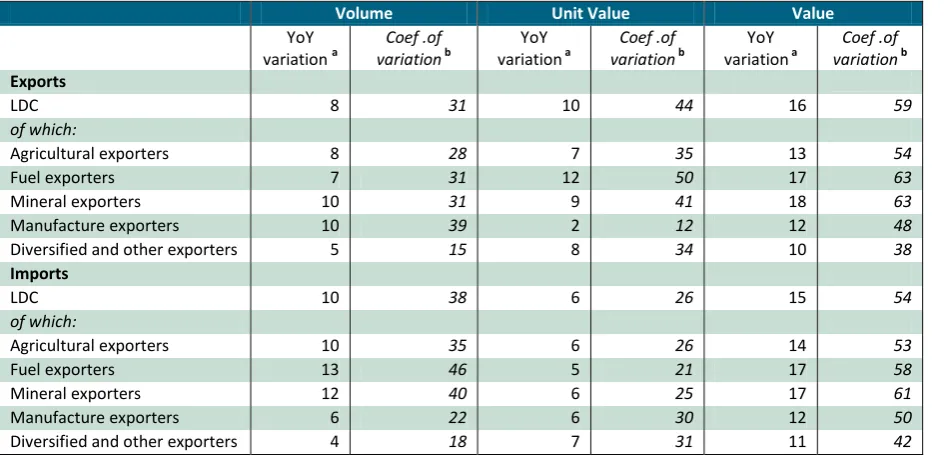
prices rose at a more comparable rate. The corollary is that the evolution of the terms of trade – positive in the case of fuel and mineral exporters, negative for the rest – goes some way to explain the different trajectories.
[image:11.595.67.542.218.447.2]As a final note, it is worth pointing to the wide heterogeneities within the different groups in terms of the evolution of volume and prices of their traded goods, as indicated by the coefficient of variation in the table.
Table 2: LDCs’ exports and imports: evolution of volume, unit value and value, 2000
-2012 (Percentage)
Volume Unit Value Value
YoY
variation a
Coef .of variationb
YoY variation a
Coef .of variation b
YoY variation a
Coef .of variation b
Exports
LDC 8 31 10 44 16 59
of which:
Agricultural exporters 8 28 7 35 13 54
Fuel exporters 7 31 12 50 17 63
Mineral exporters 10 31 9 41 18 63
Manufacture exporters 10 39 2 12 12 48
Diversified and other exporters 5 15 8 34 10 38
Imports
LDC 10 38 6 26 15 54
of which:
Agricultural exporters 10 35 6 26 14 53
Fuel exporters 13 46 5 21 17 58
Mineral exporters 12 40 6 25 17 61
Manufacture exporters 6 22 6 30 12 50
Diversified and other exporters 4 18 7 31 11 42
Notes: a Average annual rate of growth over the 2000-2012 period. b Standard deviation divided by average variation.
Source: WTO Secretariat, on the basis of deflators sourced from UNCTAD.
LDCs typically run a deficit in the services account, but as a group they tend to record a surplus specifically in Travel, reflecting the importance of in-bound Tourism in their economies.
2.3.2 Financing the gap: role of aid and worker remittances
As was seen above, LDCs registered trade surpluses in 2006-2008, but from the perspective of the past three decades this was an exception to the rule. Moreover, these positive trade balances were due primarily to fuel exporting countries and, to a lesser extent, to mineral exporters. It is therefore of interest to examine the role of aid and worker remittances in the finance of imports.
Chart 9: External development finance to LDCs: 1980- 2011, selected flows (Million dollars)
Notes: Partial coverage only; data on development assistance from private funds or official south-south partners are missing, as well as other flows of importance such as debt relief and budget support.
Source: OECD DAC-CRS, World Bank and UNCTAD.
Chart 10: Share of remittances to GDP in 2011, top ten LDCs (Percentage)
Source: World Bank
Remittance receipts of LDCs had nearly doubled from US$3.5 billion in 1990 to US$6.3 billion in 2000. Between 2000 and 2011, remittances quadrupled to US$27 billion. The magnitude of ODA was twice that of remittances and three times of FDI in 2000. In 2011, however, ODA was only one and half times bigger than remittances and double that of FDI mainly due to budgetary constraints in the developed economies. However, official figures underestimate actual flows of remittances. According to the World Bank, if remittances sent through informal channels are included, total remittances could be as much as 50% higher than the official record (World Bank, 2010). Remittance flows have offset large trade deficits in many countries like Bangladesh and Nepal and enabled these countries to maintain a current account surplus (Mohapatra, Ratha and Silwal, 2010).
remittances have been directed to investments in infrastructure, education and health, among others (Varma, 2009).
Besides its financial importance for balance of payments, FDI plays a fundamental role in transferring technology and skills to LDCs. 8 In 2011, at US$21 billion, FDI flows to the LDCs
accounted for only 1.3% of global FDI flows according to UNCTAD statistics.
2.4 Preferential Market Access
LDCs have benefited from a series of preferential market access to developed countries, promoted under the “Enabling Clause” and the Generalized System of Preferences (GSP) or resulting from bilateral or regional agreements. 9 More recently, South-South trade preferences were promoted
with the establishment of the Global System of Trade Preferences Among Developing Countries (GSTP). In December 2005, the Sixth WTO Ministerial Conference in Hong Kong adopted a decision to extend LDCs' DFQF market access granted by developed countries to at least 97% of tariff lines. India became the first developing country Member to announce its intention to implement the decision in April 2008 and since then, a growing number of developing countries have also granted specific preferences to LDCs.
The utilization and effectiveness of such preferences have been intensively debated in the development economics literature (see Hoekman and Ozden, 2005 for a review). In line with the general purpose of the paper, the following sections do not enter into the measurement debate but provide stylized facts about the implementation of these preferences and their utilization by LDCs. A thorough analysis of their impact would require factoring in trade related policies implemented by the LDCs themselves, such as trade facilitation, in addition to behind-the-border structural and supply-side domestic policies aiming at promoting non-traditional exports. Moreover, the section focuses on trade in goods. While services are labour intensive activities that present obvious advantages for developing economies with abundant work-force, trade restrictiveness in the case of services is not related to tariffs, but to a series of institutional, regulatory and administrative restrictions that are difficult to compile and compare.
Information on market conditions directly relevant for LDCs exports of commercial services is scant and often anecdotal. In addition, the existing indicators are of little relevance for most LDCs, as they focus on the effect of domestic regulations on the establishment and operation of new firms in the domestic market, i.e. they are mostly relevant for exporters of services under mode 3 (involving the presence of an affiliated firm in the market of destination). Actually, mode 4 (presence of natural persons supplying services) is probably more relevant (see WTO, 2007). The issue has been at the center of some complex negotiations due to non-economic considerations (in particular, immigration policy).
2.4.1 Tariff policy and market access conditions facing LDC exports in developed countries
LDC tariff policy is usually characterised by high bound and applied tariffs, and incomplete binding. As shown in Diakantoni and Escaith (2009), LDCs tend to apply high duties (with some exceptions) and do not always benefit from high margins in the binding overhang (difference between bound and applied tariffs).
8 In general, FDI to the LDCs takes mainly the form of greenfield projects rather than resulting from merger and acquisition between established firms.
Table 3: Average tariff profile of LDC countries, 2011 (Percentage)
Applied MFN Tariff a Binding Coverage b Average Bound Tariff a Total Agriculture Other
products
Total
Non-Agriculture
Total Agriculture Other products
11.7 14.8 11.3 59.3 53.2 59.9 73.7 42.6
Notes: a: ad valorem and equivalent, simple average of countries' tariffs. b: percentage of tariff lines.
Source: Based on World Tariff Profile 2012, ITC-UNCTAD-WTO
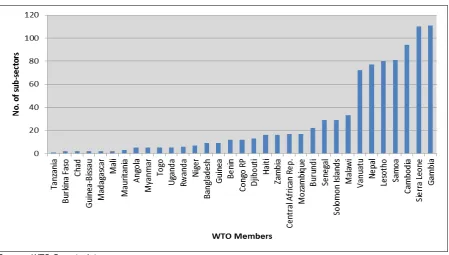
With respect to services, the difference between the existing (or applied, using the term used in tariff) LDC trade openness in services and their GATS (binding) commitments is now quite wide according to Gootiiz and Matoo (2009) and Honeck (2012). In order to attract FDI, many LDCs have already fully opened a wide range of services sectors. As seen in Chart 11, the number of existing GATS commitments varies widely among the LDCs by subsector, ranging from over 110 (Gambia and Sierra Leone) to only 1 or 2 sub-sectors (Burkina Faso, Chad, Madagascar, Mali and Tanzania).
Chart 11: LDCs GATS Commitments, 2012
Source: WTO Secretariat.
In terms of market access conditions for their exports, LDCs benefit from lower tariff duties for their merchandise exports, either because they tend to export on tariff lines with low MFN tariff (fuels and minerals) or thanks to preferential schemes. As shown in Table 4, the situation varies according to the markets of destination (developed vs. developing economies) and the type of exported products. On agricultural products, the average margin of preference over MFN treatment (6 percentage points) granted to LDCs exports is similar for both developed and developing countries. Nonetheless, the resulting best tariff remains much higher when the products are shipped to other developing countries (7.6%) rather than industrialised ones (2.2%). On non-agricultural products, exports to other developing countries benefit from very low margin of preference, yet the best tariff applied is lower (1.1%) than for exports to developed countries (2.3%).
primary commodities (fuels and minerals) that have a very low MFN tariff while South-North exports are more concentrated on those processed goods and other manufactures that benefit from higher preference margin (4.2 percentage points).
Table 4: Exports of LDCs to developed and developing markets, per sector and duties faced, 2011 or closest year
(Million dollars and percentage)
Market of destination
Sector Trade
value ($mn)
MFN tariff average a
Preference Best tariff
Duty Free Imports
Simple Weighted % of
TL
% of Value Developed
countries
Agriculture 3,467 51.0 8.2 6.0 2.2 99.6 98.6
Other 45,503 5.3 6.4 4.2 2.3 90.9 86.1
Developing countries
Agriculture 4,069 15.4 13.5 5.9 7.6 54.5 61.8
Other 65,310 8.6 1.6 0.6 1.1 56.3 81.1
Notes: a Traded tariff lines only.
Source: Based on World Tariff Profile 2012, ITC-UNCTAD-WTO
Information on preferential market access for LDCs exports of commercial services is scant. Up to early 2013, no waiver preferences have been granted under the WTO LDC services waiver (WTO, 2013a). For this reason, the remaining part of this section will concentrate on trade in goods, differentiating between preferential market accesses in developed and in developing countries.
2.4.2 LDCs' market access to developed countries
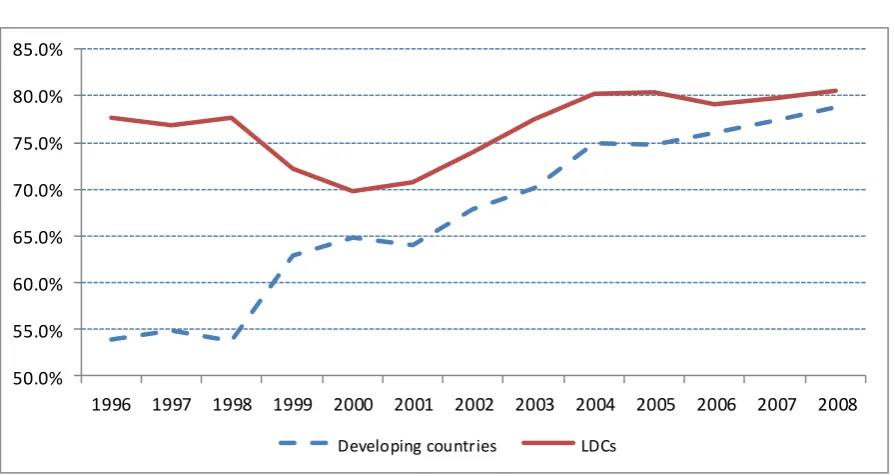
Market access to developed economies is monitored by comparing the situation of LDCs with the larger group of developing countries, as the latter group tends to compete more directly on similar market niches (agricultural and non-agricultural commodities, light manufacture). Two indicators are analysed: duty free quota free (DFQF) imports and average applied tariffs on selected products. These two indicators are those used to monitor the Market Access targets 8.6 and 8.7 of the Millennium Development Goals.
Chart 12: Share of imports from least-developed and developing countries entering duty-free in Developed Countries
(Percentage)
50.0% 55.0% 60.0% 65.0% 70.0% 75.0% 80.0% 85.0%
1996 1997 1998 1999 2000 2001 2002 2003 2004 2005 2006 2007 2008
Developing countries LDCs
Note: The evolution of the indicator is affected by changes in the composition of trade.
[image:16.595.76.524.119.357.2]Source: Based on data jointly compiled by ITC, UNCTAD and WTO.
Table 5: Proportion of developed-country imports from developing and least developed countries admitted free of duty, by value, 1996-2011
(Percentage)
1996 2000 2005 2006 2007 2008 2009 2010 2011
Total Duty Free (excluding oil and arms)
Developing countries a 54.3 64.8 74.9 76.2 77.4 78.7 77 78.8 79.7
- Least Developed Countries 77.6 69.8 80.4 79.1 79.8 80.6 80.4 80.4 83.4
Of which: True Duty Free b
Developing countries a 19.6 17 21.5 20.9 20 20 20.1 19.6 20.3
- Least Developed Countries 34.9 35 49 52.7 51.9 48.7 52.9 53.6 52.7
Notes: a Including LDCs.
b The true duty free portion is calculated by subtracting from the total duty-free access all products receiving duty free treatment under the MFN regime. The indicators are based on the best available treatment, including regional and preferential agreements.
Source: WTO-ITC-UNCTAD.
From a development perspective, preferences are particularly important to foster export diversification, in particular in products intensive in labour. Average tariffs levied on labour intensive products exported by LDCs declined significantly after the Uruguay Round in 1995 and the WTO Hong Kong Ministerial Declaration of 2005. Thanks to preferential schemes and multilateral agreements such as the ITA, tariffs have been almost entirely removed on light manufactures (with exceptions for textiles and clothing) or are very low, as in agriculture (Table 6). Average tariffs remain relatively high in the case of textiles and clothing which reflects the exclusion of large Asian LDC exporters from US preferential tariff on the basis of "competitive-need limitations". 10
With the exception of agriculture, LDCs have suffered from preference erosion when comparing their situation with the treatment granted by developed economies to all developing countries in general. While the margin stands at about 6 percentage points for agriculture, it has been reduced to low or almost inexistent levels for textiles and clothing and other industries (between 1.7 and 0.6 percentage point).
The issue of preference erosion is also present in the context of multilateral trade negotiation leading to a reduction of MFN tariffs. In the context of the Doha Round, Low et al (2005) find that almost all LDCs do not gain nor lose from MFN trade liberalization in non-agricultural (NAMA) products because their exports are dominated by fuels and minerals, products that are already largely MFN duty free. The main sectors where preference erosion occurs are textiles, fish and fish products, leather and leather products, electrical machinery, wood and wood products. Similarly, Low et al. (2006) find that the risk of preference erosion for agricultural exports in the QUAD markets is small. As a group, the LDCs would even register some moderate gains. Nevertheless, a few countries would be negatively affected, according to their product and geographical specialization. The most affected products are bananas, sugar, beverages and spirits; and much of the impact occurs in the EU market (Low, Patrick, Roberta Piermartini and Jürgen Richtering (2005-2006)).
Table 6: Average tariffs imposed by developed countries on key products exported by Least-developed and developing countries, 1996-2011
(Percentage ad valorem) a
Developing countries b
1996 2000 2005 2006 2007 2008 2009 2010 2011
Agriculture 10.4 9.2 8.8 8.5 8.3 8 7.8 7.3 7.2
Clothing 11.5 10.8 8.4 8.3 8.3 8.2 8.1 8 7.9
Textile 7.3 6.6 5.3 5.2 5.2 5.1 5.1 5 4.9
Other industries 2.0 1.4 1.1 1.1 1 1 0.9 0.9 0.8
Least Developed Countries
1996 2000 2005 2006 2007 2008 2009 2010 2011
Agriculture 3.8 3.6 3 2.7 1.9 1.6 1.2 1 1
Clothing 8.2 7.8 6.4 6.4 6.4 6.4 6.4 6.7 6.7
Textile 4.6 4.1 3.2 3.2 3.2 3.2 3.2 3.2 3.2
Other industries 1.1 0.3 0.3 0.3 0.2 0.2 0.2 0.2 0.2
Notes: a: Average tariffs are based on best applicable tariffs (MFN and preferential treatments granted to LDCs and developing countries), and weighted using a standard export structure based on 2000-2001 data, to limit the impact of the year-to-year changes in export composition and relative prices on the indicators.
b: Includes LDCs.
Source: WTO-ITC-UNCTAD.
The difference in preference margin between groups results from two main reasons, according to WTO (2012): (i) some products in the same broad category may be less taxed than others (e.g., tropical fruits vs. dairy products) on the importing market, irrespective of the preferential status of the exporter, and (ii) some exporting countries may benefit from more preferences than others. The heterogeneity of individual situations appears when disaggregating by sub-regional groupings. In 2010, the average tariffs faced by small island LDC products imported by developed countries were the lowest ( close to zero for agriculture) , higher (for clothing (5.5%) and textiles (7%)) in the case of Pacific Islands; while Haiti's exports benefited from almost complete duty free treatment. African LDCs benefited also from the best treatments on average (less than 2% for agriculture, 2.6% for textile and 3.6% for clothing). Asian LDCs confronted higher tariffs in general, at about 3% for agriculture, 2.6% for textiles, and 6.7% for clothing (WTO, 2012).
2.4.3 LDCs' market access to developing countries
[image:17.595.99.494.329.473.2]products from LDCs. These preferences are complemented by a series of bilateral or multilateral preferential market access, as well as a few non-reciprocal preferential schemes.
[image:18.595.66.529.274.549.2]Up to 2010, preference granted by developing countries to LDCs was rather limited and concerned mainly clothing. Latest data for 2011 point to a change in this situation, with a deepening of preferences granted to apparels (11 percentage points over a theoretical MFN tariff of 19%) but also some preferences being granted to textiles (about 5 percentage points). In a weighted average of all products, excepting oil, the preference margin granted to LDCs by a group of selected developing countries is 2.4%. When looking at individual import markets, China and South Africa are the two countries that have been the most active in granting preferences; the weight of China as the largest market of destination for LDCs' exports explains a large proportion of the evolution of the indicators.
Table 7: Average tariffs imposed by selected developing countries on key products from least developed countries, 2001-2011
(Percentage ad valorem)
Products Tariff and preference
(weighted average) a
2001 2006 2011
Agriculture MFN 31.9 21.4 21.2
Best applicable 31.2 20.5 18.6
Average margin 0.7 0.9 2.6
Other raw material b MFN 5.3 2.8 2.6
Best applicable 5.2 2.7 1.5
Average margin 0.1 0.1 1.0
Clothing MFN 19.4 18.4 19.1
Best applicable 18.9 15.9 8.1
Average margin 0.4 2.6 11.0
Textile MFN 12.7 9.3 9.4
Best applicable 12.5 8.6 4.1
Average margin 0.2 0.7 5.3
Other Industrial MFN 5.1 4.1 3.6
Best applicable 4.8 3.8 1.6
Average margin 0.3 0.3 2.0
Total b
MFN 11.9 8.3 8.1
Best applicable 11.6 7.8 5.6
Average margin 0.3 0.5 2.4
Notes: a: Average applied tariffs are based on best applicable tariffs (MFN and preferential treatments granted
by a group of 12 developing countries to LDCs), and weighted using a standard export structure based on 2009-2011 data.
b: Excluding oil. Source: WTO Secretariat.
2.4.4 Operationalizing market access preferences
utilization for non-reciprocal preferences is high in the case of the EU and the USA (89% and 87%) thanks, in part, to the various options offered to exporters that allow avoiding the most demanding schemes. When exporters to the EU or the US have the choice, they favour Cotonou in the case of EU, or CBERA in the case of the US. Considering that tariffs are not a variable in this case, Bureau, Chakir and Gallezot (2006) infer that administrative requirements, rules of origin or predictability of the respective regimes are potential determinants of the choice between regimes.
Thanks to leaner administrative procedure and simpler rules of origin, utilization rates of preferential treatment in developed countries have steadily improved in the past decade and are now at an average of 90 %; no data are available yet for the utilization of preferences granted by developing countries.
It is often stated that preferences lower than 4 percentage points do not materialize in significant competitive advantages and lead to low preference utilization. On this last point, however, recent research shows that they may still matter below such threshold. Keck and Lendle (2012), using US import data, find that utilization rates remain often very high, even for very small preferential margins. Albeit the debate on the effectiveness of trade preference is an open one, some authors claiming that they may even be counterproductive, none of the arguments presented by critics is fully compelling. According to Bureau et al (2006), statistical results, often based on econometric simulations, are ambiguous. Measuring the actual of preference is an empirical debate due its statistical complexity. Disdier et al. (2013) develop a dedicated database for 1996 and 2006 and find that the impact on LDCs and non-emerging developing countries was more at the intensive margin than at the extensive one (export diversification). Besides the empirical debate, the fact that preferences are generally fully utilised by exporters tend to suggest that these preferences have positive effects.
Another constraint is that those preferences, even when fully utilized, may be counterbalanced by higher transaction and transportation costs that reduce LDCs' competitiveness. Trading involves a series of transaction costs — delays, documents and administrative fees — that increase domestic prices. When these costs are significantly higher than those of the competitors, as it is often the case in LDCs, they may lead to loss of market share or missed business opportunities. These costs are part of the supply constraints that frequently reduce the international competitiveness of LDCs and limit their trade potential.
The comparison of transaction costs confirms that LDCs face a comparative disadvantage when exporting goods (see low income countries in Table 8). According to UNCTAD data for 2005, CIF/FOB difference for Africa was 10 percent, compared to a world average of 6 %, UNCTAD (2007). ECE (2003) reviews a series of transport cost studies for developing countries and conclude that a large part of the disadvantages faced by Southern Africa has to do with transport costs; this problem is particularly acute for landlocked countries. As mentioned by Djankov et al (2010), each additional day that a product is delayed prior to being shipped reduces trade by more than 1%. The authors find also that delays are particularly damaging for time-sensitive goods, such as perishable agricultural products, which are of particular interest to LDCs as they are both labour intensive and high value-added
High international trade costs are usually correlated with poor inland transportation infrastructure which reduces not only the potential for international trade but also dampen the possibility for small producers in remote areas to tap the potential of regional markets. The issue is particularly acute for Sub-Saharan Africa (Buysa et al., 2010). but is also representative of the situation of many large LDCs,
The problem, as we shall see later, is compounded when LDCs intend to diversify by joining global value chains; as delays in delivery and the necessity to maintain high inventory levels to cope with them run against the core management model of international supply chains, based on just-in-time and minimum buffer stocks. Indeed, the issue was deemed serious enough for the WTO to devote its entire 4th Global Trade Review of Aid for Trade in July 2013 to the role of trade
Table 8: Logistics Performance Index by country grouping, 2012 Country grouping a LPI b Customs Infrastructure International
shipments
Logistics competence
Tracking & tracing
Timeliness
High income 3.55 3.36 3.56 3.28 3.5 3.65 3.98
Upper middle income 2.82 2.49 2.54 2.86 2.71 2.89 3.36
Lower middle income 2.59 2.23 2.27 2.66 2.48 2.58 3.24
Low income 2.43 2.19 2.06 2.54 2.25 2.47 2.98
Notes:a: According to World Bank specifications
b: Logistics Performance Index (LPI) is the weighted average of the country scores on the six key dimensions: Efficiency of the clearance process by border control agencies; Quality of trade and transport related infrastructure; Ease of arranging competitively priced shipments; Competence and quality of logistics services; Ability to track and trace consignments; Timeliness of shipments in reaching destination within the scheduled or expected delivery time. The index ranges from 1 to 5, with a higher score representing better performance.
Source: 'Logistics Performance Index: Connecting to Compete 2012', World Bank.
3 LDCs during the Great Trade Collapse
The rapid increase in the total value of goods and services exported by LDCs during the 2000s came to an abrupt halt in 2008, in the wake of the global financial crisis. The sharp contraction in the world economy began with a financial crisis in developed countries in the second half of 2008. It worsened in the first quarter of 2009 as the subsequent collapse in demand in developed countries worked quickly its way through the global economy. The drying-up of trade finance resulting from shortages in global liquidity and increased risk aversion by major international banks was also a contributing factor to the trade collapse. Global trade contracted by 22.5% during 2009. Exports of developed economies fell by 22% while the decline for developing economies was 21%.
Trade in consumer durables and capital goods was particularly affected by the financial situation, as their demand relies on credit. This segment of the world market is not of direct relevance for LDCs as exporters, but its collapse had important impact on the demand for primary inputs used in the production of such goods. Indeed, for LDCs, the main channel of contagion was through the price effect and the reversion of the upward trend that had boosted fuel and mineral prices since 2003. Due to the dramatic fall in prices in the early stages of the crisis, the export sectors most affected were fuels and minerals. 11 The decline in prices was due to both financial factors, such as
the sales of options by investment funds, and declines in the world demand for iron and steel, fuels and mineral ores. Nevertheless, as highlighted by ITC (2010), if oil is excepted, the specialization of LDCs on primary goods may have buffered the shock, as the purchase of those goods are less likely to be deferred unlike complex manufactured goods prevalent in developed countries and in some emerging ones. Indeed, according to ITC's indicators, all commodities exported by LDCs had maintained stable volumes (i.e, after discounting the drop in prices) during 2009 relative to the previous year.
The market for primary commodities, such as fuels and minerals, was one of the first to bounce back. Prices rose in the second and third quarters of 2009 due to increased demand from large emerging countries and speculative investments. Oil prices rose above US$70/barrel while the price of some minerals, such as copper, doubled. The prices of food and agriculture products decreased during the crisis, partly due to increases in production after a series of bad harvests in 2007. Notably, the international prices of main food products remained low through the crisis thus helping deficit countries to mitigate the social cost of the crisis. Only a few exceptions, such as sugar, saw their prices increase in 2009.
The behaviour of other export products was less dramatic. As far as LDC exports of clothing are concerned, specialization in the low-price range of products helped some LDC producers weathering the storm, as cash-constrained consumers in developed markets shifted to the cheapest options. Bangladesh was even able to increase its exports, albeit marginally, thanks to its diversified export partners; while Cambodia, which focused more on the US market, saw its
exports decline. Drop in demand were mainly temporary and caused by retailers running down their stocks before placing new orders. All in all, Cambodia's exports of clothing dropped by 19% in 2009 compared with 2008; while Bangladesh's exports registered growth of 2% for the same period. Haiti, also dependent on the US market, saw its exports expanding by 20% in 2009; but this upward trend was short-lived, as most production facilities were damaged early January 2010 by a catastrophic earthquake which led exports to stagnate in 2010.
Chart 13: Quarterly evolution of LDCs merchandise exports, by major product groups, 2008-2013
(Index Q1/07 = 100)
Source: WTO Secretariat.
In summary, as shown in Chart 13, LDC exports of goods remained below their pre-crisis levels up to the first quarter of 2011. This underperformance is nevertheless, fully attributable to the exports of fuels and mining products, which never recuperated the high value observed immediately before the crisis. Exports of agricultural products were only slightly affected and resumed fairly quickly their upward trend, recovering as early as the last quarter of 2009 their pre-crisis value and continuing to expand up to the 3rd quarter of 2011. Exports of manufactures
followed a similar trend, albeit with much more quarter-to-quarter variations.
Trade in commercial services has been generally more resilient than trade in merchandise. However, transportation and – to a lesser extent – travel (which includes tourism expenditure) have been significantly affected. Based on the limited data available, mainly from OECD countries, trade in other commercial services has been less affected by the crisis. One of the reasons for the moderate decline in the demand for services is that services are not storable. While retailers and firms ran down their stocks during the initial phase of the downturn, the reduction in demand for services, especially business related services, was much less pronounced. Nevertheless, services related to trade in goods (transportation) have experienced similar declines to merchandise trade while financial services have been barely hit.
Nevertheless, it is perhaps too optimistic to limit to the 2008-2009 period the effects of global crisis that resulted from the accumulation of financial stress in the US economy in 2007, leading to the bankruptcy of major US financial companies in September 2008. As documented in WTO's World Trade Report of 2012, the world economy in 2011 was plagued by a series of economic, political and natural shocks. The earthquake, tsunami and nuclear incident that hit Japan in March, sharply depressed the country's exports in the second quarter; while flooding in Thailand reduced the supply of key parts and components in the fourth quarter, further distorting global production networks. Political turmoil in North African countries hampered regional exports, especially in Libya, where oil production and exports plunged. Finally, the European economy was hit by the euro sovereign debt crisis, with negative impact on its economic growth and international trade. The impact of the euro crisis lasted up to mid-2013, when some signs of recuperation were observed, albeit fragile ones. In the meantime, China and most other large emerging economies were revising downward their growth expectations. After rebounding in 2010 and 2011, world trade growth remained sluggish during 2012 and 2013, not growing much over 2% in real term.
For the LDCs, the slower path of the world economy resulted in a second negative shock after the third quarter of 2011. The value of their total exports decreased continuously up to the last quarter of 2012, accumulating 17% reduction. The limited information available at the time of writing the paper could not indicate if the better results observed at the beginning of 2013 would be sustained. In the longer term, a bigger challenge to the export model that emerged in the 2000s is the probable conclusion of the "super cycle" that kept the international prices of most commodities at historically high levels. The change in the main drivers of China's growth, in particular a reduction of public investment in infrastructure and heavy industry, may reduce demand for minerals and fuels, driving down prices of these commodities. The future of oil price is even more opaque, as the USA is becoming progressively self-sufficient thanks to the exploitation of new sources of gas. This reversal will/may catch the LDCs in a situation of renewed external vulnerability, as their trade balance has retuned into negative territory after the 2008-2009 crisis. In order to avoid returning to the boom-and-bust pattern that characterised their growth in the past, it is increasingly necessary for LDCs to diversify their exports into new (labour intensive) activities. This will be the subject of the next section.
4 The Way Ahead: export Diversification and trade in tasks
One classical determinant of trade performance for least-developed countries is product and market diversification. This strategy has more recently been enriched with the possibility of joining global production networks and exporting particular "tasks" rather than entire finished products. Trade in tasks and global value chains are among the important markers of international trade in the early 21st century, see Jara and Escaith (2012) for a non-technical review of the implications
on global governance, trade policy and trade statistics. This phenomenon has variously been called fragmentation, unbundling, offshoring, vertical specialization, slicing-up of the value-added chain or trade in tasks (see WTO's World Trade Report, 2008). By accelerating the transmission of technology and know-how, this trend contributed greatly to the rapid industrialization of emerging countries in the past 15 years. Actually, most of the East Asian miracle can be attributed to trade in tasks; and even China's rapid march towards industrialization relied on global supply chains (see WTO and IDE-JETRO, 2011).
As discussed in Escaith (2013), the emergence of global production networks changed the way international specialization along comparative advantages is understood by economists, some of them adventuring into proclaiming that they are causing a paradigm change in trade theory (Grossman and Rossi-Hansberg, 2006). Because production became modular and tasks outsourced, developing countries could create competitive industries focusing on a single segment of the whole industrial process, reaching international standards of quality and cost competitiveness without having to develop full-fledged industries.
automotive industry despite its tiny size. In this island of about 200,000 people, Yazaki Samoa, a Japanese-owned company, produces automotive components for export to Australia. This plant employs more than 2,000 workers and makes up over 20% of the Island's manufacturing sector's total output. In Central America, Costa Rica, a small developing economy of less than 5 million inhabitants was able to develop internationally competitive IT and medical equipment industries.
4.1 LDCs' trade in intermediates and global value chains
One indirect indicator of insertion in these global production networks is the growing trade in intermediate inputs, derived from traditional trade statistics and filtering out the goods used for final consumption. 12 Most LDCs use imports of intermediate inputs in the production of final goods
for domestic consumption. Primary product exporters, such as Angola, Yemen and Sudan, utilize imports of intermediate products as inputs for their extractive activities. There are, however, a number of LDCs that use imported intermediate inputs to produce processed goods for exports, thereby linking themselves vertically in the global value chain (Bangladesh, Cambodia or Lesotho as well as a few small island countries as Samoa or Haiti). Yet, with a few exceptions, connecting to global production network in order to benefit from these new opportunities is a formidable challenge for most LDCs. The usual points of entry for LDCs into global value chains are agro-food, clothing and tourism sectors. Nevertheless, as highlighted by WTO’s DG Pascal Lamy at the 4th
Global Review of Aid for Trade: Connecting to Value Chains (WTO, 8-10 July 2013), in a new global world where connection to industrial networks is the key to industrialization, least developed countries are also the "least connected countries".
With these caveats in mind, the overall picture is not negative when looking at the trend of intermediate goods imports. LDCs imports of such goods have increased from US$18 billion in 2000 to US$87billion in 2012 which represents an average annual increase of 14% in comparison to the world average of 8% (Chart 14). Yet, trade in intermediate inputs is very heterogeneous within the LDC group (Chart 15). Bangladesh is by far the largest LDC importer of intermediates (US$21 billion in 2012, up from US$5 billion in 2000), followed by Angola (US$8 billion in 2012). Bangladesh alone accounted for 24% of LDCs total imports of intermediate goods in 2012.
Chart 14: Imports of intermediate goods, 2000-2012 (Index 2000 = 100)
Source: WTO Secretariat and UN Comtrade database.
Chart 15: Top LDC importers of intermediate goods, 2000-2012 (Billion dollars)
Source: WTO Secretariat and UN Comtrade database.
4.1.1 Network and trade in value added statistics
The statistics on trade in intermediate products permit to analyse a series of indicators that are specific to global production networks and trade in tasks. The first group of indicators is closely related to network analysis, a relatively recent field of research that focuses on measuring connectedness. The second family of indicators derives from input-output analysis applied to international sectoral transactions. The two approaches are different ways of analysing the same topological object (a graph, in its mathematical definition) using different tools.
The network approach is interested in understanding how different vertices (countries, in our case) are connected in the network through edges (trade flows) and identify significant patterns. Without entering into details, visual representation of complex networks becomes rapidly cumbersome, but some important statistics allow characterising the main features of the network. The paper applies some of these techniques to the evolution of LDCs' imports of intermediate goods and their exports of non-primary products between 2000 and 2011.
The first set of graphs (16 and 17) look at the LDC network of suppliers of intermediate goods. Those goods are some of the key indicators of global value chains participation, because they show the upstream relationship of LDCs (where they get their inputs from).
Chart 16: Network of LDC suppliers of Intermediate Goods, 2000
Note: Source of LDCs’ imports of intermediate goods (only flows representing more than 10% of each country’s
imports; the higher the share, the darker the arrow).
Source: Elaborated on the basis of UN COMTRADE data and BEC classification.
Chart 17: Network of LDC suppliers of Intermediate Goods, 2011
Notes and Source: see Chart 16
Chart 18: Main destination markets of LDCs Food and Manufacture products, 2000
Note: LDCs’ exports of food and manufactures greater than 20% of respective national exports. Because the
Chart highlights only top bilateral trade flows, a market of destination that absorbs a significant share of all LDCs exports may not appear despite being highly relevant from a systemic perspective.
Source: WTO Secretariat and UN Comtrade database.
Chart 19: Main destination markets of LDCs Food and Manufacture products, 2011
Notes and Source: See Chart 18
and not absolute values: a lower weight does not imply a net reduction but may just reflect a trend towards more diverse geographical distribution. Another estimate of countries' and sectors' participation in global value chain is given by a new measure of trade called "trade in value added". Using inter-linked input-out matrices, the idea is to track down for each industry in each country the use of domestic and imported inputs, in order to estimate the foreign and domestic content of output, including exports, (see OECD and WTO (2012) for a technical presentation of the methodology and the data sources). Building on their own experiences and the contribution of various national and international initiatives, OECD and WTO produced in January 2013 the first interactive world trade database (TiVA) specifically dedicated to trade in value-added. 13 Because TiVA is intensive in trade and structural data that need to be harmonized and made compatible between all countries, the coverage of LDCs is still very limited in the TiVA database, which is using only official data sources. At the time of writing this document, out of 57 countries, only one (Cambodia) was an LDC.
As analysed in more details in WTO (2013b), 14 Cambodian exports of manufactures are concentrated on "clothing", by far the major manufacturing sector represented in LDC exports (60% of LDCs' manufactured products). The foreign value-added content in Cambodian exports of clothing, estimated at 63% in 2008 is much higher than what is observed for developing economies and the world average (around 25%). 15 This high share reflects the fact that LDCs
usually insert themselves in GVCs thanks to their comparative advantage in terms of labour cost for assembling or processing imported intermediate components. This processing trade, typically done in "Export Processing Zones" relies on imported inputs to produce and export goods for lead foreign companies. It is interesting to compare Cambodia's situation with other developing countries that have been moving-up on the value-chain ladder which in 2008, 75% of their exports in "textiles and textile products, leather and footwear" were based on domestic value added. While most of the domestic value added of Cambodia's textiles and clothing exports were destined for final consumption, two-thirds of other developing countries exports where further processed in other countries, showing a deeper insertion as upstream suppliers in international supply chains.
In order to fill some of the gaps in TiVA's coverage, UNCTAD paired with the Eora project to produce estimates of trade in value-added data for a large number of developing and Least-developed countries. Unlike the OECD-WTO database, which relies on official statistics, Eora uses an algorithmic approach to fill data gaps when actual statistics are missing. Its primary objective was to study global environmental issues (for a review of the methodology, see Lenzen et al., 2012). As usual, when imputations are used instead of actual observations, the hypothesis behind the exercise is that the missing data can be extrapolated from the parameters estimated on other cases. This may or not be the case, especially when LDCs are only loosely inserted in the world economy and retain a strong socio-economic specificity.
With this caveat in mind, the UNCTAD-Eora dataset that was developed for UNCTAD (2013), extends TiVA calculation to 187 countries. In the average of all sectors, the foreign content of LDCs exports is low (14%) and only half the world average (28%).16 The group of developing economies relies on foreign content for 25% of the value of its exports, a proportion that climbs to 30% in East and South East Asia. Even though foreign value added in exports is not a full-fledged indicator of the GVC complexity of industries, as indicated by UNCTAD (2013), it remains that the countries which registered higher growth in exports in the past 15 years are also those which were able to increasingly access and process foreign inputs (WTO, 2013c). Thus, while the old industrialization policy promoted by UNCTAD's founder R. Prebish was intended to build a domestic industrial base and shift away from primary products (i.e., from sectors of activity characterised by
13 Mid-2013, the database coverage included 34 OECD and 23 non OECD economies, including the BRIICS (Brazil, the Russian Federation, India, Indonesia, China and South Africa) plus an estimate for the Rest of the World. The database is hosted by OECD at www.oecd.org/trade/valueadded
14 WTO (2013b)
15 The "Foreign value added content of exports" corresponds to the inputs that were imported to produce the exported goods and services, net of any domestic content that could have been incorporated in the production of these inputs (or re-import of imbedded domestic value-added).