ISSN Online: 2162-2485 ISSN Print: 2162-2477
DOI: 10.4236/ojpm.2018.84009 Apr. 8, 2018 95 Open Journal of Preventive Medicine
The Relationship between Post-Traumatic
Stress Disorder and Self-Esteem along with the
Importance of Support for Children
Fumihiro Omasu
1*, Yukino Hotta
2, Mai Watanabe
2, Tomomi Yoshioka
21Department of Health and Nutrition, Faculty of Health and Nutrition, Yamagata Prefectural Yonezawa University of Nutrition
Sciences, Yonezawa-shi, Japan
2Department of School Health, Faculty of Education, Kumamoto University, Kumamoto-shi, Japan
Abstract
Post-Traumatic Stress Disorder (PTSD) is widely known in our society. The symptoms of PTSD are particularly believed to occur predominantly in child-ren. We believe that Yogo teachers, who play a role in maintaining and pro-moting the health of children, are expected to provide appropriate support for children with a tendency for PTSD. In this study, we investigated the tendency for PTSD in students at University, as well as self-esteem related to depression and anxiety. Furthermore, we clarified the relationship between PTSD and self-esteem and examined the support provided by Yogo teachers. As a result, it was found that the higher the tendency for PTSD, the lower the self-esteem. We believe that the onset of PTSD causes a decline in memory ability and at-tentional function, which interferes with one’s life and leads to self-denial, re-sulting in a decline in self-esteem among those with a high tendency for PTSD. These results suggest that Yogo teachers should provide support to prevent the onset of PTSD in child students due to accidents, incidents, natu-ral disasters, etc., as well as support to prevent the decline in self-esteem asso-ciated with the onset of PTSD.
Keywords
Post-Traumatic Stress Disorder, Self-Esteem, University Student, Yogo Teacher
1. Introduction
Post-Traumatic Stress Disorder (PTSD), a general term for various mental and
How to cite this paper: Omasu, F., Hotta, Y., Watanabe, M. and Yoshioka, T. (2018) The Relationship between Post-Traumatic Stress Disorder and Self-Esteem along with the Importance of Support for Children. Open Journal of Preventive Medicine, 8, 95-101.
https://doi.org/10.4236/ojpm.2018.84009
Received: March 1, 2018 Accepted: April 5, 2018 Published: April 8, 2018
Copyright © 2018 by authors and Scientific Research Publishing Inc. This work is licensed under the Creative Commons Attribution International License (CC BY 4.0).
DOI: 10.4236/ojpm.2018.84009 96 Open Journal of Preventive Medicine
physical disorders that occur after receiving deep wounds of the heart due to the influence of disasters, etc., is widely known in our society. PTSD is basically the same as anxiety neurosis. While experiences of anxiety and fear during anxiety neurosis is a condition that vaguely occurs in a very personal context, PTSD is said to occur due to experiences of strong anxiety and fear caused by unforeseen incidents such as disasters and accidents [1].
One indicators of mental health is self-esteem [2]. Self-esteem is a feeling of self-evaluation, which is regarded as satisfaction/dissatisfaction with oneself. Therefore, higher self-esteem means emotional stability and social adaptation, with lower self-esteem meaning more anxiety and an inferiority complex [3]. A person with high self-esteem can accept oneself as he/she is and love him-self/herself, enabling them to face his/her own drawbacks or limitations without fear. On the contrary, it is said that a person with low self-esteem often feels ashamed of himself/herself and pays excessive attention to the needs of others, subjecting themselves to self-humiliation and an inferiority complex [4]. It has also been reported that low self-esteem is associated with depression and anxiety [5]. We believe that it is essential to know the states of self-esteem in order to tackle the issues of PTSD. The relationship between PTSD and self-esteem has recently been partially clarified [6], but there are still no studies that have direct-ly investigated this relationship.
In particular, in the case of highly sensitive children with an undeveloped “ego”, because their psychological defenses at the sites of incidents/accidents are not sufficient and the shock thereof directly hits their minds, the risk of the on-set and rampancy of PTSD increases. It has been reported that symptoms may occur predominantly such as iterations of flashbacks and nightmares with night terrors (pavor nocturnus), sleep disturbance and a sense of anxiety/tension with strong irritability (negativity of personality traits), and a tendency for social withdrawal [7]. Therefore, we believe that Yogo teachers (school nurse in a health-care room at school in Japan), who play a role in maintaining and pro-moting the health of children, are expected to provide appropriate support for children with tendency for PTSD.
In this study, we focused on the relationship between PTSD and self-esteem and investigated how big an impact past painful event has on the formation of self-esteem. In this study, a questionnaire survey was conducted among univer-sity students regarding past painful events and self-esteem. We believed that these results would contribute to supporting children with mental health prob-lems and examined the support provided by Yogo teachers.
2. Methods
DOI: 10.4236/ojpm.2018.84009 97 Open Journal of Preventive Medicine
created questionnaires which were distributed and collected. An anonymous system was used, wherein we asked the subjects to circle the appropriate num-ber.
We used the scales of IES-R (Impact of Event Scale-Revised) [9] and Self-esteem Scale [10]. IES-R conforms to the diagnostic criteria of PTSD and is composed of the three subscales of Re-experiencing symptoms, Avoidance, and Hyperarousal, including 22 question items. Answers included five types: “Not at all (1 point)”; “A little (2 points)”; “Moderately (3 points)”; “Fairly (4 points)”; and “Remarkably (5 points)”. Therefore, the highest point total is 110 while the lowest point total is 22 points. The Self-esteem Scale was used to measure the self-esteem of subjects. The “Self-esteem Scale” is composed of the three areas of “self-acceptance”, “attitude for self-realization”, and “sense of fulfillment”, in-cluding 19 question items. The answers included four types depending on the question items: “Untrue (1 or 4 points)”; “Slightly untrue (2 or 3 points)”; “Somewhat true (3 or 2 points)”; “True (4 or 1 points)”. The highest point total is 76 while the lowest point total is 19 points.
A correlation coefficient was calculated for the relationship between the ten-dency for PTSD and self-esteem. Further, we performed variance analysis on the difference in self-esteem between groups categorized according to their tendency for PTSD, with a total score higher than the “average score + standard deviation” classified as a “high tendency for PTSD”, “ranging from the average score to the average score + standard deviation” as a “slightly high tendency for PTSD”, “ranging from the average score to the average score − standard deviation” as a “slightly low tendency for PTSD,” and lower than the “average score − standard deviation” classified as a “low tendency for PTSD”. A difference of more than 5% was considered to be statistically significant.
3. Results
This study included 350 healthy Japanese students whose average age was 20.9 ± 1.4 years (mean ± standard deviation) (range: 18 - 24 years).
3.1. Regarding the Tendency for Post-Traumatic Stress Disorder
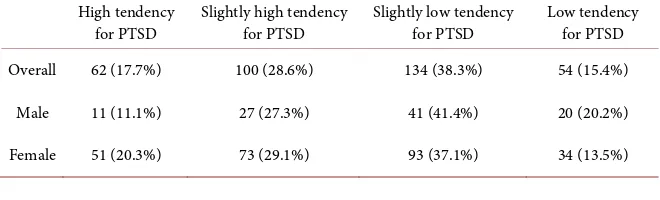
The number of people by tendency for PTSD for males, females, and all subjects was as Table 1.
[image:3.595.209.539.636.736.2]Looking at all subjects, 62 students had a high tendency for PTSD, 100 students
Table 1. Number of people who tended to demonstrate post-traumatic stress disorder.
High tendency
for PTSD Slightly high tendency for PTSD Slightly low tendency for PTSD Low tendency for PTSD Overall 62 (17.7%) 100 (28.6%) 134 (38.3%) 54 (15.4%)
Male 11 (11.1%) 27 (27.3%) 41 (41.4%) 20 (20.2%)
DOI: 10.4236/ojpm.2018.84009 98 Open Journal of Preventive Medicine
had a slightly high tendency for PTSD, 134 students had a slightly low tendency for PTSD, and 54 students had a low tendency for PTSD. Comparing the two groups in terms of sex, regarding males, 11 students had a high tendency for PTSD, 27 students had a slightly high tendency for PTSD, 41 students had a slightly low tendency for PTSD, and 20 students had a low tendency for PTSD. Regarding females, 51 students had a high tendency for PTSD, 73 students had a slightly high tendency for PTSD, 93 students had a slightly low tendency for PTSD, and 34 students had a low tendency for PTSD.
3.2. Self-Esteem
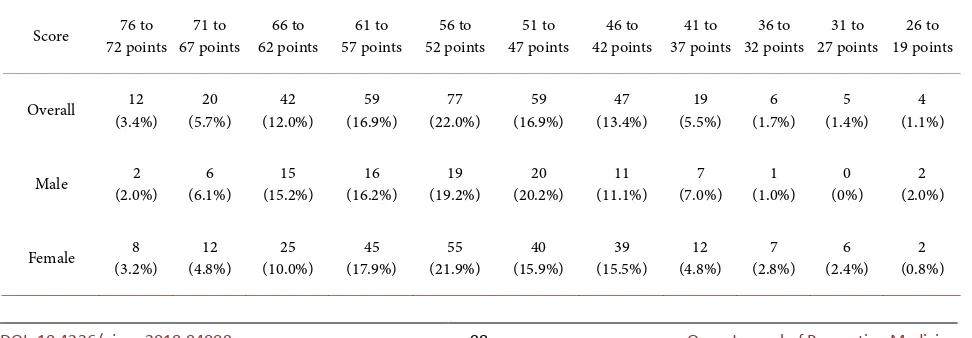
The population distribution by total self-esteem score for males and females and all subjects was as Table 2. The overall average score was 53.6 points. The aver-age score of males was 55.9, while that of females was 52.7.
3.3. Relationship between the Tendency for Post-Traumatic
Stress Disorder and Self-Esteem
The correlation coefficient between the total PTSD score and that of self-esteem for all subjects, in terms of males and females as well as school years, was shown as Table 3. As a result, only for “overall” were we able to obtain a significant negative correlation. Based on the fact that there was no significant correlation between male and female, as well as between school years, it is assumed that there is no gender difference in the correlation between PTSD tendency and self-esteem.
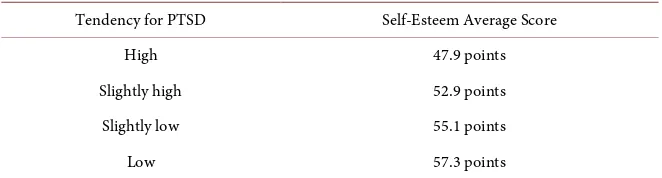
[image:4.595.58.544.576.745.2]In addition, we examined the relationship between tendency for PTSD and self-esteem by group (Table 4). In other words, variance analysis was conducted in the group with a high tendency for PTSD, the group with a slightly high ten-dency for PTSD, the group with a slightly low tenten-dency for PTSD, and the group with low tendency for PTSD. The average scores of the total self-esteem points in each group were 47.9 points, 52.9 points, 55.1 points, and 57.3 points, in order from the group with a higher tendency for PTSD, indicating a significant differ-ence between the groups (p < 0.01).
Table 2. Number of people by self-esteem score.
Score 72 points 76 to 67 points 71 to 62 points 66 to 57 points 61 to 52 points 56 to 47 points 51 to 42 points 46 to 37 points 41 to 32 points 36 to 27 points 31 to 19 points 26 to
Overall (3.4%) 12 (5.7%) 20 (12.0%) 42 (16.9%) 59 (22.0%) 77 (16.9%) 59 (13.4%) 47 (5.5%) 19 (1.7%) 6 (1.4%) 5 (1.1%) 4
Male (2.0%) 2 (6.1%) 6 (15.2%) 15 (16.2%) 16 (19.2%) 19 (20.2%) 20 (11.1%) 11 (7.0%) 7 (1.0%) 1 (0%) 0 (2.0%) 2
DOI: 10.4236/ojpm.2018.84009 99 Open Journal of Preventive Medicine
Table 3. Correlation between post-traumatic stress disorder and self-esteem.
Overall Male Female
Correlation coefficient −0.32* −0.18 −0.07
(Number of people) (350) (99) (251)
*p < 0.05.
Table 4. Self-esteem scores according to the degree of post-traumatic stress disorder.
Tendency for PTSD Self-Esteem Average Score
High 47.9 points
Slightly high 52.9 points
Slightly low 55.1 points
Low 57.3 points
High vs slightly low, low p < 0.01. Slightly high vs low p < 0.01. Slightly low vs low p < 0.05.
4. Discussion
Patients with PTSD are said to experience neuropsychological symptoms [11]. Generally speaking, such symptoms include a decrease in memory ability (mainly short-term memory) caused by the atrophy of the hippocampus due to stress, as well as a decrease in attention function (especially persistent attention function) due to abnormalities of the frontal lobe-basal ganglia. Decline in memory ability (mainly short-term memory) includes forgetting the requests of others. In addition, a decrease in attention function (especially persistent atten-tion funcatten-tion) includes being unable to read a book for an extended period of time, with mistakes increasing if persisting at desk tasks.
On the other hand, self-esteem is said to change by engaging with others in the surrounding environment, such as family, friendships, workplace, and so-ciety [8]. It is also said that self-esteem will decline if a person’s appearance, will, emotions, ability, personality, etc. are maligned or rejected while engaging with others. Therefore, one reason why people with a high tendency for PTSD had a declined self-esteem may be that their behaviors due to deterioration of memory ability and attention function were maligned or rejected. In other words, these declines in function interfere with one’s life and lead to self-denial, possibly re-sulting in declines in the self-esteem among those with a high tendency for PTSD.
Some limitations associated with the present study should be mentioned. First, the number of subjects was small. Second, since the subjects of this study consisted of healthy college students, it was therefore difficult to distinguish any clear differences regarding PTSD. Therefore, larger studies are needed in the fu-ture in order to obtain more detailed information regarding PTSD.
[image:5.595.209.540.185.274.2]DOI: 10.4236/ojpm.2018.84009 100 Open Journal of Preventive Medicine
the onset of PTSD is to provide information on the points of support for child students after accidents, incidents, and natural disasters to faculty and parents. Further, measures to prevent any decline in self-esteem due to the onset of PTSD may include the promotion of common understanding regarding PTSD know-ledge and practicing of lessons using constructive group encounters. It's said that mindfulness-based stretching and deep breathing exercise also reduce the PTSD symptom as other improvement method [12].
Symptoms of PTSD are said to include difficulties sleeping, frustration, being distracted, restlessness, hyperprosexia, poor facial expressions, going into a shell, and decreased activities in general life [1] [13]. When such symptoms are ob-served, the Yogo teacher is required to hear from such students, conduct a screening test or consult a specialized agency as necessary. Depending on the symptoms of the child students or advice from specialized agencies, it may be necessary to recommend their parents that their children consult a medical in-stitution.
5. Conclusion
A positive correlation was found between the total PTSD scores and the total self-esteem scores. It can be assumed that, the higher the tendency for PTSD, the lower the self-esteem. There is believed to be no gender differences in cortion between PTSD tendency and self-esteem. Furthermore, regarding the rela-tionship between PTSD and self-esteem, we conducted variance analysis on the differences in self-esteem between groups categorized according to their ten-dency for PTSD. As a result, the group with a higher tenten-dency for PTSD was found to have lower average scores of self-esteem. PTSD may also occur in children. For Yogo teachers, who play a role in maintaining and promoting the health of students, when accidents, incidents, or natural disasters occur, it is ne-cessary for them to consider whether or not the students have developed PTSD and provide them with support.
References
[1] Mochizuki, S., Yamada, K. and Matsui, Y. (2011) Studies on Neuro-Anatomical and Psychological Changes in PTSD Patients: A Review. Tsukuba Psychological Re-search, 42, 99-108. (In Japanese)
[2] Kawanishi, Y. (1995) The Relationship between Self-Esteem and Psychological Stress Process. The Japanese Journal of Health Psychology, 8, 22-30. (In Japanese) [3] Kawabata, K., Nishioka, N., Ishikawa, T., Katsuno, S., Haruki, T., Shimai, S. and
Nozu, Y. (2005) Relationship between Self-Esteem, Cigarette Smoking, Alcohol Drinking, and Use of Illegal Drugs among Adolescents. Japan Journal of School Health, 46, 612-627. (In Japanese)
[4] Omasu, F., Uemura, S. and Yukizane, S. (2015) The Impact of Family Relationships on the Smoking Habits of University Students. Open Journal of Preventive Medi-cine, 5, 14-22. https://doi.org/10.4236/ojpm.2015.51002
DOI: 10.4236/ojpm.2018.84009 101 Open Journal of Preventive Medicine
Preventive Medicine, 6, 84-95. https://doi.org/10.4236/ojpm.2016.62007
[6] Weinberg, M. (2013) The Bidirectional Dyadic Association between Tendency to Forgive, Self-Esteem, Social Support, and PTSD Symptoms among Terror-Attack Survivors and Their Spouses. Journal of Traumatic Stress, 26, 744-752.
https://doi.org/10.1002/jts.21864
[7] Gehrman, P.R. and Harb, G.C. (2010) Treatment of Nightmares in the Context of Posttraumatic Stress Disorder. Journal of Clinical Psychology, 11, 1185-1194.
https://doi.org/10.1002/jclp.20730
[8] Omasu, F., Ogawa, Y., Sugiura, Y. and Hamamoto, M. (2016) The Influence of the Psychological Distance between Family Members on Personality Formation. Open Journal of Preventive Medicine, 6, 222-232.
https://doi.org/10.4236/ojpm.2016.610021
[9] Creamer, M., Bell, R. and Failla, S. (2003) Psychometric Properties of the Impact of Event Scale—Revised. Behaviour Research and Therapy, 41, 1489-1496.
https://doi.org/10.1016/j.brat.2003.07.010
[10] Omasu, F. and Takahashi, Y. (2013) The Impact of a Sense of Belonging on Lethar-gy and Career Maturity. Open Journal of Preventive Medicine, 3, 393-401.
https://doi.org/10.4236/ojpm.2013.36053
[11] Samuelson, K.W., Abadjian, L., Jordan, J.T., Bartel, A., Vasterling, J. and Seal, K. (2017) The Association between PTSD and Functional Outcome Is Mediated by Perception of Cognitive Problems Rather Than Objective Neuropsychological Test Performance. Journal of Traumatic Stress, 30, 521-530.
https://doi.org/10.1002/jts.22223
[12] Kim, S.H., Schneider, S.M., Bevans, M., Kravitz, L., Mermier, C., Qualls, C. and Burge, M.R. (2013) PTSD Symptom Reduction with Mindfulness-Based Stretching and Deep Breathing Exercise: Randomized Controlled Clinical Trial of Efficacy. Journal of Clinical Endocrinology and Metabolism, 98, 2984-2992.
https://doi.org/10.1210/jc.2012-3742