Characterization of Exo 1, 4-
β
glucanase produced from
Trichoderma Viridi
through solid-state bio-processing of
orange peel waste
Muhammad Irshad1*, Zahid Anwar1, Amber Afroz2
1Department of Biochemistry, Nawaz Sharif Medical College NSMC, University of Gujrat, Gujrat, Pakistan 2Department of Biochemistry and Molecular Biology, University of Gujrat, Gujrat, Pakistan
Email: *[email protected]
Received 25 June 2012; revised 27 July 2012; accepted 10 August 2012
ABSTRACT
Agro-industrial residues are primarily composed of complex polysaccharides that strengthen the micro- bial growth for the production of industrially impor- tant enzymes like cellulases. In the present study we aimed to characterize the Exo 1, 4-β glucanase that was indigenously produced from Trichoderma viride.
T. viride MBL was cultured in the Solid-State medium of orange peel (50% w/w moisture) under optimized fermentation conditions and maximum activity of 412 ± 12 U/mL was recorded after 4th day of incubation at pH 5.5 and 30˚C. Exo 1, 4-β glucanase was 4.17-fold purified with specific activity of 642 U/mg in com-parison to the crude extract. To confirm its purity and molecular weight, sodium dodecyl sulphate poly acrylamide gel electrophoresis (SDS-PAGE) was per- formed. The enzyme was shown to have a molecular weight of 60 kDa with an optimum pH and tempera- ture of 5˚C and 50˚C, respectively. Lineweaver-Burk reciprocal plot revealed that the kinetic constants Km
and Vmax of purified Exo 1, 4-β glucanase were 76 µM
and 240 U/mL.
Keywords:Orange Peel Waste; Exo 1, 4-β Glucanase;
T. Viride; Purification; SDS-PAGE
1. INTRODUCTION
In nature, cellulose, hemicellulose and lignin are the ma- jor components of plant cell walls and among all of them, cellulose is the most common and abundant component of all plant matter comprised on about 35% to 50% [1]. It has been reported in literature by many researchers that a wide spectrum of micro-organisms mainly including Trichoderma, Trametes, Pleurotus, Aspergillus, Penicil- lium, and Fusarium has ability to produce enzymes hav- ing industrial importance like cellulases, hemicellulases,
lassases, pectinases and proteases [1,2-6]. Trichoderma is one of the most competent cellulases producer which is being study extensively for the production of cellulose degrading enzymes from various agro-industrial waste materials and their by-products. Among many of the de- veloping countries it’s a routine practice that such agri- cultural wastes are not been fully discarded that has be- come a major source of ecological pollution.
From the last several years, there is an increasing de- mand for industrial important enzymes. In such scenario, cellulase is being used in many of the industrial applica- tions mainly but not limited to in the field of cotton processing; paper recycling, agriculture and in the field of research and development [7-9]. Beside all those ap- plications, the production of fuel ethanol from lignocel- lulosic biomass through cellulase hydrolysis is a promis- ing tool of the modern world. The most promising tech- nology for the conversion of the lignocellulosic biomass to fuel ethanol is based on the enzymatic breakdown of cellulose using cellulase enzymes [10].
Pakistan is an agricultural land that produced abundant magnitude of agro-industrial wastes. However, such wastes can be utilized for the production of useful Indus- trial enzymes or enzyme based products. Enzymatic hy- drolysis of such wastes provides an environmentally friendly means of depolymerizing cellulose and other carbohydrates at high yields [10]. By keeping in mind the ever increasing demand and broad range industrial applications of cellulases, this study was performed to purify and characterize the Exo 1, 4-β glucanase from cellulase enzyme complex by T.viridi to present its po- tential application for industrial application.
2. MATERIALS AND METHODS
2.1. Chemicals and Agro-Industrial Substrate
peel waste was obtained from the local fruit market, Gu- jrat, Pakistan and used as a growth supported solid sup- port. Before to use substrate was first crushed into pieces, oven dried and finally ground to fine particle size.
2.2. Fungal Culture and Inoculum Development
Fungal strain T. viride was available in the Molecular Biotechnology Laboratory, Department of Biochemistry and Molecular Biology, University of Gujrat, Pakistan. A spore suspension inoculum of T. viride was developed in an Erlenmeyer flask containing 30 mL of Potato Dex- trose broth at 30˚C ± 1˚C for 5 days after sterilizing at 15 lbs/in2 pressure and 121˚C.
2.3. Pretreatment of Orange Peel Waste
10 g of moisture free orange peel was pretreated with 2% HCl by adopting thermal treatment methodology as de- scribed previously [1]. After pretreatment the slurry of the substrate was filtered using Whatman No. 1 filter pa- per. Residues were washed 3 times with distilled water to remove extra acidity and used for production of Exo 1, 4-β glucanase under optimum fermentation conditions.
2.4. Solid-State Fermentation
For the production of Exo 1, 4-β glucanase 10 g pre- treated orange peel was moist with Basel salt media in an Erlenmeyer flask (250 mL) capacity. The major con- stituents of the Basel media were: (NH4)2SO4, 10 g·l–1;
KH2PO4, 4 g·l–1; MgSO4·7H2O, 0.5 g·l–1 and CaCl2, 0.5
g·l–1. Orange peel based sterilized Solis-State medium
was inoculated with 5 mL of freshly prepared fungal spore suspension and incubated at 30˚C ± 1˚C for stipulated fermentation time period under still culture conditions.
2.5. Extraction of Exo 1, 4-β Glucanase
At the end of selected incubation period, Exo 1, 4-β glu- canase was extracted from the fermented biomass by adding 100 mL of 0.1 M succinate buffer of pH 5 and the flasks were shaken at 120 rpm for 30 min. The contents were filtered and filtrates were centrifuged at 10,000 × g (4˚C) for 10 min. A carefully collected supernatants were and used to determine enzyme activity and for purifica- tion purposes.
2.6. Determination of Exo 1, 4-β Glucanase Activity and Protein Contents
Exo 1, 4-β glucanase was assayed according to the method of Deshpande et al. [11], using 1% salicin as reaction substrate with DNS as coupling reagent. The reaction mixture contained 0.1 mL of enzyme extract with 1 mL
of 1% salicin and 1 mL of 0.1 M succinate buffer of pH 5. The mixture was incubated for 30 min at 50˚C and the reaction was then terminated by adding DNS reagent (2 mL). The reaction mixtures were heated for 15 min in a boiling water bath followed by cooling in ice. The ab- sorbance was measured at 540 nm against reagent blank. One unit of enzyme activity was defined as the amount of glucose (μmol) released by 1 mL of enzyme solution per min. To determine the protein contents of the crude and purified enzyme extracts bovine serum albumin was used as standard.
2.7. Purification of Exo 1, 4-β Glucanase
To purify the crude extract of Exo 1, 4-β glucanase ob- tained from T. viridi ammonium sulfate fractionation fol- lowed by the Sephadex-G-100 (Sigma, USA) column (120 × 2 cm) gel filtration chromatographic technique was adopted as described by Iqbal et al. [1], for purifica- tion purposes. Total proteins and activity of partially pu- rified Exo 1, 4-β glucanase were determined before and after each purification step as described earlier.
2.8. SDS-PAGE
To determine the molecular weight of purified Exo 1, 4-β
glucanase sodium dodecyl sulphate poly acrylamide gel electrophoresis (SDS-PAGE) was performed on a 5% stacking and a 12% resolving gel according to the meth- odology, as described previously [1].
2.9. Characterization of Purified Exo 1, 4-β Glucanase
Characterization of purified Exo 1, 4-β glucanase was done by studying the effect of various kinetic parameters including pH, temperature and substrate concentration on the Exo 1, 4-β glucanase activity. To investigate the ef- fect of pH Exo 1, 4-β glucanase was incubated in buffers of different pH (2 - 10), followed by standard assay pro- tocol. To determine the thermal features Exo 1, 4-β glu- canase was incubated without substrate under different temperatures ranging from 25˚C to 70˚C for 1 h time period followed by normal assay protocol as previously described. The Michalis-Menten kinetic constants Km
and Vmax for Exo 1, 4-β glucanase were calculated from
Lineweaver-Burk reciprocal plots using varying concen- trations of salicin as substrate.
2.10. Statistical Analysis
3. RESULTS AND DISCUSSION
3.3. Characterization of Purified Exo 1, 4-β Glucanase3.1. Production and Purification of Exo 1,
4-β Glucanase 3.3.1. Effect of pH on Exo 1, 4-β Glucanase
Activity & Stability
T. viride was cultured in Solid-State orange peel based medium for the production of Exo 1, 4-β glucanase. Un- der optimized fermentation conditions in the solid state medium of orange peel (50% w/w moisture) the maxi- mum activity of 412 ± 12 U/mL was recorded after 4th
day of incubation at pH 5.5 and 30˚C. T. viridi showed high levels of Exo 1, 4-β glucanase production during solid state bio-processing of orange peel waste. In the present study, an eco-friendly procedure has been adopted to utilize low cost substrates to induce enzymes production by T. viridi. The separated cell free super- natant crude enzyme solution containing Exo 1, 4-β glu- canase was maximally precipitated at 70% saturation with specific activity of 167 U/mg and 1.98-fold purifi- cation. The optimally active fraction was loaded on to a Sephadex G-100 column (Figure 1), and after gel filtra-
tion the enzyme was purified up to 4.17-fold with spe- cific activity of 642 U/mg (Table 1). Previously we have
successfully developed and reported Sephadex G-100 column gel filtration technique to purify various fungal enzymes mainly including cellulases from Trichoderma harzianum & Trichoderma viridi, protease from Asper-gillus niger, laccase and MnP from Trametes versicolor IBL-04 [4-6,12]. In an earlier study, El-Gindy et al. [13] has also used the Sephadex-G-100 gel filtration chroma- tographic technique to purify Exo 1, 4-β glucanase pro- duced from Chaetomiurn olivaceum.
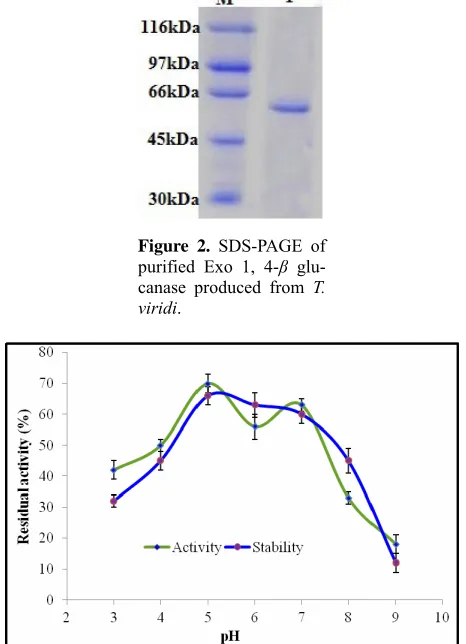
The pH-activity profile showed that the present Exo 1, 4-β glucanase was optimally activity at a pH 5 (Figure 3).
It was also observed during the trial that any further in- crease in the pH showed a sharp decreasing trend in the activity of enzyme. Stability profile based on the 1 h in- cubation time period revealed that the purified Exo 1, 4-β
glucanase was stable in a large pH range for up to 1 h. Earlier studies reported that optimum activities of β- glucosidase from different enzyme sources in the pH range 5 to 6 [15].
[image:3.595.307.541.427.578.2]3.3.2. Effect of Temperature on Exo 1, 4-β Glucanase Activity and Stability
Figure 4 illustrated that the Exo 1, 4-β glucanase from T.
viridi retained its up to 75% of original activity and was optimally active at temperature up to 60˚C. High activity and extra thermo-stability are a desirable characteristic of an enzyme for a wide range of industrial applications [5,6]. In comparison the earlier reported the present Exo 1, 4-β glucanase from T. viridi was reasonably more sta- ble and active for up to 1 h incubation at 60˚C. The maximum activity of Exo 1, 4-β glucanase was obtained at 45˚C [13].
3.2. SDS-PAGE
Exo 1, 4-β glucanase was further purified to homogene- ity and to confirm its purity, the purified Exo 1, 4-β glu- canase was resolved on 5% stacking and 12% running gel and found to be a homogenous monomeric protein as evident by single band of 60 kDa on SDS-PAGE (Figure 2). Exo 1, 4-β glucanase from Chaetomiurn olivaceum
was purified to homogeneity by SDS-PAGE with a mo- lecular mass of 88 kDa [13]. While Talaromyces emersonii exo-1,3-β-glucanase was a monomeric with a molecular
[image:3.595.53.544.637.732.2]mass of 40 kDa [14]. Figure 1. nase. Gel filtration chromatography of Exo 1, 4-β gluca-
Table 1. Purification summary of Exo 1, 4-β glucanase pro- duced by T. viridi.
Sr. No. Purification steps Volume (mL) Enzyme activity (U) Protein content (mg) Specific activity (U/mg) Purification fold Yield %
1 Crude Enzyme 200 82,400 535 154 1 100
2 (NH4)2SO4 Precipitation 25 10,875 65 167 1.08 13.2
3 Dialysis 20 9600 43 223 1.45 11.7
Figure 2. SDS-PAGE of purified Exo 1, 4-β glu- canase produced from T. viridi.
Figure 3. Effect of pH on activity and stability of Exo 1, 4-β glucanase.
Figure 4. Effect of temperature on activity and stability of Exo 1, 4-β glucanase.
3.3.3. Determination of Km and Vmax
Using varying concentrations of salicin as substrate, re- sults obtained were plotted as activity against substrate (µM). Lineweaver-Burk double reciprocal plot reflecting substrate affinity and catalytic efficiency of present re- ported Exo 1, 4-β glucanase with Km (76 µM) and Vmax
(240 U/mL) values as shown in the Figure 5. In this arti-
Figure 5. Lineweaver-Burk reciprocal plot: Km and Vmax for
Exo 1, 4-β glucanase.
cle and for the first time the kinetic constants of Exo 1, 4-β glucanase through Michalis-Menten transformation Lineweaver-Burk double reciprocal plot has been inves- tigated.
4. CONCLUSION
T. viridi produces high titers of Exo 1, 4-β glucanase dur- ing solid state bio-processing of an agro-industrial or- ange peel waste material. In conclusion, the present re- ported approach based on the bio-utilization and conver- sion of agro-industrial orange peel waste into useful products presenting a superior way out for proper waste management for agro based waste materials.
5. ACKNOWLEDGEMENTS
On providing financial support and laboratory facilities, authors are grateful to the Department of Biochemistry, NSMC, University of Gujrat, Gujrat Pakistan.
REFERENCES
[1] Iqbal, H.M.N., Ahmed, I., Zia, M.A. and Irfan M. (2011) Purification and characterization of the kinetic parameters of cellulase produced from wheat straw by Trichoderma viride under SSF and its detergent compatibility. Ad- vances in Bioscience and Biotechnology, 2,149-156. [2] Iqbal, H.M.N., Asgher, M., Ahmed, I. and Hussain, S.
(2010) Media optimization for hyper-production of car-boxymethyl cellulase using proximally analyzed agro- industrial residue with Trichoderma harzianum under SSF. International Journal of Agro Veterinary and Medi- cak Sciences, 4, 47-55.
[3] Stoilova, I., Krastanov, A. and Stanchev, V. (2010) Prop- erties of crude laccase from Trametes versicolor pro- duced by solid-substrate fermentation. Advances in Bio- science and Biotechnology, 1, 208-215.
[image:4.595.58.287.457.610.2]purified protease produced from Aspergillus niger by utilizing agro wastes. BioRes, 6, 4505-4522.
[5] Asgher, M. and Iqbal, H.M.N. (2011) Characterization of a novel manganese peroxidase purified from solid state culture of Trametes versicolor IBL-04. BioRes, 6, 4302- 4315.
[6] Iqbal, H.M.N., Asgher, M. and Bhatti, H.N. (2011b) Op- timization of physical and nutritional factors for synthesis of lignin degrading enzymes by a novel strain of Tram-etes versicolor. BioRes, 6,1273-1287.
[7] Yin, L.J., Lin, H.H. and Xiao, Z.R. (2010) Purification and characterization of a cellulase from Bacillus subtilis
YJ1. Journal of Marine Science and Technology, 18,466- 471.
[8] Iqbal, H.M.N., Ahmed, I. and Naveed, M.T. (2012) En- hanced bio-catalytic and tolerance properties of an in- digenous cellulase through xerogel immobilization. Ad-vances in Bioscience and Biotechnology, in press. doi:10.4236/abb.2012.34044
[9] Yano, S., Ozaki, H., Matsuo, S., Ito, M., Wakayama, M. and Takagi, K. (2012) Production, purification and char- acterization of D-aspartate oxidase from the fungus Tricho- derma harzianum SKW-36. Advances in Bioscience and Biotechnology, 3, 7-13. doi:10.4236/abb.2012.31002 [10] Yeh, A.I., Huang, Y.C. and Chen, S.H. (2010) Effect of
particle size on the rate of enzymatic hydrolysis of cellu- lose. Carbohydrate Polymers, 79,192-199.
doi:10.1016/j.carbpol.2009.07.049
[11] Deshpande, M.V., Eriksson, K.E. and Göran-Pettersson, L. (1984) An assay for selective determination of exo-1, 4,-β-glucanases in a mixture of cellulolytic enzymes.
Analytical Biochemistry,138, 481-487. doi:10.1016/0003-2697(84)90843-1
[12] Asgher, M., Iqbal, H.M.N. and Asad, M.J. (2012) Kinetic characterization of purified laccase produced from Tram- etes versicolor IBL-04 in solid state bio-processing of corncobs.BioRes, 7, 1171-1188.
[13] El-Gindy, A.A., Saad, R.R. and Fawzi, E. (2003) Purifi- cation and some properties of exo-1,4-beta-glucanase from
Chaetomium olivaceum. Acta Microbiologica Polonica, 52,35-44.
[14] O’Connell, E., Piggott, C. and Tuohy, M. (2011) Purifi- cation of exo-1,3-beta-glucanase, a new extracellular glu- canolytic enzyme from Talaromyces emersonii. Applied Microbiology and Biotechnology, 89, 3685-3696.