Entropy Maximization Problem in Network using
Dijkstra’s-Floyd Warshall Algorithm
Pawan Kumar Gupta
Assistant Professor
Department of Information Technology AITR, Indore
ABSTRACT
The shortest path problem is to find a path between two vertices on a given graph, such that the sum of the weights on its constituent edges is minimized. The classic Dijkstra’s algorithm was designed to solve the single source shortest path problem for a static graph. It works starting from the source node and calculating the shortest path on the whole network. This work aims to develop a Hybrid algorithm Dijkstra’s - Floyd Warshall algorithm to solve entropy maximization routing protocol problem. The algorithm has to find the shortest path between the source and destination nodes. Route guidance algorithm is use to find best shortest path in routing network, this is poised to minimize costs between the origin and destination nodes. The proposed algorithm is compared with the existing in order to find the best and shortest paths.
General Terms
Dijkstra’s Algorithm, Floyd-Warshall Algorithm, Hybrid algorithm Dijkstra’s-Floyd Warshall (HDFWA), Entropy.
Keywords
Entropy; Dijkstra’s Algorithm; Dijkstra’s-Floyd Warshall algorithm
1.
INTRODUCTION
In calculation, the network usually refers to a mathematical graph. The system is composed of nodes, arcs and curve masses. The network stands called traditional if arc heaviness is coefficients. In recent ages network optimization consumes become a significant research gratified in working Research. It comprises areas such as straight path, network flows, and carriage routing then Chinese postman difficulties and so decided. The straight path problem distillates on finding a track with smallest distance, period, or cost after the source bulge to the terminus node. Some descriptive algorithms stayed proposed through Bellman, Dijkstra’s, Dreyfus, in addition Floyd, which complete the conservative path problematic, occupy a dominant position in a system.
Entropy
In Data Communication, Entropy is Relative level of Randomness. Entropy is specifically relative to the greatest sensible information speed in bps. When we increment the entropy then it additionally expanded the many-sided quality of flag mistake. It is likewise specifically corresponding to commotion and data transfer capacity. The entropy in a flag is contrarily relative to compressibility; the more noteworthy the entropy, the littler the factor by which the information can be packed. Entropy additionally alludes to clutter purposely added to information in certain encryption forms.
Principle of Maximum Entropy
The Principle of Maximum Entropy expresses that, the likelihood dissemination which best speaks to the present condition of information is the one with biggest entropy.
Network
A connection between two or more peripheral devices that is able to share their resources between many users. The connection between computers can be done by guided or unguided media i.e. wired and wireless network. The guided media can be connected via cabling most commonly the Ethernet cable. The unguided media can be connected via radio waves. Connected computers or nodes can be shearing their resources, like access to the internet, printers, file servers, and others. A network is a multipurpose connection, which allows a single node to do more.
Traffic Engineering
Traffic Engineering is a technique for advancing the execution of an information transfers system by powerfully breaking down, foreseeing and controlling the conduct of information transmitted over that network. Traffic engineering is also known as tele-traffic engineering and traffic management.
Network Optimization
Evolving and expanding a network to meet ever-changing demands from consumers and business users is a challenge. The greatest popular impartial is minimizing highest utilization in a normal working situation. One common strategy is reducing maximum operation under de essential failure situations. Also additional objectives occur like minimizing proliferation delay, etc.
Shortest Path routing
39
Open Shortest Path First
OSPF was developed as a replacement for the distance vector routing protocol Routing Information Protocol (RIP). It operates as a classless routing protocol that uses the concept of areas for network scalability. RFC 2328 defines the OSPF metric as an arbitrary value called cost. The Cisco IOS uses bandwidth as the OSPF cost metric. OSPF’s major advantages over RIP are its fast convergence and its scalability to much larger network implementations. OSPF has a default administrative distance of 110. As a classless routing protocol, it does not use a Transport layer protocol, as OSPF packets are sent directly over IP.
2.
PROBLEM IDENTIFICATION
One of the very important practical problems has been the finding of the shortest path between two nodes. These nodes can be as big as countries or as small as atoms. The problem of finding the shortest path between all pairs of vertices on a graph is similar to making a table of all of the distances between all pairs of nodes.
3.
METHODS USED
Formulation of Entropy Optimization
Entropy optimization principles are developed to establish some inference criteria for predicting probabilities based on incomplete information. The maximum entropy principle claims: "In making inference on the basis of partial information we must use that probability distribution which has maximum entropy subject to whatever is known. This is the only unbiased assignment we can make".
Shortest Path Betweenness Centrality
[1]:
Let represent the total number of shortest paths between every pair of source-destination nodes (s, t): s and t V. Let
represent the number of geodesics between every pair
of nodes (s, t) that pass through a link (i) E. The Shortest Path Betweenness Centrality (SPBC) of a link (i) is defined as
(1)
Network Centrality
[1]:The network centrality or the entropy of SPBC is defined by
(2) Where, (3)
represents the random variable associated with the probability distribution formed from equation (3). The relative entropy is defined as
(4)
Mathematically, it is stated as the following optimization
problem (E1): (5) ,
where the vector p stands for the probability to be assigned, E[fj] denote the jth moment known from some probabilistic experiments and H( ) is the Shannon entropy measure.
It can be easily verified that the problem (E1) is a convex programming and has an unconstrained dual program in from
(6)
Where µ is a vector of Log range multiplier, if one has a prior probability q=(q1, q2, q3, …….., qn), in addition to the moment constraints in (E1), the probability p should be assigned based on the minimum cross-entropy principle. Mathematically, it leads to the following entropy optimization problem (E2):
(7)
Where D(p,q) stands for the Kullback-Leibler’s cross-entropy or relative entropy.
Dijkstra’s Algorithm:
Dijkstra’s algorithm is also known as single source shortest path algorithm. It calculates the shortest path from the source to each of the unvisited vertices in the graph. It used the method of increasing node by node to get a shortest path tree which makes the starting point as its root.
Algorithm
1. Start with the source node: the root of the node.
2. Assign a cost of 0 to this node and make it the first permanent node.
3. Examine each neighbor node of the node that was the last permanent node.
4. Assign a cumulative cost to each node and make it tentative.
5. among the list of tentative nodes
a. Find the node with the smallest cumulative cost and mark it as permanent. A permanent node will not be checked ever again; its cost recorded now is final.
b. If a node can be reached from more than one direction, select the direction with shortest cumulative cost.
6. Repeat steps 3 to 5 until every node becomes permanent.
Floyd Warshall Algorithm:
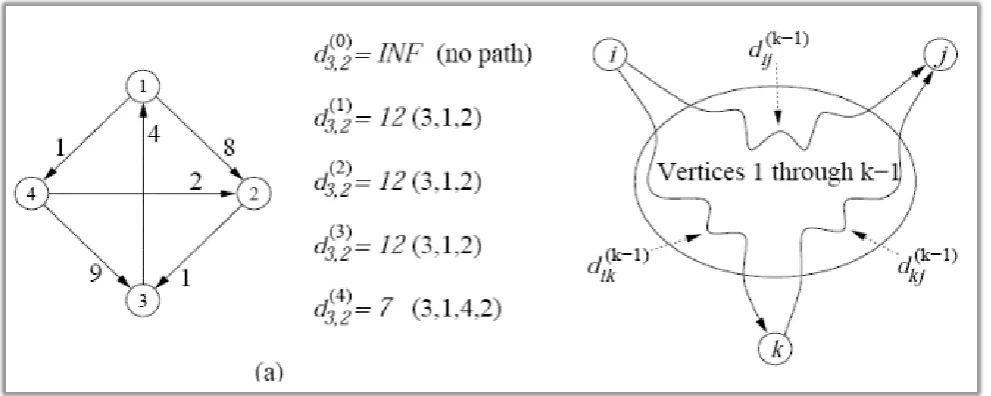
Figure 1: Floyd-Warshall Algorithm
Algorithm
Step 1: Dist (i,j) is ‘best’ distance so for from vertex I to vertex j.
Step 2: Start with all single edge paths.
3. For i=1 to n doFor j=1 to n do Dist(I,j)=weight(I,j) 4. For k=1 to n do, k is the intermediate’ vertexFor I=1 to n doFor j=1 to n do if(dist(I,k)+dist(k,j)<dist(I,j)) Then
Dist(I,j)=Dist(I,k)+Dist(k,j)
Pseudo Code
1. Let distance be a |v|*|v| array of minimum distances initialized to infinity.
2. For each vertex v distance [v][v] 0
3. For each edge (u, v) distance [u][v] w(u,v)
4. For k from 1 to |v|
5. For i from 1 to |v|
6. For j from 1 to |v|
7. If distance[i][j]>distance[i][k]+distance[k][j]
8. Distance[i][j] distance[i][k]+distance[k][j]
9. End if.
The proposed Algorithm (HDFWA)
Proposed algorithm Hybrid Dijkstra’s-Floyd Warshall Algorithm (HDFWA) can also be used for finding shortest path i.e. lowest cost from origin node to destination node in a network graph. The input of the algorithm consists of distances directed between nodes as r and a source data from origin and destination paths as s, d in the network graph G. If the distance between two nodes can be defined as path cost, the total cost of a network graph is the sum of all route distances between nodes in a graph.
Algorithm
Step 1: Node weight computation for all nodes //for each node
and edge pick the costs in W (k).For i=start to last edges
For j = first to last edges// j is set to the destination node if (G( 2 , j) = i )// k is set to the source node W(k) = W(i) + G( 3
,j);
Step 2: Shortest Path computation For i = first to last edges while (the origin (k)is the same in graph, G)
if (G( 3 , i) = W(k) - W(j))
P(k) = G( 2 , i); elsei = i + 1;
k = G( 1 , i);End
4.
RESULT
41 to assume that a better solution can be obtained and in a
shorter time. Moreover, new approach proposes that Floyd Warshall-Dijkstra’s algorithm has less probability of being stuck in the local optimum and rather produces a result close to global optimum.
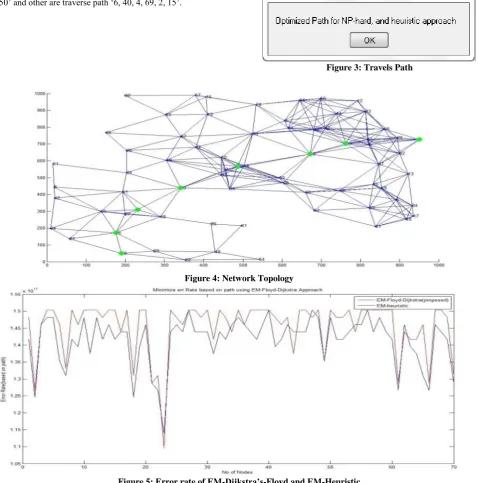
In figure 2, we get max entropy in proposed work which is ‘7’
In figure 3, we show the path {1, 6, 40, 4, 69, 2, 15, 50 } here first node is source node ‘1’ and last node is destination node ‘50’ and other are traverse path ‘6, 40, 4, 69, 2, 15’.
[image:4.595.58.537.174.658.2]Figure 2: Maximum Entropy
Figure 3: Travels Path
Figure 4: Network Topology
Figure 5: Error rate of EM-Dijkstra’s-Floyd and EM-Heuristic
In figure 5, we observed that the EM-Floyd Dijkstra’s Algorithm is batter then Error rate of EM-heuristic. Here, we get the minimum error rate at entropy 7 when number of nodes are 70, where source node and destination node are 1 and 50 which is 1.1 1011.
5.
CONCLUSION
lot of time and cost. However, in term of shortest path, Floyd Warshall-Dijkstra’s give better results than EM-heuristic algorithm but this improvement just is approximately 10 to 15 percent while it has less important versus of the processing time, especially in the wide area. Floyd Warshall-Dijkstra’s algorithm is a heuristic algorithm to search for a new route uses heuristic information. The lower nodes and therefore less time are required. For improve the effectiveness of method Floyd Warshall-Dijkstra’s is used from the restriction direction, so with it eliminated nodes that are moving in the opposite direction and further the scrolling speed rises.
In future studies, the angular size of the proposed method and floating-point values for the various routes can be determined.
6.
REFERENCES
[1] Vanniarajan Chellappan, Krishna M. Sivalingam, and Kamala Krithivasan. "An Entropy Maximization Problem in Shortest Path Routing Networks." Local & Metropolitan Area Networks (LANMAN), 2014 IEEE 20th International Workshop on. IEEE, 2014.
[2] LI Ji, WANG Bing-Hong, WANG Wen-Xu, ZHOU Tao, "Network entropy based on topology configuration and its computation to random networks."Chinese Physics Letters25.11 (2008): 4177.
[3] J. N. Kapur and H. K. Kesvan, “Entropy optimization principles and their applications. Springer Netherlands, 1992.
[4] Marco Frittelli, "The minimal entropy martingale measure and the valuation problem in incomplete markets."Mathematical finance10.1 (2000): 39-52. [5] Ginestra Bianconi, Entropy of network
ensembles."Physical Review E79.3 (2009): 036114. [6] Brian P. Tighe, Adrianne R.T. van Eerd, and Thijs J. H.
Vlugt, "Entropy maximization in the force network ensemble for granular solids."Physical review letters100.23 (2008): 238001.
[7] Naonori Ueda and Ryohei Nakano, “Deterministic annealing EM algorithm."Neural Networks11.2 (1998): 271-282.
[8] Maximilien Gadouleau and Soren Riis, “Graph-theoretical constructions for graph entropy and network coding based communications."Information Theory, IEEE Transactions on57.10 (2011): 6703-6717.
[9] S. Mart´ınez, F. Nicol´as, F. Pennini, and A. Plastino, “Tsallis’ entropy maximization procedure revisited."Physica A: Statistical Mechanics and its Applications286.3 (2000): 489-502.
[10] R.L.C. Vink_ and G.T. Barkema, “Configurational entropy of network-forming materials."Physical review letters89.7 (2002): 076405.