Parallelization of a Branch and Bound Algorithm on
Multicore Systems
Chia-Shin Chung1, James Flynn1, Janche Sang2
1Department of Operations and Supply Chain Management, Cleveland State University, Cleveland, USA; 2Department of Computer
and Information Science, Cleveland State University, Cleveland, USA. Email: [email protected], [email protected], [email protected]
Received May 22nd, 2012; revised June 23rd, 2012; accepted July 2nd, 2012
ABSTRACT
The general m-machine permutation flowshop problem with the total flow-time objective is known to be NP-hard for m
≥ 2. The only practical method for finding optimal solutions has been branch-and-bound algorithms. In this paper, we present an improved sequential algorithm which is based on a strict alternation of Generation and Exploration execution modes as well as Depth-First/Best-First hybrid strategies. The experimental results show that the proposed scheme ex-hibits improved performance compared with the algorithm in [1]. More importantly, our method can be easily extended and implemented with lightweight threads to speed up the execution times. Good speedups can be obtained on shared-memory multicore systems.
Keywords: Parallel Branch and Bound; Multithreaded Programming; Multicore System; Permutation Flowshop; Software Reuse
1. Introduction
In the permutation flowshop problem, each of n jobs has
to be processed on machines 1···m in that order. The
processing times of each job on each machine are known. At any time, each machine can process at most one job and each job can be processed on at most one machine. Once the processing of a job on a machine has started, it must be completed without interruption. The usual objec-tives are the minimization of the make-span, flow time, tardiness, lateness, and the number of jobs late. For a review of the general flowshop problem, see [2], and more recently [3]. The application of the flowshop sched- uling research can be found in the areas such as chemical process industry and manufacturing systems, especially flexible transfer or assembly lines in which a wide range of parts are manufactured [4].
Schedules where each job must be processed in the same order at every machine are called permutation schedules. When m ≤ 2, the restriction to permutation
schedules is harmless; however, when m > 3, there may
exist a schedule whose total flow is strictly less than the total flow of any permutation schedule. Finding such a schedule among (n!)m possible schedules is often
com-putationally impractical [3]. Therefore, most approaches to the m-machine flowshop problem restrict attention to
permutation schedules.
The general m-machine permutation flowshop problem
with the total flow-time objective is known to be NP- hard for m ≥ 2. Flow time measures the time a job stays
in the system. Minimizing it amounts to maximizing the utilization of resources. Because it is highly unlikely to develop a polynomial algorithm to solve the problem, researchers have focused on the use of branch and bound algorithms to find an optimal schedule for the problem.
In this paper, we propose an improved branch and bound algorithm which is based on the existing algorithm [1] for m-machine permutation flowshop problems. To
find the optimal schedule with the minimum total flow time efficiently, the existing algorithm adopts a domi-nance test and lower bound to fathom nodes. Our ap-proach to improving the algorithm is based on a strict alternation of Generation and Exploration execution modes as well as Depth-First/Best-First hybrid strategies. The algorithm starts in the Generation mode by using the depth-first search to traverse the tree from the root down to a predetermined level. The nodes explored at this level will be inserted into a work pool. When the pool is full, the algorithm switches to the Exploration mode which takes the node with the minimum (i.e. the best) lower
another candidate and insert it to the work pool. Our method fairly selects the best one from the pool because the nodes in the pool are at the same level. Furthermore, the size of pool can be controlled by a predetermined value and hence it will not grow arbitrary large as in the best-first approach. Our empirical results show that the proposed method exhibits improved performance com-pared with the existing algorithm.
Considering the lengthy process in the search for lower bounds, the use of parallelism has a better chance of speeding up the execution of the algorithm and has emerged as an attractive way of solving larger problems [5]. One of the current trends in microprocessor archi-tecture design is continually increasing chip-level paral-lelism. Multi-core processors, providing 2 - 16 scalar cores, are now commonplace and affordable. Software designers often use processes or threads to exploit the power of multicore processors. Our improved sequential algorithm can be easily extended and implemented on shared-memory multicore platforms by allowing several worker threads to explore the subtrees concurrently. We have conducted several experiments on a multicore sys-tem and the results indicate that almost linear speedups can be obtained.
Related Work
Sequential and parallel branch-and-bound algorithms have been widely studied over the past several decades. Regarding the permutation flowshop problems, the paper [6] developed a branch and bound algorithm for the two-machine case and the other paper [7] extended it to the m-machine case. A new machine-based lower bound
for the m-machine case was derived in [8]. For the search
strategies, the paper [9] evaluated the depth-first search and best-first search branch and bound algorithms and suggested a best-first search should be used when it ex-pands a much smaller number of subproblems than that of a depth-first search. Otherwise, a depth-first search should be considered. It also pointed out that the choice of a search method is problem dependent.
The paper [10] presented a Java-based software system for large-scale, fault-tolerant, adaptive parallel comput-ing. A master/worker-based branch and bound computa-tion was used as an example for solving Traveling Salesman Problem on a cluster of workstations. In the area of computational biology, a recent paper [11] im-plemented a parallel branch and bound algorithm for constructing minimum ultrametric trees. The algorithm was designed on distributed memory multiprocessors using the master/worker model.
If there is no master used for generating tasks, the de-composition of the problem tree relies on all cooperating processes. A decomposition method for parallel depth-
first search can be found in [12]. Upon request, the work in a donor’s stack is split into two stacks and one of which is given to the requester. In the paper [13], a par- allel decomposite best-first search branch-and-bound al- gorithm for MIN-based multiprocessor systems was pro- posed. A probabilistic model is used to estimate the number of evaluated nodes for a serial best-first search and to predict the speed-up of the parallel branch-and- bound algorithm. The paper [14] used a simple but ele- gant method to generate the subtree tasks in a parallel depth-first branch and bound algorithm for solving the quadratic assignment problem on shared memory multi-processors. In their method, when a process gets a node, say X, at the cutoff level, this process will generate a sibling node of X for other processes before exploring the subtree rooted at node X. Actually, this method works similarly to our model with the pool size equals to one.
An alternative way of dealing with permutation flow-shop problems is to develop effective heuristics to obtain approximate solutions. The evaluation and comparison of several heuristic approaches for permutation flowshops can be found in [15,16]. Recently, metaheuristics, such as genetic algorithms, simulated annealing, tabu search, etc., have been successfully applied to many combinato-rial optimization problems. See [17,18] for reviews of the literature on metaheuristics.
2. The Hybrid Model
Assume that there are n jobs which will be processed in
the same order by m machines. Consider the search tree
where root node represents the null schedule. Every other node represents a partial schedule s
s
1 , , s s
,indicating that job
j occupies the jth position oneach machine, for 1 ≤j ≤s, where s is the number of jobs
in the partial schedule and 1 ≤s ≤n. Any
permuta-tion of the set of unscheduled jobs defines a com-plete schedule
s
1 , , s s
, 1 , ,
ns
,s s i,
. By placing any unscheduled job i in position s+1, we
pro-duce a descendant node 1 ,i s
. Consider our lower bound on the total flow time at node . Let G
denote the total flow time for jobsin the partial schedule and let U be the set of jobs
that are not included in the partial schedule . Our lower bound is based on estimates of the earliest possible start time for any job in U assigned to position t, where s + 1 ≤t ≤n. The idea behind these estimates is that a job
can be processed at a machine only when both the job and the machine are ready. Assume that pjk denotes the
processing time of job j on machine k and the partial
processing time of job j on machines u···v is represented
by v
juv r u jr, our lower bound LB on the total
flow time at node is computed as follows:
1 n
k t s tk j U LB
E
qjkm
,
max1 k m k, 2, ,LBG LB k m
where Etk is an underestimate of the earliest start time of
the t job on machine k, for t ≥s + 1. The detail of
com-puting Etk can be found in [1].
Note that some partial sequences can be pruned with-out checking lower bounds if they are dominated by oth-ers. Specifically, let 1 and 2 be two partial schedules
for the same set of jobs S. We say that 1 dominates 2,
if G
1
G
2 for every permutation of thejobs in N −S. If the previous inequality is strict, we say
that 1 strictly dominates 2. Hence, during the branch
and bound searching process, the partial schedule 2 can
be pruned.
A branch and bound algorithm has been developed to solve the m-machine permutation flowshop problem [1].
The basic structure of the algorithm is similar to the one developed in [19]. It employs an adaptive depth-first search (DFS) strategy, which differs from the breadth- first strategy used in [7]. The advantages of a depth-first plus backtracking search strategy are: 1) the number of active nodes is always ≤ n; 2) the bottom of the tree is
reached faster so a feasible solution can be found earlier; 3) a stack can be used to reduce computations. The pro-gram uses a heuristic method to compute an upper bound
Z* from an initial feasible solution *. The search
strat-egy incorporates a dominance and a best bound rule. Given the current node r
r
,r
r
jU
1 , , let Ur
denote the set of all jobs not in the set
, and for each r, let
1 , ,
r r r r
Zr
jdenote the lower bound for node rj. Also, let
and . (Note that i
r.) For each r, our algorithm dictates the
fol-lowing. If node ij has not been previously fathomed, use
the dominance test mentioned earlier to determine whether ji strictly dominates ij. If so, then fathom ij
and assign to it the lower bound ; otherwise, compute a lower bound for ij. After calculating all of these lower
bounds
r 1 , , r r 1
jU
r
r
ri
Z j , jUr, branch on the job j with the
smallest lower bound. When the search reaches a leaf node, a complete schedule is found. If the leaf node’s lower bound value is less than the global upper bound Z*,
the value and the schedule will replace the current Z*and
*, respectively.
Our improved branch and bound algorithm is based on the existing algorithm in [1]. The new algorithm consists of two modes: Generation and Exploration. In the gen-eration mode, the program searches the upper part of the B&B tree from the root down to a node at level i and
then inserts the node along with its information, such aslower bound, partial sequence, etc., into a work pool. In the current implementation, the value of the level i and
the size of the pool psize, are determined when the
pro-gram starts and never change from then. The nodes in the work pool are ordered by using the lower bound as the key. Initially, the program keeps generating candidates until the pool is full. After that, the program switches to the Exploration mode. It extracts the node with the minimum lower bound from the pool and develops a lo-cal depth first search on the assigned subtree rooted at level i. When the exploration of the subtree is complete,
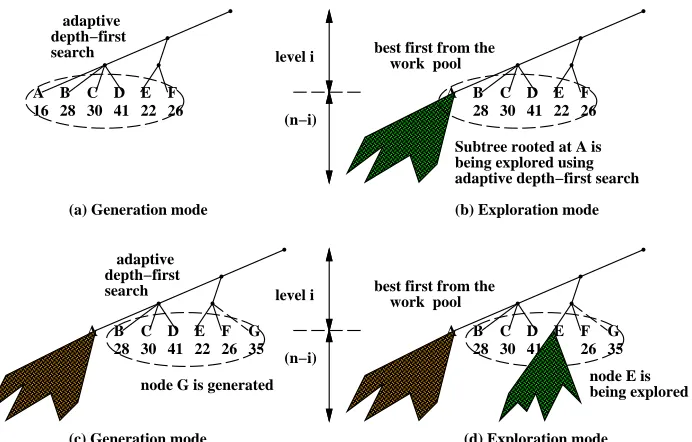
the program changes back to the Generation mode. Figure 1 shows a simple example with level i = 3, and
pool size psize = 6. Note that the algorithm generates the
subtree roots at level i from left to right (denoted from A
to F in Figure 1(a)) based on the old existing algorithm. Since node A has the minimum lower bound, it will be explored first as can be seen in Figure 1(b). Then, the algorithm generates next candidate G and inserts it to the
work pool (Figure 1(c)). As mentioned before, the algo-rithm in [1] generates the nodes under the same parent one by one using their lower bound values in ascending order. Namely, A < B < C < D and E < F < G. But this
does not guarantee that D has a smaller lower bound than E because they have different parent nodes. That’s why
our new algorithm uses a pool to possibly adjust the search order. For example, if E has the minimum value in
the pool, the subtree rooted at E will be explored next
(see Figure 1(d)).
In general, the algorithm runs by strictly alternating between the Generation and Exploration modes. When the upper tree has been traversed completely, i.e. no new
node will be generated into the work pool, all of the re-maining nodes in the work pool will be explored based on their lower bound values. Note that the pool size should be reasonable large enough to accommodate sub-tree candidates as many as possible. The nodes with smaller lower bound values at level i will have higher
chances to be explored and hence the optimal solution could be found earlier.
Figure 2 shows the pseudo code of the new algorithm which consists of the two major functions GENERATE()
and EXPLORE(). Almost all the codes between the lines
1 - 19 and the lines 25 - 36 in Figure 2 are reused from the algorithm in [1] except that the codes in the function
EXPLORE() have been modified a little bit. In the
origi-nal program, the variables such as Z, U, , etc. are
de-clared as global and hence many computation functions can access them easily. If such a program is executed without any modification, the codes in the both Genera-tion and ExecuGenera-tion modes will access the same copy of permanent variables. Instead of directly using different names/copies of global variables, our solution is through the pointer t which points to the corresponding working
data area, so the function EXPLORE() can explore its
(n−i) level i
A B C D E F 41 adaptive depth−first search
16 30
(a) Generation mode
A B C D E F 41 30
(b) Exploration mode Subtree rooted at A is being explored using adaptive depth−first search
28 22 26 22
28 26
best first from the work pool
(n−i) level i
G 35 A B C D E F
41 22 adaptive depth−first search
30
(c) Generation mode node G is generated
G 35 A B C D E F
41 30
(d) Exploration mode node E is being explored
28 26 28 26
[image:4.595.128.474.84.305.2]best first from the work pool
Figure 1. The hybrid model with DFS and best-first from the pool.
the code can be easily extended for the multithreaded parallel algorithm which will be described in the next section.
As mentioned earlier, both of the functions EX-PLORE() and GENERATE() use the same depth-first
search strategy. One difference is that the former starts search at level depth (see line 1 while the latter starts from the root, i.e., level 0 (see line 25). Another
differ-ence is that when the search level inside the function
GENERATE() is reached at a predetermined level, it will
insert the current node along with its lower bound value
Zr and partial sequence r to the pool which is
imple-mented using a heap structure. Before insertion, the algo-rithm checks whether the work pool is full or not. If the pool is full, it switches to the Exploration mode by call-ing the function EXPLORE() (see lines 37 - 42). The
ad-dress of the working data area for the Exploration mode is passed to the function EXPLORE() when it is being
invoked (see line 41 in Figure 2).
3. The Parallel Algorithm
We have designed and implemented a parallel version of our improved algorithm on a multicore system. Instead of using traditional UNIX processes which suffer from the overheads associated with process creation, context- switching between address spaces, inter-process commu-nication, etc., we adopted lightweight processes (i.e.
threads) which operate within a single address space and consequently enjoy reduced overheads [20]. The Genera-tion and ExploraGenera-tion modes in the sequential algorithm can be realized by using a master thread and several worker threads, respectively. That is, the master thread
keeps generating the subtree roots at a predetermined level to the work pool, while each of the worker threads takes turn to get the subtree root with the minimum lower bound in the pool and then explores it.
Figure 3 depicts the master/worker parallel execution model. Synchronization between the master and the workers is implemented with semaphores, especially for the work pool management. The master has to stop gen-erating candidate nodes if no more free slot is available in the pool. Similar situation occurs for an idle worker. It has to wait if the pool is empty (i.e. no item available).
Therefore, the master needs to trigger a waiting worker to run after inserting a node, while a worker has to notify the blocked master to continue after taking a node from the pool. Actually, this is the well-known Producer- Consumer problem (also known as the bounded-buffer problem) and a sample program using Pthreads can be found in [21].
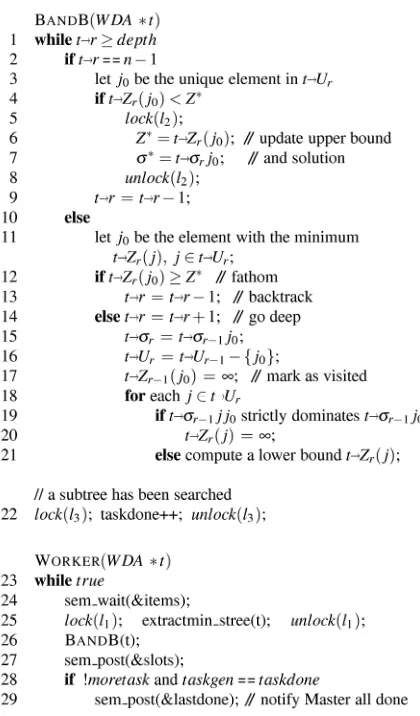
Figures 4 and 5 show the pseudo code of the worker and the master, respectively. All the codes between the lines 1 - 21 in Figure 4 and the lines 12 - 23 in Figure 5 are borrowed from the sequential program in Figure 2. As discussed earlier, we used the pointer t which points
to the corresponding thread working data area to let each thread explore its own assigned subtree using the dedi-cated space. The address of the working data area is passed to the thread when it is created (see line 6 in Master code). As can be seen in the lines 24, 27 in Fig-ure 4 and the lines 26, 29, 38 in Figure 5, the functions
sem_wait and sem_post were used along with the two
semaphores slots and items for the purpose of
Figure 2. The pseudo code of the improved algorithm.
respectively (see lines 2 - 3 in Figure 5). Another case for synchronization is between the master and the last working thread. When the latter finishes the exploration of the last subtree, it notifies the former via the sema-phore lastdone. In order to calculate the speedup
accu-rately and to compare the performance with other parallel
lock(); Work Pool unlock(); Master
Generation
Exploration Worker
Exploration Worker
sem_wait(&slots) sem_signal(&items)
sem_wait(&items) sem_signal(&slots)
insert()
[image:5.595.312.533.82.251.2]extractmin_stree()
[image:5.595.236.521.87.653.2]Figure 3. The master/worker parallel execution model.
Figure 4. The pseudo code of the Worker thread.
algorithms fairly, we use the variable p to control the
number of threads running. As mentioned before, the value of p is given at command line and it represents one
master plus p − 1 worker threads. Our Master/Worker
[image:5.595.311.521.278.636.2]Figure 5. The pseudo of the master thread.
been explored completely. To overcome this problem, we let the master do a worker’s job when such situations occur. As shown in Figure 5 lines 26 - 34, we use sem_ trywait() to detect, instead of being blocked, when the
pool is full. The master will take one subtree root from the pool and explore it by calling the function BandB(). Similarly, after the upper tree has been searched, if the master finds that the pool still has some subtrees unex-plored, it will do the worker’s job again (lines 40 - 42). Note that the master will use the reserved working area
wd[0] when it is in the Worker-mode.
Three mutexes, l1, l2, and l3, are used to guard different
critical sections via the functions pthread_mutex_lock()
and pthread_mutex_unlock() (abbreviated as lock() and unlock() in the code). The mutex l1 is used to allow only
one thread, either master or worker, to access the work pool. Another mutex, l2, is used to protect the upper
bound Z* and its corresponding schedule * which should
be kept in the global shared data region. Once a smaller upper bound is found by a worker process, the globally shared Z* and * will be updated (see lines 6 - 7 in Fig-ure 4). The third mutex l3 controls the atomic update to
the global variable taskdone (line 22), i.e., the number of
tasks completed. This variable is used to detect all the search tasks done or not.
4. Experimental Results
This section reports on computational experiments that evaluate the effectiveness of the improved branch and bound algorithm and its parallel implementation using threads. The algorithms were implemented in C under Linux. We conducted several experiments on a 16-core multiprocessor (2.4 GHz AMD Opterons, 64 GB mem-ory) supported by Ohio Supercomputing Center.
In the first experiment, we ran our improved sequential algorithm for the problem size m = 6, n = 18. We
pro-duced 50 random problems. For each problem, we pat-terned after the scheme used in [22] to generate the processing times pjk, 1 ≤ j ≤ n, 1 ≤ k≤ m,which were
independently and uniformly sampled from the interval [1,99] using the ran1 procedure described in [23]. We
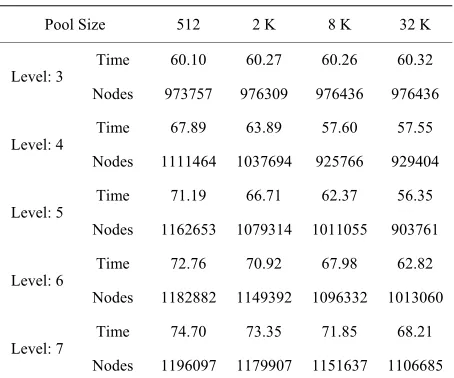
[image:6.595.310.537.525.714.2]ran the improved algorithm for the 50 random problems by varying different levels and different pool sizes. The averages of node count and the execution time were cal-culated. We also ran the old algorithm in [1] for the pur-pose of comparison. Table 1 shows the empirical result.
Table 1. Average execution (in seconds) and node count for the problem size m = 6, n = 18.
Pool Size 512 2 K 8 K 32 K
Time 60.10 60.27 60.26 60.32 Level: 3
Nodes 973757 976309 976436 976436
Time 67.89 63.89 57.60 57.55 Level: 4
Nodes 1111464 1037694 925766 929404
Time 71.19 66.71 62.37 56.35 Level: 5
Nodes 1162653 1079314 1011055 903761
Time 72.76 70.92 67.98 62.82 Level: 6
Nodes 1182882 1149392 1096332 1013060
Time 74.70 73.35 71.85 68.21 Level: 7
Nodes 1196097 1179907 1151637 1106685
Note that the execution time is proportional to the node count. That is, the smaller the node count, the less the execution time. As can be seen in the table, increasing the pool size for each level can significantly improve the performance, especially for level 4 and level 5. For level 3, the execution time cannot be improved and the aver-age node count remains at the same number when the pool size is greater than 4 K. This is because the maxi-mum number of nodes at level 3 for the problem size m =
6, n = 18 is 18 × 17 × 16 = 4896.
Note that some subtree roots which are generated into the pool earlier may have key values greater than the new global upper bound Z* found later. When the pool size
increases, there will be more redundant subtree roots in the pool. These subtree roots will not lead to an invalid result because they will be pruned immediately after be-ing extracted from the pool.
In order to achieve the same performance, a deeper level needs a much larger pool size to cover the same portion of the upper tree as in the lower level. This can explain the reason why level 6 and level 7 do not perform better than level 4 and level 5 for the same pool size. In addition, even we use a heap structure which provides efficient insert and extractmin operations, the cost of
accessing the work pool cannot be totally ignored. Fur-thermore, the switches between the Generation and Ex-ploration modes also produce extra overhead. The deeper the level is, the larger the number of subtrees and hence the more switches will be. It can be found that level 7 even performs slower than the old algorithm for smaller pool sizes.
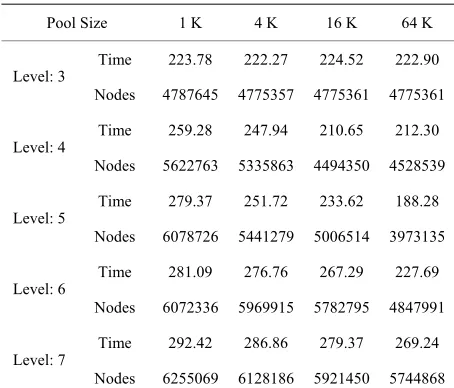
We also ran another experiment for a large-sized prob-lem m = 4, n = 20. Table 2 shows the similar result. The best performance is achieved at level 5 with pool size 64 K which yields more than 30% execution time improve-ment.
In the next experiment, we ran our parallel algorithm for the problem size m = 6, n = 18 and the depth level
was set at 5. Four different pool sizes, 512, 2048, 8192, and 32,768, were used in the experiment. For each pool size, we varied the number of processors to see how the execution time can be improved. As shown in Figure 6, increasing the number of processors and/or increasing the pool size can reduce the execution time. Similar result can be found in Figure 7 which used a larger problem size m = 4, n = 20 with the same depth level = 5.
Figures 8 and 9 show the speed-up ratios for the prob-lem sizes m = 6, n = 18 and m = 4, n = 20, respectively.
As can be seen in the figures, the speed-up ratios in-creased when the number of processors inin-creased. Moreover, particularly good speedup ratios were ob-tained for the problem size m = 4, n = 20 because of its
[image:7.595.309.536.110.304.2]larger computation workload. This result shows that our parallel algorithm is scalable.
Table 2. Average execution (in seconds) and node count for the problem size m = 4, n = 20.
Pool Size 1 K 4 K 16 K 64 K
Time 223.78 222.27 224.52 222.90
Level: 3
Nodes 4787645 4775357 4775361 4775361
Time 259.28 247.94 210.65 212.30
Level: 4
Nodes 5622763 5335863 4494350 4528539
Time 279.37 251.72 233.62 188.28
Level: 5
Nodes 6078726 5441279 5006514 3973135
Time 281.09 276.76 267.29 227.69
Level: 6
Nodes 6072336 5969915 5782795 4847991
Time 292.42 286.86 279.37 269.24
Level: 7
Nodes 6255069 6128186 5921450 5744868
The algorithm in [1]—Time: 286.71, Nodes: 6291474
0 10 20 30 40 50 60 70
0 2 4 6 8 10 12 14 16
Execution Time (sec.)
Number of Processor
[image:7.595.309.538.329.500.2]poolsize 512 poolsize 2K poolsize 8K poolsize 32K
Figure 6. Execution time for the problem size m = 6, n = 18, level = 5.
0 50 100 150 200 250 300
0 2 4 6 8 10 12 14 16
Execution Time (sec.)
Number of Processor
poolsize 1K poolsize 4K poolsize 16K poolsize 64K
[image:7.595.308.538.543.708.2]0 2 4 6 8 10 12 14 16
0 2 4 6 8 10 12 14 16
Speed Up
Number of Processor poolsize: 32K
[image:8.595.306.537.83.250.2]poolsize: 8K poolsize: 2K poolsize: 512
Figure 8. Speed up for the problem size m = 6, n = 18, level = 5.
0 2 4 6 8 10 12 14 16
0 2 4 6 8 10 12 14 16
Speed Up
Number of Processor poolsize: 64K
[image:8.595.56.295.83.248.2]poolsize: 16K poolsize: 4K poolsize: 1K
Figure 9. Speed up for the problem size m = 4, n = 20, level = 5.
We ran our program with different levels and pool sizes. Note that the depth level determines the task (i.e.
subtree) granularity assigned to the worker. It cannot be set too high or too low. Setting the level too low will increase the granularity which implies a larger variation of workload. This may cause load imbalance among processors. Setting the level too high will produce more overhead on threads switching and pool accessing. In addition, with the same pool size, a deeper level will only cover a smaller portion of the upper tree than the lower level. Figure 10 shows the result for the problem size m
= 6, n = 18 using 8 processors. Using poolsize 1 K or 8 K,
the best performance is obtained when the depth level is equal to 4. Using a much larger pool size 32 K, the level 5 performs slightly better than at level 4. Figure 11 shows the similar comparison for the larger size problem m = 4, n = 20. The best compromise is achieved at level 5.
5. Conclusion and Future Work
We have presented an improved branch and bound algo-
0 2 4 6 8 10 12 14 16 18
2 3 4 5 6 7 8
Execution Time (sec.)
Depth Level
[image:8.595.305.538.280.449.2]PoolSize 512 PoolSize 2K PoolSize 8K PoolSize 32K
Figure 10. Execution time (m = 6, n = 18, p = 8) for different pool sizes and levels.
0 10 20 30 40 50
2 3 4 5 6 7 8
Execution Time (sec.)
Depth Level
PoolSize 1K PoolSize 4K PoolSize 16K PoolSize 64K
Figure 11. Execution time (m = 4, n = 20, p = 8) for different pool sizes and levels.
rithm which is based on the strict alternation of Genera-tion and ExploraGenera-tion execuGenera-tion modes and depth-first/ best-first hybrid strategies. Because the nodes (i.e.
sub-tree roots) in the work pool are at the same level, our method can fairly select the best one from the pool and then explore it. Giving the nodes with smaller lower bounds higher priority to be explored can lead to the op-timal solution faster. The new algorithm has been ex-tended and implemented on a multicore system using multiple threads. The experimental results show that the proposed method exhibits improved performance as compared with the algorithm in [1]. Good speedups can also be obtained on multicore platforms. While this paper focuses on the permutation flowshop problem, we be-lieve that many of the ideas have the potential to be ap-plied to other combinatorial optimization problems.
[image:8.595.57.287.285.450.2]be. This also implies a smaller variation of workload. Hence, more balanced load can be achieved and the total execution time could be reduced. In addition, we are also interested in finding out any factors which can be used to determine when to adjust the cutoff level for improving performance on multicore systems.
6. Acknowledgements
This work was supported in part by an allocation of computing time from the Ohio Supercomputer Center.
REFERENCES
[1] C. Chung, J. Flynn and O. Kirca, “A Branch and Bound Algorithm to Minimize the Total Flow Time for m-Ma- chine Permutation Flowshop Problems,” International Journal of Production Economics, Vol. 79, No. 3, 2002, pp. 185-196. doi:10.1016/S0925-5273(02)00234-7 [2] K. R. Baker, “Introduction to Sequencing and
Schedul-ing,” Wiley, New York, 1974.
[3] J. N. D. Gupta and E. F. Stafford Jr., “Flowshop Sched-uling Research after Five Decades,” European Journal of Operational Research, Vol. 169, No. 3, 2006, pp. 699-
711. doi:10.1016/j.ejor.2005.02.001
[4] R. A. Dudek, S. S. Panwalker and M. L. Smith, “The Lessons of Flowshop Scheduling Research,” Operations Research, Vol. 40, No. 1, 1992, pp. 7-13.
[5] D. Gelenter and T. G. Crainic, “Parallel Branch and Bound Algorithms: Survey and Synthesis,” Operation Research, Vol. 2, 1994, pp. 1042-1066.
[6] E. Ignall and L. Schrage, “Application of the Branch and Bound Technique to Some Flow-Shop Scheduling Prob-lems,” Operations Research, Vol. 13, No. 3, 1965, pp.
400-412.
[7] S. P. Bansal, “Minimizing the Sum of Completion Times of n Jobs Over m Machines in a Flowshop—A Branch, Bound Approach,” AIIE Transactions, Vol. 9, 1977, pp.
306-311. doi:10.1080/05695557708975160
[8] R. H. Ahmadi and U. Bagchi, “Improved Lower Bounds for Minimizing the Sum of Completion Times of n Jobs Over m Machines in a Flow Shop,” European Journal of Operational Research, Vol. 44, 1990, pp. 331-336.
doi:10.1016/0377-2217(90)90244-6
[9] C.-F. Yu and B. W. Wah, “Efficient Branch-and-Bound Algorithms on a Two-Level Memory System,” IEEE Transactions on Software Engineering, Vol. 14, No. 9,
1988, pp. 1342-1356. doi:10.1109/32.6177
[10] M. O. Neary and P. Cappello, “Advanced eager schedul-ing for Java-Based Adaptive Parallel Computschedul-ing,”
Con-currency and Computation: Practice and Experience, Vol.
17, No. 7-8, 2005, pp. 797-819.
[11] K. Yu, J. Zhou, C. Lin and C. Tang, “Efficient Parallel Branch-and-Bound Algorithm for Constructing Minimum Ultrametric Trees,” Journal of Parallel and Distributed Computing, Vol. 69, No. 11, 2009, pp. 905-914.
[12] V. N. Rao and V. Kumar, “Parallel Depth-First Search on Multiprocessors—Part I: Implementation,” International Journal of Parallel Programming, Vol. 16, No. 6, 1987,
pp. 479-499. doi:10.1007/BF01389000
[13] M. K. Yang and C. R. Das, “Evaluation of a Parallel Branch-and-Bound Algorithm on a Class of Multiproces-sors,” IEEE Transactions on Parallel and Distributed Systems, Vol. 5, No. 1, 1994, pp. 74-86.
doi:10.1109/71.262590
[14] B. Mans, T. Mautor and C. Roucairol, “A Parallel Depth First Search Branch and Bound Algorithm for the Quad-ratic Assignment Problem,” European Journal of Opera-tional Research, Vol. 81, No. 3, 1995, pp. 617-628.
doi:10.1016/0377-2217(93)E0334-T
[15] J. Framinan, R. Leisten and R. Ruiz-Usano, “Comparison of Heuristics for Flow Time Minimisation in Permutation Flowshops,” Computers & Operations Research, Vol. 32,
No. 5, 2005, pp. 1237-1254.
[16] Y. D. Kim, “Heuristics for Flowshop Scheduling Prob-lems Minimizing Mean Tardiness,” Journal of Opera-tional Research Society, Vol. 44, No. 1, 1993, pp. 19-28.
[17] C. Reeves, “Genetic Algorithms for the Operations Re-searcher,” INFORMS Journal of Computing, Vol. 9, No.
3, 1997, pp. 231-250.
[18] C. Ruiz and C. Maroto, “Comprehensive Review and Evaluation of Permutation Flowshop Heuristics,” Euro-pean Journal of Operational Research, Vol. 165, 2005,
pp. 479-494. doi:10.1016/j.ejor.2004.04.017
[19] C. N. Potts, “An Adaptive Branching Rule for the Per-mutation Flow-Shop Problem,” European Journal of Op-erational Research, Vol. 5, No. 1, 1980, pp. 19-25.
[20] B. Nichols, D. Buttlar and J. P. Farrel, “Pthreads Pro-gramming,” 1st Edition, O’Reilly & Associates, Inc., Se-bastopol, 1996.
[21] K. A. Robbins and S. Robbins, “Practical UNIX Pro-gramming,” Prentice-Hall, Englewood Cliffs, 1996. [22] E. Taillard, “Benchmarks for Basic Scheduling
Prob-lems,” European Journal of Operational Research, Vol.
64, No. 2, 1993, pp. 278-285.