Efficient Algorithm and Framework for Interesting
Patterns Generation for optimization of Association rule
mining using genetic Algorithm for Social Networking
Sites
Karuna Nidhi Pandagre
Department of Computer Science, Aisect University,
Bhopal, India
S. Veenadhari
Department of Computer Science, Aisect
University,
Bhopal, India
ABSTRACT
Social Networking (SN) plays an important part in real life because people is already connected in any types of social network like facebook, twitter, linkedin, instagram etc. SN gives a platform to people to share their ideas to each other. Moreover this type of online community, people may share their common interest. SN is a medium of making link with people having unique or common interest and goals. But there are various challenges in SN services. The major challenge is privacy it means keeping your information private isn‟t just about your own choices. It‟s about your friends‟ choices, too. In this article a novel Algorithm proposed for Interesting Patterns Generation (AIPG) and framework for interesting patterns generation from weblog. This approach is also helpful in SN
General Terms
Patterns Generation Algorithms and Framework.
Keywords
Social Network, Private Data, Weblog, Visitors
1.
INTRODUCTION
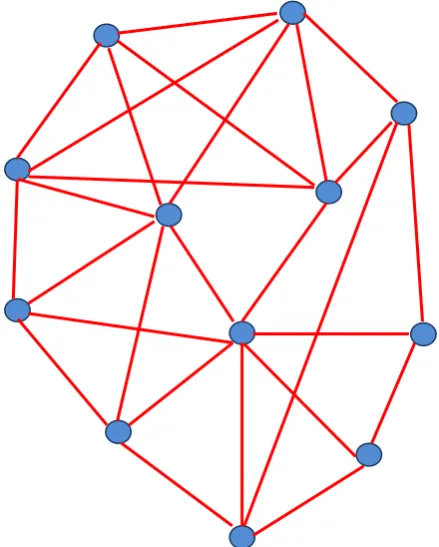
Now days SN services are rapidly growing, lots of social networks are available such as facebook, twitter, linkedin, instagram etc [1]. In social networking services any person can connect another person have shown the person using dot in the give figure and maintained its relationships through lines. In this network any number of visitors (v1, v2, v3 ...) can communicate each other. Web usage mining extracts useful information by using the web server log. By web log data can collect the behavioral patterns of the users. These patterns are used to de ne pattern discovery and associations between documents [2].
1.1
Web Server Log
Server log is a text file, which records every activity of visitors. The log file used or maintained on server log should
be in a proper format which is called as file format [3]. There are various server file formats are available and contain different types of information
such as Date- The date on which the activity occurred., Time-The time of activity occurred, Client IP addresses-Time-The IP address is address of machine, User name-The name of that particular visitor; and anonymous user indicated by a “Hyphen” (-), Service Name- It tells the internet service name, Server IP address-The IP address of machine.
1.2
Web Usage Mining
Web usage mining is one of the applications of data mining technique.[4][19]. There are various tools are available for analyzing weblog such as Rapid Miner, Weblog Expert, Deep Log Analyzer etc.[14][18], and every tool offered some or the other feature which was better than the rest. Web usage mining is one of the prominent research area due to these following reasons [5][10]. Thus personalization for a user can be achieved through web usage mining. The second is to identify frequent access patterns for the users. Those patterns are to improve the overall performance of future accesses. Common access patterns improve the actual design of web pages and for making other medications to a website [6] [11] [22]. Usage patterns can be used for business intelligence in order to improve sales and advertisement by providing product recommendations. Web usage mining approach is very efficient for identifying user's behavior in a SNS. Through this approach advertisement recommendation is possible in SNS. There are various ways to predict user behavior such as a particular timestamp, which kind of web services mostly accessed by a user. Identify commonly used browsers by user [9] [20]. Suggest friend/group in social networking with various constraints.
Fig 1:
Sample Log
1.3
Association Rule Mining (ARM)
In ARM and Frequent Pattern (FP) mining technique [16][16], the user sets a minimum threshold value and the pattern values are greater than those itemset are frequent itemsets otherwise it's called as a rare itemsets. Moreover the size of the mining outcomes depends on the user specified threshold. However, it is a very challenging task to be determined user specified threshold in real world application. If user specified threshold is too low, then it will generate more number of patterns. Some patterns may not be interesting.
1.4
Genetic Algorithms
[image:2.595.318.538.300.574.2]The pioneering work of J. H. Holland in the 1970‟s proved to be a significant contribution for scientific and engineering applications. Since then, the output of research work in this field has grown exponentially although the contributions have been, and are largely initiated, from academic institutions world-wide [6][13]. It is only very recently that it has been able to acquire some material that comes from industry. The concept of this is somehow not clearly understood. However, the obvious obstacle that may drive engineers away from using GA is the difficulty of speeding up the computational process, as well as the intrinsic nature of randomness that leads to a problem of performance assurance [21][23]. There are various terms in genetics Chromosome, Initial Population, Crossover, Offspring, Fitness and Mutation. There are various representation and selection techniques of chromosome [12]
Fig 2:
Basic structure of Social Network.
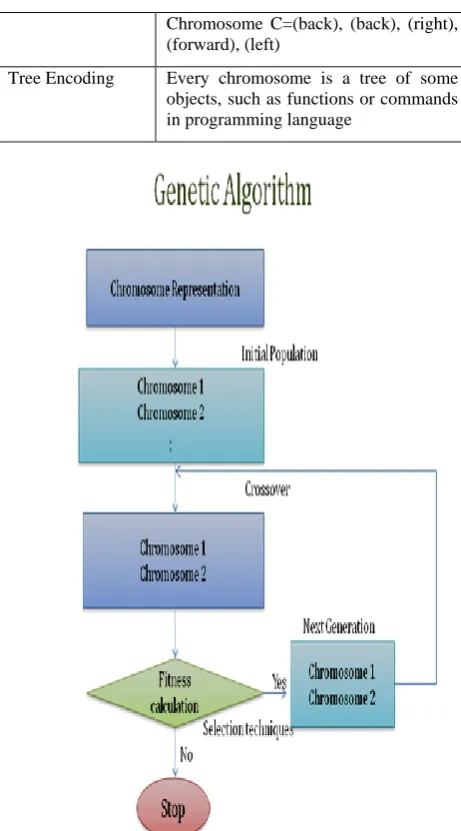
[image:2.595.311.549.605.768.2]Chromosome C=(back), (back), (right), (forward), (left)
Tree Encoding Every chromosome is a tree of some objects, such as functions or commands in programming language
Fig 3:
Genetic Algorithm Process
Crossover:
Mix and match two chromosome and produce two new chromosomes i.e. offspring's. There are two points for crossover such as Initial Strings, Offspring.
Single point
Two Point
Uniform
Arithmetic
11001011 + 11011111 = 11001001 (AND) 11001011 + 11011111 = 11001011(OR Heuristic
Offspring1 = BestParent +r*(BestParent – WorstParent) Offspring2 = BestParent
Tree crossover: In both parent one crossover point is selected, parents are divided in that point and exchange part below crossover point to produce new offspring.
Fitness Function: Fitness function is a mathematic function to calculate the survivability of chromosome mate. The fit chromosome will be the part of mating pool for the next generation.
[image:3.595.50.281.66.482.2]Mutation:
Table 2.
Mutation Table
In Numeric values: In Real values:
Flipping of bits with some fixed probability
1100010101 -> 1100110101
Any arithmetic calculation at gene position which contain the fixed probability. Eg: If δ in the range[0,1] and ν is gene
ν+-δ*ν
11000101 01011000 01101010 11000101 01111001 01101010
11000101 01011000 01101010 11000101 01011001 01111000
00100100 10111001 01111000 00100100 10111000 01101010
00100100 10111001 01111000 00100100 10011000 01111000
11000101 01011000 01101010
010001010111100001111010
00100100 10111001 01111000
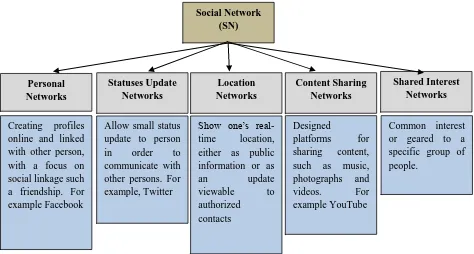
Fig 4: Genetic Algorithm Process Classification of Social Network
2.
RELATED WORK
K. Zhang et al. [6] propose a genetic algorithm to solve the influence maximization problem. S. Chang et al. [7] developed refined research model a quantitative empirical study was designed and conducted to investigate the relationships between important constructs including effort expectancy, social influence, privacy concern, perceived risk, trust, and continuance intention. Users' trust on SNS is mainly influenced by effort expectancy, social influence, and perceived risk. The impacts of influential factors are different between Facebook and LinkedIn user groups. Empirical results imply that when the positive influences, such as effort expectancy of the online community, users from different SNS have different needs in social reputation, or high security compliance, in consideration of the negative influence of perceived risk to users' trust when continuing to use the SNS. This study presents a conceptual framework using extant theories and models to form a foundation for SNS incorporating the important factors of trust and privacy concerns. B. Jang et al. [8] extract the characteristics of online news and data from social network services, including the differences and similarities between them. It found the following differences: First, the news responds to of social events but content on social network services is related to personal interests. Second, the news is continually related to a specific issue or set of issues, whereas topics of conversation change daily in social network services. Third, items from the
characteristics of online news and data from social network services. S. Rathore et al. [10] constructed a labeled dataset of the two most prominent SNSs – Twitter and Facebook. L. Bahri et al. [11] discuss the issues related to privacy preservation between centralization and decentralization, and provide a review of available research work on decentralized privacy preserving services for social networks. K. F. Man et al. [12] introduces GA and developed a framework of a design tool for industrial engineers.
3.
PROPOSED WORK
3.1
Algorithm:Algorithm for Interesting Patterns Generation (AIPG) Terms using AIPG:
Weblog W Binary Encoding BE, Transaction ID TID, Chromosome-I C-I,
Input: File with TID Output: Strong Patterns
Read W and select Webpage P parameter. Generate Binary File from P
Social Network
(SN)
Personal
Networks
Statuses Update
Networks
Location
Networks
Content Sharing
Networks
Creating profiles
online and linked
with other person,
with a focus on
social linkage such
a friendship. For
example Facebook
Allow small status
update to person
in
order
to
communicate with
other persons. For
example, Twitter
Show one‟s
real-time
location,
either as public
information or as
an
update
viewable
to
authorized
contacts
Designed
platforms
for
sharing
content,
such
as
music,
photographs
and
videos.
For
example YouTube
Shared Interest
Networks
Calculate threshold fitness for offspring. If offspring satisfy minimum threshold then select both parent chromosome-I as frequent and all associated ancestor chromosomes are frequent and select offspring in population for reproduction. Repeats steps 5, 6, 7, until find all possible frequent chromosome-I or Generated all population satisfied minimum threshold fitness.
Read BE of TID and Items in form of chromosome to create population.
Select initial population (all C-I) on basis minimum threshold fitness satisfied.
3.2
Genetic Operation to find survival
population
(Frequent Pattern) of chromosome-I
Selection of Initial population or Reproduction:
In transaction dataset there have item which represent in a particular TID (or how many object are access). Here items are treated as chromosome in form of binary encoded. Binary encoding of each item is represents its sale in corresponding TID‟s.
And Define fitness function f(x) for the chromosome-I.
3.3
Fitness Function:
Fitness function is a mathematic function to calculate the survivability of chromosome. Calculate percent support probability ratio of each chromosome-I or individual. Fitness Calculation:
1= indicate item sold in particular TID.
0= indicate item not sold in particular TID. So Fitness function support
F(s) = Total Number of true bit in chromosome-I/ Total length of chromosome-I
F(s)= TDAc / TLc Where :
TDAc= Total dominants alleles in chromosome-I TLc= Total length of chromosome-I
Percent support f(Sp)= f(s)*100= TDAc/TLc*100
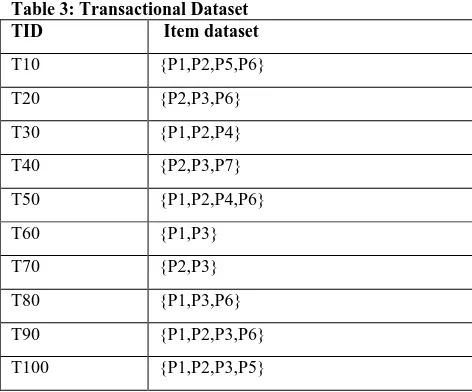
[image:5.595.310.546.89.285.2]Assume the Transaction dataset which is shown in Table 3 Table 3: Transactional Dataset
TID Item dataset
T10 {P1,P2,P5,P6}
T20 {P2,P3,P6}
T30 {P1,P2,P4}
T40 {P2,P3,P7}
T50 {P1,P2,P4,P6}
T60 {P1,P3}
T70 {P2,P3}
T80 {P1,P3,P6}
T90 {P1,P2,P3,P6}
T100 {P1,P2,P3,P5}
Scan the uncertain transactional dataset and perform value encoding scheme on transactions and items in the form of chromosome to create population.
For finding initial population select chromosome from set of all chromosomes on the basis of minimum threshold value which is calculated by defines fitness function.
Select any two chromosomes as parent from initial population and perform arithmetic crossing over (minimum ( )) to produce offspring. Only minimum value alleles are transferred in offspring.
Perform inspection of mutation. For this value of inverted bit in offspring is replace by mean of corresponding bits in its both parents.
Use fitness function to calculate fitness of offspring. If offspring satisfies minimum threshold then consider as population for reproduction.
Fig 5:
Proposed Framework
Table 4: Initial Population
There are ten chromosomes (items) in dataset D, their binary encoding.
TID T 1 0
T 20
T 30
T 40
T 50
T 60
T 70
T 80
T 90
T1 00
CI1 1 0 1 0 1 1 0 1 1 1
CI2 1 1 1 1 1 0 1 0 1 1
CI3 0 1 0 1 0 1 1 1 1 1 CI4 0 0 1 0 1 0 0 0 0 0 CI5 1 0 0 0 0 0 0 0 0 1 CI6 1 1 0 0 1 0 0 1 1 0 CI7 0 0 0 1 0 0 0 0 0 0
[image:6.595.49.289.443.614.2]Chromosome-I7= (1/10)*100=10% It assume minimum support fitness= 20% Then Initial population of individuals are: Table 5: Second Initial Population TI
D T 10
T 20
T 30
T 40
T 50
T 60
T 70
T 80
T 90
T1 00 CI
1 1 0 1 0 1 1 0 1 1 1
CI
2 1 1 1 1 1 0 1 0 1 1
CI
3 0 1 0 1 0 1 1 1 1 1
CI
4 0 0 1 0 1 0 0 0 0 0
CI
5 1 0 0 0 0 0 0 0 0 1
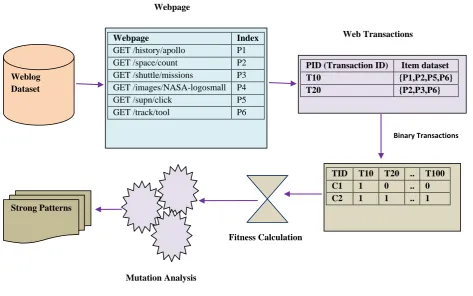
Weblog Dataset
Webpage Index
GET /history/apollo P1
GET /space/count P2
GET /shuttle/missions P3 GET /images/NASA-logosmall P4
GET /supn/click P5
GET /track/tool P6
PID (Transaction ID) Item dataset
T10 {P1,P2,P5,P6}
T20 {P2,P3,P6}
TID T10 T20 .. T100
C1 1 0 .. 0
C2 1 1 .. 1
Webpage
Web Transactions
Binary Transactions
Fitness Calculation
AND arithmetic crossing over
Offspring (child) {I1, I2}c= 1 0 1 0 1 0 0 0 1 1 Fitness value of offspring= (5/10)*100=50%
Offspring satisfy minimum threshold fitness so both parents selected as frequently associated.
4.
RESULT ANALYSIS
Result A: Two set frequent item ={P1,P2}
Step B: Suppose it is performing crossover between {P1, P2} C chromosome and Chrosome-I3.
Offspring (child) {P1, P2} c= 1 0 1 0 1 0 0 0 1 1 Chromosome-I3 = 0 1 0 1 0 1 1 1 1 1
Arithmetic AND crossing over
Offspring (child) {P1, P2, P3}c= 0 0 0 0 0 0 0 0 1 1
Fitness value of Offspring (child) {P1, P2, P3}c =(2/10)*100=20%
Offspring {P1, P2, P3}c is survivable so
Result: B Three frequent item set = {P1, P2, P3}, as per property its all two item sub sets are frequent= { {P1, P2},{P1,P3},{P2,P3}}.
StepC:
Suppose it select two individuals {P1, P2, P3}c×Chromosome-P4
Offspring (child) {P1,P2,P3}c= 0 0 0 0 0 0 0 0 11 Chromosome-P4 = 0 0 1 0 1 0 0 0 0 0 Arithmetic AND Crossing over
[image:7.595.317.540.71.239.2]Offspring (child) {P1, P2, P3, P4}c = 0 0 0 0 0 0 0 0 0 0 Fitness of Offspring (child) {P1, P2, P3, P4} c = 0% . Result C: Thus offspring is not survival or four set itemset {P1, P2, P3, P4} is not frequent.
[image:7.595.312.568.460.614.2]Fig 6:
Initial Population Analysis
Fig 7:
Chromosome Percentage Analysis
4.1
Mutation Analysis:
Once crossing over was performed, Mutation may take place. Mutation use to maintain genetics diversity form one generation to next.
It can analyze mutation in binary encode chromosome for inverting a bit „1‟ replace with „0‟ and reverse is also applicable.
Chromosome-I= 1100010000= 1000100000
[image:7.595.54.296.501.656.2]Using mutation can increase or decrease fitness of individual. It is depend on mutant. But in the case of solving real problem when analyze mutation operation it depends on what are the goals of searching solution in problem space. Arithmetic mutation transfer only common alleles (character) from parents to Children. Survivability depends on the how many common alleles in both parent chromosomes. In the arithmetic crossing over possible of mutation is Zero percent.
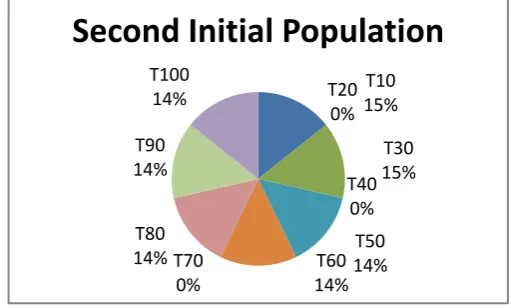
Fig 8:
Second Initial Population Analysis
One set data item = {P1, P2, P3, P4, P5, and P6}.Two set data item = {{P1,P2},{P2,P3},{P1,P3},{P2,P3}, {P1,P4},{P2,P4},{P1,P5},{P2,P5},{P1,P6},{P2,P6}and {P3,P6}}.
Three set data item= {{P1, P2, P3}, {P1, P2, P4}, {P1, P2, P5} and {P1, P2,P6}.
This genetic algorithm based approach needs only one datasets scan. It generates less number of candidates or offspring and not requires level by level candidate generation as traditional approaches. This is good approach to get maximal itemsets. It is easy to implement as parallel process
T10
15%
T20
0%
T30
15%
T40
0%
T50
14%
T60
14%
T70
0%
T80
14%
T90
14%
T100
14%
to get frequent itemsets. In this case each pair of chromosome can run on individual processor and perform logical AND operations. in next pass find only survival offspring and repeat same process to get higher size offspring. Further Generate the association rules form the frequent item set. Optimization of these rules using genetic algorithms can find best association rules.
5.
CONCLUSION
Now a days, large number of users are using social networking services and lots of social networking service providers are available to provide services at free of cost. When click on the social network that means all record maintain by the social network server. Social network server analyzes all record in the form of weblog. In this paper proposed an efficient algorithm and framework for finding strong visitor patterns from weblog. It also applied a genetic approach for optimizing those patterns. The proposed algorithm is useful in real life for different perspectives. It predicts the diseases based on the previous medical transactions. It predicts the trends for future based of sales transactions also it may be used by the business peoples for improving their business in e-commerce. It is also helpful for multidimensional association rules mining from relational databases. The frequent itemset are useful for advertisement management, tourist guidance, and product value analysis. This is also useful for gene prediction based on genetic optimization approach.
6.
ACKNOWLEDGMENTS
Our thanks to the anonymous reviewers and the authors of references.
7.
REFERENCES
[1] Chu H., Deng D. and Park J. 2011. Live Data Mining Concerning Social Networking Forensics Based on a Facebook Session Through Aggregation of Social Data, IEEE Journal On Selected Areas In Communications, Vol. 29, No. 7.
[2] Bakariya B., Thakur G. 2014. User Identification Framework in Social Network Services Environment, Informatica Economică vol. 18, no. 2, pp 15-23.
[3] Yuan M., Chen L., Yu P. and Yu T. 2013. Protecting Sensitive Labels in Social Network Data Anonymization, IEEE Transactions on Knowledge and Data Engineering, VOL. 25, NO. 3.
[4] Hajian B. and White T. 2011. Modelling In-fluence in a Social Network: Metrics and Evaluation, IEEE International Confer-ence on Privacy, Security, Risk, and Trust, IEEE International Conference on Social Computing, 2011.
[5]
[8] Jang B. and Yoon J. 2018. Characteristics Analysis Of Data From News And Social Network Services, IEEE Access.
[9] Ha T. and Hoang D. 2017. An assistive healthcare platform for both social and service networking for engaging elderly people, 23rd Asia-Pacific Conference on Communications (APCC).
[10] Rathorea S., Sangaiahb A. and Parka J. 2017. A novel framework for internet of knowledge protection in social networking services, Journal of Computational Science, pp.55–65.
[11] Bahri L., Carminati B. and Ferrari E. 2018. Decentralized privacy preserving services for Online Social Networks, Online Social Networks and Media, Vol.6, pp. 18–25.
[12] Man K., Tang K., and Kwong S. 1996. Genetic Algorithms: Concepts and Applications, IEEE TRANSACTIONS ON INDUSTRIAL ELECTRONICS, VOL. 43, NO. 5.
[13] Bakariya B., Thakur G. 2017. Pattern Mining Approach for Social Network Service, National Academy Science Letters, Springer, Volume 40, Issue 3, pp 183–187, June 2017.
[14] Bakariya B., Thakur G. 2015. An Efficient Algorithm for Extracting High Utility Itemsets from Web Log Data,The Institution of Electronics and Telecommunication Engineers (IETE) Technical Review, Volume-32, Issue-02, March- 2015, Pages 151-160.
[15] Bakariya B., Chaturvedi K., Singh KP and Thakur GS. 2016. Efficient Approach for Mining Top-k Strong Patterns in Social Network Service, 5th International Conference on Eco-friendly Computing and Communication Systems (ICECCS-2016) Dec. 8-9, IEEE, MANIT Bhopal.
[16] Chaturvedi K., Patel R. and DK. 2015. Fuzzy C-Means based Inference Mechanism for Association Rule Mining: A Clinical Data Mining Approach,INTERNATIONAL JOURNAL OF
ADVANCED COMPUTER SCIENCE AND
APPLICATIONS, Volume 6, Issue 6, Pages 103-110, 2015.
[17] Bakariya B. and Thakur G.S. 2016. Mining Rare Itemsets from Weblog Data, National Academy Science Letters, Springer, Volume-39, Issue-05, pp 359–363.
Transactions on Knowledge and Data Engineering, Volume: 16 Issue: 9.
[22] Bin W. and Zhijing L. 2003. Web mining research,Computational Intelligence and Multimedia Applications, 2003. ICCIMA.
[23] Singh A., Sharma D. and Pathak A. 2013, Web Usage Mining: A Concise Survey on Tools and Applications.
International Journal of Computer Applications, Vol. 74, Issue 1, pp.1-7.