EFFECT OF AN EDUCATIONAL PROGRAM ON NURSES’ PERCEPTION AND ATTITUDES
*, 1
Ayat Saif-elyazal Abd-elraof Oka
4
Dr. Shereen Mohammed Abo
1
Assistant Lecturer of Psychiatric Nursing,
2Professor of Psychiatric Nursing
3
Professor of Neuropsychiatry
4Lecturer of Psychiatric Nursing
ARTICLE INFO ABSTRACT
Background:
many people may be un mental illness in provide quality serv
Objective:
nurses' perception and attitudes Subjects and Methods: The study was carr nurses working in Tanta Mental Health Hospital (7 I: A structured interview que
Opinion about general
restrictiveness, pessimistic (1) and (2) (pre developed in order to illness.
Opinions about Mental applied on all the study subjects the program. The
Results:
pre intervention assessment whic educational program on nurses, it was found that nurse increased slightly immediately a whole, the total mean sc the educational program
Recommendations:
implications for the educati patients are treated with training that in commitment to
Copyright © 2015 Ayat Saif-elyazal Abd-elraof Oka. This
unrestricted use, distribution, and reproduction in any medium, provided the original work is properly cited.
INTRODUCTION
Mental illness affects many people around the world. Mental illness unlike other chronic physical illnesses like heart disease and hypertension is associated with a number of misunderstandings and myths. Due to misunderstanding and myths surrounding mental illness, mentally ill peopl sometimes stigmatized and may be labeled in stereotypical names such as madman, manics, and psycho
*Corresponding author:AyatSaif-elyazalAbd-elraof Oka
Faculty of Nursing- Tanta University, Egypt.
ISSN: 0975-833X
Vol.
Article History:
Received 25th December, 2014 Received in revised form 05th January, 2015 Accepted 19th January, 2015 Published online 28th February, 2015
Key words:
Attitude, Perception, Knowledge, Mental Illness.
RESEARCH ARTICLE
EFFECT OF AN EDUCATIONAL PROGRAM ON NURSES’ PERCEPTION AND ATTITUDES
TOWARD MENTAL ILLNESS
elraof Oka,
2Dr. Nahed Ahmed Morsy,
3Dr. HossamEldeenElsawy and
Dr. Shereen Mohammed Abo-Elyazeed
Assistant Lecturer of Psychiatric Nursing, Tanta University, Egypt
Professor of Psychiatric Nursing, Faculty of Nursing, Tanta University, Egypt
Professor of Neuropsychiatry, Faculty of Medicine, Tanta University, Egypt
Lecturer of Psychiatric Nursing, Faculty of Nursing-Tanta University
ABSTRACT
Background: Although recent advances in psychiatry have increased our understanding of many people may be unaware about mental illness and its treatment. Several studies reveal poor kno mental illness in nurses and stigmatizing attitudes toward people with mental illness which is
provide quality service to mental ill people. Mental health problems are of serious concern across the world.
Objective: The aim of the study was to measure the effectiveness of an
rses' perception and attitudes toward mental illness. The study followed a quasi experimental study design. Subjects and Methods: The study was carried out at Tanta Mental Health Hospital
nurses working in Tanta Mental Health Hospital (71 nurses). Two tools were used to colle
I: A structured interview questionnaire sheet that assesses nurses' perception toward mental illness. Opinion about Mental Illness in the Chinese Community (OMICC) scale by (Ng and Chan, 2000). It
ral attitude to mental illness. This scale has six domains: benevolence, separatism, stereotyping restrictiveness, pessimistic prediction, and stigmatization. Each nurse was interviewed individually by
(1) and (2) (pre-test) to assess the nurses' perception and attitudes toward mental illness, the pr developed in order to provide the nurses with knowledge to enhance their perceptio
illness. At the end of the program implementation, the nurses' perception questio Opinions about Mental Illness in the Chinese Community (OMICC) (Ng an
applied on all the study subjects (post- test 1) and after three months (post the program. The overall data collection took about one year.
Results: The study revealed that the majority of the studied nurses had pre intervention assessment which significantly improved after intervention whi
educational program on perception change of the nurses. Regarding attitude about mental illness of
nurses, it was found that nurses had moderately good score of attitude in pre intervention assessment which increased slightly immediately post intervention, but significantly increased in three months post
a whole, the total mean scores of attitude significantly improved in three months post intervention educational program was more effective on perception and attitude change of the nurses.
Recommendations: Knowing the attitudes of this fundamental group of mental health implications for the educational preparation and organized educational programs of al patients are treated with dignity and respect in a therapeutically effective and ethically sound training that includes greater use of teaching strategies that challenge beliefs and assumptio
mmitment to positive attitude and effective mental health practice.
This is an open access article distributed under the Creative Commons Att use, distribution, and reproduction in any medium, provided the original work is properly cited.
people around the world. Mental illness unlike other chronic physical illnesses like heart disease and hypertension is associated with a number of misunderstandings and myths. Due to misunderstanding and myths surrounding mental illness, mentally ill people are sometimes stigmatized and may be labeled in stereotypical
(WHO, 2001).
elraof Oka,
The public, including many nurses,
related to the person own failings, such as weakness of character and morals, laziness, and lack of discipline and self control. These beliefs cause discrimination leading to adverse effects on employment, income, and housing an
esteem and self-concept (Markowitz, 1998
years, programs aiming to de
advocated for medical rather than psychological explanations of mental illness. Biological and genetic factors have promoted as underlying causes. Current evidence however disputes the assumption that this information will result in more positive attitudes toward mental illness. For instance,
International Journal of Current Research
Vol. 7, Issue, 02, pp.12835-12842, February, 2015
INTERNATIONAL
EFFECT OF AN EDUCATIONAL PROGRAM ON NURSES’ PERCEPTION AND ATTITUDES
HossamEldeenElsawy and
Tanta University, Egypt
Tanta University, Egypt
Tanta University, Egypt
Tanta University,
increased our understanding of psychiatric disorders, its treatment. Several studies reveal poor knowledge about e with mental illness which is known hindrance to health problems are of serious concern across the world. easure the effectiveness of an educational program on the psychiatric
The study followed a quasi experimental study design. ied out at Tanta Mental Health Hospital. The study Subjects included all
were used to collect the study data. Tool ception toward mental illness. Tool II: the scale by (Ng and Chan, 2000). It measures the This scale has six domains: benevolence, separatism, stereotyping, as interviewed individually by using Tool attitudes toward mental illness, the program was provide the nurses with knowledge to enhance their perception and attitude toward mental nurses' perception questionnaire sheet, (tool I) and Illness in the Chinese Community (OMICC) (Ng and Chan, 2000) scale, (tool II) were
re-months (post- test 2), to evaluate the effectiveness of
that the majority of the studied nurses had poor perception about mental illness in intervention which indicates the effectiveness of titude about mental illness of the studied attitude in pre intervention assessment which increased in three months post intervention. As three months post intervention. In conclusion, was more effective on perception and attitude change of the nurses.
group of mental health professionals has educational programs of all nurses, to ensure that effective and ethically sound environment. Nurses' strategies that challenge beliefs and assumptions and promote a
is an open access article distributed under the Creative Commons Attribution License, which permits
The public, including many nurses, believe that mental illness related to the person own failings, such as weakness of laziness, and lack of discipline and self-control. These beliefs cause discrimination leading to adverse effects on employment, income, and housing and in effect,
self-Markowitz, 1998). For the past fifty
years, programs aiming to de-stigmatize mental illness have advocated for medical rather than psychological explanations of mental illness. Biological and genetic factors have been promoted as underlying causes. Current evidence however disputes the assumption that this information will result in more positive attitudes toward mental illness. For instance,
Read and Harre found that, genetic and biological causal beliefs were related to more negative attitudes toward those with mental illness (Readand Harre, 2001). Across the world, people with mental health problems, mental health services, mental health professionals and even the concept of mental health receive negative publicity and are stigmatized in public perceptions, despite growing evidence of the importance of mental health for economic, social and human capital (Ganesh, 2011). For mental health care providers, stigmatization and the negative perception of mental health care effectively operate as barriers for them to pursue a career in mental health care and prevent large group of persons affected by a mental disorder from receiving the care they need (WHO 2001).
Stigma remains a powerful negative attribute in all social relations. It is considered a result of three related problems: a lack of knowledge (ignorance), negative attitudes (prejudice), and avoidance behaviors (discrimination) (Ganesh, 2011). So, the stigma towards people with mental illness by health care providers results in disparities in access, treatment, and outcomes. Nurse can have a significant impact on decreasing or contributing to the multiple health care disparities experienced by mental health patients. Therefore, nurses need to be self-aware of their own stigma in order to avoid discrimination against their patients through inappropriate distancing, inadequate teaching, or other nursing actions based on fear. Fear is a major cause of discrimination and stigma (Scheff, 1986). So, lack of knowledge and skills to the nurses determine the nurses' perceptions of mentally ill patient. Nurses feel that if she has psychiatric or mental health nursing knowledge and skills, she will have a positive perception of the patient
(Manvundla, 2000). Attitudes influence both professional and
personal behavior. In particular, stigma and discrimination associated with mental illness and expressed by mental health professionals as well as the general public, result in the under use of mental health services (Staurt and Florez, 2001). Also, negative attitudes are revealed by mental health professionals deprive victims of human dignity and prevent social participation (Tay et al., 2004). So, contact with individuals who have mental illnesses, and education that replaces myth with fact, can decrease stigmatization and positively affect attitudes (Emrick and Thompson, 2003; Halter, 2004)
Therefore, mental illness is poorly understood by general public, including nurses. Such poor knowledge with negative attitude threatens the effectiveness of patient care and rehabilitation. This poor knowledge, inappropriate perception about mental illness and negative attitude towards the mentally ill can inhibit the decision to seek help and provide proper holistic care (Brich and Lavender, 2005). The minimal knowledge about mental illness suggests the need for strong emphasis on nurses' education to decrease mental health literacy, increase awareness, and positive attitude of nurses towards mental illness. Better knowledge is often reported to result in improved attitudes towards people with mental illness and a belief that mental illnesses are treatable; can encourage early treatment seeking and promote better outcomes (Wolf
et al., 1996). Thus, it's urgent to develop strategies and educational programs for the nurses in the community to provide them with adequate and proper knowledge that foster the positive attitude toward mental illness.
Aims of the study
The aims of the study are to
1 Assess the psychiatric nurses' perception and attitudes toward mental illness.
2 Measure the effectiveness of an educational program on the psychiatric nurses' perception and attitudes toward mental illness.
A research hypoth is
The educational program will have positive effects on nurses' perception and attitude toward mental illness.
MATERIALS AND METHODS
Research design
The present study follows a quasi-experimental study design.
Setting
The study was carried out at
Tanta Mental Health Hospital, this hospital is under the supervision and direction of ministry of health with a capacity of 80 beds and provides health care services to Gharabya, Menofia and Kafrelsheikh governorates population.
Subjects
The study Subjects included all nurses working in Tanta Mental Health Hospital (71 nurses). Numbers of nurses obviously have been increased due to increase in the participation rate of nurses.
Tools
Two tools were used to collect the study data.
Tool (1)
A structured interview questionnaire sheet that assesses nurses' perception toward mental illness: - It will include the following two parts
Part (1)
Socio-demographic and general characteristics of nurses e.g. (age, sex, marital status, residence, educational level, years of experience in the psychiatric field, and job).
Part (2)
A structured questionnaire sheet that assess nurses' perception towards mental illness. It was developed by the researcher based on reviewing the relevant literature. It aimed to measure the nurses' perception.
It includes the following headings
Knowledge about mental illness.
Causes of mental illness.
Stigma of mental illness and patients’ rights.
Management of the psychiatric patient.
The role of experience in Management of the psychiatric patient.
The Community mental health services the psychiatric patient.
This questionnaire included 65 statements; each statement was rated on a 3 point likert scale ranged from 1-3 points as following: Agree=3 point, Uncertain=2 point and Disagree =1point).
The total scores of perception questions ranged from 87-137. It was categorized into three levels as the following
-Poor (scored from 87-103) -Fair (scored from 104-120) -Good (scored from 121-137)
Tool (2)
The Opinion about Mental Illness in the Chinese Community (OMICC) scale by (Ng and Chan, 2000) which was a modified version of Community Attitude scale for Mental Illness. It measures the general attitude to mental illness. This scale has six domains: benevolence, separatism, stereotyping, restrictiveness, pessimistic prediction, and stigmatization.
Benevolence described as “a paternalistic, sympathetic view, based on humanistic and religious principles”. This attitude arises from a moral point of view, a humanitarian, religious kindliness towards the patients. This factor was intended to measure the paternalistic and sympathetic views of the nurses.
Separatism described as treating people with mental illness away from their community and in institutions. This factor was intended to measure the nurses’ attitude of discrimination.
Stereotyping described selective perceptions that place people to obscure differences within groups. It is the collectively held beliefs about the members of social groups which lead to the strong impressions and expectations of individuals. This factor was intended to measure the degree of nurses‟ maintenance of social distance towards the mentally ill.
Restrictiveness reflects the restriction of the mentally ill persons‟ freedom of social contact and activities during treatment and hospitalization, as well as upon discharge, in order to protect their families and society at large from them. This factor was intended to measure viewing the mentally ill as a threat to society.
Pessimistic prediction is the negative evaluative component towards the mentally ill. This factor was intended to measure the level of prejudice towards mental illness.
Stigmatization is the feeling of disgrace or discredit, which sets a person apart from others. This factor was
intended to measure the discriminatory behavior of the nurses towards mental illness.
The scale consists of 34 item self report surveys that use a 5-point Likert scale ranging from strongly disagrees to strongly agree. The average scores for each item range from 1.0 to 5.0. Those items with a score of 1 to 3 were considered to have an acceptable level of positive attitude towards mental illness for the factors Separatism, Stereotyping, Restrictiveness, Pessimistic prediction and Stigmatization. Those items with higher score (3 to 5) for the factor Benevolence was considered to have an acceptable level of positive attitude towards mental illness as it is a reverse score of (positively worded) items. High scores on benevolence and lower scores on the other five legends indicate a better and healthy attitude, whereas the reverse indicates an unhealthy attitude. Respondents were given the choice of five response categories to tick based on their feelings from totally disagree to totally agree (totally disagree = 1, disagree = 2, sometimes agree = 3, agree = 4, totally agree = 5). Accordingly, Items belonging to one concept or factor were grouped together and given a conceptual heading during the questionnaire development.
The total scores of attitude questions ranged from 66-138. It was categorized into three levels as the following
-Bad (scored from 66-89) -Moderate (scored from 90-113) -Good (scored from 114-138)
Method
Official permission to conduct the study was obtained from Tanta Mental Health Hospital affiliated to Ministry of health.
Tool (I) was developed by researcher after a review of the related literature and Arabic translation of the tool II was done and tested for its translation.
The study tools were tested for content validity by a jury composed of nine experts in the psychiatric field (medicine and nursing).
The study tools were tested and re-tested for reliability.
Before embarking in the actual study:
A pilot study: was carried out on (10) nurses, after taking a consent, to ascertain the clarity and applicability of the study tools and to identify obstacles that may be faced during data collection; these nurses will be excluded later from the study subjects. After its implementation and according to its results a necessary modification was done.
Actual study
Part (1): Assessment phase
Ethical consideration
Throughout the study process the following ethical points were considered:
Explanation of the purpose of the study and emphasizing the right to withdraw at any point during the study.
Assuring the nurses about their privacy and confidentiality of the obtained data.
Orienting the study subjects about date, time and place of data collection.
The collected data were used only for the purpose of research.
Each nurse was interviewed individually by using Tool (1) and (2) (pre-test) to assess the nurses' perception and attitudes toward mental illness and asked them to fill it in the presence of the researcher. The average time needed to complete the tools ranged between 20 to 30 minutes, scheduled as three days per week. The pre-test took about three months.
Part (2): Intervention phase
-Based on the obtained results from study subjects and a review of the related literature, the program was developed in order to provide the nurses with knowledge to enhance their perception and attitude toward mental illness.
-The researcher divided the study subjects into two five subgroups, (each sub group was composed of 14 nurses). -The program was implemented in the form of sessions which took about an hour and half, each subgroup was attended 15 sessions, scheduled as three sessions per week. The program took about six months.
The educational program included the following
Preparing for sessions started with creating the suitable environmental condition for conducting the program at Tanta Mental Health Hospital. The contents of sessions were divided as follows:
The first session
An introductory session that emphasized acquaintance between the group and the researcher as well as explanation of the program's purpose and sequence.
Concepts of mental health and mental illness
Causes of mental illness.
Session 2 and 3: Psychotic symptoms of mental illness.
Session 4: Stigma, myths, misconceptions, and attitudes
towards mental illness.
Session 5: Legal and ethical aspects of the psychiatric
patients.
Session 6: Principles of psychiatric nursing.
Session 7: Self-awareness.
Session 8and 9: Therapeutic communication.
Session 10: Burden of mental illness and culture
considerations on the psychiatric patients.
Session 11: Coping strategies.
Session 12: psychological adaptation.
Session 13: Stress management.
Session 14: community mental health services
Finally, session 15: Revision the overall contents of the
program.
Methods of teaching will be consisted of
Lectures.
Small group discussion.
Posters, videos, and illustrating pictures.
Role playing.
Books.
Part (3): Evaluation phase
At the end of the program implementation, the nurses' perception questionnaire sheet, (tool I) and Opinions about Mental Illness in the Chinese Community (OMICC) (Ng and Chan, 2000) scale, (toolII) were re-applied on all the study subjects (post- test 1) and after three months (post- test 2), to evaluate the effectiveness of the program. The overall data collection took about one year.
RESULTS
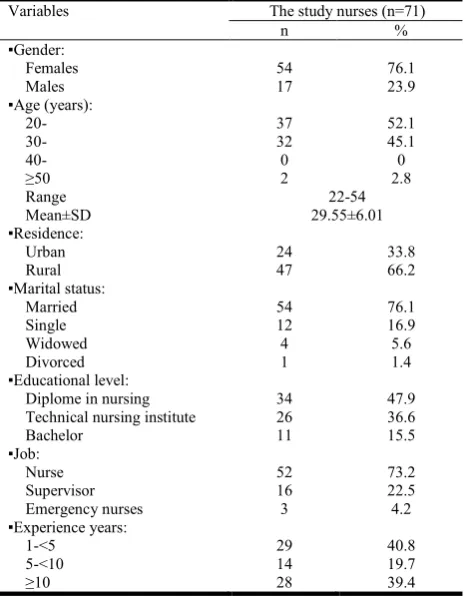
[image:4.595.318.552.411.710.2]Table 1 Illustrates the distribution of the studied nurses according to their socio-demographic characteristics. It was found that 24% of nurses were male, and 76% were females. The highest percentage of the studied nurses had age range between 20 to <30 years represent 52.1%, those who had age range between 30 to<40 years represent 45.1% and who had an age ≥ 50 represent 2.8%
Table 1. Socio-demographic and general characteristics of the study nurses (n=71)
Variables The study nurses (n=71)
n %
▪Gender:
Females 54 76.1
Males 17 23.9
▪Age (years):
20- 37 52.1
30- 32 45.1
40- 0 0
≥50 2 2.8
Range 22-54
Mean±SD 29.55±6.01
▪Residence:
Urban 24 33.8
Rural 47 66.2
▪Marital status:
Married 54 76.1
Single 12 16.9
Widowed 4 5.6
Divorced 1 1.4
▪Educational level:
Diplome in nursing 34 47.9
Technical nursing institute 26 36.6
Bachelor 11 15.5
▪Job:
Nurse 52 73.2
Supervisor 16 22.5
Emergency nurses 3 4.2
▪Experience years:
1-<5 29 40.8
5-<10 14 19.7
≥10 28 39.4
As regards the residence of the studied nurses, denoting that 66.2% of them living in rural area, while 33.8 % were from urban area. Concerning the level of education, it appears from this table that 47.9% of the studied nurses had diploma in nursing, 36.6 % of them had technical nursing institute education, and 15.5% had university and higher education. It was also found that 76.1% of the studied nurses were married, while 23.9% were unmarried. As for occupation, it was observed that the majority of the study groups (77.4%) were nurses, while only 22.5% were nursing supervisors.
Table 2 It was found that 46.5, 39.4% of the studied nurses had fair perception after intervention (post-test I and II respectively) compared with 8.5% before intervention, while only 53.5%, 60.6% of them had poor perception after intervention (post-test I and II respectively) compared with 91.5% before intervention. The difference, regarding
perception, was statistically significant (χ2 = 26.957, P < 0.05).
Table 3The table shows total attitude about mental illness of the studied nurses, it was found the nurses had good attitude increased immediately post intervention (19.7), but decreased in three months post intervention but still more than scores of attitude (7%) before intervention, while only 9.9% of them had poor attitude after intervention and none of them had poor attitude in three months post intervention compared to 25.4% before intervention.
The difference, regarding attitude, was statistically significant (χ2 = 25.816, P < 0.05).
[image:5.595.64.520.211.273.2]Table 4 The table describes the relation between main perception items about mental illness before and after intervention. It was observed that knowledge about mental Table 2. Total perception about mental illness among the studied nurses pre, immediately post and 3 months post-intervention (n=71)
Total perception about mental health
The studied nurses (n=71) Pre-intervention Immediately
post-intervention
3 months post-intervention
χ2 P
NO % n % NO %
▪poor 65 91.5 38 53.5 43 60.6 26.957 0.0001*
▪fair 6 8.5 33 46.5 28 39.4
[image:5.595.40.539.321.408.2]*Significant (P<0.05)
Table 3.Total attitude about mental illness of the studied nurses among the studied nurses pre, immediately post and 3 months post-intervention (n=71)
Total attitude about mental health The studied nurses (n=71) Pre-intervention
(n=71)
Immediately post-intervention (n=71)
3 months post-intervention (n=71)
χ2 P
No % No % No %
▪poor attitude (66-89) 18 25.4 7 9.9 0 0 25.816 0.0001*
▪fair attitude (90-113)
48 67.6 50 70.4 61 85.9
▪good attitude (114-138)
5 7.0 14 19.7 10 14.1
[image:5.595.41.557.450.670.2]*Significant (P<0.05)
Table 4. Mean scores of main perception items about mental illness among the studied nurses (n=71)
Perception main items about mental health
The studied nurses (n=71) Pre-intervention (I) Immediately
post-intervention (II)
3 months post-intervention (III)
F-value Scheffe test
Range Mean±SD
Range Mean±SD
Range Mean±SD ●Perception about mental illness 18-27
20.29±2.33
19-31 23.20±2.60
18-29 21.04±2.36
27.186 0.0001*
I vs II, P=0.0001* I vs III, 0.191 II vs III, P=0.0001* ●Causes of mental illness 20-35
24.75±3.55
21-43 28.11±4.85
20-43 25.52±5.04
10.771 0.0001*
I vs II, P=0.0001* I vs III, 0.595 II vs III, P=0.003* ● Stigma and rights of the psychiatric
patient
17-27 23.66±1.76
23-27 25.91±1.18
18-27 25.15±1.59
39.937 0.0001*
I vs II, P=0.0001* I vs III, 0.0001* II vs III, P=0.014* ● Management of people with mental
illness
20-32 24.86±2.37
22-36 27.68±3.16
20-33 25.83±2.66
19.221 0.0001*
I vs II, P=0.0001* I vs III, 0.112 II vs III, P=0.001* ● Role of experience in management of
psychiatric patient
2-6 3.60±0.98
2-6 4.06±1.04
2-6 3.98±1.14
3.750 0.025*
I vs II, P=0.041* I vs III, 0.102 II vs III, P=0.924 ● Mental health services for psychiatric
patients
10-17 11.93±1.80
12-19 14.86±2.04
10-17 12.69±1.94
44.037 0.0001*
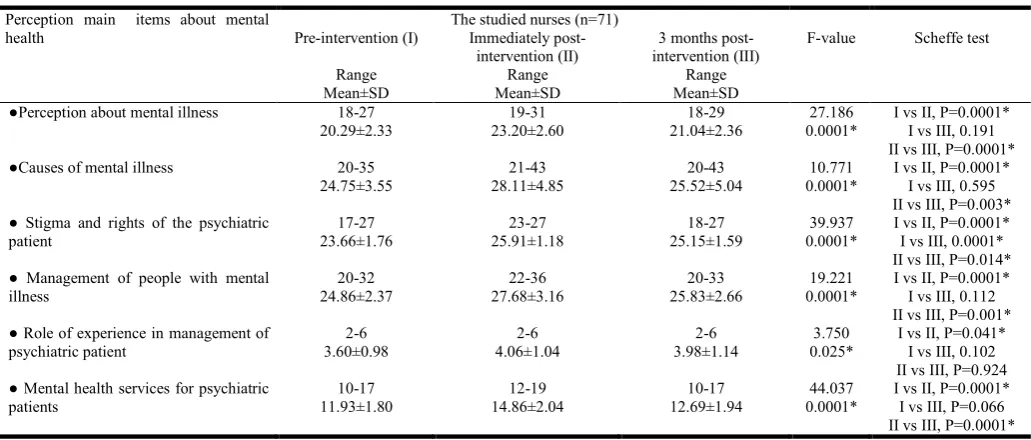
illness was apparently increased after intervention. They had 23.2 compared to 20.2 before intervention. The difference, regarding knowledge about mental illness, was statistically significant (P < 0.05). It was also observed that causes of mental illness were at a higher level after intervention. They had 28.1 compared to 24.7 before intervention. The difference, regarding causes of mental illness, was statistically significant (P < 0.05). Regarding stigma and rights of the psychiatric patients, it was found that the scores of stigma and rights of the psychiatric patients were improved after intervention. They had 25.9 compared with 23.6 before intervention. The difference, regarding stigma and rights of the psychiatric patients, was statistically significant (P < 0.05).
Regarding scores of management of people with mental illness was apparently increased after intervention. They had 27.6 compared with 24.8 before intervention. The difference, regarding management of people with mental illness, was statistically significant (P < 0.05). Regarding the role of experience in management of the psychiatric patient, was not largely increased after intervention, they had 4.06 compared with 3.6 after intervention. The difference, regarding the role of experience in management of the psychiatric patients, was statistically significant (P < 0.05). Concerning scores of mental health services were increased after intervention; they had 14.8 compared with 11.9 after intervention. The difference, regarding mental health services, was statistically significant (P < 0.05).
As a whole, the total mean scores of perception significantly improved immediately post intervention (123.8) compared with (109.1) pre intervention which decreased in three months post intervention but still high. The difference between mean scores of perception were statistically significant (P <.05).
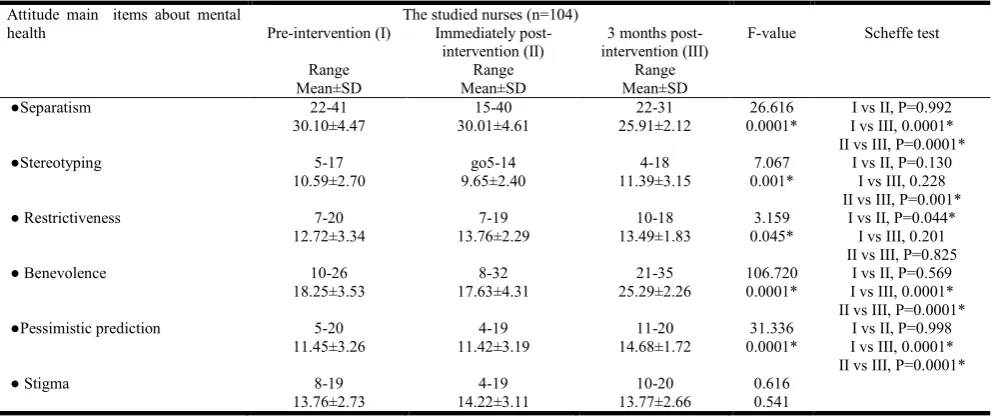
Table 6The table show mean scores of main attitude items about mental illness of the studied nurses .it was found that mean score of separatism decreased in three months post intervention (25.9), while mean scores of restrictiveness increased in immediately post intervention (13.7) and in three
months post intervention (13.4). Benevolence and pessimistic prediction apparently increased in three months post intervention (25.2, 14.6 respectively). On the other hand stigma mean scores decreased in three months post intervention (13.7).
As a whole, the total mean scores of attitude significantly improved in three months post intervention (104.5) compared with (96.7) post intervention and (96.8) pre intervention .The difference between mean scores of attitude were statistically significant (P.(05.>
DISCUSSION
Nurses are the group of professionals responsible for the majority of direct care for mentally ill patients (Baker, 2005).Studies examining the attitudes of psychiatric and mental health nurses only are rare and when they are featured it has been impossible to determine if the observed attitudes were negative or positive (Munroand Baker,2007).
The present study revealed that the majority of the studied nurses had poor perception about mental illness in pre intervention assessment which significantly improved after intervention which indicates the effectiveness of educational program on perception change of the nurses. These findings are consistent with the findings of a study by Mia Seo et al. (2010)
on effectiveness of an education program to reduce negative attitudes toward persons with mental illness using online media, the mean Score of knowledge about mental illness tended to increase in the experimental group, during the pretest, posttest I and posttest II.
[image:6.595.50.548.232.440.2]These results are also consistent with the results of a prior study by Wood and Wahl (2006), Participants’ knowledge reportedly increased after the “In Our Own Voice” mental health education program was provided to undergraduate nursing students. This study concludes that, although education Table 6. Mean scores of main attitude items about mental illness of the studied nurses among the studied nurses (n=71)
Attitude main items about mental health
The studied nurses (n=104) Pre-intervention (I) Immediately
post-intervention (II)
3 months post-intervention (III)
F-value Scheffe test
Range Mean±SD
Range Mean±SD
Range Mean±SD
●Separatism 22-41
30.10±4.47
15-40 30.01±4.61
22-31 25.91±2.12
26.616 0.0001*
I vs II, P=0.992 I vs III, 0.0001* II vs III, P=0.0001*
●Stereotyping 5-17
10.59±2.70
go5-14 9.65±2.40
4-18 11.39±3.15
7.067 0.001*
I vs II, P=0.130 I vs III, 0.228 II vs III, P=0.001*
● Restrictiveness 7-20
12.72±3.34
7-19 13.76±2.29
10-18 13.49±1.83
3.159 0.045*
I vs II, P=0.044* I vs III, 0.201 II vs III, P=0.825
● Benevolence 10-26
18.25±3.53
8-32 17.63±4.31
21-35 25.29±2.26
106.720 0.0001*
I vs II, P=0.569 I vs III, 0.0001* II vs III, P=0.0001* ●Pessimistic prediction 5-20
11.45±3.26
4-19 11.42±3.19
11-20 14.68±1.72
31.336 0.0001*
I vs II, P=0.998 I vs III, 0.0001* II vs III, P=0.0001*
● Stigma 8-19
13.76±2.73
4-19 14.22±3.11
10-20 13.77±2.66
0.616 0.541 *Significant (P<0.05)
is an important strategy in increasing knowledge regarding mental illness, not all forms of education achieves this goal. Knowledge is an important factor in the development of positive attitudes. In the same direction, a previous study by
Granesh (2011) revealed that a substantial proportion of the
community, including nurses, had poor knowledge regarding mental illness and only few had average knowledge. More than half of the subjects could mention common mental disorders which reflect the increase prevalence of mental illness in community and influence of media and other sources. Most of respondents had poor knowledge regarding causes of mental illness and believed that mental illness could result from punishment from God. More than half of the respondents had good knowledge on signs and symptoms of mental illness. Deficiency of knowledge about treatment and prognosis of mental illness is persistent in most of the subjects.
On the contrary, these finding are somewhat different from a study done by Shrestha (2013), on Knowledge and attitude about mental illness among nursing students. The participants in this study were second year nursing students who took the psychiatric / mental health course before posting in mental hospitals. This study revealed that there was overall adequate knowledge and by large a positive attitude towards mentally ill people among the nursing students. The possible explanation for the difference in the results was lack of education and information on nature and causes of mental illness among nurses in our community.
Perception of etiology of mental illness, in the present study, it was observed that causes' of mental illness were at a lower level before intervention but significantly improved after intervention. On the contrary, in the previous study, the vast majority held fairly good knowledge about it. Most of the respondents felt that God’s curse, which craft or evil spirit does not cause mental illness. Such information might have been acquired from training. Subjects’ belief in genetic heritability and biochemical disturbances in the brain indicated their better knowledge of the etiology of mental illness (Jorm, 2000). Regarding score of total attitude about mental illness of the studied nurses, in the present study, it was found that nurses had moderately good score of attitude in pre intervention which increased slightly immediately post intervention. Slight increase in good attitude due to: prejudice and negative attitudes toward people with mental illness are formed over long periods of time; thus, programs designed to change such attitudes need also to be applied for a long time and repeatedly. Even though there are limitations, this study has significance and importance regarding the use of education programs with nurses for changing negative attitudes.
This comes in agreement with a study by Yoshyo Mino et al.
in Japan (2001), on Effects of a one-hour educational program
on medical students’ attitudes to mental illness. A new 1-h educational program was developed to change attitudes towards mental illness, and was conducted on first-year medical students in order to investigate its effects on their attitudes towards mental illness, using a pre- and post-questionnaire study design. After the program, more students replied that they would accept former patients on relatively close social distance items. Favorable attitudinal changes were
observed in terms of ‘psychiatric services’, ‘human rights of the mentally ill’, ‘patients’ independence in social life’, and ‘cause and characteristics of mental illness’. These results suggest that attitudes towards mental illness could be changed favorably by this program. These results differ from a survey into student nurses' attitudes towards mental illness. This study examined the impacts of negative attitudes, stigma and discrimination on the lives of those with mental health problems and discusses the implications of this for nurse training. The survey concludes greater use of teaching strategies that challenge beliefs and assumptions and promote a commitment to multicultural mental health practice (YOSHIO,
2001).
In relation to main attitude items about mental illness of the studied nurses. It was found that separatism decreased in three months post intervention (means positive attitude), while restrictiveness increased in immediately post intervention and in three months post intervention (means negative attitude). Benevolence significantly increased which means positive attitude. Pessimistic prediction significantly increased in three months post intervention which means negative attitude. While, stigma mean scores not changed significantly. These findings agreed with a study by Mary Chambers et al. (2010) on nurses’ attitudes to mental illness; nurses were found to have positive attitudes to mental illness as measured on all four subscales. There was most positive on the benevolence subscale (the higher the score the more positive the attitude), indicating that they hold a sympathetic view of those experiencing mental health problems. Attitudes were least positive on the authoritarianism subscale, though not sufficiently to indicate that nurses reject the view that people with mental illness are inferior and require a coercive approach. Positive attitudes were associated with being female and having a senior position.
Formal education and experiences are important vehicles to change the attitudes towards individuals with mental illness. Previous researchers have shown that when participants are given accurate and enough information about mental illness, they have less negative attitude and less fear towards those individuals. Changing the negative attitude of nurses towards mental illness will affect the quality of the patient care.
From the present study one could conclude that
The present study revealed that the majority of the studied nurses had poor perception about mental illness in pre intervention assessment which significantly improved after intervention which indicates the effectiveness of educational program on perception change of the nurses.
Regarding attitude about mental illness of the studied nurses, it was found that nurses had moderately good score of attitude in pre intervention assessment which increased slightly immediately post intervention, but significantly increased in three months post intervention.
From the results of the present study one can recommend the following
preparation of all nurses, to ensure that patients are treated with dignity and respect in a therapeutically effective and ethically sound environment.
There is a need for research investigating if, and how, nurses’ attitudes to mental illness and people with mental health problems affect nursing practice and the quality of care they deliver to the mental ill patients.
REFERENCES
Baker, J. A. 2005. Nursing attitudes toward acute mental health care: a measurement tool development. Journal of
Advanced Nursing, 49(5):522 529.
Brich, S. and Lavender, T. 2005. The physical healthcare experiences of women with mental health problems: status versus stigma. Journal of Mental Health, 14(1): 61-72. Chambers M. et al. 2010. Nurses’ attitudes to mental illness: A
comparison of a sample of nurses from five European countries. International Journal of Nursing Studies, 47, 350–362
Emrick, T. and Thompson, G. 2003. Positive Attitude : An essential element for effective care for people with mental illness. Journal of Psychosocial Nursing and Mental
Health Services, 2003; 41(5): 18-25.
Ganesh K. 2011. Knowledge and attitude of mental illness among general public of southern India. National Journal
of Community Medicine, 2(1): 175-8.
Ganesh K. 2011. Knowledge of mental illness among the general public in south India. National Journal of
Community Medicine, 2(1) : 175-8.
Halter, M. 2004. Stigma and help seeking related to depression.
Journal of Psychosocial Nursing and Mental Health
Services, 42(2): 42-51.
Jorm, AF. 2000. Mental health literacy: public knowledge and beliefs about mental disorders. Br J Psychiatry, 177:396-401.
Manvundla T. 2000. Professional nurse perception of nursing mentally ill patient in general hospital setting. Journal of
Advanced Nursing, 32(6): 1569-78.
Markowitz, F E. 1998. The effect of stigma on the psychological wellbeing and life satisfaction of persons with mental illness. Journal of Health and Social
Behavior, 39(4): 335-347.
Mia Seo et al. 2010. Effectiveness of an education program to reduce negative attitudes toward persons with mental
illness using online media. Nursing Research Asian, 4 (2):90-101.
Munro, S. and Baker, J. A. 2007. Surveying the attitudes of acute mental health nurses. Journal of Psychiatric and
Mental Health Nursing, 14(2): 196202.
Ng, P. and Chan K. F. 2000. Sex differences in opinion towards mental illness of secondary school students in Hong Kong. International Journal of Social Psychiatry,
46(1) : 79-88.
Read J. and Harre N. 2001. The role of the biological and genetic causal beliefs in the stigmatization of mental patients. Journal of Mental Health, 10(2): 223-5.
Schafer, T. et al. 2011.Surveyinto student nurses' attitudes towards mental illness: Implications for nurse training. Nurse Education Today 31, 328–332
Scheff T. 1986. Being mentally ill: A sociological Theory. Chicago, IL : Aldine.
Shrestha, M. R. 2013. Knowledge and attitude about mental illness among nursing students .Psychiatrists’ Association of Nepal.2:36
Staurt, H. and Florez, J.2001. Community attitudes towards people with schizophrenia. Canadian Journal Psychiatry, 46: 245-52.
Tay, S., Ravendran, K. and Rousedeeen, M. 2004. Nurses attitude towards people with mental illness in psychiatric hospital in Singapore. Journal of Psychosocial Nursing
and Mental Health Services, 42(10): 40-7.
WHO, The world Health Report 2001. Mental Health: New Understanding, New Hope. World Health Organization, Geneva.
Wolf, G., Pather, S. and Leff, G. 1996. Public education for community care: A new approach. British Journal
Psychiatry, 168(1) : 441-7.
Wood, A. L.and Wahl, O. F. 2006. Evaluating the effectiveness of a consumer-provided mental health recovery education presentation. Psychiatric Rehabilitation Journal, 30, 46– 52.
World Health Organization, 2001. The world health report 2001-Mental Health " New understanding, new hope". Geneva: World Health Organization.
Yoshio M. et al. 2001. Effects of a one-hour educational program on medical students’ attitudes to mental illness.
Psychiatry and Clinical Neurosciences, 55, 501– 7