Structure
in Multivariate Extremes
Emma Siobhan Simpson,
M.Math.(Hons.), M.Res.
Submitted for the degree of Doctor of
Philosophy at Lancaster University.
The aim of this thesis is to present novel contributions in multivariate extreme value
analysis, with focus on extremal dependence properties. A set of random variables is
often categorized as being asymptotically dependent or asymptotically independent,
based on whether the largest values occur concurrently or separately across all
mem-bers of the set. However, there may be a more complicated structure to the extremal
dependence that is not fully described by this classification, with different subsets of
the variables potentially taking their largest values simultaneously while the others
are of smaller order. Knowledge of this detailed structure is essential, and aids
effi-cient statistical inference for rare event modelling.
We propose a new set of indices, based on a regular variation assumption, that
describe the extremal dependence structure, and present and compare a variety of
in-ferential approaches that can be used to determine the structure in practice. The first
approach involves truncation of the variables, while in the second we study the joint
tail behaviour when subsets of variables decay at different rates. We also consider
variables in terms of their radial-angular components, presenting one method based
on a partition of the angular simplex, alongside two soft-thresholding approaches
that incorporate the use of weights. The resulting estimated extremal dependence
structures can be used for dimension reduction, and aid the choice or construction of
appropriate extreme value models.
We also present an extensive analysis of the multivariate extremal dependence
properties of vine copulas. These models are constructed from a series of bivariate
copulas according to an underlying graphical structure, making them highly flexible
and useful in moderate or even high dimensions. We focus our study on the coefficient
of tail dependence, which we calculate for a variety of vine copula classes by applying
and extending an existing geometric approach involving gauge functions. We offer
new insights by presenting results for trivariate vine copulas constructed from
bivari-ate extreme value and inverted extreme value copulas. We also present new theory
for a class of higher dimensional vine copulas.
An approach for predicting precipitation extremes is presented, resulting from
participation in a challenge at the 2017 EVA conference. We propose using a Bayesian
hierarchical model with inference via Markov chain Monte Carlo methods and spatial
First and foremost, I want to say a massive thank you to my PhD supervisors, Jenny
Wadsworth and Jonathan Tawn. I couldn’t have asked for better guidance over the
last few years, and I’ve learnt so much from both of you. Thank you for your patience
and wisdom, and all the time you’ve given to helping me develop as a researcher.
You’ve really made the thesis-writing process a lot less daunting than it could have
been.
Thank you to Ingrid Hobæk Haff for your input on the vine copula work. It was
a pleasure to visit Oslo in the second year of my PhD and to have the opportunity to
work with you.
I gratefully acknowledge funding from EPSRC through the STOR-i centre for
doc-toral training. I count myself as extremely lucky to have done my PhD as part of
STOR-i. It’s a really wonderful environment full of supportive people and friends.
So thank you to everyone in the CDT, especially my cohort, who has inserted some
fun into the last few years of hard work. Tuesday mornings wouldn’t have been the
same without extremes (and spatial statistics) coffee; thank you to everyone who
con-tributed to the EVA paper, and provided interesting discussion (and snacks) over the
last few years.
A special thank you to Emily for being a wonderful desk neighbour and friend,
and for all those calming words over cups of tea; to Lucy for your friendship and
support since day one of the STOR-i internship; and to Kathryn, Emma and Chrissy
for helping me to switch-off and relax with some crochet from time to time! Outside
of STOR-i, I also want to thank Georgia, Jess and Tom for your years of friendship,
and many weekends of fun and laughter; they’re so often just what I need.
Thank you to my parents, Julia and Paul, for always encouraging curiosity and
learning. Five-year-old Emma dreamt of doing ‘lots of maths’ when she grew up,
and I think this thesis might count! That wouldn’t have happened without all your
support, for which I’m forever grateful. Also thank you to my sister Rebecca, for
always being there for me, and letting me follow you to Lancaster in the first place!
Last, but by no means least, Ollie, thank you for being there every step of the
way, to share the ups and downs of the last few years. I’m grateful to have had you
by my side through all of this, and massively appreciate your ability to always put a
smile on my face, even when life throws us challenges. I’m so lucky to be part of our
I declare that the work in this thesis has been done by myself and has not been
sub-mitted elsewhere for the award of any other degree.
A version of Chapter 3 has been submitted for publication as Simpson, E. S.,
Wadsworth J. L. and Tawn J. A. (2019). Determining the dependence structure of
multivariate extremes.
Chapter 6 is the result of a STOR-i collaboration for a competition at the 2017
conference on Extreme Value Analysis in Delft. It has been published as Barlow, A.
M., Rohrbeck, C., Sharkey, P., Shooter, R. and Simpson, E. S. (2018). A Bayesian
spatio-temporal model for precipitation extremes - STOR team contribution to the
EVA2017 challenge. Extremes, 21(3):431-439.
The word count for this thesis is approximately 68,000.
Emma S. Simpson
Abstract I
Acknowledgements III
Declaration V
Contents VI
List of Figures XI
List of Tables XVI
1 Introduction 1
1.1 Motivation . . . 1
1.2 Outline of thesis . . . 2
2 Literature Review 5 2.1 Introduction . . . 5
2.2 Univariate extreme value theory . . . 6
2.2.1 Overview . . . 6
2.2.2 Generalized extreme value distribution . . . 6
2.2.3 Generalized Pareto distribution . . . 8
2.3 Multivariate extreme value theory . . . 10
2.3.1 Defining extreme events . . . 10
2.3.2 Copula theory . . . 10
2.3.3 Componentwise maxima . . . 12
2.3.4 The linking between V and H . . . 14
2.3.5 Pickands’ dependence function . . . 15
2.3.6 Regular variation . . . 16
2.3.7 Modelling asymptotic dependence . . . 17
2.3.8 Extremal dependence structures . . . 19
2.3.9 Modelling asymptotic independence . . . 22
2.3.10 Calculating the coefficient of tail dependence from a density . 24 2.3.11 Conditional extreme value modelling . . . 28
2.4 Modelling extremes with underlying dependence structures . . . 31
2.5 Vine copulas . . . 32
2.5.1 Introduction . . . 32
2.5.2 Pair copula constructions . . . 33
2.5.3 Vine representations . . . 35
2.5.4 Tail behaviour of vine copulas . . . 37
3 Determining the Dependence Structure of Multivariate Extremes 39 3.1 Introduction . . . 39
3.2 Theoretical motivation . . . 43
3.2.1 Multivariate regular variation . . . 43
3.2.2 Hidden regular variation . . . 43
3.3 Methodology . . . 50
3.3.1 Introduction to methodology . . . 50
3.3.2 Method 1: δ = 0 . . . 51
3.3.3 Method 2: δ >0 . . . 54
3.4 Simulation study . . . 55
3.4.1 Overview and metrics . . . 55
3.4.3 Stability plots . . . 62
3.5 River flow data . . . 64
4 Radial-Angular Approaches to Determining Extremal Dependence Structures 69 4.1 Introduction . . . 69
4.2 Methodology . . . 72
4.2.1 Method 3: simplex partitioning . . . 72
4.2.2 Incorporating weights . . . 74
4.2.3 Method 4: weighted extension of the approach of Goix et al. (2016) . . . 75
4.2.4 Method 5: weighted extension of the regular variation approach 76 4.2.5 A proposed weighting . . . 77
4.3 Simulation study . . . 79
4.3.1 Max-mixture distribution . . . 79
4.3.2 Asymmetric logistic distribution . . . 82
4.4 Discussion . . . 85
5 An Investigation into the Tail Properties of Vine Copulas 86 5.1 Introduction . . . 86
5.2 Density-based calculation of ηC . . . 89
5.2.1 Geometric interpretation of ηC (Nolde, 2014) . . . 89
5.2.2 Numerical approximation of ηC . . . 90
5.2.3 Extension of Nolde (2014) when joint density not available . . 91
5.3 Vine copulas with inverted extreme value pair copula components . . 93
5.3.1 Overview . . . 93
5.3.2 Trivariate case . . . 93
5.4 Trivariate vine copulas with extreme value and inverted extreme value
pair copula components . . . 109
5.4.1 Overview . . . 109
5.4.2 Gauge functions for trivariate vines with extreme value and in-verted extreme value components . . . 109
5.4.3 η{1,2,3} and η{1,3} for vines with logistic and inverted logistic components . . . 116
5.5 Discussion . . . 121
6 A Bayesian Spatio-Temporal Model for Precipitation Extremes 124 6.1 Introduction . . . 124
6.2 Methodology . . . 127
6.2.1 Likelihood . . . 127
6.2.2 Prior model . . . 128
6.2.3 Threshold selection and estimation . . . 129
6.3 Results and discussion . . . 131
7 Discussion 134 7.1 Thesis summary . . . 134
7.2 Further work . . . 136
7.2.1 Overview . . . 136
7.2.2 Parameter estimation in Chapter 3 . . . 136
7.2.3 Redistribution of mass in Chapters 3 and 4 . . . 140
7.2.4 Conditional mixture model . . . 142
A Supplementary Material for Chapter 3 147 A.1 Calculation of τC(δ) for a bivariate extreme value distribution . . . . 147
A.2 Calculation of τC(δ) . . . 148
A.2.1 Overview . . . 148
A.2.3 Trivariate logistic distribution . . . 149
A.2.4 Trivariate distribution with extremal mass on one vertex and one edge . . . 151
A.2.5 Trivariate inverted logistic distribution . . . 153
A.2.6 Multivariate Gaussian distribution . . . 156
A.3 Simulation study . . . 158
A.3.1 Estimation of τC(δ) in Method 2 . . . 158
A.3.2 Area under the receiver operating characteristic curve results for the max-mixture distribution . . . 160
A.3.3 Asymmetric logistic distribution . . . 161
A.4 Calculating the mass on each sub-cone for an asymmetric logistic model 166 B Supplementary Material for Chapter 4 169 B.1 Properties of weights . . . 169
B.2 Max-mixture AUC and AUC* results . . . 170
B.3 Asymmetric logistic AUC results . . . 171
C Supplementary Material for Chapter 5 173 C.1 Proof of Theorem 3 . . . 173
C.1.1 Identifying sub-vines of D-vines to construct the gauge function 173 C.1.2 Properties of inverted extreme value copulas . . . 175
C.1.3 Calculation of the gauge function . . . 176
C.2 Proof of result (5.3.24) . . . 178
C.3 Properties of extreme value copulas . . . 181
C.3.1 Some properties of the exponent measure . . . 181
C.3.2 Asymptotic behaviour of −logc{F1(tx1), F2(tx2)} . . . 183
C.3.3 Asymptotic behaviour of F1|2(tx1 |tx2) . . . 186
C.4 −logc13|2(u, v) for (inverted) extreme value copulas . . . 188
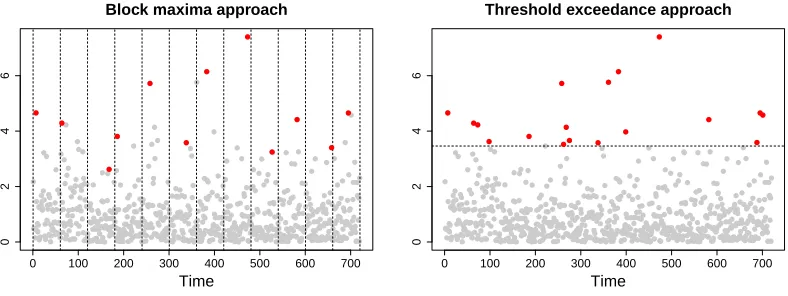
2.2.1 A demonstration of the data considered extreme in the block maxima
and threshold exceedance methods. . . 7
2.3.1 Example of data transformed to different marginal distributions. . . . 12
2.3.2 Example of a trivariate distribution with mass on five faces of the
angular simplex. The data are generated using a multivariate extreme
value distribution with an asymmetric logistic model. . . 20
2.3.3 Scaled samples (grey) from an inverted logistic copula (left), a logistic
copula (centre) and an asymmetric logistic copula (right) with α= 0.5
and θ1,{1} = θ2,{2} = θ1,{1,2} = θ2,{1,2} = 0.5; the corresponding sets G={(x, y)∈R2 :g(x, y) = 1} (red); and the sets [η
{1,2},∞)2 (blue). . 26
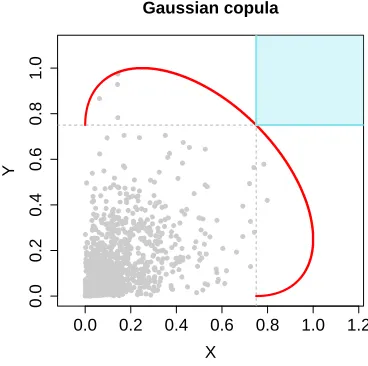
2.3.4 Scaled samples (grey) from a Gaussian copula with ρ = 0.5; the
cor-responding set G = {(x, y) ∈ R2 : g(x, y) = 1} (red); and the set [η{1,2},∞)2 (blue). . . 28
2.5.1 An example of a regular vine in five dimensions. . . 35
2.5.2 Four dimensional vine copula models;D-vine (left) and C-vine (right). 36
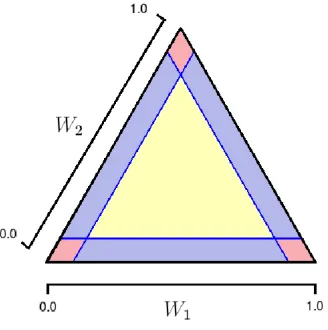
3.1.1 The simplex S2. Coordinates are transformed to the equilateral simplex. 41 3.4.1 Mean Hellinger distance, 0.05 and 0.95 quantiles over 100 simulations.
Method 1: purple; Method 2: green; Goix et al.: grey. . . 60
3.4.2 Plots to show the number of times each sub-cone is assigned mass
greater than π = 0.01 (top) and π = 0.001 (bottom), for (α, ρ) =
(0.75,0.5). Darker lines correspond to higher detection rates over 100
simulations. True sub-cones with mass: solid lines; sub-cones without
mass; dashed lines. . . 61
3.4.3 Stability plot (left) for Method 2, with dashed lines showing a 95%
bootstrapped confidence interval for the number of sub-cones with
mass, and a plot of the Hellinger distance (right) for each value of
δ. The shaded regions correspond to the stable range of tuning
param-eter values. Data were simulated from the max-mixture distribution of
Section 3.4.2 with n= 10,000, α = 0.25 andρ= 0.25. . . 63
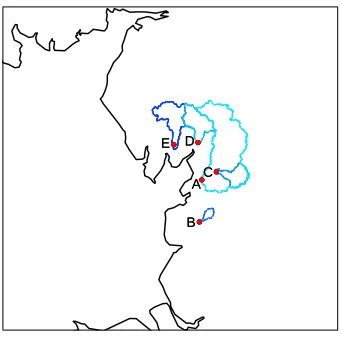
3.5.1 Locations of the river flow gauges (labelled A to E) and corresponding
catchment boundaries. . . 64
4.2.1 A partition of S2, with= 0.1; the coordinates are transformed to the equilateral simplex for visual purposes. . . 72
4.2.2 Comparison of regions BC∗ (left) and BC (right) in Cartesian
coordi-nates; the paler blue regions are truncated to the axes. . . 73
4.2.3 An example of our proposed weighting in the trivariate case, with k=
10. The grey regions in the first two plots show where the weights are
exactly 0. . . 78
4.3.1 Mean Hellinger distance over 100 simulations for the max-mixture
dis-tribution. Method 1: purple; Method 2: green; Method 3: blue;
Method 4: pink; Method 5: orange; Goix et al.: grey. . . 80
4.3.2 Mean Hellinger distance over 100 simulations from asymmetric logistic
distributions withd= 5 (top row) andd= 10 (bottom row). Method 1:
purple; Method 2: green; Method 3: blue; Method 4: pink; Method 5:
4.3.3 Boxplots of AUC* values for Methods 3, 4 and 5 with d = 5; f =
5,10,15; n = 10,000 and α = 0.75. Mean AUC* values are shown by
the circles in each plot. . . 83
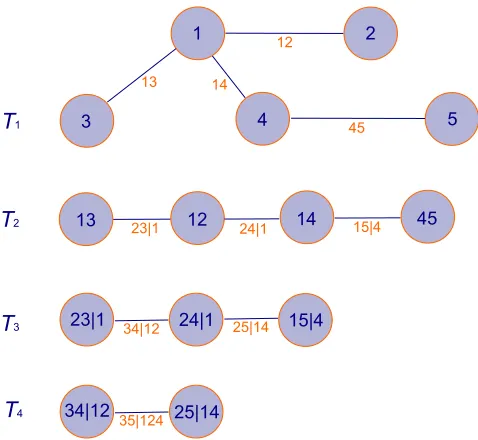
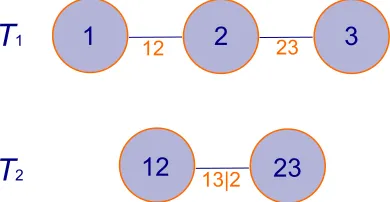
5.1.1 Graphical representation of a trivariate vine copula, with tree labels
T1,T2 as introduced in Section 2.5.3. . . 88 5.2.1 A scaled sample from a bivariate inverted logistic copula (left) and
bivariate logistic copula (right) with α = 0.5 (grey); the sets G =
{(x, y)∈R2 :g(x, y) = 1} (red); and the sets [η
{1,2},∞)2 (blue). . . . 91
5.3.1 Points in the set G = {x ∈ R3 : g(x) = 1} for a trivariate vine with three inverted logistic pair copula components (grey) and the set
[η{1,2,3},∞)3 (blue): α = 0.25 (left),α = 0.5 (centre), α= 0.75 (right); β = 0.25 and γ = 0.5. . . 97
5.3.2 Values of η{1,3} (dashed) and η{1,2,3} (solid) for a trivariate vine copula
with inverted logistic components, with α = 0.25 (left), α = 0.5
(cen-tre), α = 0.75 (right); β = 0.25 (red), β = 0.5 (purple) and β = 0.75
(orange); and γ ∈ (0.1,0.9). Average Hill estimates of η{1,3} (circles)
and η{1,2,3} (triangles) are provided in each case. . . 98
5.3.3 Left: g{1,3}(x1, x3) for (α, β, γ) = (0.5,0.25,0.5). Right: an approxima-tion of the corresponding sets G{1,3} (grey) and [η{1,3},∞)2 (blue). . 99
5.3.4 Graphical representations of four dimensional vine copula models; D
-vine (left) and C-vine (right). . . 101
5.3.5 Trivariate subsets of the four-dimensional D-vine. . . 103
5.3.6 Trivariate subsets of the four-dimensional C-vine. . . 106
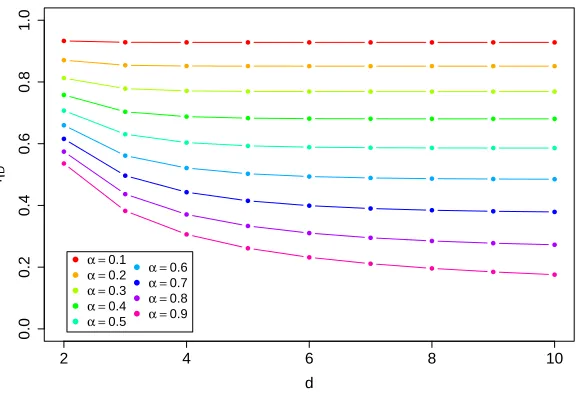
5.3.7 Values of ηD for d ∈ {2, . . . , d} for a d-dimensional D-vine or C-vine
with inverted logistic pair copulas with dependence parameters α ∈
5.4.1 Points in the set G = {x ∈ R3 : g(x) = 1} for a trivariate vine with inverted logistic copulas in T1 and a logistic copula in T2 (grey) and the set [η{1,2,3},∞)3 (blue): α= 0.25 (left), α= 0.5 (centre),α = 0.75
(right); β = 0.25 and γ = 0.5. . . 117
5.4.2 Left: g{1,3}(x1, x3) with (α, β, γ) = (0.5,0.25,0.5). Right: an approxi-mation of the corresponding sets G{1,3} (grey) and [η{1,3},∞)2 (blue). 118
5.5.1 Possible extremal dependence structures for trivariate vine copulas
con-structed from logistic and inverted logistic components. . . 122
6.3.1 MCMC chains for the scale and shape parameters for station 10 in June.131
6.3.2 Location of stations 2 (purple), 5 (pink), 7 (orange) and 10 (blue), as
well as estimates of the corresponding scale and shape parameters and
predicted 0.998 quantiles. . . 132
7.2.1 Average Hellinger distance, 0.05 and 0.95 quantiles over 25 simulations.
Method 1: purple; penalized censored log-likelihood: green. . . 137
7.2.2 Comparison of estimated τC values for cases (a)-(d) with α = 0.2 and
α = 0.8, over 25 simulations. The points show the average estimatedτC
value in each case. Method 1: purple; penalized censored log-likelihood:
green. . . 139
7.2.3 A sample of bivariate data exhibiting a mixture of asymptotic
depen-dence and asymptotic independepen-dence, and results from applying
Hamil-tonian Monte Carlo with 5000 iterations. True parameter values:
or-ange; mean of the posterior: solid pink; 90% credible interval; dashed
pink. . . 144
7.2.4 Extrapolation using the original approach of Heffernan and Tawn (top)
and our proposed two component mixture model (bottom); the orange
and blue regions show the two clusters. The original data are shown in
A.3.1Estimates of τ1(δ), τ1,2(δ) and τ1,2,3 for data simulated from trivariate logistic distributions with α= 0.25 (top) and α= 0.5 (bottom). . . . 159
A.3.2Area under the receiver operating characteristic curve results for 100
simulations from a five-dimensional max-mixture distribution. . . 160
A.3.3Area under the neighboured receiver operating characteristic curve
re-sults for 100 simulations from a five-dimensional max-mixture
distri-bution. . . 160
A.3.4Areas under the receiver operating characteristic curves for 100
simu-lations from a five-dimensional asymmetric logistic distribution. . . . 163
A.3.5Areas under the receiver operating characteristic curves for 100
simu-lations from a ten-dimensional asymmetric logistic distribution. . . . 163
A.3.6Boxplots of the areas under the neighboured receiver operating
charac-teristic curves for d = 5; f = 5,10,15; n = 10,000 and α = 0.75. The
average values are shown by the circles in each plot. . . 164
A.3.7Mean Hellinger distance, 0.05 and 0.95 quantiles over 100 simulations.
Method 1: purple; Method 2: green; Goix et al.: grey. . . 165
B.2.1AUC values for Methods 3, 4 and 5 over 100 simulations from a
five-dimensional max-mixture distribution. . . 170
B.2.2AUC* values for Methods 3, 4 and 5 over 100 simulations from a
five-dimensional max-mixture distribution. . . 171
B.3.1AUC results for Methods 3, 4 and 5 over 100 simulations from a
five-dimensional asymmetric logistic distribution. . . 171
B.3.2AUC results for Methods 3, 4 and 5 over 100 simulations from a
ten-dimensional asymmetric logistic distribution. . . 172
C.1.1Example of the extending a four-dimensionalD-vine to a five-dimensional
3.2.1 Values of τC(δ) for some trivariate copula examples. For all logistic
models the dependence parameter α satisfies 0< α <1, with larger α
values corresponding to weaker dependence. . . 49
3.4.1 Average area under the receiver operating characteristic curves, given
as percentages, for 100 samples from a five-dimensional mixture of
bi-variate Gaussian and extreme value logistic distributions; the standard
deviation of each result is given in brackets. . . 60
3.4.2 Average area under the neighboured receiver operating characteristic
curves, given as percentages, for 100 samples from a five-dimensional
mixture of bivariate Gaussian and extreme value logistic distributions;
the standard deviation of each result is given in brackets. . . 61
3.5.1 The percentage of mass assigned to each sub-cone for varying values of
the tuning parameters in Method 1 (left) and Method 2 (right). The
grey regions demonstrate the feasible stable ranges. . . 66
3.5.2 Estimated percentage of extremal mass on to each sub-cone when
con-sidering locations A-D, for varying values of the tuning parameters in
Method 1 (left) and Method 2 (right). . . 67
4.3.1 Average AUC (top) and AUC* (bottom) values, given as percentages,
for 100 samples from a five-dimensional max-mixture model. Results
in bold show where the methods are at least as successful as any of
those studied in Chapter 3. . . 81
4.3.2 Average AUC values, given as percentages, for Methods 3 and 4 over
100 samples from five-dimensional (top) and ten-dimensional (bottom)
asymmetric logistic distributions, with dependence parameter α.
Re-sults in bold show where the methods are at least as successful as any
of those studied in Chapter 3. . . 84
6.3.1 Percentage improvement over the benchmark for Challenges 1 and 2
across each month. . . 133
A.3.1Average areas under the receiver operating characteristic curves, given
as percentages, for 100 samples from five-dimensional (top) and
ten-dimensional (bottom) asymmetric logistic distributions, with
depen-dence parameter α and θi,C determined via (A.3.3). Standard
Introduction
1.1
Motivation
There are many situations where it may be necessary to understand and model
ex-treme values. Areas of interest range from environmental applications, such as high
river flows or extreme weather events, to financial ones, like stock market movements.
The occurrence of extreme events can have a huge impact, and a better understanding
of the types of extremes we may expect can help us to mitigate their effect.
One of the main issues faced in modelling extreme values is the often limited data
available; the events of interest may have never been observed, so standard statistical
modelling techniques may not apply. We therefore require a range of
asymptotically-motivated tools, which come from extreme value theory. A wide range of results are
available for modelling extremes, including classical approaches for univariate and
multivariate cases, as well as a variety of more recent advancements. There is
increas-ing interest in more complicated situations involvincreas-ing multivariate extremes, and there
is still work to be done to develop the theory and methodology necessary for these
circumstances; we focus on two such cases in this thesis.
Many existing methods for modelling multivariate extremes are only applicable
either if all of the variables take their largest values simultaneously, or if they occur
separately in each one. However, in some scenarios it is possible for certain subsets
of the variables to take their largest values simultaneously while the others are small,
and models for the extreme values should reflect this. We aim to develop methods to
determine these possibly complex extremal dependence structures, with the ultimate
aim being to aid model selection.
We also consider the case where there is a specific underlying dependence structure
among the variables. The example we focus on is vine copulas (Joe, 1996; Bedford and
Cooke, 2001, 2002), which are a class of multivariate model constructed from a series
of bivariate copulas, and whose dependence structure can be represented graphically.
Owing to their flexibility, vine copulas have grown in popularity in recent years, and
have the potential to be used for modelling multivariate extremes. We investigate
how imposing the graphical dependence structure of vine copulas influences the tail
dependence properties that can be captured by such models.
1.2
Outline of thesis
The overall aim of this thesis is to develop methods for assessing and modelling
de-pendence in multivariate extremes. There already exists a rich literature in this area;
we aim to build on this work with some novel approaches, which are outlined in this
section.
Chapter 2 gives an overview of some of the techniques that can be used in extreme
value modelling. We begin with a brief introduction to some of the standard methods
for modelling univariate extremes, before reviewing existing methods for multivariate
In Chapter 3, we introduce methodology for determining the dependence structure
of multivariate extremes; that is, the subsets of variables that can take their largest
values simultaneously, while the others are of smaller order. Under a regular
varia-tion assumpvaria-tion, we present a new set of indices that reveal aspects of the extremal
dependence structure not available through any existing measures of dependence. We
derive theoretical properties of these indices, demonstrate their value through a
se-ries of examples, and develop inferential methods that also allow us to estimate the
proportion of extremal mass associated with each subset of variables. We apply the
methods to UK river flows, estimating the probabilities of different subsets of sites
being large simultaneously.
In Chapter 4, we present alternative methods for determining extremal
depen-dence structures; this time in a radial-angular setting. The first of these is a
simplex-partitioning approach based on a regular variation assumption. This setting also
enables us to introduce a soft-thresholding approach that allows the information from
each observation to be shared across multiple faces. This is achieved by assigning
weights to points in the angular simplex based on their proximity to the various faces.
We also implement this soft-thresholding technique to extend the approach of Goix
et al. (2016). We compare the simplex-partitioning method and both these weighted
approaches to the methods in Chapter 3 via a simulation study, using receiver
op-erating characteristic curves to test their performance as classifiers, and comparing
Hellinger distances to assess the estimation of the proportion of extremal mass
as-signed to each face of the angular simplex. In several cases in this simulation study,
these radial-angular methods show improvement over those in Chapter 3.
In Chapter 5, we investigate some of the tail dependence properties of vine
certain sub-classes of this model. We focus on the trivariate case, and vine copulas
constructed from extreme value and inverted extreme value pair copulas. We follow
the approach of Nolde (2014), who investigates the limiting shape of suitably-scaled
sample clouds to give a geometric interpretation of η, which allows for calculation
of this coefficient from a joint density. By extending this theory, we propose a way
to calculate η for multivariate margins when the joint density can only be expressed
analytically for a higher order multivariate distribution. We also consider using
nu-merical approximation for cases where η cannot be found analytically.
Chapter 6 was written following entry of a STOR-i team to the EVA2017
chal-lenge. The aim of the challenge was to predict extreme precipitation quantiles across
several sites in the Netherlands. Our proposed method uses a Bayesian hierarchical
structure, and a combination of Gamma and generalized Pareto distributions. We
impose a spatio-temporal structure in the model parameters via an autoregressive
prior, and propose estimating model parameters using Markov chain Monte Carlo
techniques and spatial interpolation. Our approach was successful in the context
of the challenge, providing reasonable improvements over the benchmark method in
terms of the quantile loss function of Koenker (2005).
In Chapter 7, we summarize the contributions of this thesis, and discuss some
possible avenues for future work. The latter includes an alternative parameter
esti-mation method for the approaches of Chapter 3, and a way to deal with negligible
mass assigned to faces of the angular simplex in the methods of Chapters 3 and 4.
We also propose a mixture model based on the conditional extreme value modelling
approach of Heffernan and Tawn (2004) that has the potential to capture different
combinations of tail dependence features; we suggest using Hamiltonian Monte Carlo
Literature Review
2.1
Introduction
When studying extreme events, we are concerned with the tails of a distribution, where
the intrinsically small number of observations make statistical modelling a challenge.
We may also be interested modelling events that have not been observed in the data,
meaning that extrapolation is a key concern. Due to the usually limited amount of
data, empirical methods and other standard statistical techniques may not be
appli-cable; we instead require results from extreme value theory.
In this chapter, we introduce some of the methods currently available to model
extreme events. We begin with an overview of classical results for modelling
univari-ate extremes in Section 2.2, before discussing multivariunivari-ate techniques in Section 2.3.
In Section 2.4, we discuss existing ideas for modelling multivariate extremes where
there is some underlying structure controlling the dependence between the variables.
Finally, we introduce a class of multivariate models known as vine copulas in
Sec-tion 2.5; these models also have a specific dependence structure which can be
repre-sented graphically, and could be exploited in multivariate extreme value modelling.
2.2
Univariate extreme value theory
2.2.1
Overview
A thorough review of standard methods for modelling univariate extremes can be
found in Coles (2001). Here, we discuss some of the main results, including two
common approaches for modelling univariate extremes, based on the generalized
extreme value (GEV) and generalized Pareto (GP) distributions, discussed in
Sec-tions 2.2.2 and 2.2.3, respectively.
2.2.2
Generalized extreme value distribution
LetX1, . . . , Xn be independent random variables with common distribution function
F. The upper tail of distribution F can be modelled by considering
Mn = max(X1, . . . , Xn).
By the extremal types theorem of Leadbetter et al. (1983), if there exist seriesan>0
and bn such that
Pr
Mn−bn
an
≤x
→G(x),
as n → ∞, with G non-degenerate, then G belongs to the family of extreme value
distributions, and the distribution functionF of each of theXi variables is said to lie
in the domain of attraction of G.
The distribution function G corresponds to either a negative Weibull, Fr´echet or
Gumbel distribution, and these three cases can be combined into a single family of
the form
G(x) = exp
(
−
1 +ξ
x−µ σ
−1/ξ
+
)
, (2.2.1)
with location parameter µ ∈ (−∞,∞), scale parameter σ ∈ (0,∞) and shape
generalized extreme value (GEV) distribution. For ξ < 0, this corresponds to the
negative Weibull distribution; for ξ > 0, the distribution is Fr´echet; and the GEV
distribution withξ= 0 (interpreted asξ →0) corresponds to a Gumbel distribution.
Assuming that equation (2.2.1) holds exactly for large n, we have
Pr(Mn ≤x) =G
x−bn
an
= ˜G(x),
where ˜G represents a GEV distribution with different location and scale parameters
toG. This result allows us to use the GEV distribution to model maxima in practice.
A common method in modelling univariate extremes is to use the block maxima
approach, where data are separated into sections of equal length, and the maximum
value observed in each block is considered to be a realization of a GEV random
variable; this is demonstrated in the left panel of Figure 2.2.1. The maximum observed
values from the different blocks are used for inference of the GEV parameters.
0 100 200 300 400 500 600 700
0
2
4
6
Block maxima approach
Time
0 100 200 300 400 500 600 700
0
2
4
6
Threshold exceedance approach
[image:25.612.128.522.390.538.2]Time
Figure 2.2.1: A demonstration of the data considered extreme in the block maxima
and threshold exceedance methods.
Theory for modelling the lower tail of a distribution can be derived from the theory
for the upper tail by exploiting the relation
min(X1, . . . , Xn) =−max(−X1,· · · −Xn).
2.2.3
Generalized Pareto distribution
A common criticism of the block maxima approach is that taking only one value per
block may lead to some information about extreme events being disregarded. A
typi-cal alternative is to consider values above a high threshold,u, as being extreme, and
to fit a model to the exceedances above that threshold. This method generally
uti-lizes more of the extreme observations than the block maxima approach; an example
is shown in the right panel of Figure 2.2.1.
A model for threshold exceedances can be motivated via the point process
represen-tation of Pickands (1971). Suppose we have independent and identically distributed
random variablesX1, . . . , Xn, whose common distribution function F has upper
end-point xF, and that there exist an > 0 and bn such that Pr{(Mn−bn)/an≤x} →
G(x), where G follows a GEV distribution. As n → ∞, it can be shown that the
point process
Pn =
i n+ 1,
Xi−bn
an
:i= 1, . . . , n
converges to a non-homogeneous Poisson process,P, with integrated intensity
Λ [c1, c2]×[x,∞)
= (c2−c1)
1 +ξ
x−µ σ
−1/ξ
+
, (2.2.2)
on [0,1]×[xG,∞), for xG = inf{x : G(x) > 0} and 0 < c1 < c2 < 1. Coles (2001), for example, demonstrates that a model for threshold exceedances may be obtained
from this limiting Poisson process result. First note that the integrated intensity in
(2.2.2) may be written as
Λ [c1, c2]×(x,∞)
= Λ1 [c1, c2]
×Λ2 [x,∞)
,
with
Λ1 [c1, c2]
=c2−c1 and Λ2 [x,∞)
=
1 +ξ
x−µ σ
−1/ξ
+
.
Then, foru > xG, we have
Pr
Xi−bn
an
≤x+u
Xi−bn
an
> u
= 1−Pr
Xi−bn
an
> x+u
Xi−bn
an
> u
→1− Λ2 [x+u,∞)
Λ2 [u,∞) , as n→ ∞ = 1−
1 +ξ x+uσ−µ−1/ξ
+
1 +ξ u−σµ−+1/ξ
= 1−
1 + ξx
σu
−1/ξ
+
=:H(x), (2.2.3)
where σu = σ +ξ(u−µ). Distributions of the form H(x) are termed generalized
Pareto (GP) distributions.
By a similar argument as for the GEV distribution, treating (2.2.3) as an equality
for largen, we may disregard the constants an and bn for modelling purposes. To see
this, first note that by (2.2.3), for large u, we have
Pr (Xi > anx+anu+bn |Xi > anu+bn) =
1 + ξx
σu
−1/ξ
+
.
Now, settingun =anu+bn, and y=anx,
Pr (Xi > y+un |Xi > un) =
1 + ξx
σu,n
−1/ξ
+
,
which corresponds to a generalized Pareto distribution with scale parameter σu,n =
anσu. As the threshold un tends towards xF, exceedances above un may therefore be
modelled using the GP distribution.
We can fit both GEV and GP distributions numerically using standard maximum
likelihood techniques. One of the main issues that arises when carrying out inference
for the GP distribution is choosing a suitable value for the threshold. This must be
small enough that we have sufficient data to fit the model, but large enough that the
results provide a valid asymptotic approximation. One simple approach is to consider
parameter stability plots, as outlined by Coles (2001), in which parameter estimates
are observed over a range of threshold choices. An issue here is that stability plots
meaning they are often difficult to interpret. To overcome this, Wadsworth (2016)
proposes an alternative threshold selection method based on the joint distribution
of the estimated model parameters, and discusses a way to automate this method,
avoiding the need to interpret plots by eye. There is a large amount of further research
on the topic of threshold selection; a review of many of these techniques is given by
Scarrott and MacDonald (2012), while more recent approaches include a Bayesian
cross-validation technique proposed by Northrop et al. (2017).
2.3
Multivariate extreme value theory
2.3.1
Defining extreme events
Unlike in the univariate case where we consider maxima and minima, there is no
clear, single way to define an extreme event for multiple variables. The most suitable
definition of an extreme event will usually depend on context; Barnett (1976) suggests
several possibilities. One of the most common ways of defining a multivariate extreme
event is to consider componentwise maxima, i.e., the maximum of each variable, which
may not correspond to an actual observation. Alternatives include defining a convex
hull around the data, with points lying on or beyond this region deemed extreme;
considering observations which contain the maximum of at least one variable; and
defining some function of the data, which may allow transformation of the problem
to the univariate setting, as considered by Coles and Tawn (1994).
2.3.2
Copula theory
In multivariate modelling, it is important to consider the dependence properties of
the variables. Copulas provide a way to separate marginal modelling from
depen-dence modelling, which is often useful in practice. Joe (1997) and Nelsen (2006) give
recent developments in the area.
By Sklar’s theorem (Sklar, 1959), ifX = (X1, . . . , Xd) has joint distribution
func-tion F, and Xi ∼ Fi, for i = 1, . . . , d and each Fi continuous, then there exists a
unique copulaC such that
F(x1, . . . , xd) = C{F1(x1), . . . , Fd(xd)}.
The copula C is essentially a distribution function with Uniform(0,1) marginal
dis-tributions, and determines the dependence structure of the variables. This result,
alongside the probability integral transform, allows for transformation between
differ-ent marginal distributions while preserving the dependence properties of the variables.
If Xi is a continuous random variable with distribution function Fi and inverse
distribution function Fi−1, then by the probability integral transform, U = Fi(X) ∼
Uniform(0,1), and Fi−1(U) ∼ Fi. So for instance, we may obtain a copula CF with
standard Fr´echet margins via
F(x1, . . . , xd) =CF
− 1
logF1(x1)
, . . . ,− 1
logFd(xd)
,
a copula CE with standard exponential margins is defined by
F(x1, . . . , xd) = CE[−log{1−F1(x1)}, . . . ,−log{1−Fd(xd)}],
and for standard Gumbel margins, the copulaCG satisfies
F(x1, . . . , xd) = CG[−log{−logF1(x1)}, . . . ,−log{−logFd(xd)}].
Analogous results can be used for transformation to other marginal distributions.
These results are often used in multivariate extreme value theory, where
transform-ing margins can highlight particular features of the extreme values. In the Fr´echet
0.0 0.2 0.4 0.6 0.8 1.0
0.0
0.2
0.4
0.6
0.8
1.0
Uniform
XU YU
0 1000 3000 5000 7000
0
1000
3000
5000
7000
Frechet
XF YF
0 2 4 6 8
0
2
4
6
8
Exponential
XE YE
−2 0 2 4 6 8
−2
0
2
4
6
8
Gumbel
XG YG
Figure 2.3.1: Example of data transformed to different marginal distributions.
are used in the conditional approach of Heffernan and Tawn (2004), discussed in
Sec-tion 2.3.11, to focus on the behaviour of variables given that one of the variables is
extreme. A demonstration of data transformed to different marginal distributions is
given in Figure 2.3.1, for data simulated from a bivariate extreme value logistic
dis-tribution with dependence parameter α= 0.75. This model will be discussed further
in Section 2.3.3.
2.3.3
Componentwise maxima
Consider n independent d-dimensional random vectors X1, . . . , Xn with common
distribution function F. We denote the vector of componentwise maxima by Mn =
(Mn,1, . . . , Mn,d), where Mn,i = maxj∈{1,...,n}Xj,i, for i = 1, . . . , d, and Xj,i denotes
element i of the vector Xj. In a similar way to the univariate case, suppose there
exist constants an,i>0 and bn,i, fori= 1, . . . , d, such that
Pr
Mn,1−bn,1
an,1
≤x1, . . . ,
Mn,d−bn,d
an,d
≤xd
→G(x1, . . . , xd),
as n → ∞, for some limiting distribution function G that is non-degenerate in each
margin. Unlike in the univariate case, the distributionG does not have a single
para-metric form, although each of the marginal distributions of Gis a GEV distribution.
Setting identical margins is often the easiest way in practice to study the properties of
by the copula theory in Section 2.3.2. Choosing standard Fr´echet marginal
distribu-tions emphasizes the largest values, as demonstrated in Figure 2.3.1; this is therefore
the usual choice for modelling componentwise maxima. In particular, ifXi has a unit
Fr´echet distribution for each i= 1, . . . , d, so that Pr(Xi < x) = exp(−1/x) for x >0,
Gmay be written as
G(x) = exp{−V(x)}, (2.3.1)
where x = (x1, . . . , xd) andxi > 0 for i = 1, . . . , d. The function V is known as the
exponent measure, and, forSd−1 =
w∈[0,1]d :Pd
i=1wi = 1 , takes the form
V(x) = d
Z
Sd−1
max
i=1,...,d
wi
xi
dH(w), (2.3.2)
whereH is termed the spectral measure and, for i= 1, . . . , d, satisfies
Z
Sd−1
widH(w) =
1
d. (2.3.3)
Special cases include independence between X1 and X2, where V (x1, x2) = x−11 +
x−21 and H({0}) = H({1}) = 1/2; and perfect dependence, which corresponds to
V (x1, x2) = max x−11, x
−1 2
and H({1/2}) = 1.
Functions G(x) satisfying (2.3.1) are termed multivariate extreme value
distribu-tions. Several parametric models of this form have been proposed in the literature,
including the logistic distribution of Gumbel (1960), for which the exponent measure
is
V(x) =
d
X
i=1
x−i1/α
!α
, (2.3.4)
for α ∈ (0,1]. For this model, taking α = 1 leads to independence between the
variables, while as α → 0 we approach the case of complete dependence; in general,
smaller values ofαcorrespond to stronger dependence between the variables. Another
case by Tawn (1988), and extended to the multivariate setting by Tawn (1990). The
exponent measure for the asymmetric logistic distribution has the form
V(x) = X
C∈2D\∅
( X
i∈C
θi,C
xi
1/αC)αC
, (2.3.5)
withαC ∈(0,1],θi,C ∈[0,1],θi,C = 0 if i /∈C, and
P
C∈2D\∅
θi,C = 1 for all i= 1, . . . , d,
andC ∈2D\∅, where 2D denotes the power set ofD={1, . . . , d}. The parametersαC
control dependence in a similar way toαin the logistic model, although this time just
for the corresponding subsets of the variables. Other parametric models belonging
to the class of multivariate extreme value distributions include the negative logistic
model of Galambos (1975); the negative asymmetric logistic model of Joe (1990); and
the H¨usler-Reiss distributions (H¨usler and Reiss, 1989).
Ledford and Tawn (1997) propose inverting models of the form (2.3.1) for the
case where d = 2, so that the joint lower tail becomes the joint upper tail, and vice
versa. The resulting class of models are known as inverted bivariate extreme values
distributions, with copula of the form
C(u, v) = u+v −1 + exp
−V
−1
log(1−u),
−1
log(1−v)
. (2.3.6)
These models exhibit different tail dependence properties to the corresponding
ex-treme value distributions, and will be discussed further in Sections 2.3.7 and 2.3.10.
2.3.4
The linking between
V
and
H
The exponent measure V and spectral measure H are related, due to the definition
of V in (2.3.2), and Coles and Tawn (1991) show that these measures are linked via
further relations. Specifically, in the bivariate case, they show that
h(w) = −(x1 +x2)
3 2
∂2 ∂x1∂x2
V(x1, x2), for w∈(0,1),
H({0}) = −x
2 2 2
∂ ∂x2
V(x1, x2)
and H({1}) = −x 2 1 2 ∂ ∂x1
V(x1, x2)
x2=0 .
A similar result for thed-dimensional case links the exponent measureV and spectral
densityh via
h x
Pd i=1xi
!
=−
Pd
i=1xi
d+1
d
∂d
∂x1, . . . , ∂xd
V(x).
Moreover, for any subset of variables XC = {Xi : i ∈ C} for C ∈ 2D \ ∅ and
D={1, . . . , d}, Coles and Tawn (1991) show that the spectral density hC for events
that are extreme only in XC is given by
hC
xC
P
i∈C
xi
=−
P
i∈C
xi
|C|+1
|C|
Y
i∈C
∂ ∂xi
!
V(x). (2.3.7)
For instance, consider the asymmetric logistic model with exponent measure (2.3.5).
In this case, applying (2.3.7), we find that the spectral density corresponding to the
setC is given by
hC(wC) =−
P
i∈C
xi
|C|+1
|C|
|C|−1
Y
i=0
i−αC
αC Y
i∈C
θ1/αC
i,C
x1+1/αC
i
! ( X
i∈C
θi,C
xi
1/αC)αC−|C|
,
forwC =xC/
P
i∈C
xi.
2.3.5
Pickands’ dependence function
In the bivariate case, again with standard Fr´echet margins, the exponent measure
V(x1, x2) links to Pickands’ dependence functionA(w) (Pickands, 1981) via the equa-tion
V(x1, x2) =
1 x1 + 1 x2
A(w),
for w=x1/(x1+x2), i.e., 0 ≤w ≤1. Pickands’ dependence function is convex, and has the conditions that A(0) = A(1) = 1, and max(w,1− w) ≤ A(w) ≤ 1. The
dependence,A(w) = max(w,1−w). These cases highlight a drawback of the
compo-nentwise maxima approach for modelling the joint upper tail of (X1, X2); sinceA(w) is a convex function, with independence and perfect dependence as boundary cases,
it is not possible to model negative dependence using these componentwise maxima
results.
Pickands’ dependence function also links to the spectral measureHby the relations
dA
dw = 2H(w)−1 and d2A
dw2 = 2
dH
dw = 2h(w),
whereh(w) is the density corresponding to the spectral measure H.
2.3.6
Regular variation
An alternative tail characterization of X is in terms of its pseudo-polar coordinates (R,W). Consider the random vector X = (X1, . . . , Xd), with common marginal
distributions satisfying Pr(Xi > x) ∼ cx−1 for i = 1, . . . , d and some c > 0. For
arbitrary norms, k · k1 and k · k2, the coordinates (R,W) are defined as
R =kXk1 and W =X/kXk2,
with R > 0 and W ∈ Sd−1 =
(w1, . . . , wd) ∈ [0,1]d : Pdi=1wi = 1 , the (d−
1)-dimensional unit simplex.
Taking both norms to be the L1 norm, i.e., kxk1 =kxk2 =Pdi=1xi, the
assump-tion of multivariate regular variaassump-tion states that
lim
t→∞Pr(R > tr,W ∈B |R > t) =H(B)r
−1, (2.3.8)
forr≥1, spectral measureHsatisfying (2.3.3) andB some measurable subset ofSd−1. The right-hand side of (2.3.8) shows that under the regular variation assumption, we
values, the position of angular mass onSd−1links to the extremal dependence structure of X, i.e., the subsets of X that can take their largest values simultaneously, which will be discussed further in Section 2.3.8.
2.3.7
Modelling asymptotic dependence
Many methods for modelling multivariate extremes are only applicable for variables
with certain tail dependence properties, and an important consideration is whether
or not the variables can take their largest values simultaneously. It is useful for model
selection to have measures that allow us to categorize data as belonging to different
tail dependence classes. Several such methods are discussed by Coles et al. (1999);
we focus on one such measure here, denoted by χ.
In the bivariate case, consider variables X1 and X2 with respective distribution functionsF1 andF2. The measureχ, taking values in [0,1], is defined via the limiting conditional survivor function
χ= lim
u→1Pr{F2(X2)> u|F1(X1)> u}= limu→1
Pr{F1(X1)> u, F2(X2)> u}
1−u ,
where the limit is assumed to exist. In this case, if χ = 0, the variables are said
to be asymptotically independent, i.e., X1 and X2 cannot take their largest values simultaneously, while ifχ ∈ (0,1], the variables may be simultaneously extreme and
are said to exhibit asymptotic dependence.
For a bivariate extreme value distribution with exponent measure V(x1, x2) and distribution function of the form (2.3.1), we have
χ= lim
u→1Pr{F2(X2)> u|F1(X1)> u} = lim
u→1
1−2u+ exp{−V(−1/logu,−1/logu)}
1−u = limu→1
1−2u+uV(1,1) 1−u
= lim
u→1
1−2u+ 1 +V(1,1)(u−1) +O{(u−1)2}
This implies that the bivariate logistic model with exponent measure (2.3.4) hasχ=
2−2α. That is, it exhibits asymptotic dependence for α ∈ (0,1), and asymptotic
independence forα= 1, which corresponds to the independence case. The asymmetric
logistic model with exponent measure (2.3.5) has
χ=θ1,{1,2}+θ2,{1,2}−
θ1/α{1,2}
1,{1,2} +θ
1/α{1,2}
2,{1,2}
α{1,2}
.
For this model, if α{1,2} = 1, or if θ1,{1,2} = θ2,{1,2} = 0, we are in the independence
setting withχ= 0. Otherwise, the model exhibits asymptotic dependence. Examples
of models withχ= 0, corresponding to asymptotic independence, include the
bivari-ate Gaussian and inverted bivaribivari-ate extreme value distributions in (2.3.6).
The idea of using a limiting conditional probability to assess tail dependence
ex-tends naturally to a multivariate setting. Suppose we are interested in the random
vector X = (X1, . . . , Xd) with Xi ∼ Fi for each i ∈ D = {1, . . . , d}. To investigate
the tail dependence properties of a subset of variables XC = {Xi : i ∈ C} for some
C∈2D with |C| ≥2, a suitable measure of tail dependence is
χC = lim u→1
Pr{Fi(Xi)> u:i∈C}
1−u , (2.3.9)
see for example Hua and Joe (2011) or Wadsworth and Tawn (2013). In this case, if
χC ∈(0,1], the variables XC are asymptotically dependent, i.e., all components can
be large simultaneously. On the other hand, if χC = 0, the variables in XC cannot
all take their largest values together, although any subsetC ⊂C with |C| ≥2 could
haveχC >0, that is, XC could still exhibit asymptotic dependence.
As an example, consider the asymmetric logistic model with only pairwise
depen-dence, i.e., with exponent measure
V(x1, x2, x3) =
(
θ1
x1
1/α1
+
θ2
x2
1/α1)α1
+
(
1−θ1
x1
1/α2
+
θ3
x3
1/α2)α2
+
(
1−θ2
x2
1/α3
+
1−θ3
x3
with α1, α2, α3 ∈ (0,1] and θ1, θ2, θ3 ∈ [0,1], where the parameter subscripts have been simplified from (2.3.5) to improve readability. In this case, it can be shown that
χ{1,2,3} = 0, while the bivariate measures of dependence are
χ{1,2} =θ1+θ2−
θ1/α1
1 +θ 1/α1
2
α1
, χ{1,3} = 1−θ1+θ3−
n
(1−θ1)1/α2 +θ 1/α2
3
oα2 ,
and χ{2,3} = 1−θ2 + 1−θ3−
(1−θ2)1/α3 + (1−θ3)1/α3 α3.
That is, this particular model does not exhibit overall asymptotic dependence, but
can still have asymptotic dependence in all pairs of variables if α1, α2, α3 6= 1 and
θ1, θ2, θ3 ∈(0,1).
2.3.8
Extremal dependence structures
The definition ofχC in the previous section demonstrates that extremal dependence
in multivariate extremes can have a complicated structure, with only certain subsets
of the variables being simultaneously large while other variables are of smaller order.
In the radial-angular representation of Section 2.3.6, this corresponds to the spectral
measureH placing extremal mass on various faces of the angular simplex Sd−1. The
extremal dependence properties exhibited by a particular set of data should be
con-sidered when selecting a model for its extreme values; we should aim to match the
extremal dependence structure of the data to the structures that proposed models
can capture. Many parametric models for multivariate extremes are only suitable
for the asymptotic dependence or asymptotic independence cases, such as the logistic
model with α ∈ (0,1) and the multivariate Gaussian, respectively. However, some
models, such as the asymmetric logistic model with exponent measure (2.3.5) allow
for more complicated extremal dependence structures. In particular, ifP
i∈Cθi,C >0
forC ∈2D\ ∅, the asymmetric logistic distribution places extremal mass on the face of Sd−1 corresponding to the variables {Xi :i ∈C} being simultaneously large while
Figure 2.3.2: Example of a trivariate distribution with mass on five faces of the angular
simplex. The data are generated using a multivariate extreme value distribution with
an asymmetric logistic model.
Figure 2.3.2 shows an example of data simulated from the asymmetric logistic
distribution with the dependence parameters αC = 0.6 for allC ∈2D \ ∅, controlling
how close to the centre of the faces with mass the extremal points lie. The
depen-dence structure has been chosen to correspond to limiting mass on two of the vertices,
two of the edges and the centre of the unit simplex. In particular, X1 and X3 can both take their largest values independently of the other variables, and the subsets
{X1, X2}, {X2, X3} and {X1, X2, X3} may be simultaneously large. Here, we have
taken a sample of size n = 10,000, and the three plots show (W1, W2) |R > r, with
r taken to be the observed 0.9, 0.95 and 0.99 radial quantiles, respectively. The data
in Figure 2.3.2 are presented on the equilateral simplex for visual purposes.
As we increase the radial threshold, we observe that, although there are points
close to the boundaries of the unit simplex, none of these points lie exactly on the
boundary, so simply considering the proportion of points on each face above a high
threshold does not reveal the extremal dependence structure. Moreover, there
ap-pears to be mass close to all three corners of the unit simplex, when in fact only two
de-pendence structure of the variables using such data, conditioning onR being above a
finite threshold, we need to determine which faces truly represent this limiting
depen-dence structure, and which faces appearing to have mass do so as an artefact of lack
of convergence at finite levels. We propose methods for determining this structure
in Chapters 3 and 4, and introduce some existing methods in the remainder of this
section.
Goix et al. (2016) propose a non-parametric simplex-partitioning method for
es-timating extremal dependence structures. In this approach, the different regions of
the partition are chosen to estimate the various faces of the angular simplex Sd−1, with extremal mass on each of these faces corresponding to a different subset of the
variables being simultaneously extreme while the others are of smaller order.
Condi-tioning on the radial component being above some high threshold, empirical estimates
are obtained for the amount of extremal mass associated with each face, and a sparse
representation of the extremal dependence structure is obtained by considering faces
where this empirical estimate is sufficiently large. This method is shown to work well
in practice, particularly when the asymptotic dependence between variables in the
same subsets is strong.
In the method proposed by Goix et al. (2016), the aim is to obtain a
representa-tion of the extremal dependence structure that is sparse, i.e., the number of subsets
of variables being simultaneously large should be small compared to the dimension of
the problem. Chiapino and Sabourin (2017) point out that sparsity may not always
be achieved by this method, as too many faces that are similar in some way could be
detected. They therefore propose an algorithm that aims to group together nearby
faces with extremal mass into feature clusters. This method exploits the graphical
structure of clusters, and uses a measure of extremal dependence related toχto group
(2019) extend this approach by using the coefficient of tail dependence of Ledford and
Tawn (1996), discussed in Section 2.3.9, to assess the extremal dependence of groups
of variables. Our approaches in Chapters 3 and 4 exploit a new set of parameters,
related to this coefficient of tail dependence, that reveal additional information about
the extremal dependence structure.
Extremal dependence structures have also been studied elsewhere in the literature.
This includes the factor analysis approach of Kl¨uppelberg et al. (2015) for elliptical
copulas; the method of Chautru (2015) which incorporates principal component
anal-ysis and clustering techniques; and the Bayesian clustering approach of Vettori et al.
(2018).
2.3.9
Modelling asymptotic independence
Our focus so far has mainly been on modelling asymptotic dependence between
vari-ables; we now consider asymptotic independence in more detail. The approach of
Ledford and Tawn (1996) allows for the modelling of both asymptotic independence
and asymptotic dependence, with the latter a boundary case. For random variables
X1 and X2 with common marginal distribution F with an infinite upper endpoint, they propose a model for the limiting behaviour of the joint survivor function. This
is given by
Pr(X1 > x, X2 > x)∼L
{1−F(x)}−1
{1−F(x)}1/η, (2.3.10)
as x→ ∞, for η ∈(0,1] and some function L that is slowly varying at infinity, that
isL(tx)/L(t)→1 ast→ ∞ for allx >0. This is often presented for (X1, X2) having standard Fr´echet margins, so that asx→ ∞,
Pr(X1 > x, X2 > x)∼L(x)x−1/η.
If η = 1 and L(x) 6→ 0 as x → ∞, there is asymptotic dependence between the
used to determine the tail dependence properties of a given pair of variables. If we
haveη <1, the particular value of ηand the function Lare indicative of the strength
of asymptotic independence between the variables, with η = 1/2 corresponding to
exact independence ifL(x) = 1 or near independence for L(x)6= 1, and the variables
having some positive association forη ∈(1/2,1).
A similar approach can be adopted in the multivariate case, as considered, for
instance, by de Haan and Zhou (2011) and Eastoe and Tawn (2012). For the random
vectorX = (X1, . . . , Xd) with standard Fr´echet margins, and any setC∈2D\ ∅ with
D={1, . . . , d}, we can study
Pr(Xi > x:i∈C)∼LC(x)x−1/ηC,
as x→ ∞, for some slowly varying function LC, ηC ∈ (0,1]. In this case, if ηC = 1,
there is asymptotic dependence between the variables XC = {Xi : i ∈ C}. For
ηC <1,XC exhibits asymptotic independence, although it could still be the case that
certain subsets of the variables can be large together, relating to the more complicated
extremal dependence structures discussed in Section 2.3.8.
Inference for the parameter ηC is not straightforward since estimation of the
pa-rameter is difficult, and the value corresponding to asymptotic dependence is a
bound-ary case. One standard approach is to use the Hill estimator (Hill, 1975). Consider
ordered realizations t(1) > t(2) > · · · > t(n) of the variable T = min(Xi : i ∈ C).
Assuming model (2.3.10) holds exactly for x above some high threshold u, the Hill
estimate can be derived using maximum likelihood techniques as
ˆ
ηC =
1
nu nu
X
i=1 log
t(i)
u
, (2.3.11)
where nu denotes the number of realizations above the threshold u. In practice, this
can take values greater than 1, so we often take ˆηC to be the minimum of 1 and
via the Hill estimate. In particular, they comment that uncertainty in the
parame-ter estimation is often underestimated in practice, which could, for instance, lead to
likelihood ratio tests incorrectly rejecting asymptotic dependence. In our studies, we
found that the Hill estimate is often lower than the true value of ηC, particularly if
this true value is 1 or close to 1, also leading to difficulty in distinguishing between
asymptotic dependence and asymptotic independence. This is an issue we investigate
further in Section 7.2.2 in the context of the methods we propose in Chapters 3 and 4.
A review of other techniques for estimating ηC can be found in Section 9.5.2
of Beirlant et al. (2004). These include procedures developed by Peng (1999) and
Draisma et al. (2004), who suggest non-parametric estimates ofηC that do not depend
on the marginal distributions of the variables, and Beirlant and Vandewalle (2002)
whose approach is based on scaled log-ratios.
2.3.10
Calculating the coefficient of tail dependence from a
density
The coefficient of tail dependence ηC is defined in terms of the survivor function of
the variablesXC. However, for certain distributions, it may not be possible to obtain
this function analytically, and it may only be the joint density that is available. Nolde
(2014) presents a strategy for determining ηC in this setting using a geometric
ap-proach, by considering the shape of scaled random samples from the joint distribution
of XC.
Assuming standard exponential margins, and that the variables XC have joint
densityf(x), Nolde proposes studying the gauge functiong(x), which is homogeneous
of order 1, such that
as t → ∞. Interest then lies with the set G = {x ∈ R|C| : g(x) = 1}, which
forms the boundary of the scaled random sample (XC,1/logn, . . . ,XC,n/logn) for
largen, where the scaling function logn is chosen due to the exponential margins. In
particular, note that for each variable Xi, i∈C, with Mi,n= max(Xi,1, . . . , Xi,n),
Pr
Mi,n
logn < x
= 1−e−xlognn=
1− 1
nx
n
→
0, x <1,
e−1, x= 1,
1, x >1,
as n → ∞, so that, asymptotically, Mi,n/logn = 1. As such, the set G lies within
the region [0,1]|C|. The coefficient ηC corresponds to the smallest value of r such
that G∩[r,∞)|C| = ∅ (or the largest value of r such that G∩[r,∞)|C| 6= ∅). We
demonstrate this approach using a series of bivariate examples.
Let us first consider an inverted bivariate extreme value distribution. In
exponen-tial margins, this model has distribution function
F(x, y) = 1−e−x−e−y+ exp−V x−1, y−1 ,
for x, y > 0. By first differentiating with respect to both components to obtain the
densityf(x, y), with V1, V2 and V12 denoting the derivatives of the exponent measure with respect to the first, second and both components, respectively, we have
−logf(tx, ty) =2 log(tx) + 2 log(ty) +V
(tx)−1,(ty)−1
−log
V1
(tx)−1,(ty)−1 V2
(tx)−1,(ty)−1 −V12
(tx)−1,(ty)−1
= 2 log(tx) + 2 log(ty) +tV x−1, y−1
−logt4V1 x−1, y−1
V2 x−1, y−1
−t3V12 x−1, y−1
=tV x−1, y−1+O(logt),
ast→ ∞, by exploiting the homogeneity of the exponent measure. That is, the gauge
For the bivariate inverted logistic example, this corresponds to the gauge function
being g(x, y) = (x1/α+y1/α)α. For the case where α = 0.5, the grey points in the
left panel of Figure 2.3.3 show a suitably-normalized sample from this distribution,
while the setGwhereg(x, y) = 1 is shown by the red line. The blue region shows the
set [r,∞)2, with the smallest value of r such that the two sets do not intersect being 2−0.5 = 1/2α, occurring when x = y. This corresponds to the known value of η
{1,2}
for this copula.
0.0 0.2 0.4 0.6 0.8 1.0
0.0
0.2
0.4
0.6
0.8
1.0
Inverted logistic model
X
Y
0.0 0.2 0.4 0.6 0.8 1.0
0.0
0.2
0.4
0.6
0.8
1.0
Logistic model
X
Y
0.0 0.2 0.4 0.6 0.8 1.0
0.0
0.2
0.4
0.6
0.8
1.0
Asymmetric logistic model
X
Y
Figure 2.3.3: Scaled samples (grey) from an inverted logistic copula (left), a logistic
copula (centre) and an asymmetric logistic copula (right) with α = 0.5 and θ1,{1} = θ2,{2} =θ1,{1,2} =θ2,{1,2} = 0.5; the corresponding setsG={(x, y)∈R2 :g(x, y) = 1}
(red); and the sets [η{1,2},∞)2 (blue).
To obtain similar results for the bivariate extreme value copula, we assume that the
corresponding spectral density h(w) places no mass on {0} or {1} and has regularly
varying tails. Specifically, h(w)∼c1(1−w)s1 asw→1, andh(w)∼c2ws2 asw→0, forc1, c2 ∈R and s1, s2 >−1. In this case, the gauge function is
g(x, y) = 2 +s11{x≥y}+s21{x<y}
max(x, y)− 1 +s11{x≥y}+s21{x<y}
min(x, y).