© 2019, IRJET | Impact Factor value: 7.211 | ISO 9001:2008 Certified Journal
| Page 2328
IOT BASED SMART AMBULANCE SYSTEM
Shruthi U
1, Sindhu N
1, Supriya R Aithal
1, Swati Shripad Bhat
1, Bhavani K
21
Information Science and Engineering, Dayananda Sagar College of Engineering,
Bengaluru, Karnataka, India
2
Assistant Professor, Dept. of Information Science and Engineering, Dayananda Sagar College of Engineering,
Bengaluru, Karnataka, India
---***---Abstract -Traffic congestion is one of the major issues in India, especially in metropolitan cities like Bangalore, Mumbai, Delhi. Bangalore loses around Rs 38,000 crore every year as the social cost of traffic congestion. The main reason behind this is increasing population which leads to increased number of vehicles, due to which emergency service like Ambulance get affected. Because of this delay in ambulance service, patient may lose his life and number of these scenarios are increasing day by day. This paper proposes a solution to make such services easily available to those in need. It consists of an application called HPVB (High Priority Vehicle Booking) through which the user can book the ambulance with one tap and track the ambulance using GPS on his device, we also use microcontroller-based hardware module to provide a smooth flow for ambulance to reach the desired destination. This is achieved by implementing RFID technology which would automatically control the traffic signals in the path of ambulance thus minimizing the time required to reach the destination.
Key Words: Ambulance, GPS, Microcontroller, RFID, Node.js.
1. INTRODUCTION
The traffic condition in India effect emergency services like Ambulance and Fire engine. Time is an important factor in case of emergencies; hence we are proposing a system which makes booking and tracking of ambulance easier to the user through mobile application and also automatically controls the traffic signals in the path of ambulance.
According to research conducted by global consultancy firm, traffic in peak hours in major four cities - Delhi, Mumbai, Bengaluru, Kolkata costs the economy Rs 1.47 lakh crore per annum. Kolkata is worst among them followed by Bengaluru. In Bengaluru’s case, rail-based projects like Namma Metro or sub-urban rail, while effective, the capacity will not be sufficient to bring down congestion levels by the time they are fully operational.
Therefore, proposed system consists of mobile application through which the user can book and track the ambulance with one tap, we also provide an uninterrupted flow for ambulance to reach the desired destination. The system automatically changes the traffic signal to green in the path of ambulance thus minimising the time required to reach the destination.
2. RELATED WORK:
[1] B.Janani Saradhaet al. proposed a system using cloud network to connect both ambulance and traffic controlling unit. Intelligent traffic signal control is achieved using RFID technology. The idea is whenever the ambulance is detected near the signal, RFID reader tracks the ambulance attached with RFID tag and sends the data to the cloud. After sending the data through mobile app, acknowledgment will be sent to user, then system will automatically change the signal to green in the path of ambulance. In this, it provides uninterrupted services to emergency vehicle. Accuracy of RFID is more compared to other alternative technologies like camera.
[2] Jay Lohokare et al. proposed an idea of capturing live location of the emergency services. Using these locations, people who are in need of emergency services can connect to the officials. The main contribution of this paper is that, it provides a solution that can be extended to an entire city where there can be huge number of users using this system. Prerequisites for this application according to the author is the need of Internet and GPS (Global Positioning System) enabled device such a smart phone through which real-time location can be sent to the server. This paper gives a brief back-end Architecture that will help to handle huge number of users.
[3] Omkar Udawant et al. proposed a smart ambulance system. The basic idea is whenever the ambulance is within the range of 100m, the signal changes to green for some time.They makes use of cloud and GPRS technology. Ambulance contains sensors like heart rate sensor, blood pressure, ECG. These sensors data will be sent to hospital’s database simultaneously. Treatment will be planned by the hospital authorities according to patient condition. So it saves so much time.
3. PROBLEM STATEMENT:
© 2019, IRJET | Impact Factor value: 7.211 | ISO 9001:2008 Certified Journal
| Page 2329
Traffic signals in India has a fixed time period to switch the signals. No changes for emergency vehicles. There is no traffic control unit in ambulance. Whenever ambulance reaches a certain junction with a traffic signal, it has to wait for several minutes until clearance.
4. SYSTEM ARCHITECTURE:
4.1. Traffic management Architecture:
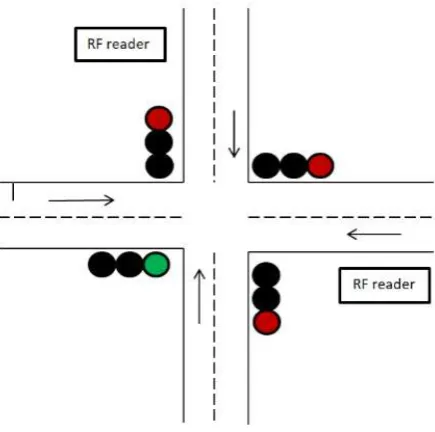
[image:2.595.320.553.109.341.2]It is an intelligent traffic controlling system. There are four lanes and four traffic signals in the above diagram. Every signal has an RFID reader and a controller unit.
Fig 1. Traffic management
Whenever an ambulance is within the range of RFID reader of the traffic signal, RFID reader scans the RFID tag which is attached to the ambulance and the control unit automatically changes that signal to green and all other signals in the circle to red.
4.2 HPVB App Architecture
The software architecture contains 5 modules which are as follows:
[image:2.595.54.272.256.472.2]Server: Here all the main activities take place. It is the brain of the application. The language used is node.js. Communication between all the modules take place through server. Some of the jobs of the server are accepting request from the user, communicating with the nearby ambulance, finding the nearest ambulance with the help of Google Maps, storing the user and ambulance information in the database, assigning the nearest ambulance to the user etc.
Fig 2. HBVB ARchitecture
MongoDB: MongoDB is a cross platform document-oriented database program. Classified as a NoSQL database program, MongoDB uses JSON-like documents with schemata. We use MongoDB to store user and ambulance information. Once the ambulance is assigned to the user, the user id, their location, ambulance id and its initial location is stored in the database for future reference.
Google Maps: The Google Maps API allow for the embedding of Google Maps onto web pages of outside developers, using a simple JavaScript interface. Some of the APIs used in our applications are Maps JavaScript API, Distance matrix API and Directions API. Server sends the location of all nearby ambulance to the Google Maps which finds the nearest ambulance using distance matrix API and sends it back to the server. After the ambulance assignment ambulance request for the navigation, which shows the shortest distance to reach its destination i.e. the user.
User: This is where the user requests for ambulance. Initially a socket connection is established between the user and the server. Then when user presses the Get Ambulance button, a unique ID is generated for the user. This ID and the location of the user is sent to server. Once the ambulance is assigned to the requested user, the real time location of the ambulance is sent to the user so that they can track the location of the ambulance.
© 2019, IRJET | Impact Factor value: 7.211 | ISO 9001:2008 Certified Journal
| Page 2330
the ambulance. Once the user has been assigned, using Navigation it reaches the user and its real time location is sent to user to the user can track the ambulance.
5. METHODOLOGY
[image:3.595.303.569.114.683.2]5.1 Block diagram
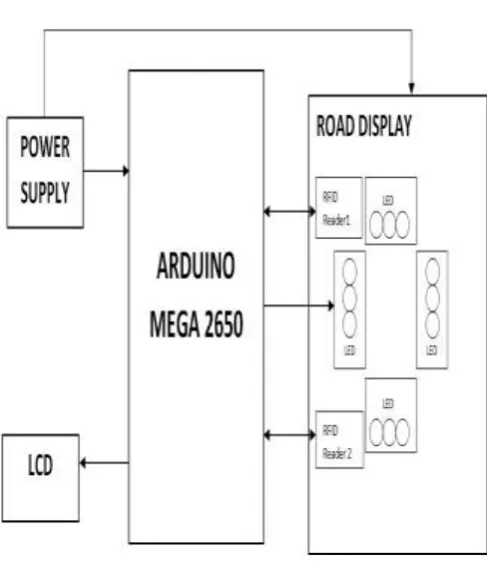
Fig 3. Block diagram of Traffic Management System
The above block diagram consists of Arduino, RFID Reader, LED(Light Emitting Diode), LCD(Liquid Crystal Display) and power supply. Power supply of 5v is given to Arduino and RFID reader when it is powered it supplies power to LED and LCD.
Three types of LED are used RED, YELLOW and GREEN. When RFID reader detects the RFID tag attached to ambulance it sends the data contained in the tag to Arduino and after checking the priority of vehicle, Arduino powers the Green LED of the respective lane for a fixed time. After the fixed time Arduino resumes the normal operation. This process is repeated whenever RFID tag is scanned through RFID reader.
5.2 Data flow of Traffic management system
Fig 4. Data flow diagram for Traffic management
5.3 About High Priority Vehicle Booking Application
[image:3.595.48.292.186.470.2]© 2019, IRJET | Impact Factor value: 7.211 | ISO 9001:2008 Certified Journal
| Page 2331
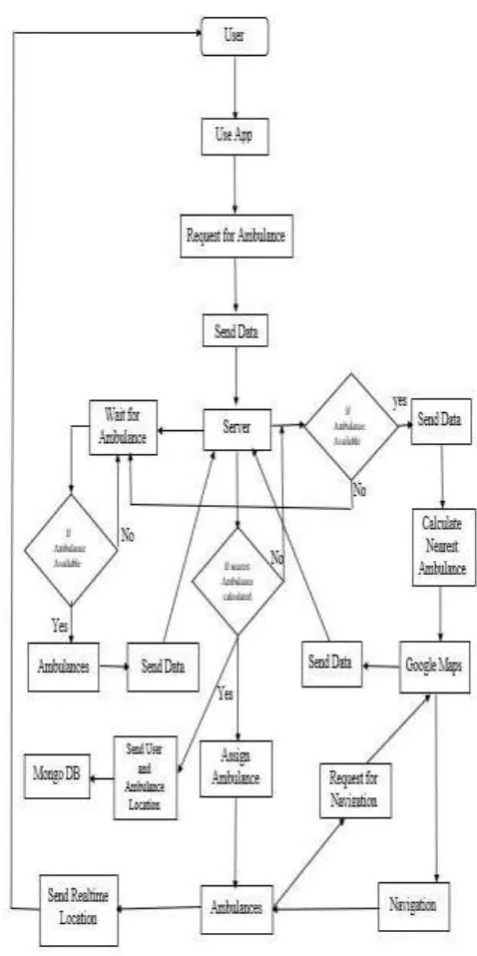
Initially, when the page is loaded by the user a socket connection is established between the user and the server for communication.
When the user is in need of an ambulance, he/she will press the Get Ambulance button to request the ambulance. This button will send the generated user ID and the user’s location to the server. The sent location is extracted using the Google Maps API.
In the meantime, all the ambulances which are available a socket connection to the server for communication. These ambulances are added to active ambulance room.
Once the server receives the request from the user, it pings all the connected ambulance to send its location to the server.
When ambulances encounter the ping, it sends its location to the server. The location is sent with is help of Google Maps API.
When the server has locations of the ambulances, these locations along with the user location is sent to Google Maps to find the nearest ambulance to the user.
Google Maps make use of the Distance Matrix API to find the nearest ambulance to the user and send the information about this ambulance back to the server.
Once the server has the location of the nearest ambulance, it sends the user ID, user location, Ambulance ID, ambulance location to the MongoDB database.
Along with sending the information to the database, it assigns the nearest ambulance located to the user by sending user location to the ambulance. And the assigned ambulance is removed from active ambulance room.
Once the ambulance has the user location, a google map is rendered and when the navigation button is pressed, it gives the shortest distance for an ambulance to reach the destination i.e. user location.
The assigned ambulance information is sent back to the user. This helps the user to track ambulance.
Once the user has ambulance information, it pings the ambulance for every 5 seconds so that the location of the ambulance is updated. This helps the user with real-time tracking of the ambulance
[image:4.595.315.554.114.593.2]5.4 Data flow of HBVB Application
Fig 5. Data flow diagram for HBVB App
6. WORKING OF THE ENTIRE SYSTEM:
Both hardware and software module’s implementation can be combined as follows:
© 2019, IRJET | Impact Factor value: 7.211 | ISO 9001:2008 Certified Journal
| Page 2332
time. Along with this, the navigation provides the shortest path for the ambulance to reach the destination.
7. CONCLUSION
The existing traffic management system in India has fixed timers for traffic signals to switch traffic between different direction and no specific changes in traffic signals for emergency vehicles. Ambulance service is one of the important services that get delayed very often due to traffic. To deal with this problem we designed this system. It comprises of two systems i.e. one which automatically change the traffic lights in the path of the ambulance and another is real time ambulance tracking system. As the ambulance itself change the signal, it doesn’t require to wait in the traffic. This will save many lives as ambulance will be able to reach its destination on time. And real time tracking helps the person who called the ambulance to track the movements of ambulance and call another ambulance if the called ambulance is taking too long to reach. Thus, this project can be a life saver project.
8. FUTURE SCOPE
This system can be extended to send the patient's vitals to the hospital once the patient has been picked up by the ambulance. This can be achieved by monitoring the health of the patients using different sensors and sending the data collected by the sensors to the hospital. The hospital staff can use this information to provide medical assistance to the patient without any delay.
There are many other high priority vehicles like ambulance which requires to reach its destination without any hindrance. Some of high priority vehicles are fire engines, police vehicle etc. Our application to can be extended to these High Priority Vehicles also.
REFERENCES
[1] B.Janani Saradha, G.Vijayshri, T.Subha2 UG students “Intelligent Traffic Signal Control System for Ambulance Using RFID and CLOUD”, Second International Conference On Computing and Communications, 2017
[2] Jay Lohokare, Reshul Dani, Sumedh Sontakke, Ameya Apte,Rishabh Sahni “Emergency services platform for smart cities”, 2017
[3] Omkar Udawant, Nikhil Thombare, Devanand Chauhan, Akash Hadke, Dattatray Waghole “Smart Ambulance System using IoT”, 2017
[4] S.N.Sivaraj, K.Vigneshwaran, S.Vigneshwarn, M.Vishnu Priyan “IoT Ambulance with Automatic Traffic Light Control”, 2017
[5] Usha.N.S, Aritha. S, Viswathika.S “Make Way for Ambulance Using IOT”, 2017
[6] Dr.Sarbpreet , Dr.Somanath Tripathy , Dr.Jimson Mathew “Design and Evaluation of an IoT enabled Secure Multi-service Ambulance Tracking System”, 2016
[7] Gargi Beri, Pankaj Ganjare, Amruta Gate, Ashwin Channawar, Vijay Gaikwad “Intelligent Ambulance with Traffic Control”, 2016
[8] Dheeraj Dang, Jitin Tanwar, Sarfaraz Masood “A Smart Traffic Solution for High Priority Vehicles”, 2015
[9] Prof. Hate S.G, Nangare Yogini K “Intelligent Ambulance Rescue System”, 2014
[10] Veeramuthu Venkatesh, V Vaithyanathan, B.Manikandan & Pethuru Raj “A Smart Ambulance for the Synchronized Health Care –A service Oriented Device Architecture-Based”, 2012
[11] Luigi Atzori, Antonio Iera, and Giacomo Morabito. The internet of things: A survey. Computer Networks, 54(15):2787 - 2805, 2010
[12] Nicola Bui and Michele Zorzi. Health care applications: A solution based on the internet of things. In Proceedings of the 4th International Symposium on Applied Sciences in Biomedical and Communication Technologies, ISABEL '11, pages 131:1 - 131:5, New York, NY, USA, 2011. ACM.
[13] G. Beri, P. Ganjare, A. Gate, A. Channawar, Vijay Gaikwad, “Intelligent Ambulance with Traffic Control”, in International Jour. Of Elect, Electronics and Comp Systems, vol. 4 , pp 43-46, Feb. 2016.
[14] M. Abinaya and R. Uthira Devi, “Intelligent Vehicle Control Using Wireless Embedded System in Transportation System Based On GSM and GPS Technology,” Int. J. Comput. Sci. Mob. Comput., vol. 3, no. 9, pp. 244–258, 2014.
[15] S. R. Prof. Nalawade and A. S. Devrukhkar, “Bus Tracking by Computing Cell Tower Information on Raspberry Pi,” in International Conference on Global Trends in Signal
Processing, Information Computing and Communication,