A Probabilistic Framework for Answer Selection in Question Answering
Jeongwoo Ko1, Luo Si2, Eric Nyberg1
1Language Technologies Institute, Carnegie Mellon, Pittsburgh, PA 15213 2Department of Computer Science, Purdue University, West Lafayette, IN 47907
[email protected], [email protected], [email protected]
Abstract
This paper describes a probabilistic swer selection framework for question an-swering. In contrast with previous work using individual resources such as ontolo-gies and the Web to validate answer can-didates, our work focuses on developing a unified framework that not only uses multiple resources for validating answer candidates, but also considers evidence of similarity among answer candidates in or-der to boost the ranking of the correct an-swer. This framework has been used to se-lect answers from candidates generated by four different answer extraction methods. An extensive set of empirical results based on TREC factoid questions demonstrates the effectiveness of the unified framework.
1 Introduction
Question answering aims at finding exact answers to a user’s natural language question from a large collection of documents. Most QA systems com-bine information retrieval with extraction techniques to identify a set of likely candidates and then uti-lize some selection strategy to generate the final answers (Prager et al., 2000; Clarke et al., 2001; Harabagiu et al., 2001). Since answer extractors may be based on imprecise empirical methods, the selection process can be very challenging, as it often entails identifying correct answer(s) amongst many incorrect ones.
Question
Question Analysis
Query
Document Retrieval
Corpus Docs
Answer Extraction
Answer candidates
Answer Selection
Answer Shanghai FT942-2016 0.5 Taiwan
FBIS3-45320
0.4
Shanghai
FBIS3-58 0.64
Shanghai
WSJ920110-0013 0.65
Hong Kong
AP880603-0268 0.7
Beijing
Document extracted Score Answer candidates
[image:1.612.317.544.242.385.2]Which city in China has the largest number of foreign financial companies?
Figure 1: A traditional QA pipeline architecture
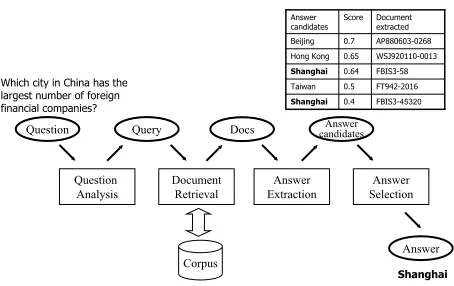
Figure 1 shows a traditional QA architecture with an example question. Given the question “Which city in China has the largest number of foreign fi-nancial companies?”, the answer extraction com-ponent produces a ranked list of five answer can-didates. Due to imprecision in answer extraction, an incorrect answer (“Beijing”) was ranked at the top position. The correct answer (“Shanghai”) was extracted from two documents with different confi-dence scores and ranked at the third and the fifth po-sitions. In order to select “Shanghai” as the final answer, we need to address two issues:
• Answer Validation. How do we identify correct answer(s) amongst incorrect ones? Validating an answer may involve searching for facts in a knowledge base, e.g. IS-A(Shanghai, city),IS-IN(Shanghai, China).
• Answer Similarity. How do we exploit evi-dence of similarity among answer candidates?
For example, when there are redundant swers (“Shanghai”, as above) or several an-swers which represent a single instance (e.g. “Clinton, Bill” and “William Jefferson Clin-ton”) in the candidate list, how much should we boost the answer candidate scores?
To address the first issue, several answer selec-tion approaches have used semantic resources. One of the most common approaches relies on Word-Net, CYC and gazetteers for answer validation or answer reranking; answer candidates are pruned or discounted if they are not found within a re-source’s hierarchy corresponding to the expected an-swer type (Xu et al., 2003; Moldovan et al., 2003; Prager et al., 2004). In addition, the Web has been used for answer reranking by exploiting search en-gine results produced by queries containing the an-swer candidate and question keywords (Magnini et al., 2002), and Wikipedia’s structured information has been used for answer type checking (Buscaldi and Rosso, 2006).
To use more than one resource for answer type checking of location questions, Schlobach et al. (2004) combined WordNet with geographi-cal databases. However, in their experiments the combination actually hurt performance because of the increased semantic ambiguity that accompanies broader coverage of location names. This demon-strates that the method used to combine potential answers may matter as much as the choice of re-sources.
To address the second issue we must determine how to detect and exploit answer similarity. As an-swer candidates are extracted from different docu-ments, they may contain identical, similar or com-plementary text snippets. For example, the United States may be represented by the strings “U.S.”, “United States” or “USA” in different documents. It is important to detect this type of similarity and ex-ploit it to boost answer confidence, especially for list questions that require a set of unique answers. One approach is to incorporate answer clustering (Kwok et al., 2001; Nyberg et al., 2003; Jijkoun et al., 2006). For example, we might merge “April 1912” and “14 Apr 1912” into a cluster and then choose one answer as the cluster head. However, clustering raises new issues: how to choose the cluster head
and how to calculate the scores of the clustered an-swers.
Although many QA systems individually address these issues in answer selection, there has been lit-tle research on generating a generalized probabilistic framework that allows any validation and similarity features to be easily incorporated.
In this paper we describe a probabilistic answer selection framework to address the two issues. The framework uses logistic regression to estimate the probability that an answer candidate is correct given multiple answer validation features and answer sim-ilarity features. Experimental results on TREC factoid questions (Voorhees, 2004) show that our framework significantly improved answer selection performance for four different extraction techniques, when compared to default selection using the indi-vidual candidate scores produced by each extractor.
This paper is organized as follows: Section 2 de-scribes our answer selection framework and Section 3 lists the features that generate similarity and va-lidity scores for factoid questions. In Section 4, we describe the experimental methodology and the re-sults. Section 5 describes how we intend to extend our framework to handle complex questions. Finally Section 6 concludes with suggestions for future re-search.
2 Method
Answer validation is based on an estimate of the probability P(correct(Ai)|Ai, Q), where Q is a
question andAi is an answer candidate to the
ques-tion. Answer similarity is is based on an estimate of the probabilityP(correct(Ai)|Ai, Aj), where Aj
is similar to Ai. Since both probabilities
influ-ence answer selection performance, it is important to combine them in a unified framework and es-timate the probability of an answer candidate as: P(correct(Ai)|Q, A1, ..., An).
In this paper, we propose a proba-bilistic framework that directly estimates P(correct(Ai)|Q, A1, ..., An) using multiple
P(correct(Ai)|Q, A1, ..., An) (1) ≈P(correct(Ai)|val1(Ai), ..., valK1(Ai), sim1(Ai), ..., simK2(Ai))
=
exp(α0+
K1
P
k=1
βkvalk(Ai) + K2
P
k=1
λksimk(Ai))
1 +exp(α0+
K1
P
k=1
βkvalk(Ai) + K2
P
k=1
λksimk(Ai))
where, simk(Ai) = N X
j=1(j6=i)
sim0k(Ai, Aj).
~
α, ~β, ~λ= argmax ~ α,~β,~λ
R X
j=1
Nj
X
i=1
logP(correct(Ai)|val1(Ai), ..., valK1(Ai), sim1(Ai), ..., simK2(Ai)) (2)
regression has been successfully employed in many applications including multilingual document merg-ing (Si and Callan, 2005). In our previous work (Ko et al., 2006), we showed that logistic regression performed well in merging three resources to vali-date answers to location and proper name questions. We extended this approach to combine multiple similarity features with multiple answer validation features. The extended framework estimates the probability that an answer candidate is correct given the degree of answer correctness and the amount of supporting evidence provided in a set of answer candidates (Equation 1).
In Equation 1, each valk(Ai) is a feature function
used to produce an answer validity score for an an-swer candidate Ai. Each sim0k(Ai, Aj) is a
similar-ity function used to calculate an answer similarsimilar-ity between Ai and Aj. K1 and K2 are the number of
answer validation and answer similarity features, re-spectively. N is the number of answer candidates.
To incorporate multiple similarity features, each simk(Ai) is obtained from an individual similarity
metric. For example, if Levenshtein distance is used as one similarity metric, simk(Ai)is calculated by
summing N-1 Levenshtein distances between one answer candidate and all other candidates. As some string similarity metrics (e.g. Levenshtein distance) produce a number between 0 and 1 (where 1 means two strings are identical and 0 means they are
differ-ent), similarity scores less than some threshold value are ignored.
The parametersα, β, λwere estimated from train-ing data by maximiztrain-ing the log likelihood as shown in Equation 2, where R is the number of training questions and Njis the number of answer candidates
for each question Qj. For parameter estimation, we
used the Quasi-Newton algorithm (Minka, 2003).
To select correct answers, the initial answer candi-date set is reranked according to the estimated prob-ability of each candidate. For factoid questions, the top answer is selected as the final answer to the ques-tion. As logistic regression can be used for binary classification with a default threshold of 0.5, we can also use the framework to classify incorrect answers: if the probability of an answer candidate is lower than 0.5, it is considered to be a wrong answer and is filtered out of the answer list. This is useful in deciding whether or not a valid answer exists in the corpus, an important aspect of the TREC QA evalu-ation (Voorhees, 2004).
3 Feature Representation
3.1 Answer Validation Features
Each answer validation feature produces a validity score which predicts whether or not an answer can-didate is a correct answer for the question. This task can be done by exploiting external QA resources such as the Web, databases, and ontologies. For fac-toid questions, we used gazetteers and WordNet in a knowledge-based approach; we also used Wikipedia and Google in a data-driven approach.
3.1.1 Knowledge-based Features
In order to generate answer validity scores using gazetteers and WordNet, we reused the algorithms described in our previous work (Ko et al., 2006).
Gazetteers: Gazetteers provide geographic information, which allows us to identify strings as instances of countries, their cities, continents, capitals, etc. For answer selec-tion, we used three gazetteer resources: the Tipster Gazetteer, the CIA World Factbook (https://www.cia.gov/cia/publications/factbook/inde x.html) and information about the US states pro-vided by 50states.com (http://www.50states.com). These resources were used to assign an answer validity score between -1 and 1 to each candidate (Figure 2). A score of 0 means the gazetteers did not contribute to the answer selection process for that candidate. For some numeric questions, range checking was added to validate numeric questions similarly to Prager et al. (2004). For example, given the question “How many people live in Chile?”, if an answer candidate is within ± 10% of the population stated in the CIA World Factbook, it receives a score of 1.0. If it is in the range of 20%, its score is 0.5. If it significantly differs by more than 20%, it receives a score of -1.0. The threshold may vary based on when the document was written and when the census was taken1.
WordNet: The WordNet lexical database includes English words organized in synonym sets, called synsets (Fellbaum, 1998). We used WordNet in or-der to produce an answer validity score between -1 and 1, following the algorithm in Figure 3. A score
1
The ranges used here were found to work effectively, but were not explicitly validated or tuned.
1) If the answer candidate directly matches the gazetteer answer for the question, its gazetteer score is 1.0. (e.g. Given the question “What continent is Togo on?”, the candidate “Africa” receives a score of 1.0.)
2) If the answer candidate occurs in the gazetteer within the subcategory of the expected answer type, its score is 0.5. (e.g., Given the question “Which city in China has the largest number of foreign financial
companies?”, the candidates “Shanghai” and “Boston” receive a score of 0.5 because they are both cities.) 3) If the answer candidate is not the correct semantic type, its score is -1. (e.g., Given the question “Which city in China has the largest number of foreign financial companies?”, the candidate “Taiwan” receives a score of -1 because it is not a city.) 4) Otherwise, the score is 0.0.
Figure 2: Validity scoring with gazetteers.
1) If the answer candidate directly matches WordNet, its
WordNet score is 1.0. (e.g. Given the question “What is
the capital of Uruguay?”, the candidate “Montevideo” receives a score of 1.0.)
2) If the answer candidate’s hypernyms include a
subcategory of the expected answer type, its score is
0.5. (e.g., Given the question “Who wrote the book
‘Song of Solomon’?", the candidate “Mark Twain” receives a score of 0.5 because its hypernyms include “writer”.)
3) If the answer candidate is not the correct semantic
type, this candidate receives a score of -1. (e.g., Given
the question “What state is Niagara Falls located in?”,
the candidate “Toronto” gets a score of -1 because it is
not a state.)
4) Otherwise, the score is 0.0.
Figure 3: Validity scoring with WordNet.
of 0 means that WordNet does not contribute to the answer selection process for a candidate.
3.1.2 Data-driven Features
Wikipedia and Google were used in a data-driven approach to generate answer validity scores.
For each answer candidate Ai,
1. Initialize the Wikipedia score: ws(Ai) = 0 2. Search for a Wikipedia document whose title is Ai 3. If a document is found, calculate tf.idf score of Aiin the
retrieved Wikipedia document ws(Ai) = (1+log(tf)) × (1+log(idf)) 4. If not, for each question keyword Kj,
4.1. Search for a Wikipedia document that includes Kj 4.2. If a document is found, calculate tf.idf score of Ai
ws(Ai) += (1+log(tf)) × (1+log(idf))
Figure 4: Validity scoring with Wikipedia
1
) 1 ( 2 ) ( )
(s =css × +d−
cs
For each answer candidate Ai,
1. Initialize the Google score: gs(Ai) = 0
2. For each snippet s:
2.1. Initialize the snippet co-occurrence score: cs(s) = 1 2.2. For each question keyword kin s:
2.2.1 Compute distance d, the minimum number of words between kand the answer candidate 2.2.2 Update the snippet co-occurrence score:
2.3. gs(Ai) = gs(Ai) + cs(s)
3. Normalize the Google score (dividing it by a constant C)
Figure 5: Validity scoring with Google
frequency (idf) of the candidate, from which a tf.idf score is calculated. When there is no matched document, each question keyword is also processed as a back-off strategy, and the answer validity score is calculated by summing the tf.idf scores. To calculate word frequency, the TREC Web Corpus (http://ir.dcs.gla.ac.uk/test collections/wt10g.html) was used as a large background corpus.
Google: Following Magnini et al. (2002), we used Google to generate a numeric score. A query con-sisting of an answer candidate and question key-words was sent to the Google search engine. To calculate a score, the top 10 text snippets returned by Google were then analyzed using the algorithm in Figure 5.
3.2 Answer Similarity Features
We calculate the similarity between two answer can-didates using multiple string distance metrics and a list of synonyms.
3.2.1 String Distance Metrics
There are several different string distance metrics to calculate the similarity of short strings. We used five popular string distance metrics: Levenshtein, Jaccard, Jaro, Jaro-Winkler, and Cosine similarity.
3.2.2 Synonyms
Synonyms can be used as another metric to calcu-late answer similarity. We defined a binary similar-ity score for synonyms.
sim(Ai, Aj) =
1, if Ai is a synonym of Aj 0, otherwise
To get a list of synonyms, we used three knowl-edge bases: WordNet, Wikipedia and the CIA World Factbook. WordNet includes synonyms for English words. Wikipedia redirection is used to obtain an-other set of synonyms. For example, “Calif.” is redi-rected to “California” in Wikipedia, and “William Jefferson Clinton” is redirected to “Bill Clinton”.
The CIA World Factbook includes five different names for a country: conventional long form, con-ventional short form, local long form, local short form and former name. For example, the conven-tional long form of Egypt is “Arab Republic of Egypt”, the conventional short form is “Egypt”, the local short form is “Misr”, the local long form is “Jumhuriyat Misr al-Arabiyah” and the former name is “United Arab Republic (with Syria)”. All are con-sidered to be synonyms of “Egypt”.
In addition, manually generated rules are used to obtain synonyms for different types of answer can-didates (Nyberg et al., 2003):
• Dates are converted into the ISO 8601 date for-mat (YYYY-MM-DD) (e.g., “April 12 1914” and “12th Apr. 1914” are converted into “1914-04-12” and considered as synonyms).
• Temporal expressions are converted into the HH:MM:SS format (e.g., “six thirty five p.m.” and “6:35 pm” are converted into “18:35:xx” and considered as synonyms).
• Representative entities are converted into the represented entity when the expected answer type isCOUNTRY(e.g., “the Egyptian govern-ment” is changed to “Egypt” and “Clinton ad-ministration” is changed to “U.S.”).
4 Experiment
This section describes the experiments we used to evaluate our answer selection framework. The JAVELIN QA system (Nyberg et al., 2006) was used as a testbed for the evaluation.
4.1 Experimental Setup
A total of 1760 factoid questions from the TREC8-12 QA evaluations served as a dataset, with 5-fold cross validation.
To better understand how the performance of our framework varies for different extraction techniques, we tested it with four JAVELIN answer extraction modules: FST, LIGHTv1, LIGHTv2 and SVM (Ny-berg et al., 2006). FST is an answer extractor based on finite state transducers that incorporate a set of extraction patterns (both manually-created and gen-eralized patterns). LIGHTv1 is an extractor that se-lects answer candidates using a non-linear distance heuristic between the keywords and an answer can-didate. LIGHTv2 is another extractor based on a different distance heuristic, originally developed as part of a multilingual QA system. SVM is an extrac-tor that uses Support Vecextrac-tor Machines to discrimi-nate between correct and incorrect answers.
Answer selection performance was measured by average accuracy: the number of correct top answers divided by the number of questions where at least one correct answer exists in the candidate list pro-vided by an extractor. The baseline was calculated with the answer candidate scores provided by each individual extractor; the answer with the best extrac-tor score was chosen, and no validation or similarity processing was performed. For Wikipedia, we used a version downloaded in Nov. 2005, which con-tained 1,811,554 articles.
4.2 Results and Analysis
We first analyzed the average accuracy when us-ing individual validation features. Figure 6 shows the effect of the individual answer validation fea-tures on different extraction outputs. The
combina-0.0 0.1 0.2 0.3 0.4 0.5 0.6 0.7 0.8 0.9 1.0
ALL GL WIKI WN GZ Baseline
A
verag
e Accuracy
[image:6.612.324.519.58.204.2]FST LightV1 LightV2 SVM
Figure 6: Average accuracy of individual answer validation features (GZ: gazetteers, WN: WordNet, WIKI: Wikipedia, GL: Google, ALL: combination of all features).
tion of all features significantly improved the per-formance when compared to answer selection using a single feature. Comparing the data-driven features with the knowledge-based features, the data-driven features (such as Wikipedia and Google) increased performance more than the knowledge-based fea-tures (such as gazetteers and WordNet); our intuition is that the knowledge-based features covered fewer questions. The biggest improvement was found with candidates produced by the SVM extractor: a 242% improvement over the baseline. It was mostly be-cause SVM tended to produce several answer can-didates with the same or very similar confidence scores, but our framework could select the correct answer among many incorrect ones by exploiting answer validation features.
Table 1 shows the effect of individual similarity features on different extractors when using 0.3 and 0.5 as a similarity threshold, respectively. When comparing five different string similarity features (Levenshtein, Jaro, Jaro-Winkler, Jaccard and Co-sine similarity), Levenshtein and Jaccard tended to perform better than the others. When comparing synonym features with string similarity features, synonyms performed slightly better.
Similarity FST LIGHTv1 LIGHTv2 SVM
feature 0.3 0.5 0.3 0.5 0.3 0.5 0.3 0.5
[image:7.612.126.492.59.211.2]Levenshtein 0.728 0.728 0.471 0.455 0.399 0.400 0.381 0.383 Jaro 0.708 0.705 0.422 0.440 0.373 0.378 0.274 0.282 Jaro-Winkler 0.701 0.705 0.426 0.442 0.374 0.379 0.277 0.275 Jaccard 0.738 0.738 0.438 0.448 0.452 0.448 0.382 0.390 Cosine 0.738 0.738 0.436 0.435 0.418 0.422 0.380 0.378 Synonyms 0.745 0.745 0.458 0.458 0.442 0.442 0.412 0.412 Lev+Syn 0.748 0.751 0.460 0.466 0.445 0.448 0.420 0.412 Jac+Syn 0.742 0.742 0.456 0.465 0.440 0.445 0.396 0.396 All 0.755 0.755 0.405 0.425 0.435 0.431 0.303 0.302
Table 1: Average accuracy using individual similarity features under different thresholds: 0.3 and 0.5 (“Lev+Syn”: the combination of Levenshtein with synonyms, “Jac+Syn”: the combination of Jaccard and synonyms, “All”: the combination of all similarity metrics)
Baseline Sim Val All
FST 0.658 0.751 0.855 0.877
LIGHTv1 0.394 0.466 0.612 0.628
LIGHTv2 0.343 0.448 0.578 0.582
SVM 0.169 0.420 0.578 0.586
Table 2: Average accuracy of individual features (Sim: merging similarity features, Val: merging val-idation features, ALL: combination of all features).
provided too much redundancy to the logistic regres-sion. We also compared the combination of Leven-shtein with synonyms and the combination of Jac-card with synonyms, and then chose Levenshtein and synonyms as the two best similarity features in our framework.
We also analyzed the degree to which the average accuracy was affected by answer similarity and val-idation features. Table 2 compares the average ac-curacy using the baseline, the answer similarity fea-tures, the answer validation features and all feature combinations. As can be seen, the similarity fea-tures significantly improved performance, so we can conclude that exploiting answer similarity improves answer selection performance. The validation fea-tures also significantly improved the performance.
When combining both sets of features together, the answer selection performance increased for all four extractors: an average of 102% over the base-line, 30% over the similarity features and 1.82% over the validation features. Adding the similarity
features to the validation features generated small but consistent improvement in all configurations. We expect more performance gain from similar-ity features when merging similar answers returned from all four extractors.
5 Extensions for Complex Questions
Although we conducted our experiments on fac-toid questions, our framework can be easily ex-tended to handle complex questions, which require longer answers representing facts or relations (e.g., “What is the relationship between Alan Greenspan and Robert Rubin?”). As answer candidates are long text snippets, different features should be used for answer selection. Possible validation features include question keyword inclusion and predicate structure match (Nyberg et al., 2005). For exam-ple, given the question “Did Egypt sell Scud mis-siles to Syria?”, the key predicate from the ques-tion is Sell(Egypt, Syria, Scud missile). If there is a sentence which contains the predicate structure Buy(Syria, Scud missile, Egypt), we can calculate the predicate structure distance and use it as a val-idation feature. For answer similarity, we intend to explore novelty detection approaches evaluated in Allan et al. (2003).
6 Conclusion
[image:7.612.77.298.281.352.2]vali-dation and similarity features. We conducted a series of experiments to evaluate the performance of the framework and analyzed the effect of individual val-idation and similarity features. Empirical results on TREC questions show that our framework improved answer selection performance in the JAVELIN QA system by an average of 102% over the baseline, 30% over the similarity features alone and 1.82% over the validation features alone.
We plan to improve our framework by adding reg-ularization and selecting the final answers among candidates returned from all extractors. As our current framework is based on the assumption that each answer is independent, we are building another probabilistic framework which does not require any independence assumption, and uses an undirected graphical model to estimate the joint probability of all answer candidates.
7 Acknowledgments
This work was supported in part by ARDA/DTO Advanced Question Answering for Intelli-gence (AQUAINT) program award number NBCHC040164.
References
J. Allan, C. Wade, and A. Bolivar. 2003. Retrieval and novelty detection at the sentence level. In Proceedings
of SIGIR.
D. Buscaldi and P. Rosso. 2006. Mining Knowledge from Wikipedia for the Question Answering task. In
Proceedings of the International Conference on Lan-guage Resources and Evaluation.
C. Clarke, G. Cormack, and T. Lynam. 2001. Exploiting redundancy in question answering. In Proceedings of
SIGIR.
C. Fellbaum. 1998. WordNet: An Electronic Lexical
Database. MIT Press.
S. Harabagiu, D. Moldovan, M. Pasca, R. Mihalcea,
M. Surdeanu, R. Bunescu, R. Grju, V. Rus, and
P. Morarescu. 2001. FALCON: Boosting knowledge for answer engines. In Proceedings of TREC.
V. Jijkoun, J. van Rantwijk, D. Ahn, E. Tjong Kim Sang, and M. de Rijke. 2006. The University of Amsterdam at CLEF@QA 2006. In Working Notes CLEF.
J. Ko, L. Hiyakumoto, and E. Nyberg. 2006. Exploit-ing semantic resources for answer selection. In
Pro-ceedings of the International Conference on Language Resources and Evaluation.
C. Kwok, O. Etzioni, and D. S. Weld. 2001.
Scal-ing question answerScal-ing to the web. In ProceedScal-ings of
WWW10 Conference.
B. Magnini, M. Negri, R. Pervete, and H. Tanev. 2002. Comparing statistical and content-based techniques for answer validation on the web. In Proceedings of the
VIII Convegno AI*IA.
T. Minka. 2003. A Comparison of Numerical Optimizers for Logistic Regression. Unpublished draft.
D. Moldovan, D. Clark, S. Harabagiu, and S. Maiorano. 2003. Cogex: A logic prover for question answering. In Proceedings of HLT-NAACL.
E. Nyberg, T. Mitamura, J. Carbonell, J. Callan,
K. Collins-Thompson, K. Czuba, M. Duggan,
L. Hiyakumoto, N. Hu, Y. Huang, J. Ko, L. Lita, S. Murtagh, V. Pedro, and D. Svoboda. 2003. The JAVELIN Question-Answering System at TREC 2002. In Proceedings of the Text REtrieval Conference.
E. Nyberg, T. Mitamura, R. Frederking, M. Bilotti, K. Hannan, L. Hiyakumoto, J. Ko, F. Lin, V. Pedro, and A. Schlaikjer. 2006. JAVELIN I and II Systems at TREC 2005. In Proceedings of TREC.
E. Nyberg, T. Mitamura, R. Frederking, V. Pedro, M. Bilotti, A. Schlaikjer, and K. Hannan. 2005. Ex-tending the javelin qa system with domain semantics. In Proceedings of AAAI-05 Workshop on Question
An-swering in Restricted Domains.
J. Prager, E. Brown, A. Coden, and D. Radev. 2000. Question answering by predictive annotation. In
Pro-ceedings of SIGIR.
J. Prager, J. Chu-Carroll, K. Czuba, C. Welty, A. Itty-cheriah, and R. Mahindru. 2004 IBM’s Piquant in Trec2003. In Proceedings of TREC.
S. Schlobach, M. Olsthoorn, and M. de Rijke. 2004.
Type checking in open-domain question answering. In
Proceedings of European Conference on Artificial In-telligence.
L. Si and J. Callan. 2005 CLEF2005: Multilingual
retrieval by combining multiple multilingual ranked lists. In Proceedings of Cross-Language Evaluation
Forum.
E. Voorhees. 2004. Overview of the TREC 2003 ques-tion answering track. In Proceedings of TREC.