Proceedings of the Fourth Joint Conference on Lexical and Computational Semantics (*SEM 2015), pages 228–238,
Implicit Entity Recognition in Clinical Documents
Sujan Perera*, Pablo Mendes†, Amit Sheth*, Krishnaprasad Thirunarayan*,
Adarsh Alex*,Christopher Heid¶,Greg Mott¶
*Kno.e.sis Center, Wright State University, Dayton, OH, USA
†IBM Research, San Jose, CA, USA
¶Boonshoft School of Medicine, Wright State University, Dayton, OH, USA
[email protected], [email protected], [email protected], [email protected] [email protected], [email protected], [email protected]
Abstract
With the increasing automation of health care information processing, it has become crucial to extract meaningful information from textual notes in electronic medical records. One of the key challenges is to extract and normalize entity mentions. State-of-the-art approaches have focused on the recognition of entities that are explicitly mentioned in a sentence. How-ever, clinical documents often contain phrases that indicate the entities but do not contain their names. We term those implicit entity mentions and introduce the problem of im-plicit entity recognition (IER) in clinical doc-uments. We propose a solution to IER that leverages entity definitions from a knowledge base to create entity models, projects sen-tences to the entity models and identifies im-plicit entity mentions by evaluating semantic similarity between sentences and entity mod-els. The evaluation with 857 sentences se-lected for 8 different entities shows that our al-gorithm outperforms the most closely related unsupervised solution. The similarity value calculated by our algorithm proved to be an effective feature in a supervised learning set-ting, helping it to improve over the baselines, and achieving F1 scores of .81 and .73 for dif-ferent classes of implicit mentions. Our gold standard annotations are made available to en-courage further research in the area of IER.
1 Introduction
Consider the following sentence, extracted from a clinical document: “Patient has shortness of breath with reaccumulation of fluid in extremities.” It states that the patient has ‘shortness of breath’ and ‘edema’. The former is explicitly mentioned, while
the latter is implied by the semantics of the phrase ‘reaccumulation of fluid in extremities’. We term such occurrencesimplicit entity mentions.
While implicit entity mentions are common in many domains, resolving them is particularly valu-able in the clinical domain. Clinical documents are rich in information content that plays a cen-tral role in understanding patients’ health status and improving the quality of the delivered services. It is a common practice to employ computer assisted coding (CAC) solutions to assist expert “coders” in determining the unique identifier (e.g., ICD9 or ICD10) for each medical condition or combina-tion of condicombina-tions. These identifiers are impor-tant to unambiguously represent the medical con-ditions, to prepare the post-discharge plan, and to perform secondary data analysis tasks. A human coder reading the sentence ‘Patient has shortness of breath with reaccumulation of fluid in extremi-ties’would generate the corresponding codes for en-tities ‘shortness of breath’ and ‘edema’. However, the solutions developed to perform entity recogni-tion in clinical documents (Aronson, 2006) (Fried-man et al., 1994) (Savova et al., 2010) (Fried(Fried-man et al., 2004) (Fu and Ananiadou, 2014) (Pradhan et al., 2015) do not recognize the presence of entity ‘edema’ in this sentence.
Implicit entity mentions are a common occur-rence in clinical documents as they are often typed during a patient visit in a way that is natural in spo-ken language and meant for consumption by the professionals with similar backgrounds. An anal-ysis with 300 documents in our corpus showed that 35% of the ‘edema’ mentions and 40% of the ‘shortness of breath’ mentions are implicit.
challenging since, besides the fact that they lack the entity name, they can be embedded with negations. For example, the semantics of the sentence‘The pa-tients’ respiration become unlabored’ implies that the patient does not have ‘shortness of breath’. Iden-tification of the negated mentions of entities in clin-ical documents is crucial as they provide valuable insights into the patients’ health status.
We propose an unsupervised solution to the IER problem that leverages knowledge embedded in en-tity definitions obtained for each enen-tity from the Unified Medical Language System (UMLS) (Bo-denreider, 2004). UMLS provides a standard vocab-ulary for the clinical domain. Our solution: a) Cre-ates an entity model from these definitions, b) Iden-tifies the sentences in input text that may contain implicit entity mentions, c) Projects these sentences onto our entity model, and d) Classifies the sen-tences to distinguish between those containing im-plicit entity mentions or negated imim-plicit mentions, by calculating the semantic similarity between the entity model and the projected sentences.
The contributions of this work are as follows: 1. We introduce the problem of implicit entity
recognition (IER) in clinical documents. 2. We propose an unsupervised solution to IER
that outperforms the most relevant unsuper-vised baseline and improves the results of a su-pervised baseline.
3. We create a gold standard corpus annotated for IER in the clinical domain and make it avail-able to encourage research in this area.
2 Related Work
To the best of our knowledge, this is the first work to address the problem of Implicit Entity Recogni-tion (IER) in clinical documents. However, there is a large body of research that is relevant to the problem, including Named Entity Recognition (NER), Entity Linking (EL), Coreference Resolution, Paraphrase Recognition, and Textual Entailment Recognition.
Much like IER, both NER and EL have the ob-jective of binding a natural language expression to a semantic identifier. However, related work in NER and EL expect the proper name (explicit mention) of entities and assume the presence of
noun phrases (Collins and Singer, 1999) (Bunescu and Pasca, 2006). The solutions developed for NER leverage regularities on morphological and syntactical features that are unlikely to hold in the case of IER. The most successful NER approaches use word-level features (such as capitalization, pre-fixes/suffixes, and punctuation), list lookup fea-tures (such as gazetteers, lexicons, or dictionaries), as well as corpus-level features (such as multiple occurrences, syntax, and frequency) (Nadeau and Sekine, 2007) that are not exhibited by the phrases with implicit entity mentions.
Many approaches couple NER with a follow up EL step (Hachey et al., 2013) in order to assign an unique entity identifiers to mentions. Therefore, the inadequacy of NER techniques will limit the capa-bility of recognizing implicit entity mentions by a solution developed for EL. Moreover, state-of-the-art EL approaches include a ‘candidate mapping’ step that uses entity names to narrow down the space of possible entity identifiers, which is also a limiting factor in the IER case. Finally, neither NER nor EL deal with the negated mentions of entities.
Coreference resolution (CR) focuses on grouping multiple mentions of the same entity with different surface forms. The solutions to CR focus on map-ping explicit mentions of entity names to other pro-nouns and noun phrases referring to the same en-tity (Ng, 2010) (Durrett and Klein, 2013). In IER implicit mentions occur without co-referring corre-sponding entity. Hence, they must be resolved with-out dependencies on co-referents.
In contrast to NER, EL, and CR problems and their solutions, IER addresses instances where nei-ther explicit mention of an entity nor noun phrases or any of the above mentioned features are guaran-teed to appear in the text but still have a reference to a known entity. Hence, IER solutions require treat-ment for implied meaning of the phrases beyond its syntactic features.
recogni-tion are defined at the sentence level, whereas text phrases considered for IER can exist as a sentence fragment or span across multiple sentences, and 2) The objective of IER is to find whether a given text phrase has a mention of anentity—as opposed to determining whether two sentences are similar or entail one another. However, our solution benefits from the lessons learned from both tasks.
The question answering solutions cope with the questions that describe the characteristics of a con-cept and expect that concon-cept as the answer. This particular type of questions resembles implicit en-tity mentions. However, they assume that the ques-tions are referring to some concept and the problem is to uncover which one, whereas the implicit entity mention problem requires us to first check whether a particular sentence/phrase has a mention of an en-tity at all. Furthermore, question answering systems benefit from the presence of pronouns, nouns, and noun phrases in the questions and the candidate an-swers to derive helpful syntactic and semantic fea-tures (Lally et al., 2012)(Wang, 2006), while phrases with implicit entity mentions may not contain such features.
The existing work on clinical document annota-tion focused on explicit entity menannota-tions with con-tiguous phrases (Aronson, 2006) (Savova et al., 2010) (Friedman et al., 2004) (Fu and Ananiadou, 2014). Going one step beyond, the SemEval 2014 task 7 recognized the need for identifying discon-tiguous mentions of explicit entities (Pradhan et al., 2014). However, the recognition of implicit entities has yet to address by this community.
3 Implicit Entity Recognition (IER) in Clinical Documents
We define the Implicit Entity Recognition (IER) task in clinical documents as: given input text that does not have explicit mentions of target entities, find which target entities are implied (including implied negations) in the input text.
Negation detection is traditionally separated from the entity recognition task because negation indi-cating terms can be recognized separately from the phrases that contain explicit mention of an entity. In contrast, implicit mention can involve an antonym that fuses the entity indication with negated sense
Knowledge Base on Entities
Entity Representative Term Selection
Entity Model Creation
Similarity Calculation
Candidate Sentence Selection
Candidate Sentence Pruning
[image:3.612.331.531.81.182.2]Annotations
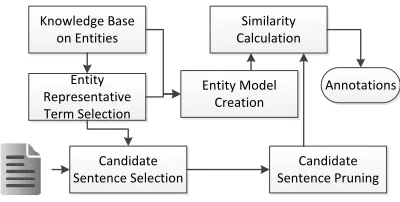
Figure 1: Components of the Proposed Solution
(e.g.,‘patient denies shortness of breath’vs‘patient is breathing comfortably’). Hence, negation detec-tion is considered as a sub-task of IER.
Typical entity recognition task considers the de-tection of the boundaries of the phrases with enti-ties (i.e., segmentation) as a sub-task. We consider boundary detection of the implicit entity mentions as an optional step due to two reasons: 1) It is con-sidered an optional step in biomedical entity recog-nition task (Tsai et al., 2006), and 2) The phrases with implicit entity mentions can be noncontiguous and span multiple sentences. Further, in some cases, even domain experts disagree on the precise phrase boundaries.
We define the IER as a classification task. Given an input text, classify it to one of the three cate-gories: TPe if the text has a mention of entitye, or
Tnegeif the text has a negated mention of entitye, or TNeif the entityeis not mentioned at all. As men-tioned, the phrases with implicit entity mentions can span to multiple sentences. However, this work will focus only on implicit mentions exist within a sen-tence. Our unsupervised solution to this classifica-tion task: 1) Creates anentity modelfrom the entity definitions, 2) Selectscandidate sentencesthat may contain implicit entity mentions, 3) Projects the can-didate sentences into entity model space, and 4) Cal-culates the semantic similarity between projected sentences and theentity model. Figure 1 shows the components of our solution which are discussed be-low in detail.
3.1 Entity Representative Term Selection
Entity representative term (ERT) selection finds a term with highrepresentative powerto an entity and plays an important role in defining it.
The representative powerof a termtfor entity e
is defined based on two properties: its dominance among the definitions of entitye, and its ability to discriminate the mentions of entityefrom other en-tities. This is formalized in eq. (1). Consider the entity ‘appendicitis’ as an example. It is defined as ‘acute inflammation of appendix’. Intuitively, both terms inflammationandappendix are candidates to explain the entityappendicitis. However, the term appendixhas more potential to discriminate the im-plicit mentions ofappendicitisthan the term inflam-mation, because the terminflammationis used to de-scribe many entities. Also, none of the definitions defineappendicitiswithout using the termappendix; therefore,appendixis the dominant term, and conse-quently it has the most representative power for the entity ‘appendicitis’.
We used a score inspired by the TF-IDF measure to capture this intuition. The IDF (inverse document frequency) value measures the specificity of a term in the definitions. The TF (term frequency) captures the dominance of a term. Hence the representative power of a termtfor entitye(rt) is defined as,
rt=freq(t,Qe)∗log|E|E|
t| (1)
Qe is the set of definitions of entity e, E is the set of all entities. freq(t,Qe) is the frequency of termtin setQe,|E|is the size of the setE(3962in our corpus), and the denominator|Et|calculates the number of entities defined using termt. We expand the ERT found for an entity with this technique by adding its synonyms obtained from WordNet.
We can define entity representative terms based on the definition of representative power.
Definition 3.1 (Entity Representative Term). Let
Le = {t1, t2, ..., tn} be the set of terms in a defi-nitions of an entitye. LetRLe = {rt1, rt2, ..., rtn}
be the representative power calculated for each term
ti inLe fore. We select termtm as the entity rep-resentative term of the entityeif its representative power is maximum, i.e., rtm ≥ rti for all iwhere
1≤i≤n.
3.2 Entity Model Creation
Our algorithm creates an entity indicator from a definition of the entity. An entity indicator con-sists of terms that describe the entity. Consider the definition ‘A disorder characterized by an un-comfortable sensation of difficulty breathing’ for ‘shortness of breath’, for which the selected ERT is ‘breathing’. The terms uncomfortable, sensation, difficulty, andbreathingcollectively describe the tity. Adding other terms in this definition to the en-tity indicator negatively affects the similarity calcu-lation with the candidate sentences since they are less likely to appear in a candidate sentence. We exploited the neighborhood of the ERT in the defini-tion to create the entity indicator and automatically selected the nouns, verbs, adjectives, and adverbs in the definition within a given window size to the left and to the right of the ERT. We used a window size of four in our experiments.
An entity can have multiple definitions each ex-plaining it using diverse vocabulary. On average, an entity in our corpus had 3 definitions. We cre-ate an entity indicator from each definition of the entity, hence an entity has multiple indicators. We call the collection of indicators of an entity as its en-tity model. In other words, an entity model consists of multiple entity indicators that capture diverse and orthogonal ways an entity can be expressed in the text.
3.3 Candidate Sentence Selection
The sentences with ERT in an input text are identi-fied ascandidate sentencescontaining implicit men-tion of the corresponding entity. A sentence may contain multiple ERTs and consequently become a candidate sentence for multiple entities. This step reduces the complexity of the classification task as now a sentence has only a few target entities.
3.4 Candidate Sentence Pruning
fol-lowing the same steps followed to create the entity indicators from the entity definitions.
3.5 Semantic Similarity Calculation
As the last step, our solution calculates the similarity between the entity model and the pruned candidate sentence. The sentences with implicit entity men-tions often use adjectives and adverbs to describe the entity and they may indicate the absence of the en-tities using antonyms or explicit negations. These two characteristics pose challenges to the applica-bility of existing text similarity algorithms such as MCS (Mihalcea et al., 2006) and matrixJcn (Fer-nando and Stevenson, 2008) which are proven to perform well among the unsupervised algorithms in paraphrase identification task (ACLWiki, 2014).
The existing text similarity algorithms largely benefit from the WordNet similarity measures. Most of these measures use the semantics of the hierar-chical arrangement of the terms in WordNet. Unfor-tunately, adjectives and adverbs are not arranged in a hierarchy, and terms with different part of speech (POS) tags cannot be mapped to the same hierarchy. Hence, they are limited in calculating the similar-ity between terms of these categories. This limi-tation negatively affects the performance of IER as the entity models and pruned sentences often contain terms from these categories. Consider the following examples:
1. Her breathing is still uncomfortableadjective. 2. She is breathing comfortablyadverbin room air. 3. His tip of the appendix was inflamedverb. The first two examples use an adjective and an ad-verb to mention the entity ‘shortness of breath’ im-plicitly. The third example uses a verb to men-tion the entity ‘appendicitis’ implicitly instead of the nouninflammationthat is used by its definition.
We have developed a text similarity measure over-coming these challenges and weigh the contributions of the words in the entity model to the similarity value based on their representative power.
Handling adjectives, adverbs and words with different POS tags:To get the best out of all Word-Net similarity measures, we exploited the relation-ships between different forms of the terms in Word-Net to find the noun form of the terms in the entity
models and pruned sentences before calculating the similarity. We found the adjective for an adverb us-ing relationship ‘pertainym’ and noun for an adjec-tive or a verb using the relationship ‘derivationally related form’ in WordNet.
Handling negations:Negations are of two types: 1) Negations mentioned with explicit terms such as no, not, and deny, and 2) Negations indicated with antonyms (e.g., 2ndexample in above list). We used
the NegEx algorithm (Chapman et al., 2001) to ad-dress the first type of negations. To adad-dress the sec-ond type of negations, we exploited the antonym re-lationships in the WordNet.
The similarity between an entity model and the pruned candidate sentence is calculated by comput-ing the similarities of their terms. The term sim-ilarity is computed by forming an ensemble using the standard WordNet similarity measures namely, WUP (Wu and Palmer, 1994), LCH (Leacock and Chodorow, 1998), Resnik (Resnik, 1995), LIN (Lin, 1998), JCN (Jiang and Conrath, 1997), as well as a predict vector-based measure Word2vec (Mikolov et al., 2013) and a morphology-based similarity metric Levenshtein1as:
sim(t1, t2) =maxm∈M(simm(t1, t2)) (2)
where t1 and t2 are input terms and M is the
set of above mentioned similarity measures. This ensemble-based similarity measure exploits orthog-onal ways of comparing terms: semantic, statisti-cal, and syntactic. An ensemble-based approach is preferable over picking one of them exclusively since they are complementary in nature, that is, each outperforms the other two in certain scenarios.
The similarity values calculated by WordNet sim-ilarity measures insimm(t1, t2) are normalized to
range between 0 and 1.
The similarity of a pruned candidate sentence to the entity model is calculated by calculating its sim-ilarity to each entity indicator in the entity model, and picking the maximum value as the final simi-larity value for the candidate sentence. The similar-ity between entsimilar-ity indicator eand pruned sentence
s,sim(e, s), is calculated by summing the similari-ties calculated for each termte in the entity indica-tor weighted by its representative power as defined
in eq. (1). If te is an antonym for any term in s (ts), it contributes negatively to the overall similar-ity value, else it contributes in linear portion of the maximum similarity value between te and somets (eqs. (4) and (5)). The overall similarity value is normalized based on the total representative power of all the termstes (eq. (1)) and ranges between -1 and +1.
Note that this formulation weighs the contribution of each term according to its importance in defining the entity. The higher similarity with a term that has higher representative power leads to higher overall similarity value, while the lower similarity with such terms leads to a lower total similarity value. The spe-cial treatment for antonyms takes care of the negated mentions of an entity.
sim(e, s) =
P
te∈ePf(te, s)∗rte
te∈erte
(3)
f(te, s) =
(
−1 α(te, s) == 0
maxts∈ssim(te, ts) otherwise
(4)
α(te, s) =Qts∈s (
0 ifteis an antonym ofts 1 otherwise
(5) Finally, the sentences are classified based on a configurable threshold values selected between -1 and +1.
4 Evaluation
We reannotated a sample of the corpus created for SemEval-2014 task 7 (Pradhan et al., 2014) to in-clude implicit mention annotations and measured the performance of our proposed method in classify-ing entities annotated withTPandTnegmentions2. 4.1 Gold Standard Dataset
The SemEval-2014 task 7 corpus consists of 24,147 de-identified clinical notes. We used this corpus to create a gold standard for IER with the help of three domain experts. The gold standard consists of 857
2We do not explicitly report performance onTNbecause our
focus is to find sentences that contain entity mentions rather than those devoid of mentions.
Entity TP Tneg TN
Shortness of breath 93 94 29
Edema 115 35 81
Syncope 96 92 24
Cholecystitis 78 36 4
Gastrointestinal gas 18 14 5
Colitis 12 11 0
Cellulitis 8 2 0
[image:6.612.317.537.70.177.2]Fasciitis 7 3 0
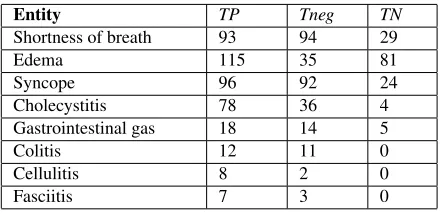
Table 1: Candidate Sentence Statistics
sentences selected for eight entities. The creation of the gold standard is described below in detail.
We have annotated the corpus for explicit men-tions of the entities using cTAKES (Savova et al., 2010) and ranked the entities based on their frequency. The domain experts on our team then selected a subset of these entities that they judged to be frequently mentioned implicitly in clinical documents. For example, the frequent entity ‘shortness of breath’ was selected but not ‘chest pain’ since the former is mentioned implic-itly often but not the latter. We used four frequently implicitly mentioned entities as the primary focus of our evaluation. We refer to these asprimary enti-tiesfrom here on (the first four entities in Table 1). To test the generalizability of our method, as well as to evaluate its robustness when lacking training data, we selected another four entities (the last four entities in Table 1). We then selected a random sam-ple of candidate sentences for each of these entities based on their ERTs and winnowed it down further by manually selecting a subset that exhibits syntactic diversity. Ultimately, our corpus consisted of 120-200 sentences for each primary entity and additional 80 sentences selected from the other four entities.
means the negation of entity ‘shortness of breath’ (because that is a normal breathing pattern) or just lacks a mention of the entity. The final anno-tation label for a sentence is decided based on majority voting. Table 1 shows the statistics of the annotated candidate sentences. The prepared data set is available at http://knoesis.org/ researchers/sujan/data-sets.html
4.2 Implicit Entity Recognition Performance
Since IER is a novel task, there are no baseline algo-rithms that can be directly applied such that it would yield a fair comparison with our algorithm. How-ever, we deem some of the related algorithms to have good potential applicability for this task. Therefore, we included two strong algorithms from the closest related work as baseline solutions to the problem.
The first baseline is the well-known text similar-ity algorithm MCS (Mihalcea et al., 2006). MCS is one of the best performing unsupervised algorithms in paraphrase recognition task (ACLWiki, 2014). It uses an ensemble of statistical and semantic similar-ity measures, which is a preferable feature for the IER as opposed to one measure used by the ma-trixJcn (Fernando and Stevenson, 2008). Both MCS and our algorithm classify the candidate sentences based on threshold values selected experimentally.
To include also a supervised baseline, we trained an SVM (Cortes and Vapnik, 1995) one of the state-of-the-art learning algorithms, shown to per-form remarkably well in a number of classifica-tion tasks. We trained separate SVMs for each pri-mary entity, considering unigrams, bigrams, and tri-grams as the features. It has been shown that SVM trained on ngrams performed well on text classifica-tion tasks (Pang et al., 2002) (Zhang and Lee, 2003). The SVMs trained with bigrams consistently pro-duced the best results for the 4-fold cross validation. Therefore, our testing phase used the SVMs trained with the bigrams.
Preparation of training and testing datasets:
We created training and testing datasets by splitting the dataset annotated for each primary entity as 70% (training) and 30% (testing). The training datasets were used to train the SVM models for each pri-mary entity and to select the threshold values for both MCS and our algorithm.
The classification performance of each algorithm
is studied in theTPandTnegcategories using preci-sion, recall, and F-measure.
The precision (PP) and recall (PR) for category TPat thresholdtare defined as:
P Pt= all sentences with sim≥tST Pwith sim≥t
P Rt= ST Pwith sim≥tST P
Similarly,NPandNRforTnegare defined as:
NPt= all sentences with sim<tST negwith sim<t
NRt= ST negSwith sim<tT neg
where ST P and ST neg denote the sentences anno-tated withTPandTnegrespectively by domain ex-perts andsimis the calculated similarity value for the pruned sentence.
Selecting threshold value: The threshold values for both MCS and our algorithm are selected based on their classification performance in the training dataset. The MCS algorithm produced the best F1 score for theTPcategory with a threshold value of 0.5, and for theTnegcategory with a threshold value of 0.9, while our algorithm produced the best F1 for theTPcategory with 0.4 and for theTnegcategory with 0.3. We examined threshold values that pro-duce best F1 scores by the two algorithms by starting with 10% of the training data and gradually increas-ing the size of the trainincreas-ing data. The threshold val-ues with best F1 scores were stabilized after adding 30% of the training data. Hence, we could select the threshold values with just 50% of the training data.
4.3 Classification Performance
The first experiment evaluates the classification per-formance of our algorithm, MCS, and SVM.
Method PP PR PF1 NP NR NF1
Our 0.66 0.87 0.75 0.73 0.73 0.73
MCS 0.50 0.93 0.65 0.31 0.76 0.44 SVM 0.73 0.82 0.77 0.66 0.67 0.67
Table 2: precision, recall, and F1 values for each algorithm (PF1 and NF1 indicate F1 scores for theTPandTnegcategories respectively). SVM outperforms our algorithm in theTPcategory, while our algorithm outperforms SVM on theTnegcategory.
mechanical ventilation shortly after presentation’is annotated asTP in the gold standard for the entity ‘shortness of breath’ since ‘mechanical ventilation’ indicates the presence of ‘shortness of breath’. This annotation requires domain knowledge that was not present in the entity definitions that we used to build entity models. However, with enough examples, the SVM was able to learn the importance of the bigram ‘mechanical ventilation’and classify it asTP.
For the Tneg category, however, our algorithm outperforms the SVM (NF1 on Table 2). This is due to the explicit treatment for the negated men-tions by our algorithm to capture different variamen-tions of the negated mentions.
The MCS algorithm underperformed in both cat-egories. We observed that this was mostly due to its limitations described in Section 3.5. The over-all classification accuracy—the accuracy of classify-ing bothTPandTneginstances—of our algorithm, MCS, and SVM are 0.7, 0.4, and 0.7 respectively.
Method PP PR PF1 NP NR NF1
SVM 0.73 0.82 0.77 0.66 0.67 0.67 SVM+MCS 0.73 0.82 0.77 0.66 0.66 0.66 SVM+Our 0.77 0.85 0.81 0.72 0.75 0.73
Table 3: Comparison of SVM results incorporating similarity values calculated by our algorithm and MCS as a feature. Our algorithm com-plements the SVM in both categories whereas MCS does not contribute to improve the classification.
The second experiment evaluates the impact of in-cluding the similarity scores calculated by MCS and our algorithm for each candidate sentence as a fea-ture to the best performing SVM model. Table 3 shows that the inclusion of MCS scores as a fea-ture did not help to improve the SVM results. In fact, it negatively affected the results for the Tneg category. Since the MCS showed low precision for the Tneg category in the previous experiment (Ta-ble 2), it is potentially introducing too much noise that the SVM is not able to linearly separate. How-ever, the similarity value calculated by our algorithm improves the SVM classifiers. It increased the pre-cision and recall values for both the TP and Tneg categories. This shows that the similarity value cal-culated by our algorithm can be used as an effective feature for a learning algorithm that is designed to solve the IER problem. The overall classification accuracy of SVM, SVM+MCS, and SVM+Our
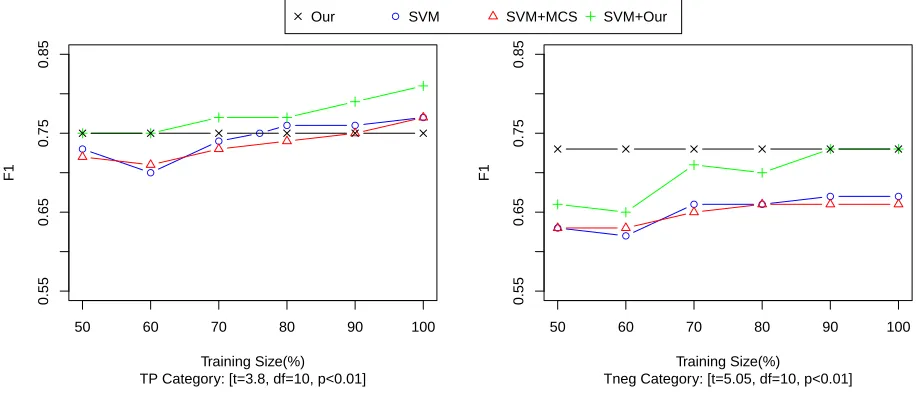
con-figurations are 0.7, 0.7, and 0.74 respectively. We were interested in exploring how much la-beled data would be needed for supervised solution to outperform our unsupervised score alone. We an-alyzed the behavior of the three configurations of the SVM with our unsupervised approach with different training set sizes. Figure 2 shows the F1 values ob-tained by gradually increasing the size of the train-ing dataset3, while testing on the same test set. The
F1 value of our approach remains constant after 50% training data since it has already decided the thresh-old values. Figure 2 shows that the SVM trained with bigrams needs 76% of the training dataset to achieve the F1 value achieved by our unsupervised approach in theTPcategory, and it does not achieve the F1 achieved by our algorithm inTneg category (note the crossing points of the line marked with ‘X’ and line marked with circles).
Figure 2 also shows that the similarity score cal-culated by our algorithm complements the SVM at each data point. After adding our similarity score to the SVM as a feature, it achieved the F1 achieved by our unsupervised algorithm with 50% of the training data in theTPcategory and with 90% of the training data in theTneg category (note the crossing points of the line marked with ‘X’ and line marked with ‘+’). Also, SVM+Our configuration achieved the best F1 value for SVM with just 70% of the train-ing data in theTPcategory and with just 50% of the training data in theTnegcategory. This shows that our similarity score can be used as an effective fea-ture to reduce manual labeling effort and to improve the supervised learning algorithms to solve the IER problem.
Finally, to evaluate the generalization ability of our algorithm and to demonstrate its usage in situ-ations with a lack of training data, we applied it to a set of 80 sentences selected for four new entities (the last four entities in Table 1). Our algorithm pro-duced the following results for these entities when we classify their sentences with the threshold values selected using the training dataset created for the pri-mary entities.
P P = 0.72, P R = 0.77, P F1 = 0.74
NP = 0.78, NR= 0.83, NF1 = 0.80
3We draw these graphs considering training dataset size
50 60 70 80 90 100
0.55
0.65
0.75
0.85
TP Category: [t=3.8, df=10, p<0.01] Training Size(%)
F1
●
●
● ●
● ● ●
50 60 70 80 90 100
0.55
0.65
0.75
0.85
Tneg Category: [t=5.05, df=10, p<0.01] Training Size(%)
F1
●
●
● ● ● ●
●
[image:9.612.73.531.85.283.2]Our SVM SVM+MCS SVM+Our
Figure 2: The variation of the F1 value in theTP(left) andTneg(right) categories with varying sizes of training datasets. These graphs show that the SVM trained with bigrams needs 76% of the training data to achieve the F1 score of our unsupervised method in theTPcategory while it does not achieve the F1 score of our algorithm in theTnegcategory. This also shows that the similarity value calculated by our algorithm complements the SVM trained with bigrams at each data point and helps it to beat or perform on par with our algorithm. The paired T-test values calculated for SVM and SVM+Our configurations show that this is not a random behavior (t- T-test value, df- degree of freedom, p- probability value).
Although negation detection with NegEx is not a contribution of our work, our algorithm enables its application to IER. This is not possible for MCS. NegEx requires two inputs: 1) The sentence, and 2) The term being considered for possible negation. MCS does not detect the key term in the sentence, hence it is not possible to apply NegEx with MCS. However, our algorithm starts with identifying the ERT which is considered for possible negation.
5 Limitations
The candidate sentence selection based on the ERT can be seen as a limitation of our approach since it does not select sentences with implicit entity men-tions that do not use the selected ERT. However, we do not expect this limitation to have a major impact. We asked our domain experts to come up with sen-tences that contain implicit mentions of the entity ‘shortness of breath’ without using its ERT ‘breath-ing’ or its synonyms (‘respiration’ and ‘ventila-tion’). According to them, the sentences‘the patient hadlow oxygen saturation’,‘the patient was gasp-ing for air’, and ‘patient wasair hunger’are such sentences (the emphasis indicates the phrases that imply ‘shortness of breath’). However, we found only 113 occurrences of these phrases as opposed
to 8990 occurrences of its ERTs in our corpus.
6 Conclusion and Future Work
We defined the problem of implicit entity recogni-tionin clinical documents and proposed an unsuper-vised solution that recognizes the implicit mentions of entities using a model built from their definitions in a knowledge base. We showed that our algorithm outperforms the most relevant unsupervised method and it can be used as an effective feature for a su-pervised learning solution based on an SVM. The ability to capture the diverse ways in which an en-tity can be implicitly mentioned by exploiting their definitions with special treatment for two types of negations are the main strengths of our method.
In the future, we will explore the ability to detect the boundary of the phrases with implicit mentions, capture the sentences with implicit mentions with-out selected ERT, and investigate more intensive ex-ploitation of domain knowledge for IER.
7 Acknowledgement
References
ACLWiki. 2014. Paraphrase identification (state of the art). http://aclweb.org/aclwiki/index. php?title=Paraphrase_Identification_
(State_of_the_art). [Online; accessed
19-Dec-2014].
Alan R Aronson. 2006. Metamap: Mapping text to the umls metathesaurus. Bethesda, MD: NLM, NIH, DHHS.
Regina Barzilay and Noemie Elhadad. 2003. Sen-tence alignment for monolingual comparable corpora. In Proceedings of the 2003 conference on Empirical methods in natural language processing, pages 25–32. Association for Computational Linguistics.
Olivier Bodenreider. 2004. The unified medical lan-guage system (umls): integrating biomedical terminol-ogy. Nucleic acids research, 32(suppl 1):D267–D270. Razvan C Bunescu and Marius Pasca. 2006. Using ency-clopedic knowledge for named entity disambiguation. InEACL, volume 6, pages 9–16.
Wendy W Chapman, Will Bridewell, Paul Hanbury, Gre-gory F Cooper, and Bruce G Buchanan. 2001. A sim-ple algorithm for identifying negated findings and dis-eases in discharge summaries. Journal of biomedical informatics, 34(5):301–310.
Michael Collins and Yoram Singer. 1999. Unsupervised models for named entity classification. InProceedings of the joint SIGDAT conference on empirical methods in natural language processing and very large cor-pora, pages 100–110. Citeseer.
Corinna Cortes and Vladimir Vapnik. 1995. Support-vector networks. Machine learning, 20(3):273–297. Bill Dolan, Chris Quirk, and Chris Brockett. 2004.
Unsupervised construction of large paraphrase cor-pora: Exploiting massively parallel news sources. In Proceedings of the 20th international conference on Computational Linguistics, page 350. Association for Computational Linguistics.
Greg Durrett and Dan Klein. 2013. Easy victories and uphill battles in coreference resolution. In EMNLP, pages 1971–1982.
Samuel Fernando and Mark Stevenson. 2008. A seman-tic similarity approach to paraphrase detection. In Pro-ceedings of the 11th Annual Research Colloquium of the UK Special Interest Group for Computational Lin-guistics, pages 45–52. Citeseer.
Carol Friedman, Philip O Alderson, John HM Austin, James J Cimino, and Stephen B Johnson. 1994. A general natural-language text processor for clinical ra-diology. Journal of the American Medical Informatics Association, 1(2):161–174.
Carol Friedman, Lyudmila Shagina, Yves Lussier, and George Hripcsak. 2004. Automated encoding of clin-ical documents based on natural language processing. Journal of the American Medical Informatics Associa-tion, 11(5):392–402.
Xiao Fu and Sophia Ananiadou. 2014. Improving the extraction of clinical concepts from clinical records. Proceedings of BioTxtM14.
Danilo Giampiccolo, Bernardo Magnini, Ido Dagan, and Bill Dolan. 2007. The third pascal recognizing tex-tual entailment challenge. InProceedings of the ACL-PASCAL workshop on textual entailment and para-phrasing, pages 1–9. Association for Computational Linguistics.
Ben Hachey, Will Radford, Joel Nothman, Matthew Hon-nibal, and James R. Curran. 2013. Evaluating entity linking with wikipedia. Artif. Intell., 194:130–150, January.
Jay J Jiang and David W Conrath. 1997. Semantic simi-larity based on corpus statistics and lexical taxonomy. arXiv preprint cmp-lg/9709008.
Adam Lally, John M Prager, Michael C McCord, BK Boguraev, Siddharth Patwardhan, James Fan, Paul Fodor, and Jennifer Chu-Carroll. 2012. Question analysis: How watson reads a clue. IBM Journal of Research and Development, 56(3.4):2–1.
Claudia Leacock and Martin Chodorow. 1998. Com-bining local context and wordnet similarity for word sense identification. WordNet: An electronic lexical database, 49(2):265–283.
Dekang Lin. 1998. An information-theoretic definition of similarity. InICML, volume 98, pages 296–304. Rada Mihalcea, Courtney Corley, and Carlo Strapparava.
2006. Corpus-based and knowledge-based measures of text semantic similarity. InAAAI, volume 6, pages 775–780.
Tomas Mikolov, Kai Chen, Greg Corrado, and Jeffrey Dean. 2013. Efficient estimation of word representa-tions in vector space.arXiv preprint arXiv:1301.3781. David Nadeau and Satoshi Sekine. 2007. A survey of named entity recognition and classification. Lingvisti-cae Investigationes, 30(1):3–26.
Vincent Ng. 2010. Supervised noun phrase coreference research: The first fifteen years. In Proceedings of the 48th Annual Meeting of the Association for Com-putational Linguistics, ACL ’10, pages 1396–1411, Stroudsburg, PA, USA. Association for Computational Linguistics.
Sameer Pradhan, No´emie Elhadad, Wendy Chapman, Suresh Manandhar, and Guergana Savova. 2014. Semeval-2014 task 7: Analysis of clinical text. Se-mEval 2014, 199(99):54.
Sameer Pradhan, No´emie Elhadad, Brett R South, David Martinez, Lee Christensen, Amy Vogel, Hanna Suomi-nen, Wendy W Chapman, and Guergana Savova. 2015. Evaluating the state of the art in disorder recognition and normalization of the clinical narrative. Journal of the American Medical Informatics Associa-tion, 22(1):143–154.
Philip Resnik. 1995. Using information content to evalu-ate semantic similarity in a taxonomy. InProceedings of the 14th International Joint Conference on Artifi-cial Intelligence - Volume 1, IJCAI’95, pages 448–453, San Francisco, CA, USA. Morgan Kaufmann Publish-ers Inc.
Guergana K Savova, James J Masanz, Philip V Ogren, Jiaping Zheng, Sunghwan Sohn, Karin C Kipper-Schuler, and Christopher G Chute. 2010. Mayo clinical text analysis and knowledge extraction system (ctakes): architecture, component evaluation and ap-plications. Journal of the American Medical Informat-ics Association, 17(5):507–513.
Richard Tzong-Han Tsai, Shih-Hung Wu, Wen-Chi Chou, Yu-Chun Lin, Ding He, Jieh Hsiang, Ting-Yi Sung, and Wen-Lian Hsu. 2006. Various criteria in the evaluation of biomedical named entity recognition. BMC bioinformatics, 7(1):92.
Mengqiu Wang. 2006. A survey of answer extraction techniques in factoid question answering. Computa-tional Linguistics, 1(1).
Zhibiao Wu and Martha Palmer. 1994. Verbs semantics and lexical selection. InProceedings of the 32Nd An-nual Meeting on Association for Computational Lin-guistics, ACL ’94, pages 133–138, Stroudsburg, PA, USA. Association for Computational Linguistics. Dell Zhang and Wee Sun Lee. 2003. Question