Original Article
Use of a dual-chamber pacemaker to achieve
an excellent response to cardiac resynchronization
therapy in patients with dilated cardiomyopathy and
complete left bundle branch block: a case report
Lijin Pu1,2*, Yu Wang1,2*, Lulu Zhao2, Baotong Hua1, Shumin Li1, Ling Zhao1,2, Tao Guo1,2
1Department of Cardiology, 2Institute of Cardiovascular Diseases, The First Affiliated Hospital of Kunming Medical University, Kunming, P. R. China. *Co-first authors.
Received June 14, 2016; Accepted August 15, 2016; Epub April 15, 2017; Published April 30, 2017
Abstract: The atrioventricular delay (AVD) in cardiac resynchronization therapy (CRT) is usually programmed to be shorter than the physiological AVD, which can lead to patients non-responsive to CRT. Although the programming of rate-adaptive AV delay (RAAVD) has been recommended for the optimization of the AVD in CRT with a triloculare pacemaker, the response to CRT is disappointing. Moreover, few studies have reported a dual chamber pacemaker to achieve response to CRT based on RAAVD algorithm. This study reported a 58-year-old male patient who was diagnosed with dilated cardiomyopathy and complete left bundle branch block. He achieved an excellent response to CRT with a dual-chamber pacemaker by left univentricular pacing with RAAVD algorithm.
Keywords: Cardiac resynchronization therapy, dilated cardiomyopathy, rate-adaptive atrioventricular delay algo-rithm, optimal atrioventricular delay
Introduction
Cardiac resynchronization therapy (CRT) has
been demonstrated to significantly improve
cardiac function and clinical outcomes in patients with New York Heart Association (NYHA) class III or IV congestive heart failure (CHF) and a left ventricular ejection fraction (LVEF) less than 30%. However, approximately 20-30% of patients are non-responsive to CRT [1]. Fixed short atrioventricular delay (AVD) in current CRT [2] has been considered as one of the reasons, which can abolish the physio-logical AVD of atrioventricular node (AVN),
thereby counteracting the benefit of standard
biventricular (BiV) pacing. It is well known that physiological AVD plays a key role in achieving optimal atrioventricular (AV) synchrony and
atri-al contribution to ventricular filling [3]. There- fore, the optimal AVD is important for patients’ response to CRT. Currently, the programming of rate-adaptive AV delay (RAAVD) has been rec-ommended for the optimization of the AVD in atrioventricular block pacing [4]. To date, few
studies have reported a dual chamber (DDD) pacemaker achieving response to CRT based on RAAVD algorithm. Here, we reported a patient with dilated cardiomyopathy (DCM) and chronic complete left bundle branch block (CLBBB) who was implanted with a DDD pace-maker to achieve an excellent response to CRT by left-univentricular (LUV) pacing with a novel RAAVD algorithm.
Case presentation
A 58-year-old male patient was admitted to the hospital with palpitations and dyspnea after physical activities for more than 1 year (app-
roved by ethical committee of the First
and LVEF was 34%. Electrocardiograph (ECG) revealed a sinus rhythm and CLBBB. Finally, the patient was diagnosed with DCM, CLBBB and NYHA class III by echocardiography.
Based on the diagnosis of DCM and CLBBB, the patient accepted the pacemaker implantation. After the informed consent to implantation of pacemaker was obtained, a DDD pacemaker (Relia RED01, Medtronic, Inc., Minneapolis, MN, USA) was implanted on October 15, 2013. The surgery of DDD pacemaker implantation was performed according to the standard pro-cedure. X-ray percutaneous transluminal
coro-= optimal AVD + (intrinsic PR interval at start rate - intrinsic PR interval at optimization) = 150 + (220 - 190) = 180 (ms); paced AV (PAV) interval for start rate = SAV interval for start rate + ASC = 180 + 30 = 210 (ms); and maxi-mum offset was set at -40 ms (intrinsic PR interval at stop rate - intrinsic PR interval at start rate). Medications were unchanged during follow-up (oral administration of 40 mg furose-mide and 25 mg spironolactone daily). Transthoracic echocardiogram was performed at the follow-up of 6 and 12 months after the device implantation. Cardiac output was
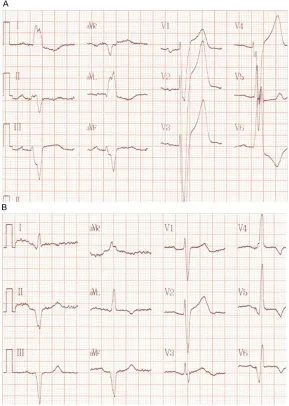
assessed using the LV outflow tract velocity-Figure 1. Comparation of QRS complex between before and after RAAV LUV
pacing. A: Before CRT (CLBBB, QRS duration was 200 ms under intrinsic atrioventricular conduction). B: After LUV pacing with RAAV (QRS duration was 137 ms).
nary angioplasty (PTCA) wire guided electrode of left ven-tricular lead to position in the left posterolateral cardiac vein and right atrium elec-trode in the right atrial appendage. The left ventricu-lar electrode lead and right atrial electrode lead were connected to the jacks on the pulse generator
correspon-dently. The operation was fin -ished successfully without complications.
[image:2.612.89.378.74.480.2]time integrals from apical five-chamber views.
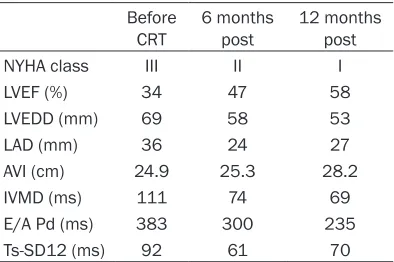
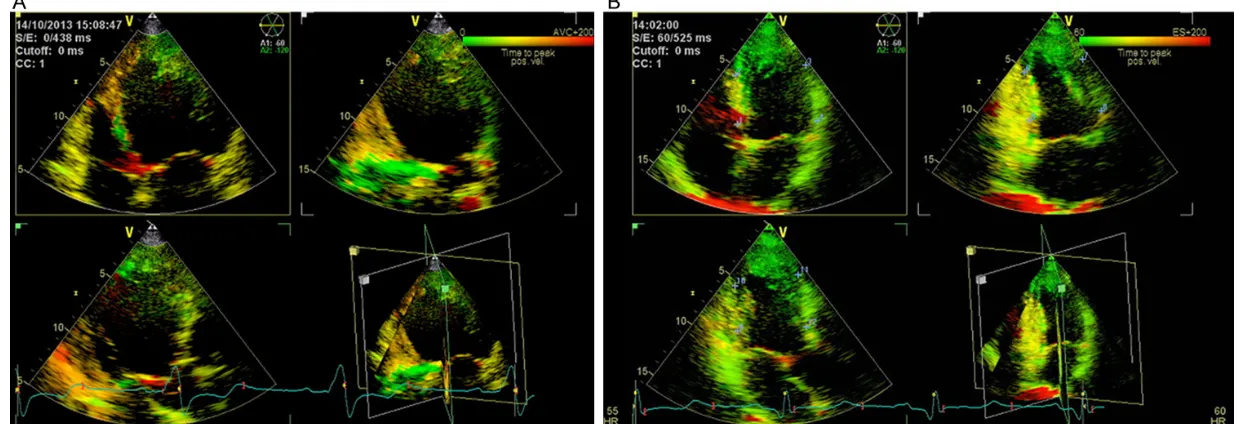
The cardiac function corresponding to each AVD was calculated after the AVD titrated for 5 min. Standard deviation of time intervals of the 12 LV segments (Ts-SD12) was measured. During follow-up, the cardiac function of pati- ent was found to recover very well. Therefore, the patient has never been admitted to hospi- tal again. QRS duration was narrowed from 200 ms to 137 ms after LUV pacing with RAAVD (Figure 1). Compared with the baseline, echo-cardiographic parameters such as LVEF, left ventricular end-diastolic diameter (LVDD), Ts-SD12, AVI, interventricular mechanical delay time (IVMD), and E/A procedure duration (E/A Pd) were improved at 6 and 12 months post-implantation (Table 1). After DDD pacemaker implantation for 12 months, LVEF increased by 24%, and the patient remained in good condi-tion without hospitalizacondi-tion. Chest X-ray showed that the cardiothoracic ratio (CTR) decreased from 56% to 49% (Figure 2). LVDD decreased from 68 to 53 (mm) and cardiac function improved from NYHA class III to I within 1 year. Ts-SD12 at base and papillary levels were improved from 92 ms to 70 ms (Figure 3). QRS duration and morphology did not change with varying HR. Threshold of pacing and sensing of LV lead were 0.75 V and 6 mV, respectively. Percentage of ventricular pacing was 99.7%. Left ventricular output was set at 2.0 V. The average battery life which was automatically calculated by the system was 10 years.
Discussion
In this study, for the first time, we implanted
a dual chamber pacemaker and developed a novel algorithm to preserve the physiological AVD. The results showed that QRS duration was shortened after LUV pacing with RAAVD, as well as the echocardiographic parameters such as NYHA class, LVEF, LVDD, Ts-SD12, AVI, IVMD, and E/A Pd were all improved after DDD pacemaker implantation for 6 and 12 months, which suggested that the patient with DCM and CLBBB achieved an excellent response to CRT by LUV pacing with this novel RAAVD algorithm.
Our results showed that the LUV pacing with RAAVD algorithm shortened the QRS duration from 200 ms to 137 ms in patients with DCM and CLBBB. Because the BiV pacing activation was slowly conducted retrograde through car-diomyocytes via His-Purkinje system, the time for RV activation was longer under the standard BiV pacing than that for physiological activa-tion, which manifested as the longer QRS dura-tion. Previous research had proved that the abnormality of intraventricular conduction was associated with the extension of QRS duration, which increased the percentage of mechanical dyssynchrony, thereby leading to the lower car-diac function and the higher mortality [5]. Therefore, narrow QRS wave under LUV pacing
with RAAVD algorithm may obtain more benefit
than standard BiV pacing and LUV pacing with
fixed AVD.
The first study of the RAAVD in patients with
CRT was reported by Scharf et al. and the results showed that the optimal AVD increased during exercise and a progressive fusion at lon-ger AVD might increase ventricular resynchroni-zation [6]. Therefore, the recommendation by Scharf et al. was suggested to be used with extreme caution. In addition, determined the optimal AVD by simultaneous measurement of electrocardiographic and doppler-echocardio-graphic parameters, and then programmed the RAAVD in CRT [1]. The results showed that opti-mal AVD was shortened with increased HR and the RAAVD parameters in CRT patients was advised to be turned off. Excitingly, our study showed that QRS duration and morphology did not change with varying HR, which demonstrat-ed that RAAVD algorithm could track physiologi-cal AVD and enable fusion of intrinsic right
bun-Table 1. NYHA class and echocardiographic parameters of baseline, 6 and 12 months post-implantation
Before
CRT 6 months post 12 months post
NYHA class III II I
LVEF (%) 34 47 58
LVEDD (mm) 69 58 53
LAD (mm) 36 24 27
AVI (cm) 24.9 25.3 28.2
IVMD (ms) 111 74 69
E/A Pd (ms) 383 300 235
Ts-SD12 (ms) 92 61 70
[image:3.612.91.288.108.239.2]thereby solving the problem that the changes of
fusion and QRS duration resulted from fixed
AVD and intrinsic conduction. This may partly explain the results of the previous studies which showed that fusion was not established and LV pacing was not superior to BiV pacing [7, 8]. Furthermore, the left-sided AVD automati-cally tracked physiological AVD by RAAV algo-rithm to allow fusion with intrinsic conduction coming from the normal-conducting right bun-dle branch, which averted the deleterious effects from right ventricular (RV) pacing, then in- creased device longevity due to unnecessary RV pacing. Higher percentage of ventricular pacing in patients with intact AVD had been found to be associated with increased
inci-dence of atrial fibrillation and heart failure [9]. Our previous study showed that preserving intrinsic conduction via the right bundle branch potentially and pacing LV simultaneously could improve acute hemodynamic effect than stan-dard right BiV pacing and avert deleterious effects from RV pacing [10].
AV and interventricular interval optimization were time-consuming in conventional BiV
pac-ing, and it was difficult to achieve individualiza -tion and dynamic optimiza-tion [11]. However, under LUV pacing with RAAVD algorithm, the intrinsic PR interval was the physiological and
optimal AVD, it was unnecessary to optimize. Therefore, LUV pacing RAAVD algorithm could realize dynamic optimization of AVD, which adapted to physiological alterations during exercise and sympathetic tone changes, and thereby preserving optimal atrial contribution
to ventricular filling. However, a randomized,
multicenter, double-blind, controlled clinical rese-
arch is needed to confirm our finding.
The algorithm tracking physiological AVD in LUV pacing will contribute to the research and development of new pacemaker. Previous study had shown that the numerous proposed
meth-ods, including predefined formulas, iterative
methods and automatic methods, were used to obtain optimized AVD. Recent study had shown that adaptive CRT algorithm (Medtronic, Inc.)
significantly reduces RV pacing and improves
response rates to CRT [12]; however, adaptive CRT algorithm was based on three chamber pacemaker.
[image:4.612.92.525.72.308.2]In conclusion, our LUV pacing with RAAVD algo-rithm could be used in both dual and three-chamber pacemaker. This novel algorithm will cause dispute on preserve or abolish of the physiological AVD of AVN in CRT. The patient with DCM and CLBBB who use dual-chamber pacemaker achieved superior response to CRT by LUV pacing with RAAVD algorithm.
Acknowledgements
This study was supported by two grants from National Natural Science Foundation of China National Science Foundation (81360044) and Yunnan Science and Technology Committee (2013FB133).
Disclosure of conflict of interest
None.
Address correspondence to: Drs. Ling Zhao and Tao Guo, Department of Cardiology, The First
Affiliated Hospital of Kunming Medical University,
295 Xi Chang Road, Kunming 650032, P. R. China. Tel: +8687165324888; Fax: +8687165377618; E-mail: [email protected] (LZ); [email protected] (TG)
References
[1] Melzer C, Bondke H, Körber T, Nienaber CA, Baumann G and Ismer B. Should we use the rate-adaptive AV delay in cardiac resynchroni-zation therapy-pacing? Europace 2008; 10: 53-58.
[2] Ellenbogen KA, Gold MR, Meyer TE, Lozano IF, Mittal S, Waggoner AD, Lemke B, Singh JP, Spinale FG and Van Eyk JE. Primary Results From the SmartDelay Determined AV Opti- mization: A Comparison to Other AV Delay Methods Used in Cardiac Resynchronization Therapy (SMART-AV) Trial A Randomized Trial Comparing Empirical, Echocardiography-Gui- ded, and Algorithmic Atrioventricular Delay Programming in Cardiac Resynchronization Therapy. Circulation 2010; 122: 2660-2668. [3] Antonini L, Auriti A, Pasceri V, Meo A, Pristipino
C, Varveri A, Greco S and Santini M. Opti- mization of the atrioventricular delay in se-quential and biventricular pacing: physiologi-cal bases, critiphysiologi-cal review, and new purposes. Europace 2012; 14: 929-938.
[4] Melzer C, Körber T, Theres H, Nienaber CA, Baumann G and Ismer B. How can the rate-adaptive atrioventricular delay be programmed in atrioventricular block pacing? Europace 2007; 9: 319-324.
[5] Iuliano S, Fisher SG, Karasik PE, Fletcher RD and Singh SN. QRS duration and mortality in patients with congestive heart failure. Am Heart J 2002; 143: 1085-1091.
[6] Scharf C, Li P, Muntwyler J, Chugh A, Oral H, Pelosi F, Morady F and Armstrong WF. Rate-dependent AV delay optimization in cardiac re-synchronization therapy. Pacing Clin Electro-physiol 2005; 28: 279-284.
[7] Rao RK, Kumar UN, Schafer J, Viloria E, De Lurgio D and Foster E. Reduced ventricular volumes and improved systolic function with cardiac resynchronization therapy a random-ized trial comparing simultaneous biventricu-lar pacing, sequential biventricubiventricu-lar pacing, and left ventricular pacing. Circulation 2007; 115: 2136-2144.
[8] Thibault B, Ducharme A, Harel F, White M, O’Meara E, Guertin MC, Lavoie J, Frasure-Smith N, Dubuc M and Guerra P. Left ven- tricular versus simultaneous biventricular pacing in patients with heart failure and a
QRS complex ≥ 120 milliseconds. Circulation
2011; 124: 2874-2881.
[9] Sweeney MO, Hellkamp AS, Ellenbogen KA, Greenspon AJ, Freedman RA, Lee KL and Lamas GA. Adverse effect of ventricular pac-
ing on heart failure and atrial fibrillation
am-ong patients with normal baseline QRS dura-tion in a clinical trial of pacemaker therapy for sinus node dysfunction. Circulation 2003; 107: 2932-2937.
[10] Pu LJ, Wang Y, Zhao L, Luo ZL, Hua BT, Han MH, Li SM, Yang J, Li L, Peng YZ and Guo T. Cardiac resynchronization therapy (CRT) with right ventricular sense triggered left
ventricu-lar pacing benefits for the hemodynamics
compared with standard CRT for chronic con-gestive heart failure: A cross-over study. Cardiol J 2015; 22: 80-86.
[11] Brugada J, Brachmann J, Delnoy PP, Padeletti L, Reynolds D, Ritter P, Borri-Brunetto A and Singh JP. Automatic Optimization of Cardiac Resynchronization Therapy Using SonR-Ra- tionale and Design of the Clinical Trial of the SonRtip Lead and Automatic AV-VV Optimi- zation Algorithm in the Paradym RF SonR CRT-D (RESPOND CRT) Trial. Am Heart J 2014; 167: 429-436.