Patterns of Wisdom: Discourse-Level Style in Multi-Sentence Quotations
Kyle Booten and Marti A. Hearst UC Berkeley
Berkeley, CA 94720
[email protected], [email protected]
Abstract
Quotations are kernels not just of wisdom but also of beautiful and striking language. While recent studies have characterized the stylistic features of quotations, we characterize the or-derof stylistic information within quotations. Analyzing a corpus of two-sentence quota-tions collected from the social network Tum-blr, we explore the ways that both low-level features and high-level features tend to occur in either the first or second sentence. Through analysis of examples, we interpret these ten-dencies as manifestations of rhetorical pat-terns. Results from a prediction task suggest that stylistic patterns are more prominent in quotations than in a comparison corpus.
1 Introduction
The ancient arts of rhetoric described ways of wield-ing language to make it particularly persuasive or memorable. Central in this endeavor—a predecessor to modern linguistics (Dolven, 2013)—was the de-scription of rhetorical “tropes” or “figures,” patterns of language from the level of the phoneme (as in the case of rhyme or alliteration) to higher-level syntac-tic and even logical structures (Peacham, 1954). In the figure ofepistrophe, successive clauses end with the same words. In pysma, the speaker (or writer) launches a series of sharp and vehement questions; this and other rhetorical figures describe language at the level of discourse—that is, the relationship be-tween linguistic elements across sentences.
Recent studies of quotations have described what makes certain fragments of text more memorable than others (Danescu-Niculescu-Mizil et al., 2012;
Guerini et al., 2015); this ongoing project can be seen as a contemporary, empirical investigation of the rhetorical arts. Inspired by the way that clas-sical rhetoricians described complicated and high-level linguistic patterns, the present study takes the novel step of analyzing the way linguistic elements are sequenced within quotations. After describing a minimalistic set of stylistic features designed to cap-ture common patterns in quotations, we demonstrate that some features tend to occur in certain positions within a quotation. We investigate whether quotes are more predictable than other genres in a “Quote Ordering Task” in which the goal is to distinguish the correct version of a quotation from one whose sentences have been reversed.
2 Related Work
2.1 Style of Memorable Language
Danescu-Niculescu-Mizil et al. (2012) used a vari-ety of features to distinguish popular movie quota-tions from unmemorable lines from the same movie. By modeling word and part-of-speech sequences of quotes and non-quotes, they found that quotations tended to use less common words but that these words were placed in more common syntactic pat-terns. The researchers evocatively hint at some “common syntactic scaffolding” that structures quo-tations, and we build on this finding by characteriz-ing these patterns. They also found that quotations tend to contain linguistic features that make them more “generalizable,” such as tendency toward in-definite over in-definite articles.
Other researchers have attempted to analyze quo-tations in ways that evoke the traditional figures
of rhetoric. Exploring the same movie quotes cor-pus as well as other corpora, Guerini et al. (2015) found that memorable quotes were more euphonic, with more instances of rhyme and alliteration than their non-memorable counterparts. Kuznetsova et al. (2013) developed several methods for quantify-ing the creativity of word combinations like “dis-advantageous peace,” and found that quotes were more likely to contain creative combinations than non-quotes. In terms of classical rhetoric, such un-expected word combinations could embody figures such asoxymoron.
2.2 High-Level Style
To investigate quotations in a new way, we are in-spired by researchers who have analyzed text qual-ity using what may be called “high-level” features — i.e., moving beyond the specific lexical, syntac-tic, or phonemic properties of sentences to explore the overall structure of sentences or even the discur-sive relationships between them.
Feng et al. (2012) engineered features from sen-tences’ CFG parse trees to describe their overall structure and classify them in terms of a priori
rhetorical categories, such as loose vs. periodic. They found that these features were helpful for au-thorship classification, and a later study used similar features to predict the success of novels (Ashok et al., 2013). Wible and Tsao (2010) and Gianfortoni et al. (2011) designed n-gram based features to capture local lexico-syntactic sequences within sentences.
Looking at the level of discourse, Louis and Nenkova (2012) found that adjacent sentences “ex-hibit stable patterns of syntactic co-occurence” — i.e., certain types of sentences tend to follow certain other types of sentences. Furthermore, they demon-strated that sentences with similar communicative purposes are syntactically similar, so syntax can be taken as a proxy for communicative purpose. We build on both of these observations.
3 Data-sets
Quotations 1. We gathered a data-set of quotations from the social network Tumblr (Chang et al., 2014). Like other social networks, Tumblr has become a place where users frequently share quotations. In fact, users have the option of using a “quote”
data-type, which provides separate text-entry fields for the quotation and its source. We gathered quotes via Tumblr’s API. Users sometimes use the “quote” data-type to share messages that are not actually quotations, most often brief personal musings. To minimize such non-quotes in our corpus, we re-tained only those quotes that users themselves had described with the hashtag “#quote.” Since we were interested primarily in discourse-level schemas of quotations, we retained only quotations that were exactly two sentences long. In the pre-processing of this and other corpora we removed repeats within and between corpora. We also removed quotations containing quotations (i.e. reported speech), as they were used in highly inconsistent ways in the Tumblr data. (n=4237)
Quotations 2. A test set. We repeated the same steps described above for Tumblr quotes gathered with the “#quotation” hashtag. (n=1846)
Non-Quotes 1.As a comparison corpus, we gath-ered two-sentence paragraphs from the Brown cor-pus (Francis and Kucera, 1979). After the same pre-processing steps, we were left with a collection of such paragraphs. (n=1846)
Non-Quotes 2. Again mining the Brown Corpus, we also gathered sequential pairs of sentences ran-domly chosen from paragraphs longer than two sen-tences. (n=1846)
4 Features
Take the following quotation from our data set, at-tributed to Philip Roth: “You cannot observe peo-ple through an ideology. Your ideology observes for you.”1 In simple terms, this quotation is a
nega-tive statement (“cannot”) followed by a positive one. Yet the opposite pattern can likewise appear in quo-tations, as in this one attributed to William Blake: “Great things are done when men and mountains meet. This is not done by jostling in the street.” Some quotations begin with questions; others end with them. Some (like the one by Roth) begin with a generic “you,” while others deploy this pronoun in the second sentence. We describe each sentence of each quotation in terms of the following features meant to capture general lexical and syntactic
pat-1This quote also exemplifiesantimetabole, in which words
Feature #S1 #S2 χ2 NQ2? Highestχ2
It 60 175 56.3 x
But 18 93 50.7 x
it 266 436 41.2 x
And 33 93 28.6 x
They 7 44 26.8 x
Other Unigrams
People 21 2 15.7
? 120 66 15.7
simply 3 20 12.6
Do 38 13 12.3
Love 19 3 11.6
When 43 22 6.8
n’t 262 209 6.0
not 212 170 4.6
What 45 28 4.0
High-Level
CC + NP + VP . 11 68 41.1 x
WHNP + SQ + S + . 39 9 18.7
NP + VP + . 883 748 11.2
WHADVP + SQ + . 18 5 7.3
CC + PP + , + NP + VP + . 2 12 7.1
CC + SBAR + , + NP + VP + . 5 16 5.8
IN + NP + VP + . 2 10 5.3
S + , + S + CC + S + . 5 0 5.0
INTJ + , + NP + VP + . 7 1 4.5
[image:3.612.76.294.58.334.2]CC + NP + ADVP + VP + . 2 9 4.5
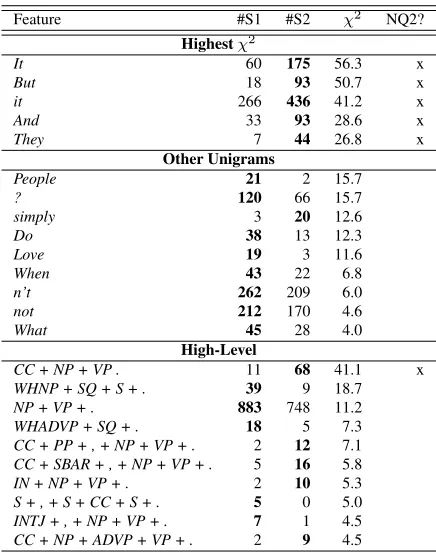
Table 1: Features that preferentially occur in a sentence posi-tion, sorted byχ2value; dominant sentence position is in bold. Highestχ2represents the top five unigrams. Other Unigrams represents other select examples. NQ2 is whether feature is also ordered in the same way in the comparison corpus (“x” if this is the case).
terns in quotations, regardless of what other more classical rhetorical figures they may contain.
Unigrams. As a baseline feature, we note in which sentence, 1 or 2, a unigram occurs.
High-Level Syntax.Feng et al. (2012) found that the top level of syntactic parse trees (in the case of Stanford PCFG Parser’s output, which we also used (Klein and Manning, 2003), two levels beneath
ROOT) provided a useful feature for authorship iden-tification. For instance, the sentence “Forgotten is forgiven.” can be represented by the constructionNP + VP + ., a noun phrase followed by a verb phrase followed by punctuation. This feature, they argue, provides an interpretable representation of the gen-eral syntactic structure of a sentence. We directly employ this feature.
General/Abstract Words. Through qualitative analysis of our data, we noticed that many quota-tion make pronouncements about nouns that might be considered as generalizations or abstractions. For
instance: “Peace comes from within. Do not seek it without.” In this case, the abstract noun “peace” is the subject of the first sentence. To capture such nouns, we first use the Stanford Dependency Parser (Chen and Manning, 2014) to extract all words in the head position of nominal subject dependencies (excluding stopwords). Using WordNet, we check whether the word’s most common synset is both within the hyponym hierarchy of the synset “ab-straction.n.06” and within a minimum distance (5) of it2; if so, we consider this noun Abstract.3 The
most common such nouns in the Quotations 1 cor-pus are not necessarily concept words like “peace”. For instance, the word “men” appears in this list; many quotations use the word to evoke a general-ized (male) subject.4 We consider a nominal
sub-ject to be General if it is within a minimum distance (6) of its root hypernym. As a feature, we observe which (if either) sentence contains more such Ab-stract or General nouns, normalized by the number of nominal subject dependencies per sentence.
5 Differences Between Sentence Positions
5.1 Feature Comparison
Using balanced subsets of Quotations 1 and Non-Quotes 1 (n=1846), we investigated which feature was more likely to occur in either one of the two sentences’ positions within a two-sentence text. For each feature we used aχ2 test (α=.05) to compare the number of times the feature occurred in first sen-tences with the number of times the feature occurred in second sentences. Table 1 presents features with a statistically-significant tendency to appear in one sentence or the other, limited to those features that occur at least 5 times and are among the 300 most common features of its type for that corpus. We sug-gest that this type of analysis can shed light on some of the overarching stylistic strategies of quotations:
Negative-to-Positive: As shown in Table 1, “n’t”
2We found this number by taking the whole number above
the mean of distances to the “abstraction.n.06” synset of a sam-ple of nouns from Project Gutenberg text. For General words we did the same but averaging distances to a noun’s root hyper-nym.
3Kao and Jurafsky Kao and Jurafsky (2012) investigated
ab-stractions in poetry using a dictionary of abstract terms.
4“The mass of men lead lives of quiet desperation.” (H.D.
and “not” were ore likely to occur in the first sen-tence position than the second sensen-tence position. This tendency suggests that quotations that begin with a negative construction (like the earlier quote by Roth) are more common than those ending with one (like the earlier quote by Blake). Quotes that contain “not” in the first sentence often use the first sentence to make a negative claim about reality, fol-lowed by a positive claim. Such quotations tend to use repetitive structures or other types of paral-lelism, such asantimetabole:
We are not human beings having a spiritual experience. We are spiritual beings having a human experience. (P. de Chardin)
In quotations, “Never” was also more likely to oc-cur in the first sentence than the second sentence, as was “Do”; studying examples revealed that “Do” was very often followed by “not” or “n’t.” These sta-tistical tendencies point to the ways that Negative-to-Positive constructions also take the form of a neg-ative commandment (e.g., “Never doX”) in the first sentence, followed either by a positive command-ment or an explanation of the reasoning for the com-mandment:
Do not worry about your difficulties in mathe-matics. I can assure you mine are still greater. (A. Einstein)
Cross-Sentence Conjunction: For both Quota-tions 1 and Non-Quotes 1, the high-level syntax fea-ture with the highestχ2value wasCC + NP + VP +
.. This feature tended to occur in the second tence for both collections; likewise, for both sen-tences “But” and “And” were more likely to appear in the second sentence. This is not surprising, as co-ordinating conjunctions mark the “conjunction” re-lationship of cohesion (Halliday and Hasan, 2014) (i.e. clauses that begin with conjunctions like “But” implicitly refer back to a previous clause). How-ever, for Quotations 1, this syntax pattern was over six times as likely to occur in the second sentence, compared to nearly two times for Non-Quotes 2, a statistically-significant difference (χ2, p<.01). In the Quotations 1 corpus, other high-level features beginning with a coordinating conjunction were also more likely to occur in sentence 1 than 2, including
CC + PP + , + NP + VP + .andCC + SBAR + , + NP + VP + .. For instance:
Where a goat can go, a man can go. And where a man can go, he can drag a gun. (William Phillips)
Similarly, the high-level syntax pattern IN + NP + VP + . was more likely to occur in the second
sen-tences of quotations than the first sentence; this pat-tern also indicates cohesion:
One of the most adventurous things left us is to go to bed. For no one can lay a hand on our dreams. (E.V. Lucas)
We note that either of these quotations could be rephrased as a single sentence, such as:
One of the most adventurous things left us is to go to bed, for no one can lay a hand on our dreams.
We speculate that there is something stylistically powerful about such sentences in which the second sentence begins with a coordinating or subordinating conjunction. (Perhaps such quotations create a “dra-matic” pause for the reader between the sentences.)
Questions: Table 1 shows that high-level syntax patterns that indicate questions,WHNP + SQ + .and
WHADVP + SQ + .occurred more frequently in the first sentence position than the second sentence po-sition, as did the unigram “When.” Examining data with theWHNP + SQ + .pattern revealed that many of these quotations were actually jokes that take the form of a question/answer dyad.
Sweeping Declarations: For Quotations 1, Ab-stract Nouns and General Nouns as nominal subjects were more prevalent in the first than in the second sentence (χ2, p<.01). For Non-Quotes 1, General Nouns were also significantly more likely to occur in the first sentence (χ2, p<.01); this was not the case for General Nouns. For quotations only, however, “is” was more likely to occur in the first sentence; likewise, the NP + VP + . pattern was also more likely to occur in the first sentences of quotations. Remaining open to other interpretations, we suggest that these facts point to the tendency of quotations to begin with sweeping declarations about “people,” “life,” “truth,” and other broad concepts, kernels of wisdom which the next sentence elaborates or illus-trates:
Love is a trap. When it appears, we see only its light, not its shadows. (P. Coelho)
I used to dream about escaping my ordinary life, but my life was never ordinary. I had sim-ply failed to notice how extraordinary it was. (R. Riggs)
6 Quote Order Task
We have analyzed stylistic patterns in quotations. However, are these patterns characteristic of quo-tations? To explore this question and to investigate the overall robustness of our features, we define a
Quote Ordering Task, the goal of which is to dis-tinguish between the original and reversed versions of a quotation. This experiment is in the tradition of tasks for evaluating models of text coherence, such as the one used by Louis and Nenkova (2012). During training, the classifier is shown either the
originalor reversedversion of a quote. At
test time, the classifier must identify each quote as eitheroriginalorreversed.
We conducted two experiments. First, using Naive Bayes classifiers, we performed a 5-fold cross-validation test on balanced subsets of three of the four data-sets: Quotations 1, Non-Quotes 1, and Non-Quotes 2 (n=1846 for each). Next we trained on all of Quotations 1 (n=4237) and tested on a sep-arate test set, Quotations 2 (n=1846). In this sec-ond test, we trained on both the original and
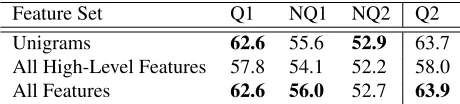
reversedversion of each quote. Table 2 reports results for both tests under various conditions.
For these tests, “high-level features” refers to high-level syntax (of the first sentence, of the sec-ond sentence, and both in a sequence), which if either sentence contains more Abstract Nouns, and which if either sentence contain more Gen-eral Nouns. Combined with unigrams (includ-ing stopwords), these features offered slight but not statistically-significant benefit for Non-Quotes 1 in the cross-validation test and slight but not statistically-significant benefit in the second test (testing on Quotations 2). It remains a challenge to integrate such features for classification purposes.
In both tests, however, we were able to predict the order of quotations upwards of 60% of the time. This was not the case for the non-quotes corpora. In cross-validation, the classifier achieved a high score of 62.6% on Quotations 1, 56.0% on Non-Quotes 1, and 52.9% on Non-Quotes 2. The mean top score for Quotations 1 was higher than for the other two
[image:5.612.313.543.62.114.2]col-Feature Set Q1 NQ1 NQ2 Q2 Unigrams 62.6 55.6 52.9 63.7 All High-Level Features 57.8 54.1 52.2 58.0 All Features 62.6 56.0 52.7 63.9 Table 2:Performance on Quote Ordering Task for Quotations 1, Non-Quotes 1, and Non-Quotes 2 (5-fold cross-validation, baseline = 50%) and on a separate test set, Quotations 2 (base-line = 52%).
lections (two-tailed t-test,p<.01). This is evidence that quotations as a genre are more “formulaic” than other textual sequences, their order more easily pre-dicted. We suggest that adherence to latent stylis-tic patterns is part of what makes quotations seem quotable; as rhetoricians have observed since antiq-uity, there is power in a pattern.
7 Conclusion
We have analyzed linguistic style not merely as the
presenceof features but also the order of features across sentences. In quotations, certain words as well as categories of words and syntactic patterns are more likely to appear in the first or second of two-sentence texts. While other genres may also ex-hibit regularities in the patterning of stylistic infor-mation, our results indicate that this stylistic pattern-ing may be especially strong in quotations. Further research could compare a wider variety of genres. Next steps include investigating the relationship to rhetorical goals and running studies with users to de-termine if they are consciously aware of these stylis-tic elements when they post quotations. We would like to a better understanding of why people chose to share the quotations they do.
References
Vikas Ganjigunte Ashok, Song Feng, and Yejin Choi. 2013. Success with style: Using writing style to pre-dict the success of novels. Poetry, 580(9):70.
Michael Bendersky and David A Smith. 2012. A dictio-nary of wisdom and wit: Learning to extract quotable phrases. In Proceedings of the NAACL-HLT 2012 Workshop on Computational Linguistics for Litera-ture, pages 69–77.
Yi Chang, Lei Tang, Yoshiyuki Inagaki, and Yan Liu. 2014. What is tumblr: A statistical overview and comparison. ACM SIGKDD Explorations Newsletter, 16(1):21–29.
Danqi Chen and Christopher D Manning. 2014. A fast and accurate dependency parser using neural net-works. InEMNLP, pages 740–750.
Cristian Danescu-Niculescu-Mizil, Justin Cheng, Jon Kleinberg, and Lillian Lee. 2012. You had me at hello: How phrasing affects memorability. In Pro-ceedings of the 50th Annual Meeting of the Association for Computational Linguistics, pages 892–901. Asso-ciation for Computational Linguistics.
Jeff Dolven. 2013. Style. In Roland Greene, editor,The New Princeton Encyclopedia of Poetry and Poetics, pages 1369–1370. Princeton University Press, Prince-ton.
Song Feng, Ritwik Banerjee, and Yejin Choi. 2012. Characterizing stylistic elements in syntactic struc-ture. In Proceedings of the 2012 Joint Conference on Empirical Methods in Natural Language Process-ing and Computational Natural Language LearnProcess-ing, pages 1522–1533. Association for Computational Lin-guistics.
W Nelson Francis and Henry Kucera. 1979. Brown cor-pus manual. Brown University.
Philip Gianfortoni, David Adamson, and Carolyn P Ros´e. 2011. Modeling of stylistic variation in social me-dia with stretchy patterns. InProceedings of the First Workshop on Algorithms and Resources for Modelling of Dialects and Language Varieties, pages 49–59. As-sociation for Computational Linguistics.
Marco Guerini, G¨ozde ¨Ozbal, and Carlo Strapparava. 2015. Echoes of persuasion: The effect of euphony in persuasive communication. In Human Language Technologies: The 2015 Annual Conference of the North American Chapter of the ACL (NAACL 2015), pages 1483–1493.
Michael Alexander Kirkwood Halliday and Ruqaiya Hasan. 2014. Cohesion in english. Routledge. Justine Kao and Dan Jurafsky. 2012. A computational
analysis of style, affect, and imagery in contemporary poetry. In NAACL Workshop on Computational Lin-guistics for Literature, pages 8–17.
Dan Klein and Christopher D Manning. 2003. Ac-curate unlexicalized parsing. In Proceedings of the 41st Annual Meeting on Association for Computa-tional Linguistics-Volume 1, pages 423–430. Associ-ation for ComputAssoci-ational Linguistics.
Polina Kuznetsova, Jianfu Chen, and Yejin Choi. 2013. Understanding and quantifying creativity in lexical composition. InEMNLP, pages 1246–1258.
Annie Louis and Ani Nenkova. 2012. A coherence model based on syntactic patterns. In Proceedings of the 2012 Joint Conference on Empirical Methods in Natural Language Processing and Computational Natural Language Learning, pages 1157–1168. Asso-ciation for Computational Linguistics.
Henry Peacham. 1954. The garden of eloquence (1593): a facsimile reproduction. Scholars’ Facsimiles & Reprints.
Tony Veale. 2011. Creative language retrieval: A robust hybrid of information retrieval and linguistic creativ-ity. InProceedings of the 49th Annual Meeting of the Association for Computational Linguistics: Human Language Technologies-Volume 1, pages 278–287. As-sociation for Computational Linguistics.