Debiasing Word Embeddings Improves Multimodal Machine Translation
Tosho Hirasawa Tokyo Metropolitan University
Mamoru Komachi Tokyo Metropolitan University
Abstract
In recent years, pretrained word embed-dings have proved useful for multimodal neural machine translation (NMT) mod-els to address the shortage of available datasets. However, the integration of pretrained word embeddings has not yet been explored extensively. Further, pre-trained word embeddings in high dimen-sional spaces have been reported to suf-fer from the hubness problem. Although some debiasing techniques have been pro-posed to address this problem for other nat-ural language processing tasks, they have seldom been studied for multimodal NMT models. In this study, we examine various kinds of word embeddings and introduce two debiasing techniques for three mul-timodal NMT models and two language pairs — English–German translation and English–French translation. With our op-timal settings, the overall performance of multimodal models was improved by up to +1.62 BLEU and +1.14 METEOR for English–German translation and +1.40 BLEU and +1.13 METEOR for English– French translation.
1 Introduction
Inmultimodal machine translation, a target sen-tence is translated from a source sensen-tence together with related nonlinguistic information such as vi-sual information. Recently, neural machine trans-lation (NMT) has superseded traditional statisti-cal machine translation owing to the introduction
c
⃝2019 The authors. This article is licensed under a Creative Commons 4.0 licence, no derivative works, attribution, CC-BY-ND.
of the attentive encoder-decoder model, in which machine translation is treated as a sequence-to-sequence learning problem and is trained to pay attention to the source sentence while decoding (Bahdanau et al., 2015).
Pretrained word embeddings are considered an important part of neural network models in many natural language processing (NLP) tasks. In the context of NMT, pretrained word embeddings have proved useful in low-resource domains (Qi et al., 2018), in which FastText (Bojanowski et al., 2017) embeddings are used to initialize the encoder and decoder of the NMT model. They provided sub-stantial overall performance improvement for low-resource language pairs. Similarly, Hirasawa et al. (2019) introduced a multimodal NMT model with embedding prediction that provided substan-tial performance improvement.
However, when word embeddings are used in the k-nearest neighbor (kNN) problem, certain words appear frequently in thek-nearest neighbors for other words (Dinu et al., 2015; Faruqui et al., 2016); this is called the hubness problem in the general machine learning domain (Radovanovi´c et al., 2010). This phenomenon harms the utility of pretrained word embeddings. In the context of NMT, Rios Gonzales et al. (2017) reported that NMT models produce less-accurate translations for less-frequent words, but they are not aware of the hubness problem in word embeddings. Instead, they proposed annotating sense labels or lexical la-bels to address this problem. However, it is known to be effective to debias word embeddings based on their local bias (Hara et al., 2015) or global bias (Mu and Viswanath, 2018) for word analogy tasks, which does not require extra expensive annotations and references.
well-established word embeddings and introduce de-biasing techniques for multimodal NMT models. The main contributions of this study are as follows:
1. We show that GloVe word embeddings are useful for various multimodal NMT models irrespective of the extent to which visual fea-tures are used in them.
2. We introduce All-but-the-Top debiasing tech-nique for pretrained word embeddings to fur-ther improve multimodal NMT models.
2 Related Works
With the recent development of multimodal paral-lel corpora such as Multi30K (Elliott et al., 2016), many multimodal NMT models have been pro-posed. Most of these models are divided into two categories: visual feature integration and multitask learning. In both categories, visual features are ex-tracted using image processing techniques.
Visual feature adaptation Visual features are extracted using image processing techniques and then integrated into a machine translation model in many ways. These studies include incorpora-tion with visual features in NMT models (Calixto et al., 2017; Zhou et al., 2018) and multitask learn-ing models (Elliott and K´ad´ar, 2017; Zhou et al., 2018), as discussed later in Section 3.
Data augmentation Owing to the lack of the available datasets, data augmentation is widely studied in multimodal NMT. Compared to a paral-lel corpus without images (Gr¨onroos et al., 2018) and a pseudo-parallel corpus (Helcl et al., 2018), few studies have used monolingual data. Hirasawa et al. (2019) proposed a multimodal NMT model with embedding prediction to fully use pretrained word embeddings. However, the use of word em-beddings has not been studied among various mul-timodal NMT models. We examine three differ-ent word embeddings for three multimodal NMT models.
3 Multimodal Neural Machine Translation
In this study, we measure the effectiveness of pretrained word embeddings for doubly-attentive NMT (Calixto et al., 2017), IMAGINATION (Elliott and K´ad´ar, 2017), and visual attention grounding NMT (Zhou et al., 2018); these use
visual feature integration, multitask learning, and mixed model, respectively.
First, in visual feature integration, visual fea-tures are incorporated into NMT models in differ-ent ways. Calixto et al. (2017) separately calculate textual and visual context vectors using an atten-tion mechanism and then forward the concatenated context vector to output the probabilities of target words. Caglayan et al. (2018) use hidden states in the encoder to mask the local visual features and concatenate the textual context vector and the masked visual context vector to obtain the final context vector.
Second, in multitask learning, most multitask learning models use latent space learning as an auxiliary task. Models share the encoder between the main translation task and the auxiliary task, thereby improving the encoder. Elliott and K´ad´ar (2017) proposed the IMAGINATION model that learns to construct the corresponding visual feature from the hidden states of the textual encoder of a source sentence.
Third, visual feature integration and multitask learning are not mutually exclusive and can be used together. Zhou et al. (2018) compute the text representation from a source sentence while paying attention to each word based on the paired image. This text representation is used in both the machine translation task and the shared space learning task.
All of these models tackle machine transla-tion as a sequence-to-sequence learning prob-lem in which a neural model is trained to translate a source sentence of N–tokens x = {x1, x2,· · · , xN} into the target sentence ofM–
tokensy ={y1, y2,· · ·, yM}.
3.1 Doubly-attentive NMT
Doubly-attentive NMT (Calixto et al., 2017) has a simple encoder and a modified decoder from Bah-danau et al. (2015) that uses two individual atten-tion mechanisms to compute the textual context vector and the visual context vector.
Architecture The encoder is a bidirectional gated recurrent unit (GRU) (Cho et al., 2014), in which a forward GRU encodes source sentencex in the normal order to generate a sequence of for-ward hidden states→−h ={−h→1,h−→2,· · · ,−→hN}and a
hidden states h for each position i are given as a concatenation of each forward hidden state and each backward hidden state.
− →
hi = −−−→GRU(−−→hi−1,eenc(xi)) (1)
←−
hi = ←−−−GRU(←−−hi+1,eenc(xi)) (2)
hi = [−→hi;←h−i] (3)
wherei∈[1, N]denotes each position in a source sentence; −−−→GRU and ←−−−GRU are the forward and backward GRU, respectively; andeenc(xi) is the
embedding representation for a wordxi.
While decoding, the model first computes a hid-den state proposalsjfor each time stepj∈[1, M].
sj = GRU(ˆsj−1,edec(ˆyj−1)) (4)
where sˆj−1 is the previous hidden state and
edec(ˆyj−1)is the embedding for the previous
out-put wordyˆj−1.
The textual context vector and the visual con-text vector are computed using two independent attention mechanisms. In each time step j while decoding, a feed-forward layer is used to calculate a normalized soft alignmentαj,iwith each source
hidden statehi, and the textual context vector ctj
is computed as a weighted sum of source hidden states.
ztj,i = vttanh(Uαtsj +Wαthi) (5)
αtj,i = exp(z
t j,i)
∑N
k=1exp(ztj,k)
(6)
ctj =
N
∑
i=1
αtj,ihi (7)
wherevt,Uαt andWαt are model parameters.
The visual context vector cv
j is also computed
from the spatial visual features vi of the paired
image in the same manner as the textual context vector along with the gating scalar mechanism, in which a scalar variable is computed based on the previous hidden state to decide how much atten-tion should be paid to the entire visual features.
zj,iv = vvtanh(Uαvsj+Wαvvi) (8)
αvj,i = exp(z
v j,i)
∑N
k=1exp(zj,kv )
(9)
βj = σ(Wssˆj−1+bs) (10)
cvj = βj N
∑
i=1
αvj,ivi (11)
wherevv,Uαv,Wαv,Ws, andbsare model
param-eters. σ is the gating scalar function learnt while training; it projects a vector to a scalar value and activates with a sigmoid function.
The final hidden statesˆj is computed using the
hidden state proposal sj, textual context ctj, and
visual contextcvj.
zj =σz(Wztctj +Wzvcvj +Wzˆsj) (12)
rj =σr(Wrtctj+Wrvcvj +Wrˆsj) (13)
s′j = tanh(Wztctj+Wzvcvj +rj⊙(Uˆsj)) (14)
ˆ
sj = (1−zj)⊙s′j+zj ⊙sj (15)
whereσzandσrare feed-forward layers with
sig-moid activation, and Wt
z, Wzv, Wz, Wrt, Wrv,
Wr,Wzt,Wzv, andU are model parameters.
The system output at timestepj is obtained us-ing the current hidden state, previous word embed-ding, textual context, and visual context.
p(w|yˆ<j) = softmax(tanh(Lssˆj
+Lwedec(ˆyj−1) +Ltctj +Licvj))
(16)
ˆ
yj = argmax w∈V {
p(w|yˆ<j)} (17)
whereLs,Lw,LtandLiare model parameters. Loss function We use the negative log likeli-hood of the probabilities to generate reference to-kens as the loss functionJfor this model.
J =−
M
∑
j=1
log(p(yj|yˆ<j)) (18)
3.2 IMAGINATION
IMAGINATION (Elliott and K´ad´ar, 2017) is a multitask learning model that jointly learns ma-chine translation and visual latent space models. It trains an NMT model for a machine translation task and a latent space learning model for an auxil-iary task, in which a source sentence and the paired image are mapped closely in the latent space. The models for each task share the same encoder in a multitask scenario.
Architecture The encoder is the same as that in the doubly-attentive NMT model described in Sec-tion 3.1. The decoder in the NMT model is the same as that proposed by Bahdanau et al. (2015); it first computes the hidden state proposalsj, then
states, and finally outputs the predicted wordyjfor
each time stepj∈[1, M].
sj = GRU(ˆsj−1,edec(ˆyj−1)) (19)
zj,i = vatanh(Wasj +Uahi) (20)
αj,i =
exp(zj,i)
∑N
k=1exp(zj,k)
(21)
cj = N
∑
i=1
αj,ihi (22)
p(w|yˆ<j) = softmax(tanh(sj+edec(ˆyj−1)+cj))
(23) ˆ
yj = argmax w∈V {
p(w|yˆ<j)} (24)
whereWa,Uaandvaare model parameters.
The latent space learning model calculates the average vector over the hidden stateshiin the en-coder and maps it to the final vectorvˆin the latent space.
ˆ
v= tanh(Wv·
1 N
N
∑
i
hi) (25)
whereWvis a model parameter.
Loss function The loss function for IMAGINA-TION is the linear interpolation of loss functions of each task.
J =λJT(θ, ϕT) + (1−λ)JV(θ, ϕV) (26)
whereθis the parameter of the shared encoder;ϕT
andϕV are parameters of the machine translation
model and latent space model, respectively; andλ is the interpolation coefficient1.
We use the loss function defined in Eq. 18 for the NMT modelJT(θ, ϕT).
JT(θ, ϕT) =−
M
∑
j=1
log(p(yj|yˆ<j)) (27)
The max margin loss is used as the loss function for latent space learning; it makes corresponding latent vectors of a source sentence and the paired image closer.
JV(θ, ϕV) =
∑
v′̸=v
max{0, α−d(vˆ,v) +d(vˆ,v′)}
(28) where v is the latent vector of the paired image; v′, the image vector for other examples;d, the co-sine similarity function that is used to calculate the word similarity; andα, the margin that adjusts the sparseness of each vector in the latent space2.
1We useλ= 0.5in our experiment. 2We useα= 0.1in our experiment.
3.3 Visual Attention Grounding NMT
Visual Attention Grounding NMT (VAG-NMT) (Zhou et al., 2018) uses a combination of the visual feature integration model and the multitask learn-ing model, which also uses latent space learnlearn-ing as the auxiliary task.
Architecture The shared encoder of this model is an extension of Bahdanau et al. (2015), in which the model computes the sentence representationt by paying attention to the hidden states hi based
on the visual featurev.
zi = tanh(Wvv)·tanh(Whhi) (29)
βi =
exp(zi)
∑N
k=1exp(zk)
(30)
t =
N
∑
i=1
βihi (31)
whereWvandWhare model parameters.
The decoder of the NMT model is the same as that used in IMAGINATION (Section 3.2) with a slight modification for initializing the hidden state with the sentence representationt.
s0= tanh(Winit(ρt+ (1−ρ)
1 N
N
∑
i
hi)) (32)
whereWinitis a model parameter; andρ, a
hyper-parameter to determine the ratio of text representa-tion in the decoder initial state3.
In latent space learning, both the sentence repre-sentationtand the visual representationvare pro-jected to the latent space and made closer in the space during training.
temb = tanh(Wtt+bt) (33)
vemb = tanh(Wvv+bv) (34)
whereWt,bt,Wv, andbvare model parameters.
Loss function The loss function for VAG-NET is given as described in Eq.26, and we use the loss function defined in Eq.27 forJT(θ, ϕT).
The max margin loss with negative sampling is used as the loss function for latent space learning.
JV(θ, ϕV)
=∑
p
∑
k
max{0, γ−d(vp,tp) +d(vp,tk̸=p)}
+∑
k
∑
p
max{0, γ−d(tk,vk) +d(tp,vk̸=p)}
wheredis a cosine similarity function;kandpis the index for sentences and images, respectively; tk̸=p, the negative samples for which all examples
in the same batch with the target example are se-lected; andγ, the margin that adjusts the sparse-ness of each item in the latent space4.
4 Word Embedding
In this study, we compare three different word embeddings: word2vec (Mikolov et al., 2013), GloVe (Pennington et al., 2014), and FastText (Bo-janowski et al., 2017). Section 5.1 describes the configurations to build each embedding.
When we use word embeddings of high dimen-sion in the kNN problem in which the similar-ity of two words is computed using a distance function, certain words frequently appear in the k-nearest neighbors of other words (Dinu et al., 2015; Faruqui et al., 2016); this is called the hubness problem in the general machine learning domain (Radovanovi´c et al., 2010). This phe-nomenon harms the utility of pretrained word em-beddings. In the context of NMT, Rios Gonzales et al. (2017) report that less-frequent words are trans-lated with low-accuracy; that may be influenced by the hubness problem.
To address this problem, localized centering (Hara et al., 2015) and All-but-the-Top (Mu and Viswanath, 2018) have been proposed in NLP lit-erature, in which pretrained word embeddings are debiased using the local bias of each word or the global bias of the entire vocabulary. In this study, both debiasing techniques are tested for all embed-ding types.
Localized centering Localized centering shifts each word based on its local bias. The local cen-troid for each wordxis computed and subtracted from the original wordxto obtain the new embed-dingx.ˆ
ck(x) =
1 k
∑
x′∈kNN(x)
x′ (36)
ˆ
x = x−ck(x) (37)
wherekis a hyperparameter called local segment size5;kNN(x)returns thek–nearest neighbors of
the wordx.
4We useγ= 0.1in our experiment. 5We usek= 10in our experiment.
Language Lines Types Tokens English 96M 10M 2,347M
German 35M 11M 829M
[image:5.595.329.525.299.383.2]French 39M 4M 703M
Table 1:Statistics of Wikipedia corpus for each language.
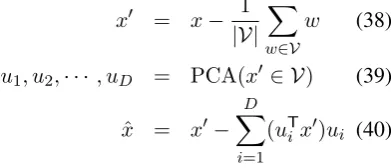
All-but-the-Top All-but-the-Top uses the global bias of the entire vocabulary to shift the embedding of each word. The algorithm of All-but-the-Top has three steps: subtract the centroid of all words from each wordx, compute the PCA components for the centered space, and subtract the topnPCA components from each centered word to obtain the final wordx.ˆ
x′ = x− 1 |V|
∑
w∈V
w (38)
u1, u2,· · · , uD = PCA(x′∈ V) (39)
ˆ
x = x′−
D
∑
i=1
(uTix′)ui (40)
where D is a hyperparameter that is used to de-termine how many principal components of pre-trained word embeddings are ignored6.
5 Experiment 5.1 Word Embeddings
Training corpus As publicly available pre-trained word embeddings use different training corpora, we created a monolingual corpus from Wikipedia for a fair comparison. We downloaded the January 20, 2019, version of Wikidump for En-glish, German, and French7 and extracted article
pages. All extracted sentences are preprocessed by lower-casing, tokenizing, and normalizing the punctuation using the Moses script 8. Table 1
shows the statistics of the preprocessed Wikipedia corpus for each language.
Training settings All embeddings trained on Wikipedia have a dimension of 300. The specific options set for training are as follows; default val-ues were used for other options.
We trained the word2vec model9 using the
CBOW algorithm with window size of 10, nega-6We useD= 3in our experiment.
7https://dumps.wikimedia.org/
8We applied preprocessing using task1-tokenize.sh from https://github.com/multi30k/dataset.
tive sampling of 10, and minimum count of 10; the GloVe model10with windows size of 10 and
mini-mum count of 10; and the FastText model11using
the CBOW algorithm with word n-gram of 5, win-dow size of 5, and negative sampling of 10.
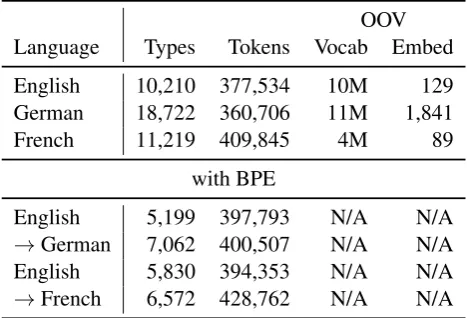
Unknown words There are two types of un-known words: words that are a part of pretrained word embeddings but are not included in a vo-cabulary (Out-Of-Vovo-cabulary (OOV) words) and words that are a part of a vocabulary but are not included in pretrained word embeddings (OOV words for embeddings). OOV words for dings only exist when using word-level embed-dings (word2vec and glove); the embedembed-dings of such words in FastText are calculated as the mean embedding of character n-grams consisting of the word.
The embeddings for both types of OOV words are calculated as the average embedding over words that are a part of pretrained word embed-dings but are not included in the vocabularies, and they are updated individually during training.
5.2 Dataset
We train, validate, and test all multimodal NMT models using the Multi30K (Elliott et al., 2016) dataset. English is selected as the source lan-guage, and German/French are selected as target languages. All sentences in all languages are pre-processed by lower-casing, tokenizing, and nor-malizing the punctuation.
We run experiments without byte pair encod-ing (BPE) (Sennrich et al., 2016) for all models as BPE breaks a word into subwords, resulting in an increase in OOV words for word2vec and GloVe embeddings. In addition, we also run ex-periments using BPE with 10k merge operations to show the utility of pretrained word embeddings. The BPE subwords are shared for source and tar-get languages and learnt from training dataset12.
Table 2 shows the statistics of vocabularies in the Multi30K training data.
Visual features are extracted using pretrained ResNet-50 (He et al., 2016). We encode all images in the Multi30K dataset using ResNet-50 and pick out the hidden state in the res4f layer of 1024D for the doubly-attentive model, and that in the pool5
10We train using https://github.com/stanfordnlp/GloVe. 11We train using https://github.com/facebookresearch/fastText. 12We use https://github.com/rsennrich/subword-nmt to train and apply BPE.
OOV Language Types Tokens Vocab Embed English 10,210 377,534 10M 129 German 18,722 360,706 11M 1,841
French 11,219 409,845 4M 89
with BPE
[image:6.595.305.539.73.232.2]English 5,199 397,793 N/A N/A →German 7,062 400,507 N/A N/A English 5,830 394,353 N/A N/A →French 6,572 428,762 N/A N/A
Table 2: Statistics of vocabularies without BPE (upper) and with BPE (lower) in Multi30K training data. “Vocab” denotes the number of OOV words for the vocabulary. “Embed” de-notes the number of OOV words for embeddings. “English→
German” shows statistics of the shared subwords for English– German translation, and “English→ French” for English– French translation.
layer of 2048D for IMAGINATION and VAG-NET, respectively.
5.3 Model
All models are implemented using nmtpytorch toolkit v3.0.013(Caglayan et al., 2017).
The encoder for each model has one layer with 256 hidden dimensions, and therefore the bidirec-tional GRU has 512 dimensions. We set the latent space vector size for IMAGINATION to 2048 and the dimension of the shared visual-text space for VAG-NET to 512. The input word embedding size and output vector size are 300 each.
We use the Adam optimizer with learning rate of 0.0004. The gradient norm is clipped to 1.0. The dropout rate is 0.3.
English→German
debiasing None Localized Centering All-but-the-Top
Model embedding BLEU METEOR BLEU METEOR BLEU METEOR
NMT random 34.57 54.50
Doubly-attentive random 33.50 52.75 IMAGINATION random 34.97 54.21
VAG-NET random 35.55 54.87
NMT word2vec 34.23 52.83 34.14 53.09 33.88 52.66
[image:7.595.80.521.92.372.2]GloVe 35.49 55.14 35.33 54.89 35.98 55.15 FastText 33.63 52.48 33.42 52.34 33.91 52.65 Doubly-attentive word2vec 32.05 50.85 32.07 51.23 32.73 51.04 GloVe 34.06 53.74 33.37 52.98 34.77 53.86 FastText 31.14 49.29 31.04 50.33 30.86 50.13 IMAGINATION word2vec 33.97 52.59 33.43 52.32 34.35 52.79 GloVe 35.74 55.00 35.92 55.15 36.59 55.35 FastText 34.21 52.53 33.69 52.22 33.83 52.31 VAG-NET word2vec 34.32 53.01 34.10 53.40 33.91 52.70 GloVe 36.01 55.31 35.56 54.61 36.36 55.17 FastText 34.12 52.56 33.92 52.75 33.82 52.38
Table 3: Results obtained using Multi30K test2016 dataset for English–German translation. “NMT” shows the results of Bahdanau et al. (2015). When the debiasing is “None,” we show the results obtained with raw pretrained word embeddings or random values.
English→French
debiasing None Localized Centering All-but-the-Top
Model embedding BLEU METEOR BLEU METEOR BLEU METEOR
NMT random 57.15 72.47
Doubly-attentive random 54.85 71.06 IMAGINATION random 57.38 72.57
VAG-NET random 57.78 73.21
NMT word2vec 55.65 70.79 55.82 70.90 56.20 71.20
GloVe 58.14 73.67 57.76 73.00 58.24 73.40 FastText 55.13 70.18 55.24 70.56 55.42 70.60 Doubly-attentive word2vec 52.32 68.06 53.30 68.98 52.95 68.68 GloVe 56.25 72.19 54.58 71.23 56.12 71.91 FastText 50.46 66.35 51.02 67.20 51.22 67.09 IMAGINATION word2vec 55.94 70.91 55.63 70.73 55.96 70.93 GloVe 57.89 73.09 57.65 73.16 58.10 73.26 FastText 55.12 70.17 55.52 70.77 55.52 70.42 VAG-NET word2vec 56.23 71.14 55.79 70.82 56.33 71.34 GloVe 58.45 73.59 57.31 73.16 57.94 73.40 FastText 55.25 70.45 55.33 70.51 55.49 70.63
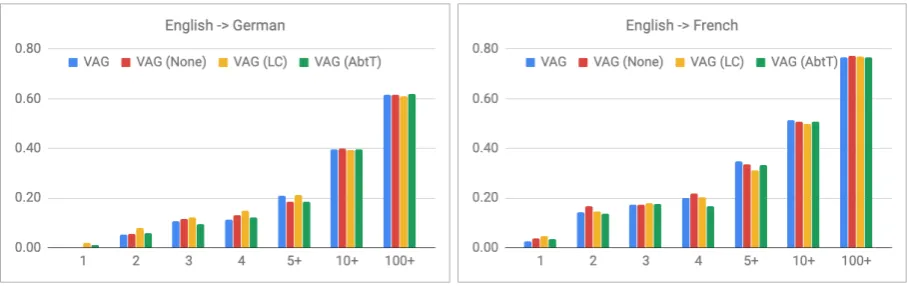
[image:7.595.79.522.427.727.2]Figure 1: F-score of word prediction per frequency breakdown in training corpus. The model without brackets is initialized with random values: “(None),” GloVe without debiasing; “(LC),” GloVe with localized centering; and “(AbtT),” GloVe with All-but-the-Top.
Source two men playing guitar in front of a large au-dience .
Reference zwei m¨anner spielen gitarre vor einem großen publikum .
VAG zwei m¨anner spielen vor einem großen pub-likum gitarre .
[image:8.595.79.525.264.402.2]VAG (GloVe) zwei m¨anner spielen gitarre vor einem großen publikum .
Table 5:Examples of English–German translations obtained using test dataset. “(GloVe)” denotes the model with the optimal settings for GloVe.
5.4 Results
Table 3 shows the overall performance of the randomly initialized models and the models ini-tialized with pretrained word embeddings for English–German translation. Though GloVe em-beddings show considerable improvement for both in text-only NMT and all types of multimodal NMT, word2vec and FastText embeddings greatly reduce model performance even with some debi-asing. With GloVe embeddings, All-but-the-Top debiasing results in further improvement. In par-ticular, IMAGINATION is improved with GloVe embedding initialization (+0.77 BLEU and +0.79 METEOR) and showed further improvement with All-but-the-Top debiasing (+1.62 BLEU and +1.14 METEOR).
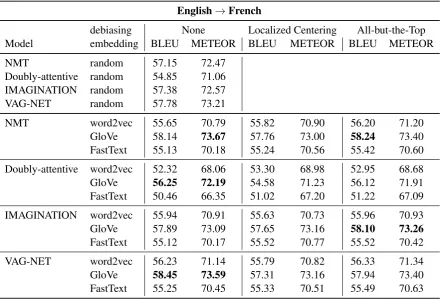
Table 4 shows that the combination of GloVe embedding and All-but-the-Top debiasing greatly improves the overall performance of each model for English–French translation. The model with GloVe and All-but-the-Top surpasses the randomly
13https://github.com/toshohirasawa/mmt-emb-init
initialized model by +1.09 BLEU and +0.93 ME-TEOR in the text-only NMT model, by +1.27 BLEU and +0.85 METEOR in the doubly-attentive model, by +0.72 BLEU and +0.69 METEOR in the IMAGINATION model, by +0.16 BLEU and +0.19 METEOR in the VAG-NET model, respec-tively.
6 Discussion
Word embedding In our study, GloVe performs the best among three word embeddings, while word2vec and FastText do not help multimodal NMT models; the degradation of word2vec is at-tributed to the cohesiveness of word embeddings and that of FastText the shortage of training data, respectively.
English→German
BPE Init BLEU METEOR
No random 35.55 54.87 No GloVe 36.36 55.17 Yes random 35.46 55.30
English→French
BPE Init BLEU METEOR
[image:9.595.102.281.72.258.2]No random 57.78 73.21 No GloVe 58.45 73.59 Yes random 56.63 72.38
Table 6:Results of VAG-NET with various settings obtained using Multi30K test2016 dataset for English–German transla-tion (upper) and English–French translatransla-tion (lower). “BPE” denotes whether a model uses BPE. “Init” denotes the ini-tialization strategy: “random,” a model initialized using ran-dom values and “GloVe,” a model initialized using GloVe em-beddings with All-but-the-Top debiasing (English–German) or without debiasing (English–French).
word representations from almost the same value i.e. the mean vector of entire embeddings.
FastText requires more training data than GloVe does, as it learns not only embeddings for words but also those of their subwords. Our pre-trained word embeddings are pre-trained using only Wikipedia and do not use Common Crawl; it con-tains at least 50 times tokens and three times words than Wikipedia does, and is used together with Wikipedia to construct FastText embeddings that improve NMT models (Qi et al., 2018).
Debiasing All-but-the-Top improves most of models for both English–German translation and English–French translation; this may prove the idea suggested in Mu and Viswanath (2018), in which neural network models may not be able to learn the debiasing technique by themselves.
In contrast, models using localized centering only show a comparable performance with models not using debiasing. It is because that the debiased vector has small norm and thus the additional train-ing may break the relation of debiased vectors, as localized centering subtracts the local centroid of a word that is quite similar with the word. This observation is contrary with Hara et al. (2015), in which debiased word embeddings are used without the additional training.
Languages We found that pretrained word em-beddings are more useful for English–German translation than for English–French translation. The best models with GloVe embedding surpasses the randomly initialized model by +1.28 BLEU in average for English–German translation, but by only +0.97 BLEU for English–French translation with the optimal settings. This is because the Ger-man decoder has more unique words (18,722 for German and 11,219 for French, as listed in Table 2) in the original training dataset, resulting in less in-vocabulary words after restricting the vocabu-lary and making it difficult for the German decoder learn embeddings from scratch.
BPE BPE is an alternative approach to improve translation quality. Therefore, we compared the VAG-NET model with GloVe embeddings and the VAG-NET model with BPE to validate which ap-proach would contribute more to the overall per-formance (Table 6). Although BPE does not improve the VAG-NET model for both English– German and English-French translation, GloVe embeddings provide a substantial improvement in both language pairs.
Translation quality To understand the model performance for translating rare words, we com-puted the F-score of VAG-NET models with var-ious debiasing techniques (Figure 1). Although VAG-NET models with GloVe embeddings out-perform the model with random initialization, we do not observe a consistent improvement for rare word translation, as reported in (Qi et al., 2018). Translation examples Table 5 shows English– German translations generated by VAG-NET mod-els with different initialization strategies. Com-pared to the model without pretrained word em-beddings, the model with GloVe embeddings gen-erates a more fluent sentence.
7 Conclusion
We have explored the use of pretrained word em-beddings with various multimodal NMT models. We showed that GloVe embeddings improve the performance of all multimodal translation models, and All-but-the-Top debiasing can result in further improvement.
em-beddings. For example, fine-tuning word embed-dings based on BLEU or other metrics for machine translation could further improve the compatibility of pretrained word embeddings with multimodal NMT models.
Acknowledgment
This work was partially supported by JSPS Grant-in-Aid for Scientific Research (C) Grant Number JP19K12099.
References
Bahdanau, Dzmitry, Kyunghyun Cho, and Yoshua Ben-gio. 2015. Neural machine translation by jointly
learning to align and translate. InICLR.
Bojanowski, Piotr, Edouard Grave, Armand Joulin, and Tomas Mikolov. 2017. Enriching word vectors with
subword information. In TACL, volume 5, pages
135–146.
Caglayan, Ozan, Mercedes Garc´ıa-Mart´ınez, Adrien Bardet, Walid Aransa, Fethi Bougares, and Lo¨ıc Bar-rault. 2017. NMTPY: A flexible toolkit for
ad-vanced neural machine translation systems. Prague
Bull. Math. Linguistics, pages 15–28.
Caglayan, Ozan, Adrien Bardet, Fethi Bougares, Lo¨ıc Barrault, Kai Wang, Marc Masana, Luis Herranz, and Joost van de Weijer. 2018. LIUM-CVC submis-sions for WMT18 multimodal translation task. In
WMT, pages 597–602.
Calixto, Iacer, Qun Liu, and Nick Campbell. 2017. Doubly-attentive decoder for multi-modal neural
machine translation. InACL, pages 1913–1924.
Cho, Kyunghyun, Bart van Merrienboer, Dzmitry Bah-danau, and Yoshua Bengio. 2014. On the properties of neural machine translation: Encoder–decoder
ap-proaches. In Proceedings of SSST-8, Eighth
Work-shop on Syntax, Semantics and Structure in Statisti-cal Translation, pages 103–111.
Denkowski, Michael and Alon Lavie. 2014. Meteor Universal: Language specific translation evaluation
for any target language. InWMT, pages 376–380.
Dinu, Georgiana, Angeliki Lazaridou, and Marco Ba-roni. 2015. Improving zero-shot learning by
mit-igating the hubness problem. In ICLR, Workshop
Track.
Elliott, Desmond and `Akos K´ad´ar. 2017. Imagination
improves multimodal translation. InIJCNLP, pages
130–141.
Elliott, Desmond, Stella Frank, Khalil Sima’an, and Lu-cia SpeLu-cia. 2016. Multi30k: Multilingual
English-German image descriptions. InProceedings of the
5th Workshop on Vision and Language, pages 70–74.
Faruqui, Manaal, Yulia Tsvetkov, Pushpendre Rastogi, and Chris Dyer. 2016. Problems with evaluation of word embeddings using word similarity tasks. In Proceedings of the 1st Workshop on Evaluating Vector-Space Representations for NLP, pages 30–35, August.
Gr¨onroos, Stig-Arne, Benoit Huet, Mikko Kurimo, Jorma Laaksonen, Bernard Merialdo, Phu Pham, Mats Sj¨oberg, Umut Sulubacak, J¨org Tiedemann, Raphael Troncy, and Ra´ul V´azquez. 2018. The MeMAD submission to the WMT18 multimodal
translation task. InWMT, pages 603–611.
Hara, Kazuo, Ikumi Suzuki, Masashi Shimbo, Kei Kobayashi, Kenji Fukumizu, and Miloˇs Radovanovi´c. 2015. Localized Centering:
Reduc-ing hubness in large-sample data. InAAAI, pages
2645–2651.
He, Kaiming, Xiangyu Zhang, Shaoqing Ren, and Jian Sun. 2016. Deep residual learning for image
recog-nition. InCVPR, pages 770–778.
Helcl, Jindˇrich, Jindˇrich Libovick´y, and Dusan Varis. 2018. CUNI system for the WMT18 multimodal
translation task. InWMT, pages 616–623.
Hirasawa, Tosho, Hayahide Yamagishi, Yukio Mat-sumura, and Mamoru Komachi. 2019. Multimodal machine translation with embedding prediction. In
NAACL SRW, pages 86–91.
Mikolov, Tomas, Ilya Sutskever, Kai Chen, Greg S Cor-rado, and Jeff Dean. 2013. Distributed representa-tions of words and phrases and their
compositional-ity. InNIPS, pages 3111–3119.
Mimno, David and Laure Thompson. 2017. The strange geometry of skip-gram with negative
sam-pling. InEMNLP, pages 2873–2878.
Mu, Jiaqi and Pramod Viswanath. 2018. All-but-the-Top: Simple and effective postprocessing for word
representations. InICLR.
Papineni, Kishore, Salim Roukos, Todd Ward, and Wei-Jing Zhu. 2002. BLEU: a method for automatic
evaluation of machine translation. In ACL, pages
311–318.
Pennington, Jeffrey, Richard Socher, and Christo-pher D. Manning. 2014. GloVe: Global vectors for
word representation. InEMNLP, pages 1532–1543.
Qi, Ye, Devendra Sachan, Matthieu Felix, Sarguna Pad-manabhan, and Graham Neubig. 2018. When and why are pre-trained word embeddings useful for
neu-ral machine translation? InNAACL, pages 529–535.
Radovanovi´c, Miloˇs, Alexandros Nanopoulos, and Mir-jana Ivanovi´c. 2010. Hubs in Space: Popular
Near-est Neighbors in High-Dimensional Data.Journal of
Rios Gonzales, Annette, Laura Mascarell, and Rico Sennrich. 2017. Improving Word Sense Disam-biguation in Neural Machine Translation with Sense
Embeddings. InWMT, pages 11–19.
Sennrich, Rico, Barry Haddow, and Alexandra Birch. 2016. Neural machine translation of rare words with
subword units. InACL, pages 1715–1725.
Zhou, Mingyang, Runxiang Cheng, Yong Jae Lee, and Zhou Yu. 2018. A visual attention grounding neu-ral model for multimodal machine translation. In