FinTOC-2019 Shared Task: Finding Title in Text Blocks
Hanna Abi Akl Yseop
Anubhav Gupta Yseop
Dominique Mariko Yseop
Abstract
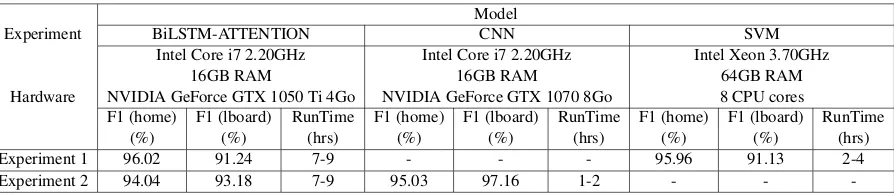
As part of FNP Workshop Series, “Title Detec-tion” is one of the two shared tasks proposed on Financial Document Structure Extraction. The objective of the task was to classify a given text block, that had been extracted from financial prospectuses in pdf format, as a title. Our DNN-based approach scored a weighted F1 of 97.16% on the test data.
1 Introduction
The Portable Document Format, also known as pdf, is an electronic document format from Adobe Inc. Launched in early 1990s, this format has now become the de-facto means of sharing informa-tion across the Internet. However, given the lack of ”basic high level logical structure information” (Chao and Fan, 2004), the process of layout and content extraction from a pdf is difficult. The ob-stacles in extracting information from a pdf, as enumerated byHu and Liu(2014), are:
• absence of information regarding structure
• disagreement of the render order with the “reading order”
• overlap of object blocks
• myriad layouts and fonts
Consider the process of automating the infor-mation extraction from financial documents. Not being able to recognize where a paragraph begins or ends in a financial report can be a strain on many levels: a) it not only blurs important infor-mation, but b) can also be misleading in decisions taken based on said report. Though a number of open-source and commercial tools are available, the goal of establishing correctly a semantic unit (paragraphs, tables) and ascertaining its role (title,
header) is far from being complete (Bast and Ko-rzen,2017).
The FinTOC-2019 Shared Task: “Financial Document Structure Extraction” (Juge et al.,
2019) ofFinancial Narrative Processing Work-shopcomprises two shared-tasks:
• Title detection
• TOC structure extraction
In this paper, we propose and evaluate three methods to detect titles (Shared Task 1). Since text comes in many different formats, this problem can become exponentially heavy to treat. For that pur-pose, our experiment is concerned with identifying only titles in pdf reports.
2 Experiments
Our first approach was to use a standard SVM classifier (Cortes and Vapnik,1995) to understand the data and evaluate their non-linearity. The sec-ond and third approaches are based on deep learn-ing classifiers. The second design is inspired by a BiLSTM recurrent neural network (RNN) model with attention (Zhou et al.,2016). The third model is a convolutional neural network (CNN) with character embedding (Zhang et al.,2015).
2.1 Data
and addresses were erroneously marked as be-gins with numbering. Even though the original pdf files were provided we decided to work only with the provided xml and csv files because a) the result needed to be submitted in the provided csv format and b) the heuristic to transform xml into text blocks (as presented in csv) was unknown.
2.2 Approach
The first model we evaluated was a SVM classifier. It was trained on a combination of features, com-piled from the existing features presented within the original csv file as well as additional features extracted from pre-processing work on the xml files (similar to format and linguistic features of
Hu et al. (2006)). These features capture layout and form of the text, which can play a deciding part in the classification. In addition to the pro-vided features, we computed:
1. top: integer indicating the placement of the text with respect to the top of the document page
2. left: integer indicating the placement of the text with respect to the left of the document page
3. width: integer indicating the horizontal space occupied by the text
4. height: integer indicating the vertical space occupied by the text
5. font:integer indicating the size of the text
6. number of dots: integer indicating the total number of dots in the text
7. is last character dot:binary indicating if the text ends with a dot (1) or not (0)
8. count of capital letters: integer indicating the total number of capital characters in the text
9. character count: integer indicating the total number of characters in the text
10. word count: integer indicating the total number of words in the text
11. average word length:float indicating the av-erage number of characters per word in the text
12. number count: integer indicating the total number of digits in the text
13. count of words in capital:integer indicating the total number of capitalized words in the text
14. similarly avg word length: integer indicat-ing average token length
15. cnn outputbinary prediction provided by the CNN model (described later).
The observed variance and results were very close with and without the CNN outputs added as input features, so after evaluation of the noise in the features (as predictors), we decided to foster two deep learning approaches based on raw text entries and to focus on regularisation methods to prevent high variance observed in the SVM results.
The second model is a BiLSTM–Attention model relying on word embedding. It has 2 dense layers, each composed of 64 neurons and is de-ployed with a batch size of 256 and 100 epochs. The purpose of this method is to evaluate the pos-sible semantic composition of sentences (as pre-dictors) and how relevant they are for the task. It contains five components:
1. Input layer:inputs text to the model
2. Embedding layer: parses text into words and maps each word into a low dimension vector
3. LSTM layer: makes use of BiLSTM to get high-level features from the previous step
4. Attention layer: produces a weight vector, and merges word-level features from each time step into a sentence-level feature vector, by multiplying the weight vector
5. Output layer: uses the sentence-level fea-ture vector for classification
Experiment
Model
BiLSTM-ATTENTION CNN SVM
Hardware
Intel Core i7 2.20GHz 16GB RAM
NVIDIA GeForce GTX 1050 Ti 4Go
Intel Core i7 2.20GHz 16GB RAM
NVIDIA GeForce GTX 1070 8Go
Intel Xeon 3.70GHz 64GB RAM 8 CPU cores F1 (home)
(%)
F1 (lboard) (%)
RunTime (hrs)
F1 (home) (%)
F1 (lboard) (%)
RunTime (hrs)
F1 (home) (%)
F1 (lboard) (%)
RunTime (hrs) Experiment 1 96.02 91.24 7-9 - - - 95.96 91.13 2-4 Experiment 2 94.04 93.18 7-9 95.03 97.16 1-2 - -
-Table 1: Comparative table of results provided for leaderboard
hyper-parameter selection follows the findings of (Zhou et al., 2016) for the neural network. The number of layers, batch size, number of epochs, and learning rate have all been picked from a referenced model which achieved competitive results against state-of-the-art networks. The sequence length has been chosen to match the number of characters in the longest sentence. We also used dropout to regularize the network and alleviate over-fitting. Between experiments 1 and 2, we increased the number of hidden units from 32 to 64 to improve the accuracy of the model.
The third model is a CNN classifier. The pur-pose of this method is to evaluate the combina-torics of characters at word level (as predictors) and how relevant they are for the task. A state-of-the-art competitive word-level character embed-ded convolution network is used. The model fol-lows the conclusion of Zhang et al. (2015) for tackling small dimensional problems: integrating both upper-case and lower-case letters in set of predictors might improve the results in case the data set is small (AG news case). This consider-ation was reinforced by the intuition that identify-ing both small and capital characters was relevant for the Title detection task, which was confirmed by comparing between the results driven from dif-ferentiating between upper and lower cases and the those driven by lower-case only. From a dic-tionary of all characters included in the training set, a character embedding operation is performed on all sentences. Word-level character embedding size of 175 is chosen for this transformation and sentences are turned into a matrix of embedded characters. This matrix is then fed to the CNN, which has the following characteristics:
1. Convolution layers: 2D convolution (4 con-volution layers)
2. Pooling layers: 1D convolution reducing
di-mensions
3. Fully connected layers: transformation pro-viding the prediction from softmax probabil-ities.
4. Parameters selection: In order to reduce the variance while training, we used a stan-dard dropout of 0.5 at each epoch. Aug-menting or reducing the dropout has showed worse results. We also added a cross vali-dation step from a set of 1500 individuals, evaluated every ten epoch, the best epoch in this evaluation range was then chosen to be-come the warm start for the next 10 epochs. The number of layers chosen is the best trade off we found between a deeper network, our GPU computational capacity and runtime. The model was trained on 100 epochs, but converges quickly towards epoch 40, which eventually provided the best results.
2.3 Evaluation
For the given training data set, approximately 1 in 6 text blocks was a title. Thus, it was a case of class imbalance. A classifier which labels every text block as ‘non-title’ scored a weighted F1 of
[image:3.595.78.525.61.159.2]CNN Model AUC (train)
(%)
F1 (home) (%)
RunTime (hrs) Intel Core i7 2.20GHz
16GB RAM NVIDIA GeForce GTX 1070 8Go
91.41 95.03 1-2
Intel Core i7 2.20GHz 16GB RAM NVIDIA GeForce GTX 1050 Ti 4Go
[image:4.595.190.409.61.140.2]90.99 95.01 5
Table 2: Compared results for CNN, GPU dependent
3 Related Works
Most of the literature deals with extraction of in-formation from scientific documents since they are publicly available and in large quantity. Gao et al. (2011) exploited common typesetting prac-tice (Style Consistency of page Components) in books to extract structural information from pdf documents. Their solution was based on weighted bipartite graphs and optimal matching based on Kuhn-Munkres algorithm. A similar approach was used byKlampfl et al.(2014) to analyse the struc-ture of scientific articles. They defined a heading as a text block that appears, in reading order, be-fore amaintext block. Other defining features of a heading, according to them, are:
• starts with a number or a capital letter
• consists of at least one non-whitespace letter
• has at most 3 lines
• font size is not less that of surrounding text blocks
• distance to the text block is not more than a given level
According to Constantin et al. (2013), the dif-ferentiating feature of a title is font frequency. In other words, since titles occur less frequently in a document their font will also be rare with respect to other fonts present in the document.
Most of the works that process financial doc-uments focus on obtaining tabular data from the files. Potvin et al. (2016) employs rectilinear search algorithm andChen et al.(2017) makes use of rectangle mining (REMINE).
In summary, almost every approach utilizes the geometric data available in pdf files to analyse and extract their content.
4 Conclusions
We proposed three different approaches to tackle the problem of title identification. Designing and
working with different architectures allows room for improvement. For the BiLSTM-Attention model, depth can be experimented with by adding more layers and invigorating existing layers with more neurons. Of course, a subliminal challenge here would be accommodating the necessary hard-ware and supplying enough computational power to run such model in a reasonable time. For the CNN model, there are many possibilities in exper-imenting by acting on each component separately and fine-tuning its hyper-parameters, trying to op-timize the network for small dimensional sets. We have not tried initializing the weights with a spe-cific distribution yet and though the number of possible convolutions is limited by our GPU ca-pacity, we believe there is room for performance improvement optimising the convolution graphs to precisely fit the memory capacities on larger GPU. Another path would be to consider this task as a computer vision one and try the CNN to detect graphical areas related to titles from PDF images.
Finally, it would also be interesting to build on our efforts to examine and rank features by im-portance and study the most influential features on the title classification exclusively. That trail might bring up interesting patterns worth exploring and possibly even replicating over other NLP tasks.
References
Hannah Bast and Claudius Korzen. 2017. A bench-mark and evaluation for text extraction from pdf. In Proceedings of the 17th ACM/IEEE Joint Confer-ence on Digital Libraries, JCDL ’17, pages 99–108, Piscataway, NJ, USA. IEEE Press.
Hui Chao and Jian Fan. 2004. Layout and content extraction for pdf documents. In Document Anal-ysis Systems VI, pages 213–224, Berlin, Heidelberg. Springer Berlin Heidelberg.
Recognition, ICDAR 2017, Kyoto, Japan, November 9-15, 2017, pages 268–273.
Alexandru Constantin, Steve Pettifer, and Andrei Voronkov. 2013. Pdfx: Fully-automated pdf-to-xml conversion of scientific literature. InProceedings of the 2013 ACM Symposium on Document Engineer-ing, DocEng ’13, pages 177–180, New York, NY, USA. ACM.
Corinna Cortes and Vladimir Vapnik. 1995. Support-vector networks. Machine Learning, 20(3):273– 297.
Liangcai Gao, Zhi Tang, Xiaofan Lin, Ying Liu, Ruiheng Qiu, and Yongtao Wang. 2011. Struc-ture extraction from pdf-based book documents. In Proceedings of the 11th Annual International ACM/IEEE Joint Conference on Digital Libraries, JCDL ’11, pages 11–20, New York, NY, USA. ACM.
Jianying Hu and Ying Liu. 2014. Analysis of Docu-ments Born Digital, pages 775–804. Springer Lon-don, London.
Yunhua Hu, Hang Li, Yunbo Cao, Li Teng, Dmitriy Meyerzon, and Qinghua Zheng. 2006. Automatic extraction of titles from general documents using machine learning.Information Processing Manage-ment, 42(5):1276 – 1293.
R´emi Juge, Najah-Imane Bentabet, and Sira Ferradans. 2019. The fintoc-2019 shared task: Financial doc-ument structure extraction. In The Second Work-shop on Financial Narrative Processing of NoDal-ida 2019.
Stefan Klampfl, Michael Granitzer, Kris Jack, and Ro-man Kern. 2014. Unsupervised document structure analysis of digital scientific articles. International Journal on Digital Libraries, 14(3):83–99.
Benoit Potvin, Roger Villemaire, and Ngoc-Tan Le. 2016. A position-based method for the extraction of financial information in PDF documents. In Pro-ceedings of the 21st Australasian Document Com-puting Symposium, ADCS 2016, Caulfield, VIC, Australia, December 5-7, 2016, pages 9–16.
Xiang Zhang, Junbo Zhao, and Yann LeCun. 2015. Character-level convolutional networks for text clas-sification. In Advances in neural information pro-cessing systems, pages 649–657.