Failure Transducers and Applications in
Knowledge-Based Text Processing
Stoyan MihovInstitute of Information and Communication Technologies Bulgarian Academy of Sciences
25A, Acad. G. Bonchev Str., Sofia 1113, Bulgaria [email protected]
Klaus U. Schulz
Centrum f¨ur Informations- und Sprachverarbeitung (CIS)
Ludwig-Maximilians-Universit¨at M¨unchen Oettingenstr. 67,
80538 M¨unchen, Germany [email protected]
Abstract
Finite-state devices encoding lexica and related knowledge bases often become very large. A well-known technique for reducing the size of finite-state automata is the use of failure transitions. Here we generalize the concept of failure transi-tions for finite-state automata to the case of subsequential transducers. Failure tran-sitions in the new sense do not have in-put but may produce outin-put. As an ap-plication field for failure transducers we consider text rewriting with large rewrite lexica under the leftmost-longest replace-ment strategy. It is shown that using fail-ure transducers leads to a huge space re-duction compared to the use of standard subsequential transducers. As a concrete example we show how all Wikipedia con-cepts in an input text can be linked in an online manner with the Wikipedia pages of the concepts using failure transducers.
1 Introduction
A wellknown technique for reducing the size of large finite-state automata is the use of failure tran-sitions (Aho and Corasick, 1975; Mohri, 1995; Crochemore and Hancart, 1997; Kourie et al., 2012; Bj¨orklund et al., 2014). While automata help to find strings in text, more advanced text pro-cessing tasks are often based on knowledge bases that provide information on characteristic portions of input texts (endings, words, phrases, etc.). Us-ing this information, given input texts are trans-lated to a new output form. Examples for this form of “text rewriting” include various forms of tag-ging, stemming, and (linguistic, semantic,..) an-notation (KESA, 2016).
There are a number of efficient techniques for
representing a finite dictionary of string entries with their corresponding mappings as finite-state machines and transducers (Mihov and Maurel, 2001; Daciuk et al., 2010). These techniques can produce a very compact representation of the dic-tionary. But in order to perform text rewriting based on the dictionary one has to traverse the dic-tionary starting from each text position and in ad-dition apply a conflict resolution strategy. There-fore the time complexity for text rewriting is given by the length of the text multiplied by the maximal length of a dictionary entry.
Deterministic finite-state transducers offer an elegant framework to solve such a text process-ing task in a more efficient way. In (Mihov and Schulz, 2007) we considered “rewriting dictionar-ies”, i.e. collections of strings where for each en-try a replacement value (another string) is speci-fied. We showed how to translate a given rewriting dictionary into a subsequential finite-state trans-ducer that may be used to replace all occurrences of dictionary entries in a text by the replacements with only one traversal of the text by the trans-ducer. Using this solution, the time complexity for text rewriting is linear in the length of the text and does not depend on the dictionary. For resolving conflicts between overlapping entries the leftmost-largest rewriting strategy is used. However, when using large rewriting dictionaries the size of the re-sulting subsequential transducer can become very large. A similar technique is used by Schmitz in (Schmitz, 2011) for constructing subsequential transducers that represent part-of-speech rules.
In this paper we introduce f-transducers, a new kind of deterministic transducer with failure tran-sitions. A failure transition in our sense does not consume input, but it is essential that it may pro-duce output. We show how to translate a given rewriting dictionary into an f-transducer that has the same functionality as the subsequential
finite-1
state transducer obtained in (Mihov and Schulz, 2007). In this way, a huge space reduction is ob-tained for large rewriting dictionaries. Since tran-sitions in transducers come with output, saving transitions has even a larger benefit than in the au-tomaton case. As a concrete application we con-sider a rewriting dictionary with 8 million entries where each title of a page of the English Wikipedia obtains a link text with anchor on the correspond-ing page of the concept. The f-transducer obtained from the translation runs over a text and replaces every mentioning of a Wikipedia concept by a link to the Wikipedia page. In this way, texts can be linked to the Wikipedia in an online-manner.
We start with formal preliminaries in Section 2. In Section 3 we introduce failure transducers. Sec-tion 4 presents the construcSec-tion of f-transducers for text rewriting. The algorithm and complex-ity analysis of our construction is given in Sec-tion 5. SecSec-tion 6 describes the annotaSec-tion of con-cept names with Wikipedia. We finish with a short conclusion in Section 7.
2 Formal Preliminaries
Analphabetis a finite setΣof symbols. Words of lengthn≥0over an alphabetΣare introduced as usual and writtena1. . . an (ai ∈ Σ). The unique
word of length0is writtenε. As usual,Σ∗denotes the set of all words overΣ. The concatenation of two wordsu, v∈Σ∗ is writtenu·voruv.
Definition 2.1 A deterministic finite-state au-tomatonis a tuple
A=hΣ, Q, i, F, δi
whereΣis an alphabet, Qis a finite set of states, i ∈ Q is the start state, F ⊆ Q is the set of final states, and δ : Q × Σ → Q is a par-tial function called the transition function. Let
A = hΣ, Q, i, F, δi be a deterministic finite-state automaton. Thegeneralized transition functionis the partial functionδ∗ :Q×Σ∗ →Qinductively defined as
• δ∗(q, ε) :=qfor allq ∈Q,
• δ∗(q, wσ) := δ(δ∗(q, w), σ) for all q ∈ Q, w ∈ Σ∗, σ ∈ Σ such that δ∗(q, w) and δ(δ∗(q, w), σ)are defined.
The language accepted by A is L(A) := {w ∈
Σ∗|δ∗(i, w)∈F}.
Definition 2.2 A failure automaton or f-automatonis a tuple
F A=hΣ, Q, i, F, δ, fi
where hΣ, Q, i, F, δ, fi is a deterministic finite-state automaton and f : Q → Q is a partial function called the failure function. Let F A =
hΣ, Q, q0, F, δ, fi be an f-automaton. The
com-pleted transition functionδf :Q×Σ→ Qis the
least (with respect to⊆) functionδ0:Q×Σ→Q such thatδ0(q, σ) :=
δ(q, σ) ifδ(q, σ)is defined,
δ0(f(q), σ) otherwise, iff(q)is defined.
Similarly asδ andf also δf is a partial function.
The generalized completed transition functionis the (partial) functionδf∗ :Q×Σ∗ →Qinductively defined as
1. for allq ∈Q:δf∗(q, ε) :=q,
2. for all q ∈ Q, u ∈ Σ∗ and σ ∈ Σ such thatδf∗(q, u)andδf(δf∗(q, u), σ)are defined:
δf∗(q, uσ) :=δf(δ∗f(q, u), σ).
Thelanguageof the f-automatonF Ais defined as
L(F A) ={w∈Σ∗|δ∗f(q0, w)∈F}.
Definition 2.3 A subsequential transducer is a tuple T = hΣ, Q, q0, F, δ, λ,Ψi where hΣ, Q, q0, F, δi is a deterministic finite-state
au-tomaton, λ : Q ×Σ → Σ∗ is a partial func-tion called thetransition output function andΨ : F →Σ∗ is a total function called thestate output function. The domains ofδ andλmust coincide. The generalized transition function δ∗ is defined as above. The generalized output functionis the partial functionλ∗ :Q×Σ∗ →Σ∗defined as
• λ∗(q, ε) :=εfor allq∈Q,
• λ∗(q, wσ) :=λ∗(q, w)·λ(δ∗(q, w), σ)for all q∈Q,w∈Σ∗,σ∈Σsuch thatδ∗(q, w)and δ(δ∗(q, w), σ)are defined.
The setsLinp(T) := {w ∈Σ∗ |δ∗(q0, w) ∈F}
andL(T) :=
{hw, λ∗(q0, w)·Ψ(δ∗(q0, w))i |δ∗(q0, w)∈F}
The notion of paths in a finite-state device and the length of a path are introduced as usual.
Definition 2.4 A position of t ∈ Σ∗ is a pair
hu, visuch thatt = uv. An infix occurrence(of the infixv) int∈Σ∗is a triplehu, v, wisuch that t =uvw. An infix occurrencehu1, v1, w1iof the
texttblocksanother infix occurrencehu2, v2, w2i
oftif|u1|<|u2|<|u1v1|. In this case we write hu1, v1, w1i <ov hu2, v2, w2iand say that the two
infix occurrencesoverlap. A setAof infix occur-rences of the texttis said to benon-overlappingif two distinct infix occurrences ofAnever overlap.
Definition 2.5 Let A, B be two sets of infix oc-currences of the textt. We define
AFTER(A, B) :=
{hu, v, wi ∈A| ∀
u0, v0, w0
∈B :|u0v0| ≤ |u|}
LEFTMOST(A) :=
{hu, v, wi ∈A| ∀
u0, v0, w0
∈A:|u| ≤ |u0|}
LONGEST(A) :=
{hu, v, wi ∈A | ∀
u0, v0, w0∈A:
|u| 6=|u0| ∨ |v0| ≤ |v|}
Definition 2.6 Let A be set of infix occurrences of the textt. The subset of leftmost-longest infix occurrences ofAis the set LML(A) := S∞
i=0Vi
whereV0 :=∅andVi+1:=
Vi∪LONGEST(LEFTMOST(AFTER(A,Vi))).
3 Failure transducers
Failure transducers, or f-transducers, represent a kind of deterministic transducer with a failure transition function. When applying a failure tran-sition during text traversal, an empty part of the input is consumed. However, a non-empty output string may be produced. We start with an illustrat-ing example.
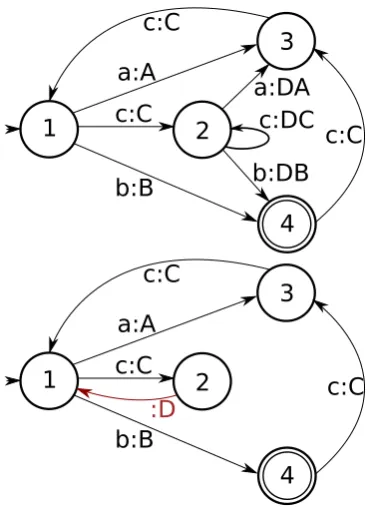
Example 3.1 Consider the transducer in the up-per part of Figure 1. Similarly as State 1, State 2 has outgoing transitions for input letters a, b, andc. Corresponding transitions lead to the same state. After introducing a failure transition from 2 to 1 with outputD we can eliminate the stan-dard transitions departing from State2. The new transducer with failure transitions is shown below. Note that both the number of transitions and the size of the output representation has been reduced.
Figure 1: Illustration for Example 3.1: Com-pressing deterministic finite-state transducers us-ing failure transitions.
When reading, say, symbolain State2, we follow the failure link to1, producing outputD. Then we use thea-transition from1to arrive at State3. The total output isDA. The example might appear ar-tificial since with other outputs we could not use the same technique. However, we shall see later that moving parts of the output to the failure tran-sitions is often possible.
Transducers that are used for rewriting texts need to accept arbitrary strings. For this reason we do not introduce a special set of final states in our for-malization of failure-transducers. As a matter of fact, generalizations are possible.
Definition 3.2 Anf-transduceris a tuple
F T =hΣ, Q, q0, δ, λ, ϕ, fi
whereΣ is a finite alphabet,Q is a set of states, q0 ∈ Qis the start state,δ : Q×Σ → Qis the
deterministic transition function,λ:Q×Σ→Σ∗ is the transition output function,ϕ : Q → Σ∗ is thefailure transition output function, andf :Q→
Qis thefailure transition function. The following conditions must hold:
1. ϕ and f are partial functions such that
[image:3.595.324.508.60.314.2]2. the domains of δ and λ are identical, i.e.,
dom(δ) =dom(λ).
Definition 3.3 Let F T = hΣ, Q, q0, δ, λ, ϕ, fi
be an f-transducer. The completed transition function δf : Q×Σ → Q and thegeneralized completed transition functionδ∗f : Q×Σ∗ → Q are defined as in Definition 2.2. The completed transition output function λf : Q×Σ → Σ∗ is
defined as the least (with respect to ⊆) function λ0:Q×Σ→Σ∗ such thatλ0(q, σ) :=
λ(q, σ) ifδ(q, σ)is defined,
ϕ(q)λ0(f(q), σ) otherwise, iff(q)is defined.
Thegeneralized completed transition output func-tion λ∗f : Q×Σ∗ → Σ∗ is inductively defined as
1. For allq∈Q:λ∗f(q, ε) :=ε,
2. For all q ∈ Q, u ∈ Σ∗ and σ ∈ Σ: λ∗f(q, uσ) :=λ∗f(q, u)λf(δf∗(q, u), σ).
The final state output function Ψf : Q → Σ∗ is
defined asΨf(q) :=
ε iff(q)is undefined, ϕ(q)Ψf(f(q)) otherwise.
Lettbe a text. Theoutputof the f-transducerF T
for inputtis
OF T(t) :=λ∗f(q0, t)Ψf(δ∗f(q0, t)).
Informally, the way how an f-transducer processes a texttcan be described as follows: starting from the start state and using the deterministic transition functionδ we read the symbols of the text. The output at each transition is defined by the transi-tion output functransi-tion. When reaching a statepand a text symbol σ such that δ(p, σ) is not defined we apply a series of failure transitions until we ar-rive at a statepnsuch thatδ(pn, σ) =p0is defined.
The output produced on this intermediate walk has two parts. The first part is the concatenation of all failure transition outputs of the statesp, . . . , pn
visited. The second part is given by the transition output of the finalσ-transition. Finally, when ar-riving at stateq at the end of the text, we apply a series of failure transitions, producing failure tran-sition outputs, until we reach a state for which the failure function is not defined.
The following lemma shows that an f-transducer F T in a natural way defines a corre-sponding subsequential transducer with the same
output function. The proof is a direct consequence of our definition of the output functionOF T.
Lemma 3.4 Let F T = hΣ, Q, q0, δ, λ, ϕ, fi be
an f-transducer, letδf,λf, andΨf as above. Then TF T := hΣ, Q, q0, Q, δf, λf,Ψfiis a subsequen-tial transducer and we haveOF T =OTF T.
In what follows we consider failure transducers
F T where each state q can be reached from the start state. The depth of a state q ∈ Q, denoted d(q), is the minimal length of a path from startq0
toq.
Definition 3.5 Abackwards f-transduceris an f-transducer
F T =hΣ, Q, q0, δ, λ, ϕ, fi
such that for every q ∈ Q we have d(q) > d(f(q)).
Proposition 3.6 The time complexity (assuming a random access machine) for rewriting a wordαof lengthnto a wordβ of lengthmby a backwards f-transducer isO(n+m)and does not depend on the size of the transducer.
The simple proof is omitted.
4 From rewrite dictionaries to f-transducers
As an application field for f-transducers we now look at text rewriting using dictionaries of a par-ticular form.
Definition 4.1 (Mihov and Schulz, 2007) A rewrite dictionaryis a pair D = (D,Σ) whereΣ is an alphabet andDis a finite mapping of words over Σ. The mapping can be represented in the form
D={αi 7→βi |1≤i≤k}
such thatαi 6=αjfori6=j∈ {1,2, . . . , k}. Each
string αi is called an entry or an original of D,
andβi is called thereplacement valueforαi(i=
1, . . . , k).
Definition 4.2 Let t ∈ Σ∗ be a text and D = (D,Σ)be a rewrite dictionary. A rewrite occur-rence of D in t is an infix occurrence hu, v, wit
such thatv ∈ dom(D). ByCD
t we denote the set
Example 4.3 (From (Mihov and Schulz, 2007)). LetDdenote the rewriting dictionary with alpha-betΣ := {a, b, c,1,2,3,4,5}and mapping Dof the form
(a 7→ 1)
(ab 7→ 2) (abcc 7→ 3)
(babc 7→ 4)
(c 7→ 5)
The leftmost-longest infix occurrences of CtD in the textt=abcbbbabccbare
h, ab, cbbbabccbi
hab, c, bbbabccbi
habcbb, babc, cbi
habcbbbabc, c, bi
andL(D)(t) = 25bb45b.
We now describe a procedure for translating a rewrite lexicon D into a backwards f-transducer
F T such that the global rewriting functionL(D) associated with D and OF T are identical. The
construction is a variant of the construction pre-sented (Mihov and Schulz, 2007) for translat-ing rewrite dictionaries into standard subsequen-tial transducers. As in (Mihov and Schulz, 2007) we proceed in two steps.
Step 1. Given the rewrite lexiconD, as in (Mihov and Schulz, 2007) we build a trie transducer TD
representing the domain of the lexicon mapping D. The final states ofTDcorrespond to the entries (“originals”) ofD, and the failure transition output of each final state is defined as the image of the en-try. The transition output for each transition is the empty stringε. The trie transducer thus represents the finite mappingDgiven byD.
Step 2. The second step, where we build the fail-ure transducerF T representing the global rewrit-ing function forD, is based on a procedure where we visit the states of the trie transducer in a breadth-first manner, starting at the initial stateq0.
We first complete the initial stateq0 adding loop
transitions with any symbolσ∈Σsuch that there is no outgoingσ-transition fromq0in the trie. The
transition output for a loop transitions with symbol σisσ. For all statesqwhich are direct ancestors of q0i.e. such thatq=δ(q0, σ)we definef(q) :=q0
[image:5.595.325.508.59.268.2]andϕ(q) := σ if q is not final. In caseq is final the functionϕ(q)is already defined.
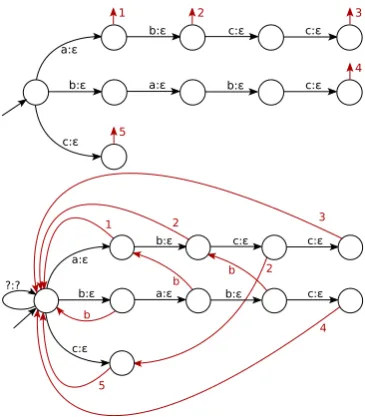
Figure 2: Trie-transducer (Step 1) and f-transducer (Step 2) obtained for the rewrite lexicon from Ex-ample 4.4.
Assume now that for the stateq 6= q0 we have
already defined f(q) = p0q and ϕ(q) = γq0. Let q0 =δ(q, σ)be an ancestor ofqin the trie.
Case a. Ifq0is a final state of the trie transducer - i.e., if the failure transition outputϕ(q0)forqis already defined - we just definef(q0) :=q0.
Case b. In the other case we definef(q0) := δf(p0q, σ)andϕ(q0) :=γ0q·λf(p0q, σ).
The definition ofδf shows that we find statef(q0)
by starting fromf(q) = p0q and applying failure transitions until we arrive at a statepn such that
δ(pn, σ) =f(q0)is defined.
Example 4.4 As an illustration for the translation of rewrite lexica into f-transducer we use the re-wite lexicon from Example 4.3. The resulting trie transducer (Step 1) and f-transducer (Step 2) are shown in Figure 2. When processing text t = abcbbbabccbwe first read prefix abcwith no output. Then two failure transitions produce out-put 25 before we can read the next letter b from the start. After readingtwe have produced output 25bb45 and the current state is theb-successor of the start. We have to add the final state output for this state, which is given by the failure transition outputb(cf. Def. 3.3). The total output is25bb45b as in Example 4.3.
each symbol σ ∈ Σ such that q does not have a σ transition in the transducer trie TD a newσ
-transition with suitable output needs to be added. Forq0the procedure is as above (as for each state,
also q0 is made final). Consider a state q0 6= q
processed during Step 2. Letplab(q) = a1. . . ar
denote the label of the pathπin the trie fromq0to
q. Theskip part ofplab(q) = a1. . . ar, denoted
u1, is:
1. a1 if the state sequence π does not contain
any final state ofTD, and
2. a1· · ·af (f ≤ r) if this prefix of plab(q)
leads fromq0to the last final state ofπ.
The read part of plab(q) (denoted u2) is the
re-maining partu2ofplab(q) =u1u2. Note that the
read part is the empty word ifq is a final state of
TDor ifqis a direct successor of the start stateq0.
Thefailure state forqis the statep0obtained when traversing the transducerT with the read partu2,
starting from q0. The construction order
guaran-tees thatu2 can be completely read in the
prelim-inary version of the subsequential transducer T
computed up to this point since the length of the read partu2 is smaller than the length ofplab(q).
The output prefix for q is the string γ0 that rep-resents the concatenation of (i) the output of the transducerT for the skip partu1 (eithera1or the
substitute for the lexical entrya1· · ·af, cf. cases
above) and (ii) the transition output of the trans-ducer T for the read part u2 when starting from
q0. With these notions, the processing ofqcan be
described in the following way:
1. The state output forqis the concatenation of the output prefixγ0 with the state output of the failure statep0.
2. If a new σ-transition from q is needed, the target state is the σ-successor of the failure state forq (it always exists since the failure state has smaller depth thanq). The transition output for the newσ-transition fromq is the concatenation of the output prefixγ0with the transition output of the transition with labelσ from the failure statep0.
Correctness proof. Because of space lim-itations, an independent and fully selfcontained proof cannot be given here. However, using the correctness of the parallel construction in (Mihov
and Schulz, 2007) (shown in the paper) and Re-mark 4.5 we can prove correctness of the new con-struction. Let
F T =hΣ, Q, q0, δ, λ, ϕ, fi
denote the f-transducer obtained. Let
T =hΣ, Q, q0, Q, δT, λT,ΨTi
denote the subsequential transducer obtained from the construction described in (Mihov and Schulz, 2007). The following lemma captures some paral-lelisms between the two devices. We use the nota-tion introduced in Defininota-tion 3.3.
Lemma 4.6 1. For any state q 6= q0 the state
f(q) is the failure state ofq in the sense of Remark 4.5. We haved(f(q))< d(q).
2. For any state q and any letter σ we have δT(q, σ) = δf(q, σ). Furthermore
d(δT(q, σ))≤d(q) + 1.
3. For any state q 6= q0 the failure transition
outputϕ(q) is the output prefix γ0(q) in the sense of Remark 4.5.
4. For any state q and any letter σ we have
λT(q, σ) =λF(q, σ).
The proof for Lemma 4.6 is given in below. Look-ing at Part 3 of Lemma 4.6 it is simple to see that for each state q we have ΨT(q) = Ψf(q).
When we now compare the outputs produced for a texttbyT andF T respectively we find, using Lemma 4.6, that
OT(t) = λ∗T(q0, t)·ΨT(δT(q0, t))
= λ∗f(q0, t)·Ψf(δf(q0, t)) =OF T(t).
In (Mihov and Schulz, 2007) it has been shown that OT represents the global rewrite function
L(D) for the rewrite lexicon D under the left-most largest strategy in the sense of Definition 4.2. Hence the same holds forOF T, which shows that
the new construction is correct.
Proof of Lemma 4.6. Recall that for a stateq, the length of the unique path from q0 to q in the
transducer trie is denoted d(q). The proof is by induction on d(q). Ifd(q) = 0we haveq = q0.
In this case, Claims 2 and 4 are obvious since we haveδT(q0, σ) =δf(q0, σ) =
δ(q0, σ) ifδ(q0, σ)is defined,
andλT(q0, σ) =λF(q0, σ) =
ε ifδ(q0, σ)is defined,
σ otherwise.
There is nothing to show as to Claims 1 and 3. For the induction step consider a successor state q=δ(q0, σ0). Letp0denote the failure state ofq0in the sense of Remark 4.5. Letp := δT(p0, σ0). By
induction hypothesis we have (i)p0 = f(q0) and (ii)δT(p0, σ0) = δf(p0, σ0). Furthermored(p0) <
d(q0)< d(q)andd(p)≤d(p0) + 1< d(q). We show Claim 1. Ifq is final, thenq0 =f(q)
is the failure state ofqin the sense of Remark 4.5. In the other case the failure state ofqin the sense of Remark 4.5 is p = δT(p0, σ0) = δf(p0, σ0) =
δf(f(q0), σ0) =f(q).
We show Claim 2. Let σ ∈ Σ. If δ(q, σ) is defined we haveδT(q, σ) = δ(q, σ) = δf(q, σ).
In the other case, first consider the case where q is final. Then q0 is the failure state for
q and δT(q, σ) = δT(q0, σ) = δf(q0, σ) =
δf(f(q), σ) = δf(q, σ). By induction
hypothe-sisd(δf(q0, σ)) ≤1and thusd(δT(q, σ))≤ 1 <
d(q) + 1. Ifqis not final, thenp=δT(p0, σ0)is the
failure state forq. We have seen thatd(p)< d(q). By induction hypothesis δT(p, σ) = δf(p, σ).
Claim 1 shows thatp=f(q). Hence
δT(q, σ) = δT(p, σ) =δf(p, σ)
= δf(f(q), σ) =δf(q, σ).
We haved(δT(q, σ)) =d(δT(p, σ))≤d(p) + 1≤
d(q) + 1.
We show Claim 3. If q is final, then γ0(q) = ΨT(q) =ϕ(q)(note thatΨT(q)is the state output
forq in the transducer trie). In the other case, by induction hypothesis we haveγ0(q0) = ϕ(q0)and λT(p0, σ0) =λF(p0, σ0). In this situation
γ0(q) = γ0(q0)·λT(p0, σ0) =ϕ(q0)·λT(p0, σ0)
= ϕ(q0)·λF(p0, σ0) =ϕ(q).
We show Claim 4. Let σ ∈ Σ. If δ(q, σ) is defined we haveλT(q, σ) =ε=λF(q, σ). In the
other case we have λT(q, σ) = γ0(q)·λT(p, σ)
whereγ0(q)is the output prefix forq in the sense of Remark 4.5. Using Claim 3 and the induction hypothesis we see that
λT(q, σ) = ϕ(q)·λT(p, σ)
= ϕ(q)·λf(p, σ) =λf(q, σ).
5 Implementation and complexity analysis
Algorithm 1 presents the pseudo-code of the con-struction. Clearly, the number of states of the f-transducer is bounded by ||DI|| + 1 and the
number of transitions is bounded by 2||DI|| and
does not depend on the alphabet size, where
||DI|| = P
hα,βi∈D|α|. The complexity of
the trie construction is O(||D||), where ||D|| =
P
hα,βi∈D|α|+|β|. If each output string is
repre-sented in the standard way as a sequence of sym-bols, the space complexity ofϕ can get cubic in
||D||. Using the technique for tree-based out-put string representation introduced in (Mihov and Schulz, 2007) the space complexity remains lin-ear in||D||. In that case the space and time com-plexity of the proposed algorithm1isO(||D||). In contrast, the space and time complexity of the con-struction presented in (Mihov and Schulz, 2007) is O(||D|| · |Σ|)for an alphabetΣ. The complexity for rewriting a textttot0 isO(|t|+|t0|).
6 Application for Online Hyperlinking Using Link Databases
Document repositories often come with a large number of internal or external links that lead from concepts (entities, references, etc.) mentioned in the text to other web pages. A well-known exam-ple is the Wikipedia2. On a Wikipedia page, all concepts of the text that are described in more de-tail in some other article of the Wikipedia are high-lighted. When clicking at the concept the visitor is led to the relevant page of the Wikipedia, using an internal link (wikilink). In the same way, arbitrary texts can be linked with the Wikidedia.
To create a wikilink, concept names such as “United Kingdom” or “Kingdom University” mentioned in the text are replaced by anchor el-ements of the form
<a href="/wiki/United_Kingdom"> United Kingdom</a> <a href="/wiki/Kingdom_University">
Kingdom University</a>
In order to automatize this form of hyperlink-ing, rewriting dictionaries may be used that list relevant concept names (e.g. “United Kingdom”) together with the corresponding anchor elements
1Assuming that in the functionf-transducerthe loop transitions ofq0in Lines 5-6 are not explicitly generated and the loops starting at Line 2 and Line 16 iterate only through existing transitions.
Algorithm 1Construction of an f-transducer for a given alphabetΣand rewrite dictionaryD.
Trie(Σ, D)
@1 q0←new state()
@2 Q← {q0}
@3 δ← ∅
@4 λ← ∅
@5 ϕ← ∅
@6 for hα, βi ∈D do
@7 q←q0
@8 for each symbol σ of α do
@9 p←δ(q, σ)
@10 if p=nil then
@11 p←new state()
@12 Q←Q∪ {p}
@13 δ(q, σ)←p
@14 λ(q, σ)←ε
@15 q←p
@16 F ←F∪ {q}
@17 ϕ(q)←β
@18 return hΣ, Q, q0, δ, λ, ϕ,∅i
f-transducer(Σ, D)
@1 hΣ, Q, q0, δ, λ, ϕ, fi ←T rie(Σ, D)
@2 for σ∈Σ do
@3 q←δ(q0, σ)
@4 if q=nil then
@5 δ(q0, σ)←q0 @6 λ(q0, σ)←σ
@7 else
@8 if !ϕ(q) then
@9 push queue(hq, q0, ϕ(q)i)
@10 else
@11 push queue(hq, q0, σi)
@12 while not empty queue() do
@13 q, p0q, γ
0
q
←pull queue()
@14 f(q)←p0q @15 ϕ(q)←γq0
@16 for σ∈Σ do
@17 q0←δ(q, σ)
@18 if q06=nil then
@19 if !ϕ(q0) then
@20 push queue(hq0, q0, ϕ(q0)i)
@21 else
@22 p00←p0q
@23 γ00←γq0
@24 while δ(p00, σ) =nil do
@25 γ00←concat(γ00, ϕ(p00))
@26 p00←f(p00)
@27 push queue(hq0, δ(p00, σ), concat(γ00, λ(p00, σ))i)
@28 return hΣ, Q, q0, δ, λ, ϕ, fi
as a replacement. When processing a text with the rewriting dictionary, each occurrence of a concept name is replaced by the corresponding anchor el-ement as a form of annotation. We note that the rewriting dictionaries used for automated hyper-linking are often extremely large.
Algorithm 1 has been applied for constructing a rewrite f-transducer for annotating texts with the anchor elements of practically all Wikipedia con-cept names in English3. The rewrite dictionary has 8,083,029entries and occupies831MB. The cor-responding f-transducer was constructed by a not optimized implementation of Algorithm 1 using 64bits for pointer, number and character represen-tation. The resulting f-transducer has69,037,940 states and occupies 11.5 GB. On an Intel Xeon CPU at2.40GHz the construction time is63 min-utes. Using the constructed f-transducer,100MB of text are rewritten in approximately19seconds. This makes it possible to maintain huge knowl-edge bases in memory and rewrite texts in an on-line matter. In the same way, texts could be linked with any other collection of linked open data.
In order to compare the new construction with the construction presented in (Mihov and Schulz,
3There can be multiple concept names for one Wikipedia page.
[image:8.595.324.516.392.437.2]time size subseq. transducer 283 s 1170 MB f-transducer 12 s 79 MB
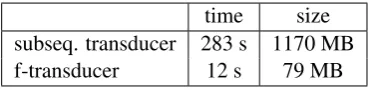
Table 1: Translation of a5MB rewrite dictionary into a text rewriting device. Construction times and sizes when using a subsequential transducer and an f-transducer.
2007) we used a 5 MB English correction dic-tionary with 220,231 entries. All words in the correction dictionary are over the 26 lower case English letters. The rewrite f-transducer is con-structed in12 seconds and occupies79 MB. The corresponding subsequential transducer is con-structed in283seconds and occupies1170MB (cf. Table 1).
7 Conclusion
avoids the increase in complexity which is caused by the enormous number of transitions needed for subsequential transducers when using rewrite dic-tionary over large alphabets. In our construction the number of ordinary transitions and the num-ber of failure transitions of the f-transducer are bounded by the sum of the lengths of input words in the dictionary and do not depend on the alpha-bet size. This made it possible to construct an f-transducer for annotating all concept names of the English Wikipedia in a text in online manner on a personal computer. The same technique can be applied to similar forms of knowledge-based text rewriting. In this way, interesting items in input texts can be linked “on demand” in a user-driven online manner to distict targets such as lex-ica, authority pages, product catalogues and other resources.
References
Alfred Aho and Margaret Corasick. 1975. Efficient string matching: an aid to bibliographic search.
Communications of the ACM, 18:333–340.
Henrik Bj¨orklund, Johanna Bj¨orklund, and Niklas Zechner. 2014. Compression of finite-state au-tomata through failure transitions. Theoretical Com-puter Science, 557:87–100.
Maxime Crochemore and Christophe Hancart. 1997. Automata for matching patterns. In Handbook of formal languages, pages 399–462. Springer.
Jan Daciuk, Jakub Piskorski, and Strahil Ristov, 2010.
Scientific Applications of Language Methods, chap-ter Natural Language Dictionaries Implemented as Finite Automata, pages 133–204. Imperial College Press.
KESA. 2016. Third international workshop on knowl-edge extraction and semantic annotation. In Pro-ceedings ALLDATA 2016 The Second International Conference on Big Data, Small Data, Linked Data and Open Data, Lisbon, Portugal.
Derrick G. Kourie, Bruce W. Watson, Loek Cleophas, and Fritz Venter. 2012. Failure deterministic fi-nite automata. In Proceedings of Prague Stringol-ogy Conference, pages 28–41.
Stoyan Mihov and Denis Maurel. 2001. Direct con-struction of minimal acyclic subsequential transduc-ers. In Proceedings of the Conference on Imple-mentation and Application of Automata CIAA’2000, number 2088 in LNCS, pages 217–229. Springer.
Stoyan Mihov and Klaus U. Schulz. 2007. Effi-cient dictionary-based text rewriting using subse-quential transducers. Natural Language Engineer-ing, 13(4):353–381, December.
Mehryar Mohri. 1995. Matching patterns of an au-tomaton. InCombinatorial Pattern Matching, pages 286–297. Springer.