Class-based Prediction Errors to Detect Hate Speech with
Out-of-vocabulary Words
Joan Serr`a
Telef´onica Research, Barcelona, Spain
Ilias Leontiadis
Telef´onica Research, Barcelona, Spain
Dimitris Spathis
Aristotle University, Thessaloniki, Greece
Gianluca Stringhini
University College London, United Kingdom
Jeremy Blackburn
Telef´onica Research, Barcelona, Spain
Athena Vakali
Aristotle University, Thessaloniki, Greece
Abstract
Common approaches to text categoriza-tion essentially rely either on n-gram counts or on word embeddings. This presents important difficulties in highly dynamic or quickly-interacting environ-ments, where the appearance of new words and/or varied misspellings is the norm. A paradigmatic example of this situation is abusive online behavior, with social networks and media platforms struggling to effectively combat uncommon or non-blacklisted hate words. To better deal with these issues in those fast-paced environ-ments, we propose using the error signal of class-based language models as input to text classification algorithms. In partic-ular, we train a next-character prediction model for any given class, and then ex-ploit the error of such class-based models to inform a neural network classifier. This way, we shift from the ability to describe seen documents to the ability to predict unseen content. Preliminary studies us-ing out-of-vocabulary splits from abusive tweet data show promising results, out-performing competitive text categorization strategies by 4–11%.
1 Introduction
The first steps in automatic text categorization rely on the description of the document con-tent. Typically, such content is characterized by some sort of word, stem, and/or n-gram counts (e.g. Wang and Manning, 2012) or, more recently, by unsupervised or semi-supervised
word/sentence/paragraph embeddings (e.g.Arora et al., 2017). While the common pipeline per-forms well for a myriad of tasks, there are a num-ber of situations where a large ratio of seen vs. un-seen tokens threatens the performance of the clas-sifier. This is the case, for instance, with abusive language in online user content or microblogging sites (Nobata et al., 2016;Mehdad and Tetreault, 2016). In such cases, the volume of annotated data is not massive, and the vocabulary changes rapidly and non-consistently across sites and user commu-nities. Sometimes these changes and inconsisten-cies are intentional, so as to hide the real meaning from traditional automatic detectors using hate-word dictionaries or blacklists. For example, the notorious online community4chanlaunched “Op-eration Google”, which aimed to replace racial slurs on social media with the names of prominent tech companies in a sort of adversarial attack on Google’s Jigsaw project (Hine et al.,2017).
To avoid relying on specific tokens, existing text classification approaches can incorporate so-called linguistic features (Brody and Diakopoulos, 2011), such as number of tokens, length of to-kens, number of punctuations, and so on, or syn-tactic features (Nobata et al.,2016), based on part-of-speech tags, dependency relations, and sen-tence structure. Distributional representations (Le and Mikolov,2014) and recurrent neural network (RNN) language models (Mikolov,2012) are also used, together with more classical approaches in-volving word or character n-grams (Wang and Manning,2012).
The task of automatic hate speech detection is usually framed as a supervised learning problem. Surface-level features like bag-of-words and em-beddings systematically produce reasonable
sification results (Chen et al.,2012;Nobata et al., 2016). Character-level approaches perform bet-ter than token-level ones, since the rare spelling variations of slang and swear words will result in unknown tokens (Mehdad and Tetreault,2016). More complex features like dependency-parse information or specific linguistic attributes like politeness-imperatives have been effective (Chen et al., 2012). Also lexical resources like lists of slurs, are proven effective but only in combination with other features (Schmidt and Wiegand,2017).
2 Proposed approach
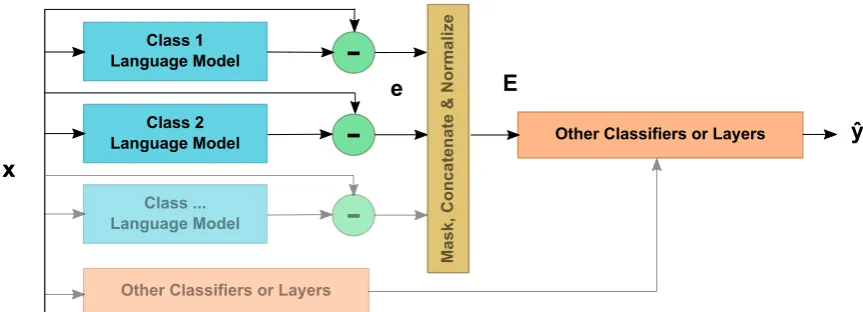
We propose to perform text categorization fol-lowing a two step approach (Fig. 1). Firstly, a language model for next-character prediction is trained with the data corresponding to each sin-gle category. Secondly, we use a normalized, se-quential measurement of the performance of those language models as input to a neural network clas-sifier. In a sense, we aim to shift from ‘what is said’ (ability to describe) to ‘the way of saying’ (ability to predict). The idea is that the language model should be tailored to a given category, but without developing a strong dependence on partic-ular characters that are frequent or representative for that category.
The concept of class-based errors is reminis-cent of universal background models in speaker verification (Reynolds et al., 2000) and a few document attribution strategies in information re-trieval (Serr`a et al.,2012). Using error signals for classification also relates to derivative-based simi-larity and classification in time series (Keogh and Pazzani,2001).
2.1 Class-conditioned language model
For the class-conditioned language model we use a character-based RNN. Sequences of one-hot en-coded characters X are passed through a time-distributed dense layer with parametric rectified linear unit (PReLU) activation (He et al., 2015), which form a preliminary embedding. This is shared with the subsequent layers. The intuition behind using a PReLU activation after the embed-ding stems from the fact that it can only improve the results or, at worst, be automatically bypassed: if a linear transformation (no activation) is really the best option, the model can still learn it (He et al.,2015).
For each classi, one gated recurrent unit (GRU;
Cho et al., 2014) is used, followed by a time-distributed dense layer with softmax output, yield-ing the next-character prediction sequence Xˆ(i). With that and the delayed version of X, we cal-culate a class-conditioned error sequencee(i) for each character (and zero-mask it according to the sequence length, if needed). In our experiments with one-hot encoded character inputs,e(i) corre-sponds to categorical cross-entropy. The final loss is taken to be
Ly,e(1), . . .e(c)=Xc i=1
1{i}(y)
n−1
n−1 X
j=1 e(i)j
,
whereyis the class label of the instance,cis the total number of classes, nis the sequence length of the instance, and1()is an indicator function.
2.2 Normalization
To perform classification, we take the class-conditioned error sequences e(i) provided by the language model, and concatenate them into a ma-trixE= [e(1), . . .e(c)]for each instance. We then use an instance normalization layer
¯
E=σ(gE/µ),
where σ() is an activation function, g is a gain constant, and µ is the average over all the el-ements of E (taking sequence masking into ac-count). In principle, we could learng(or extended vector/matrix versions of it) and use any activa-tion. However, we empirically found g = 1/3
and a sigmoid activation to work well enough with character-based cross-entropy sequences.
2.3 Classification
x
M
as
k,
C
o
n
ca
te
n
at
e
&
N
o
rm
al
iz
e
Class 1
Language Model
-Class 2
Language Model
-Class ...
Language Model
-Other Classifiers or Layers
Other Classifiers or Layers ŷ
x
[image:3.595.82.514.61.217.2]e E
Figure 1: General schema of the proposed model. First, a language model for next-character prediction is trained with the data corresponding to each single class. Second, a normalized, sequential measurement of the performance of those language models is fed as input to a neural network classifier.
2.4 Model setup
We train our models using Adam gradient de-scent (Kingma and Ba,2015) until we do not see an improvement on the validation set for 4 epochs. For the language model, we use layer dimension-alities 250 (embedding) and 500 (GRU). For the classification model, we use a dropout of 0.5 and dimensionality 100. At classification time, the lan-guage model’s weights remain frozen. To imple-ment our models we used Keras (Chollet, 2015) with Theano (Theano Development Team,2016).
3 Evaluation data
To evaluate the suitability of the proposed con-cepts, we choose the task of detecting abusive tweets with out-of-vocabulary (OOV) words, us-ing a sample of 2 million tweets from the Twitter 1% feed. Half of the sample is selected based on their use of ‘hate words’ from a crowdsourced dic-tionary1, while the other half is selected randomly. We manually filter the dictionary to remove overly common and ambiguous words like “india”, a lo-calized slur for dark skinned people.
Due to lack of baselines and datasets that take into account OOV words, we create semi-synthetic splits with OOV words, in order to simulate data with new or heavily misspelled tokens. We ran-domly perform 10 train/validation/test splits, com-pute the area under the receiver operating char-acteristic curve (AUC), and report the mean and standard deviation over the 10 test splits. Two se-tups are considered:
1http://hatebase.org
• Easy – For the positive class, we take the hate-word list and split it into 70% for train-ing and 15% for validation and testtrain-ing. In performing such split, we force words with the same stem to end up in the same split. We then select tweets from the entire corpus that contain at least one stemmed word from each split. For the negative class, we just select randomly from the remaining tweets until we have balanced train/validation/test sets. • Hard – Besides the list of hate words,
we also consider a list of common words (top 1,000 to 3,000 most frequent English words2). We proceed as with the positive class of the Easy setup, and generate bal-anced train/validation/test splits for both abu-sive and non-abuabu-sive tweets. In addition, to increase difficulty, we remove tweets with list words appearing in more than one split (that is, we ensure that the intersection of listed words is null between train/validation/test). To the best of our knowledge, there are no es-tablished benchmark datasets for the problem of OOV word detection. Recent work on character-izing OOV words in twitter attempted to build a dataset of such words (Maity et al., 2016), but mostly focused on content analysis and catego-rization (e.g.,wassup andiknow, belong to word mergings). We plan to develop big crowd-sourced datasets of OOV social media texts and provide them free to the research community.
2http://www.ef.com/english-resources/
Setup Word NB Char NB Word NB-LR Char NB-LR Char RNN Proposed Easy 0.900 (0.091) 0.849 (0.052) 0.912 (0.113) 0.902 (0.102) 0.858 (0.141) 0.951(0.080) Hard 0.634 (0.109) 0.663 (0.080) 0.580 (0.089) 0.679 (0.038) 0.619 (0.101) 0.705(0.059)
Table 1: AUC scores for the considered baselines (see text) and the proposed approach. A null random-ized model yields 0.514 (0.082) and 0.503 (0.090) for the Easy and Hard setups, respectively.
4 Results
We compare the proposed approach with 5 of the most common and competitive baselines in abusive language detection (Djuric et al., 2015; Mehdad and Tetreault, 2016). The first two are based on a na¨ıve Bayes classifier using the TF-IDF of both word and character n-grams (NB). The next two are based on the approach proposed by Wang and Manning (2012): similarly, word and character n-grams are constructed, but NB ra-tios are calculated, and logistic regression is used as a classifier (NB-LR). The rationale behind this choice over other classifiers (e.g SVMs) was that Wang and Manning (2012) found that for short text sentiment tasks, NB actually does performs better than SVMs. For the previous non-neural count-based baselines, we use all combinations of {1,2,3}-grams with cutoff frequencies of 20 (NB) and 100 (NB-LR). These cutoff frequencies were chosen in-sample in order to maximize the perfor-mance of these baselines. The fifth baseline is a character-based RNN using a time-distributed em-bedding layer, followed by a PReLU activation, a GRU, a dense layer with PReLU activation, and a dense layer with sigmoid output. We try differ-ent values for the dimensionality of the aforemen-tioned layers and finally use 200 (embedding), 400 (GRU), and 200 (dense).
The result of the comparison is reported in Ta-ble 4. We see that, among the 5 baselines, there is no clear winner for the two setups. Word-based NB-LR performs best in the Easy setup and character-based NB-LR performs best in the Hard setup. Nonetheless, the proposed approach outper-forms them by 4.2 and 3.8%, respectively. Com-pared to the average baseline performance, we ob-serve a relative improvement of 7.5 and 11.0%. We also note that the standard deviation of the pro-posed approach (across runs) is comparatively low with respect to the baselines.
5 Future work
In this paper, we deal with hate speech detection and, in particular, with abusive OOV words. To this extent we propose to use the error signal of class-based language models as input to text clas-sification algorithms. In particular, we train a next-character prediction model for any given class, and then exploit the error of such class-based models to inform a neural network classifier. This way, we intend to shift from the ‘ability to describe seen documents to the ‘ability to predict unseen con-tent. Experiments using OOV splits from abusive tweet data show promising results, outperform-ing competitive text categorization strategies by 4– 11%.
We envision a number of potential extensions for the proposed approach: adding an ‘all-class’ predictor to the language models, improve (or learn) the error sequence normalization, studying the effect of adding further classifiers in paral-lel to the proposed classification model, ways of fusing those, play with class-based sentence or paragraph embeddings, etc. Generalizing the ar-chitecture to longer sequences is a main task for further research, perhaps considering recurrent, quasi-recurrent (Bradbury et al.,2017), or convo-lutional networks for the classification stage. A qualitative analysis of the output of above classi-fiers is planned as future work. Due to the fact that our data are weakly-labeled and come from dic-tionaries, we also plan to shift our focus to real-world, curated data sets of abusive language, as well as evaluate our models on human-annotated crowd-sourced data.
Acknowledgments
References
S. Arora, Y. Liang, and T. Ma. 2017. A simple but
tough to beat baseline for sentence embeddings. In
Proc. of the Int. Conf. on Learning Representations (ICLR).https://openreview.net/pdf?id=SyK00v5xx.
J. Bradbury, S. Merity, C. Xiong, and R. Socher. 2017. Quasi-recurrent neural networks. InProc. of the Int. Conf. on Learning Representations (ICLR).
http://arxiv.org/abs/1611.01576.
S. Brody and N. Diakopoulos. 2011.
Cooooooooooooooollllllllllllll!!!!!!!!!!!!!! Using
word lengthening to detect sentiment in microblogs. In Proc. of the Conf. on Empirical Methods in Natural Language Processing (EMNLP). pages 562–570.
Ying Chen, Yilu Zhou, Sencun Zhu, and Heng Xu. 2012. Detecting offensive language in social media to protect adolescent online safety. InPrivacy, Se-curity, Risk and Trust (PASSAT), 2012 International Conference on and 2012 International Confernece on Social Computing (SocialCom). IEEE, pages 71– 80.
K. Cho, B. Van Merri¨enboer, D. Bahdanau, and Y. Ben-gio. 2014. On the properties of neural machine
translation: encoder-decoder approaches. InProc.
of the Workshop on Syntax, Semantics and Structure in Statistical Translation (SSST). pages 103–111.
Franois Chollet. 2015. keras. https://github.
com/fchollet/keras.
N. Djuric, J. Zhou, R. Morris, M. Grbovic, V. Ra-dosavljevic, and N. Bhamidipati. 2015. Hate speech
detection with comment embeddings. InProc. of the
Int. Conf. on World Wide Web (WWW). pages 29–30.
K. He, X. Zhang, S. Ren, and J. Sun. 2015. Delving deep into rectifiers: surpassing human-level
perfor-mance on ImageNet classification. In Proc. of the
IEEE Int. Conf. on Computer Vision (ICCV). pages 1026–1034.
G Hine, J Onaolapo, E De Cristofaro, N Kourtellis, I Leontiadis, R Samaras, G Stringhini, and J Black-burn. 2017. Kek, cucks, and god emperor trump: A measurement study of 4chan’s politically incorrect
forum and its effects on the web. In International
Conference on Web and Social Media (ICWSM). As-sociation for the Advancement of Artificial Intelli-gence (AAAI).
E. Keogh and M. Pazzani. 2001. Derivative dynamic
time warping. In Proc. of the SIAM Int. Conf. on
Data Mining (SDM).
D. P. Kingma and J. L. Ba. 2015. Adam: a
method for stochastic optimization. In Proc. of the Int. Conf. on Learning Representations (ICLR).
https://arxiv.org/abs/1412.6980.
Q. Le and T. Mikolov. 2014. Distributed
representa-tions of sentences and documents. In Proc. of the
Int. Conf. on Machine Learning (ICML). volume 32, pages 1188–1196.
Suman Maity, Anshit Chaudhary, Shraman Kumar, Animesh Mukherjee, Chaitanya Sarda, Abhijeet Patil, and Akash Mondal. 2016. Wassup? lol: Char-acterizing out-of-vocabulary words in twitter. In
Proceedings of the 19th ACM Conference on puter Supported Cooperative Work and Social Com-puting Companion. ACM, pages 341–344.
Y. Mehdad and J. Tetreault. 2016. Do characters abuse
more than words? InProc. of the Annual Meeting
of the Special Interest Group on Discourse and Dia-logue (SIGDIAL). pages 299–303.
T. Mikolov. 2012. Statistical language models based
on neural networks. Ph.D. thesis, Brno University of Technology.
C. Nobata, J. Tetreault, A. Thomas, Y. Mehdad, and Y. Chang. 2016. Abusive language detection in on-line user content. InProc. of the Int. Conf. on World Wide Web (WWW). pages 145–153.
D. A. Reynolds, T. F. Quatieri, and R. B. Dunn. 2000. Speaker verification using adapted Gaussian mixture
models. Digital Signal Processing10(1-3):19–41.
Anna Schmidt and Michael Wiegand. 2017. A survey on hate speech detection using natural language
pro-cessing.SocialNLP 2017page 1.
J. Serr`a, H. Kantz, X. Serra, and R. G. Andrzejak. 2012. Predictability of music descriptor time series and its application to cover song detection. IEEE Trans. on Audio, Speech and Language Processing20(2):514– 525.
N. Srivastava, G. Hinton, A. Krizhevsky, I. Sutskever, and R. Salakhutdinov. 2014. Dropout: a simple way to prevent neural networks from overfitting. Journal of Machine Learning Research15:1929–1958.
Theano Development Team. 2016. Theano: A
Python framework for fast computation of mathe-matical expressions.arXiv e-printsabs/1605.02688.
http://arxiv.org/abs/1605.02688.