Review Article
Structure and function of LIM domain proteins are
regulated by alternative splicing
Quan-Hui Zheng1, Ai-Hong Zhang2, Yong Zhao3
1Hebei Key Laboratory for Chronic Diseases, Tangshan Key Laboratory for Preclinical and Basic Research on
Chronic Diseases, School of Basic Medical Sciences, North China University of Science and Technology, Tang-shan, China; 2Department of Intensive Care Unit, 3Institute of Zoology, Chinese Academy of Sciences, Beijing,
China
Received February 2, 2016; Accepted May 2, 2016; Epub July 15, 2016; Published July 30, 2016
Abstract: LIM domain proteins display various functions including gene regulation, cell fate determination, tumour
formation and cytoskeleton organization. A diverse group of LIM domain proteins have been identified, and alter -native RNA splicing combined with alter-native transcription/translation initiation or termination sites is one of the key molecular mechanisms contributing to the proteome and functional diversity of LIM domain proteins. However,
to date, few of the alternative spliced LIM domain proteins has been fully clarified. Further studies on functional significance of the alternative spliced LIM domain proteins and their relevance to the full length isoforms should be done in a cell and tissue specific manner.
Keywords: LIM domain protein, alternative splicing, isoforms
Introduction
The Lin-11, Isl-1 and Mec-3 (LIM) domain is one of the protein-protein interaction motifs that are 50-60 amino acids in size and share two characteristic zinc fingers. Based on the arrangement of LIM domains and the overall structure of proteins, LIM domain proteins can be roughly classified into three groups. The first group consists of LIM homeodomain proteins (LHXs), which feature two tandem LIM domains in their N-terminal and a DNA binding home-odomain in the C-terminal. The second group is LIM domain only protein (LMO), which consists of two or more LIM domains clustered at their N- or C-terminal. The third group includes most of the LIM domain proteins that contain various other protein-protein interaction motifs such as postsynaptic density-95, discs large, zona occludens-1 (PDZ), leucine-aspartate repeat (LD), prickle, espinas and testin (PET), and actin binding domain (ATD), besides the character-ized LIM domains [1, 2]. The conditional expres-sion of LIM domain proteins are controlled by different regulatory mechanisms. However, one of the most remarkable observations stemming
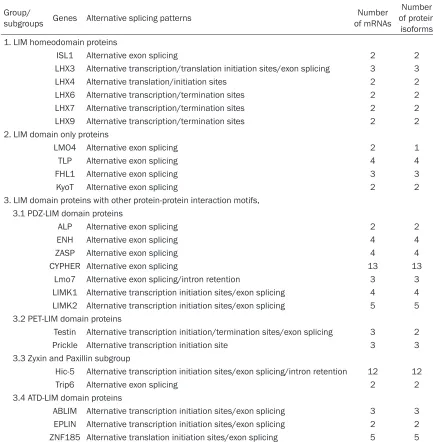
from the sequencing of LIM domain proteins is that most of these genes are regulated by alter-native splicing (AS) and encode different pro-tein isoforms (Table 1). In the present review, we focus on the extensive AS events of LIM domain proteins and their effects on the struc-tural and functional diversity of LIM domain pro-teins. In addition, as alternative transcription/ translation initiation or termination sites are of equal importance to the diversity of LIM domain proteins, which were also included in the manuscript.
Alternative splicing of LIM homeodomain proteins (LHXs)
Alternative splicing of LIM domain proteins
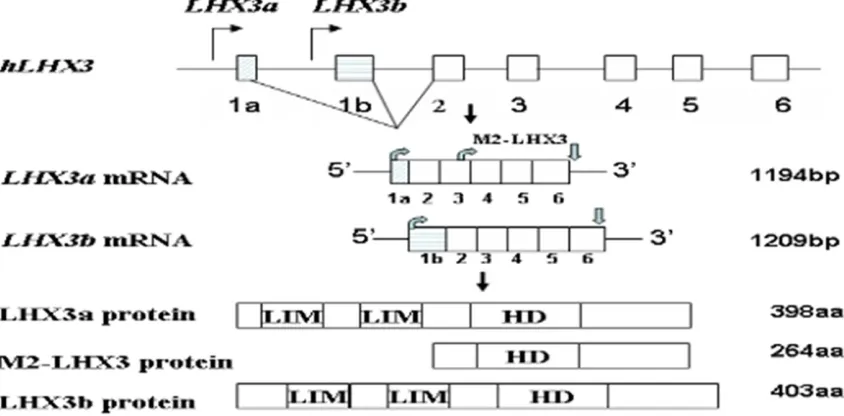
[image:2.612.87.520.97.539.2]the shorter Isl-1encodes isl-1 isoforms (isl1-β) lacking the C-terminal 23aa of isl1-α. Unlike Isl-1, the LHX3 LIM homeodomain transcription factor is essential for the expression of pitu-itary hormone genes [6, 7]. Both mouse and the human LHX3 gene contain seven exons including two alternatively spliced first exons (Figure 1). This structure encodes two distinct protein isoforms, LHX3a and LHX3b, which dif-fer exclusively in their N-terminus [8]. In addi-tion, another protein isoform of LHX3, M2-LHX3, is specifically expressed from the LHX3a tran-script using an alternate in-frame translation
Table 1. LIM domain proteins undergo alternative splicing and produce different mRNA and protein isoforms
Group/
subgroups Genes Alternative splicing patterns of mRNAsNumber
Number of protein
isoforms 1. LIM homeodomain proteins
ISL1 Alternative exon splicing 2 2
LHX3 Alternative transcription/translation initiation sites/exon splicing 3 3
LHX4 Alternative translation/initiation sites 2 2
LHX6 Alternative transcription/termination sites 2 2
LHX7 Alternative transcription/termination sites 2 2
LHX9 Alternative transcription/termination sites 2 2
2. LIM domain only proteins
LMO4 Alternative exon splicing 2 1
TLP Alternative exon splicing 4 4
FHL1 Alternative exon splicing 3 3
KyoT Alternative exon splicing 2 2
3. LIM domain proteins with other protein-protein interaction motifs, 3.1 PDZ-LIM domain proteins
ALP Alternative exon splicing 2 2
ENH Alternative exon splicing 4 4
ZASP Alternative exon splicing 4 4
CYPHER Alternative exon splicing 13 13
Lmo7 Alternative exon splicing/intron retention 3 3
LIMK1 Alternative transcription initiation sites/exon splicing 4 4 LIMK2 Alternative transcription initiation sites/exon splicing 5 5 3.2 PET-LIM domain proteins
Testin Alternative transcription initiation/termination sites/exon splicing 3 2 Prickle Alternative transcription initiation site 3 3 3.3 Zyxin and Paxillin subgroup
Hic-5 Alternative transcription initiation sites/exon splicing/intron retention 12 12
Trip6 Alternative exon splicing 2 2
3.4 ATD-LIM domain proteins
ABLIM Alternative transcription initiation sites/exon splicing 3 3 EPLIN Alternative transcription initiation sites/exon splicing 2 2 ZNF185 Alternative translation initiation sites/exon splicing 5 5
initiation site, and translates a LHX3 protein lacking the amino terminus and both LIM domains (Figure 1).
Figure 1.The alternative splicing of human LHX3 gene and its protein isoforms. LIM, LIM domains, HD, homeodo-main , Transcriptional start sites, ,Translational start sites, ,Translational end sites.
unaffected, and its specific functions need to be further studied [9, 10].
LIM domain only proteins (LMOs)
LMO4, a member of the nuclear LIM domain only protein, is overexpressed in more than 50% of primary breast cancers and cell lines [11]. Two non-coding 5’UTR exons (exon1a and exon1b) in the human LMO4 gene are differen-tially utilized in a mutually exclusive manner, which result in the expression of two LMO4
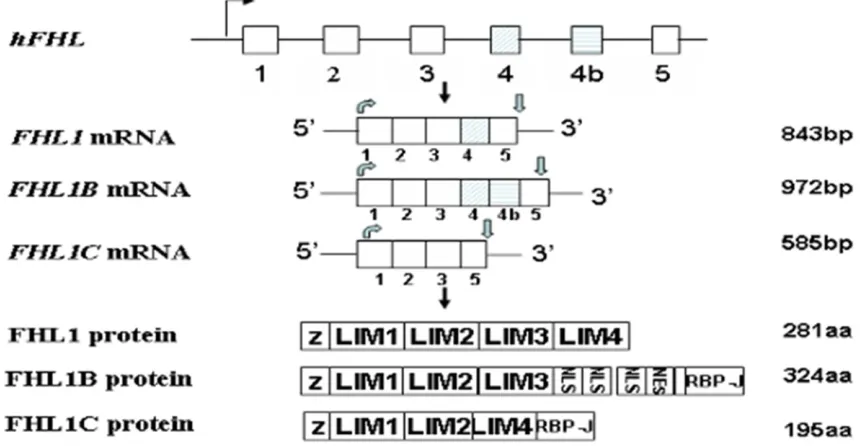
mRNAs among breast epithelial cells. Fur- thermore, two promoter regions are defined: upstream of exon1a, and upstream of exon1b. Northern blot analysis revealed that the longer transcript of LMO4 is expressed in both normal breast epithelial cells and cancer cell lines, while the shorter transcript is primarily ex- pressed in transformed breast epithelial cells. Therefore, the overexpression of LMO4 in bre- ast cancer reflects increased promoter activity and appears to involve the aberrant activation of the second promoter [12, 13]. Similarly, three alternatively spliced isoforms of human four-and-a-half LIM protein 1 (FHL1): FHL1, FHL1B and FHL1C; and two of its mouse homo-log, KyoT1 and KyoT2, are generated by alterna-tive exon splicing. Genomic organization reveals that the FHL1 gene has six exons (1, 2, 3, 4, 4b and 5). FHL1 transcript contains exons 1, 2, 3, 4 and 5; while FHL1B transcript contains exons
1, 2, 3, 4, 4b and 5. In contrast, FHL1C is differ-ent from both FHL1 and FHL1B transcripts, which only contains exons 1, 2, 3 and 5 (Figure 2).
Amino-acid sequence analysis reveal that both the additional alternative exon 4b in FHL1B and the absence of exon 4 in FHL1C cause a differ-ent open reading frame in exon 5 compared with that of FHL1, and the frame-shifted exon 5 produces a putative RBP-J (J kappa recombina-tion signal binding protein) binding region in the C-terminus of FHL1B and FHL1C [14, 15]. On the other hand, FHL1C is different from FHL1B, in which FHL1C lacks the third LIM domain encoded by exon 4 and three potential bipartite nuclear localization signals (NLS) and a puta-tive nuclear export sequence (NES) encoded by exon 4b (Figure 2).
Alternative splicing of LIM domain proteins
The third group of LIM domain proteins
PDZ-LIM domain proteins
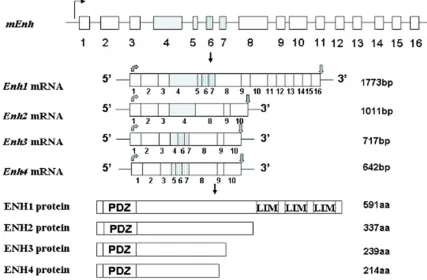
PDZ-LIM domain proteins including actinin-associated LIM protein (ALP), Enigma, LIM kinases (LIMKs) subfamily and LIM domain only7 (LMO7) are characterized by a single N-terminal or centrally positioned PDZ domain, and single or multiple LIM domains positioned either in the N-terminal or C-terminal from the PDZ domain. All these proteins are involved in cytoskeleton-associated activities through interaction with other protein partners [19, 20]. Enigma homolog (ENH) and Z-band alternative-ly spliced PDZ motif protein (ZASP/Cypher) belong to the Enigma family of PDZ-LIM domain proteins, which are characterized by an N-terminal PDZ domain and three C-terminal LIM domains. To date, four ENH isoforms have been identified in both human and mouse tis-sues. The larger isoform of mice enh, enh1, contains 16 exons; whereas the shorter iso-forms named enh2, enh3 and enh4 lack the last six exons of the enh gene. Moreover, exon 5 is only found in the enh4 isoform; and exons 6 and 7 belong to the enh3 and enh4 isoforms. Interestingly, exon 4, found in enh1 and enh2, is internally spliced and gives rise to a truncat-ed exon in enh3 (Figure 3). Consistent with
nucleotide sequences of mouse enh isoforms,
[image:4.612.92.525.78.301.2]Figure 3.The alternative splicing of mouse enh gene and its protein isoforms. PDZ, Postsynaptic density-95, Discs large, Zonaoccludens-1.
At least five LIMK2 protein isoforms have been identified. One of them is denoted as LIMK2t, which lacks both LIM domains and a small part of the PDZ domain due to alternative transcrip-tion initiatranscrip-tion site usage; and is specifically expressed in intact adult mouse testis [25] (Figure 4). In addition to LIMK2t, the full length one is usually denoted as LIMK2a, and a short-er vshort-ersion, LIMK2b, contains the kinase domain and PDZ domain; but only one and a half LIM domain have been described in humans, mice and rats. Genomic analysis revealed that the mouse limk2a gene consists of 16 exons, while
limk2b lacks the exon 2 that encodes the first half of the LIM domain (Figure 4). LIMK2a and LIMK2b are expressed at different ratios in a variety of mouse tissues. LIMK2a is preferen-tially expressed in digestive organs of fetal and adult tissues, while LIMK2b is expressed more abundantly than LIMK2a in the placenta [23, 26]. Another transcript of limk2, termed limk2c, codes for a protein with a 6-amino-acid insert within the protein kinase domain, which has been found in the mouse brains [27]. In addi-tion, a kinase-deleted alternative splice prod-uct of LIMK2 was also identified and
character-ized (Figure 4). In vivo analysis revealed that this alternate splice product inhibited LIM kinase activity, indicating that the amino termi-nus of LIMK2 may suppress the activity of the kinase domain [28]; as LIMK controls actin organization through phosphorylation, and actin binding/depolymerizing factor cofilin is inactivated. Thus, the kinase-deleted protein of LIMK2 may function as a negative regulator of LIMK2 in actin cytoskeleton organization.
Zyxin and paxillin subfamily
Alternative splicing of LIM domain proteins
Figure 4.The alternative splicing of mouse limk2 gene and its protein isoforms.
(Hic-5), a member of the paxillin subfamily, are produced by using alternative transcription ini-tiation sites; and they are described as Hic-5α
and Hic-5β, respectively [33]. Hic-5α has an exon 1’ and translates four LD motifs, while
Hic-5β lacks the exon 1’ and only translates the last three LD motifs (Figure 5). Further studies using RT-PCR with Hic-5 isoform-specific prim-ers and sequencing reveal a total of 12 tran-scripts of the Hic-5 gene, in which five of them fall into Hic-5α and others associate with Hic-5β. Isoforms in the Hic-5α group are mainly generated by exon skipping, while isoforms in the Hic-5β group use intron retention. All Hic-5 protein isoforms are identical within the LIM domains, which serve to target Hic-5 and paxil-lin to focal adhesions, as well as mediate hor-mone co-activation [31, 34, 35]. Both the
Hic-5α and Hic-5β transcripts are extensively expressed with the exception of the nervous system such as the brain. However, Hic-5β tran-scripts are much less abundant than that of
Hic-5α. Conflicting reports have suggested that Hic-5 can both repress and enhance a number of biological processes including apoptosis, tumorigenesis, myogenesis, hormone action and integrin signaling [36-38]. The identifica-tion of numerous Hic-5 isoforms may help to explain the diversity of biological functions attributed to Hic-5.
Actin-binding LIM domain proteins
gen-Figure 5. The alternative splicing of mouse Hic-5 gene and its protein isoforms. LD: leucine-aspartate repeat.
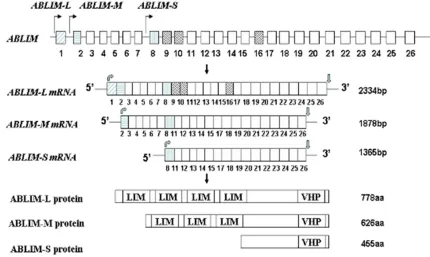
erated from alternative transcription initiation sites and alternative exon splicing (Figure 6). The full length of ABLIM, ABLIM-L, contains 26 exons; while exons 9, 10 and 16 are completely skipped in ABLIM-M and ABLIM-S. Conceptual translation of the coding sequences of ABLIM-L,
ABLIM-M and ABLIM-S shows that, except the common C-terminal VHP domain, ABLIM-L, AB-
LIM-M contain four and three N-terminal LIM domains, respectively. ABLIM-S, in contrast, does not contain any LIM domain [39, 40] (Figure 6).
[image:7.612.95.522.75.283.2] [image:7.612.88.518.329.586.2]Alternative splicing of LIM domain proteins
ABLIM-L is highly enriched in the retina gangli-on cell layer (RGCs). During embrygangli-onic develop-ment, ABLIM-L expression is at a basal level at embryonic E12, but it is steadily upregulated postnatally. In contrast, the expression of ABLIM-M and ABLIM-S remains constant during this period. Thus, the expression of ABLIM-L is both retina-specific and temporally regulated. However, ABLIM-L knockout mice display no obvious defects in the development and matu-ration of retinofugal projections and in vitro
growth of RGCs. It is known that ABLIM-L and ABLIM-M are structurally extremely similar, and both are expressed in the retina; while ABLIM-L may only play a minor role in regulating axon path finding/remodeling compared with AB- LIM-M, or is functionally redundant in the pres-ence of ABLIM-M. ABLIM-S, on the other hand, is unlikely to compensate for the loss of ABLIM-L function, since it does not have any LIM domain [41, 42].
Zinc finger protein 185 (ZNF185) is a novel actin-cytoskeleton-associated LIM domain pro-tein that localizes to F-actin structures, and is enriched at focal adhesions. At least four
ZNF185 mRNA isoforms have been identified. They have the same nucleotide sequence encoding a C-terminal LIM domain and a N-terminal ATD domain, but differ from exon 10 to 16 due to alternative exon splicing. In addi-tion, a ZNF185 cDNA encoding only a single C-terminal LIM domain was assembled based on the sequence of an expressed sequence tagged clone and a genomic DNA sequence. The highest expression of various ZNF185
mRNA isoforms is in normal prostate, but decreases dramatically in metastatic prostate cancer tissues and several PCa cell lines. Although the functional difference of these
ZNF185 isoforms remain to be established, in vitro transfection analysis with different domains of ZNF185 reveal that the N-terminal ATD is necessary and sufficient to suppress proliferation and anchorage-independent gro- wth of PCa cells; indicating that ZNF185 iso-forms with the ATD domain may function as tumor-suppressors by associating with the actin-cytoskeleton, although the biological function of this ATD deleted isoform of ZNF185 and its pathological relevance to PCa is unknown [43, 44].
Closing remarks
Alternative splicing (AS) is one of the most
late and diversify gene functions. A large num-ber of LIM domain proteins have been discov-ered to be regulated by AS, and produce even larger numbers of tissue specific proteins. Although the issue on how the AS of genes cod-ing for LIM domain proteins may be regulated in different tissues remain diffused, some clues may be obtained from other AS studies [45, 46]. On the other hand, alternative splicing is likely to be important for LIM domain proteins to bring into full play in many, if not all, develop-mental pathways. This has also been observed in some diseases such as cancer. To date, very few alternatively spliced LIM domain proteins have been characterized at a functional level. Further studies emphasized on the splicing mechanism and functional difference of the respective isoform of LIM domain proteins should be performed in a cell and tissue spe-cific manner.
Acknowledgements
This work was supported by National Natural Science Foundation of China (81373111) and Natural Science Foundation of Hebei Province in China (H2013209019).
Disclosure of conflict of interest
None.
Address correspondence to: Quan-Hui Zheng, Hebei Key Laboratory for Chronic Diseases, Tangshan Key
Laboratory for Preclinical and Basic Research on Chronic Diseases, School of Basic Medical Sciences, North China University of Science and Technology,
No. 57 of Jianshe South Road, Lubei District, Tangshan 063000, China. Tel: +8603153724598; Fax: +8603153725427; E-mail: [email protected]
References
[1] Smith MA, Hoffman LM, Beckerle MC. LIM pro- teins in actin cytoskeleton mechanoresponse.
Trends Cell Biol 2014; 24: 575-583.
[2] Zheng Q, Zhao Y. The diverse biofunctions of LIM domain proteins: determined by subcellu-lar localization and protein-protein interaction.
Biol Cell 2007; 99: 489-502.
[3] Ando K, Shioda S, Handa H, Kataoka K. Isola-tion and characterizaIsola-tion of an alternatively spliced variant of transcription factor Islet-1. J Mol Endocrinol 2003; 31: 419-425.
[5] Wilfinger A, Arkhipova V, Meyer D. Cell type and tissue specific function of islet genes in zebraf
-ish pancreas development. Dev Biol 2013;
378: 25-37.
[6] Park S, Mullen RD, Rhodes SJ. Cell-specific ac -tions of a human LHX3 gene enhancer during pituitary and spinal cord development. Mol En- docrinol 2013; 27: 2013-2027.
[7] Savage JJ, Hunter CS, Clark-Sturm SL, Jacob
TM, Pfaeffle RW, Rhodes SJ. Mutations in the
LHX3 gene cause dysregulation of pituitary and neural target genes that reflect patient
phenotypes. Gene 2007; 400: 44-51.
[8] Kobayashi M, Takatori N, Nakajima Y, Kumano G, Nishida H, Saiga H. Spatial and temporal ex- pression of two transcriptional isoforms of Lhx3, a LIM class homeobox gene, during em-bryogenesis of two phylogenetically remote as-cidians, Halocynthia roretzi and Ciona intesti-nalis. Gene Expr Patterns 2010; 10: 98-104. [9] Savage JJ, Hunter CS, Clark-Sturm SL, Jacob
TM, Pfaeffle RW, Rhodes SJ. Mutations in the LHX3 gene cause dysregulation of pituitary
and neural target genes that reflect patient
phenotypes. Gene 2007; 400: 44-51.
[10] Savage JJ, Mullen RD, Sloop KW, Colvin SC, Camper SA, Franklin CL, Rhodes SJ. Transgen-ic mTransgen-ice expressing LHX3 transcription factor isoforms in the pituitary: effects on the
gonad-otrope axis and sex-specific reproductive dis -ease. J Cell Physiol 2007; 212: 105-117. [11] Sum EY, Segara D, Duscio B, Bath ML, Field
AS, Sutherland RL, Lindeman GJ, Visvader JE. Overexpression of LMO4 induces mammary hyperplasia, promotes cell invasion, and is a predictor of poor outcome in breast cancer.
Proc Natl Acad Sci U S A 2005; 102:
7659-7664.
[12] Wittlin S, Sum EY, Jonas NK, Lindeman GJ, Vis-vader JE. Two promoters within the human LMO4 gene contribute to its overexpression in breast cancer cells. Genomics 2003; 82: 280-287.
[13] Montañez-Wiscovich ME, Shelton MD, Seachrist DD, Lozada KL, Johnson E, Miedler JD, Abdul-Karim FW, Visvader JE, Keri RA. Aber-rant expression of LMO4 induces centrosome
amplification and mitotic spindle abnormali -ties in breast cancer cells. J Pathol 2010; 222: 271-281
[14] Pen AE, Nyegaard M, Fang M, Jiang H,
Chris-tensen R, Mølgaard H, Andersen H, Ulhøi BP,
Østergaard JR, Væth S, Sommerlund M,de
Brouwer AP, Zhang X, Jensen UB. A novel sin -gle nucleotide splice site mutation in FHL1
confirms an Emery-Dreifuss plus phenotype
with pulmonary artery hypoplasia and facial dysmorphology. Eur J Med Genet 2015; 58: 222 -229
[15] Ng EK, Lee SM, Li HY, Ngai SM, Tsui SK, Waye MM, Lee CY, Fung KP. Characterization of
tis-sue-specific LIM domain protein (FHL1C) which
is an alternatively spliced isoform of a human
LIM-only protein (FHL1). J Cell Biochem 2001;
82: 1-10.
[16] McGrath MJ, Cottle DL, Nguyen MA, Dyson JM, Coghill ID, Robinson PA, Holdsworth M,
Cowl-ing BS, Hardeman EC, Mitchell CA, Brown S.
Four and a half LIM protein 1 binds
myosin-binding protein C and regulates myosin fila -ment formation and sarcomere assembly. J
Biol Chem 2006; 281: 7666-7683.
[17] Qin H, Du D, Zhu Y, Li J, Feng L, Liang Y, Han H.
The PcG protein HPC2 inhibits RBP-J-mediated
transcription by interacting with LIM protein
KyoT2. FEBS Lett 2005; 579: 1220-1226.
[18] Wang J, Qin H, Liang J, Zhu Y, Liang L, Zheng M, Han H. The transcriptional repression activity
of KyoT2 on the Notch/RBP-J pathway is regu
-lated by PIAS1-catalyzed SUMO ylation. J Mol Biol 2007; 370: 27-38.
[19] Velthuis AJ, Bagowski CP. PDZ and LIM
domain-encoding genes: molecular interactions and their role in development.
ScientificWorldJour-nal 2007; 7: 1470-1492.
[20] Krcmery J, Camarata T, Kulisz A, Simon HG. Nucleocytoplasmic functions of the PDZ-LIM protein family: new insights into organ
develop-ment. Bioessays 2010; 32: 100-108.
[21] Yamazaki T, Wälchli S, Fujita T, Ryser S, Hoshi-jima M, Schlegel W, Kuroda S, Maturana AD. Splice variants of enigma homolog, differen-tially expressed during heart development, promote or prevent hypertrophy. Cardiovasc Res 2010; 86: 374-382
[22] Niederländer N, Fayein NA, Auffray C, Pomiès P. Characterization of a new human isoform of
the enigma homolog family specifically ex
-pressed in skeletal muscle. Biochem Biophys
Res Commun 2004; 325: 1304-1311. [23] Nikitina EA, Kaminskaya AN, Molotkov DA,
Pop-ov AV, Savvateeva-PopPop-ova EV. Effect of heat shock on courtship behavior, sound produc-tion, and learning in comparison with the brain content of LIMK1 in Drosophila melanogaster males with altered structure of the LIMK1
gene. Zh Evol Biokhim Fiziol 2014; 50:
137-147.
[24] Ott EB, Te Velthuis AJ, Bagowski CP. Compara
-tive analysis of splice form-specific expression of LIM Kinases during zebrafish development.
Gene Expr Patterns 2007; 7: 620-629. [25] Takahashi H, Koshimizu U, Miyazaki J, Naka
-mura T. Impaired spermatogenic ability of
tes-ticular germ cells in mice deficient in the LIM-kinase 2 gene. Dev Biol 2002; 241: 259-272
fas-Alternative splicing of LIM domain proteins
cin-1 with p-Lin-11/Isl-1/Mec-3 kinase (LIMK)
1/2 to promote fascin-1/actin binding and filo
-podia stability. BMC Biol 2012; 10:
1186-1190.
[27] Cuberos H, Vallée B, Vourc’h P, Tastet J, Andres CR, Bénédetti H. Roles of LIM kinases in cen -tral nervous system function and dysfunction.
FEBS Lett 2015; 589: 3795-806.
[28] Chen X, Macara IG. Par-3 mediates the
inhibi-tion of LIM kinase 2 to regulate cofilin phos -phorylation and tight junction assembly. J Cell
Biol 2006; 172: 671-678.
[29] Smith MA, Blankman E, Deakin NO, Hoffman LM, Jensen CC, Turner CE, Beckerle MC. LIM
domains target actin regulators paxillin and
zyxin to sites of stress fiber strain. PLoS One 2013; 8: e69378.
[30] Lecroisey C, Brouilly N, Qadota H, Mariol MC, Rochette NC, Martin E, Benian GM, Ségalat L,
Mounier N, Gieseler K. ZYX-1, the unique zyxin protein of Caenorhabditis elegans, is involved in dystrophin-dependent muscle
degenera-tion. Mol Biol Cell 2013; 24: 1232-1249. [31] Warner A, Qadota H, Benian GM, Vogl AW, Mo
-erman DG. The Caenorhabditis elegans paxil-lin orthologue, PXL-1, is required for
pharynge-al muscle contraction and for viability. Mol Biol
Cell 2011; 22: 2551-2563
[32] Luo S, Schaefer AM, Dour S, Nonet ML. The conserved LIM domain-containing focal adhe-sion protein ZYX-1 regulates synapse mainte-nance in Caenorhabditis elegans. Develop-ment 2014; 141: 3922-4933.
[33] Gao ZL, Deblis R, Glenn H, Schwartz LM. Dif-ferential roles of HIC-5 isoforms in the regula-tion of cell death and myotube formaregula-tion dur-ing myogenesis. Exp Cell Res 2007; 313: 4000-4014.
[34] Deakin NO, Turner CE. Distinct roles for paxillin and Hic-5 in regulating breast cancer cell
mor-phology, invasion, and metastasis. Mol Biol
Cell 2011; 22: 327-341
[35] Yund EE, Hill JA, Keller RS. Hic-5 is required for fetal gene expression and cytoskeletal organi-zation of neonatal cardiac myocytes. J Mol Cell Cardiol 2009; 47: 520-527.
[36] Desai LP, Zhou Y, Estrada AV, Ding Q, Cheng G, Collawn JF, Thannickal VJ. Negative regulation of NADPH oxidase 4 by hydrogen peroxide-in-ducible clone 5 (Hic-5) protein. J Biol Chem
2014; 289: 18270-18278.
[37] Solomon JD, Heitzer MD, Liu TT, Beumer JH, Parise RA, Normolle DP, Leach DA, Buchanan G, DeFranco DB. VDR activity is differentially
affected by Hic-5 in prostate cancer and stro-mal cells. Mol Cancer Res 2014; 12: 1166-1180.
[38] Kim-Kaneyama JR, Takeda N, Sasai A, Miyaza-ki A, Sata M, Hirabayashi T, Shibanuma M,
Yamada G, Nose K. Hic-5 deficiency enhances
mechanosensitive apoptosis and modulates vascular remodeling. J Mol Cell Cardiol 2011; 50: 77-86.
[39] Lu C , Huang X, Ma HF, Gooley JJ, Aparacio J, Roof DJ, Chen C, Chen DF, Li T. Normal retinal development and retinofugal projections in
mice lacking the retina-specific variant of ac -tin-binding LIM domain protein. Neuroscience 2003; 120: 121-131.
[40] Matsuda M, Yamashita JK, Tsukita S, Furuse M. abLIM3 is a novel component of adherens junctions with actin-binding activity. Eur J Cell
Biol 2010; 89: 807-816.
[41] Lu C, Huang X, Ma HF, Gooley JJ, Aparacio J, Roof DJ, Chen C, Chen DF, Li T. Normal retinal development and retinofugal projections in
mice lacking the retina-specific variant of ac -tin-binding LIM domain protein. Neuroscience 2003; 120: 121-131.
[42] Garcia MC, Abbasi M, Singh S, He Q. Role of Drosophila gene dunc-115 in nervous system. Invert Neurosci 2007; 7: 119-128.
[43] Pan ZF, Feng WG, Chen LM, Liu XY, Zhao CL,
Lian B, Yu WJ, Gao ZQ. ZNF185 gene cloning and the localization in mouse testis. Xi Bao Yu
Fen Zi Mian Yi Xue Za Zhi 2010; 26: 973-975. [44] Zhang JS, Gong A, Young CY. ZNF185, an actin-cytoskeleton-associated growth inhibitory LIM protein in prostate cancer. Oncogene 2007; 26: 111-122.
[45] Guryanova OA, Drazba JA, Frolova EI, Chumak-ov PM. Actin cytoskeleton remodeling by the alternatively spliced isoform of PDLIM4/RIL
protein. J Biol Chem 2011; 286:
26849-26859.
[46] Ohsawa N, Koebis M, Suo S, Nishino I, Ishiura S. Alternative splicing of PDLIM3/ALP, for
α-actinin- associated LIM protein 3, is aberrant