138
Chat-crowd: A Dialog-based Platform for Visual Layout Composition
Paola Cascante-Bonilla1 Xuwang Yin1 Vicente Ordonez1 Song Feng2
1University of Virginia,2IBM Thomas J. Watson Research Center.
[pc9za, xy4cm, vicente]@virginia.edu, [email protected]
Abstract
In this paper we introduce Chat-crowd, an in-teractive environment for visual layout com-position via conversational interactions. Chat-crowd supports multiple agents with two con-versational roles: agents who play the role of
adesignerare in charge of placing objects in
an editable canvas according to instructions or commands issued by agents with a director
role. The system can be integrated with crowd-sourcing platforms for both synchronous and asynchronous data collection and is equipped with comprehensive quality controls on the performance of both types of agents. We ex-pect that this system will be useful to build multimodal goal-oriented dialog tasks that re-quire spatial and geometric reasoning.
1 Introduction
There has been growing interest in building visu-ally grounded dialog systems (Ren et al., 2015;
Bisk et al., 2016; Das et al., 2017; Chen et al.,
2018; El-Nouby et al., 2018; Shridhar and Hsu,
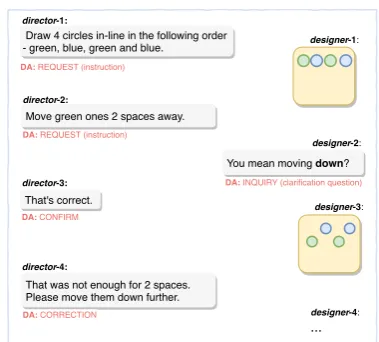
2018). Building interactive agents that can com-plete goal-oriented tasks in a situated environ-ment using natural language is a challenging prob-lem that requires both robust natural language un-derstanding (NLU) and natural language genera-tion (NLG). Datasets for visually grounded dialog tasks have started to emerge but more general and effective tools for data collection are still missing. We introduce an interactive data collection and annotation tool1 for the collaborative tasks of vi-sual layout composition through natural language dialogs (see Figure1). In this work, we refer to layouts to the spatial distribution of objects in a 2D canvas as well as their attributes such as name, shape, or color. More specifically, Chat-crowd is designed to support a basic model task consisting
1chatcrowd.github.io
Draw 4 circles in-line in the following order
- green, blue, green and blue. designer-1:
Move green ones 2 spaces away.
designer-3:
You mean moving down?
designer-2: director-1:
director-2:
That's correct.
director-3:
That was not enough for 2 spaces. Please move them down further.
director-4:
DA: REQUEST (instruction)
DA: CONFIRM
DA: INQUIRY (clarification question)
DA: CORRECTION designer-4:
...
[image:1.595.320.510.218.389.2]DA: REQUEST (instruction)
Figure 1: An illustration of the interactions and dialog acts (DA) between adirectorand adesignerfor one of our sample tasks. In asynchronous mode, the role of an agent can be taken by a different user in each round.
of dialogs between a director agent that is pro-vided with a visual layout as a reference, and a de-signeragent that is provided with a canvas where one can add, remove, resize, or relocate visual el-ements. The two agents can communicate using natural language within the context of various di-alog acts (“DA”) as illustrated in Figure 1. The directorprovides instructions to modify elements in the canvas, and the designer optionally writes clarifying questions or modifies the canvas. While the director can see the progress of the designer as the dialog proceeds, thedesigner only sees the instructions from the director. The dialog ends when the visual layout composed by thedesigner matches the given visual layout to thedirector.
it enables a process for data validation and job dis-tribution at a finer level. Additionally, our sys-tem optionally employs a bot agent to inject syn-thetic utterances that trigger diversified or less rep-resented dialog activities. Such injections can also be used for evaluating the responses from human agents since the optimal responses to the synthetic utterances are already given. We show that under this asynchronous mode, crowdsourced contribu-tors are still able to converse based on the dialog history and complete the tasks.
To validate our system, we first apply the sys-tem on a task with more controllable visual lay-outs consisting of visual primitives (e.g., circles, rectangles, triangles); we also test our system on grounding for visual layouts corresponding to ob-jects in real-images from an object recognition dataset (Lin et al., 2014). Separating the pat-tern recognition task from the visual understand-ing task through visual layouts allows us to ex-plore richer language for spatial reasoning yet still connects to real-world images.
Our contributions are the following: (1) a new multi-modal dialog simulation system with a focus on spatial reasoning; (2) an asynchronous dialog collection platform that can trigger more diverse dialog activities and evaluate the performance of crowdsourced contributors in ongoing tasks; (3) an analysis of the difficulty and the type of lan-guage used by people to accomplish the proposed collaborative task of re-constructing visual layouts from asynchronous dialogs.
2 Visual Layout Dialog Collection
This work aims to demonstrate the usage of Chat-crowd for obtaining dialog data for geometric and spatial reasoning, ranging from abstract to more complex scenes. To this end, we explore two types of visual layouts: layouts in a shape-world with automatically generated simple 2D shape primi-tives, and layouts of objects from real images.
2D-shape Layouts We propose a synthetic lay-out world where objects of different shapes (circle, square, triangle) and colors (blue, red, green) are pinned to a set of 5×5 grid locations on a can-vas. This setup allows us to focus on the language, and the accurate reconstruction of the visual lay-outs by discarding the additional complexities of real-world scenes. We generate two types of 2D-shape layouts: (1) 2d-shape-random: con-sisting of scenes with 4 to 6 objects with shapes,
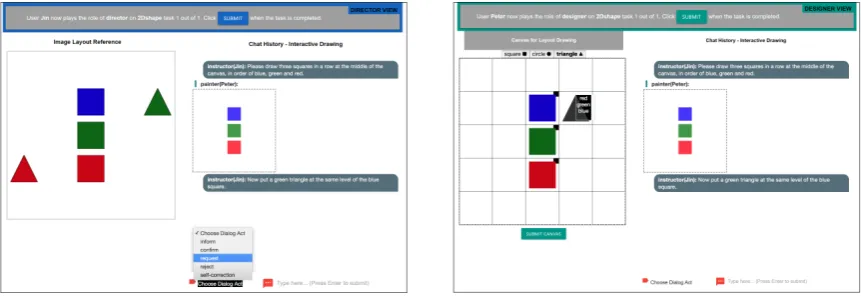
color, and locations selected randomly, and 2d-shape-pattern: consisting of objects gener-ated by following a set of customizable produc-tion rules that encourage adjacent objects. Figure
3presents our user interface for the data collection tasks of 2D-shape layouts. For the real-image lay-outs, the interface includes additional features for resizing, moving, and naming objects.
COCO Layouts We use as reference and test bed of the object layouts of real-world images from the COCO dataset (Lin et al., 2014). The layout of an image includes objects and their loca-tions. All objects are represented by a set of rect-angles (proportional to the size of the correspond-ing object) and the object class (e.g., people, dogandsurfboard). We also experiment with two types of scenarios: (1)COCO-simple: cor-responding to images with simple layouts with 3 to 4 object instances belonging to 3 distinct classes, and (2) COCO-complex: corresponding to im-ages consisting of layouts with 6 to 8 object in-stances belonging to 6 distinct object classes.
2.1 Crowdsourcing Task Design
In our task, crowd agents interact under two roles: director and designer. In the director mode, agents direct the drawing in the following ways: (1) providing instructions for how layouts should be modified; (2) giving suggestions for correct-ing or improvcorrect-ing the current layout; (3) answer-ing questions from the designer agents. In the designer mode, the agents either follow the in-structions to draw on the canvas by specifying the attributes and locations for 2D-shapes/COCO, or ask clarifying questions if needed.
Data Collection One challenge for such multi-model dialog collection via crowdsourcing is that it could be very complicated and expensive to pair two qualified contributors to converse in real time (Lasecki and Bigham,2013). Our system is designed to support both synchronous as well as asynchronous interactions. In the asynchronous mode, the agents are asked to review and under-stand a chat history before taking an action. Thus, we design quizzes to assist agents in learning how to examine the chat history to determine what ac-tions are helpful for reconstructing the layouts.
dialog act utterance
designer
dialog act latest drawing
utterance
task status (pre)
Job Dispatcher
completion status performance analysis latest canvas
dialog history
reference image dialog history task status (new)
Dialog Interface Renderer director
job queue
Input Analyzer
Synthetic Generator
[image:3.595.90.272.61.174.2]Input Validator
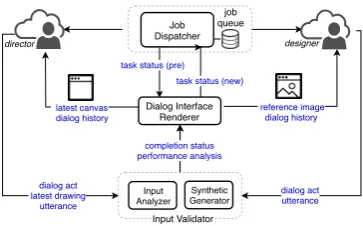
Figure 2: Overview of the Chat-crowd System
which is not applicable in our case. We propose to verify and ensure the success of the task using the following criteria: a task is considered success-ful if a layout is reconstructed with high similarity with respect to the reference layout. For 2D shape layouts, a layout similarity is tested by computing an exact match; For COCO layouts the matching is confirmed by thedirectoragents who determines when the task should end.
Output Data The output includes free-form tex-tual utterances fromdirectoranddesigner agents annotated with dialog acts, a sequence of drawings on the canvas and the final layouts of images. In our task setting, the dialog data can be potentially divided into sub-dialogs or atomic dialog interac-tions accordingly.
3 Experiment Results and Analysis
3.1 System Overview
Figure2 presents an overview of our system. In synchronous mode, it allows the agents to con-verse in real time to perform a given task. In asyn-chronous mode, the automated Job Dispatcher de-termines a job of a role for next turn to inter-face with the crowdsourcing platforms. The latest canvas and dialog history of a given job are dy-namically generated by Dialog Interface Renderer. Once an input (e.g, dialog act, utterance, or latest canvas) is submitted, Input Validator first examine the content via its sub-module Input Analyzer. It identifies the modification to the previous canvas; object features and locations in the utterance2and the dialog acts etc.. Additionally, Synthetic Gen-erator is applied to inject certain responses: (1) to intrigue more diverse dialog activities such as designer asking clarification questions; (2) to spect the performance of the contributors, for in-stance, when adesigner submits a canvas given a non-viable instruction by Synthetic Generator.
2We employ NLP tools byspacy.io
3.2 Experimental Settings
We post the jobs on the FigureEight crowdsourc-ing platform. We collected dialogs for 100 2d-shape-randomlayouts, 100 2d-shape-pattern layouts, and additionally run a pi-lot study on 10 COCO-simple layouts and 10 COCO-complexlayouts, leading to2,520 indi-vidual user interactions for 2d-shapes and595for real scene COCO layouts.
3.3 Quantitative and Qualitative Analysis
Director Word Usage Analysis We first ana-lyzed the types of words that people in thedirector agent role used to provide instructions to the de-signers. We found that people mention location, color, and shape words in over90% of the total of instructions and often all three with a slight pref-erence for mentioning shape over color informa-tion. For the 2d-shape-pattern task there was slightly lower preference to mention shape and color, than in2d-shape-random. This is because when each object is placed randomly, then people have to more often refer to each object in-dividually on each round.
Designer Reactions Analyzing the interactions by designer agents we found that about 60% of the times they modify the canvas without necessar-ily asking clarification questions. Here is a set of example responses: “I did not understand instruc-tions from instructor ...”, “please give instruction”, examples of questions are: “where to put circle?”, “do the boxes mean squares”, “where exactly, in the middle, left or right?”, “It is done?”.
Task Duration We additionally analyze the dif-ficulty of each task by the number of rounds that it takes to complete a layout, and the average length (in words) for the instructions issued by the direc-tor. Table 1 shows these statistics for our four type of layouts. We found, unsurprisingly, that for 2d-shape-pattern layouts, the average number of rounds is significantly lower than for 2d-shape-random, indicating that the pattern in the distribution of objects in the canvas is in-deed being exploited by the agents. Additionally, we can gauge the difference in difficulty between COCO-complexandCOCO-simple, where the number of rounds is more than double even when the average instruction is only two words larger.
2d-Figure 3: UI fordirector(left) anddesigner(right) agents for 2D-shape layout task.
LAYOUT-TYPE #ROUNDS AVG-WORDS
2d-shape-random 7.23 18.0±14.3
2d-shape-pattern 5.37 19.4±15.8
COCO-simple 7.6 18.7±13.9
COCO-complex 22.1 20.9±28.2
Table 1: Statistics for task duration for each type of lay-out based on the number of rounds needed and average number of words in the instructions.
shape-random layouts, designer agents were able to modify more than three objects per turn only 14% of the times, while this number was 20% for2d-shape-pattern layouts. Thus, it fur-ther confirms that people are effective at using the patterns to optimize language for the task. We also notice how the COCO layouts elicit semantic re-lations that are not present in the 2D-shape lay-outs, so while we expect that some of the language from 2D-shape layouts will translate to real-world scenes, such as references to locations, and shapes, the realm of semantic relations might need a sepa-rate treatment.
4 Related Work
Given some of the limitations of tasks such as human-robot interactions, text-to-scene conver-sion or visual question answering, there has been recent interest on building more complex multi-modal datasets of visually grounded dialogs (
Ge-man et al.,2015;Mostafazadeh et al.,2017;Das
et al., 2017; Kim et al., 2017). Our goal
ori-ented task of re-constructing the spatial distribu-tion of objects in a canvas through conversadistribu-tional interactions sets our task apart from these previ-ous works. In our work, we additionally explore re-construction of layouts corresponding to real-world images with a focus on the inclusion of
spa-tial and geometric reasoning and more dynamic di-alog activities while completing the tasks.
Another aspect that sets our work apart from previous efforts in this domain is that we lever-age asynchronous dialog interactions. However, there have been important previous works study-ing this type of dialogs in the more general set-ting (e.g.Blaylock et al.(2002);Joty et al.(2011);
Tavafi et al. (2013)). We similarly show that our
proposed visually grounded task is feasible under asynchronous dialogs.
Finally, object layouts, and visual grounding on geometric primitives has generally been of inter-est to study the compositionality of language. The work of Mitchell et al. (2013); FitzGerald et al.
(2013) used synthetic object layouts and simple scenes to study referring expressions, while Yin
and Ordonez(2017) used layouts from real images
for image captioning. Andreas et al.(2016), and
Johnson et al.(2017) introduced synthetic abstract
scene datasets to test visual question answering. Our work is instead focused on visually grounded dialogs for spatial reasoning.
5 Conclusions
We developed Chat-crowd, a framework and asso-ciated platform to collect dialogs for goal-oriented tasks involving visual reasoning. Our platform in-corporates mechanisms to encourage diverse dia-log activities and provides a new way of evaluating the performance of crowdsourcing agents during the task. Our system demonstrated the feasibil-ity of adirector-designer agent interaction to re-construct input visual layouts based only on asyn-chronous dialog interactions.
[image:4.595.82.513.62.210.2]References
Jacob Andreas, Marcus Rohrbach, Trevor Darrell, and Dan Klein. 2016. Neural module networks. In Pro-ceedings of the IEEE Conference on Computer
Vi-sion and Pattern Recognition, pages 39–48.
Yonatan Bisk, Deniz Yuret, and Daniel Marcu. 2016. Natural language communication with robots. In
Proceedings of the 2016 Conference of the North American Chapter of the Association for
Computa-tional Linguistics: Human Language Technologies,
pages 751–761.
Nate Blaylock, James Allen, and George Ferguson. 2002. Synchronization in an asynchronous agent-based architecture for dialogue systems. In Pro-ceedings of the 3rd SIGdial workshop on Discourse
and dialogue-Volume 2, pages 1–10. Association for
Computational Linguistics.
Howard Chen, Alane Shur, Dipendra Misra, Noah Snavely, and Yoav Artzi. 2018. Touchdown: Natural language navigation and spatial reason-ing in visual street environments. arXiv preprint
arXiv:1811.12354.
Abhishek Das, Satwik Kottur, Khushi Gupta, Avi Singh, Deshraj Yadav, Jos´e MF Moura, Devi Parikh, and Dhruv Batra. 2017. Visual dialog. In Proceed-ings of the IEEE Conference on Computer Vision
and Pattern Recognition, volume 2.
Alaaeldin El-Nouby, Shikhar Sharma, Hannes Schulz, Devon Hjelm, Layla El Asri, Samira Ebrahimi Kahou, Yoshua Bengio, and Graham W Taylor. 2018. Keep drawing it: Iterative language-based image generation and editing. arXiv preprint
arXiv:1811.09845.
Nicholas FitzGerald, Yoav Artzi, and Luke Zettle-moyer. 2013. Learning distributions over logical forms for referring expression generation. In Pro-ceedings of the 2013 conference on empirical
meth-ods in natural language processing, pages 1914–
1925.
Donald Geman, Stuart Geman, Neil Hallonquist, and Laurent Younes. 2015. Visual turing test for com-puter vision systems. Proceedings of the National
Academy of Sciences, 112(12):3618–3623.
Justin Johnson, Bharath Hariharan, Laurens van der Maaten, Li Fei-Fei, C Lawrence Zitnick, and Ross Girshick. 2017. Clevr: A diagnostic dataset for compositional language and elementary visual rea-soning. InComputer Vision and Pattern Recognition
(CVPR), 2017 IEEE Conference on, pages 1988–
1997. IEEE.
Shafiq Joty, Giuseppe Carenini, and Chin-Yew Lin. 2011. Unsupervised modeling of dialog acts in asynchronous conversations. InIJCAI Proceedings-International Joint Conference on Artificial
Intelli-gence, volume 22, page 1807.
Jin-Hwa Kim, Devi Parikh, Dhruv Batra, Byoung-Tak Zhang, and Yuandong Tian. 2017. Codraw: Vi-sual dialog for collaborative drawing. arXiv preprint
arXiv:1712.05558.
Walter S Lasecki and Jeffrey P Bigham. 2013. Inter-active crowds: Real-time crowdsourcing and crowd agents. InHandbook of human computation, pages 509–521. Springer.
Tsung-Yi Lin, Michael Maire, Serge Belongie, James Hays, Pietro Perona, Deva Ramanan, Piotr Doll´ar, and C Lawrence Zitnick. 2014. Microsoft coco: Common objects in context. In European
confer-ence on computer vision, pages 740–755. Springer.
Margaret Mitchell, Kees Van Deemter, and Ehud Re-iter. 2013. Generating expressions that refer to visi-ble objects. InProceedings of the 2013 Conference of the North American Chapter of the Association for Computational Linguistics: Human Language
Technologies, pages 1174–1184.
Nasrin Mostafazadeh, Chris Brockett, Bill Dolan, Michel Galley, Jianfeng Gao, Georgios P Sp-ithourakis, and Lucy Vanderwende. 2017. Image-grounded conversations: Multimodal context for natural question and response generation. arXiv
preprint arXiv:1701.08251.
Mengye Ren, Ryan Kiros, and Richard Zemel. 2015. Exploring models and data for image question an-swering. In Advances in neural information
pro-cessing systems, pages 2953–2961.
Mohit Shridhar and David Hsu. 2018. Interactive vi-sual grounding of referring expressions for human-robot interaction. arXiv preprint arXiv:1806.03831.
Maryam Tavafi, Yashar Mehdad, Shafiq Joty, Giuseppe Carenini, and Raymond Ng. 2013. Dialogue act recognition in synchronous and asynchronous con-versations. In Proceedings of the SIGDIAL 2013
Conference, pages 117–121.
Xuwang Yin and Vicente Ordonez. 2017. Obj2text: Generating visually descriptive language from ob-ject layouts. InConference on Empirical Methods