R E S E A R C H A R T I C L E
Open Access
Measuring women
’
s childbirth experiences:
a systematic review for identification and
analysis of validated instruments
Helena Nilvér
1*, Cecily Begley
1,2and Marie Berg
1,3Abstract
Background:
Women
’
s childbirth experience can have immediate as well as long-term positive or negative effects
on their life, well-being and health. When evaluating and drawing conclusions from research results, women
’
s
experiences of childbirth should be one aspect to consider. Researchers and clinicians need help in finding and
selecting the most suitable instrument for their purpose. The aim of this study was therefore to systematically
identify and present validated instruments measuring women
’
s childbirth experience.
Methods:
A systematic review was conducted in January 2016 with a comprehensive search in the bibliographic
databases PubMed, CINAHL, Scopus, The Cochrane Library and PsycINFO. Included instruments measured women
’
s
childbirth experiences. Papers were assessed independently by two reviewers for inclusion, and quality assessment
of included instruments was made by two reviewers independently and in pairs using Terwee et al
’
s criteria for
evaluation of psychometric properties.
Results:
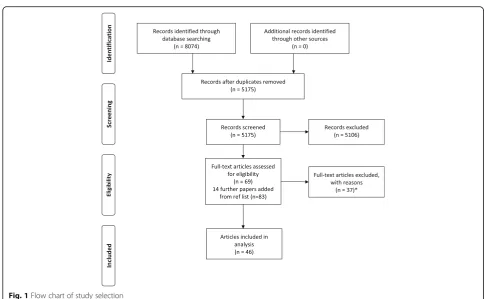
In total 5189 citations were screened, of which 5106 were excluded by title and abstract. Eighty-three
full-text papers were reviewed, and 37 papers were excluded, resulting in 46 included papers representing 36
instruments. These instruments demonstrated a wide range in purpose and content as well as in the quality of
psychometric properties.
Conclusions:
This systematic review provides an overview of existing instruments measuring women
’
s childbirth
experiences and can support researchers to identify appropriate instruments to be used, and maybe adapted, in
their specific contexts and research purpose.
Keywords:
Systematic review, Validated questionnaires, Measurement instruments, Psychometric properties,
Childbirth experiences, Childbirth satisfaction
Background
Childbirth experiences can have immediate as well as
long-term positive or negative effects on life, well-being
and health [1]. A positive experience can be remembered
as an empowering life event [1
–
3] connected to personal
growth and self-knowledge affecting the transition to
motherhood [4]. A negative birth experience increases the
risk of negative health outcomes, such as postpartum
depression [5] and future fear of giving birth [6], that can
lead to a request for caesarean birth in future pregnancies
[7, 8], and have an impact on future reproduction [9, 10].
The memory of a birth can vary over time for the woman,
with either more positive or negative memories being
recalled at a later period after birth compared to directly
after [3, 11]. Furthermore childbirth, as experienced by
the woman giving birth, can vary considerably from how a
caregiver or relative may experience the same event. The
person beside the woman may focus on more tangible,
observable aspects and underestimate psychological
as-pects. It is therefore important that women are asked
for their experiences [12]. Women have the right to a
dignified, respectful, and humane health care during
childbirth. Mistreatment of women in childbirth is a
violation of women
’
s fundamental human rights [13].
* Correspondence:[email protected]1Institute of Health and Care Sciences, Sahlgrenska Academy, University of
Gothenburg, Gothenburg, Sweden
Full list of author information is available at the end of the article
Such mistreatment can occur both in the interaction
between the woman and health care provider as through
systematic failures in health facilities and health system
levels. Therefor there is need of reliable and validated
in-struments to highlight women’s experiences and promote
respectful and supportive care [14].
Studies on women’s childbirth experiences have been
using different surrogate terms and related concepts such
as
‘
childbirth satisfaction’
,
‘satisfaction with care’
,
‘experi-ences of control’
or
‘of support’
,
‘experience of relationship
with caregivers’
and
‘experience of pain’
[15]. Women’s
satisfaction with childbirth is multidimensional and affects
the childbirth experience [16]. When evaluating and
draw-ing conclusions from care in labour and birth, women’s
experiences of childbirth should be one outcome of
con-siderable importance to measure. This requires the use of
reliable and valid instruments adapted to the purpose. As
researchers might select and use different terms related to
each other when studying women’s childbirth experiences,
we have chosen to include instruments that use surrogate
terms and related concepts in this review.
For an instrument to receive good levels of reliability and
validity, extensive development and testing of psychometric
properties is needed [17]. Without valid psychometric
properties, conclusions drawn may be false and lead to
invalid conclusions on the concept [18].
No review specifically focusing on instruments
meas-uring women’s childbirth experiences has been found,
but there are two reviews evaluating instruments
meas-uring
‘maternal childbirth satisfaction’
[19, 20]. Perriman
and Davis identified and reviewed 4 instruments
measur-ing maternal satisfaction with continuity of maternity
care models in before, during and after labour and birth.
The papers describing the instruments primarily
com-pared outcomes rather than describing the development
of the tool [19]. Sawyer et al. identified and reviewed 9
multi-item instruments specifically studying maternal
satisfaction with care given during labour and birth [20].
In an attempt to give researchers and clinicians an
overview, we performed a systematic review to identify
and present validated instruments measuring women’s
childbirth experience.
Methods
A systematic review is a rigorous method of research
that follows a systematic procedure to enable a
sum-mary of all findings from multiple studies on a specific
topic. The start point is a rigorous search process for
capturing the entire body of scientific studies [21]. As
researchers might select and use different terms related
to each other when studying women’s childbirth
experi-ence [15], we have chosen to use a broad definition and
use surrogate terms and related concepts in this review,
e.g. childbirth satisfaction, control, support, fear. The
Cochrane guideline was used as guidance [21].
Eligibility criteria
First a review protocol was developed (see Additional file1).
Inclusion and exclusion criteria were established in advance
and documented in the review protocol. Criteria for
inclu-sion in this review were as follows:
Papers representing instruments measuring women
’
s
childbirth experience.
Papers should describe the development or test
psychometric properties of an instrument.
Instruments assessing both pregnancy, childbirth
and the postpartum period are included if one or
more dimensions are related to women
’
s childbirth
experiences, and this could be assessed as a separate
scale.
Papers reporting original research, published in
peer-reviewed journal.
Reviews were included to enable us to find original
papers.
Papers published in English or French were included
as the researchers could understand these languages.
Dissertations, non-original research, or conference
papers were excluded.
Search strategy
The search strategy was designed and developed following
consultation with a healthcare librarian. Before the final
search all authors commented and agreed on the search
string that was adapted for the individual databases (see
Additional file 2). The final search took place in January
2016 in the electronic databases of PubMed, Scopus,
CINAHL, Cochrane Library and PsycINFO. No restriction
in the dates of publishing was made.
Fourteen additional studies were found through search of
reference lists of included papers and were assessed in
full-text by two independent reviewers for eligibility criteria
(HN and MB). Three of these papers were included after
assessment in full text. In total 83 papers were thus
assessed in full text of which 37 did not fulfil the inclusion
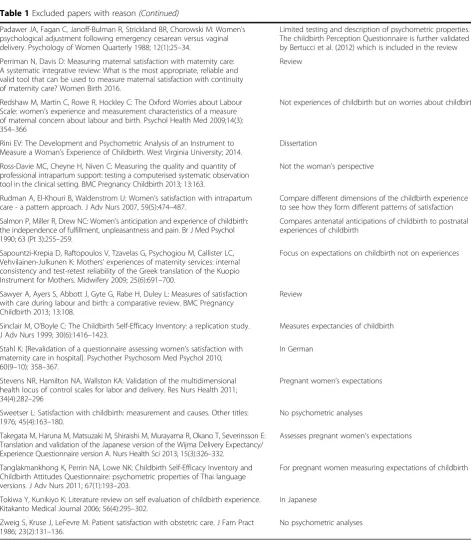
criteria and were excluded with reason (see Table 1). The
names of each instrument were then searched in PubMed
and CINAHL to retrieve further potential papers related to
the specific instrument. No further papers on the
develop-ment or testing of psychometric properties of the identified
instruments were found. The flow of selection for studies
are shown in Fig. 1.
Quality assessment of included instruments
As the aim of this review was to identify and assess
instru-ments measuring women’s childbirth experiences, the
focus was not on the quality of the studies of the included
articles but to identify psychometric properties of
identi-fied instruments. This was done using criteria speciidenti-fied by
Terwee et al. [17] which refer to the following properties;
Content validity, Internal consistency, Criterion validity,
Construct validity, Reproducibility agreement,
Reproduci-bility reliaReproduci-bility, Responsiveness, Floor and ceiling effects,
and Interpretability. The properties were evaluated as; + =
positive rating, ? = indeterminate rating,
−
= negative
rat-ing, and 0 = no information available. Terwee et al.
em-phasise the importance of a clear design and method, and
that the sample size needs to be greater than 50 subjects
in every subgroup of the analysis [17]. In addition to
qual-ity assessment of these properties we added another two
criteria. The first one considers the need for the
ment and, for a positive rating, a search for existing
instru-ments had to have been done, demonstrating the need to
develop and test a new instrument. The second rating
item added is related to face validity. For a positive rating,
members of the target population should have been asked
about the appropriateness of the questionnaire and of
each question.
This rating of the measurement properties was
per-formed independently by two review authors (HN and
MB, or HN and CB, or MB and CB). When ratings
differed between the pairs, it was discussed and, when
conflict remained, the third reviewer was included in the
discussion to reach consensus. An overview of the results
of the quality rating of psychometric properties of
included instruments is displayed in Table 2. The last
col-umn in the table gives the total figure awarded to each
tool, based on a mark of 1 for each
‘+’
, and 0.5 for one or
more
‘?’
grades. This is only a rough guide to the overall
quality of the instrument and must be interpreted with
caution. For example, two tools that both received a mark
of 6 may be of very different quality, depending on the
criteria that were awarded the points.
In conducting this review, our focus and aim was on
identifying measures and conducting a broad assessment
of their psychometric properties. Given the large number
of instruments found, and their very different foci, it was
not possible to make clear recommendations as to one
particular instrument that would suit all purposes. Instead,
some general suggestions are made as to the instruments
that appear to be emerging as the top ranking tools in
terms of the quality measurement performed, and the
overall mark given.
Data extraction and analysis
The following data were extracted for each instrument:
Name of instrument/acronym, authors (year), country of
origin, aim/motive of instrument, number of items,
di-mensions/subscales, response scale, timeframe to answer
the questionnaire, whether or not the questionnaire was
available and a short narrative summary of included
in-struments. The data extraction was made by the first
au-thor (HN) and then checked by the other auau-thors for
accuracy.
One of the individual papers was conducted by one
of the authors (MB). To avoid conflict of interest this
paper was assessed for eligibility criteria, and quality
assessment was made, by the two other authors (HN
and CB).
Results
Forty-six articles presenting 36 instruments [22–59]
meas-uring women’s childbirth experiences were included for
quality assessment. Different surrogate terms and related
concepts used in identified instruments were described by
authors as: childbirth experience (27.8%), satisfaction with
care/birth/childbirth (36.1%), perception of birth/care
(13.9%), control (11.1%), support (8.3%), fear of childbirth
(5.6%), childbirth trauma (2.8%), birth memories (2.8%)
and childbirth schema (2.8%). In five of the identified
instruments we found cultural validation/translation of
the instrument had been done. Most of the instruments
were developed and tested in the United States (6) and in
the United Kingdom (6). Further countries represented
were: Canada (4), the Netherlands (4), Turkey (3), Sweden
(3), Jordan (3), France (2), Italy (2), Australia (1), Senegal
(1), and Norway (1). Number of items in the instruments
varied from three to 145. Nine of the instruments were
uni-dimensional, and 27 consisted of several dimensions/
subscales. Quality ratings of psychometric properties are
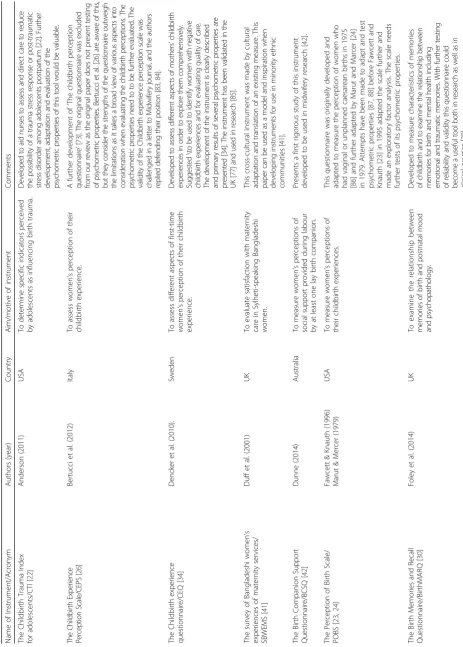
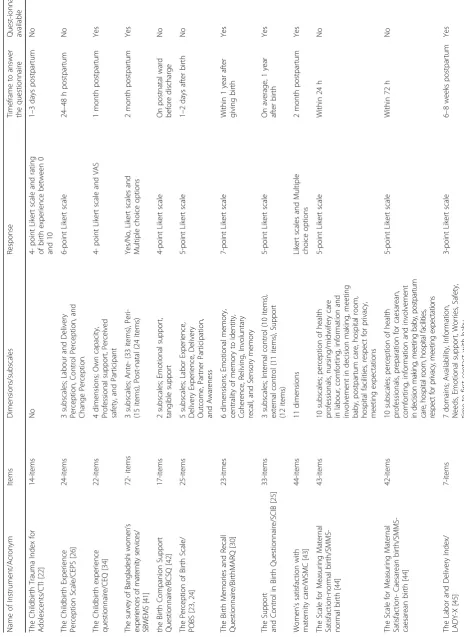
presented in Table 2. Descriptive data of included
instru-ments are presented in Table 3, and characteristics in
Table 4. Instruments are reported in alphabetical order by
first author.
Table 1
Excluded papers with reason
Instrument Reason for exclusion
Bowers BB: Development of an instrument to measure mothers’perceptions of professional labor support. Texas Woman’s University; 2001.
Dissertation
Callahan JL, Hynan MT: Identifying mothers at risk for postnatal emotional distress: further evidence for the validity of the perinatal posttraumatic stress disorder questionnaire. J Perinatol 2002; 22(6):448–454.
Focus on postnatal medical complications of infant in relation to mothers health rather than on childbirth experiences
Chen CH, Wang SY: Women’s perceptions of caesarean delivery. Gaoxiong Yi Xue Ke Xue Za Zhi 1992; 8(5):241–246.
In Chinese
Claudia Uribe T, Aixa Contreras M, Luis Villarroel D: Adaptation and validation of the Maternal Welfare Scale in childbirth situations: Second version for integral assistance scenarios. Revista Chilena de Obstetricia y Ginecologia 2014; 79(3): 154–160.
In Spanish
Claudia Uribe T, Aixa Contreras M, Luis Villarroel D, Soledad Hivera M, Paulina Bravo V, Marieta Cornejo A: Maternal wellbeing during childbirth: Development and application of a measurement scale. Revista Chilena de Obstetricia y Ginecologia 2008; 73(1):4–10.
In Spanish
Declercq ER, Sakala C, Corry MP, Applebaum S: Listening to Mothers II: Report of the Second National U.S. Survey of Women’s Childbearing Experiences: Conducted January-February 2006 for Childbirth Connection by Harris Interactive(R) in partnership with Lamaze International. J Perinat Educ 2007; 16(4):9–14.
Not able to distinguish childbirth experience as separate scale from rest of questionnaire.
De Holanda CSM, Alchieri JC, Morais FRR, De Oliveira Maranhão TM: Strategies for development, follow-up, and assessment of care provided to women in the pregnancy-postnatal cycle. Revista Panamericana de Salud Publica/Pan American Journal of Public Health 2015; 37(6):388–394.
In Portuguese
Drummond J, Rickwood D: Childbirth confidence: validating the Childbirth Self-Efficacy Inventory (CBSEI) in an Australian sample. J Adv Nurs 1997; 26(3):613–622
Measures expectancies of labour
Denis A, Séjourné N, Callahan S: Étude de validation française de la version courte du Maternal Self-report Inventory. L’Encéphale: Revue de psychiatrie clinique biologique et thérapeutique 2013; 39(3):183–188.
Not able to separate childbirth experience from the rest of the questionnaire.
Garthus-Niegel S, Storksen HT, Torgersen L, Von Soest T, Eberhard-Gran M: The Wijma Delivery Expectancy/Experience Questionnaire: a factor analytic study. J Psychosom Obstet Gynaecol 2011; 32(3):160–163.
To assess fear of childbirth during pregnancy
Harvey S, Rach D, Stainton MC, Jarrell J, Brant R: Evaluation of satisfaction with midwifery care. Midwifery 2002; 18(4):260–267.
Not specifically on the childbirth experience
Hung CH, Hsu YY, Lee SF: Couples’satisfaction with health care service during labor and delivery. Kaohsiung J Med Sci 1997; 13(4):255–262.
Assess couples’experience, not able to distinguish women’s experiences.
Ip WY, Chan D, Chien WT: Chinese version of the Childbirth Self-efficacy Inventory. J Adv Nurs 2005, 51(6):625–633.
Measures expectancies of labour
Ip WY, Chung TK, Tang CS: The Chinese Childbirth Self-Efficacy Inventory: the development of a short form. J Clin Nurs 2008; 17(3):333–340.
Measures expectancies of labour
Janssen PA, Dennis C, Reime B: Development and psychometric testing of the Care in Obstetrics: Measure For Testing Satisfaction (COMFORTS) scale. Research in Nursing & Health 2006, 29(1):51–60 10p.
Not able to distinguish childbirth experience so that it can qualify as a scale of its own
Khalatbari J, Ghasemabadi E, Ghorbanshirodi S: Effect of early Skin-to-skin contact of mother and newborn on mother’s satisfaction. Life Science Journal 2013; 10(SUPPL.3):423–425.
No psychometric analyses
Kishi R, McElmurry B, Vonderheid S, Altfeld S, McFarlin B, Tashiro J: Japanese Translation and Cultural Adaptation of the Listening to Mothers II Questionnaire. J Perinat Educ 2011; 20(1):14–27.
Not able to distinguish childbirth experience from the rest of the questionnaire.
Lee ML, Cho JH: [Development of a scale to measure the self concept of cesarean section mothers]. Kanho Hakhoe Chi 1990; 20(2):131–141.
In Korean
Lowe NK: Maternal confidence for labor: development of the Childbirth Self-Efficacy Inventory. Res Nurs Health 1993; 16(2):141–149.
Measures expectancies of childbirth
Mas-Pons R, Barona-Vilar C, Carregui-Vilar S, Ibanez-Gil N, Margaix-Fontestad L, Escriba-Aguir V: [Women’s satisfaction with the experience of childbirth: validation of the Mackey Childbirth Satisfaction Rating Scale]. Gac Sanit 2012; 26(3):236–242.
included:
The Childbirth Trauma Index for adolescents
[22] (overall quality mark of 2);
The Perception of Birth
Scale
[23, 24] (overall quality marks of 3);
Support and
Control in Birth
[25] (overall quality marks of 4);
The
Childbirth Experience Perception Questionnaire
[26] and
The Birth satisfaction scale
and
the Birth satisfaction
scale - revised
[27–29] (overall quality marks of 4.5);
The
Birth Memories and Recall Questionnaire
[30],
The
labour and delivery satisfaction index
[31] (an
instru-ment developed and evaluated in 1987, and in need of
further testing and updating of its psychometric
proper-ties), the
Women
’
s delivery experience measures
[32],
and the
Childbirth schema scale
[33] (overall quality
marks of 5).
[image:5.595.57.529.79.624.2]In general, we would suggests that tools with marks of
2 to 4.5 are not suitable for use without further testing,
Table 1
Excluded papers with reason
(Continued)
Padawer JA, Fagan C, Janoff-Bulman R, Strickland BR, Chorowski M: Women’s psychological adjustment following emergency cesarean versus vaginal delivery. Psychology of Women Quarterly 1988; 12(1):25–34.
Limited testing and description of psychometric properties. The childbirth Perception Questionnaire is further validated by Bertucci et al. (2012) which is included in the review Perriman N, Davis D: Measuring maternal satisfaction with maternity care:
A systematic integrative review: What is the most appropriate, reliable and valid tool that can be used to measure maternal satisfaction with continuity of maternity care? Women Birth 2016.
Review
Redshaw M, Martin C, Rowe R, Hockley C: The Oxford Worries about Labour Scale: women’s experience and measurement characteristics of a measure of maternal concern about labour and birth. Psychol Health Med 2009;14(3): 354–366
Not experiences of childbirth but on worries about childbirth
Rini EV: The Development and Psychometric Analysis of an Instrument to Measure a Woman’s Experience of Childbirth. West Virginia University; 2014.
Dissertation
Ross-Davie MC, Cheyne H, Niven C: Measuring the quality and quantity of professional intrapartum support: testing a computerised systematic observation tool in the clinical setting. BMC Pregnancy Childbirth 2013; 13:163.
Not the woman’s perspective
Rudman A, El-Khouri B, Waldenstrom U: Women’s satisfaction with intrapartum care - a pattern approach. J Adv Nurs 2007, 59(5):474–487.
Compare different dimensions of the childbirth experience to see how they form different patterns of satisfaction Salmon P, Miller R, Drew NC: Women’s anticipation and experience of childbirth:
the independence of fulfillment, unpleasantness and pain. Br J Med Psychol 1990; 63 (Pt 3):255–259.
Compares antenatal anticipations of childbirth to postnatal experiences of childbirth
Sapountzi-Krepia D, Raftopoulos V, Tzavelas G, Psychogiou M, Callister LC, Vehvilainen-Julkunen K: Mothers’experiences of maternity services: internal consistency and test-retest reliability of the Greek translation of the Kuopio Instrument for Mothers. Midwifery 2009; 25(6):691–700.
Focus on expectations on childbirth not on experiences
Sawyer A, Ayers S, Abbott J, Gyte G, Rabe H, Duley L: Measures of satisfaction with care during labour and birth: a comparative review. BMC Pregnancy Childbirth 2013; 13:108.
Review
Sinclair M, O’Boyle C: The Childbirth Self-Efficacy Inventory: a replication study. J Adv Nurs 1999; 30(6):1416–1423.
Measures expectancies of childbirth
Stahl K: [Revalidation of a questionnaire assessing women’s satisfaction with maternity care in hospital]. Psychother Psychosom Med Psychol 2010; 60(9–10): 358–367.
In German
Stevens NR, Hamilton NA, Wallston KA: Validation of the multidimensional health locus of control scales for labor and delivery. Res Nurs Health 2011; 34(4):282–296
Pregnant women’s expectations
Sweetser L: Satisfaction with childbirth: measurement and causes. Other titles: 1976; 45(4):163–180.
No psychometric analyses
Takegata M, Haruna M, Matsuzaki M, Shiraishi M, Murayama R, Okano T, Severinsson E: Translation and validation of the Japanese version of the Wijma Delivery Expectancy/ Experience Questionnaire version A. Nurs Health Sci 2013; 15(3):326–332.
Assesses pregnant women’s expectations
Tanglakmankhong K, Perrin NA, Lowe NK: Childbirth Self-Efficacy Inventory and Childbirth Attitudes Questionnaire: psychometric properties of Thai language versions. J Adv Nurs 2011; 67(1):193–203.
For pregnant women measuring expectations of childbirth
Tokiwa Y, Kunikiyo K: Literature review on self evaluation of childbirth experience. Kitakanto Medical Journal 2006; 56(4):295–302.
In Japanese
Zweig S, Kruse J, LeFevre M: Patient satisfaction with obstetric care. J Fam Pract 1986; 23(2):131–136.
especially if there is another existing tool that will serve
the same purpose. Tools with a mark of 5 may be
suit-able if they are the only instrument developed in that
topic area, but not otherwise, and further testing before
use is recommended.
The majority of tools (20 out of 36, 56%) had marks
of 6 or 6.5, which probably indicates a suitable tool,
unless there is a higher quality one in the same area.
We suggest that the seven instruments with marks of
7 to 9 (Table 2) can be considered valid and reliable
although, of course, further testing is always welcome
and could improve them further. These included:
The
Childbirth Experience Questionnaire
[34],
The
mater-nal satisfaction scale for caesarean section
[35],
The
Responsiveness in Perinatal and Obstetric Health Care
Questionnaire
[36, 37],
Pregnancy and maternity care
patients experiences questionnaire
[38] and
The
Child-birth Perception Scale
[39]. The tool with the highest
quality rating, of 9, was the
Wijma Delivery
Expect-ancy/experience Questionnaire
[40], an instrument
measuring fear specific to labour and childbirth with
one version used during pregnancy (version A) and
one used after childbirth (version B). The Wijma Delivery
Expectancy/experience questionnaire has been used
ex-tensively [60–66] and cultural validation and translations
have been made in several countries [67–69]. As this scale
is commonly used for measuring fear of childbirth, and it
is properly developed with good psychometric properties,
we recommend this scale for measuring women’s
experi-ence of fear in childbirth, when a detailed survey is
neces-sary. However, a number of different cut-off points are
used to define severe fear of childbirth, resulting in
differ-ent prevalence rates, and these should be standardised.
Discussion
The purpose of this systematic review was to identify and
analyse instruments that measure women’s childbirth
ex-periences, and 46 papers representing 36 instruments
were identified and included. By including surrogate terms
and related concepts to the childbirth experiences, a
broader and more holistic overview of existing
instru-ments was achieved. Identified instruinstru-ments demonstrated
a wide range in purpose and content as well as in the
quality of psychometric properties.
[image:6.595.54.540.82.381.2]Table
2
Quality
rating
of
psychometric
properties
with
Terwee
et
al.
’
s
criteria
(Continued)
Pregnanc
y
and
mate
rnity
car
e
patien
ts
exper
iences
questionna
ire
[
38
]
+
+
++
0
+
+
+
+0
+
9
Wom
en
’
s
vie
w
o
f
brith
lab
our
satisfaction
questionna
ire
[
53
]
++
+
+
?
+
0
0
0
0
+
6
.5
The
Perc
eived
Contr
ol
in
Chil
dbirth
Scal
e
[
54
]+
0
+
+
+
+
0
0
0
0
+
6
The
Satisf
action
with
Childbirth
Scal
e
[
54
]+
0
+
+
+
+
0
0
0
0
+
6
The
Pregnan
cy
and
Childbirth
Que
stionnaire
[
55
]
+
+
+
+
?
?
0
+
0
0
+
6.
5
The
Chil
dbirth
Perc
epti
on
Scale
[
39
]+
+
+
+
0
+
0
+
0
0
+
7
The
Scal
e
of
Wom
en
’
s
Percep
tion
for
Supportive
Care
Given
Durin
g
Labor
[
56
]
++
+
+
0
+
0
0
0
0
+
6
The
Delive
ry
Fear
Scale
[
57
]
+
+
+
+
0
+
?
0
0
0
+
6.
5
The
Wijm
a
D
elivery
Exp
ectancy/Exper
ience
Quest
ionnaire
[
40
]
+
+
++
+
+
0
+
+0
+
9
The
Parent
al
Satis
faction
and
Qualit
y
Indicators
of
Perinat
al
Care
Instrumen
t
[
58
,
59
]
++
+
+
0
+
0
0
0
0
+
6
Rating:
+
=
positive,
?
=
intermediate,
−
=
negative,
0
=
no
information
available,
N/A
not
Table
3
Descriptive
data
of
the
included
instruments
(Continued)
The maternal satisfaction scale for caesarean section/MSS-caesar ean section [ 35 ] Morgan et al. (1999) Canada To measure maternal satisfaction in women undergoing elective or non-emergent caesarean section under regional anaesthesia. D e ve lo pe d b y ana es th es io lo gi st s and tw o o f th e di m e ns io ns ar e m e as u ring satis fa cti o n w ith anae sthe tics an d side-ef fec ts .It has b ee n p ro per ly tes ted fo r validi ty and relia bility [ 35 ]. The Sa tisf acti o n w it h chi ldb irth expe rience ques tionnair e/SWCBE [ 48 ] Oweis (2009) Jordan No aim/purpose of the instrument documented. Oweis [ 48 ] developed two scales in the same study to a ss e ss wo me n ’ s ch ild bi rt h ex pe ri en ce s inc lud in g e xp ec ta ti on s, sa ti sf ac ti on an d se lf -c on tr ol . Th es e two sc al e s ne e d fu rt he r ev al u at io n of th e ir p sy ch om e tr ic pr op er ti es . Women ’ s Perception of Control during Childbirth/PCCB [ 48 ] Oweis (2009) Jordan No aim/purpose of the instrument documented. See above. Th e C h ild bir th Sc h e m a Scale /C SS [ 33 ] Peirce (1994) US To obtain an understanding of schema formation and revision with the known stressor of childbirth. D e ve lop ed to ga in un de rs ta nd in g of th e u nd e rl yi ng structu re o f known stre ss ors o f childbirth, by com p aring the sc he m as be for e an d a ft e r bi rt h [ 33 ]. Fu rt he r d ev e lo pm en t a nd ad a pt at ion of th e in st ru m en t w ou ld st re ng th e n the ps yc ho m et ri c p ro pe rt ie s. Satisfaction with obstetrical care/ SSO [ 49 ] Ramanah (2014)France Canada Senegal
Table
4
Characteristics
of
included
instruments
(Con
tinued)
Wom
en
’
s
View
of
Bir
th
Labou
r
Satisf
action
Question
naire/
WOMB
LSQ
[
53
]
Not
rep
orted
10
dimen
sions
in
addition
to
general
sat
isfaction
Not
repo
rted
Wi
thin
10
days
of
birth
No
The
perceived
Con
trol
in
Chil
dbirth
Scal
e/PCCh
[
54
]
12
-item
s
No
6-po
int
Likert
scale
Prio
r
to
disc
harge
Yes
The
Satisf
action
with
Childbirth
Scal
e/SWCh
[
54
]
7-i
tems
No
7-po
int
Likert
scale
Prio
r
to
disc
harge
Yes
The
Pregnan
cy
and
Childbirth
Quest
ionnaire/PC
Q
[
55
]
25
-items
Tw
o
sc
al
es
:1
8-it
em
s
re
fe
rr
in
g
to
p
re
g
n
an
cy
,7
-it
em
s
referrin
g
to
p
erso
n
al
tr
ea
tment
d
uring
d
elivery.
5-po
int
Likert
scale
Wi
thin
6
we
eks
of
birth
No
The
Chil
dbirth
Perc
epti
on
Scale/
CPS
[
39
]
12
-items
2
dime
nsions
;
Perc
eptio
n
o
f
delivery
(6-ite
ms),
perception
of
first
postpartum
we
ek
(6-it
ems)
4-po
int
Likert
scale
7
day
s
postpartum
Yes
The
Scal
e
of
Wom
en
’
s
Percep
tion
for
Supporti
ve
Care
Given
During
Labor
[
56
]
33
-items
3
subdi
mensi
ons:
Comfo
rtable
Beh
aviours
(15-item
s),
Educ
ation
(8-ite
ms),
Distu
rbing
Behaviou
rs
(10
items)
4-po
int
Likert
scale
Not
rep
orted
No
The
Delive
ry
Fear
Scale/DFS
[
57
]
10
-items
No
10-poi
nt
scale
Duri
ng
an
y
mom
ent
of
lab
or
and
delivery
Yes
The
Wijm
a
D
elivery
Exp
ectancy/
Exper
ience
Que
stionnaire/W-DEQ
[
40
]
29
-items
No
6-po
int
Likert
scale
W
it
h
in
2
h
o
f
b
irt
h
an
d
5
w
eeks
after
b
irth
Yes
The
Parent
al
Satis
faction
and
Qual
ity
Indicators
of
Pe
rinatal
Care
Instrument
[
58
,
59
]
Intr
a-partum
scale
:
37
item
s
Post-n
atal
scale
inc
lude
an
add
it-ion
al
7
item
s
3
scales:
The
Pre
natal,
The
Intr
apartum,
The
Postnat
al
Scal
e
8
dom
ains
:
Struct
ure
and
proces
ses
of
care,
physical
aspects
o
f
car
e,
psycho
logical
and
psychiat
ric
asp
ects
of
car
e,
social
asp
ects
of
care,
spirit
ual,
rel
igious,
and
existent
ial
aspects
o
f
car
e,
cultural
asp
ects
of
care,
care
of
the
immi
nently
dy
ing
patie
nt,
and
et
hical
an
d
legal
aspects
o
f
car
e.
7-po
int
Likert
scale
Not
rep
orted
instead of a single global measure, gave a more diverse
and richer picture of women’s childbirth experiences but
also led to a more negative picture [72]. To choose the
right instrument for clinicians and researchers for their
specific context is a complex process. In our result we
present an overview in Tables 1 and 2 of descriptive data
and characteristics of instruments as well as a narrative
summary of the individual instruments, which can aid in
this process.
Terwee et al. [17] consider the content validity to be
the single most important psychometric property of the
questionnaire, and state that only if the content validity
is adequate can the questionnaire be considered, and the
remaining measurement properties become useful. All
instruments in our review did get a positive rating of
content validity. But a more thorough investigation
would still be advisable to see which instruments have
the strongest content validity to aid in choosing an
appropriate instrument. Many of the instruments that
we identified would need further testing of their
psycho-metric properties to determine which would be best.
This is consistent with the finding of Sawyer et al. [20],
who evaluated nine questionnaires about women’s
satis-faction during labour and birth, concluding that none of
the questionnaires had optimal testing of validity and
reliability. Most of the instruments in our review did
report on several tests of psychometric properties, but
further evaluation of validity and reliability was needed.
Among the excluded papers (Table 1) there are
sev-eral questionnaires developed that were not included
in this review as they did not report on psychometric
properties [73] or the focus was on a study rather
than development of the instrument [72, 74]. Before
using a specific instrument, we suggest that a
thor-ough investigation of the development and testing of
the instrument should be done to ensure good
psy-chometric properties. In the US Food and Drug
Ad-ministration’s guidelines on developing new
patient-reported outcome measures, they suggest that a new
instrument can be developed by modifying an existing
one [18]. As we found a large number of
question-naires and instruments, we agree with this suggestion.
When conducting studies of psychometric properties
of an instrument, we recommend applying standards
such as the COSMIN checklist [75, 76] and Terwee
et al.
’
s criteria [17] in order to enhance the quality of
the results and to facilitate the researcher to compare
and find an instrument with good psychometric
properties.
Several of the papers included in our review consisted
of development and validation of existing questionnaires
[23, 26, 41]. As well, several of the questionnaires have
been culturally translated and validated in other
lan-guages and cultures [67–69, 77–80].
Methodological considerations
The attempt with this review was to identify all studies
and instruments that meet the eligibility criteria, but it is
possible that we have missed relevant articles, written in
other languages than English and French, or indexed in
other databases than those chosen. A limitation of this
search was that we did not use Terwee et al’s PubMed
search filter [81] which may have generated more papers.
We suggest that this review can be used as a tool for
iden-tification of existing instruments, while acknowledging
that each researcher will have to assess their chosen tool
themselves in the light of the lack of, in most cases,
suffi-cient testing. Terwee et al. [82] raised in their discussion
of the quality of systematic reviews of health related
out-come measurement the need for reviewers to make strong
recommendations. Our review consists of a large number
and wide range of instruments, making it difficult to make
those recommendations, particularly as a more thorough
evaluation of psychometric properties and quality
assess-ment of included studies was needed. Nevertheless, we
have made some suggestions in relation to use of tools
depending on their overall quality score. As we chose to
include instruments that use surrogate terms and related
concepts to women’
s childbirth experiences this review
presents for researchers and clinicians the diversity of
in-struments developed. For assessing methodological
qual-ity, the COSMIN checklist has newly been developed. It is
a detailed and rigorous checklist [75, 76], useful in future
systematic literature reviews that have a more narrowed
construct of interest, so it could be manageable to do a
more in-depth assessment of each instrument comprising
both psychometric properties and methodological quality
of the development process of each instrument.
Conclusions
This systematic review provides an overview of existing
instruments measuring women’s childbirth experiences
and can support researchers to identify an appropriate
instrument for their research purpose. Most of the
instru-ments require further validation and reliability testing.
Given the plethora of instruments in use in the literature,
and the lack of complete testing for many of them, we
recommend that researchers do not develop any more
new tools, but try to test thoroughly, adapt and improve
those that already exist.
trust that this review can contribute in helping clinicians
and researchers to find the right instrument for their
specific context.
Additional files
Additional file 1:Review protocol. (DOCX 17 kb)
Additional file 2:Search strategy. (DOCX 15 kb)
Acknowledgments
We thank librarian Tobias Prenler at Gothenburg university library who provided support and knowledge in develop and perform the literature search. We thank collaborator Jenny Carlsson (JC), RM, MSc, for co-screening articles for initial inclusion/exclusion.
Funding
This study was not funded.
Availability of data and materials Not applicable.
Authors’contributions
HN, MB and CB planned the study. HN conducted the literature search and initial screening of papers. HN and MB screened papers for full text assessment. All authors screened full text articles for inclusion and were involved with quality assessment of included instruments. HN extracted descriptive data and characteristics of included instruments. This was checked by MB and CB. HN drafted the manuscript. All authors contributed to the intellectual content, read and approved the final manuscript.
Competing interests
One of the reviewers, MB, was involved in the development and validation of the Childbirth experience questionnaire [30], one of the instruments included in the review. The inclusion and quality assessment where therefore assessed and evaluated by the other two reviewers (HN and CB).
Consent for publication Not applicable.
Ethics approval and consent to participate
This is a systematic review of already published primary sources and as such no further ethical approval was required.
Publisher
’
s Note
Springer Nature remains neutral with regard to jurisdictional claims in published maps and institutional affiliations.
Author details
1Institute of Health and Care Sciences, Sahlgrenska Academy, University of
Gothenburg, Gothenburg, Sweden.2School of Nursing and Midwifery, Trinity College Dublin, Dublin, Ireland.3Centre for Person-Centred Care (GPCC),
University of Gothenburg, Gothenburg, Sweden.
Received: 14 December 2016 Accepted: 26 May 2017
References
1. Lundgren I. Swedish women’s experience of childbirth 2 years after birth. Midwifery. 2005;21(4):346–54.
2. Simkin P. Just another day in a woman’s life? Women’s long-term perceptions of their first birth experience. Part I. Birth. 1991;18(4):203–10. 3. Simkin P. Just another day in a woman’s life? Part II: Nature and consistency
of women’s long-term memories of their first birth experiences. Birth. 1992; 19(2):64–81.
4. Nelson AM. Transition to motherhood. J Obstet Gynecol Neonatal Nurs. 2003;32(4):465–77.
5. Bell AF, Andersson E. The birth experience and women’s postnatal depression: A systematic review. Midwifery. 2016;39:112–23.
6. Nilsson C, Lundgren I, Karlstrom A, Hildingsson I. Self reported fear of childbirth and its association with women’s birth experience and mode of delivery: a longitudinal population-based study. Women Birth. 2012;25(3):114–21. 7. Hildingsson I, Radestad I, Rubertsson C, Waldenstrom U. Few women wish
to be delivered by caesarean section. BJOG. 2002;109(6):618–23. 8. Pang MW, Leung TN, Lau TK, Hang Chung TK. Impact of first childbirth on
changes in women’s preference for mode of delivery: follow-up of a longitudinal observational study. Birth. 2008;35(2):121–8.
9. Gottvall K, Waldenstrom U. Does a traumatic birth experience have an impact on future reproduction? BJOG. 2002;109(3):254–60.
10. Larkin P, Begley CM, Devane D.‘Not enough people to look after you’: an exploration of women’s experiences of childbirth in the Republic of Ireland. Midwifery. 2012;28(1):98–105.
11. Waldenstrom U. Women’s memory of childbirth at two months and one year after the birth. Birth. 2003;30(4):248–54.
12. Fayers PM, Machin D, Ebooks C. Quality of Life: the assessment, analysis and interpretation of patient-reported outcomes, vol. 2nd. Chichester: John Wiley & Sons, Ltd; 2007.
13. World Health Organization. WHO Statment: The prevention and elimiation of disrespect and abuse during facility-based childbirth. 2014.
14. Bohren MA, Vogel JP, Hunter EC, Lutsiv O, Makh SK, Souza JP, Aguiar C, Saraiva Coneglian F, Diniz AL, Tuncalp O, et al. The Mistreatment of Women during Childbirth in Health Facilities Globally: A Mixed-Methods Systematic Review. PLoS Med. 2015;12(6):e1001847. discussion e1001847.
15. Larkin P, Begley CM, Devane D. Women’s experiences of labour and birth: an evolutionary concept analysis. Midwifery. 2009;25(2):e49–59. 16. Goodman P, Mackey MC, Tavakoli AS. Factors related to childbirth
satisfaction. J Adv Nurs. 2004;46(2):212–9.
17. Terwee CB, Bot SD, de Boer MR, van der Windt DA, Knol DL, Dekker J, Bouter LM, de Vet HC. Quality criteria were proposed for measurement properties of health status questionnaires. J Clin Epidemiol. 2007;60(1):34–42.
18. US Department of Helath and Human Services, Food and Drug Administration. Guidance for industry: patient-reported outcome measures: use in medical product development to support labeling claims. 2009. http://www.fda.gov/ downloads/Drugs/GuidanceComplianceRegulatoryInformation/Guidances/ UCM193282.pdf.
19. Perriman N, Davis D. Measuring maternal satisfaction with maternity care: A systematic integrative review: What is the most appropriate, reliable and valid tool that can be used to measure maternal satisfaction with continuity of maternity care? Women Birth. 2016;29(3):293–9.
20. Sawyer A, Ayers S, Abbott J, Gyte G, Rabe H, Duley L. Measures of satisfaction with care during labour and birth: a comparative review. BMC Pregnancy Childbirth. 2013;13:108.
21. Higgins JPT & Green S. Cochrane Handbook for Systematic Reviews of Interventions Version 5.1.0 [updated March 2011]. Cochrane Collaboration. 2011. Available from www.handbook.cochrane.org.
22. Anderson C. Construct validity of the childbirth trauma index for adolescents. J Perinat Educ. 2011;20(2):78–90.
23. Fawcett J, Knauth D. The factor structure of the perception of birth scale. Nurs Res. 1996;45(2):83–6.
24. Marut JS, Mercer RT. Comparison of primiparas’perceptions of vaginal and cesarean births. Nurs Res. 1979;28(5):260–6.
25. Ford E, Ayers S, Wright DB. Measurement of maternal perceptions of support and control in birth (SCIB). J Womens Health (Larchmt). 2009;18(2):245–52. 26. Bertucci V, Boffo M, Mannarini S, Serena A, Saccardi C, Cosmi E, Andrisani A,
Ambrosini G. Assessing the perception of the childbirth experience in Italian women: A contribution to the adaptation of the childbirth perception questionnaire. Midwifery. 2012;28(2):265–74.
27. Hollins Martin C, Fleming V. The birth satisfaction scale. Int J Health Care Qual Assur. 2011;24(2):124–35.
28. Hollins Martin CJ, Martin CR. Development and psychometric properties of the Birth Satisfaction Scale-Revised (BSS-R). Midwifery. 2014;30(6):610–9. 29. Hollins Martin CJ, Snowden A, Martin CR. Concurrent analysis: Validation of
the domains within the Birth Satisfaction Scale. J Reprod Infant Psychol. 2012;30(3):247–60.
30. Foley S, Crawley R, Wilkie S, Ayers S. The Birth Memories and Recall Questionnaire (BirthMARQ): development and evaluation. BMC Pregnancy Childbirth. 2014;14:211.
32. Mannarini S, Boffo M, Bertucci V, Andrisani A, Ambrosini G. A Rasch-based dimension of delivery experience: spontaneous vs. medically assisted conception. J Clin Nurs. 2013;22(17–18):2404–16.
33. Peirce AG. Cognitive appraisal of stress events: measuring the personal schema of childbirth. J Nurs Meas. 1994;2(2):117–27.
34. Dencker A, Taft C, Bergqvist L, Lilja H, Berg M. Childbirth experience questionnaire (CEQ): development and evaluation of a multidimensional instrument. BMC Pregnancy Childbirth. 2010;10:81.
35. Morgan PJ, Halpern S, Lo J. The development of a maternal satisfaction scale for caesarean section. Int J Obstet Anesth. 1999;8(3):165–70. 36. Scheerhagen M, van Stel HF, Birnie E, Franx A, Bonsel GJ. Measuring client
experiences in maternity care under change: development of a questionnaire based on the WHO Responsiveness model. PLoS One. 2015;10(2):e0117031. 37. van der Kooy J, Valentine NB, Birnie E, Vujkovic M, de Graaf JP, Denktas S, Steegers EA, Bonsel GJ. Validity of a questionnaire measuring the world health organization concept of health system responsiveness with respect to perinatal services in the Dutch obstetric care system. BMC Health Serv Res. 2014;14:622.
38. Sjetne IS, Iversen HH, Kjollesdal JG. A questionnaire to measure women’s experiences with pregnancy, birth and postnatal care: instrument development and assessment following a national survey in Norway. BMC Pregnancy Childbirth. 2015;15:182.
39. Truijens SE, Wijnen HA, Pommer AM, Oei SG, Pop VJ. Development of the Childbirth Perception Scale (CPS): perception of delivery and the first postpartum week. Arch Womens Ment Health. 2014;17(5):411–21. 40. Wijma K, Wijma B, Zar M. Psychometric aspects of the W-DEQ; a new
questionnaire for the measurement of fear of childbirth. J Psychosom Obstet Gynaecol. 1998;19(2):84–97.
41. Duff LA, Lamping DL, Ahmed LB. Evaluating satisfaction with maternity care in women from minority ethnic communities: development and validation of a Sylheti questionnaire. Int J Qual Health Care. 2001;13(3):215–30. 42. Dunne CL, Fraser J, Gardner GE. Women’s perceptions of social support
during labour: development, reliability and validity of the Birth Companion Support Questionnaire. Midwifery. 2014;30(7):847–52.
43. Gerbaud L, Mascart M, Belgacem B, Lejeune ML, Lacombe C, Prunayre M, Mille P, Lemery D, Buisson J, Colomb A, et al. Development of a self-administered questionnaire to assess women’s satisfaction with maternity care. J Gynecol Obstet Biol Reprod (Paris). 2003;32(2):139–56.
44. Gungor I, Beji NK. Development and psychometric testing of the scales for measuring maternal satisfaction in normal and caesarean birth. Midwifery. 2012;28(3):348–57.
45. Gärtner FR, De Miranda E, Rijnders ME, Freeman LM, Middeldorp JM, Bloemenkamp KWM, Stiggelbout AM, Van Den Akker-Van Marle ME. Good reliability and validity for a new utility instrument measuring the birth experience, the Labor and Delivery Index. J Clin Epidemiol. 2015;68(10):1184–94.
46. Hodnett ED, Simmons-Tropea DA. The Labour Agentry Scale: psychometric properties of an instrument measuring control during childbirth. Res Nurs Health. 1987;10(5):301–10.
47. Janssen PA, Desmarais SL. Development and psychometric properties of the Early Labour Experience Questionnaire (ELEQ). Midwifery. 2013; 29(3):181–9.
48. Oweis A. Jordanian mother’s report of their childbirth experience: findings from a questionnaire survey. Int J Nurs Pract. 2009;15(6):525–33.
49. Ramanah R, Dumont A, Schepens F, Traore M, Gaye A, Schaal JP, Riethmuller D, Rude N. Satisfaction with obstetrical care: development and validation of a scale on quality of care. Gynecol Obstet Fertil. 2014;42(7–8):477–82. 50. Sawyer A, Rabe H, Abbott J, Gyte G, Duley L, Ayers S. Measuring parents’
experiences and satisfaction with care during very preterm birth: a questionnaire development study. BJOG. 2014;121(10):1294–301. 51. Shaban I, Mohammad K, Homer C. Development and Validation of
Women’s Satisfaction With Hospital-Based Intrapartum Care Scale in Jordan. J Transcult Nurs. 2016;27(3):256–261.
52. Siassakos D, Clark J, Sibanda T, Attilakos G, Jefferys A, Cullen L, Bisson D, Draycott T. A simple tool to measure patient perceptions of operative birth. BJOG. 2009;116(13):1755–61.
53. Smith LF. Development of a multidimensional labour satisfaction questionnaire: dimensions, validity, and internal reliability. Qual Health Care. 2001;10(1):17–22.
54. Stevens NR, Wallston KA, Hamilton NA. Perceived control and maternal satisfaction with childbirth: a measure development study. J Psychosom Obstet Gynaecol. 2012;33(1):15–24.
55. Truijens SE, Pommer AM, van Runnard Heimel PJ, Verhoeven CJ, Oei SG, Pop VJ. Development of the Pregnancy and Childbirth Questionnaire (PCQ): evaluating quality of care as perceived by women who recently gave birth. Eur J Obstet Gynecol Reprod Biol. 2014;174:35–40.
56. Uludag E, Mete S. Development and Testing of Women’s Perception for the Scale of Supportive Care Given During Labor. Pain Manag Nurs. 2015;16(5): 751–8.
57. Wijma K, Alehagen S, Wijma B. Development of the Delivery Fear Scale. J Psychosom Obstet Gynaecol. 2002;23(2):97–107.
58. Wool C. Instrument development: Parental satisfaction and quality indicators of perinatal palliative care. J Hosp Palliat Nurs. 2015;17(4):301–8. 59. Wool C. Instrument Psychometrics: Parental Satisfaction and Quality
Indicators of Perinatal Palliative Care. J Palliat Med. 2015;18(10):872–7. 60. Carlsson IM, Ziegert K, Nissen E. The relationship between childbirth
self-efficacy and aspects of well-being, birth interventions and birth outcomes. Midwifery. 2015;31(10):1000–7.
61. Christiaens W, Verhaeghe M, Bracke P. Childbirth expectations and experiences in Belgian and Dutch models of maternity care. J Reprod Infant Psychol. 2008;26(4):309–22.
62. Fenwick J, Gamble J, Nathan E, Bayes S, Hauck Y. Pre- and postpartum levels of childbirth fear and the relationship to birth outcomes in a cohort of Australian women. J Clin Nurs. 2009;18(5):667–77.
63. Larsson C, Saltvedt S, Edman G, Wiklund I, Andolf E. Factors independently related to a negative birth experience in first-time mothers. Sex Reprod Healthc. 2011;2(2):83–9.
64. Rouhe H, Salmela-Aro K, Toivanen R, Tokola M, Halmesmaki E, Saisto T. Life satisfaction, general well-being and costs of treatment for severe fear of childbirth in nulliparous women by psychoeducative group or conventional care attendance. Acta Obstet Gynecol Scand. 2015;94(5):527–33.
65. Sluijs AM, Cleiren MP, Scherjon SA, Wijma K. No relationship between fear of childbirth and pregnancy-/delivery-outcome in a low-risk Dutch pregnancy cohort delivering at home or in hospital. J Psychosom Obstet Gynaecol. 2012;33(3):99–105.
66. Ulfsdottir H, Nissen E, Ryding EL, Lund-Egloff D, Wiberg-Itzel E. The association between labour variables and primiparous women’s experience of childbirth; a prospective cohort study. BMC Pregnancy Childbirth. 2014; 14:208.
67. Fenaroli V, Saita E. Fear of childbirth: A contribution to the validation of the Italian version of the Wijma Delivery Expectancy/Experience Questionnaire (WDEQ). TPM - Testing, Psychometrics, Methodology in Applied Psychology. 2013;20(2):131–54.
68. Korukcu O, Bulut O, Kukulu K. Psychometric Evaluation of the Wijma Delivery Expectancy/Experience Questionnaire Version B. Health Care Women Int. 2014;37(5):1–18.
69. Korukcu O, Kukulu K, Firat MZ. The reliability and validity of the Turkish version of the Wijma Delivery Expectancy/Experience Questionnaire (W-DEQ) with pregnant women. J Psychiatr Ment Health Nurs. 2012;19(3):193– 202.
70. Mokkink LB, Terwee CB, Patrick DL, Alonso J, Stratford PW, Knol DL, Bouter LM, de Vet HC. The COSMIN study reached international consensus on taxonomy, terminology, and definitions of measurement properties for health-related patient-reported outcomes. J Clin Epidemiol. 2010;63(7):737–45. 71. Ioannidis JP, Greenland S, Hlatky MA, Khoury MJ, Macleod MR, Moher D,
Schulz KF, Tibshirani R. Increasing value and reducing waste in research design, conduct, and analysis. Lancet. 2014;383(9912):166–75. 72. Rudman A, El-Khouri B, Waldenstrom U. Women’s satisfaction with
intrapartum care - a pattern approach. J Adv Nurs. 2007;59(5):474–87. 73. Padawer JA, Fagan C, Janoff-Bulman R, Strickland BR, Chorowski M.
Women’s psychological adjustment following emergency cesarean versus vaginal delivery. Psychol Women Q. 1988;12(1):25–34.
74. Salmon P, Miller R, Drew NC. Women’s anticipation and experience of childbirth: the independence of fulfillment, unpleasantness and pain. Br J Med Psychol. 1990;63:255–9.
75. Mokkink LB, Prinsen CA, Bouter LM, Vet HC, Terwee CB. The COnsensus-based Standards for the selection of health Measurement INstruments (COSMIN) and how to select an outcome measurement instrument. Braz J Phys Ther. 2016;20(2):105–13.
77. Walker KF, Wilson P, Bugg GJ, Dencker A, Thornton JG. Childbirth experience questionnaire: validating its use in the United Kingdom. BMC Pregnancy Childbirth. 2015;15:86.
78. Inci F, Gokce Isbir G, Tanhan F. The Turkish version of perceived support and control in birth scale. J Psychosom Obstet Gynaecol. 2015;36(3):103–13. 79. Barbosa-Leiker C, Fleming S, Hollins Martin CJ, Martin CR. Psychometric
properties of the Birth Satisfaction Scale-Revised (BSS-R) for US mothers. J Reprod Infant Psychol. 2015;33(5):504–11.
80. Vardavaki Z, Hollins Martin CJ, Martin CR. Construct and content validity of the Greek version of the Birth Satisfaction Scale (G-BSS). J Reprod Infant Psychol. 2015;33(5):488–503.
81. Terwee CB, Jansma EP, Riphagen II, de Vet HC. Development of a methodological PubMed search filter for finding studies on measurement properties of measurement instruments. Qual Life Res. 2009;18(8):1115–23. 82. Terwee CB, Prinsen CA, Ricci Garotti MG, Suman A, de Vet HC, Mokkink LB. The quality of systematic reviews of health-related outcome measurement instruments. Qual Life Res. 2016;25(4):767–79.
83. Mannarini S, Boffo M. Reply to‘Measurement validity of childbirth perceptions’by H. Shepherd and L.L. Glenn. Midwifery. 2013;29(5):e28–9. 84. Shepherd HL, Glenn LL. Measurement validity of childbirth perceptions.
Midwifery. 2013;29(5):e27.
85. Toivonen E, Palomaki O, Huhtala H, Uotila J. Maternal experiences of vaginal breech delivery. Birth. 2014;41(4):316–22.
86. Samko MR, Schoenfeld LS. Hypnotic susceptibility and the Lamaze childbirth experience. Am J Obstet Gynecol. 1975;121(5):631–6. 87. Cranley MS, Hedahl KJ, Pegg SH. Women’s perceptions of vaginal and
cesarean deliveries. Nurs Res. 1983;32(1):10–5.
88. Mercer RT, Hackley KC, Bostrom AG. Relationship of psychosocial and perinatal variables to perception of childbirth. Nurs Res. 1983;32(4):202–7. 89. Calisir H, Karacam Z. Factors associated with parenting behavior of mothers
in the early postpartum period in Turkey. Nurs Health Sci. 2011;13(4):488–94. 90. Cheung W, Ip WY, Chan D. Maternal anxiety and feelings of control during
labour: a study of Chinese first-time pregnant women. Midwifery. 2007;23(2): 123–30.
91. Geerts CC, Klomp T, Lagro-Janssen AL, Twisk JW, van Dillen J, de Jonge A. Birth setting, transfer and maternal sense of control: results from the DELIVER study. BMC Pregnancy Childbirth. 2014;14:27.
92. Goffinet F, Dreyfus M, Carbonne B, Magnin G, Cabrol D. Survey of the practice of cervical ripening and labor induction in France. J Gynecol Obstet Biol Reprod (Paris). 2003;32(7):638–46.
93. Iida M, Horiuchi S, Porter SE. The relationship between women-centred care and women’s birth experiences: a comparison between birth centres, clinics, and hospitals in Japan. Midwifery. 2012;28(4):398–405. 94. Janssen PA, Carty EA, Reime B. Satisfaction with planned place of birth
among midwifery clients in British Columbia. J Midwifery Women’s Health. 2006;51(2):91–7.
95. Lee SL, Liu CY, Lu YY, Gau ML. Efficacy of warm showers on labor pain and birth experiences during the first labor stage. J Obstet Gynecol Neonatal Nurs. 2013;42(1):19–28.
96. Sapkota S, Kobayashi T, Kakehashi M, Baral G, Yoshida I. In the Nepalese context, can a husband’s attendance during childbirth help his wife feel more in control of labour? BMC Pregnancy Childbirth. 2012;12:49. 97. Hollins Martin CJ, Robb Y. Women’s views about the importance of
education in preparation for childbirth. Nurse Educ Pract. 2013;13(6):512–8. 98. Belanger-Levesque MN, Pasquier M, Roy-Matton N, Blouin S, Pasquier JC.
Maternal and paternal satisfaction in the delivery room: a cross-sectional comparative study. BMJ Open. 2014;4(2):e004013.
99. Hinic KA. The relationships among perceived stress, birth satisfaction, and breastfeeding self-efficacy in early postpartum women. New Jersey; Seton Hall University. vol. Ph.D. 2015.
100. Fleming SE, Donovan-Batson C, Burduli E, Barbosa-Leiker C, Hollins Martin CJ, Martin CR. Birth Satisfaction Scale/Birth Satisfaction Scale-Revised (BSS/ BSS-R): A large scale United States planned home birth and birth centre survey. Midwifery. 2016;41:9–15.
101. Janssen PA, Desmarais SL. Women’s experience with early labour management at home vs. in hospital: a randomised controlled trial. Midwifery. 2013;29(3):190–4.
102. Bernitz S, Oian P, Sandvik L, Blix E. Evaluation of satisfaction with care in a midwifery unit and an obstetric unit: a randomized controlled trial of low-risk women. BMC Pregnancy Childbirth. 2016;16(1):143.
103. Harvey S, Rach D, Stainton MC, Jarrell J, Brant R. Evaluation of satisfaction with midwifery care. Midwifery. 2002;18(4):260–7.
104. Letts PJ, Baker PRA, Ruderman J, Kennedy K. The use of hypnosis in labor and delivery: a preliminary study. J Women’s Health. 1993;2(4):335–41. 105. Scheerhagen M, van Stel HF, Tholhuijsen DJ, Birnie E, Franx A, Bonsel GJ.
Applicability of the ReproQ client experiences questionnaire for quality improvement in maternity care. PeerJ. 2016;4:e2092.
106. Hitzert M, Hermus MA, Scheerhagen M, Boesveld IC, Wiegers TA, van den Akker-van Marle ME, van Dommelen P, van der Pal-de Bruin KM, de Graaf JP. Experiences of women who planned birth in a birth centre compared to alternative planned places of birth. Results of the Dutch Birth Centre Study. Midwifery. 2016;40:70–8.
107. Hickson GB, Clayton EW, Entman SS, Miller CS, Githens PB, Whetten-Goldstein K, Sloan FA. Obstetricians’prior malpractice experience and patients’satisfaction with care. JAMA. 1994;272(20):1583–7.
108. Floris L, Mermillod B, Chastonay P. Translation and validation in French of a multidimensional scale to evaluate the degree of satisfaction during childbirth. Rev Epidemiol Sante Publique. 2010;58(1):13–22.
109. Marin-Morales D, Carmona-Monge FJ, Penacoba-Puente C, Olmos Albacete R, Toro Molina S. Factor structure, validity, and reliability of the Spanish version of the Women’s Views of Birth Labour Satisfaction Questionnaire. Midwifery. 2013;29(12):1339–45.
110. Frauenfelder S, van Rijn R, Radder CM, de Vries MC, Dijksman LM, Godfried MB. Patient satisfaction between remifentanil patient-controlled analgesia and epidural analgesia for labor pain. Acta Obstet Gynecol Scand. 2015; 94(9):1014–21.
111. Banga FR, Truijens SE, Fransen AF, Dieleman JP, van Runnard Heimel PJ, Oei GS. The impact of transmural multiprofessional simulation-based obstetric team training on perinatal outcome and quality of care in the Netherlands. BMC Med Educ. 2014;14:175.
112. Truijens SE, Banga FR, Fransen AF, Pop VJ, van Runnard Heimel PJ, Oei SG. The Effect of Multiprofessional Simulation-Based Obstetric Team Training on Patient-Reported Quality of Care: A Pilot Study. Simul Healthc. 2015;10(4): 210–6.
113. Alehagen S, Wijma K, Wijma B. Fear during labor. Acta Obstet Gynecol Scand. 2001;80(4):315–20.
114. Jespersen C, Hegaard HK, Schroll AM, Rosthoj S, Kjaergaard H. Fear of childbirth and emergency caesarean section in low-risk nulliparous women: a prospective cohort study. J Psychosom Obstet Gynaecol. 2014;35(4):109–15.
• We accept pre-submission inquiries
• Our selector tool helps you to find the most relevant journal • We provide round the clock customer support
• Convenient online submission • Thorough peer review
• Inclusion in PubMed and all major indexing services • Maximum visibility for your research
Submit your manuscript at www.biomedcentral.com/submit