Noisy Uyghur Text Normalization
Osman Tursun Ruket C¸akıcı Computer Engineering Department Middle East Technical University
Ankara Turkey
wusiman.tuerxun, [email protected]
Abstract
Uyghur is the second largest and most actively used social media language in China. However, a non-negligible part of Uyghur text appearing in social media is unsystematically written with the Latin alphabet, and it continues to increase in size. Uyghur text in this format is incom-prehensible and ambiguous even to na-tive Uyghur speakers. In addition, Uyghur texts in this form lack the potential for any kind of advancement for the NLP tasks related to the Uyghur language. Restor-ing and preventRestor-ing noisy Uyghur text writ-ten with unsystematic Latin alphabets will be essential to the protection of Uyghur language and improving the accuracy of Uyghur NLP tasks. To this purpose, in this work we propose and compare the noisy channel model and the neural encoder-decoder model as normalizing methods.
1 Introduction
Uyghur is an alphabetic language, whose alpha-bet includes 32 phones. Currently, the Uyghur is written with Perso-Arabic, Latin or Cyrillic-based scripts. The most widely used Uyghur alphabet is the modified Perso-Arabic script. However, in some situations, especially in social media, users adopt Latin letters to overcome certain limitations of the Perso-Arabic script. A major problem is that Latin letters are irregularly used as alterna-tives to Perso-Arabic script because mapping be-tween Perso-Arabic script and Latin alphabet is not trivial. For example, “X”, “SH” or “S¸” are all used as alternative representations for the
Perso-Arabic character
(phoneme [+]). Table1, which based on the result of a conducted survey, shows that 15 out of 32 letters have two to four alter-natives. To the best of our knowledge, although unsystematic usage of Latin-based alphabets is a well-discussed problem within Uyghur society, it does not appear in the literature. As far as we know it is only described in (Duval and Janbaz, 2006) as “unsystematic transliterations”. In this paper, we refer to this issue asunsystematic us-age of Latin alphabets(UULA).UULA problem is similar to text normaliza-tion, which has received attention recently (Sproat et al.,2001;Ikeda et al.,2016) because of a large amount of unnormalized text in the social me-dia. In this work, with respect to the small-est text element, we divide the text normaliza-tion problem into two sub-categories: word-based
and character-based normalization. The word-based normalization (Sproat et al., 2001; Ikeda et al., 2016) turns non-standard words such as slang, acronyms and phonetic substantiation into standard dictionary words. On the other hand, character-based normalization transform the raw text through substituting the irregularly used char-acters with proper ones. Character-level nor-malization includes problems such as diacritic restoration (DR) (Mihalcea and Nastase, 2002), de-ASCIIfication (Arslan,2015) and so on.
UULA normalization is a character-level nor-malization, yet it is harder than other character-level normalization problems. It is a many-to-many mapping problem while most of the other types of character-level normalizations are one-to-many. As mentioned above, Table1 shows 15 of 32 characters have 2 to 4 alternatives. Besides that, UULA texts suffer heavy ambiguity as well. For instance, if the sentence “I gave a Yuan” is written in Uyghur UULA as “Men bir koy berdim”, which may mean “I gave a sheep” or “I gave a Yuan”.
Table 1: Possible Latin alphabet alternatives of Uyghur Perso-Arabic alphabet.
Uyghur
P
ñK éK ùK
ñK
h
ñK
¨
p
è
¼
ù..K ð
Phonetics Z o E q i e >tS ø K X S h N e v
CTA1 J O E Q I ¨U C¸ ¨O ˘G X S¸ H ˜N ´E V
Alternatives ZH, JZ, Y OU AE QK EI O, ¨UV, U C¸, QCH O, UV, ¨O G, GHH, ˘G HX SH, S¸X HY NG, ˜NG ¨E, ´E WE, I V
[image:2.595.98.265.241.310.2]Table2shows some other cases of ambiguity. In short, UULA restoration which is addressed in this paper is a non-trivial problem.
Table 2: Examples of confusion cases.
UULA CTA(Means)
Kan Qan(Blood) — Kan(Mine) Soz S¨oz(Word) — Soz(Stretch) Oruk Oruq(Thin) — ¨Or¨uk(Apricot) Soyux S¨oyus¸(Kiss) — Soyus¸(Peel off) Kalgin Kelgin(come) — Qalghin (stay)
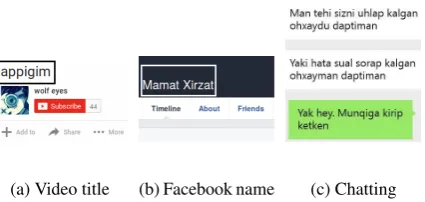
UULA restoration techniques are critical to pro-cess non-standard Uyghur text and develop a new type of input method editor (IME) that automat-ically suggests correctly written words and thus reduce the amount of UULA text. Figure 1 and Table3show several real examples of the increas-ing amount of UULA text on social media and the Internet. In this study we aim to 1) process and standardize the UULA text on the web so that it can be used for other NLP tasks such as informa-tion retrieval 2) help to create IMEs equipped with UULA restoration techniques that will prevent the generation of more non-standard text. Further-more, although UULA restoration is a problem specific to the Uyghur language, the result will be useful for other character-level normalization problems and may be used for languages with sim-ilar mapping issues.
[image:2.595.76.289.577.678.2](a) Video title (b) Facebook name (c) Chatting
Figure 1: Examples of UULA cases from social media.
The rest of the paper is organized as follows: we first talk about the background and related work in Section 2 and 3. Then, the methods for UULA
Table 3: Illustrations of examples displayed in Figure1.
Figure UULA CTA Means
1a Appigim Apiim My Baby
1b Mamat irzat Memet irzat Uyghur Per-son Name
1c Men tehi sizni uh-lap kalgan ohxaydu daptiman.
Men texi sizni uxlap kalgan oxshaydu deptimen.
I thought
you were
sleeping.
1c Yaki hata sual sorap kalgan ohxayman daptiman.
Yaki hata soal sorap kalgan oxshaymen deptimen.
Or I asked improper question.
1c Yak hey. Munqiga kirip ketken.
Yak hey, munchigha kirip ketken.
Nothing hap-pen. I was taking a bath.
restoration are described in Section4. The exper-imental setup is given in Section 5 which is fol-lowed by results, and discussion. Finally, we talk about the conclusion and future work.
2 Background and Survey 2.1 Uyghur Alphabets
Uyghur is the native language of more than 15 million Uyghur people. Currently, the modern Uyghur Perso-Arabic alphabet (UPAA) is the most used and official script of Xinjiang Uyghur Au-tonomous regions of China. In the last century, due to cultural and political reasons (Duval and Janbaz,2006), Uyghurs have witnessed several re-forms of the Uyghur writing system. Each of them brings certain adverse effects on Uyghur culture and society such as creating generation gaps, in-creasing illiteracy ratio, loss of materials written in previous scripts and so on. As a result, Uyghur so-ciety tends to refuse any new alternative scripts to the currently used UPAA. Furthermore, this social atmosphere causes unsuccessful propagation of an authentic Uyghur Latin alphabet system: Uyghur Latin alphabet (ULA), which is a project by Xin-1CTA: Common Turkic Alphabet, which is composed of
jiang University in July 2001 (Duval and Janbaz, 2006). However, many Uyghur people have not adopted or even learned this system yet.
With the digital information age, Uyghur peo-ple, especially the young generation, are starting to use Latin letters to bypass the limitation re-lated to the UPAA in social media and the inter-net. There are intrinsic and extrinsic limitations of UPAA. The intrinsic limitation is that, in many new computer programs, web pages, applications etc., UPAA suffers many problems such as un-qualified display, absence of IME, and so on. On the other hand, the extrinsic limitation comes from users. Many Uyghur people are not familiar with the UPAA keyboard. Additionally, some Uyghur people consider typing with UPAA input method or switching to it from the other input methods like English as inconvenient work.
Although Uyghur people use Latin letters as an alternative to UPAA, many of them have not cho-sen the authentic ULA as the alternative. Before and after the announcement of ULA, both system-atic and unsystemsystem-atic transliterations with Latin letters were actively used. According to the sur-vey mentioned in (Duval and Janbaz, 2006), up to 18 different systematic Latin Alphabet systems existed in 2000. These are replaced by the ULA since it is announced as the official Latin alterna-tive of UPAA. However, UULA is still very com-mon in spite of anti-UULA propaganda. Possible explanations can be found for this from many as-pects: linguistic, social, political, and so on. These discussions are not in the scope of this paper as our goal is restoring and preventing UULA texts with the aid of an automated system.
2.2 Survey
In 2016, we conducted a small e-survey2 about
how Uyghur-speaking people use Latin alphabets when writing in Uyghur. In this survey, we in-cluded questions about the participants’ favorite alphabet system and Latin-based alternatives to UPAA. Besides that, we asked them to write 10 different words or phrases given in Latin-derived alphabets they personally use (Table5).
Among 170 attenders, 39.8% mainly used UPAA, 29.7% mainly use ULA, 30.5% use UULA. However, we also discovered that Uyghur people use different scripts in different circum-stances. We discover that nearly half of the
[image:3.595.319.512.98.193.2]peo-2available at http://goo.gl/forms/5Pi2vCeUr3
Table 4: Possible alternatives of corrupted charac-ters.
Char. Alt. Char. Alt. Char. Alt.
u u, ¨o, ¨u a a, e w v
v v, ¨o, ¨u k k, q ch c¸
o o, ¨o, ¨u n n, ˜n ng ˜n
i, i, ´e j j, c sh s¸
h h, x, ˘g q q, c¸ gh ˘g
y y, h, j x x, s¸ zh j
e e, ´e, i k k, q ¨e ´e
g g, ˜n, ˘g z z, j
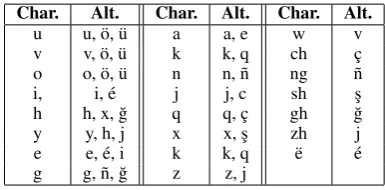
ple use Latin-based characters as alternatives to UPAA frequently. Nevertheless, through asking attendees to type 10 different words or sentences with Latin letters, we concluded the pattern of UULA is the one shown in Table4. According to the table, if a sentence includes all of these char-acters, there will be nearly 450,000 different alter-native representations of that sentence.
Table 5: Selected survey results.
Samples Feedback
ÈA KPð P
Jurnal, Jornal, Zhornal, Zhurnal, Zornal,Zurnal, Yornal, YurnalÉJ¯éK
akil, eqil, ekil, akelñ¯ñë
huquq, hukuk, hokok, hoqoq, hoquq, hokuk¼ð QKéÊJK.
Bilayzuk, Belayzuk, Bilayzvk, Be-leyzuk, Bileyzvk, Bileyzk, Bileyzvk, Bi-layzuk, BileyzukèP ñk ñk
Qoqura, Chochure, Ququra, Chchre,Ququre, Qoqure, Qoqore, Chochvre, Chuchure, Qvqvra, Qoqvra, Qoqora, Chchvre, Chochore, Ququra Qoqvre, re, Chchre½J JJ..Ó
Menig, Mening, Mning, Mning, Mening, Mineg, Mineng, Minig, MiningHA «ðX
dogap, doghap, dohap, dugap, dughap,dohap, duhapIK QJ..Ã
ø QJ «é¯
gezit qeghizi, gezit kagizi, gizit qeghizi, gizit kagizi, gizit qeghizi, gizit kegizi, gizit kagizi, gezit kegizi, gzit qeghizi, gezit kagizi, gzit qeghizi, gezit qeghizi, gizit qegizi, gizit kagaz
-
àééë ñ k
øQKé k
xeyr xosh hesen, hayri hox hasan, xeyirxosh hesen, hair hox hasan, heyir hosh hesen, xeyir xosh hesen, heyir hox hesenàAJ Kñ ¯ ù®JÊJ..ë
heliki fontan, heliqi fontan, hiliki fontan,hiliqi fontan, heliqi fontan, yiliki fontan, heliki fontan, hiliki funtan, hiliki fontan, hliqi fontan3 Related Work
studies given in this section. With an exponen-tial growth of noisy texts, the text normalization study has become a hot topic in NLP. In the lit-erature, text normalization is viewed as being re-lated to either spell-checking (Cook and Steven-son, 2009; Choudhury et al., 2007) or machine translation (Aw et al., 2006;Kobus et al., 2008; Ikeda et al., 2016). However, it is pointed out that traditional spell-checking algorithms are not very effective on some text normalization prob-lems such as normalizing text messages like SMS, tweets, comments, etc (Pennell and Liu, 2010; Clark and Araki,2011).
According to Kukich’s early survey (Kukich, 1992) on automatic word correction, there are sev-eral types of spelling correction techniques such as minimum edit distance (Damerau, 1964), sim-ilarity key (Odell and Russell, 1918), rule-based methods (Yannakoudakis and Fawthrop,1983), N-gram-based models (Riseman and Hanson,1974), probabilistic (Bledsoe and Browning,1959;Cook and Stevenson,2009;Choudhury et al.,2007) and neural net techniques (Cherkassky and Vassilas, 1989). Among them, probabilistic models (e.g. noisy channel model) are successfully used for text normalization (Cook and Stevenson, 2009; Choudhury et al.,2007). The noisy channel model method normalizes non-standard words with the channel model and the language model, which are achieved by analyzing and processing a large cor-pus of noisy and formal texts.
Statistical (Aw et al., 2006), rule-based ( Beau-fort et al., 2010) and neural network techniques (Ikeda et al.,2016) from machine translation are used for text normalization. Since the neural machine translation (Cho et al., 2014) showed promising results, it has also been adapted to other problems such as text normalization and language correction. Xie et al. (2016) applied character-based sequence modelling with attention mecha-nism for language correction. The most closely related previous work to our study is Ikeda et al. (2016). They used a neural encoder-decoder model for normalizing noise in Japanese text in-troduced by the usage of three different writing systems. They also built a synthetic database with predefined rules for data augmentation. They compared their neural network model with rule-based methods, while we compare our neural net-work model with a probabilistic model.
4 Method
For UULA restoration, the aim is to recover the target sequence Y from the source sequence X. Word-based or character-based models can be used for this. In the character-based model, X =< lx
1, l2x, . . . , lxn >, Y =< l1y, l2y, . . . , lny >
wherelx
1 is the first character of X, and nis the
length of the word(s) . On the other hand, for the word-based model, X =< wx
1, wx2, . . . , wmx >,
Y =< wy1, w2y, . . . , wmy >wheremis number of
words in X or Y, and w is a word. For word-based restoration, we adopt the noisy channel model. Meanwhile, we use an encoder-decoder based sequence to sequence model for character-based restoration. In fact, both of models can be character or word based. In the encoder-decoder model, to reduce the input dimension, we picked the character-based solution over the word-based. However, we choose the word-based solution for the noisy channel model because of simple imple-mentation and robust filtering with a dictionary. 4.1 Noisy Channel Model (NCM)
Noisy channel model (Church and Gale, 1991; Mays et al.,1991) is a widely applied method for spell checking. It assumes spelling mistakes were introduced while inputs were passing through a noisy communication channel. If P is the prob-abilistic model of the noisy channel, then the cor-rect wordwyi, from the dictionaryV, correspond-ing to the wordwx
i can be found by using the
fol-lowing formula:
wyi = argmax
w∈V P(w|w x
i) (1)
= argmax
w∈V
P(wx
i|w)P(w)
P(wx
i) (2)
= argmax
w∈V P(w
x
i|w)P(w) (3)
Equation 3 shows that the target word wyi de-pends on conditional probability P(wx
i|w) and
apply the Bledsoe-Browning technique (Bledsoe and Browning,1959). It calculates the word-level confusion probability by multiplying the confu-sion probability of the letters as in Equation4.
P(wiy|wix) =Yi
n
P(liy|lxi) (4)
4.2 Neural Encoder-Decoder Model (NEDM) From a different perspective, the text normaliza-tion task can be considered as a text regeneranormaliza-tion process starting with the information extracted from noisy data. We can view text reconstruction as rewriting new text with same meaning. Dur-ing generation, the text process model (encoder) extracts abstract information from un-normalized text. The generalization model (decoder) starts to generate the text once it receives information from the text processing model. The generation model is trained by maximizing the probability of the generated text,P(Y). According to the chain rule, it is decomposed into:
P(Y) =
M
Y
t=1
p(yi|y1, y2, . . . , yi−1) (5)
where M is the length of the sequence, and yi is a unit in the sequence. Therefore, we need
[image:5.595.73.290.479.544.2]a model that learns the conditional distributions: p(yi|y1, y2, . . . , yi−1).
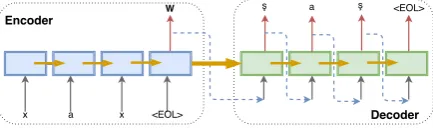
Figure 2: Encoder-decoder model.
The encoder-decoder model in (Cho et al., 2014) works in a similar fashion. It divides many-to-many mappings into many-to-one and one-to-many mappings. The encoder does a one-to-many-to-one mapping, while the decoder performs a one-to-many mapping. Both the encoder and the decoder are recurrent neural networks. One of the advan-tages of this model is that the encoder and the de-coder are jointly trained to maximize the condi-tional probability,P(Y|X).
P(Y|X) =YM
t=1
p(lyi|ly1, ly2, . . . , lyi−1, X) (6)
As the Figure 2 and Equation6 show, the en-coder extracts abstract informationW from input X, and then the decoder starts generating target text sequentially with the information that comes from the encoder and the previous time step.
5 Experiment and Results
5.1 Dataset
In the experiments, we use both synthetic and au-thentic data. We train/build our models with syn-thetic data because of limited access to the real cases and difficulties of building ground truth. Nevertheless, we conduct tests both on synthetic and real data that we have collected.3
5.1.1 Synthetic Data
The synthetic dataset used in our experiments is built by scrawling raw text from news websites such as “tianshannet.com”, “okyan.com” and “uy-cnr.cn”. In total, we collected 2GB of data for training and testing, 10 text files of different gen-res, each of which includes around 586 words. Note that these data are written in UPAA, while we convert them to the CTA format for convenience.
The training of the encoder-decoder model uses pairs of source and target sequences. Target se-quences are collected from raw text, while source sequences are created synthetically by randomly replacing letters in the target sequence using the mapping shown in Table 4. Notice that words in synthetic UULA text may include more characters than ground-truth target words. This is caused by replacing some single letters by double letters. For example, s¸ to sh , c¸ to ch, and so on. To ensure that corresponding words in source-target pairs have the same length, we pad n “w”s at the end of a target word whose corresponding source word in-cludesnadditional letters. The reason for choos-ing the character “w” is that it is not in CTA. Sim-ilarly, we generate the target and source text for testing. However, for more convincing test results on synthetic data, we generated 10 different source texts for each of the target text. Testing results on each of the synthetic files are the mean of 10 cases, while the final accuracy of all synthetic data is the mean of all the results on the synthetic files.
3The Noisy Uyghur Text Dataset used in this study is
5.1.2 Real Data
We collect 226 sentences (1372 words in total) from social media platforms such as “Wechat”, “Facebook” and so on. For building the ground truth, we first use our model for restoration. Sec-ondly, we restore texts manually. Finally, we apply a spell-checker for further restoring. While col-lecting real data and building the corresponding ground, we found that the real data has more noise than the usual UULA. We found in real data that there are various types of spelling errors, misuse of punctuation and repetitions.
5.2 Implementation Details
5.2.1 Neural Encoder-Decoder Model
We built our neural encoder-decoder model with TensorFlow (Abadi et al., 2015). Both encoder and decoder models used three layers stacked LSTMs with 256 hidden units and 256 dimension character embeddings. For training the model, the Adam optimizer with 0.0001 learning rate is ap-plied. We trained the model in only 2 epochs with a 128 batch size. We selected the model with the best validation results on the validation set that is described below. The training process is accom-plished on Tesla K40 GPU.
In this model, the length of the target and the source sequences is 30, and, instead of special to-kens, blank space is placed at the beginning and the end of a sequence. Note that these sequences are constructed by grouping words in the raw text by keeping sequence length under 30. We build them as follows: First, we tokenize the text with blank space or new line character, then we ap-pend a blank space to the beginning of each to-ken. Then, we concatenate them in order by keep-ing the sequence length at maximum 30. If con-catenating the next word makes the current se-quence length bigger than 30, then only blank spaces are appended. However, the new sequence will start from the next word. In total, we gen-erate 63,824,760 sequences. We divide them into training, validation and testing sets in this portion: 60%, 20%, 20%.
5.2.2 Noisy Channel Model
The channel probability, in other words, the error model, in the NCM is generated according to the Table 1. For example, the probability of l1=‘s¸’
turning into l2=‘x’, p(l2|l1) is 1/3, since s¸ has
three alternatives. We generate a 3-gram language
model by running Kenlm language modeling tool (Heafield,2011) on our collected text.
The Noisy channel model method normalizes the text word-by-word by selecting the most prob-able candidate from all possible candidates by ranking their probabilities. These candidates are generated with Table 1. For example, the word ”xax” will have 8 candidates: “xax, s¸ax, xex, s¸ex, xes¸, s¸es¸, s¸as¸, xas¸”, since both “x” and “a” have two alternatives. According to our experiment, on average, 1074 candidates are proposed for each word. However, we filter these candidates with the use of a dictionary. The dictionary includes all unique words from the raw text. With this dictio-nary filter, 1074 candidates are filtered to an aver-age of 1.6 candidates. After filtering, a candidate is passed to the noisy channel model to find the candidate with the highest likelihood. If all candi-dates are filtered, then the original is kept.
5.3 Results and Analysis
The performance of two models is evaluated by conducting two tests: UULA text restoration test and the IME recommendation test. The former tests the accuracy the model on restoring docu-ments with UULA noise. On the other hand, the latter checks a model’s prediction accuracy of the word being typed. In the IME recommendation test, we conjecture that the models have limited access to previous words. Therefore, we test two models by providing a limited number of previous words to them (at most two words in IME testing). In fact, the noisy channel model always has lim-ited access to the previous context, therefore its results are the same for two tests.
Accuracy results of the tests are calculated as in Equation7.
Accuracy = # of correct words# of words (7)
where “correct words” means correctly recom-mended or restored words. We did not calculate the precision-recall value, since the recall is al-ways equal to 1, and precision is equal to the ac-curacy.
restoration. However, the 2-gram noisy channel model returns the best performance. We believe that there are three possible explanations for why the NCM outperforms the NEDM on the synthetic dataset: 1) The dictionary used in NCM is very robust, it filters out almost all of the unqualified candidates. 2) The channel model used in NCM is too ideal because it is exactly calculated not gen-erally approximated. 3) The NEDM model needs more training with synthetic data pairs.
[image:7.595.308.525.150.538.2]In the real cases as Table 8 shows, the neural encoder-decoder model is slightly better than the noisy channel model. In the real dataset, some words are not included in the dictionary, there-fore noisy channel model cannot restore them cor-rectly. Besides, other factors such as spelling er-rors, misuse of punctuation and redundant repeat-ing brrepeat-ing more challenges to the noisy channel model as compared to the neural encoder-decoder model, since the former works at word-level but the latter at character-level.
Table 6: The results of UULA restoration on syn-thetic dataset (Before restoration, the accuracy is 19.40±0.03).
Model Accuracy (%) NEDM 93.09±2.21 NCM 1-gram 94.16±0.08 NCM 2-gram 94.54±0.11 NCM 3-gram 94.52±0.11
Table 7: The results of IME recommendation on synthetic dataset.
[image:7.595.106.259.406.477.2]N-gram NEDM (%) NCM (%) 1-gram 91.65 94.16 2-gram 94.38 94.54
Table 8: The results of UULA restoration on real noisy data (Before restoration, the accuracy is 26.14 %).
Model Accuracy (%)
NEDM 65.69
NCM 2-gram 64.95
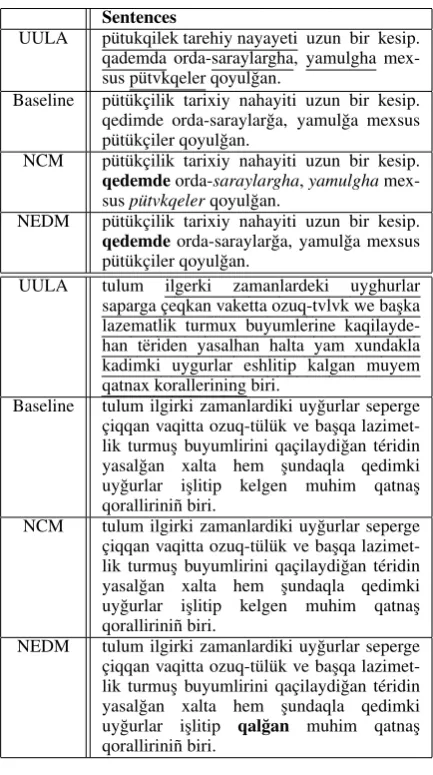
In Tables9,10and Figure3, the qualitative re-sults are given, where both NCM and NEDM fail to restore certain noisy words. The NCM fails in restoring a noisy word when the corresponding
Table 9: Examples of comparison of two mod-els and the baselines on synthetic UULA texts (Underlined means the original noisy text. Italic
means the text is erroneously restored to non-standard text. Boldmeans the text is wrongly re-stored to an unwanted (but in dictionary) text).
Sentences
UULA p¨utukqilek tarehiy nayayeti uzun bir kesip. qademda orda-saraylargha, yamulgha mex-sus p¨utvkqeler qoyul˘gan.
Baseline p¨ut¨ukc¸ilik tarixiy nahayiti uzun bir kesip. qedimde orda-saraylar˘ga, yamul˘ga mexsus p¨ut¨ukc¸iler qoyul˘gan.
NCM p¨ut¨ukc¸ilik tarixiy nahayiti uzun bir kesip.
qedemdeorda-saraylargha,yamulgha mex-susp¨utvkqelerqoyul˘gan.
NEDM p¨ut¨ukc¸ilik tarixiy nahayiti uzun bir kesip.
qedemdeorda-saraylar˘ga, yamul˘ga mexsus p¨ut¨ukc¸iler qoyul˘gan.
UULA tulum ilgerki zamanlardeki uyghurlar saparga c¸eqkan vaketta ozuq-tvlvk we bas¸ka lazematlik turmux buyumlerine kaqilayde-han t¨eriden yasalkaqilayde-han halta yam xundakla kadimki uygurlar eshlitip kalgan muyem qatnax korallerining biri.
Baseline tulum ilgirki zamanlardiki uy˘gurlar seperge c¸iqqan vaqitta ozuq-t¨ul¨uk ve bas¸qa lazimet-lik turmus¸ buyumlirini qac¸ilaydi˘gan t´eridin yasal˘gan xalta hem s¸undaqla qedimki uy˘gurlar is¸litip kelgen muhim qatnas¸ qorallirini˜n biri.
NCM tulum ilgirki zamanlardiki uy˘gurlar seperge c¸iqqan vaqitta ozuq-t¨ul¨uk ve bas¸qa lazimet-lik turmus¸ buyumlirini qac¸ilaydi˘gan t´eridin yasal˘gan xalta hem s¸undaqla qedimki uy˘gurlar is¸litip kelgen muhim qatnas¸ qorallirini˜n biri.
[image:7.595.91.270.537.581.2]NEDM tulum ilgirki zamanlardiki uy˘gurlar seperge c¸iqqan vaqitta ozuq-t¨ul¨uk ve bas¸qa lazimet-lik turmus¸ buyumlirini qac¸ilaydi˘gan t´eridin yasal˘gan xalta hem s¸undaqla qedimki uy˘gurlar is¸litip qal˘gan muhim qatnas¸ qorallirini˜n biri.
Table 10: Examples of comparison of two models and the baselines on real UULA texts (The text formatting has the same meaning as in Table9).
Sentences
UULA nur xirkitinig adrisini bildihanlar bamu? Baseline nur s¸irkitini˜n adr´esini bilidi˘ganlar barmu?
NCM nur s¸irkitini˜nadrisini bildihanlar bamu? NEDM nur s¸irkitini˜nadrisinibildi˘ganlarbamu? UULA muxu hakta taklip pikir berilsa? Baseline mus¸u heqte teklip pikir b´erilse? NCM mus¸uhaktateklip pikir b´erilse? NEDM mus¸u heqte teklip pikirbirilse?
UULA chishliri chushup ketkuche eytiptu bichare ashiq boway
[image:7.595.105.258.653.697.2]original word does not appear in the dictionary or has an ignorable N-gram score. Meanwhile, the NEDM model tends to map characters to popu-lar patterns. Therefore, in a few cases, it restores noisy words to unexpected ones.
Figure 3: An example output of the neural encoder-decoder model on a subset of the syn-thetic UULA text (Top and bottom left part are the same ground truth, top right is the UULA, bottom right is the restoration. Blue highlights are differ-ences.).
6 Conclusion and Future Work
In this work, we propose two models for normaliz-ing Uyghur UULA texts. The noisy channel model views the problem as a spell-checking problem, while the neural encoder-decoder model views it as a machine translation problem. Both of them re-turn highly accurate results on restoration and rec-ommendation tasks on the synthetic dataset. How-ever, their accuracy on real datat would benefit from further improvement. To improve their per-formance on the real dataset, one possible strat-egy is to consider other noisy factors appearing in the real dataset. In future work, we will update our models to handle other noisy elements such as spelling errors and the misuse of punctuation on the real dataset. However, we believe that it is
eas-ier to adapt the neural encoder-decoder model to the new challenges than the noisy channel model. This is because it only requires fine-tuning on ex-tra data for different kinds of noise, while the noisy channel model requires redesigning of the model structure.
7 Acknowledgement
We gratefully acknowledge the support of NVIDIA Corporation with the donation of the Tesla K40 GPU used for this research.
References
Mart´ın Abadi, Ashish Agarwal, Paul Barham, Eugene Brevdo, Zhifeng Chen, Craig Citro, Greg S. Cor-rado, Andy Davis, Jeffrey Dean, Matthieu Devin, Sanjay Ghemawat, Ian Goodfellow, Andrew Harp, Geoffrey Irving, Michael Isard, Yangqing Jia, Rafal Jozefowicz, Lukasz Kaiser, Manjunath Kudlur, Josh Levenberg, Dan Man´e, Rajat Monga, Sherry Moore, Derek Murray, Chris Olah, Mike Schuster, Jonathon Shlens, Benoit Steiner, Ilya Sutskever, Kunal Tal-war, Paul Tucker, Vincent Vanhoucke, Vijay Va-sudevan, Fernanda Vi´egas, Oriol Vinyals, Pete Warden, Martin Wattenberg, Martin Wicke, Yuan
Yu, and Xiaoqiang Zheng. 2015. TensorFlow:
Large-scale machine learning on heterogeneous
sys-tems. Software available from tensorflow.org.
http://tensorflow.org/.
Ahmet Arslan. 2015. Deasciification approach to han-dle diacritics in turkish information retrieval. Infor-mation Processing & Management.
AiTi Aw, Min Zhang, Juan Xiao, and Jian Su. 2006. A phrase-based statistical model for sms text
nor-malization. In Proceedings of the COLING/ACL
on Main conference poster sessions. Association for Computational Linguistics, pages 33–40.
Richard Beaufort, Sophie Roekhaut, Louise-Am´elie Cougnon, and C´edrick Fairon. 2010. A hybrid rule/model-based finite-state framework for
normal-izing sms messages. InProceedings of the 48th
An-nual Meeting of the Association for Computational Linguistics. Association for Computational Linguis-tics, pages 770–779.
Woodrow Wilson Bledsoe and Iben Browning. 1959.
Pattern recognition and reading by machine. In
Pa-pers presented at the December 1-3, 1959, eastern joint IRE-AIEE-ACM computer conference. ACM, pages 225–232.
Kyunghyun Cho, Bart Van Merri¨enboer, Caglar Gul-cehre, Dzmitry Bahdanau, Fethi Bougares, Holger Schwenk, and Yoshua Bengio. 2014. Learning phrase representations using rnn encoder-decoder for statistical machine translation. arXiv preprint arXiv:1406.1078.
Monojit Choudhury, Rahul Saraf, Vijit Jain, Animesh Mukherjee, Sudeshna Sarkar, and Anupam Basu. 2007. Investigation and modeling of the structure of texting language. International journal on docu-ment analysis and recognition10(3):157–174. Kenneth W Church and William A Gale. 1991.
Proba-bility scoring for spelling correction. Statistics and Computing1(2):93–103.
Eleanor Clark and Kenji Araki. 2011. Text normal-ization in social media: progress, problems and applications for a pre-processing system of casual
english. Procedia-Social and Behavioral Sciences
27:2–11.
Paul Cook and Suzanne Stevenson. 2009. An un-supervised model for text message normalization. In Proceedings of the workshop on computational approaches to linguistic creativity. Association for Computational Linguistics, pages 71–78.
Fred J Damerau. 1964. A technique for computer de-tection and correction of spelling errors. Communi-cations of the ACM7(3):171–176.
Jean Rahman Duval and Walis Abdukerim Janbaz. 2006. An introduction to latin-script uyghur. In
Middle East & Central Asia Politics, Economics, and Society Conference. pages 7–9.
Kenneth Heafield. 2011. Kenlm: Faster and smaller language model queries. InProceedings of the Sixth Workshop on Statistical Machine Translation. Asso-ciation for Computational Linguistics, pages 187– 197.
Taishi Ikeda, Hiroyuki Shindo, and Yuji Matsumoto. 2016. Japanese text normalization with
encoder-decoder model. WNUT 2016page 129.
Catherine Kobus, Franc¸ois Yvon, and G´eraldine
Damnati. 2008. Normalizing sms: are two
metaphors better than one? In Proceedings of
the 22nd International Conference on Computa-tional Linguistics-Volume 1. Association for Com-putational Linguistics, pages 441–448.
Karen Kukich. 1992. Techniques for automatically
correcting words in text. ACM Computing Surveys
(CSUR)24(4):377–439.
Eric Mays, Fred J Damerau, and Robert L Mercer.
1991. Context based spelling correction.
Informa-tion Processing & Management27(5):517–522. Rada Mihalcea and Vivi Nastase. 2002. Letter level
learning for language independent diacritics
restora-tion. Inproceedings of the 6th conference on
Nat-ural language learning-Volume 20. Association for Computational Linguistics, pages 1–7.
M Odell and R Russell. 1918. The soundex coding sys-tem. US Patents1261167.
Deana L Pennell and Yang Liu. 2010. Normalization
of text messages for text-to-speech. In Acoustics
Speech and Signal Processing (ICASSP), 2010 IEEE International Conference on. IEEE, pages 4842– 4845.
Edward M Riseman and Allen R Hanson. 1974. A contextual postprocessing system for error
correc-tion using binary n-grams. IEEE Transactions on
Computers100(5):480–493.
Richard Sproat, Alan W Black, Stanley Chen, Shankar Kumar, Mari Ostendorf, and Christopher Richards.
2001. Normalization of non-standard words.
Com-puter speech & language15(3):287–333.
Ziang Xie, Anand Avati, Naveen Arivazhagan, Dan Ju-rafsky, and Andrew Y Ng. 2016. Neural language
correction with character-based attention. arXiv
preprint arXiv:1603.09727.