Monads for hyperintensionality? A situation semantics for
hyperintensional side effects and intra-sentential anaphora
Luke Burke –University of BambergandUniversity College London
20th April, 2019
P-HYPE, the semantic theory we outline, uses monads from category theory in order to integrate a perspective-sensitive semantic theory with a hyperintensional logic, HYPE (Leitgeb 2018). This enables us to to capture in a fine-grained way the utterer’s perspective on other people’s perspectives, a phenomenon that (Asudeh and Giorgolo 2016) argue plays a role in natural language. But it also enables us to construct a particular approach to hyperintensionality in natural language within HYPE, since HYPE itself is compatible with different accounts of hyperintensionality in natural language. In P-HYPE, hyperintensionality is modelled as a side effect in the sense of (Charlow 2014) and of consisting in a special type of perspective sensitivity. P-HYPE builds on the account of (Asudeh and Giorgolo 2016), by carving out a notion of perspectives as special sets of situations which can be combined together via a fusion relation. In addition, we briefly illustrate how we can combine P-HYPE with an account of certain kinds of intra-sentential anaphora.
Keywords:Attitude verbs, monads, side effects, perspective, hyperintensionality, situation semantics
1.
Introduction: Hyperintensionality as a side effect
So-called ‘hyperintensional’ semantic theories allow us to block the free substitution of intensionally equivalent sentences (see (Fox and Lappin 2008) and references therein), such as tautologies and mathematical truths, which, at least in standard frameworks used in natural language semantics (Gallin 1975), express the same function from worlds to truth values. The phenomenon of hyperintensionality might therefore be thought to constitute a ‘compositionality challenge’ (Zimmermann 2012), in that the na¨ıf semantics employed in standard frameworks cannot compositionally account for the different meaning of distinct mathematical/logical truths and we lack an agreed-upon method of compositionally deriving their meanings. (Shan 2002) had the intuition that we can model many seemingly
non-compositional phenomena by using monads, as ‘side effects’ of computing the main value of an expression. Subsequently, certain linguistic phenomena exhibiting non-determinism, intensionality or state-changing operators have been captured via monads (Charlow 2014). We propose that
hyperintensionality be added to this list as a particular kind of side effect, in the sense of (Charlow 2014) and (Shan 2007). (Shan 2007) in particular, includes amongst so-calledlinguistic side effects
certain types of referential opacity and certain expressions whose meaning and compositional contribution is not pre-theoretically transparent. Hyperintensionality is arguably a good example of a linguistic side effect in Shan’s sense, since it is not clear what distinction to make between the semantic contribution of logically equivalent statements, how their meanings relate to their truth conditions, and how to characterise their behaviour compositionally. But from both (Charlow 2014) and Shan’s list of linguistic side effects, hyperintensionality is conspicuous by its absence. It is high time to fit
hyperintensionality into the monadic fold.
(Leitgeb 2018) points out regarding verbs likebelieve, which he calls ‘quasi-syntactic’1).2 For example,
A→(B →A)is an axiom in HYPE, and so true in all states of every HYPE model. Likewise,A→A
is an axiom of HYPE. But someone might not believeA→(B→A), for certainA, B. And, again instantiating sentences forAandB,A→(B →A)andA→Amight differ in meaning, even though they are logically equivalent in HYPE.3No doubt these problems could be circumvented by a theory of natural language hyperintensionality in HYPE.4That is precisely what we are providing here (however in (Burke 2019) we discuss the particular problem just mentioned), but incorporating perspective sensitivity into HYPE itself. Both P-HYPE and the semantics of (Asudeh and Giorgolo 2016) (from now onAG), enrich the typed lambda calculus with a reader monad (Shan 2002) defined on the typep, of perspective indices. We will discuss how perspective indices are employed later. For now we can just say that to every agent in a discourse there corresponds a perspective index, and that certain terms which are perspective sensitive are interpreted relative to perspective indices. If an expression has type
α, a perspectivally sensitive expression has typep→α. The reader monad is a triple(♦, η,F).
♦:TYPE →TYPE, is a type-constructor, which behaves as a special modal operator in Lax logic (Fairtlough and Mendler 1997).5 ♦maps any typeτ top→τ and, for alla, b, maps a function
f :a→bto a function♦f :♦a→♦b, such that(♦f)(x) =λi.f(xi).6η :τ →♦τ is a
value-constructor that takes a non-monadic valuex:τ and trivially upgrades it to monadic values by forming a constant function from perspective indices tox. It is called theunitof the monad:
Definition 1 :η(x) =def λi.x:p→α (1) F(‘bind’): ♦τ →(τ →♦δ)→♦δ
Finally,F(calledbind) is a polymorphic binary infix operator acting as a sort of functional application:
Definition 2 :aFf =def λi.f(a(i))(i) wherea:♦τ, f :τ →♦δ
1.1.
AG’s semantic theory
Consider the sentence (2a), uttered in the scenario (2b)
(2) a. Mary Jane loves Spiderman.
b. Scenario:Mary Jane does not know Peter Parker’s secret identity and loves the man she
calls ‘Peter Parker’. A speakerσwho knows or is ‘enlightened’ (Zimmermann 2005) about Peter Parker’s secret identity utters (2a)
According to AG, there is a sense in which (2a) is true, from the perspective of an enlightened utterer, but false from Mary Jane’s perspective. (Asudeh and Giorgolo 2016) model this by making certain names perspective relative, so that Mary Jane can associate a distinct denotation with the names ‘Spiderman’ and ‘Peter Parker’. Thus names denote certain people’s mental
representations-perspectives. We can then imagine a private mental lexicon for each person, consisting of the set of perspectives that a given person associates with terms of her language, which we call that person’s perspective. We use ‘perspective’ ambiguously–both to denote a semantic value in someone’s lexicon, and that person’s lexicon itself–with the context serving to disambiguate which notion we have
1
“Once again, the logic and semantics of the system HYPE to be developed in the present article would not be able to contribute to investigations into hyperintensional operators of any such quasi-syntactic kind.”(Leitgeb 2018)
2A reviewer asks why HYPE is not sufficient to account for hyperintensionality. This paragraph gives some reasons for this conclusion. Another reviewer also writes that HYPE is already hyperintensional, so adding another device (perspectives) for hyperintensionality should be carefully argued for. This paragraph should also be relevant to her question.
3
For example, ‘If I will be late then if I have a coffee then I will be late’ has a different meaning from ‘If I am late then I am late’. Other examples could be given not involving conditional connectives.
4
In (Burke 2019) we show that such examples can be dealt with both with HYPE and with P-HYPE. But P-HYPE in addition accounts for a variety of data involving perspective relativity, so isceterus paribuspreferable.
5It is an endofunctor, as this is understood in Category theory; that is, a functor that maps a category to itself (in this case the category of types).
6
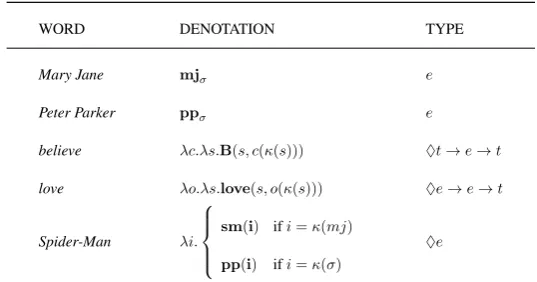
WORD DENOTATION TYPE
Mary Jane mjσ e
Peter Parker ppσ e
believe λc.λs.B(s, c(κ(s))) ♦t→e→t
love λo.λs.love(s, o(κ(s))) ♦e→e→t
Spider-Man λi.
sm(i) ifi=κ(mj)
pp(i) ifi=κ(σ)
[image:3.595.162.431.70.211.2]♦e
Table 1 Lexicon ofσ, the enlightened speaker
in mind. Consider the lexicon (Table 1) of the enlightened speakerσof (2a). Plain names are
subscripted withσto indicate that this is the denotation of that name forσ. The names which are type
♦ehave different denotations, depending on the perspective index they are fed. AG suppose that certain names vary in perspective but others do not. Those which do not vary in perspective have something like a default status, in the following sense: if someone becomes enlightened, and learns, for example that Spiderman and Peter Parker are one and the same thing, then they will, by and large, just use plain ‘Peter Parker’, and this name will thence have default status, with ‘Spiderman’.7 Notice theκoperator
in the denotation ofbelieveandlove.κhas the following interpretation (whereDeis the domain of
individuals of a model):
(3) ∀x∈De(κ(x)∈P)
Perspective sensitive expressions that scope belowκare interpreted relative to the perspective index corresponding to the subject of the attitude report (seeTable 1). Expressions that scope aboveF, are interpreted relative to the default perspective of the utterer. Let us consider the two readings of (2a). The false reading of (2a) is represented by (4),whichβ-reduces to (5), and the true reading is represented by (6), whichβ-reduces to (7):
(4) love(mjσ, λi.
sm(i) ifi=κ(mj)
pp(i) ifi=κ(σ) (κ(mj)))
(5) love(mjσ, sm(κ(mj)))
(6) λi. (
sm(i) ifi=κ(mj) :P
pp(i) ifi=κ(σ) :P Fλz.η(love(mj,z))) !
(κ(σ))
7
(7) love(mjσ, sm(κ(σ)))
SinceSpidermanin (6) scopes aboveFand aboveκ, it is interpreted relative to the default perspective index, which is the index of the speaker, who they assume in their model to be enlightened. They thus stipulate that the speaker’s perspective is the one fed to an expression of the formaFf, which by definition denotesλi.f(a(i))(i), and thus, if the speaker’s index isj, we always evaluate some expression of the formaFf atj.8 When, however, a perspective relative expression scopes below the functionf inaFf, it is caught by theκoperator.
2.
P-HYPE: a combination of HYPE and perspective sensitivity
HYPE (Leitgeb 2018) is a logic which employs states/situations.9 States may be like classical possible worlds, but may also be partial (orgappy)–verifying neither a formula nor its negation– and inconsistent (orglutty)– verifying a formula and its negation. One nice feature of HYPE is that it behaves entirely classically at a subset of states; as such, linguistic analyses couched in classical logics can be
transferred to HYPE. HYPE incorporates special incompatibility⊥and fusion operators◦in the satisfaction clauses for negation and the conditional, somewhat like (Veltman 1985: pp. 202–7):
1. ◦:S×S →S is a partial commutative, associative binary function (calledfusion), such that:
- Eithers◦s0is undefined, ors◦s0 is defined (and hence inS) in which case it is required that
V(s◦s0)⊇V(s)∪V(s0). - s◦sis defined, ands◦s=s.
2. ⊥is a binary symmetric relation onS(the incompatibility relation), such that:
- If there is avwithv∈V(s)and¯v∈V(s0), thens⊥s0.
- Ifs⊥s0and boths◦s00ands0◦s000are defined, thens◦s00⊥s0◦s000.
◦gives rise to a partial order≤, such that, for alls, s0 ∈S,s≤s0 iffs◦s0is defined ands◦s0=s0. Importantly, truth is monotonic under fusion extension: for alls, ifs|=Aands◦s0is defined, then
s◦s0 |=A.
Variable assignmentsρand their modified variantsρ(d/x)behave as in Classical Predicate logic. Satisfaction of a formulaφis defined relative to a state and a variable assignment (written:s, ρ|=φ), and the clauses for the logical symbols are as usual, except for¬and⊃, which have a distinctly modal flavour: s, ρ|=¬Aiff for alls0 : ifs0, ρ|=Athens⊥s0 ands, ρ|=A⊃B iff for alls0: ifs0, ρ|=A
ands◦s0is defined, thens◦s0|=B. The reader should consult (Leitgeb 2018) for more details, including the relationship of HYPE to Classical, Intuitionistic and four-valued logic.
2.1.
Introducing P-HYPE: a combinination of HYPE and AG’s
perspective-sensitive semantics
In P-HYPE, we require the usual hierarchy of typed domains familiar from (Gallin 1975), whose elements correspond to different kinds of entities. To this end, letT Y P Ebe the smallest set such that:
8
The technical stipulation they make is grounded in certain claims about perspective relativity, such as the claim that sen-tences or expressions which are perspective relative are usually relative to the perspective of the utterer of them, and if they are relative to other perspectives, they are relative either to individuals salient in some group within a given context, or are relative to the perspective of the subject of the sentence. We won’t assess these claims here, but suffice to say that they have been discussed and broadly endorsed by researchers working on perspective relativity.
1. e, t, p, s∈T Y P E 2. α, β ∈T Y P Eimpliesα →β ∈T Y P E
3. α∈T Y P Eimplies♦α∈T Y P E
For each type, there is a countable set of constants, and variables, and the set of constants (variables) is the union of the sets of constants (variables) of each type:
• CON =S
τ∈T Y P ECONτ • V AR=Sτ∈T Y P EV ARτ
The set of terms is the union of the sets of terms of typeτ, for arbitraryτ:
T ERM =S
τ∈T Y P ET ERMτ
The setT ERMτ for arbitrary typeτ is then defined as follows:
• c∈CONτ impliesc∈T ERMτ; • x∈V ARτimpliesx∈T ERMτ;
• τ =α→β,t∈T ERMβandx∈V ARαimply(λx.t)τ ∈T ERMτ
• t∈T ERMα→τ andu∈T ERMαimplies(t u)∈T ERMτ.
• A∈T ERMtandx∈V ARαimplies
(∀x.A)∈T ERMt
• A∈T ERMtimplies¬cA∈T ERMt
• A, B ∈T ERMtimplies(A∗B)∈T ERMt, for∗ ∈ {∧,∨,→}
• x∈T ERMeimpliesDOXx ∈T ERMs→s→tandP ROVx∈T ERMs→s→t
• ◦ ∈T ERMs→s→s • ≤ ∈T ERMs→s→t • π ∈T ERMp→s→s→t
• κ∈T ERMe→s→p • ⊥ ∈T ERMs→s→t
Suppose we have setsS, D, P, where:
• S =Sc]Sn=6 ∅, whereSnis the set of glutty or gappy states (‘non-classical’ states) andScis
the set of classical states.
• D6=∅is the domain of individuals • P 6=∅is the set of perspective indices.
Consider functionsκ, π:
• κ:D→S →P, is a function that associates a unique perspective indexκ(d)(s)to each individualdin a states. (refinements possible)
• π :P →S →P(S)maps every perspective indexκ(d)(s)∈P and statess∈S to a set of statesπ(κ(d)(s)) (s)⊆S, theperspective setorp-set ofdats. We presentπin the term language as a characteristic function of typeP →S→S → {1,0}.
We also have a distinguished perspective index:
• E ∈P is calledenlightenedand is such that for alls, s0:π(E)(s)(s0)iffs0 ∈ {s}, whences0 =s
The (optional)‘privacy’ condition of AG:
• For alld, d0∈Dfor whichd=6 d0, and alls∈S,π(κ(d, s), s)∩π(κ(d0, s), s) =∅.
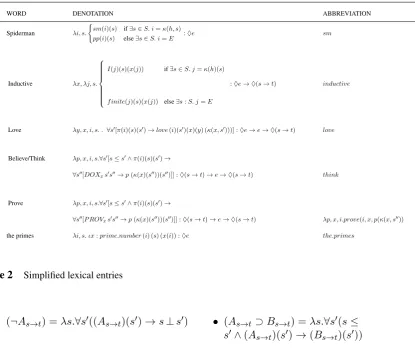
WORD DENOTATION ABBREVIATION
Spiderman λi, s. (
sm(i)(s) if∃s∈S. i=κ(h, s)
pp(i)(s) else∃s∈S. i=E :♦e sm
Inductive λx, λj, s.
I(j)(s)(x(j)) if∃s∈S. j=κ(h)(s)
f inite(j)(s)(x(j)) else∃s:S. j=E
:♦e→♦(s→t) inductive
Love λy, x, i, s. .∀s0[π(i)(s)(s0)→love(i)(s0)(x)(y) (κ(x, s0)))] :♦e→e→♦(s→t) love
Believe/Think λp, x, i, s.∀s0[s≤s0∧π(i)(s)(s0)→
∀s00[DOX
xs0s00→p(κ(x)(s00))(s00)]] :♦(s→t)→e→♦(s→t) think
Prove λp, x, i, s.∀s0[s≤s0∧π(i)(s)(s0)→
∀s00[P ROV
xs0s00→p(κ(x)(s00))(s00)]] :♦(s→t)→e→♦(s→t) λp, x, i.prove(i, x, p(κ(x, s00))
[image:6.595.92.508.69.424.2]the primes λi, s. ιx:prime.number(i) (s) (x(i)) :♦e the.primes
Table 2 Simplified lexical entries
• (¬As→t) =λs.∀s0((As→t)(s0)→s⊥s0) • (As→t⊃Bs→t) =λs.∀s0(s≤ s0∧(As→t)(s0)→(Bs→t)(s0))
A frameF =hS,D, κ, P, E, π,◦,⊥ibased onD, S andP is a family of setsD ={Dα|α∈T Y P E}
such thatDe=D, Dt={1,0},Ds=SandDp=P, andDα→β ⊆ {f |f :Dα →Dβ}for each type α→βandE, κ, π,◦,⊥are as above. AP-HYPEmodel is a structureM=hF, miwhereFis as above andm: Πα.CONα→Dαis an interpretation of constants. An assignment overMis a function ρ: Πα.V ARα→Dα. Variable assignmentsρand their modified variantsρ(d/x)(i.ex7→d) behave as
in Classical Predicate logic. There exists anadmissiblevaluationV, which assigns to each assignmentρ
overMand each termAαa valueVa(Aα)∈Dα, provided the following conditions are met:
• Vρ(xα) =ρ(xα) • Vρ(cα) =m(cα)
• Vρ(∀xαA) =Td∈DαVρ(d/x)(A) • Vρ(∃xαA) = S
d∈DαVρ(d/x)(A)
• Vρ(Aα→βBα) =Vρ(Aα→β)Vρ(Bα) • Vρ(Aα≡Bα) ={s|Vρ(Aα) =Vρ(Bα)}
• Vρ(λxαAβ) =the functionf onDαwhose value atd∈Dαis equal toVρ0Aβ, where ρ0=ρ(d/x)
2.2.
Lexical entries and example
truth of its complement. Thirdly, a crucial aspect of the lexical entries for verbs, is that we are able to formalise the intuition of AG that such complements are always interpreted relative to a perspective which the utterer thinks is the perspective of another person. Consider the denotation ofbelieve, which combines with a proposition of type♦(s→t)(i.e, a function from perspective indices to states to truth values), an individual and a perspective index. We assume that, in the case of propositional attitude verbs, this perspective index must always be the utterer’s perspective index. Whereuis the utterer’s perspective index at states,Believethen universally quantifies over both (i) all the statess0≥s, such thats0∈π(u)(s), wheresis the world in which the sentence is being evaluated and (ii) all the statess00
which are doxastically accessible froms◦s0.x believes pis then true iffpis true ins00relative to the perspective index associated withxats00.
Consider (8) and (9):10
(8) Harold proves that the primes are not inductive.
(9) Harold proves that the primes are infinite.
Using the lexical entries above, we can derive (10) for a sentence like (8) and (11) for a sentence like (9):
(10) λs.∀s0[s≤s0∧s0 ∈π(u, s)]→ ∀s00[P ROVxs0s00→
¬I(κ(h, s00))(s00)(ιx.prime.number(x(κ(h, s00))))]
(11) λs.∀s0[s≤s0∧s0 ∈π(u, s)]→ ∀s00[P ROVxs0s00→
¬f inite(κ(h, s00))(s00)(ιx.prime.number(x(κ(h, s00))))]
Crucially, (10) and (11) will differ in truth value, if Harold associates distinct denotations withinductive
andfinite.
If we scope bothinductiveandthe primesaboveF, we derive ((12)), the interpretation on which both
are not inductive, andthe prime numbersare interpreted relative toEand within thep-set of associated withE:
(12) (η(λx, λj, s.
I(j)(s)(x(j)) if∃s∈S. j =κ(h)(s)
f inite(j)(s)(x(j)) else∃s:S. j =E
))F
λR.λj, s.
ιx:prime.number(j)(s)(x(j)) if∃s∈S. j =κ(h)(s)
ιx:prime.number(j)(s)(x(j)) else∃s:S. j =E )F
λy.not(λi, s.∀s0, s00(s≤s0∧ π(i)(s)(s0)∧(P ROVxs0s00)→R(η(y))(s00)(κ(h)(s00)))])
FeedingEto (12) reduces to (13) :
(13) λs.∀s00(P ROVxs s00→ ¬cf inite(E)(s00)(ιx.prime.number(E)(s00)(x(E)))]
The interpretation on which bothare not inductive, andthe prime numbersare interpreted relative tou
and within thep-set of associated withuis as follows:
(14) λs.∀s0[s≤s0∧s0 ∈π(u)(s)]→ ∀s00[P ROVxs0s00 →
¬I(u)(s00)(ιx.prime.number(u)(s00)(x(u)))]
There remain two ‘mixed’ interpretations:
(15) λs.∀s0[s≤s0∧s0 ∈π(u)(s)]→ ∀s00[P ROVxs0s00 →
¬I(u)(s00)(ιx.prime.number(κ(h)(s00))(s00)(x(κ(h)(s00))))]
10
(16) λs.∀s0[s≤s0∧s0 ∈π(u)(s)]→ ∀s00[P ROVxs0s00 →
¬I(κ(h)(s00))(s00)(ιx.prime.number(u)(s00)(x(u)))]
Having introduced P-HYPE, we would like to respond to a few remarks made by reviewers. A reviewer asks how well the view of perspectives outlined deals with cases where on one perspective a proper name does not denote at all whereas on other perspectives it does. In P-HYPE any user of a name would, if they can use the name, associate a perspective with the name, even if the user considers the name to be non-denoting. Thus the difference between the two cases depends on whether someone has a metalinguistic belief to the effect that, for example, ‘Zeus’ denotes. The reviewer asks also how in P-HYPE we can account for someone, let’s call her Mary, who considers Jupiter to be identical to Zeus but does not believe that there is such a god. There are various ways we might consider accounting for this, however, we have not decided which is best, and so suggest just one possibility. Suppose that a perspective index can be supplied for certain fictions which are salient in a discourse context, or perhaps certain people’s views of those fictions. Then the identity of Zeus and Jupiter would be true relative to the perspective index associated with this fiction in the mind of Mary, and the perspective index supplied for her belief that there are no gods would be her very own dedicated perspective index. This supports the intuition that when we speak truth about fiction, we often do so from within a particular fiction, or from some messy combination of the fiction with other beliefs we have (Lewis 1978).
Another reviewer had trouble seeing what the value of HYPE is in the semantics outlined, and asks how perspectives are acquired and modified. These are good questions, which I attempt to answer in (Burke 2019). Suffice to say that the role of the fusion operator in HYPE actually forms a crucial role in my account, in that it allows us to combine and enlarge perspectives. Thus the HYPE framework is very useful for this. Furthermore, as discussed earlier, the HYPE framework is compatible with the sorts of analyses that semanticists have given of intensional phenomena (for example in (Heim&von Fintel 2011)), which usually employ classical logic.
Finally, the same reviewer questions a perceived ‘relativism’ that she thinks our semantics entails, by having both the reference of names and predicates as being dependent on a perspective. Here we would like to clarify and expand upon this objection. According to the objection, if we allow predicates to be perspective relative across the board, we predict that sentences like (17) could be true relative to some perspectives, and therefore not plainly false:
(17) There are ten natural numbers.
But this objection misunderstands what we intend by saying something is true relative to a perspective. To say this is simply to say that there exists a speaker whose whose mental model is constituted in such a way as to associate certain representations with certain sentence parts.11 This is compatible with (17) being plainly false, and the truth/falsitysimpliciterof a sentence is determined relative to the
enlightened perspective index. We are not denying, unlike MacFarlane (2014), that certain sentences are truesimpliciter. For us, (17) is strictly speaking false, however it is true (or coherent) relative to some bizarre perspective index, which is unlikely to be associated with all but the strangest of individuals, and unlikely to be salient in any context. In fact, in P-HYPE we haveE, the dedicated, designated
perspective index associated with the enlightened perspective, which allows us to reason about ‘plain truth’ by simply providing the ordinary intension associated with a sentence constituent. So the charge of relativism is not correct.
2.3.
Anaphora in P-HYPE: the State.Set monad
In this final section we will take a quick look at how intra-sentential anaphora can be analysed in P-HYPE.
Consider (18), on the reading in whichheis anaphoric toa man she thinks is Peter Parker: 11
(18) Mary Jane loves a man she believes is Peter Parker. She believes he isn’t Spiderman.
In the standard intensional semantics, at least in which, following (Kripke 1980), co-referring names are given the same semantic value and identity statements are necessarily true or necessarily false, the second sentence of ((18)) denotes the empty set. Clearly, however, there is a sense in which Mary Jane can believe that Spiderman is not Peter Parker. (Lewis 1979) uses centred worlds to account for cases like this, in which someone does not believe a true identity statement and these can potentially be combined with the dynamic semantics of (Groenendijk and Stokhof 1991) in order to model sentences such as (18). Our semantics can also be enriched with a monad that has been used to model anaphora (Charlow 2014): the State Set monad, which is defined as follows:
1. ♦α=
R→(α×R)→t
2. η(a) =λr.{ha, ri} 3. mFλv.π=
λs.S
ha,s0i∈m sπ[a/v]s0
Here, following (Charlow 2014),Ris the set of stacks, which are linear sequences of discourse referents (drefs), andr, r0are variables over stacks. The stackrcan be extended withx(writtenrxb).
The last member ofris the most recently introduced dref, and is notatedr>, such that(rba)>=a.
Following (Charlow 2014), we adopt the definitions in (19) (whereprois the denotation of a pronoun, which picks out the most recent dref), which allow for indefinites to bind pronouns intra-sententially:
(19) a. a.man=λr.S{h
x, ri |man(x)})
b. m. =mFλv, r.η(v)rbv =mFλv, r.{hv, rbvi}.
c. pro:=λr.{hr>, ri}
We can in fact derive (20) from these definitions (see (Charlow 2014:p.47)), which enables a.-shifted
mto bind a pronoun in its scope:
(20) m.Fλv.proFλu.π=m.Fλv.π[v/u]
With these definitions in place (and the fact,LeftId, that in any monadη(a)Ff =f a), we can give the semantics of (18) (which we notateJ(18)K) via the first equation in this reduction series below, and we
can compositionally derive this lambda term from the parts of (18) (though space reasons precludes us doing so here:12
J(18)K= (η(mj))
.
Fλx.proFλx0.proFλx00.a.man. Fλy.proFλy0.smFλz.proFλy00. η[(love(x, y) ∧ think(x0, y0 =z)), ∧think(x0, y006=sm(κ(x0)(s00)) ]
=by(20)(η(mj)). Fλx.a.man. Fλy.η(sm)Fλz.proFλy00.
η[(love(x, y)∧think(x, y=z)), ∧think(x, y00 6=sm(κ(x)(s00)) ] =by Lef tId a.man. Fλy.proFλy00.
λr.{h[(love(mj, y)∧think(mj, y=pp)), ∧think(m, y00 6=sm(κ(m)(s00))], rbmjbyi} =by(20)a.man.Fλy, r.
{h[(love(mj, y)∧think(mj, y=pp)), ∧think(mj, y6=sm(κ(m)(s00)) ]rbmjbyi}
The last member of this sequence, reduces by definition ofFto (21), which consists of a function from stacks to sets of pairs consisting of booleans and stacks updated with the drefsmjanda, ifais a man:
(21) λr.S
ha,r0i∈(a.man.(r)){h[(love(m, y)∧think(m, a=pp)), ∧think(m, a=
sm(κ(m)(s00)) ]rbmjbai}
3.
Conclusion
We have presented P-HYPE and discussed a monadic approach to hyperintensionality. Elsewhere (Burke 2019) we have discussed the role of perspectives in our account, and phenomena such as metalinguistic focus negation. Here we in addition extend our fragment to cover intra-sentential anaphora, and we have responded to some questions that arise in our account of hyperintensionality. In future work we hope to explore the P-HYPE account of hyperintensionality by comparing it with alternative frameworks which are similar in some respects, such as that of truthmaker semantics (Fine 2017).
References
Asudeh, A. and G. Giorgolo (2016). Perspectives. Semantics&Pragmatics 9(21), 1–53.
Barker, C. and C.-c. Shan (2014). Continuations and natural language, Volume 53. Oxford studies in theoretical linguistics, OUP.
Burke, L. (2019). On P-HYPE: a compositional extension of hype. Analysing hyperintensionality and metalinguistic focus via multiple side effects.Studia Logica. Trends in Logic XVIII. Logic in High Definition: Developing Fine-Grained Semantics.
Charlow, S. (2014). On the semantics of exceptional scope. PhD diss,. New York University. Cresswell, M. J. (1985). Structured meanings. Cambridge, MA: MIT.
Fairtlough, M. and M. Mendler (1997). Propositional Lax logic. Information and Computation 137(1), 1–33.
Fine, K. (2017). Truthmaker semantics. In C. W. B. Hale and A. Miller (Eds.),A Companion to the Philosophy of Language. John Wiley & Sons, Ltd, Chichester, UK (online).
Fox, C. and S. Lappin (2008). Foundations of Intensional Semantics. Oxford: Blackwell.
Gallin, D. (1975). Intensional and higher-order modal logic: With applications to Montague semantics, Volume 19. Elsevier.
Groenendijk, J. and M. Stokhof (1991). Dynamic predicate logic. Linguistics and philosophy 14(1), 39–100.
Heim&von Fintel (2011). Intensional semantics: Mit spring 2011 edition. Retrieved from http://mit.edu/fintel/IntensionalSemantics.pdf..
Kripke, S. A. (1980). Naming and Necessity. Cambride, MA: Harvard University Press. Leitgeb, H. (2018). HYPE: A system of hyperintensional logic (with an application to semantic
paradoxes).Journal of Philosophical Logic, 1–101.
Lewis, D. (1978). Truth in fiction. American philosophical quarterly 15(1), 37–46. Lewis, D. (1979). Attitudes de dicto and de se. The philosophical review 88(4), 513–543. MacFarlane, J. (2014). Assessment sensitivity: Relative truth and its applications. OUP Oxford. Shan, C.-C. (2002). Monads for natural language semantics. InProceedings of the ESSLLI 2001
Student Session, pp. 285–298.
Shan, C.-C. (2007). Linguistic side effects. In C. Barker and P. Jacobson (Eds.),Direct compositionality, pp. 132–163. Oxford: Oxford studies in theoretical linguistics,. Veltman, F. (1985). Logic for Conditionals. Ph. D. thesis, University of Amsterdam. Zimmermann, T. E. (2005). What’s in two names? Journal of Semantics 22(1), 53–96.