Text Alignment for Real-Time Crowd Captioning
Iftekhar Naim, Daniel Gildea, Walter Lasecki and Jeffrey P. Bigham
Department of Computer Science University of Rochester
Rochester, NY 14627
Abstract
The primary way of providing real-time cap-tioning for deaf and hard of hearing people is to employ expensive professional stenogra-phers who can type as fast as natural speak-ing rates. Recent work has shown that a feasible alternative is to combine the partial captions of ordinary typists, each of whom types part of what they hear. In this paper, we describe an improved method for combin-ing partial captions into a final output based on weighted A∗search and multiple sequence
alignment (MSA). In contrast to prior work, our method allows the tradeoff between accu-racy and speed to be tuned, and provides for-mal error bounds. Our method outperforms the current state-of-the-art on Word Error Rate (WER) (29.6%), BLEU Score (41.4%), and F-measure (36.9%). The end goal is for these captions to be used by people, and so we also compare how these metrics correlate with the judgments of 50 study participants, which may assist others looking to make fur-ther progress on this problem.
1 Introduction
Real-time captioning provides deaf or hard of hear-ing people access to speech in mainstream class-rooms, at public events, and on live television. To maintain consistency between the captions being read and other visual cues, the latency between when a word was said and when it is displayed must be under five seconds. The most common approach to real-time captioning is to recruit a trained stenogra-pher with a special purpose phonetic keyboard, who transcribes the speech to text within approximately 5 seconds. Unfortunately, professional captionists are quite expensive ($150 per hour), must be recruited in blocks of an hour or more, and are difficult to sched-ule on short notice. Automatic speech recognition (ASR) (Saraclar et al., 2002) attempts to solve this
TXLFNIR[OD]\GRJ
&RPELQHU
WKHEURZQIR[MXPSHG
IR[MXPSHGRYHUWKHOD]\
WKHTXLFNEURZQIR[MXPSHGRYHUWKHOD]\GRJ )LQDO&DSWLRQ
0HUJLQJ,QFRPSOHWH&DSWLRQV
WKHEURZQIR[MXPSHG
&
TXLFNIR[OD]\GRJ
&
[image:1.612.311.542.178.275.2]IR[MXPSHGRYHUWKHOD]\ &
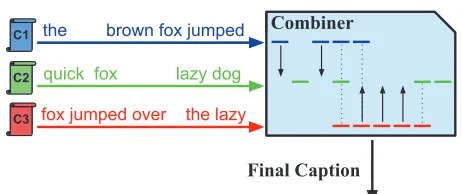
Figure 1: General layout of crowd captioning systems. Captionists (C1, C2, C3) submit partial captions that are automatically combined into a high-quality output.
problem by converting speech to text completely au-tomatically. However, the accuracy of ASR quickly plummets to below 30% when used on an untrained speaker’s voice, in a new environment, or in the ab-sence of a high quality microphone (Wald, 2006b).
An alternative approach is to combine the efforts of multiple non-expert captionists (anyone who can type) (Lasecki et al., 2012; Lasecki and Bigham, 2012; Lasecki et al., 2013). In this approach, mul-tiple non-expert human workers transcribe an audio stream containing speech in real-time, and their par-tial input is combined to produce a final transcript (see Figure 1). This approach has been shown to dramatically outperform ASR in terms of both accu-racy and Word Error Rate (WER), even when us-ing captionists drawn from Amazon’s Mechanical Turk. Furthermore, recall approached and even ex-ceeded that of a trained expert stenographer with seven workers contributing, suggesting that the in-formation is present to meet the performance of a stenographer. However, combining these captions involves real-time alignment of partial captions that may be incomplete and that often have spelling er-rors and inconsistent timestamps. In this paper, we present a more accurate combiner that leverages
Multiple Sequence Alignment (MSA) and Natural Language Processing to improve performance.
Gauging the quality of captions is not easy. Al-though word error rate (WER) is commonly used in speech recognition, it considers accuracy and com-pleteness, not readability. As a result, a lower WER does not always result in better understanding (Wang et al., 2003). We compare WER with two other com-monly used metrics: BLEU (Papineni et al., 2002) and F-measure (Melamed et al., 2003), and report their correlation with that of 50 human evaluators.
The key contributions of this paper are as follows:
• We have implemented an A∗-search based Mul-tiple Sequence Alignment algorithm (Lermen and Reinert, 2000) that can trade-off speed and accuracy by varying the heuristic weight and chunk-size parameters. We show that it outper-forms previous approaches in terms of WER, BLEU score, and F-measure.
• We propose a beam-search based technique us-ing the timus-ing information of the captions that helps to restrict the search space and scales ef-fectively to align longer sequences efficiently.
• We evaluate the correlation of WER, BLEU, and F-measure with 50 human ratings of cap-tion readability, and found that WER was more highly correlated than BLEU score (Papineni et al., 2002), implying it may be a more useful metric overall when evaluating captions.
2 Related Work
Most of the previous research on real-time caption-ing has focused on Automated Speech Recognition (ASR) (Saraclar et al., 2002; Cooke et al., 2001; Praˇz´ak et al., 2012). However, experiments show that ASR systems are not robust enough to be ap-plied for arbitrary speakers and in noisy environ-ments (Wald, 2006b; Wald, 2006a; Bain et al., 2005; Bain et al., 2012; Cooke et al., 2001).
2.1 Crowd Captioning
To address these limitations of ASR-based tech-niques, the Scribe system collects partial captions from the crowd and then uses a graph-based in-cremental algorithm to combine them on the fly (Lasecki et al., 2012). The system incrementally
builds a chain graph, where each node represents a set of equivalent words entered by the workers and the link between nodes are adjusted according to the order of the input words. A greedy search is per-formed to identify the path with the highest confi-dence, based on worker input and an n-gram lan-guage model. The algorithm is designed to be used online, and hence has high speed and low latency. However, due to the incremental nature of the algo-rithm and due to the lack of a principled objective function, it is not guaranteed to find the globally op-timal alignment for the captions.
2.2 Multiple Sequence Alignment
The problem of aligning and combining multiple transcripts can be mapped to the well-studied Mul-tiple Sequence Alignment (MSA) problem (Edgar and Batzoglou, 2006). MSA is an important prob-lem in computational biology (Durbin et al., 1998). The goal is to find an optimal alignment from a given set of biological sequences. The pairwise alignment problem can be solved efficiently using dynamic programming in O(N2) time and space, whereN is the sequence length. The complexity of the MSA problem grows exponentially as the num-ber of sequences grows, and has been shown to be NP-complete (Wang and Jiang, 1994). Therefore, it is important to apply some heuristic to perform MSA in a reasonable amount of time.
Most MSA algorithms for biological sequences follow a progressive alignment strategy that first per-forms pairwise alignment among the sequences, and then builds a guide tree based on the pairwise simi-larity between these sequences (Edgar, 2004; Do et al., 2005; Thompson et al., 1994). Finally, the input sequences are aligned according to the order spec-ified by the guide tree. While not commonly used for biological sequences, MSA with A∗-style search has been applied to these problems by Horton (1997) and Lermen and Reinert (2000).
errors. However, MUSCLE relies on a progressive alignment strategy and may result in suboptimal so-lutions. Moreover, it uses characters as atomic sym-bols instead of words. Our approach operates on a per-word basis and is able to arrive at a solution that is within a selectable error-bound of optimal.
3 Multiple Sequence Alignment
We start with an overview of the MSA problem us-ing standard notations as described by Lermen and Reinert (2000). LetS1, . . . , SK, K ≥ 2, be the K sequences over an alphabet Σ, and having length
N1, . . . , NK. The special gap symbol is denoted by
‘−’ and does not belong toΣ. LetA = (aij)be a
K×Nf matrix, whereaij ∈ Σ∪ {−}, and theith row has exactly(Nf −Ni)gaps and is identical to
Si if we ignore the gaps. Every column ofAmust have at least one non-gap symbol. Therefore, thejth column ofAindicates an alignment state for thejth
position, where the state can have one of the2K−1 possible combinations. Our goal is to find the op-timum alignment matrix AOP T that minimizes the sum of pairs (SOP) cost function:
c(A) = X 1≤i≤j≤K
c(Aij) (1)
where c(Aij) is the cost of the pairwise alignment between Si and Sj according to A. Formally,
c(Aij) = P Nf
l=1sub(ail, ajl), where sub(ail, ajl)
denotes the cost of substituting ajl for ail. If ail and ajl are identical, the substitution cost is usu-ally zero. For the caption alignment task, we treat each individual word as a symbol in our alphabet
Σ. The substitution cost for two words is estimated based on the edit distance between two words. The exact solution to the SOP optimization problem is NP-Complete, but many methods solve it approxi-mately. In this paper, we adapt weighted A∗search for approximately solving the MSA problem.
3.1 A∗Search for MSA
The problem of minimizing the SOP cost func-tion forK sequences is equivalent to estimating the shortest path between a single source and single sink node in a K-dimensional lattice. The total num-ber of nodes in the lattice is (N1 + 1) ×(N2 +
Algorithm 1 MSA-A∗Algorithm
Require: K input sequences S = {S1, . . . , SK} having
lengthN1, . . . , NK, heuristic weightw, beam sizeb
1: start←0K
,goal←[N1, . . . , NK]
2: g(start)←0,f(start)←w×h(start).
3: Q← {start}
4: whileQ6=∅do
5: n←EXTRACT-MIN(Q) 6: for alls∈ {0,1}K
− {0K
}do 7: ni←n+s
8: ifni=goalthen
9: Return the alignment matrix for the reconstructed path fromstarttoni
10: else ifni6∈Beam(b)then
11: continue; 12: else
13: g(ni)←g(n) +c(n, ni)
14: f(ni)←g(ni) +w×h(ni)
15: INSERT-ITEM(Q, ni, f(ni))
16: end if 17: end for 18: end while
1)× · · · ×(NK + 1), each corresponding to a dis-tinct position inK sequences. The source node is
[0, . . . ,0]and the sink node is [N1, . . . , NK]. The dynamic programming algorithm for estimating the shortest path from source to sink treats each node position[n1, . . . , nK]as a state and calculates a ma-trix that has one entry for each node. Assuming the sequences have roughly same lengthN, the size of the dynamic programming matrix is O(NK). At each vertex, we need to minimize the cost over all its 2K −1 predecessor nodes, and, for each such transition, we need to estimate the SOP objective function that requiresO(K2)operations. Therefore, the dynamic programming algorithm has time com-plexity of O(K2
2KNK) and space complexity of
O(NK), which is infeasible for most practical prob-lem instances. However, we can efficiently solve it via heuristic A∗search (Lermen and Reinert, 2000).
Q Q 7
&
&
&
WKH TXLFN EURZQ IR[ MXPSHG RYHU WKH OD]\ GRJ
WKH EURZQ IR[ MXPSHG
TXLFN IR[ OD]\ GRJ IR[ MXPSHG RYHU WKH OD]\ BB BBBB BB BBBB BB BBB BBBBB BBBB BB BB BBB BB BBB BBBB
WKH EURZQEURZQ IR[ MXPSHG
TXLFN IR[IR[ OD]\ GRJ IR[ MXPSHGMXPSHG RYHURYHU WKHWKH OD]\
WKH EURZQ IR[ MXPSHG
TXLFN IR[ OD]\ GRJ IR[ MXPSHG RYHURYHU WKHWKH OD]\ IR[
BBBB BB BBBB
TXLFN BBBB IR[ TXLFN BB
WKH BBBB WKH EURZQ IR[ MXPSHG
TXLFN IR[ OD]\ GRJ IR[ MXPSHG RYHU WKH OD]\ IR[
BBBB BB BBBB
BBBBB TXLFN BBBB IR[ TXLFN BB
WKH BBBB WKH EURZQ IR[ MXPSHG
TXLFN IR[ OD]\ GRJ IR[ MXPSHG RYHURYHU WKH OD]\ BB IR[ BBBB BB BBBB BB BBB BBBBB IR[ BBBB TXLFN BB BB BBB BB BBB WKH BBBB QL
B
MXPSHGMXPSHG
7 GRJ GRJ BB GRJ BB Q IR[ IR[
IR[IR[
IR[ 6 N BB BB RYHU MXPSHG OD]\ MXPSHG WKH TXLFN TXLFN IR[ OD]\ RYHU RYHU GRJ BB BB OD]\ OD]\ BB OD]\ RYHU GRJ GRJ GRJ BB BB BB WKH &DSWLRQ TXLFN WKH TXLFN &DSWLRQ &DSWLRQ IR[ TXLFN IR[ &DSWLRQ &DSWLRQ
BB BB BB OD]\ OD]\ [image:4.612.72.545.41.115.2]
BBOD]\ BB
Figure 2: A∗MSA search algorithm. Each branch is one of2K −1possible alignments for the current input. The
branch with minimum sum of the current alignment cost and the expected heuristic valuehpair(precomputed).
tionsg(n) and the heuristic functionh(n)for node
n. The cost function g(n) denotes the cost of the shortest path from the sourcesto the current node
n. The heuristic function h(n) is the approximate estimated cost of the shortest path fromnto the des-tinationt. At each step of the A∗ search algorithm, we extract the node with the smallest f(n) value from the priority queueQand expand it by one edge. The heuristic functionh(n)is admissible if it never overestimates the cost of the cheapest solution from
nto the destination. An admissible heuristic func-tion guarantees that A∗ will explore the minimum number of nodes and will always find the optimal solution. One commonly used admissible heuristic function ishpair(n):
hpair(n) =L(n→t) =
X
1≤i<j≤K
c(A∗p(σin, σjn))
(2) where L(n → t) denotes the lower bound on the cost of the shortest path fromnto destinationt,A∗p
is the optimal pairwise alignment, andσni is the suf-fix of nodenin thei-th sequence. A∗ search using the pairwise heuristic functionhpairsignificantly re-duces the search space and also guarantees finding the optimal solution. We must be able to estimate
hpair(n) efficiently. It may appear that we need to estimate the optimal pairwise alignment for all the pairs of suffix sequences at every node. However, we can precompute the dynamic programming ma-trix over all the pair of sequences(Si, Sj)once from the backward direction, and then reuse these values at each node. This simple trick significantly speeds up the computation ofhpair(n).
Despite the significant reduction in the search space, the A∗ search may still need to explore a
large number of nodes, and may become too slow for real-time captioning. However, we can further improve the speed by following the idea of weighted
A∗ search (Pohl, 1970). We modify the evaluation
functionf(n) =g(n)+hpair(n)to a weighted eval-uation functionf′(n) = g(n) +wh
pair(n), where
w ≥ 1is a weight parameter. By setting the value ofw to be greater than 1, we increase the relative weight of the estimated cost to reach the destina-tion. Therefore, the search prefers the nodes that are closer to the destination, and thus reaches the goal faster. Weighted A∗ search can significantly reduce the number of nodes to be examined, but it also loses the optimality guarantee of the admissible heuristic function. We can trade-off between accuracy and speed by tuning the weight parameterw.
3.2 Beam Search using Time-stamps
The computational cost of the A∗ search algorithm grows exponentially with increase in the number of sequences. However, in order to keep the crowd-sourced captioning system cost-effective, only a small number of workers are generally recruited at a time (typicallyK ≤10). We, therefore, are more concerned about the growth in computational cost as the sequence length increases.
In practice, we break down the sequences into smaller chunks by maintaining a window of a given time interval, and we apply MSA only to the smaller chunks of captions entered by the workers during that time window. As the window size increases, the accuracy of our MSA based combining system increases, but so does the computational cost and la-tency. Therefore, it is important to apply MSA with a relatively small window size for real-time caption-ing applications. Another interestcaption-ing application can be the offline captioning, for example, captioning an entire lecture and uploading the captions later.
1. so now what i want to do is introduce some of the
2. what i wanna do is introduce some of the aspects of the class 3. so now what i want to do is is introduce some of the aspects of the class 4. so now what i want to do is introduce
5. so now what i want to do is introduce some of the operational of the class 6. so i want to introduce some of the operational aspects of the clas
[image:5.612.67.543.57.128.2]C. so now what i want to do is introduce some of the operational aspects of the class
Figure 3: An example of applying MSA-A∗(thresholdt
v = 2) to combine 6 partial captions (first 6 lines) by human
workers to obtain the final output caption (C).
set the beam size to be 20 seconds, then we ignore any state in our search space that aligns two words having more than 20 seconds time lag. Given a fixed beam size b, we can restrict the number of priority queue removals by the A∗ algorithm to O(N bK). The maximum size of the priority queue isO(N bK). For each node in the priority queue, for each of the
O(2K) successor states, the objective function and heuristic estimation requiresO(K2)
operations and each priority queue insertion requiresO(log(N bK)) i.e. O(logN + Klogb) operations. Therefore, the overall worst case computational complexity is
O N bK2K(K2
+ logN +Klogb)
. Note that for fixed beam sizeband number of sequences K, the computational cost grows as O(NlogN) with the increase in N. However, in practice, weighted A∗ search explores much smaller number of states com-pared to this beam-restricted space.
3.3 Majority Voting after Alignment
After aligning the captions by multiple workers in a given chunk, we need to combine them to obtain the final caption. We do that via majority voting at each position of the alignment matrix containing a non-gap symbol. In case of tie, we apply the language model to choose the most likely word.
Often workers type in nonstandard symbols, ab-breviations, or misspelled words that do not match with any other workers’ input and end up as a sin-gle word aligned to gaps in all the other sequences. To filter out such spurious words, we apply a vot-ing threshold (tv) during majority voting and filter out words having less than tv votes. Typically we settv = 2 (see the example in Figure 3). While ap-plying the voting threshold improves the word error rate and readability, it runs the risk of loosing correct words if they are covered by only a single worker.
3.4 Incorporating an N-gram Language Model
We also experimented with a version of our system designed to incorporate the score from an n-gram language model into the search. For this purpose, we modified the alignment algorithm to produce a hypothesized output string as it moves through the input strings, as opposed to using voting to produce the final string as a post-processing step. The states for our dynamic programming are extended to in-clude not only the current position in each input string, but also the last two words of the hypothesis string (i.e.[n1, . . . , nK, wi−1, wi−2]) for use in
com-puting the next trigram language model probability. We replace our sum-of-all-pairs objective function with the sum of the alignment cost of each input with the hypothesis string, to which we add the log of the language model probability and a feature for the to-tal number of words in the hypothesis. Mathemati-cally, we consider the hypothesis string to be the 0th row of the alignment matrix, making our objective function:
c(A) = X 1≤i≤K
c(A0,i) +wlen Nf
X
l=1
I(a0,l 6=−)
+wlm
Nf
X
l=1
logP(a0,l|a0,l−2, a0,l−1)
wherewlm andwlenare negative constants indicat-ing the relative weights of the language model prob-ability and the length penalty.
Extending states with two previous words results in a larger computational complexity. GivenK se-quences of lengthNeach, we can haveO(N K) dis-tinct words. Therefore, the number disdis-tinct states is O(N bK(N K)2)
i.e. O(N3K2bK). Each state can have O(K2K) successors, giving an overall computational complexity ofO(N3K3bK2K(K2+
vo-cabulary size|V|is smaller thanN K, the number of distinct states is bounded byO(N bK|V|2).
3.5 Evaluation Metric for Speech to Text Captioning
Automated evaluation of speech to text captioning is known to be a challenging task (Wang et al., 2003). Word Error Rate (WER) is the most commonly used metric that finds the best pairwise alignment be-tween the candidate caption and the ground truth reference sentence. WER is estimated as S+NI+D, whereS,I, andDis the number of incorrect word substitutions, insertions, and deletions required to match the candidate sentence with reference, andN
is the total number of words in the reference. WER has several nice properties such as: 1) it is easy to estimate, and 2) it tries to preserve word order-ing. However, WER does not account for the overall ‘readability’ of text and thus does not always corre-late well with human evaluation (Wang et al., 2003; He et al., 2011).
The widely-used BLEU metric has been shown to agree well with human judgment for evaluating translation quality (Papineni et al., 2002). However, unlike WER, BLEU imposes no explicit constraints on the word ordering. BLEU has been criticized as an ‘under-constrained’ measure (Callison-Burch et al., 2006) for allowing too much variation in word ordering. Moreover, BLEU does not directly esti-mate recall, and instead relies on the brevity penalty. Melamed et al. (2003) suggest that a better approach is to explicitly measure both precision and recall and combine them via F-measure.
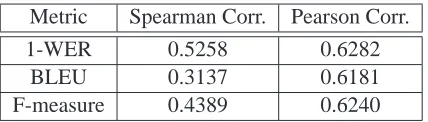
Our application is similar to automatic speech recognition in that there is a single correct output, as opposed to machine translation where many out-puts can be equally correct. On the other hand, un-like with ASR, out-of-order output is frequently pro-duced by our alignment system when there is not enough overlap between the partial captions to de-rive the correct ordering for all words. It may be the case that even such out-of-order output can be of value to the user, and should receive some sort of partial credit that is not possible using WER. For this reason, we wished to systematically compare BLEU, F-measure, and WER as metrics for our task. We performed a study to evaluate the agreement of the three metrics with human judgment. We
ran-Metric Spearman Corr. Pearson Corr.
1-WER 0.5258 0.6282
BLEU 0.3137 0.6181
[image:6.612.321.535.56.117.2]F-measure 0.4389 0.6240
Table 1: The correlation of average human judgment with three automated metrics: 1-WER, BLEU, and F-measure.
domly extracted one-minute long audio clips from four MIT OpenCourseWare lectures. Each clip was transcribed by 7 human workers, and then aligned and combined using four different systems: the graph-based system, and three different versions of our weighted A∗ algorithm with different values of tuning parameters. Fifty people participated in the study and were split in two equal sized groups. Each group was assigned two of the four audio clips, and each person evaluated all four captions for both clips. Each participant assigned a score between 1 to 10 to these captions, based on two criteria: 1) the overall estimated agreement of the captions with the ground truth text, and 2) the readability and under-standability of the captions.
Finally, we estimated the correlation coefficients (both Spearman and Pearson) for the three metrics discussed above with respect to the average score assigned by the human participants. The results are presented in Table 1. Among the three metrics, WER had the highest agreement with the human par-ticipants. This indicates that reconstructing the cor-rect word order is in fact important to the users, and that, in this aspect, our task has more of the flavor of speech recognition than of machine translation.
4 Experimental Results
mul-0.0 0.1 0.2 0.3 0.4 0.5 0.6 0.7 0.580.60 0.36 0.47 0.54 0.0 0.1 0.2 0.3 0.4 0.5 0.6 0.7 0.600.63 0.40 0.49 0.41 0.0 0.1 0.2 0.3 0.4 0.5 0.60.53 0.55
0.35 0.45 0.42 0.0 0.1 0.2 0.3 0.4 0.5 0.6 0.49 0.51 0.26 0.36 0.30 0.0 0.1 0.2 0.3 0.4 0.5 0.6 0.7 0.53 0.55 0.44 0.39 0.37 0.0 0.1 0.2 0.3 0.4 0.5 0.6 0.7 0.56 0.56 0.45 0.39 0.19 0.0 0.1 0.2 0.3 0.4 0.5 0.6
0.43 0.440.41 0.35 0.23 0.0 0.1 0.2 0.3 0.4 0.5 0.6 0.43 0.46 0.36 0.29 0.09 0.0 0.1 0.2 0.3 0.4 0.5 0.6 0.7 0.62 0.64 0.53 0.47 0.55 0.0 0.1 0.2 0.3 0.4 0.5 0.6 0.70.63 0.63
0.53 0.45 0.44 0.0 0.1 0.2 0.3 0.4 0.5 0.6
0.52 0.54 0.49 0.43 0.39 0.0 0.1 0.2 0.3 0.4 0.5 0.6 0.530.56 0.46 0.38 0.35
(1.0-WER) BLEU Score F-Measure
Da ta S et 1 Da ta S et 2 Da ta S et 3 Da ta S et 4 A*-10-t
(c=10 sec, threshold=2)
A*-15-t
(c=15 sec, threshold=2)
A*-15
(c=15 sec, no threshold)
[image:7.612.77.297.56.372.2]
Graph-based MUSCLE
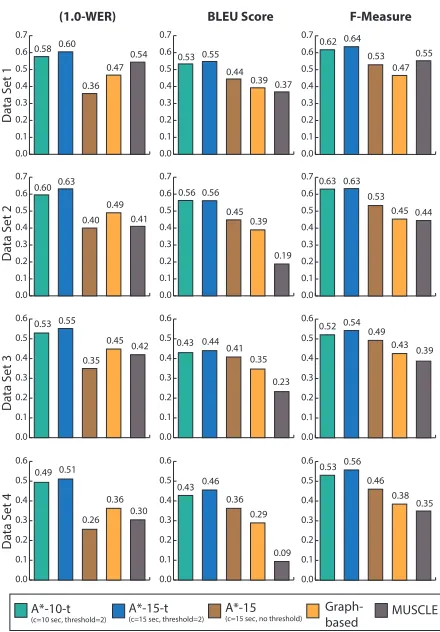
Figure 4: Evaluation of different systems on using three different automated metrics for measuring transcription quality: 1- Word Error Rate (WER), BLEU, and F-measure on the four audio clips.
tiple sequence alignment using MUSCLE.
As explained earlier, we vary the four key pa-rameters of the algorithm: the chunk size (c), the heuristic weight (w), the voting threshold (tv), and the beam size (b). The heuristic weight and chunk size parameters help us to trade-off between speed versus accuracy; the voting threshold tv helps im-prove precision by pruning words having less than
tv votes, and beam size reduces the search space by restricting states to be inside a time window/beam. We use affine gap penalty (Edgar, 2004) with dif-ferent gap opening and gap extension penalty. We set gap opening penalty to 0.125 and gap extension penalty to 0.05. We evaluate the performance using the three standard metrics: Word Error Rate (WER), BLEU, and F-measure. The performance in terms of these metrics using different systems is presented in Figure 4.
Out of the five systems in Figure 4, the first three are different versions of our A∗ search based MSA
algorithm with different parameter settings: 1) A∗ -10-t system (c= 10 seconds,tv= 2), 2) A∗-15-t (c= 15 seconds,tv= 2), and 3) A∗-15 (c= 15 seconds,tv = 1 i.e. no pruning while voting). For all three sys-tems, the heuristic weight parameterwis set to 2.5 and beam sizeb = 20 seconds. The other two sys-tems are the existing graph-based system and mul-tiple sequence alignment using MUSCLE. Among the three A∗based algorithms, both A∗-15-t and A∗ -10-t produce better quality transcripts and outper-form the existing algorithms. Both systems apply the voting threshold that improves precision. The system A∗-15 applies no threshold and ends up pro-ducing many spurious words having poor agreement among the workers, and hence it scores worse in all the three metrics. The A∗-15-t achieves 57.4% aver-age accuracy in terms of (1-WER), providing 29.6% improvement with respect to the graph-based sys-tem (average accuracy 42.6%), and 35.4% improve-ment with respect to the MUSCLE-based MSA sys-tem (average accuracy 41.9%). On the same set of audio clips, Lasecki et al. (2012) reported 36.6% ac-curacy using ASR (Dragon Naturally Speaking, ver-sion 11.5 for Windows), which is worse than all the crowd-based based systems used in this experiment. To measure the statistical significance of this im-provement, we performed at-test at both the dataset level (n =4 clips) and the word level (n =2862 words). The improvement over the graph-based model was statistically significant with dataset level
p-value 0.001 and word level p-value smaller than 0.0001. The average time to align each 15 second chunk with 10 input captions is∼400 milliseconds.
We have also experimented with a trigram lan-guage model, trained on the British National Cor-pus (Burnard, 1995) having ∼122 million words. The language-model-integrated A∗ search provided a negligible 0.21% improvement in WER over the A∗-15-t system on average. The task of
2 3 4 5 6 7 8 0.42
0.44 0.46 0.48 0.5 0.52 0.54 0.56 0.58
1−WER
Avg Running Time (in Seconds) c = 5 c = 10 c = 15 c = 20 c = 40 c = 60
(a) Varying heuristic weights for fixed chunk sizes (c)
2 3 4 5 6 7 8
0.42 0.44 0.46 0.48 0.5 0.52 0.54 0.56 0.58
1−WER
Avg Running Time (in Seconds) w = 1.8 w = 2 w = 2.5 w = 3 w = 4 w = 6 w = 8
[image:8.612.85.515.63.233.2](b) Varying chunk size for fixed heuristic weight (w)
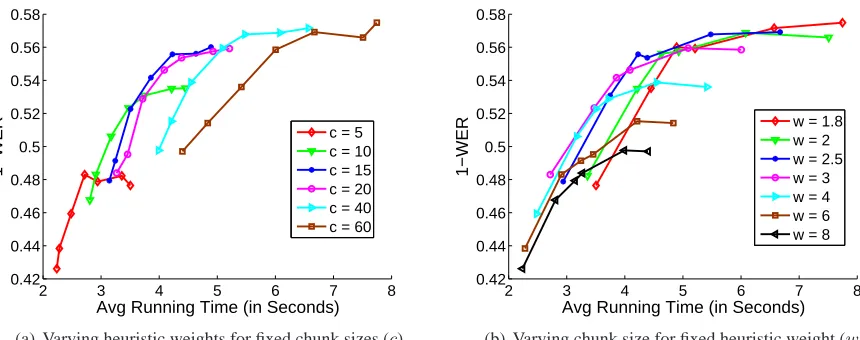
Figure 5: The trade-off between speed and accuracy for different heuristic weights and chunk size parameters.
experiments.
Next, we look at the critical speed versus accuracy trade-off for different values of the heuristic weight (w) and the chunk size (c) parameters. Since WER has been shown to correlate most with human judg-ment, we show the next results only with respect to WER. First, we fix the chunk size at different val-ues, and then vary the heuristic weight parameter:
w = 1.8, 2, 2.5, 3, 4, 6, and 8. The results are shown in Figure 5(a), where each curve represents how time and accuracy changed over the range of values ofwand a fixed value ofc. We observe that for smaller values ofw, the algorithm is more accu-rate, but comparatively slower. Aswincreases, the search reaches the goal faster, but the quality of the solution degrades as well. Next, we fixwand vary chunk sizec=5, 10, 15, 20, 40, 60 second. We re-peat this experiment for a range of values ofwand the results are shown in Figure 5(b). We can see that the accuracy improves steeply up toc=20 seconds, and does not improve much beyondc=40 seconds. For all these benchmarks, we set the beam size (b) to 20 seconds and voting threshold (tv) to 2.
In our tests, the beam size parameter (b) did not play a significant role in performance, and setting it to any reasonably large value (usually≥15 seconds) resulted in similar accuracy and running time. This is because the A∗search withhpairheuristic already reduces the the search space significantly, and usu-ally reaches the goal in a number of steps smaller than the state space size after the beam restriction.
Finally, we investigate how the accuracy of our algorithm varies with the number of inputs/workers. We start with a pool of 10 input captions for one of the audio clips. We vary the number of input cap-tions (K) to the MSA-A∗algorithm from 2 up to 10.
The quality of input captions differs greatly among the workers. Therefore, for each value ofK, we re-peat the experimentmin 20, 10K
times; each time we randomly selectKinput captions out of the total pool of 10. Figure 6 shows that accuracy steeply increases as the number of inputs increases to 7, and after that adding more workers does not pro-vide much improvement in accuracy, but increases running time.
5 Discussion and Future Work
In this paper, we show that the A∗ search based MSA algorithm performs better than existing algo-rithms for combining multiple captions. The exist-ing graph-based model has low latency, but it usually can not find a near optimal alignment because of its incremental alignment. Weighted A∗ search on the other hand performs joint multiple sequence align-ment, and is guaranteed to produce a solution hav-ing cost no more than(1 +ǫ)times the cost of the optimal solution, given a heuristic weight of(1 +ǫ). Moreover, A∗ search allows for straightforward in-tegration of an n-gram language model during the search.
0 2 4 6 8 10 0
0.1 0.2 0.3 0.4 0.5 0.6
Average (1−WER)
[image:9.612.78.277.67.238.2]Average Running Time (in sec)
Figure 6: Experiments showing how the accuracy of the final caption by MSA-A∗algorithm varies with the
num-ber of inputs from 2 to 10.
speed and accuracy. The algorithm can be tailored to real-time by using a larger heuristic weight. On the other hand, we can produce better transcripts for offline tasks by choosing a smaller weight.
It is interesting to compare our results with those achieved using the MUSCLE MSA tool of Edgar (2004). One difference is that our system takes a hi-erarchical approach in that it aligns at the word level, but also uses string edit distance at the letter level as a substitution cost for words. Thus, it is able to take advantage of the fact that individual transcrip-tions do not generally contain arbitrary fragments of words. More fundamentally, it is interesting to note that MUSCLE and most other commonly used MSA tools for biological sequences make use of a guide
tree formed by a hierarchical clustering of the
in-put sequences. The guide tree produced by the algo-rithms may or may not match the evolutionary tree of the organisms whose genomes are being aligned, but, nevertheless, in the biological application, such an underlying evolutionary tree generally exists. In aligning transcriptions, there is no particular reason to expect individual pairs of transcriptions to be es-pecially similar to one another, which may make the guide tree approach less appropriate.
In order to get competitive results, the A∗ search based algorithm aligns sequences that are at least 7-10 seconds long. The delay for collecting the cap-tions within a chunk can introduce latency, however,
each alignment usually takes less than 300 millisec-onds, allowing us to repeatedly align the stream of words, even before the window is filled. This pro-vides less accurate but immediate response to users. Finally, when we have all the words entered in a chunk, we perform the final alignment and show the caption to users for the entire chunk.
After aligning the input sequences, we obtain the final transcript by majority voting at each alignment position, which treats each worker equally and does not take individual quality into account. Recently, some work has been done for automatically estimat-ing individual worker’s quality for crowd-based data labeling tasks (Karger et al., 2011; Liu et al., 2012). Extending these methods for crowd-based text cap-tioning could be an interesting future direction.
6 Conclusion
In this paper, we have introduced a new A∗ search based MSA algorithm for aligning partial captions into a final output stream in real-time. This method has advantages over prior approaches both in for-mal guarantees of optifor-mality and the ability to trade off speed and accuracy. Our experiments on real captioning data show that it outperforms prior ap-proaches based on a dependency graph model and a standard MSA implementation (MUSCLE). An periment with 50 participants explored whether ex-iting automatic metrics of quality matched human evaluations of readability, showing WER did best.
Acknowledgments Funded by NSF awards IIS-1218209 and IIS-0910611.
References
Keith Bain, Sara Basson, A Faisman, and D Kanevsky. 2005. Accessibility, transcription, and access every-where. IBM Systems Journal, 44(3):589–603.
Keith Bain, Eunice Lund-Lucas, and Janice Stevens. 2012. 22. transcribe your class: Using speech recogni-tion to improve access for at-risk students. Collected
Essays on Learning and Teaching, 5.
Lou Burnard. 1995. Users Reference Guide British Na-tional Corpus Version 1.0.
Martin Cooke, Phil Green, Ljubomir Josifovski, and As-cension Vizinho. 2001. Robust automatic speech recognition with missing and unreliable acoustic data.
Speech Communication, 34(3):267–285.
Chuong B Do, Mahathi SP Mahabhashyam, Michael Brudno, and Serafim Batzoglou. 2005. Prob-cons: Probabilistic consistency-based multiple se-quence alignment. Genome Research, 15(2):330–340. Richard Durbin, Sean R Eddy, Anders Krogh, and Graeme Mitchison. 1998. Biological sequence
analy-sis: probabilistic models of proteins and nucleic acids.
Cambridge university press.
Robert C Edgar and Serafim Batzoglou. 2006. Multi-ple sequence alignment. Current opinion in structural
biology, 16(3):368–373.
Robert C Edgar. 2004. MUSCLE: multiple sequence alignment with high accuracy and high throughput.
Nucleic Acids Research, 32(5):1792–1797.
Xiaodong He, Li Deng, and Alex Acero. 2011. Why word error rate is not a good metric for speech rec-ognizer training for the speech translation task? In
IEEE International Conference on Acoustics, Speech and Signal Processing (ICASSP), 2011, pages 5632–
5635. IEEE.
Phillip B Horton. 1997. Strings, algorithms, and
ma-chine learning applications for computational biology.
Ph.D. thesis, University of California, Berkeley. David R Karger, Sewoong Oh, and Devavrat Shah. 2011.
Iterative learning for reliable crowdsourcing systems. In Proceedings of Advances in Neural Information
Processing Systems (NIPS), volume 24, pages 1953–
1961.
Walter Lasecki and Jeffrey Bigham. 2012. Online qual-ity control for real-time crowd captioning. In
Pro-ceedings of the 14th international ACM SIGACCESS conference on Computers and accessibility (ASSETS 2012), pages 143–150. ACM.
Walter Lasecki, Christopher Miller, Adam Sadilek, An-drew Abumoussa, Donato Borrello, Raja Kushalnagar, and Jeffrey Bigham. 2012. Real-time captioning by groups of non-experts. In Proceedings of the 25rd
an-nual ACM symposium on User interface software and technology, UIST ’12.
Walter Lasecki, Christopher Miller, and Jeffrey Bigham. 2013. Warping time for more effective real-time crowdsourcing. In Proceedings of the ACM
confer-ence on Human Factors in Computing Systems, CHI
’13, page To Appear, New York, NY, USA. ACM. Martin Lermen and Knut Reinert. 2000. The
prac-tical use of the A* algorithm for exact multiple se-quence alignment. Journal of Computational Biology, 7(5):655–671.
Qiang Liu, Jian Peng, and Alex Ihler. 2012. Varia-tional inference for crowdsourcing. In Proceedings of
Advances in Neural Information Processing Systems (NIPS), volume 25, pages 701–709.
Dan Melamed, Ryan Green, and Joseph P Turian. 2003. Precision and recall of machine translation. In
Pro-ceedings HLT-NAACL 2003, volume 2, pages 61–63.
Association for Computational Linguistics.
Kishore Papineni, Salim Roukos, Todd Ward, and Wei-Jing Zhu. 2002. Bleu: a method for automatic eval-uation of machine translation. In Proceedings of the
40th annual meeting of Association for Computational Linguistics, pages 311–318. Association for
Computa-tional Linguistics.
Ira Pohl. 1970. Heuristic search viewed as path finding in a graph. Artificial Intelligence, 1(3):193–204. Aleˇs Praˇz´ak, Zdenˇek Loose, Jan Trmal, Josef V Psutka,
and Josef Psutka. 2012. Captioning of Live TV Programs through Speech Recognition and Re-speaking. In Text, Speech and Dialogue, pages 513– 519. Springer.
Murat Saraclar, Michael Riley, Enrico Bocchieri, and Vincent Goffin. 2002. Towards automatic closed cap-tioning: Low latency real time broadcast news tran-scription. In Proceedings of the International
Confer-ence on Spoken Language Processing (ICSLP), pages
1741–1744.
Julie D Thompson, Desmond G Higgins, and Toby J Gibson. 1994. Clustal w: improving the sensitivity of progressive multiple sequence alignment through sequence weighting, position-specific gap penalties and weight matrix choice. Nucleic Acids Research, 22(22):4673–4680.
Mike Wald. 2006a. Captioning for deaf and hard of hearing people by editing automatic speech recogni-tion in real time. Computers Helping People with
Spe-cial Needs, pages 683–690.
Mike Wald. 2006b. Creating accessible educational mul-timedia through editing automatic speech recognition captioning in real time. Interactive Technology and
Smart Education, 3(2):131–141.
Lusheng Wang and Tao Jiang. 1994. On the complexity of multiple sequence alignment. Journal of
Computa-tional Biology, 1(4):337–348.
Ye-Yi Wang, Alex Acero, and Ciprian Chelba. 2003. Is word error rate a good indicator for spoken language understanding accuracy. In IEEE Workshop on