Creating Reverse Bilingual Dictionaries
Khang Nhut Lam
Department of Computer Science University of Colorado Colorado Springs, USA
Jugal Kalita
Department of Computer Science University of Colorado Colorado Springs, USA [email protected]
Abstract
Bilingual dictionaries are expensive resources and not many are available when one of the languages is resource-poor. In this paper, we propose algorithms for creation of new reverse bilingual dictionaries from existing bilingual dictionaries in which English is one of the two languages. Our algorithms exploit the simi-larity between word-concept pairs using the English Wordnet to produce reverse dictionary entries. Since our algorithms rely on available bilingual dictionaries, they are applicable to any bilingual dictionary as long as one of the two languages has Wordnet type lexical ontol-ogy.
1 Introduction
The Ethnologue organization1 lists 6,809 distinct languages in the world, most of which are resource-poor. Most existing online bilingual dictionaries are between two resource-rich languages (e.g., English, Spanish, French or German) or between a resource-rich language and a resource-poor language. There are languages for which we are lucky to find a single bilingual dictionary online. For example, the Uni-versity of Chicago hosts bilingual dictionaries from 29 Southeast Asian languages2, but many of these
languages have only one bilingual dictionary online. Existing algorithms for creating new bilingual dictionaries use intermediate languages or interme-diate dictionaries to find chains of words with the same meaning. For example, (Gollins and Sander-son, 2001) use lexical triangulation to translate in parallel across multiple intermediate languages and
1http://www.ethnologue.com/ 2
http://dsal.uchicago.edu/dictionaries/list.html
fuse the results. They query several existing dictio-naries and then merge results to maximize accuracy. They use four pivot languages, German, Spanish, Dutch and Italian, as intermediate languages. An-other existing approach for creating bilingual dictio-naries is using probabilistic inference (Mausam et al., 2010). They organize dictionaries in a graph topology and use random walks and probabilistic graph sampling. (Shaw et al., 2011) propose a set of algorithms to create a reverse dictionary in the context of single language by using converse map-ping. In particular, given an English-English dictio-nary, they attempt to find the original words or terms given a synonymous word or phrase describing the meaning of a word.
The goal of this research is to study the feasibility of creating a reverse dictionary by using only one ex-isting dictionary and Wordnet lexical ontology. For example, given a Karbi3-English dictionary, we will construct an ENG-AJZ dictionary. The remainder of this paper is organized as follows. In Section 2, we discuss the nature of bilingual dictionaries. Section 3 describes the algorithms we propose to create new bilingual dictionaries from existing dictionaries. Re-sults of our experiments are presented in Section 4. Section 5 concludes the paper.
2 Existing Online Bilingual Dictionaries
Powerful online translators developed by Google and Bing provide pairwise translations (including for individual words) for 65 and 40 languages, re-spectively. Wiktionary, a dictionary created by vol-unteers, supports over 170 languages. We find a
3Karbi is an endangered language spoken by 492,000
peo-ple (2007 Ethnologue data) in Northeast India, ISO 639-3 code AJZ. ISO 693-3 code for English is ENG.
large number of bilingual dictionaries at PanLex4 including an ENG-Hindi5 and a Vietnamese6-ENG dictionary. The University of Chicago has a number of bilingual dictionaries for South Asian languages. Xobdo7 has a number of dictionaries, focused on Northeast India.
We classify the many freely available dictionaries into three main kinds.
• Word to word dictionaries: These are dictionar-ies that translate one word in one language to one word or a phrase in another language. An example is an ENG-HIN dictionary at Panlex.
• Definition dictionaries: One word in one lan-guage has one or more meanings in the second language. It also may have pronunciation, parts of speech, synonyms and examples. An exam-ple is the VIE-ENG dictionary, also at Panlex.
• One language dictionaries: A dictionary of this kind is found at dictionary.com.
We have examined several hundred online dictionar-ies and found that they occur in many different for-mats. Extracting information from these dictionaries is arduous. We have experimented with five existing bilingual dictionaries: VIE-ENG, ENG-HIN, and a dictionary supported by Xobdo with 4 languages: Assamese8, ENG, AJZ, and Dimasa9. We consider the last one to be a collection of 3 bilingual dictio-naries: ASM-ENG, AJZ-ENG, and DIS-ENG. We choose these languages since one of our goals is to work with resource-poor languages to enhance the quantity and quality of resources available.
3 Proposed Solution Approach
A dictionary entry, calledLexicalEntry, is a 2-tuple
<LexicalUnit, Definition>. A LexicalUnit is a word or a phrase being defined, also called definien-dum (Landau, 1984). A list of entries sorted by the LexicalUnit is called a lexiconor a dictionary. Given aLexicalUnit, theDefinition associated with it usually contains its class and pronunciation, its
4
http://panlex.org/
5
ISO 693-3 code HIN
6ISO 693-3 code VIE 7
http://www.xobdo.org/
8
Assamese is an Indo-European language spoken by about 30 million people, but it is resource-poor, ISO 693-3 code ASM.
9
Dimasa is another endangered language from Northeast In-dia, spoken by about 115,000 people, ISO 693-3 code DIS.
meaning, and possibly additional information. The meaning associated with it can have severalSenses. ASenseis a discrete representation of a single aspect of the meaning of a word. Thus, a dictionary entry is of the form<LexicalUnit,Sense1,Sense2,· · ·>. In this section, we propose a series of algorithms, each one of which automatically creates a reverse dictionary, or ReverseDictionary, from a dictio-nary that translates a word in languageL1to a word or phrase in language L2. We require that at least one of two these languages has a Wordnet type lexi-cal ontology (Miller, 1995). Our algorithms are used to create reverse dictionaries from them at various levels of accuracy and sophistication.
3.1 Direct Reversal (DR)
The existing dictionary has alphabetically sorted LexicalUnits in L1 and each of them has one or more Senses in L2. To create ReverseDictionary, we simply take every pair <LexicalU nit, Sense> in SourceDictionaryand swap the positions of the two.
Algorithm 1DR Algorithm
ReverseDictionary:=φ
for allLexicalEntryi ∈SourceDictionarydo for allSensej ∈LexicalEntryido
Add tuple <Sensej,
LexicalEntryi.LexicalU nit> to
ReverseDictionary
end for end for
This is a baseline algorithm so that we can com-pare improvements as we create new algorithms. If in our input dictionary, the sense definitions are mostly single words, and occasionally a sim-ple phrase, even such a simsim-ple algorithm gives fairly good results. In case there are long or com-plex phrases in senses, we skip them. The ap-proach is easy to implement, and produces a high-accuracyReverseDictionary. However, the num-ber of entries in the created dictionaries are lim-ited because this algorithm just swaps the posi-tions ofLexicalUnitandSenseof each entry in the
3.2 Direct Reversal with Distance (DRwD)
To increase the number of entries in the output dic-tionary, we compute the distance between words in the Wordnet hierarchy. For example, the words "hasta-lipi" and "likhavat" in HIN have the meanings "handwriting" and "script", respectively. The dis-tance between "handwriting" and "script" in Word-net hierarchy is 0.0, so that "handwriting" and "script" likely have the same meaning. Thus, each of "hasta-lipi" and "likhavat" should have both mean-ings "handwriting" and "script". This approach helps us find additional words having the same meanings and possibly increase the number of lexi-cal entries in the reverse dictionaries.
To create a ReverseDictionary, for every
LexicalEntryi in the existing dictionary, we find all LexicalEntryj, i 6= j with dis-tance to LexicalEntryi equal to or smaller than a threshold α. As results, we have new pairs of entries <LexicalEntryi.LexicalU nit,
LexicalEntryj.Sense> ; then we swap positions in the two-tuples, and add them into the Reverse-Dictionary. The value of α affects the number of entries and the quality of created dictionaries. The greater the value of α, the larger the number of lexical entries, but the smaller the accuracy of the ReverseDictionary.
The distance between the twoLexicalEntrys is the distance between the twoLexicalU nits if the Lexi-calUnits occur in Wordnet ontology; otherwise, it is the distance between the twoSenses. The distance between each phrase pair is the average of the to-tal distances between every word pair in the phrases (Wu and Palmer, 1994). If the distance between two words or phrases is 1.00, there is no similarity be-tween these words or phrases, but if they have the same meaning, the distance is 0.00.
We find that aReverseDictionarycreated using the value 0.0 forαhas the highest accuracy. This ap-proach significantly increases the number of entries in the ReverseDictionary. However, there is an is-sue in this approach. For instance, the word "tuhbi" in DIS means "crowded", "compact", "dense", or "packed". Because the distance between the En-glish words "slow" and "dense" in Wordnet is 0.0, this algorithm concludes that "slow" has the mean-ing "tuhbi" also, which is wrong.
Algorithm 2DRwD Algorithm
ReverseDictionary :=φ
for allLexicalEntryi ∈SourceDictionarydo for allSensej ∈LexicalEntryido
for all LexicalEntryu ∈
SourceDictionarydo
for allSensev ∈LexicalEntryudo
ifdistance(<LexicalEntryi.LexicalU nit,
Sensej> ,<LexicalEntryu.LexicalU nit,
Sensev> )6αthen
Add tuple <Sensej,
LexicalEntryu.LexicalU nit> toReverseDictionary
end if end for end for end for end for
3.3 Direct Reversal with Similarly (DRwS)
The DRwD approach computes simply the dis-tance between two senses, but does not look at the meanings of the senses in any depth. The DRwS approach represents a concept in terms of its Wordnet synset10, synonyms, hyponyms and hypernyms. This approach is like the DRwD approach, but instead of computing the distance between lexical entries in each pair, we calcu-late the similarity, called simValue. If the sim-Valueof a<LexicalEntryi,LexicalEntryj>,i6=
j pair is equal or larger than β, we conclude that the LexicalEntryi has the same meaning as
LexicalEntryj.
To calculate simValue between two phrases, we obtain the ExpansionSet for every word in each phrase from the WordNet database. An Expansion-Setof a phrase is a union of synset, and/or synonym, and/or hyponym, and/or hypernym of every word in it. We compare the similarity between the Expan-sionSets. The value of β and the kinds of Expan-sionSets are changed to create different ReverseDic-tionarys. Based on experiments, we find that the best value of β is 0.9, and the best ExpansionSet is the union of synset, synonyms, hyponyms, and hyper-nyms. The algorithm for computing thesimValueof entries is shown in Algorithm 3.
10
Algorithm 3 simValue(LexicalEntryi,
LexicalEntryj)
simW ords:=φ
if LexicalEntryi.LexicalU nit &
LexicalEntryj.LexicalU nit have a Word-net lexical ontologythen
for all(LexicalU nitu ∈ LexicalEntryi) &
(LexicalU nitv ∈LexicalEntryj)do
Find ExpansionSet of every
LexicalEntrybased onLexicalU nit
end for else
for all (Senseu ∈ LexicalEntryi) &
(Sensev ∈LexicalEntryj)do
Find ExpansionSet of every
LexicalEntrybased onSense
end for end if
simWords ← ExpansionSet (LexicalEntryi) ∩ ExpansionSet(LexicalEntryj)
n←ExpansionSet(LexicalEntryi).length m←ExpansionSet(LexicalEntryj).length simValue←min{simW ords.lengthn ,simW ords.lengthm }
4 Experimental results
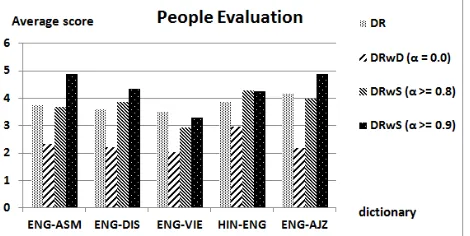
The goals of our study are to create the high-precision reverse dictionaries, and to increase the numbers of lexical entries in the created dictio-naries. Evaluations were performed by volunteers who are fluent in both source and destination lan-guages. To achieve reliable judgment, we use the same set of 100 non-stop word ENG words, ran-domly chosen from a list of the most common words11. We pick randomly 50 words from each created ReverseDictionary for evaluation. Each volunteer was requested to evaluate using a 5-point scale, 5: excellent, 4: good, 3: average, 2: fair, and 1: bad. The average scores of entries in the Reverse-Dictionarys is presented in Figure 1. The DRwS dic-tionaries are the best in each case. The percentage of agreements between raters is in all cases is around 70%.
The dictionaries we work with frequently have several meanings for a word. Some of these mean-ings are unusual, rare or very infrequently used. The
11
http://www.world-english.org/english500.htm
DR algorithm creates entries for the rare or unusual meanings by direct reversal. We noticed that our evaluators do not like such entries in the reversed dictionaries and mark them low. This results in lower average scores in the DR algorithm compar-ing to averages cores in the DRwS algorithm. The DRwS algorithm seems to have removed a number of such unusual or rare meanings (and entries simi-lar to the rare meanings, recursively) improving the average score
[image:4.612.315.550.473.591.2]Our proposed approaches do not work well for dictionaries containing an abundance of complex phrases. The original dictionaries, except the VIE-ENG dictionary, do not contain many long phrases or complex words. In Vietnamese, most words we find in the dictionary can be considered com-pound words composed of simpler words put to-gether. However, the component words are sepa-rated by space. For example, "bái thần giáo" means "idolatry". The component words are "bái" mean-ing "bow low"; "thần" meaning "deity"; and "giáo" meaning "lance", "spear", "to teach", or "to edu-cate". The presence of a large number of compound words written in this manner causes problems with the ENG-VIE dictionary. If we look closely at Fig-ure 1, all language pairs, except ENG-VIE show substantial improvement in score when we compare the DR algorithm with DRwS algorithm.
Figure 1: Average entry score inReverseDictionary
shown in Figure 2.
Figure 2: Number of lexical entries in ReverseDictionarys generated from 100 common words
We also create the entire reverse dictionary for the AJZ-ENG dictionary. The total number of en-tries in the ENG-AJZ dictionaries created by us-ing the DR algorithm and DRwS algorithm are 4677 and 5941, respectively. Then, we pick 100 random words from the ENG-AJZ created by us-ing the DRwS algorithm for evaluation. The av-erage score of every entry in this created nary is 4.07. Some of the reversal bilingual dictio-naries can be downloaded at http://cs.uccs.edu/ lin-clab/creatingBilingualLexicalResource.html.
5 Conclusion
We proposed approaches to create a reverse dic-tionary from an existing bilingual dicdic-tionary using Wordnet. We show that a high precision reverse dic-tionary can be created without using any other inter-mediate dictionaries or languages. Using the Word-net hierarchy increases the number of entries in the created dictionaries. We perform experiments with several resource-poor languages including two that are in the UNESCO’s list of endangered languages.
Acknowledgements
We would like to thank the volunteers evaluating the dictionaries we create: Morningkeey Phangcho, Dharamsing Teron, Navanath Saharia, Arnab Phon-glosa, Abhijit Bendale, and Lalit Prithviraj Jain. We also thank all friends in the Xobdo project who pro-vided us with the ASM-ENG-DIS-AJZ dictionaries.
References
Mausam, S. Soderlan, O. Etzioni, D.S. Weld, K. Reiter, M. Skinner, M. Sammer, and J. Bilmers 2010. Pan-lingual lexical translation via probabilistic inference, Artificial Intelligence, 174:619–637.
R. Shaw, A. Datta, D. VanderMeer, and K. Datta 2011.
Building a scalable database - Driven Reverse Dic-tionary, IEEE Transactions on Knowledge and Data Engineering, volume 99.
T. Gollins and M. Sanderson. 2001.Improving cross lan-guage information retrieval with triangulated transla-tion, SIGIR ’01 Proceedings of the 24th annual in-ternational ACM SIGIR conference on Research and development in information retrieval, New York, 90– 95.
S.I. Landau. 1984.Dictionaries, Cambridge Univ Press. G.A. Miller. 1995. Wordnet: a lexical database for English, Communications of the ACM, vol-ume 38(11):39–41.