Sample-efficient Actor-Critic Reinforcement Learning
with Supervised Data for Dialogue Management
Pei-Hao Su, Paweł Budzianowski, Stefan Ultes, Milica Gaˇsi´c, and Steve Young Department of Engineering, University of Cambridge, Cambridge, UK
{phs26, pfb30, su259, mg436, sjy11}@cam.ac.uk
Abstract
Deep reinforcement learning (RL) meth-ods have significant potential for dia-logue policy optimisation. However, they suffer from a poor performance in the early stages of learning. This is es-pecially problematic for on-line learning with real users. Two approaches are in-troduced to tackle this problem. Firstly, to speed up the learning process, two sample-efficient neural networks algorithms: trust region actor-critic with experience replay (TRACER) and episodic natural actor-critic with experience replay (eNACER) are presented. For TRACER, the trust re-gion helps to control the learning step size and avoid catastrophic model changes. For eNACER, the natural gradient iden-tifies the steepest ascent direction in pol-icy space to speed up the convergence. Both models employ off-policy learning with experience replay to improve sample-efficiency. Secondly, to mitigate the cold start issue, a corpus of demonstration data is utilised to pre-train the models prior to on-line reinforcement learning. Combin-ing these two approaches, we demonstrate a practical approach to learning deep RL-based dialogue policies and demonstrate their effectiveness in a task-oriented infor-mation seeking domain.
1 Introduction
Task-oriented Spoken Dialogue Systems (SDS) aim to assist users to achieve specific goals via speech, such as hotel booking, restaurant informa-tion and accessing bus-schedules. These systems are typically designed according to a structured
ontology(or a databaseschema), which defines the
domain that the system can talk about. The de-velopment of a robust SDS traditionally requires a substantial amount of hand-crafted rules com-bined with various statistical components. This includes a spoken language understanding mod-ule (Chen et al., 2016; Yang et al., 2017), a dia-logue belief state tracker (Henderson et al., 2014; Perez and Liu, 2016; Mrkˇsi´c et al., 2017) to predict user intent and track the dialogue history, a dia-logue policy (Young et al., 2013; Gaˇsi´c and Young, 2014; Budzianowski et al., 2017) to determine the dialogue flow, and a natural language generator (Rieser and Lemon, 2009; Wen et al., 2015; Hu et al., 2017) to convert conceptual representations into system responses.
In a task-oriented SDS, teaching a system how to respond appropriately in all situations is non-trivial. Traditionally, this dialogue management
component has been designed manually using flow charts. More recently, it has been formulated as a planning problem and solved using reinforce-ment learning (RL) to optimise a dialogue policy through interaction with users (Levin and Pierac-cini, 1997; Roy et al., 2000; Williams and Young, 2007; Jurˇc´ıˇcek et al., 2011). In this framework, the system learns by atrial and errorprocess gov-erned by a potentially delayed learning objective called thereward. This reward is designed to en-capsulate the desired behavioural features of the dialogue. Typically it provides a positive reward for success plus a per turn penalty to encourage short dialogues (El Asri et al., 2014; Su et al., 2015a; Vandyke et al., 2015; Su et al., 2016b).
To allow the system to be trained on-line, Bayesian sample-efficient learning algorithms have been proposed (Gaˇsi´c and Young, 2014; Daubigney et al., 2014) which can learn policies from a minimal number of dialogues. However, even with such methods, the initial performance is still relatively poor, and this can impact negatively
on the user experience.
Supervised learning (SL) can also be used for dialogue action selection. In this case, the policy is trained to produce an appropriate response for any given dialogue state. Wizard-of-Oz (WoZ) meth-ods (Kelley, 1984; Dahlb¨ack et al., 1993) have been widely used for collecting domain-specific training corpora. Recently an emerging line of research has focused on training neural network-based dialogue models, mostly in text-network-based sys-tems (Vinyals and Le, 2015; Shang et al., 2015; Serban et al., 2015; Wen et al., 2017; Bordes et al., 2017). These systems are directly trained on past dialogues without detailed specification of the in-ternal dialogue state. However, there are two key limitations of using SL in SDS. Firstly, the effect of selecting an action on the future course of the dialogue is not considered and this may result in sub-optimal behaviour. Secondly, there will of-ten be a large number of dialogue states which are not covered by the training data (Henderson et al., 2008; Li et al., 2014). Moreover, there is no rea-son to suppose that the recorded dialogue partici-pants are acting optimally, especially in high noise levels. These problems are exacerbated in larger domains where multi-step planning is needed.
In this paper, we propose a network-based ap-proach to policy learning which combines the best of both SL- and RL-based dialogue management, and which capitalises on recent advances in deep RL (Mnih et al., 2015), especially off-policy algo-rithms (Wang et al., 2017).
The main contribution of this paper is two-fold: 1. improving the sample-efficiency of actor-critic RL: trust region actor-actor-critic with ex-perience replay (TRACER) and episodic natural actor-critic with experience replay (eNACER).
2. efficient utilisation of demonstration data for improved early stage policy learning.
The first part focusses primarily on increasing the RL learning speed. For TRACER, trust regions are introduced to standard actor-critic to control the step size and thereby avoid catastrophic model changes. For eNACER, the natural gradient iden-tifies steepest ascent direction in policy space to ensure fast convergence. Both models exploit the off-policy learning with experience replay (ER) to improve sample-efficiency. These are compared with various state-of-the-art RL methods.
The second part aims to mitigate the cold start issue by usingdemonstration data to pre-train an RL model. This resembles the training procedure adopted in recent game playing applications (Sil-ver et al., 2016; Hester et al., 2017). A key feature of this framework is that a single model is trained using both SL and RL with different training ob-jectives but without modifying the architecture.
By combining the above, we demonstrate a practical approach to learning deep RL-based dia-logue policies for new domains which can achieve competitive performance without significant detri-mental impact on users.
2 Related Work
RL-based approaches to dialogue management have been actively studied for some time (Levin et al., 1998; Lemon et al., 2006; Gaˇsi´c and Young, 2014). Initially, systems suffered from slow train-ing, but recent advances in data efficient meth-ods such as Gaussian Processes (GP) have enabled systems to be trained from scratch in on-line inter-action with real users (Gaˇsi´c et al., 2011). GP pro-vides an estimate of the uncertainty in the underly-ing function and a built-in noise model. This helps to achieve highly sample-efficient exploration and robustness to recognition/understanding errors.
However, since the computation in GP scales with the number of points memorised, sparse ap-proximation methods such as thekernel span al-gorithm (Engel, 2005) must be used and this limits the ability to scale to very large training sets. It is therefore questionable as to whether GP can scale to support commercial wide-domain SDS. Never-theless, GP provides a good benchmark and hence it is included in the evaluation below.
that imposes heuristic data pair correlation, a pre-optimised Gaussian kernel learned using SL from a dialogue corpus has been proposed (Chen et al., 2015). The resulting kernel was more accurate on data correlation and achieved better performance, however, the SL corpus did not help to initialise a better policy. Better initialisation of GPRL has been studied in the context of domain adaptation by specifying a GP prior or re-using an existing model which is then pre-trained for the new do-main (Gaˇsi´c et al., 2013).
A number of authors have proposed training a standard neural-network policy in two stages (Fatemi et al., 2016; Su et al., 2016a; Williams et al., 2017). Asadi and Williams (2016) also ex-plored off-policy RL methods for dialogue policy learning. All these studies were conducted in ulation, using error-free text-based input. A sim-ilar approach was also used in a conversational model (Li et al., 2016). In contrast, our work intro-duces two new sample-efficient actor-critic meth-ods, combines both two-stage policy learning and off-policy RL, and testing at differing noise levels.
3 Neural Dialogue Management
The proposed framework addresses the dialogue management component in a modular SDS. The input to the model is the belief statebthat encodes a distribution over the possible user intents along with the dialogue history. The model’s role is to select the system action aat every turn that will lead to the maximum possible cumulative reward and a successful dialogue outcome. The system action is mapped into a system reply at the seman-tic level, and this is subsequently passed to the nat-ural language generator for output to the user.
The semantic reply consists of three parts: the
intent of the response, (e.g. inform), whichslots
to talk about (e.g. area), and avaluefor each slot (e.g. east). To ensure tractability, the policy selects
afrom a restricted action set which identifies the
intentand sometimes aslot, any remaining infor-mation required to complete the reply is extracted using heuristics from the tracked belief state.
[image:3.595.316.518.62.216.2]3.1 Training with Reinforcement Learning Dialogue policy optimisation can be seen as the task of learning to select the sequence of responses (actions) at each turn which maximises the long-term objective defined by the reward function. This can be solved by applying either value-based
Figure 1: A2C, TRACER and eNACER architec-tures using feed-forward neural networks.
or policy-based methods. In both cases, the goal is to find an optimal policy π∗ that maximises the
discounted total return R = PtT=0−1γtrt(bt, at) over a dialogue with T turns where rt(bt, at) is the reward when taking action at in dialogue be-lief statebtat turntandγis the discount factor.
The main difference between the two categories is that policy-based methods have stronger con-vergence characteristics than value-based meth-ods. The latter often diverge when using function approximation since they optimise in value space and a slight change in value estimate can lead to a large change in policy space (Sutton et al., 2000).
Policy-based methods suffer from low sample-efficiency, high variance and often converge to lo-cal optima since they typilo-cally learn via Monte Carlo estimation (Williams, 1992; Schulman et al., 2016). However, they are preferred due to their su-perior convergence properties. Hence in this paper we focus on policy-based methods but also include a value-based method as a baseline.
3.1.1 Advantage Actor-Critic (A2C)
In a policy-based method, the training objective is to find a parametrised policyπθ(a|b)that max-imises the expected rewardJ(θ)over all possible dialogue trajectories given a starting state.
Following thePolicy Gradient Theorem(Sutton et al., 2000), the gradient of the parameters given the objective function has the form:
baseline is the value functionV(b). Equation 2 then becomes:
∇θJ(θ) =E[∇θlogπθ(a|b)Aw(b, a)], (2) where Aw(b, a) = Q(b, a) −V(b) is the
ad-vantage function. This can be viewed as a spe-cial case of the actor-critic, where πθ is the ac-tor andAw(b, a)is the critic, defined by two pa-rameter sets θ and w. To reduce the number of required parameters, temporal difference (TD) er-rorsδw =rt+γVw(bt+1)−Vw(bt)can be used
to approximate the advantage function (Schulman et al., 2016). The left part in Figure 1 shows the architecture and parameters of the resulting A2C policy.
3.1.2 The TRACER Algorithm
To boost the performance of A2C policy learning, two methods are introduced:
I. Experience replay with off-policy learning for speed-up
On-policy RL methods update the model with the samples collected via the current policy. Sample-efficiency can be improved by utilising
experience replay (ER) (Lin, 1992), where mini-batches of dialogue experiences are randomly sampled from a replay poolP to train the model. This increases learning efficiency by re-using past samples in multiple updates whilst ensuring sta-bility by reducing the data correlation. Since these past experiences were collected from differ-ent policies compared to the currdiffer-ent policy, the use of ER leads tooff-policyupdates.
When training models with RL, -greedy ac-tion selecac-tion is often used to trade-off between exploration and exploitation, whereby a random action is chosen with probability otherwise the top-ranking action is selected. A policy used to generate a training dialogues (episodes) is referred to as abehaviour policyµ, in contrast to the policy to be optimised which is called thetarget policyπ. The basic A2C training algorithm described in §3.1.1 ison-policysince it is assumed that actions are drawn from the same policy as the target to be optimised (µ = π). In off-policy learning, since the current policy π is updated with the samples generated from old behaviour policies µ, an im-portance sampling (IS) ratio is used to rescale each sampled reward to correct for the sampling bias at time-stept:ρt =π(at|bt)/µ(at|bt)(Meuleau et al., 2000).
For A2C, the off-policy gradient for the parametrised value functionVwthus has the form:
∆woff=PT−1
t=0 R¯t−Vˆw(bt)∇wVˆw(bt) t
Π
i=0ρi, (3)
where R¯t is the off-policy Monte-Carlo return (Precup et al., 2001):
¯
Rt=rt+γrt+1 1
Π
i=1ρt+i+· · ·+γ T−t−1r
T−1 T−1
Π
i=1ρt+i. (4)
Likewise, the updated gradient for policyπθ is:
∆θoff= TX−1
t=0
ρt∇θlogπθ(at|bt)ˆδw, (5)
whereδˆw =rt+γVˆw(bt+1)−Vˆw(bt)is the TD
error using the estimated value ofVˆw.
Also, as the gradient correlates strongly with the sampled reward, rewardrtand total return Rare normalised to lie in [-1,1] to stabilise training.
II. Trust region constraint for stabilisation
To ensure stability in RL, each per-step policy change is often limited by setting a small learn-ing rate. However, settlearn-ing the rate low enough to avoid occasional large destabilising updates is not conducive to fast learning.
Here, we adopt a modified Trust Region Policy Optimisation method introduced by Wang et al. (2017). In addition to maximising the cumula-tive rewardJ(θ), the optimisation is also subject to a Kullback-Leibler (KL) divergence limit be-tween the updated policyθand anaverage policy
θato ensure safety. This average policy represents a running average of past policies and constrains the updated policy to not deviate far from the av-erageθa←αθa+ (1−α)θwith a weightα.
Thus, given the off-policy policy gradient∆θoff
in Equation 5, the modified policy gradient with trust regiongis calculated as follows:
minimize g
1
2k∆θoff−gk22,
subject to ∇θDKL[πθa(bt)kπθ(bt)]T g≤ξ,
be derived using the KKT conditions. Setting
k=∇θDKL[πθa(bt)kπθ(bt)], we get:
g∗
tr = ∆θoff−max
kT∆θoff−ξ kkk2
2 ,0
k. (6)
When this constraint is satisfied, there is no change to the gradient with respect toθ. Otherwise, the update is scaled down along the direction ofkand the policy change rate is lowered. This direction is also shown to be closely related to thenatural gra-dient(Amari, 1998; Schulman et al., 2015), which is presented in the next section.
The above enhancements speed up and stabilise A2C. We call it the Trust Region Actor-Critic with Experience Replay (TRACER) algorithm.
3.1.3 The eNACER Algorithm
Vanilla gradient descent algorithms are not guaranteed to update the model parameters in the steepest direction due to re-parametrisation (Amari, 1998; Martens, 2014). A widely used so-lution to this problem is to use acompatible func-tion approximafunc-tionfor the advantage function in Equation 2:∇wAw(b, a) =∇θlogπθ(a|b), where the update ofw is then in the same update direc-tion asθ(Sutton et al., 2000). Equation 2 can then be rewritten as:
∇θJ(θ) =E∇θlogπθ(a|b)∇θlogπθ(a|b)Tw =F(θ)·w,
whereF(θ)is the Fisher information matrix. This implies ∆θNG = w = F(θ)−1∇θJ(θ) and it is called thenatural gradient. The Fisher Matrix can be viewed as a correction term which makes the natural gradient independent of the parametrisa-tion of the policy and corresponds to steepest as-cent towards the objective (Martens, 2014). Em-pirically, the natural gradient has been found to significantly speed up convergence.
Based on these ideas, the Natural Actor-Critic (NAC) algorithm was developed by Peters and Schaal (2006). In its episodic version (eNAC), the Fisher matrix does not need to be explicitly com-puted. Instead, the gradient is estimated by a least squares method given then-th episode consisting of a set of transition tuples{(bn
t, ant, rnt)}Tt=0n−1:
Rn=hPTn−1
t=0 ∇θlogπθ(ait|bit;θ)T i
·∆θNG+C, (7)
which can be solved analytically. C is a constant which is an estimate of the baselineV(b).
As in TRACER, eNAC can be enhanced by using ER and off-policy learning, thus called eNACER, whereby Rn in Equation 7 is replaced by the off-policy Monte-Carlo returnR¯n
0 at
time-stept= 0as in Equation 4. For very large models, the inversion of the Fisher matrix can become pro-hibitively expensive to compute. Instead, a trun-cated variant can be used to calculate the natural gradient (Schulman et al., 2015).
eNACER is structured as a feed forward net-work with the outputπ as in the right of Figure 1, updated with natural gradient∆θNG. Note that by using the compatible function approximation, the value function does not need to be explicitly cal-culated. This makes eNACER in practice a policy-gradient method.
3.2 Learning from Demonstration Data From the user’s perspective, performing RL from scratch will invariably result in unacceptable per-formance in the early learning stages. This prob-lem can be mitigated by an off-line corpus of
demonstration data to bootstrap a policy. This data may come from a WoZ collection or from in-teractions between users and an existing policy. It can be used in three ways: A: Pre-train the model, B: Initialise a supervised replay bufferPsup, and C: a combination of the two.
(A) For model pre-training, the objective is to ‘mimic’ the response behaviour from the corpus. This phase is essentially standard SL. The input to the model is the dialogue belief state b, and the training objective for each sample is to minimise a joint cross-entropy lossL(θ) = −Pkyklog(pk) between action labelsy and model predictionsp, where the policy is parametrised by a setθ.
A policy trained by SL on a fixed dataset may not generalise well. In spoken dialogues, the noise levels may vary across conditions and thus can sig-nificantly affect performance. Moreover, a policy trained using SL does not perform any long-term planning on the conversation. Nonetheless, su-pervised pre-training offers a good model starting point which can then be fine-tuned using RL.
(B) For supervised replay initialisation, the demonstration data is stored in a replay poolPsup which is kept separate from the ER pool used for RL and is never over-written. At each RL up-date iteration, a small portion of the demonstration data P0sup is sampled, and the supervised
to the RL objectiveJ(θ). Also, an L2 regularisa-tion lossk·k2
2is applied toθto help prevent it from
over-fitting on the sampled demonstration dataset. The total loss to be minimised is thus:
Lall(θ) =−J(θ)+λ1L(θ;P0sup)+λ2kθk22, (8)
whereλ’s are weights. In this way, the RL policy is guided by the sampled demonstration data while learning to optimise the total return.
(C) The learned parameters of the pre-trained model in method A above might distribute differ-ently from the optimal RL policy and this may cause some performance drop in early stages while learning an RL policy from this model. This can be alleviated by using the composite loss proposed in method B. A comparison between the three op-tions is included in the experimental evaluation.
4 Experimental Results
Our experiments utilised the software tool-kit Py-Dial (Ultes et al., 2017), which provides a platform for modular SDS. The target application is a live telephone-based SDS providing restaurant infor-mation for the Cambridge (UK) area. The task is to learn a policy which manages the dialogue flow and delivers requested information to the user. The domain consists of approximately 100 venues, each with 6 slots out of which 3 can be used by the system to constrain the search (food-type, area and price-range) and 3 are system-informable proper-ties (phone-number, address and postcode) avail-able once a database entity has been found.
The input for all models was the full dialogue belief stateb of size 268 which includes the last system act and distributions over the user inten-tion and the three requestable slots. The output in-cludes 14 restricted dialogue actions determining the system intent at the semantic level. Combin-ing the dialogue belief states and heuristic rules, it is then mapped into a spoken response using a natural language generator.
4.1 Model Comparison
Two value-based methods are shown for compar-ison with the policy-based models described. For both of these, the policy is implicitly determined by the action-value (Q) function which estimates the expected total return when choosing action a
given belief state b at time-step t. For an opti-mal policyπ∗, the Q-function satisfies theBellman
equation(Bellman, 1954):
Q∗(bt, at) =Eπ∗{rt+γmaxa0Q∗(bt+1, a0)|bt, at}. (9)
4.1.1 Deep Q-Network (DQN)
DQN is a variant of the Q-learning algorithm whereby a neural network is used to non-linearly approximate the Q-function. This suggests a se-quential approximation in Equation 9 by minimis-ing the loss:
L(wt) =E(yt −Q(bt, at;wt))2, (10) whereyt = rt+γmaxa0Q(bt+1, a0;w−t ) is the
target to update the parameters w. Note that yt is evaluated by a target networkw− which is
up-dated less frequently than the network w to sta-bilise learning, and the expectation is over the tu-ples(bt, at, rt+1,bt+1)sampled from the
experi-ence replay pool described in §3.1.2.
DQN often suffers from over-estimation on Q-values as the max operator is used to select an action as well as to evaluate it. Double DQN (DDQN) (Van Hasselt et al., 2016) is thus used to de-couple the action selection and Q-value esti-mation to achieve better performance.
4.1.2 Gaussian Processes (GP) RL
GPRL is a state-of-the-art value-based RL algo-rithm for dialogue modelling. It is appealing since it can learn from a small number of obser-vations by exploiting the correlations defined by a
kernel functionand provides an uncertainty mea-sure of its estimates. In GPRL, the Q-function is modelled as a GP with zero mean and kernel:
Q(B, A) ∼ GP(0,(k(b, a), k(b, a)). This Q-function is then updated by calculating the poste-rior given the collected belief-action pairs (b, a) (dictionary points) and their corresponding re-wards (Gaˇsi´c and Young, 2014). The implicit knowledge of the distance between data points in observation space provided by the kernel greatly speeds up learning since it enables Q-values in as yet unexplored space to be estimated. Note that GPRL was used by Fatemi et al. (2016) to com-pare with deep RL but no uncertainty estimate was used to guide exploration and as a result had rela-tively poor performance. Here GPRL with uncer-tainty estimate is used as the benchmark.
0 500 1000 1500 2000 2500 3000 3500
Training Dialogues
60 65 70 75 80 85 90 95 100
Success rate (%)
[image:7.595.61.284.64.229.2]eNACER GP DQN ER TRACER A2C ER A2C on-policy
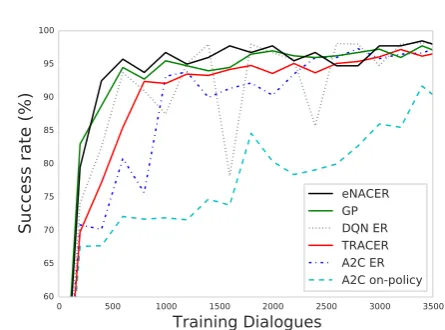
Figure 2: The success rate learning curves of on-policy A2C, A2C with ER, TRACER, DQN with ER, GP and eNACER in user simulation under noise-free condition.
semantic-level (Schatzmann et al., 2006). In this case, the user intent is perfectly captured in the di-alogue belief state without noise.
The total return of each dialogue was set to
1(D)−0.05×T, whereT is the dialogue length and 1(D) is the success indicator for dialogue
D. The maximum dialogue length was set to 20 turns andγwas 0.99. All deep RL models (A2C, TRACER, eNACER and DQN) contained two hid-den layers of size 130 and 50. The Adam opti-miser was used (Kingma and Ba, 2014) with an initial learning rate of 0.001. During training, an
-greedy policy was used, which was initially set to 0.3 and annealed to 0.0 over 3500 training dia-logues. For GP, a linear kernel was used.
The ER pool P size was 1000, and the mini-batch size was 64. Once an initial 192 samples had been collected, the model was updated after ev-ery 2 dialogues. Note that for DQN, each sample was a state transition(bt, at, rt,bt+1), whereas in
A2C, TRACER and eNACER, each sample com-prised the whole dialogue with all its state tran-sitions. For eNACER, the natural gradient was computed to update the model weights of size ∼
42000. For TRACER,αwas set to 0.02, andξwas 0.01. Since the IS ratio has a high variance and can occasionally be extremely large, it was clipped be-tween [0.8,1.0] to maintain stable training.
Figure 2 shows the success rate learning curves of on-policy A2C, A2C with ER, TRACER, DQN with ER, GP and eNACER. All were tested with 600 dialogues after every 200 training dialogues. As reported in previous studies, the benchmark
GP model learns quickly and is relatively sta-ble. eNACER provides comparable performance. DQN also showed high sample-efficiency but with high instability at some points. This is because an iterative improvement in value space does not guarantee an improvement in policy space. Al-though comparably slower to learn, the differ-ence between on-policy A2C and A2C with ER clearly demonstrates the sample-efficiency of re-using past samples in mini-batches. The enhance-ments incorporated into the TRACER algorithm do make this form of learning competitive al-though it still lags behind eNACER and GPRL. 4.2.1 Learning from Demonstration Data Regardless of the choice of model and learning al-gorithm, training a policy from scratch on-line will always result in a poor user experience until suffi-cient interactions have been experienced to allow acceptable behaviours to be learned.
As discussed in §3.2, an off-line corpus of demonstration data can potentially mitigate this problem. To test this, a corpus of 720 real user spoken dialogues in the Cambridge restaurant do-main was utilised. The corpus was split in a 4:1:1 ratio for training, validation and testing. It con-tains interactions between real users recruited via the Amazon Mechanical Turk service and a well-behaved SDS as described in Su et al. (2016b).
For A2C with ER and TRACER, the three ways of exploiting demonstration data in §3.2 were ex-plored. The exploration parameterwas also set to 0.3 and annealed to 0.0 over 2000 training di-alogues. Since TRACER has similar patterns to A2C with ER, we first explored the impact of demonstration data on the A2C with ER results since it provides more headroom for identifying performance gains.
0 500 1000 1500 2000
Training Dialogues
30 40 50 60 70 80 90 100
Success rate (%)
A2C ER + SL_model+replayA2C ER + SL_model A2C ER + SL_replay A2C ER from scratch SL model(a) Learning for A2C ER with demonstration data.
0 500 1000 1500 2000
Training Dialogues
30 40 50 60 70 80 90 100
Success rate (%)
eNACER from scratchTRACER SL_model+replay TRACER from scratch eNACER SL_model SL model [image:8.595.82.519.72.232.2](b) Learning for TRACER and eNACER with demonstration data.
Figure 3: Utilising demonstration data for improving RL learning speed.
(A2C ER+SL model+replay), it achieved the best result. Note thatλ1 andλ2 in Equation 8 were 10
and 0.01 respectively. In each policy update, 64 demonstration data were randomly sampled from the supervised replay poolPsup, which is the same number of RL samples selected from ER for A2C learning. Similar patterns emerge when utilising demonstration data to improve early learning in the TRACER and eNACER algorithms as shown in Figure 3b. However, in this case, eNACER is less able to exploit demonstration data since the training method is different from standard actor-critics. Hence, the supervised loss L cannot be directly incorporated into the RL objectiveJ as in Equation 8. One could optimise the model using
L separately after every RL update. However, in our experiments, this did not yield improvement. Hence, only eNACER learning from a pre-trained SL model is reported here. Compared to eNACER learning from scratch, eNACER from SL model started with good performance but learned more slowly. Again, this may be because the optimised SL pre-trained parameters distributed very differ-ently from the optimal eNACER parameters and led to sub-optimality. Overall, these results sug-gest that the proposed SL+RL framework to ex-ploit demonstration data is effective in mitigat-ing the cold start problem and TRACER provides the best solution in terms of avoiding poor initial performance, rapid learning and competitive fully trained performance.
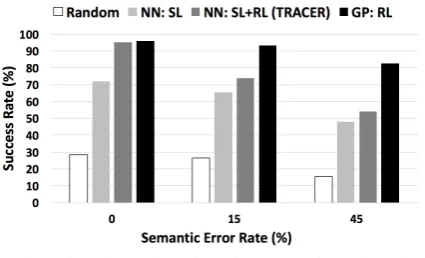
In addition to the noise-free performance, we also investigated the impact of noise on the TRACER algorithm. Figure 4 shows the results af-ter training on2000dialogues via interaction with
Figure 4: The success rate of TRACER for a random policy, policy trained with corpus data (NN:SL) and further improved via RL (NN:SL+RL) respectively in user simulation un-der various semantic error rates.
[image:8.595.312.525.295.424.2]5 Conclusion
This paper has presented two compatible ap-proaches to tackling the problem of slow learn-ing and poor initial performance in deep reinforce-ment learning algorithms. Firstly, trust region actor-critic with experience replay (TRACER) and episodic natural actor-critic with experience re-play (eNACER) were presented, these have been shown to be more sample-efficient than other deep RL models and broadly competitive with GPRL. Secondly, it has been shown that demonstration data can be utilised to mitigate poor performance in the early stages of learning. To this end, two methods for using off-line corpus data were pre-sented: simple pre-training using SL, and using the corpus data in a replay buffer. These were particularly effective when used with TRACER which provided the best overall performance.
Experimental results were also presented for mismatched environments, again TRACER demonstrated the ability to avoid poor initial performance when trained only on the demon-stration corpus, yet still improve substantially with subsequent reinforcement learning. It was noted, however, that performance still falls off rather rapidly in noise compared to GPRL as the uncertainty estimates are not handled well by neural networks architectures.
Finally, it should be emphasised that whilst this paper has focused on the early stages of learning a new domain where GPRL provides a benchmark and is hard to beat, the potential of deep RL is its readily scalability to exploit on-line learning with large user populations as the model size is not re-lated with experience replay buffer.
Acknowledgments
Pei-Hao Su is supported by Cambridge Trust and the Ministry of Education, Taiwan. Paweł Budzianowski is supported by EPSRC Council and Toshiba Research Europe Ltd, Cambridge Re-search Laboratory. The authors would like to thank the other members of the Cambridge Dia-logue Systems Group for their valuable comments.
References
Shun-Ichi Amari. 1998. Natural gradient works ef-ficiently in learning. InNeural computation. MIT Press, volume 10, pages 251–276.
Kavosh Asadi and Jason D Williams. 2016. Sample-efficient deep reinforcement learning for dialog con-trol. InarXiv preprint arXiv:1612.06000.
Richard Bellman. 1954. The theory of dynamic pro-gramming. Technical report, DTIC Document.
Antoine Bordes, Y-Lan Boureau, and Jason Weston. 2017. Learning end-to-end goal-oriented dialog. In Proc of ICLR.
Paweł Budzianowski, Stefan Ultes, Pei-Hao Su, Nikola Mrkˇsi´c, Tsung-Hsien Wen, Inigo Casanueva, Lina M. Rojas Barahona, and Milica Gaˇsi´c. 2017. Sub-domain modelling for dialogue management with hi-erarchical reinforcement learning. InProc of SIG-DIAL.
Lu Chen, Pei-Hao Su, and Milica Gaˇsic. 2015. Hyper-parameter optimisation of gaussian process rein-forcement learning for statistical dialogue manage-ment. InProc of SigDial.
Yun-Nung Chen, Dilek Hakkani-T¨ur, Gokhan Tur, Jianfeng Gao, and Li Deng. 2016. End-to-end mem-ory networks with knowledge carryover for multi-turn spoken language understanding. InProc of
IN-TERSPEECH.
Nils Dahlb¨ack, Arne J¨onsson, and Lars Ahrenberg. 1993. Wizard of oz studies: why and how. InProc of Intelligent user interfaces.
Lucie Daubigney, Matthieu Geist, Senthilkumar Chan-dramohan, and Olivier Pietquin. 2014. A compre-hensive reinforcement learning framework for dia-logue management optimisation. volume 6.
Layla El Asri, Romain Laroche, and Olivier Pietquin. 2014. Task completion transfer learning for reward inference. InProc of MLIS.
Yaakov Engel. 2005. Algorithms and representations for reinforcement learning. PhD Thesis.
Mehdi Fatemi, Layla El Asri, Hannes Schulz, Jing He, and Kaheer Suleman. 2016. Policy networks with two-stage training for dialogue systems. InProc of SigDial.
Milica Gaˇsi´c, Catherine Breslin, Matt Henderson, Dongho Kim, Martin Szummer, Blaise Thomson, Pirros Tsiakoulis, and Steve Young. 2013. Pomdp-based dialogue manager adaptation to extended do-mains. InSigdial.
Milica Gaˇsi´c, Filip Jurcicek, Blaise. Thomson, Kai Yu, and Steve Young. 2011. On-line policy optimisation of spoken dialogue systems via live interaction with human subjects. InIEEE ASRU.
James Henderson, Oliver Lemon, and Kallirroi Georgila. 2008. Hybrid reinforcement/supervised learning of dialogue policies from fixed data sets. In Computational Linguistics. MIT Press, volume 34, pages 487–511.
M. Henderson, B. Thomson, and S. J. Young. 2014. Word-based Dialog State Tracking with Recurrent Neural Networks. InProc of SIGdial.
Todd Hester, Matej Vecerik, Olivier Pietquin, Marc Lanctot andTom Schaul, Bilal Piot, Andrew Sendonaris, Gabriel Dulac-Arnold, Ian Osband, John Agapiou, Joel Z. Leibo, and Audrunas Gruslys. 2017. Learning from demonstrations for real world reinforcement learning. InarXiv:1704.03732. Zhiting Hu, Zichao Yang, Xiaodan Liang, Ruslan
Salakhutdinov, and Eric P Xing. 2017. Controllable text generation.Proc of ICML.
Filip Jurˇc´ıˇcek, Blaise Thomson, and Steve Young. 2011. Natural actor and belief critic: Reinforcement algorithm for learning parameters of dialogue sys-tems modelled as pomdps. In ACM TSLP. ACM, volume 7, page 6.
John F. Kelley. 1984. An iterative design methodology for user-friendly natural language office information applications.
Diederik Kingma and Jimmy Ba. 2014. Adam:
A method for stochastic optimization. In arXiv preprint arXiv:1412.6980.
Oliver Lemon, Kallirroi Georgila, and James Hender-son. 2006. Evaluating effectiveness and portabil-ity of reinforcement learned dialogue strategies with real users: the talk towninfo evaluation. In SLT. pages 178–181.
Esther Levin and Roberto Pieraccini. 1997. A stochas-tic model of computer-human interaction for learn-ing dialogue strategies. InEurospeech.
Esther Levin, Roberto Pieraccini, and Wieland Eckert. 1998. Using markov decision process for learning dialogue strategies. InICASSP.
Jiwei Li, Will Monroe, Alan Ritter, and Dan Juraf-sky. 2016. Deep reinforcement learning for dialogue generation. InProc of EMNLP.
Lihong Li, He He, and Jason D Williams. 2014. Temporal supervised learning for inferring a dia-log policy from example conversations. InSpoken Language Technology Workshop (SLT), 2014 IEEE. IEEE, pages 312–317.
Long-Ji Lin. 1992. Self-improving reactive agents based on reinforcement learning, planning and teaching. In Machine learning. volume 8, pages 293–321.
James Martens. 2014. New insights and perspectives on the natural gradient method. arXiv preprint arXiv:1412.1193.
Nicolas Meuleau, Leonid Peshkin, Leslie P Kaelbling, and Kee-Eung Kim. 2000. Off-policy policy search. InTechnical report, MIT AI Lab.
Volodymyr Mnih, Koray Kavukcuoglu, David Silver, Andrei A Rusu, Joel Veness, Marc G Bellemare, Alex Graves, Martin Riedmiller, Andreas K Fidje-land, Georg Ostrovski, et al. 2015. Human-level control through deep reinforcement learning. In Na-ture. Nature Publishing Group, volume 518, pages 529–533.
Nikola Mrkˇsi´c, Diarmuid ´O S´eaghdha, Blaise Thom-son, Tsung-Hsien Wen, and Steve Young. 2017. Neural Belief Tracker: Data-driven dialogue state tracking. InProc of ACL.
Julien Perez and Fei Liu. 2016. Dialog state tracking, a machine reading approach using memory network. arXiv preprint arXiv:1606.04052.
Jan Peters and Stefan Schaal. 2006. Policy gradient methods for robotics. InIEEE RSJ.
Doina Precup, Richard S Sutton, and Sanjoy Dasgupta. 2001. Off-policy temporal-difference learning with function approximation. InProc of ICML.
Verena Rieser and Oliver Lemon. 2006. Using logistic regression to initialise reinforcement-learning-based dialogue systems. InSpoken Language Technology Workshop, 2006. IEEE. IEEE, pages 190–193. Verena Rieser and Oliver Lemon. 2009. Natural
lan-guage generation as planning under uncertainty for spoken dialogue systems. InProc of EACL. pages 683–691.
Nicholas Roy, Joelle Pineau, and Sebastian Thrun. 2000. Spoken dialogue management using proba-bilistic reasoning. InProc of SigDial.
Jost Schatzmann, Karl Weilhammer, Matt Stuttle, and Steve Young. 2006. A survey of statistical user simulation techniques for reinforcement-learning of dialogue management strategies. In The knowl-edge engineering review. Cambridge Univ Press, volume 21, pages 97–126.
John Schulman, Sergey Levine, Philipp Moritz, Michael I Jordan, and Pieter Abbeel. 2015. Trust region policy optimization. InProc of ICML. John Schulman, Philipp Moritz, Sergey Levine,
Michael Jordan, and Pieter Abbeel. 2016. High-dimensional continuous control using generalized advantage estimation. InProc of ICLR.
Iulian V Serban, Alessandro Sordoni, Yoshua Bengio, Aaron Courville, and Joelle Pineau. 2015. Hierar-chical neural network generative models for movie dialogues. InarXiv preprint arXiv:1507.04808. Lifeng Shang, Zhengdong Lu, and Hang Li. 2015.
David Silver, Aja Huang, Chris J Maddison, Arthur Guez, Laurent Sifre, George Van Den Driessche, Ju-lian Schrittwieser, Ioannis Antonoglou, Veda Pan-neershelvam, Marc Lanctot, et al. 2016. Mastering the game of go with deep neural networks and tree search. InNature. Nature Publishing Group, volume 529, pages 484–489.
Pei-Hao Su, Milica Gasic, Nikola Mrksic, Lina Rojas-Barahona, Stefan Ultes, David Vandyke, Tsung-Hsien Wen, and Steve Young. 2016a. Continuously learning neural dialogue management. In arXiv preprint arXiv:1606.02689.
Pei-Hao Su, Milica Gaˇsi´c, Nikola Mrkˇsi´c, Lina Rojas-Barahona, Stefan Ultes, David Vandyke, Tsung-Hsien Wen, and Steve Young. 2016b. On-line active reward learning for policy optimisation in spoken di-alogue systems. InProc of ACL.
Pei-Hao Su, David Vandyke, Milica Gaˇsi´c, Dongho Kim, Nikola Mrkˇsi´c, Tsung-Hsien Wen, and Steve Young. 2015a. Learning from real users: Rating di-alogue success with neural networks for reinforce-ment learning in spoken dialogue systems. InProc of Interspeech.
Pei-Hao Su, David Vandyke, Milica Gaˇsi´c, Nikola Mrkˇsi´c, Tsung-Hsien Wen, and Steve Young. 2015b. Reward shaping with recurrent neural networks for speeding up on-line policy learning in spoken dia-logue systems. InProc of SigDial.
Richard S. Sutton and Andrew G. Barto. 1999. Rein-forcement Learning: An Introduction. MIT Press.
Richard S Sutton, David A McAllester, Satinder P Singh, Yishay Mansour, et al. 2000. Policy gradi-ent methods for reinforcemgradi-ent learning with func-tion approximafunc-tion. InProc of NIPS.
Stefan Ultes, Lina M. Rojas Barahona, Pei-Hao Su, David Vandyke, Dongho Kim, Inigo Casanueva, Pawel Budzianowski, Nikola Mrkˇsi´c, Tsung-Hsien Wen, Milica Gaˇsi´c, and Steve Young. 2017. CU-PyDial: A Multi-domain Statistical Dialogue Sys-tem Toolkit. InACL Demo.
Hado Van Hasselt, Arthur Guez, and David Silver. 2016. Deep reinforcement learning with double q-learning. InProc of AAAI.
David Vandyke, Pei-Hao Su, Milica Gaˇsi´c, Nikola Mrkˇsi´c, Tsung-Hsien Wen, and Steve Young. 2015. Multi-domain dialogue success classifiers for policy training. InIEEE ASRU.
Oriol Vinyals and Quoc Le. 2015. A neural conversa-tional model. InarXiv preprint arXiv:1506.05869.
Ziyu Wang, Victor Bapst, Nicolas Heess, Volodymyr Mnih, Remi Munos, Koray Kavukcuoglu, and Nando de Freitas. 2017. Sample efficient actor-critic with experience replay. InProc of ICLR.
Tsung-Hsien Wen, Milica Gaˇsi´c, Nikola Mrkˇsi´c, Lina M. Rojas-Barahona, Pei-Hao Su, Stefan Ultes, David Vandyke, and Steve Young. 2017. A network-based end-to-end trainable task-oriented dialogue system. InProc of EACL.
Tsung-Hsien Wen, Milica Gaˇsi´c, Nikola Mrkˇsi´c, Pei-Hao Su, David Vandyke, and Steve Young. 2015. Semantically conditioned lstm-based natural lan-guage generation for spoken dialogue systems. In EMNLP.
Jason D Williams, Kavosh Asadi, and Geoffrey Zweig. 2017. Hybrid code networks: practical and efficient end-to-end dialog control with supervised and rein-forcement learning. InACL.
Jason D. Williams and Steve Young. 2007. Partially observable Markov decision processes for spoken dialog systems. volume 21, pages 393–422. Ronald J Williams. 1992. Simple statistical
gradient-following algorithms for connectionist reinforce-ment learning. InMachine learning. Springer, vol-ume 8, pages 229–256.
Xuesong Yang, Yun-Nung Chen, Dilek Hakkani-T¨ur, Paul Crook, Xiujun Li, Jianfeng Gao, and Li Deng. 2017. End-to-end joint learning of natural lan-guage understanding and dialogue manager. In IEEE ICASSP. pages 5690–5694.