A Bag of Useful Tricks for Practical Neural Machine Translation:
Embedding Layer Initialization and Large Batch Size
Masato Neishi∗and Jin Sakuma∗and Satoshi Tohda∗and Shonosuke Ishiwatari
The University of Tokyo
{neishi, jsakuma, tohda, ishiwatari}@tkl.iis.u-tokyo.ac.jp
Naoki Yoshinaga and Masashi Toyoda Institute of Industrial Science, the University of Tokyo
{ynaga, toyoda}@iis.u-tokyo.ac.jp
Abstract
In this paper, we describe the team UT-IIS’s system and results for the WAT 2017 translation tasks. We further investigated several tricks including a novel technique for initializing embedding layers using only the parallel corpus, which increased the BLEU score by 1.28, found a practical large batch size of 256, and gained insights regarding hyperparameter settings. Ulti-mately, our system obtained a better result than the state-of-the-art system of WAT 2016. Our code is available onhttps:
//github.com/nem6ishi/wat17.
1 Introduction
The advent of neural networks in machine trans-lation has contributed greatly to the transtrans-lation quality. Since proposed in (Cho et al., 2014;
Sutskever et al.,2014), the sequence-to-sequence (SEQ2SEQ) model has been achieving the state-of-the-art performance when combined with the attention mechanism (Bahdanau et al., 2015). Many studies have focused on modifying the SEQ2SEQnetwork structure, including modifying the encoder (Eriguchi et al.,2016;Gehring et al.,
2017;Li et al.,2017;Chen et al.,2017), or the de-coder (Ishiwatari et al.,2017;Eriguchi et al.,2017;
Aharoni and Goldberg,2017;Wu et al.,2017). While these network structure modifications have been found to improve the translation qual-ity, many systems, including the best system from WAT 2016 (Cromieres et al., 2016), still depend on the vanilla SEQ2SEQ model, the model with the attention mechanism. Denkowski and Neu-big (2017) confirmed the large impact of com-mon techniques such as training algorithms, sub-words (Sennrich et al., 2016) and model
ensem-∗Authors contributed equally.
bles upon this vanillaSEQ2SEQ model. This sug-gests that there may be some unexplored tricks we may apply to the vanilla model to significantly im-prove the translation quality.
This paper describes the system that we have built for the ASPEC (Nakazawa et al., 2016) en-ja translation subtask for WAT 2017 (Nakazawa et al.,2017), which incorporates a novel trick, em-bedding layer initialization. This trick improves upon the vanilla SEQ2SEQ model by initializing the word embedding layers of both the encoder and the decoder with word embeddings that are pretrained on the parallel corpus. Our system in-volves generating multiple models usingSEQ2SEQ with embedding layer initialization, exhaustively searching for a combination of models with the highest ensemble score, and finally, conducting a beam search on the best ensemble. We achieved a BLEU score of 38.93 on the ASPEC en-ja trans-lation task as the team UT-IIS, which outperforms the state-of-the-art system of WAT 2016.
Furthermore, we have provided insight on NMT by detailing experiments on the tricks used in our system. This includes testing embedding layer ini-tialization with multiple word embedding meth-ods (§5.3.1), a thorough investigation of the point where increasing the batch size ceases to be ben-eficial (§5.3.2), finding the optimal learning rate (§ 5.3.3), and investigating the relation between the number of models used in the ensemble and translation performance (§5.3.4). We believe that these findings, particularly regarding embedding layer initialization and practical batch size, can serve as useful tricks for future neural machine translation (NMT) systems.
The structure of this paper is as follows. In§2, we review related work, and in§3, we present an overview of NMT. We describe our system in§4
and show the official evaluation result and further investigations in§5. We conclude our work in§6.
2 Related Work
In this section, we will survey existing techniques used in NMT systems. We first focus on pretrain-ing, for which we have proposed a new method, and then batch size, of which we have confirmed the effect.
2.1 Pretraining
Training deep neural networks with a relatively small amount of training data risks creating a model that performs poorly. One technique used to minimize this drawback is pretraining of the model (Hinton et al., 2006;Bengio et al., 2007), which initializes (part of) the parameters of the model using parameters of another model.
Pretraining has led to promising results in NLP tasks usingSEQ2SEQmodels. In languages with a small amount of supervised data, it has been found that NMT results can be improved by transferring parameters from a high-resource language pair to a low-resource one (Zoph et al.,2016). G¨ulc¸ehre et al. (2015) proposed a method using a combi-nation of the output probabilities of a language model trained on large monolingual corpora and a SEQ2SEQ NMT model, which are both trained separately. Venugopalan et al.(2016) studied dif-ferent types of systems combined with a language model under the video description generation task and also introduced a method to initialize the em-bedding layer and the RNN layer of the decoder of theSEQ2SEQ based model with pretrained pa-rameters of the language model. They addition-ally proposed a method to initialize the embedding layer of the decoder with pretrained GloVe ( Pen-nington et al.,2014) embeddings. Ramachandran et al.(2017) initializes both the encoder and de-coder of the SEQ2SEQ model with attention us-ing language models trained on monolus-ingual, un-labeled corpus of the source and target domains, respectively. This led to a significant improvement over the baseline.
The aforementioned studies, however, demand a large computational cost for pretraining a com-plex language model on large external data. Al-though Ramachandran et al.(2017) has provided a comparison of a system initialized using a lan-guage model trained only on the parallel corpus (in addition to their proposed method) to a base-line system without initialization, the translation performance did not improve but rather degraded with this setting.
Our work investigates the effect of initializing only the embedding layer using embeddings pre-trained at low cost from the parallel corpus. We will later confirm that this initialization leads to a BLEU score increase of 1.28 (§5.3.1).
2.2 Batch Size
Batch size is the number of data points in a mini-batch, which is a representative portion of the training data from which the gradient is calcu-lated at each step in the stochastic gradient descent (SGD) optimizer (or its variants). In general, the batch size chosen for deep neural networks ranges from 32 to 512. It is known that a batch size that is too large leads to performance degradation in deep neural networks (Keskar et al.,2017).
Recent studies in NMT have used values such as 64 (Rush et al.,2015) or 128 (Wu et al.,2016). WhileBritz et al.(2017) conducted a thorough in-vestigation of hyperparameters in NMT, they fixed batch size to 128. The specific effect of batch size on NMT was studied by Morishita et al. (2017), who found that, for batch sizes of 8 to 64, a larger batch size has a positive impact on model perfor-mance.
In this study, we seek to empirically clarify the point where increasing the batch size no longer improves NMT performance. Our work expands upon Morishita et al. (2017) and further investi-gates how NMT performance varies with larger batch sizes, up to 512.
3 The VanillaSEQ2SEQModel
The SEQ2SEQ (or encoder-decoder) model have been achieving the state-of-the-art in machine translation (Kalchbrenner and Blunsom, 2013;
Sutskever et al., 2014; Cho et al., 2014). Bah-danau et al.(2015) further improved this model by proposing the attention mechanism.
This neural machine translation (NMT) ap-proach involves an RNN-based encoder that con-verts the source sentence into vector representa-tions which are then converted into the output sen-tence by an RNN-based decoder.
bidirec-Embedding Layer
Bi-LSTM
!"# !$# % # !&# % # !'(
E
n
co
d
er
Attention
LSTM
D
ec
o
d
er
Dense Layer
Softmax
)"# )$# % # )&# % # )'(
Embedding Layer
[image:3.595.73.290.60.333.2]*"# *$# % # *&# % # *'(
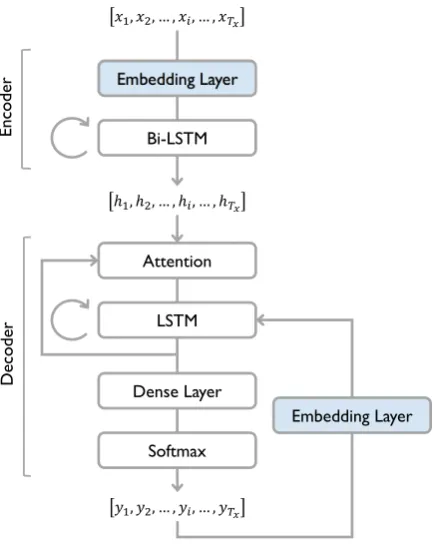
Figure 1: Basic structure of our system.
tional LSTM consists of a forward LSTM and a backward LSTM that move from left to right and right to left respectively to update their hidden states. The hidden states of the last layer are the outputs of the encoder which is then fed into the decoder.
Given the encoder output, the decoder generates an output sequence. Following Sutskever et al.
(2014) andBahdanau et al.(2015), we decided to use a multi-layer LSTM decoder with an attention mechanism. At each step, an attention mechanism computes a weighted average of vectors in the en-coder output, called an attention context vector. A weight of a hidden state vector is computed using both itself and the hidden state of the decoder at that step. In addition to the attention context tor, the decoder also receives an embedding vec-tor of the previous output token in order to retain the information of tokens it has already generated. These two vectors, an attention context vector and an embedding vector of the previous output token, are concatenated and given to the decoder LSTM, which then generates tokens and updates its state.
4 System Description
Our system implemented two tricks on a vanilla SEQ2SEQ model implemented by Google (Britz
et al., 2017)1 on Tensorflow2 (ver. 1.0). The tricks are embedding layer initialization (§ 4.2) and batch size expansion (§4.3).
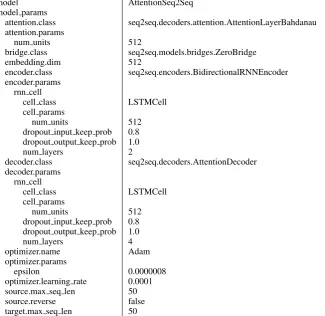
In what follows, we explain our system in de-tail. The basic structure of our system is depicted in Figure1. The configuration and the default pa-rameters used in our experiments are described in
§5.1and in Appendix.
4.1 Preprocessing
As for the preprocessing, we basically followed the description of WAT 2017 Baseline Systems Data preparation.3 We used scripts included in Moses toolkit4(ver. 2.2.1) (Koehn et al.,2007) for English tokenization and truecasing, and KyTea5 (ver. 0.4.2) (Neubig et al.,2011) for Japanese seg-mentations.
After the above basic preprocessing, we applied SentencePiece,6which is an unsupervised text to-kenizer and detoto-kenizer, to the corpus. Senten-cePiece decides token boundaries using raw sen-tences (a white space is treated as a character) based on statistical models like charactern-grams. This alleviates the problem of unknown tokens in a similar manner as using subword units. For this model, we picked unigram which is a default set-ting in the given implementation.
4.2 Embedding Layer Initialization
Because of the nature of the neural network model, each layer in the NMT model can only handle fixed-length inputs and outputs. Since our model is an end-to-end NMT model, both the first en-coder layer and the deen-coder layer which feeds the previous output into the decoder accepts a vocabulary-size-length one-hot vector. In this re-gard, both layers are embedding layers which con-vert a one-hot vector into a word embedding vec-tor.
Usually, all the layers, including embedding layers, are initialized randomly and trained in the exact same way. We attempted pretraining of these embedding layers, initializing them with word em-beddings from an unsupervised neural language model trained on the training datasets in the source
1https://google.github.io/seq2seq/
2https://www.tensorflow.org/
3http://lotus.kuee.kyoto-u.ac.jp/WAT/
WAT2017/baseline/dataPreparationJE.html
4http://www.statmt.org/moses/
5http://www.phontron.com/kytea/
6https://github.com/google/
and target languages. It is expected that these word embeddings improve the translation performance as well as speeding up convergence.
In addition to the original vocabulary, there are three special tokens in our system, “SE-QUENCE START,” “SE“SE-QUENCE END,” and “UNK.” The embeddings for the first two tokens were trained by adding them into the training dataset before the pretraining procedure. On the other hand, the embedding for “UNK” was generated by averaging all the out-of-vocabulary token embeddings.
Our proposed embedding layer initialization is a quick and simple trick, but effective on NMT systems (§5.3.1).
4.3 Using Large Batch Size
Gradient descent (GD) computes a gradient of pa-rameters based on the entire dataset to update the parameters at each step. While this gives the most accurate gradient, it is computationally inefficient, as all data points need to be evaluated.
To overcome this issue, stochastic gradient de-scent (SGD) and its variants computes a gradient using a small portion of the dataset, called a mini-batch. We may consider the gradient computed in SGD as an expectation of the gradient which is in-accurate. However, as SGD is faster than GD, we can execute more steps which leads to better train-ing in the same amount of time.
The accuracy of a gradient at each step depends on batch size, the number of samples in a mini-batch. A larger batch size leads to a more accurate gradient. The impact of large batch size on the translation quality will be investigated in§ 5.3.2, in which we found that large batch size improves the translation significantly up to 256.
4.4 Ensemble
Ensemble of models is a widely used technique that improves the translation quality. After train-ing several models, the decoders’ outputs are com-bined to get the ensemble output. The effective-ness of ensemble was investigated inDenkowski and Neubig(2017).
For our system, we implemented a simple aver-aging ensemble. Let N be the number of mod-els to ensemble, X = {x1, x2,· · ·, xTx} and
Y = {y1, y2,· · · , yTy} be the source and target
sequences respectively, andpn(w|X, Y:j−1)be the probability of wordwof thenth model at stepj, whereY:j−1 denotes the firstj−1tokens in the
sequence Y. Then, the probability of word wis determined by taking the average of all models.
p(w|X, Y:j−1) = N1
N X
n=1
pn(w|X, Y:j−1)
Each model is independently trained in the training phase and the decoders’ outputs are combined in the prediction phase. This sim-ple technique gave us a significant BLEU score boost (§5.3.4).
4.5 Beam Search
Another technique to improve the translation qual-ity is a beam search. The objective of translation system is
ˆ
Y = arg max
Y∈Y p(Y|X)
whereY is the set of all possible translations and X is the input sequence. However, Y is such a huge set that computingp(Y|X)for allY ∈ Y is not realistic. A simple solution to this problem is to decideyjto be
yj = arg max
w∈V p(w|X, Y:j−1).
This algorithm is called a greedy search. A greedy search algorithm is fast but may miss the best out-put sequence if the early portion of the sequence has a low probability.
The beam search algorithm addresses this issue by keeping multiple possible hypotheses, which are incomplete output sequences ( Boulanger-Lewandowski et al.,2013). At each step, the top l hypotheses with the highest scores are kept for the next step. When every hypothesis terminates with an EOS token, the hypothesis with the high-est score is chosen as the final result.
The beam search algorithm favors shorter se-quences on average because a longer sequence tends to have a lower probability,p(Y|X).
To overcome this problem,Wu et al.(2017) pro-posed a length penalty which gives advantages to longer sentences. With a length penalty, the score of a sequence Y given a source sequence X is computed by
score(Y|X) = log(P(Y|X)) lp(Y) lp(Y) = (5 +(5 + 1)|Y|α)α
Train Dev Test en ja en ja en ja # sentences 1,783,817 1790 1812 Ave. # tokens 31.08 33.13 31.06 34.58 30.69 34.03
Table 1: Details of corpus after preprocessing.
5 Evaluation
In this section, we report the default configuration of our system (§5.1) and the official evaluation re-sult of our system for ASPEC English to Japanese translation subtask (§5.2). Furthermore, we report several other experiments that aim to show the ef-fects of our tricks (§5.3).
5.1 Setup
The following settings are used as our default con-figuration in the experiments and the final sys-tem, unless otherwise noted. We use a two-layer bidirectional LSTM with dropout on input with p = 0.8 for the encoder, and a four-layer LSTM with the same dropout settings for the decoder. The number of units in hidden layers and the em-bedding dimension are set to 512. Adam (Kingma and Ba, 2015) is used for the optimizer, with a learning rate of 0.0001 and batch size is set to 256. The vocabulary size after SentencePiece pre-processing is 16,000. The number of sentences and the average number of tokens after preprocess-ing in a spreprocess-ingle sentence are shown in Table1.
As the default embedding method for embed-ding layer initializaion, we use Continuous Bag of Words (CBOW) (Mikolov et al.,2013) with win-dow size of 5. We use word2vec (ver. 1.0)7 with default parameters, except for the embedding di-mension which was changed to 512. We train the word embeddings using only the preprocessed training dataset, in which both languages are con-catenated to share the source and target vocabu-lary. All other layers were initialized randomly using uniform distribution.
We train the model for 200,000 steps, and at ev-ery 2000 steps during training, the current model is saved as a “checkpoint.” When the training is done, all the checkpoints are evaluated using a greedy search algorithm on the development cor-pus. Only the checkpoint with the highest BLEU score is used for all of the following experiments and our final translation system. If the checkpoint with the highest BLEU score is at or near 200,000
7https://github.com/svn2github/
word2vec
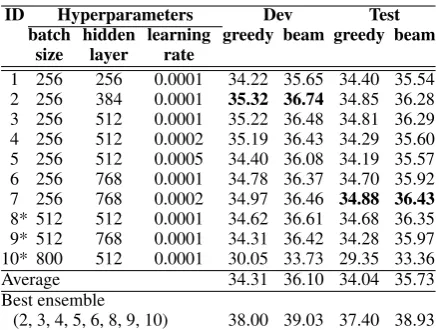
ID Hyperparameters Dev Test batch hidden learning greedy beam greedy beam
size layer rate
1 256 256 0.0001 34.22 35.65 34.40 35.54 2 256 384 0.0001 35.32 36.74 34.85 36.28 3 256 512 0.0001 35.22 36.48 34.81 36.29 4 256 512 0.0002 35.19 36.43 34.29 35.60 5 256 512 0.0005 34.40 36.08 34.19 35.57 6 256 768 0.0001 34.78 36.37 34.70 35.92 7 256 768 0.0002 34.97 36.46 34.88 36.43 8* 512 512 0.0001 34.62 36.61 34.68 36.35 9* 512 768 0.0001 34.31 36.42 34.28 35.97 10* 800 512 0.0001 30.05 33.73 29.35 33.36
Average 34.31 36.10 34.04 35.73
Best ensemble
[image:5.595.74.290.62.105.2](2, 3, 4, 5, 6, 8, 9, 10) 38.00 39.03 37.40 38.93 Table 2: List of models trained for use in ensemble (* 200k steps unattained due to time constraints).
steps (we define this as larger than 190,000 steps), we regard this model as not having converged, and will be identified as such in the results.
For all evaluations, KyTea segmentation was used to compute the BLEU score. For a prediction with the beam search algorithm, we used beam width of 128 except in our final system, which we used 256. For length penalty, we chooseα = 1 after parameter turning. Detailed settings are pro-vided in the Appendix.
5.2 Official Evaluation Result
This section briefly explains how we built our fi-nal system and its result for the ASPEC English to Japanese translation subtask. We trained ten mod-els with different hyperparameters which are listed in Table 2. For these models, we evaluated ev-ery possible ensemble combination using greedy search on the development corpus.8 We chose the ensemble combination with the highest BLEU score to make prediction on the test corpus using a beam search algorithm. Consequently, we chose an ensemble of eight models, which achieved a BLEU score of 38.93 and an official human eval-uation score of 68.000.
5.3 Further Investigations
In addition to the official evaluation, we conducted several other experiments. This section reports re-sults and analyses of these experiments. We first confirm the impact of the embedding layer initial-ization, and then compare several word embed-ding methods (§ 5.3.1). Next, we investigate the
8Due to GPU memory limitations, three combinations are
0k 25k 50k 75k 100k 125k 150k 175k 200k
The number of steps
0 5
10 15 20 25 30 35 40 45
BLEU score
35.50
(138k) 34.20 (186k)
33.71 (160k)
[image:6.595.307.526.62.226.2]Initialized by CBOW Initialized by Gaussian Initialized by Uniform
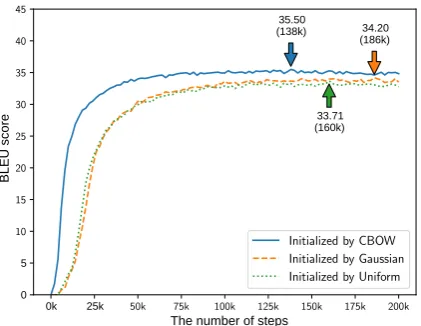
Figure 2: Training curve for models with different initialization methods. Arrows indicate the steps that achieved the best BLEU score on develop-ment data.
effect of batch size (§ 5.3.2). We then conduct experiments to discover the optimal learning rate when our initialization trick is employed (§5.3.3). Lastly, we examine the relation between the num-ber of models used in the ensemble and translation performance (§5.3.4).
5.3.1 Impact of Embedding Layer Initialization
We first investigated the impact of our embedding layer initialization. The embeddings for the ini-tialization are trained only on the training dataset of ASPEC using word2vec with CBOW and win-dow size of 5. The question here is whether or not initialization with those word embeddings which were trained without any external data, by a task-independent, unsupervised method, improves the NMT model. In these experiments, the greedy search algorithm was used in order to obtain the training curve, as there are too many checkpoints to be evaluated by a beam search.
Figure2shows the training curve of three mod-els, one initialized using CBOW, and the rest ini-tialized randomly, with one using a Gaussian dis-tribution, and the other a uniform distribution. The best score of the model with the CBOW initializa-tion is 35.50 at step 138,000, and the best score of the model with random initialization is 34.20 with the Gaussian distribution at step 186,000. We observed that embedding layer initialization im-proves both the translation performance and the convergence time, increasing the former and de-creasing the latter. Along with the following batch
Initialization Window Greedy Beam ∆
Random (Gaussian) - 34.20 35.57 -Random (Uniform) - 33.71 35.02 −0.55
2 34.97 36.38 +0.81 CBOW 5 35.50 36.85 +1.28 10 35.25 36.57 +1.00 2 34.17 35.90 +0.33 Skip-gram 5 34.44 36.04 +0.47 10 34.38 36.00 +0.43 2 34.04 35.16 −0.41 SI-Skip-gram 5 34.44 35.91 +0.34 10 34.33 35.69 +0.12 2 34.50 36.01 +0.44
GloVe 5 34.58 35.86 +0.29
[image:6.595.76.287.64.227.2]10 33.98 35.39 −0.18 15 34.35 36.00 +0.43 Table 3: Translation performance by embedding methods and window size. Evaluation is done on development dataset.
size experiment in § 5.3.2, the same experiment was done (using the greedy search algorithm) with batch sizes of 32, 64, 128, and 512, and this effect was observed across all batch sizes.
The results indicate that embedding layer ini-tialization works in our NMT model, even though the embeddings are generated by CBOW, which is a totally task-irrelevant method.
Since we confirmed the effectiveness of our embedding layer initialization, we then investi-gate the effect of different embedding methods on translation performance. There are various meth-ods other than CBOW to create word embeddings.
Mikolov et al.(2013) proposed Skip-gram. Pen-nington et al. (2014) proposed another method called GloVe. Bojanowski et al.(2017) proposed Subword Information Skip-gram (SI-Skip-gram) that utilizes morphological information by includ-ing charactern-grams of words in the model.
These methods train word embeddings using windows that obtain co-occurrences of neighbor-ing words. It is known that a smaller window size leads to more syntactic embeddings and a larger one leads to more semantic embeddings (Lin and Wu,2009;Levy and Goldberg,2014).
Skip-32 64 128 256 512
Batch size
0 5
10 15 20 25 30 35 40 45
BLEU score
28.69 (84k)
31.55 (88k)
34.82 (120k)
36.85 (138k)
36.78 (160k)
25.33 (96k)
29.24 (116k)
32.34 (120k)
35.57 (186k)
35.58 (180k)
[image:7.595.77.288.63.228.2]Initialized by CBOW Initialized by Gaussian
Figure 3: Translation performance by initializa-tion and batch size. The values in the parentheses indicate the step that resulted in the best BLEU score on development data.
gram, we used word2vec (ver. 1.0). For GloVe and SI-Skip-gram, we used GloVe (ver 1.2)9and fast-text (ver. 1.0),10respectively.
The results are shown in Table 3. Most of the embedding methods outperformed random initial-ization by Gaussian distribution. This confirms the effectiveness of embedding layer initialization. Among those embedding methods, CBOW yields the best BLEU score of 35.50 for greedy search and 36.85 for beam search. For the window sizes, we found that each method has a different window size that yields the best result. Given this result, we decided to use CBOW with window size of 5 as our default setting.
5.3.2 Impact of Large Batch Size
We used the mini-batch method to train the net-work. WhileMorishita et al. (2017) investigated the effect of large batch size up to 64, it is unclear how an even larger batch size will impact transla-tion performance. To evaluate this, we conducted experiments with different batch sizes.
Figure 3confirms our idea and shows that, up until 256,11 a larger batch size results in a better BLEU score, indicating that batch size has a sig-nificant impact on translation performance. The
9https://github.com/stanfordnlp/GloVe
10https://github.com/facebookresearch/
fastText
11Initialized randomly by uniform distribution, the
mod-els achieved BLEU scores of 35.02 and 36.15 for batch sizes 256 and 512 respectively, and are seemingly still improving. However, we think this is within fluctuation range caused by random initialization.
0k 25k 50k 75k 100k 125k 150k 175k 200k
The number of steps
0 5
10 15 20 25 30 35 40 45
BLEU score
9.02 (20k)
33.99 (42k)
35.50 (138k)
29.92 (198k)
[image:7.595.308.523.64.228.2]0.01 0.001 0.0001 0.00001
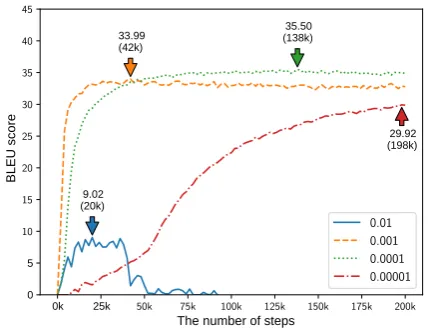
Figure 4: Training curve for different learning rates. Arrows indicate the steps that achieved the best BLEU score on development data.
significance of the results are surprising, given the trick’s simplicity.
When using this trick in NMT systems, it is im-portant to recognize the tradeoff between trans-lation performance and the memory and time re-quired. In terms of the required memory, we were able to conduct the experiments up to a batch size of 256 on a server with 12GB of GPU memory, but a server with 24GB of GPU memory was re-quired for experiments with a batch size of 512. Also, when we compared the time required to reach 200,000 steps when trained with batch sizes of 128 and 256, which were both trained on the same server, the larger batch size took 1.57 times as much time. The steps needed to reach the max-imum BLEU score on development set became larger as the batch size increases, which indicates slower convergence with the larger batch size.
With the above factors taken into consideration, a batch size of 256 is a practical choice, and we can also expect an additive effect in translation quality by the use of CBOW initialization.
5.3.3 Impact of Learning Rate
An improperly large learning rate changes the val-ues of each layers in a neural network drastically. Since we hypothesize that the pretrained embed-dings have well-adjusted values, a drastic change in these values would spoil the effect of embed-ding layer initialization. To confirm this hypoth-esis, we compared four different learning rates of [0.01, 0.001, 0.0001, 0.00001] with the same con-figuration including initialization method.
1 2 3 4 5 6 7 8 9
The number of models
30
31 32 33 34 35 36 37 38
[image:8.595.75.287.65.229.2]BLEU score
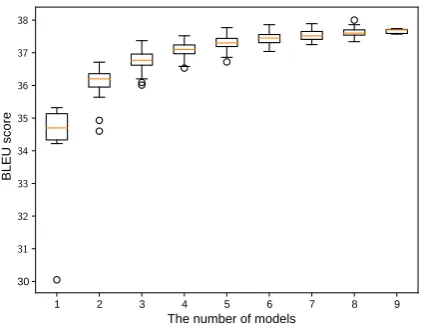
Figure 5: Performance of ensemble. As a beam search is costly, a greedy search was used.
different models. A learning rate of 0.01 per-formed abysmally, not only in terms of the worst best score but also in terms of the unstable training curve. The neural network could not be success-fully trained at this learning rate. With the learn-ing rate less than or equal to 0.001, the trainlearn-ing curve becomes stable and the best score marks a reasonable value. A learning rate of 0.001 resulted in the best score of 33.99 at step 42,000, which is good and fast enough. As expected, a learning rate of 0.0001 raised the best score to 35.50 at step 138,000, which is 1.51 higher than the score with a learning rate of 0.001, but at a much later step. The best score for learning rate of 0.00001 was 29.92 at step 198,000, but the model did not converge.
It is difficult to confirm our hypothesis that smaller learning rate is always better for keeping the well-adjusted values by the initialization, with the above results. However, considering the fact that the time spent on training is limited, we be-lieve 0.0001 to be the most practical learning rate among them, because it marked a score almost 1.0 higher than the second best one.
5.3.4 Ensemble Strategy
It is known that ensemble technique improves translation (Denkowski and Neubig, 2017). The intuition is that the larger the number of models is, the better the translation will be. To test this hy-pothesis, we exhaustively compared the results of ensembles with a different number of models.
The ten models from Table2were used for this experiment. We evaluated ensembles of all possi-ble combinations. As mentioned in the footnote in
§ 5.2, three combinations are omitted because of
the memory limitation, which yielded 1,020 com-binations in total.
The result is reported in Figure 5. We can see the positive correlation between number of models used in the ensemble and the performance. How-ever, as the number of models gets bigger, the ef-fect of adding models gets smaller; the difference between a single model and two model ensemble is significant, but the difference between an eight model ensemble and a nine model ensemble is not so evident.
6 Conclusion
We have described the translation system, experi-ments, and the results of the team UT-IIS. As for the result of our system on the ASPEC En-Ja task, we were able to achieve a BLEU score of 38.93, which is higher than the score for the state-of-the-art system of WAT 2016. This reflects the effec-tiveness of our word embedding layer initializa-tion technique, when combined with model en-semble and a beam search on the vanillaSEQ2SEQ model. Our findings are as follows:
• Embedding layer initialization technique us-ing only the parallel corpus improves transla-tion quality (§5.3.1).
• Embedding layer initialization trick with CBOW works the best (§5.3.1).
• Benefits of a larger batch size reached satu-ration at 256, and we believe this to be the practical setting (§5.3.2).
• A learning rate of 0.0001 is both good and fast enough to be practical with the initializa-tion trick (§5.3.3).
• Ensemble of many models improves transla-tion quality significantly (§5.3.4).
We believe that the embedding layer initializa-tion technique, as well as the insights gained from our experiments, will contribute to the improve-ment of NMT when used in combination with other novel techniques.
We have published our code on https://
github.com/nem6ishi/wat17.
model AttentionSeq2Seq model params
attention.class seq2seq.decoders.attention.AttentionLayerBahdanau attention.params
num units 512
bridge.class seq2seq.models.bridges.ZeroBridge
embedding.dim 512
encoder.class seq2seq.encoders.BidirectionalRNNEncoder encoder.params
rnn cell
cell class LSTMCell
cell params
num units 512
dropout input keep prob 0.8 dropout output keep prob 1.0
num layers 2
decoder.class seq2seq.decoders.AttentionDecoder decoder.params
rnn cell
cell class LSTMCell
cell params
num units 512
dropout input keep prob 0.8 dropout output keep prob 1.0
num layers 4
optimizer.name Adam
optimizer.params
epsilon 0.0000008
optimizer.learning rate 0.0001 source.max seq len 50
source.reverse false
[image:9.595.142.468.65.381.2]target.max seq len 50
Table 4: Configuration of seq2seq model.
A Hyperparameters and configuration Table4lists the default hyperparameters and con-figuration for our system, which is built based on Google’s implementation of the SEQ2SEQ model (Britz et al.,2017).
References
Roee Aharoni and Yoav Goldberg. 2017. Towards string-to-tree neural machine translation. In Pro-ceedings of the 55th Annual Meeting of the Asso-ciation for Computational Linguistics (ACL), Short Papers, pages 132–140.
Dzmitry Bahdanau, Kyunghyun Cho, and Yoshua Ben-gio. 2015. Neural machine translation by jointly learning to align and translate. InProceedings of the Third International Conference on Learning Repre-sentations (ICLR).
Yoshua Bengio, Pascal Lamblin, Dan Popovici, and Hugo Larochelle. 2007. Greedy layer-wise training of deep networks. InAdvances in Neural Informa-tion Processing Systems (NIPS) 19, pages 153–160. Piotr Bojanowski, Edouard Grave, Armand Joulin, and Tomas Mikolov. 2017. Enriching word vectors with subword information. Transactions of the Associa-tion of ComputaAssocia-tional Linguistics, 5:135–146.
Nicolas Boulanger-Lewandowski, Yoshua Bengio, and Pascal Vincent. 2013. Audio chord recognition with recurrent neural networks. In Proceedings of the 14th International Society for Music Information Retrieval Conference (ISMIR), pages 335–340. Denny Britz, Anna Goldie, Minh-Thang Luong, and
Quoc V. Le. 2017. Massive exploration of neural machine translation architectures. arXiv preprint arXiv: 1703.03906.
Huadong Chen, Shujian Huang, David Chiang, and Ji-ajun Chen. 2017. Improved neural machine trans-lation with a syntax-aware encoder and decoder. In
Proceedings of the 55th Annual Meeting of the Asso-ciation for Computational Linguistics (ACL), pages 1936–1945.
Kyunghyun Cho, Bart van Merri¨enboer, Caglar Gul-cehre, Dzmitry Bahdanau, Fethi Bougares, Holger Schwenk, and Yoshua Bengio. 2014. Learning phrase representations using RNN encoder–decoder for statistical machine translation. InProceedings of the 2014 Conference on Empirical Methods in Nat-ural Language Processing (EMNLP), pages 1724– 1734.
Michael Denkowski and Graham Neubig. 2017.
Stronger baselines for trustable results in neural machine translation. In Proceedings of the First Workshop on Neural Machine Translation (WNMT), pages 18–27.
Akiko Eriguchi, Kazuma Hashimoto, and Yoshimasa Tsuruoka. 2016. Tree-to-sequence attentional neu-ral machine translation. InProceedings of the 54th Annual Meeting of the Association for Computa-tional Linguistics (ACL), pages 823–833.
Akiko Eriguchi, Yoshimasa Tsuruoka, and Kyunghyun Cho. 2017. Learning to parse and translate improves neural machine translation. InProceedings of the 55th Annual Meeting of the Association for Compu-tational Linguistics (ACL), Short Papers, pages 72– 78.
Jonas Gehring, Michael Auli, David Grangier, and Yann Dauphin. 2017. A convolutional encoder model for neural machine translation. In Proceed-ings of the 55th Annual Meeting of the Association for Computational Linguistics (ACL), pages 123– 135.
C¸aglar G¨ulc¸ehre, Orhan Firat, Kelvin Xu, Kyunghyun Cho, Lo¨ıc Barrault, Huei-Chi Lin, Fethi Bougares, Holger Schwenk, and Yoshua Bengio. 2015. On us-ing monolus-ingual corpora in neural machine transla-tion.arXiv preprint arXiv: 1503.03535.
Geoffrey E. Hinton, Simon Osindero, and Yee-Whye Teh. 2006. A fast learning algorithm for deep belief nets. Neural Computation, 18(7):1527–1554.
Sepp Hochreiter and J¨urgen Schmidhuber. 1997.
Long short-term memory. Neural Computation, 9(8):1735–1780.
Shonosuke Ishiwatari, Jingtao Yao, Shujie Liu, Mu Li, Ming Zhou, Naoki Yoshinaga, Masaru Kitsuregawa, and Weijia Jia. 2017. Chunk-based decoder for neu-ral machine translation. InProceedings of the 55th Annual Meeting of the Association for Computa-tional Linguistics (ACL), pages 1901–1912.
Nal Kalchbrenner and Phil Blunsom. 2013. Recurrent continuous translation models. In Proceedings of the 2013 Conference on Empirical Methods in Nat-ural Language Processing (EMNLP), pages 1700– 1709.
Nitish Shirish Keskar, Dheevatsa Mudigere, Jorge No-cedal, Mikhail Smelyanskiy, and Ping Tak Peter Tang. 2017. On large-batch training for deep learn-ing: Generalization gap and sharp minima. In Pro-ceedings of 5th International Conference on Learn-ing Representations (ICLR).
Diederik P. Kingma and Jimmy Ba. 2015. Adam: A method for stochastic optimization. InProceedings of the third International Conference on Learning Representations (ICLR).
Philipp Koehn, Hieu Hoang, Alexandra Birch, Chris Callison-Burch, Marcello Federico, Nicola Bertoldi, Brooke Cowan, Wade Shen, Christine Moran, Richard Zens, Chris Dyer, Ondrej Bojar, Alexandra Constantin, and Evan Herbst. 2007. Moses: Open source toolkit for statistical machine translation. In
Proceedings of the 45th Annual Meeting of the Asso-ciation for Computational Linguistics (ACL), Demo and Poster Sessions, pages 177–180.
Omer Levy and Yoav Goldberg. 2014. Dependency-based word embeddings. InProceedings of the 52nd Annual Meeting of the Association for Computa-tional Linguistics (ACL), Short Papers, pages 302– 308.
Junhui Li, Deyi Xiong, Zhaopeng Tu, Muhua Zhu, Min Zhang, and Guodong Zhou. 2017. Modeling source syntax for neural machine translation. In Proceed-ings of the 55th Annual Meeting of the Association for Computational Linguistics (ACL), pages 688– 697.
Dekang Lin and Xiaoyun Wu. 2009. Phrase cluster-ing for discriminative learncluster-ing. In Proceedings of the Joint Conference of the 47th Annual Meeting of the ACL and the 4th International Joint Conference on Natural Language Processing (ACL-IJCNLP), pages 1030–1038.
Tomas Mikolov, Kai Chen, Greg Corrado, and Jeffrey Dean. 2013. Efficient estimation of word represen-tations in vector space. InProceedings of the First International Conference on Learning Representa-tions (ICLR).
Makoto Morishita, Yusuke Oda, Graham Neubig, Koichiro Yoshino, Katsuhito Sudoh, and Satoshi Nakamura. 2017. An empirical study of mini-batch creation strategies for neural machine translation. In
Proceedings of the First Workshop on Neural Ma-chine Translation, pages 61–68.
Toshiaki Nakazawa, Shohei Higashiyama, Chenchen Ding, Hideya Mino, Isao Goto, Graham Neubig, Hideto Kazawa, Yusuke Oda, Jun Harashima, and Sadao Kurohashi. 2017. Overview of the 4th Work-shop on Asian Translation. InProceedings of the 4th Workshop on Asian Translation (WAT2017), Taipei, Taiwan.
Toshiaki Nakazawa, Manabu Yaguchi, Kiyotaka Uchi-moto, Masao Utiyama, Eiichiro Sumita, Sadao Kurohashi, and Hitoshi Isahara. 2016. ASPEC: Asian scientific paper excerpt corpus. In Pro-ceedings of the Ninth International Conference on Language Resources and Evaluation (LREC 2016), pages 2204–2208.
Jeffrey Pennington, Richard Socher, and Christo-pher D. Manning. 2014. Glove: Global vectors for word representation. In Proceedings of the 2014 Conference on Empirical Methods in Natural Lan-guage Processing (EMNLP), pages 1532–1543. Prajit Ramachandran, Peter Liu, and Quoc Le. 2017.
Unsupervised pretraining for sequence to sequence learning. InProceedings of the 2017 Conference on Empirical Methods in Natural Language Process-ing, pages 383–391.
Alexander M. Rush, Sumit Chopra, and Jason Weston. 2015. A neural attention model for abstractive sen-tence summarization. In Proceedings of the 2015 Conference on Empirical Methods in Natural Lan-guage Processing (EMNLP), pages 379–389. Rico Sennrich, Barry Haddow, and Alexandra Birch.
2016.Neural machine translation of rare words with subword units. InProceedings of the 54th Annual Meeting of the Association for Computational Lin-guistics (ACL), pages 1715–1725.
Ilya Sutskever, Oriol Vinyals, and Quoc V. Le. 2014.
Sequence to sequence learning with neural net-works. InAdvances in Neural Information Process-ing Systems (NIPS) 27, pages 3104–3112.
Subhashini Venugopalan, Lisa Anne Hendricks, Ray-mond Mooney, and Kate Saenko. 2016. Improv-ing LSTM-based video description with lImprov-inguistic knowledge mined from text. InProceedings of the 2016 Conference on Empirical Methods in Natural Language Processing (EMNLP), pages 1961–1966. Shuangzhi Wu, Dongdong Zhang, Nan Yang, Mu Li,
and Ming Zhou. 2017. Sequence-to-dependency neural machine translation. InProceedings of the 55th Annual Meeting of the Association for Compu-tational Linguistics (ACL), pages 698–707.
Yonghui Wu, Mike Schuster, Zhifeng Chen, Quoc V. Le, Mohammad Norouzi, Wolfgang Macherey, Maxim Krikun, Yuan Cao, Qin Gao, Klaus Macherey, Jeff Klingner, Apurva Shah, Melvin Johnson, Xiaobing Liu, Lukasz Kaiser, Stephan Gouws, Yoshikiyo Kato, Taku Kudo, Hideto Kazawa, Keith Stevens, George Kurian, Nishant Patil, Wei Wang, Cliff Young, Jason Smith, Jason Riesa, Alex Rudnick, Oriol Vinyals, Greg Corrado, Macduff Hughes, and Jeffrey Dean. 2016. Google’s neural machine translation system: Bridging the gap between human and machine translation. arXiv preprint arXiv: 1609.08144.