Quantitative Comparative Syntax on the Cantonese-Mandarin
Parallel Dependency Treebank
Tak-sum Wong
City University of Hong Kong
[email protected]Kim Gerdes
Sorbonne Nouvelle, LPP (CNRS)
Paris, France
Herman Leung
City University of Hong Kong
[email protected]John Lee
City University of Hong Kong
[email protected]Abstract
This paper describes a new Cantonese-Man-darin parallel dependency treebank. We dis-cuss the extent to which the treebank allows for comparative measures with the goal of quantifying structural differences between the two languages. After presenting syntactic dif-ferences between the two languages, we com-puted various frequency measures on the tree-bank. We present the results and discuss whether they reflect differences in text genre, differences in annotation scheme design, or ac-tual structural differences. Finally, we com-pare the structural differences to previous ac-counts of the observed construction.
1
Introduction
Cantonese is part of the Yue dialect group which is spoken by more than 55 million people mostly in Canton, Hong Kong, Macao, the rest of the Pearl River Delta, and overseas Chinese commu-nities. It is the “most widely known and influen-tial variety of Chinese other than Mandarin” (Matthews & Yip 1994), and the early contact of Cantonese speakers with European explorers has given rise to the Western “Cantonese” pronunci-ations of some Chinese cities (e.g. Canton). Can-tonese is not only used orally or in informal con-versation, but also in the legislative councils in Hong Kong and Macao.
The special status of Hong Kong and Macao and the economic and educational importance of the region has made Cantonese a relatively well-studied and well-resourced language. A number of Cantonese corpora have already been tagged with part-of-speech (POS), including the Early Cantonese Tagged Database (Yiu 2012), the Hong Kong Cantonese Child Language Corpus (CANCORP, Lee et al. 1996), the Hong Kong
Bilingual Child Language Corpus (Yip and Matthews 2007), the Hong Kong Cantonese Cor-pus (HKCanCor, Luke & Wong 2015), the Can-tonese Chinese Corpus of Oral Narratives (CANON, Law et al. 2012), and the Hong Kong Mid-1990s Newspaper Column Corpus (Li et al. 2016). However, to our best knowledge, no syn-tactic treebank has been published prior to our work, neither phrase structure nor dependency based.
This paper presents the first parallel depen-dency treebank for Cantonese and Mandarin and analyzes statistical differences between the tree-banks. The rest of the paper is organized as fol-lows. The next section summarizes syntactic dif-ferences between Cantonese and Mandarin. Sec-tion 3 discusses the construcSec-tion process of the treebanks. Section 4 presents statistical analyses on the treebank. Finally, Section 5 concludes.
2
Linguistic background
Cantonese and Mandarin are similar languages in most major respects, leaving aside pronunciation and grammatical particles. Some significant lin-guistic differences between the two languages are well-established (Ouyang 1993), including phonology, vocabulary, and in particular the rich Cantonese system of utterance particles. Some differences of grammatical structure have been described as well but, due to the absence of a Cantonese treebank and, even less so, of a paral-lel treebank, descriptions of structural differences could not be put on empirical grounds so far. We will show that some of these differences reflect measures that we can take on our treebank; for other phenomena our treebank does not yet pro-vide enough data to assess significant differ-ences.
2.1 Double objects
Among the commonly known syntactic differ-ences we have to cite is the canonical word order of monotransitive and ditransitive verb construc-tions, which is reversed compared to Mandarin: For a ditransitive verb, in Cantonese we have the following word order:
verb + direct object + indirect object.
畀 一枝花 我
Péi yātjīfā ngóh give a flower 1SG ‘Give me a flower.’
In Mandarin it is
verb + indirect object + direct object.
給 我 一枝花ㄦ
Gěi wǒ yīzhīhuār give 1SG a flower ‘Give me a flower.’
These two alternative constructions recall the English dative shift alternation.
2.2 Use of the object marker
For monotransitive verbs, the object marker (OM) being more prominent in Mandarin, the SOV order is more frequent in Cantonese. The same word order exists in Cantonese but is marked. It is used when the speaker wants to put stress on the object. The two competing Can-tonese constructions are:
閂 咗 度 門 啦!
Sāan jó douh mùhn lā!
close PERF CLF door SFP
‘Close the door!’
PERF=perfective particle CLF=classifier
SFP=sentence final particle
vs.
將 度 門 閂 咗 (佢) 啦!
Jēung douh mùhn sāan jó (kéuih) lā!
OM CLF door close PERF (3SG) SFP ‘the Door, close (it)!’
2.3 Post-verbal modifiers
Another notable difference of the two languages is the structure of post-verbal modifiers: Com-pare the following Cantonese sentence (Nr 0_189 of the parallel treebank) with its Mandarin coun-terpart.
Cantonese:
Wa! Jáu saai làh?
Wow go all SFP
‘Wow! All of them have gone already’ / ‘They have all gone?’ / ‘They have all been released from duty?’
Mandarin:
Dōu xiàbān le ma
all off-duty ASP SFP
The Cantonese post-verbal modifier 晒saai ‘all’ is often considered as a quantifying verb-com-pound with the verb grammaticalizing to a quan-tifying particle that can translate as “additionally, also”. The Mandarin counterpart is an adverb in the standard preverbal position.
2.4 Coverb constructions
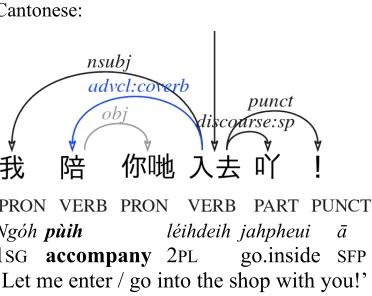
As pointed out by Francis and Matthews (2006), Cantonese coverbs are actually verbs, e.g. they can be used with aspect markers and verbal parti-cles, In contrast, the Mandarin counterpart is rather a preposition – a preposition of verbal ori-gin that has lost all of its verbal properties, ex-cept that it can still take a (prepositional) object.
Mandarin (0_28):
Wǒ péi nǐmen jìnqù ba
Cantonese:
Ngóhpùih léihdeih jahpheui ā 1SG accompany 2PL go.inside SFP ‘Let me enter / go into the shop with you!’
Similarly, in beneficial constructions, the English preposition for is translated by the polysemous character for give. Its usage in Mandarin is quite grammaticalized and it is usually considered a preposition, Cantonese remaining more analyti-cal. In our Mandarin UD guidelines, we intro-duce a specific sub-relation of advcl, advcl:coverb, to account for these constructions.
2.5 Expletives
A last well-known difference between Cantonese and Mandarin is the existence of expletives in Cantonese (annotated with the relation name expl), which are completely absent from Man-darin. An example is 佢 kéuih ‘3SG’. The pro-noun is part of a grammatical construction and actually does not refer to anything or anyone, the condition for qualifying as expletive.1
大家 飲勝 佢!
Daaihgā jámsing kéuih everyone cheers KEUHI
‘Everyone! Cheers (to it)!’
我 不如 死 咗 佢 好過 啦!
Ngóh bātyùh séi jó kéuih hóugwo lā 1SG had.better die PERF KEUIH better SFP
‘It would be better for me to die.’
3
Treebank construction
Our corpus is based on television programs broadcast in Hong Kong (Lee, 2011). The Can-tonese text is thus semi-planned spoken text. Cantonese TV dramas are widely distributed in southern China and beyond and mostly have Mandarin subtitles. The annotation is still ongo-ing and the texts that still await annotation are taken from movies that are distributed on Youtube, which will ultimately allow transform-ing this part of the treebank into a completely free language resource since the creators agreed to the distribution of the language data. The
spo-1 For further details and examples see
http://univer-saldependencies.org/yue/dep/expl.html
ken Cantonese was transcribed with traditional Chinese characters by a native speaker of the lan-guage.
Although the subtitles were in traditional nese, we added a transcription in simplified Chi-nese as a separate feature. The reason being that we need both character sets: The simplified char-acters are necessary in order to apply parsing and segmentation tools. And we kept the traditional characters because the ongoing alignment is more straightforward with identical character sets and also because the Hong Kong residents who are working on the project are more used to traditional characters. Moreover, the projection from traditional to simplified characters is mostly one-to-one but for some characters many to one, and thus easier in the direction traditional → simplified.
The Cantonese transcription was done inde-pendently of the Mandarin subtitles. This has im-portant consequences on the measures that we are able to take, because, as we will see, the tree-bank is not as strictly parallel as we had hoped because the subtitles are condensed and simpli-fied versions of the Cantonese original.
The currently annotated part of the corpus con-sists of 569 parallel sentences. The treebank is sentence-aligned. As shown in Table 1, the spo-ken Cantonese sentences are longer than their counterpart of Mandarin subtitles.
Language Number of tokens Average sentence length
Mandarin 4149 7.29
[image:3.595.74.260.72.220.2]Cantonese 5428 9.54 Table 1: Corpus data
3.1 The UD annotation scheme
For the annotation of the parallel treebank, we decided to follow the Universal Dependency (UD, de Marneffe et al., 2014; Nivre et al., 2016) annotation scheme, as this allows the comparison of our resource also with external treebanks. However, even for Mandarin, no annotation guide existed, and the first UD v1 Mandarin tree-bank does not come with any explanation of the annotation choices and its annotation is, unsur-prisingly, quite heterogeneous.
verb constructions. In accordance with discus-sions around the development of this Mandarin annotation guide, UD v2 explicitly takes into ac-count a specific clf ‘classifier’ relation, which is a unique type of syntactic relations that only ex-ists for languages that have classifiers – Man-darin being the first language with this feature that is described in UD.
The UD v1 guide has been completed during the ongoing annotation experience and then adapted to v2. The Mandarin-specific part of the UD documentation is currently one of the most complete language specific annotation descrip-tions2
The similarity of Cantonese and Mandarin makes it reasonable to conceive the Cantonese annotation guide on the basis of the Mandarin guide, with modifications wherever necessary. The development of this guide is work in progress.
The whole semi-automatic annotation process is done in the Arborator annotation tool (Gerdes 2013), which allows blind and open annotation by multiple users as well as integrated parser bootstrapping possibilities
3.2 Outline
UD has been conceived with a double objective: The parallel construction of the treebanks facili-tates the developments of parsers and other NLP tools. And, more importantly for the present study, it allows studies in empirical comparative syntax. There are some caveats to this claim, some of which we will discuss later. But any comparative measure on the current UD tree-banks will always measure either structural dif-ferences, genre differences of the underlying cor-pus, differences in the design of the annotation scheme, or annotation errors and incoherences of course. Our corpus is, at least partly different in this aspect: Being a parallel treebank, the content of both treebanks is identical and any ascertained difference should be attributed to a structural dif-ference. Alas, as we have mentioned before, this is not completely true, as the Mandarin subtitles are not precise translations of the original Can-tonese words. Therefore, the measured differ-ences can always either be an actual syntactic difference, or rather a difference of genre: The genre of spoken texts in TV dramas vs. the genre of subtitles in “Translationese” – although the pure informational content is mostly identical.
2 The annotation guidelines that we have developed
can be accessed at: http://universaldependen-cies.org/zh/overview/introduction.html
The measured differences between the two sides of the parallel treebank that cannot easily be attributed to the genre variation may either be new to us or corroborate known syntactic differ-ences between the two languages.
4
Statistical measures
This section first presents the statistical measures that will be used to assure the validity of the sig-nificance of the observations (Section 4.1). Fur-ther, various difference measures based on the POS distribution will be presented and discussed (Section 4.2). Then we move on to differences in the functional distribution (Section 4.3) and fi-nally we mix categorical and functional informa-tion (Secinforma-tion 4.4). After a short presentainforma-tion of dependency directional measures (Section 4.5), we will conclude with an outlook on the ongoing annotation and alignment process.
4.1 Fisher Test and Specificity
In order to distinguish significant from insignifi-cant over- and under-representation of features of our parallel treebank, we systematically apply the exact Fisher test which is based on the cumu-lative hypergeometric distribution. The null hy-pothesis is that the size of the two corpora as well as the number of total words having a spe-cific category (or syntactic function) being fixed, the actually observed number of occurrences is due to chance. The p-value measures the proba-bility that the observed frequency (or more oc-currences if the number is already over-repre-sented or less if already under-repreover-repre-sented) actu-ally occurred. To make the probabilities more readable, we transform them in specificity values (Lebart et al. 1991): specificity=−log10(p) if the
observed frequency is higher than the expected value and log10(1−p) if the frequency is lower
than expected. The expected value is the equi-distribution of categories and functions into the two corpora depending on the size of the corpora and the frequency of the categories and func-tions. This is a well-established method in textual statistics, but still quite rarely used in syntactic comparisons.
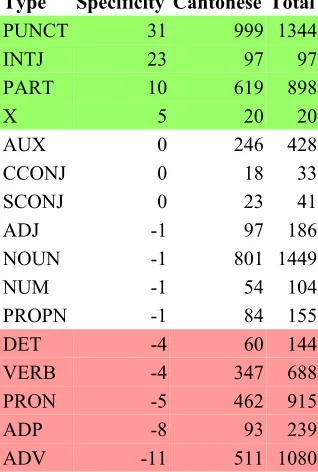
4.2 Categorical differences
that PUNCT is over-represented in Cantonese. The probability that this is due to chance is very low: 1/1031.
Inversely, the last row of Table 2 indicates the following observation: Cantonese has only 511 of the total of 1080 ADV(erbial) tokens. This is less than statistically expected if the POS were distributed evenly, given that the Cantonese part of the corpus is larger. The probability that the observed frequency difference is due to chance is 1/1011. The upper shaded (green) rows of the
ta-ble thus show significant over-representation of categories in Cantonese, the lower shaded (red) rows show significant under-representation. The unshaded rows have over- or under-representa-tion of order 0 or 1 (p~1/10) and thus non-signif-icant differences. The signifnon-signif-icantly lower fre-quency of adverbs in Cantonese is likely due to the prominence of Cantonese post-verbal parti-cles where in Mandarin adverbs are often used to express the same meaning. For instance, for the progressive aspect, in Mandarin the adverb zhèngzài 正在 is used (zhèngzài + V) where the Cantonese counterpart is V-gán in which gán緊
is a post-verbal aspect particle. (Also cf. section 2.3)
We see that the Cantonese treebank was not only punctuated very differently than the Man-darin subtitles. The Cantonese side contains all the observed interjections of the whole parallel treebank as well as a much higher frequency of particles. This underlines again that the subtitle translation is actually a condensed, not to say im-poverished, version that lacks many of the oral
features of the spoken original. The fact that the POS tag X (words where annotators cannot de-termine a POS, like the prefix a 阿) only appear in Cantonese can be attributed to possible dis-agreements between the annotators which may be due to the oral character of the transcription as well as to the underdeveloped formal grammars of Cantonese – making the annotation task harder.
Further, we observe the expected under-repre-sentation of ADP(ositions) in Cantonese due to the verbal character of many Cantonese equiva-lents of Mandarin prepositions, as discussed in section 2.4. It remains to explain why verbs are nonetheless also under-represented in Cantonese. The under-representation of PRON(ouns) in Cantonese is unexpected. This may be an actual linguistic difference between the two languages or it may be due to the less oral character of the Mandarin translation compared to the Cantonese transcriptions, leading to less pronoun dropping. This will have to be examined further.
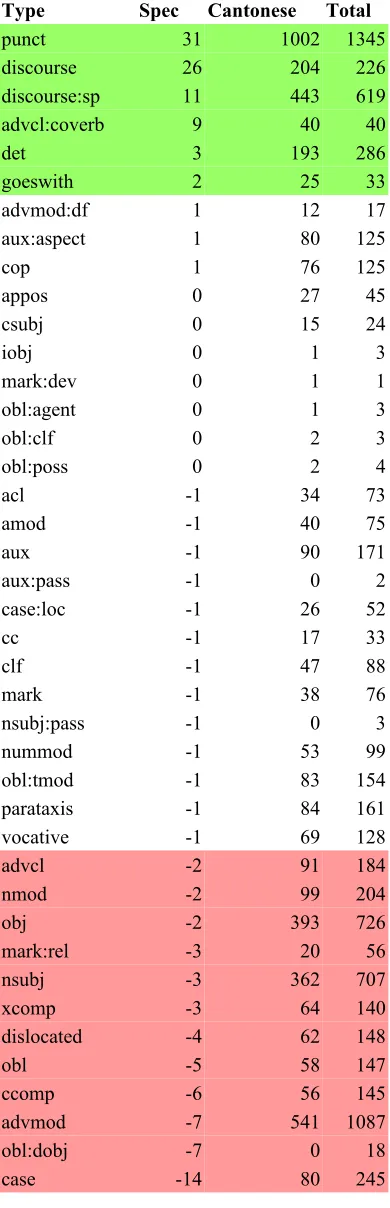
4.3 Functional differences
Table 3 shows the significant differences in the distribution of syntactic functions, partly cor-responds to what has been observed for the POS (e.g. the high frequency of punct, discourse, and discourse:sp = “sentence final particle” rela-tions), but also shows a few more interesting variations: The current Mandarin annotation does not contain any advcl:coverb relations, which is due to differences in annotation, but which none-theless reveals a significant structural difference between the languages: The Mandarin preposi-tions are of verbal origin but have lost all verbal properties whereas their Cantonese counterparts can still be modified by verbal articles and have thus to be tagged and annotated differently (see section 2.4). The UD annotation scheme handles prepositions as case-markers, and thus as
depen-dent from their argument, i.e. what is commonly called a prepositional object. This results in UD’s Type Specificity Cantonese Total
PUNCT 31 999 1344
INTJ 23 97 97
PART 10 619 898
X 5 20 20
AUX 0 246 428
CCONJ 0 18 33
SCONJ 0 23 41
ADJ -1 97 186
NOUN -1 801 1449
NUM -1 54 104
PROPN -1 84 155
DET -4 60 144
VERB -4 347 688
PRON -5 462 915
ADP -8 93 239
[image:5.595.75.234.118.354.2]ADV -11 511 1080
[image:5.595.307.523.602.722.2]Table 2: POS frequencies by specificity
Figure 1: Analyses of two (semantically full) prepositions in UD 2.0 English, the first being a
infamous “Turkish” analysis of English preposi-tions (Chris Manning, 2016, personal communi-cation). Figure 1 shows the situation for English (example taken from Gerdes & Kahane 2016, up-dated to UD 2.0).
The following pair of sentence segments illus-trates this point for Chinese. The 1st person
sin-gular pronoun in the Mandarin tree 我‘wǒ’ is an obl:dobj that has a case-marker. In the Cantonese equivalent, what has been analyzed as a (verbal) preposition in Mandarin is now a coverb, which takes its argument as a regular direct object. Mandarin (sentence 0-7):
Jiù bùyào bǎ wǒ dàng shì then do.not OM 1SG treat COP
nǐ de nāishū
2SG REL youngest.uncle.on.paternal.side
‘Don’t treat me as your uncle.’
Cantonese:
Dong ngóh haih treat 1SG COP
léih ge lāaisuk
2SG REL youngest.uncle.on.paternal.side
‘Treat me as your uncle.’
We end up with structurally very different trees for a simple categorical choice. Note that the proximity between verbs and preposition is not reserved to Chinese. The English during or the French equivalent pendant are similar cases where the verbal character of the preposition is still visible.
Alternatively, we could have decided to treat all Cantonese coverbs as prepositions, so that the Cantonese trees would be in line with the Man-darin ones. This is a difficult choice as UD seeks
“to maximize parallelism by allowing the same grammatical relation to be annotated in the same way across languages, while making enough cru-cial distinctions to differentiate constructions that are not the same.” (Nivre 2015 and UD
home-Type Spec Cantonese Total
punct 31 1002 1345
discourse 26 204 226
discourse:sp 11 443 619
advcl:coverb 9 40 40
det 3 193 286
goeswith 2 25 33
advmod:df 1 12 17
aux:aspect 1 80 125
cop 1 76 125
appos 0 27 45
csubj 0 15 24
iobj 0 1 3
mark:dev 0 1 1
obl:agent 0 1 3
obl:clf 0 2 3
obl:poss 0 2 4
acl -1 34 73
amod -1 40 75
aux -1 90 171
aux:pass -1 0 2
case:loc -1 26 52
cc -1 17 33
clf -1 47 88
mark -1 38 76
nsubj:pass -1 0 3
nummod -1 53 99
obl:tmod -1 83 154
parataxis -1 84 161
vocative -1 69 128
advcl -2 91 184
nmod -2 99 204
obj -2 393 726
mark:rel -3 20 56
nsubj -3 362 707
xcomp -3 64 140
dislocated -4 62 148
obl -5 58 147
ccomp -6 56 145
advmod -7 541 1087
obl:dobj -7 0 18
[image:6.595.309.504.142.746.2]case -14 80 245
page. And although prepositions in English are considered by any syntactic analysis that we are aware of to be “crucially” different from case markers (Osborne 2015), UD decided to treat them just like Turkish case markers, leading to greater similarity between Turkish and English and at the same time to the structurally very dif-ferent trees for simple and complex prepositions (Figure 1)
A good syntactic annotation scheme would al-low for slight structural differences to be re-flected by slight differences in the annotation, for example in the case of Cantonese coverbs by a different categorization of the coverb, once as a verb and once as a preposition, but with identical dependency structures in both treebanks. The “Turkish” analysis of prepositions, on the con-trary, triggers a structural upheaval, for a small real difference: A “catastrophe” in a strictly mathematical sense of Thom’s catastrophe the-ory (Saunders 1980, Gerdes & Kahane 2016), i.e. a brutal structural change in a continuum. This results in measures of important differences where there are few (between Mandarin and Cantonese for example), and in the absence of annotation differences where syntactic differ-ences actually occur (e.g. English prepositions vs. Turkish case markers).
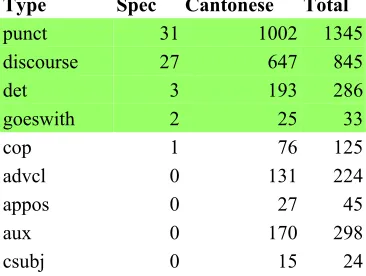
The UD annotation scheme obliges all depen-dency relations to be taken from a fixed set of 37 functions but it allows for the creation of idio-syncratic sub-relations when needed by a given language. The sub-relations are separated by a colon from the main relation: relation:subrela-tion. When grouping together subrelations, we obtain Table 4, a simpler table with similar sig-nificant variations between Cantonese and Man-darin. Concerning the adverbial clause (advcl) relation, we see that its distribution is no longer significantly different between the two lan-guages: Mandarin had more simple advcl, Can-tonese more coverb constructions which adds up to an equal distribution.
Type Spec Cantonese Total
punct 31 1002 1345
discourse 27 647 845
det 3 193 286
goeswith 2 25 33
cop 1 76 125
advcl 0 131 224
appos 0 27 45
aux 0 170 298
csubj 0 15 24
iobj 0 1 3
acl -1 34 73
amod -1 40 75
cc -1 17 33
clf -1 47 88
nummod -1 53 99
parataxis -1 84 161
vocative -1 69 128
nmod -2 99 204
obj -2 393 726
mark -3 59 133
xcomp -3 64 140
dislocated -4 62 148
nsubj -4 362 710
advmod -6 553 1104
ccomp -6 56 145
obl -6 146 329
[image:7.595.71.254.620.758.2]case -14 106 297
Table 4: simple dependency relation frequencies ordered by specificity (simple meaning that
sub-relations are grouped under the main relation) 4.4 Mixed measures
When grouping together the syntactic function and the POS of the dependent token, we obtain 128 classes of function-POS pairs. Although the small size of our current parallel corpus makes most differences fall under the significance threshold, some couples are significantly over-and under-represented. See Table 5 for details.
We observe for example that Cantonese parti-cles are mostly in discourse or advmod relations whereas Mandarin particles are mark (~verbal complementizers) and case markers (~preposi-tions).
Since UD v2.0, the dislocated relation is used for objects in a non-canonical position “that do not fulfill the usual core grammatical relations of a sentence” (UD page for the dislocated rela-tion3), so all the obj and obl relations in the
above list are actually post-verbal. Since the Cantonese data is more oral, the over-representa-tion of objects could also partially be due to this distinction and not to an actual difference in the valency structures of the observed verbal objects.
3 It is not completely clear what is actually meant by
If we go one step further, we can measure triples POS–func→ POS. The two treebanks con-tain more than 300 of these triples, the two most frequent ones, with more than 700 occurrences being VERB–punct→PUNCT and VERB–adv-mod→ADV.
The most significantly over-represented Can-tonese triples are shown in Table 6.
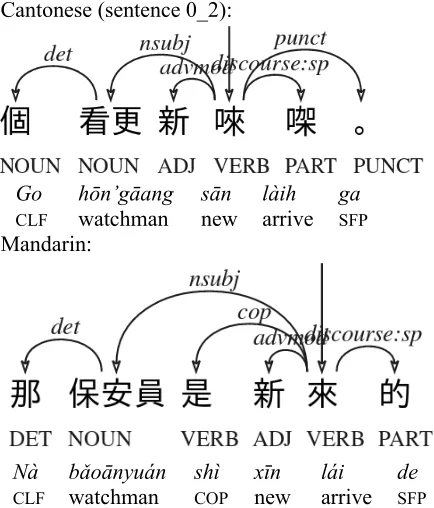
The significant over-representation of NOUN– det→NOUN relations in Cantonese may seem surprising and does not seem to follow directly from the POS distribution. Note first that the fixed UD POS tag-set does not include a specific category for classifiers which are therefore tagged as nouns. What we are actually observing here is that bare classifier noun phrases [CLF NOUN] is a common Cantonese strategy for def-inite NP constructions. In Cantonese only [CLF NOUN] and [DET CLF NOUN] are possible for
definite NPs. In Mandarin we have [NOUN], [DET NOUN], or [DET CLF NOUN].4
Cantonese (sentence 0_2):
Go hōn’gāang sān làih ga
CLF watchman new arrive SFP Mandarin:
Nà bǎoānyuán shì xīn lái de
CLF watchman COP new arrive SFP
On the lower edge of the table, the most typi-cally Mandarin triples are these:
In common copula constructions, UD im-poses the analysis of the copula verb as the
de-4 Note that [CLF NOUN] is also possible in
Man-darin, but only in post-verbal position, and it can only have an indefinite interpretation, hence it oc-curs much less frequently than in Cantonese. In Cantonese, [CLF NOUN] can occur in both pre-verbal and postpre-verbal position, but in prepre-verbal position it must be definite; in postverbal position, it can be ambiguous between definite and indefi-nite.
VERB-advmod→ADV -10 332 729
[image:8.595.304.510.74.190.2]AUX-ccomp→VERB -14 0 38
Table 7: The most significantly over-repre-sented triples POS – dependency – POS on the
Mandarin side of the parallel treebank Type Spec Can-tonese Total
punct→PUNCT 31 998 1341
discourse→INTJ 23 97 97
det→NOUN 19 126 135
discourse→PART 18 516 692
advmod→PART 10 44 44
det→PRON 2 7 7
goeswith→NOUN 2 15 18
vocative→X 2 7 7
…
acl→VERB -2 32 70
dislocated→NOUN -2 43 92
nmod→PRON -2 71 146
nsubj→NOUN -2 87 178
obj→NOUN -2 266 505
obl→PROPN -2 2 10
xcomp→VERB -2 49 110
mark→PART -3 25 68
nsubj→PRON -3 252 490
obl→NOUN -3 120 247
det→DET -4 60 144
case→PART -5 30 89
ccomp→VERB -5 44 119
dislocated→ADV -5 0 13
obl→PRON -6 18 63
advmod→ADV -10 472 1004
[image:8.595.72.281.76.468.2]case→ADP -10 73 204
Table 5: selection of dependency-POS couples, ordered by specificity
Type Spec Can-tonese Total
VERB-punct→PUNCT 24 595 781
INTJ-punct→PUNCT 22 93 93
NOUN-det→NOUN 19 126 135
VERB-discourse→INTJ 15 64 64
VERB-discourse→PART 12 369 503
Table 6: The most over-represented triples POS – dependency – POS on the Cantonese side of
[image:8.595.306.523.264.518.2]pendent of the semantically full element, which is commonly a noun or an adjective. In the new UD v2 annotation scheme however, the auxiliary is considered the head of the con-struction if the semantically full argument is a verb itself, the copula verb becomes the head of the construction, a decision which attempts to avoid cases of embedded multiple auxiliary constructions where the subject can no longer be unequivocally attributed to its governor. This explains the existence of the AUX– ccomp→VERB triple, but it does not explain why this construction is over-represented in Mandarin. This will have to be explained by returning on the actual parallel data where the AUX–ccomp→VERB triple must have a struc-turally different translation in Cantonese.
4.5 Directional measures
A final set of measures on the treebank is based on the direction of the dependency link:
This kind of measures has been used in vari-ous treebank analysis methods, in particular in typological research, where the direction of the head-daughter relations has been shown to corre-late with many important language features (Liu 2010, Chen & Gerdes 2017).
Here we just briefly want to point to a few as-pects that have been mentioned above: We see that our annotation scheme only has objects to the right of its verbal governor – other positions would be annotated as dislocated. For the oblique verbal argument, however, we observe an important difference between Cantonese and Mandarin: Mandarin has around 20% of its oblique arguments to the right of their governor – Cantonese has 10% more, corresponding to the aforementioned structural preferences.
The higher number of right-branching advmod and aux relations in Cantonese, however, does not follow directly from the known language dif-ferences and should be explored further, prefer-ably on more, and if possible, less genre depen-dent parallel data.
5
Conclusion
This article presents a method of empirical comparative syntax using statistical measures on
a comparatively small sentence-aligned parallel dependency treebank. The specificity measure-ments, based on the exact Fisher test, are well-adapted to small corpora because the alternative test for categorical data, the approximating χ² test, gives incorrect results for very small (and very frequent) occurrences (compared to the size of the corpus) – and the frequencies of most words in a corpus are very low.
The significant observations can often be ex-plained by actual differences in the language structure or at least in the language annotation scheme. Since the corpus is parallel, the differ-ences are not due to different vocabulary etc., but the subtle genre differences on the two sides of our treebank (transcription vs subtitle) remain very visible in the resulting measures.
We can see that Cantonese has significant structural differences with its Mandarin counter-part, although some of these differences are rein-forced by the UD annotation scheme while other actual structural differences may have remained hidden from our statistical analysis. Inversely, however, not all well-known structural differ-ences between the languages can be put under scrutiny by means of the parallel treebank. The expletive, for example, is absent from our corpus – pointing to the fact that frequently discussed phenomena are not necessarily frequent syntactic phenomena. The specificity measure allows or-dering the observed differences by statistical im-portance, the degree of astonishment, thus empir-ically guiding the research to actual hotspots of syntactic variation.
The annotation choices we face with different stages of preopositional grammaticalization in a parallel or comparable treebanks can be seen as part of a more general question about the goal of the syntactic annotation: The UD choice to favor similar structures whenever possible leads to skewed typological similarity measures. Future UD schemes should be evaluated as to the extent that they allow avoiding catastrophes and captur-ing similarities between closely related struc-tures.
The ongoing word alignment of the parallel treebank will soon allow for more precise queries concerning the differences or similarity between the two languages. But just like for the annota-tion, the word alignment, too, is already a struc-tural choice (many alignments?, one-to-zero alignments?) that determines which results can finally be extracted. Ideally the word-align-ment would allow for compleword-align-mentary measure-ments that cannot be obtained on the sole
sen-name advmod aux obj obl
Cantonese 13,74 48,82 100 28,08 Mandarin 3,81 35,16 100 19,67
tence aligned parallel treebank. Work in progress on a parallel treebank online query tool could also benefit from the integration of these types of statistical measures. It would allow to not only search for and count pre-discovered structural discrepancy, but rather permit exploring interest-ing facts hidden in the raw data.
Acknowledgments
This work was supported by a grant from the PROCORE-France/Hong Kong Joint Research Scheme sponsored by the Research Grants Coun-cil and the Consulate General of France in Hong Kong (Reference No.: F-CityU107/15 and N° 35322RG); and by two Strategic Research Grants (Project No. 7004494 and No. 7004736) from City University of Hong Kong.
References
Chen, Xinying, and Kim Gerdes. “Classifying Lan-guages by Dependency Structure: Typologies of Delexicalized Universal Dependency Treebanks”, Depling, 2017
David C. S. LI, Cathy S. P. WONG, Wai Mun LE-UNG and Sam T. S. WONG. “Facilitation of Transference: The Case of Monosyllabic Salience in Hong Kong Cantonese” Linguistics, Vol. 54(1), pp. 1−58, January 2016.
Francis, Elaine J., and Stephen Matthews. “Categori-ality and object extraction in Cantonese serial verb constructions.” Natural Language & Linguistic Theory 24.3 (2006): 751-801.
Gerdes, Kim. “Collaborative Dependency Annota-tion.” Depling, 2013.
Gerdes, Kim, and Sylvain Kahane. “Dependency An-notation Choices: Assessing Theoretical and Practi-cal Issues of Universal Dependencies.” LAW X (2016) The 10th Linguistic Annotation Workshop: 131. 2016.
Law SP, Kong APH, Lee A, Lai CT, Lam VVV. 2012. “Cantonese Chinese corpus of oral narratives (CANON) with morphological tagging: a prelimi-nary report.” Presented in the Workshop on Inno-vations in Cantonese Linguistics (WICL), Colum-bus, OH., 16-17 March 2012.
Lebart, Ludovic, André Salem, and Lisette Berry. “Recent developments in the statistical processing of textual data.” Applied Stochastic Models and Data Analysis 7.1 (1991): 47-62.
Leung, Herman, Rafaël Poiret, Tak sum Wong, Xiny-ing Chen, Kim Gerdes, and John Lee “DevelopXiny-ing Universal Dependencies for Mandarin Chinese.” The 12th Workshop on Asian Language Resources. 2016.
Lee, John. Toward a Parallel Corpus of Spoken Can-tonese and Written Chinese. In Proc. 5th Interna-tional Joint Conference on Natural Language Pro-cessing (IJCNLP), 2011.
Lee, Thomas H. T. and Colleen Wong. 1998. CAN-CORP: the Hong Kong Cantonese Child Language Corpus. Cahiers de Linguistique Asie Orientale vol. 27, no. 2, pp. 211-228.
Liu, Haitao. “Dependency direction as a means of word-order typology: A method based on depen-dency treebanks.” Lingua, 120.6 (2010): 1567-1578.
Luke, Kang-Kwong, & Wong, May L-Y. 2015. The Hong Kong Cantonese Corpus: design and uses. Journal of Chinese Linguistics 25 (2015): 309-330 Matthews, Stephen and Virginia Yip. (2011)
Can-tonese: A comprehensive grammar. New York: Routledge.
de Marneffe, Marie-Catherine, Timothy Dozat, Na-talia Silveira, Katri Haverinen, Filip Ginter, Joakim Nivre, and Christopher D. Manning. 2014. Univer-sal Stanford Dependencies: A cross-linguistic ty-pology. Proceedings of the Ninth International Conference on Language Resources and Evalua-tion (LREC 2014): 4584-4592.
Nivre, Joakim. “Towards a Universal Grammar for Natural Language Processing.” CICLing (1) 2015 (2015): 3-16.
Nivre, Joakim, Marie-Catherine de Marneffe, Filip Ginter, Yoav Goldberg, Jan Hajič, Christopher D. Manning, Ryan McDonald, Slav Petrov, Sampo Pyysalo, Natalia Silveira, Reut Tsarfaty, and Daniel Zeman. 2016a. Universal Dependencies v1: A Multilingual Treebank Collection. Proceedings of the Tenth International Conference on Lan-guage Resources and Evaluation (LREC 2016): 1659-1666.
Osborne, Timothy. “Diagnostics for Constituents: De-pendency, Constituency, and the Status of Function Words.” Depling, 2015.
Ōuyáng, Juéyà. (1993) 普通話廣州話的比較與學習
Pŭtōnghuà Guăngzhōuhuà de bĭjiào yŭ xuéxí (The comparison and learning of Mandarin and Can-tonese). Peking: China Social Science Press. Saunders, Peter T. An introduction to catastrophe
the-ory. Cambridge University Press, 1980.
Yip, Virginia and Stephen Matthews. (2000) Syntac-tic transfer in a bilingual child. Bilingualism: Lan-guage and Cognition 3.3, 193-208