Cross-Document Co-Reference Resolution using Sample-Based Clustering
with Knowledge Enrichment
Sourav Dutta
Max Planck Institute for Informatics Saarbr¨ucken, Germany [email protected]
Gerhard Weikum
Max Planck Institute for Informatics Saarbr¨ucken, Germany [email protected]
Abstract
Identifying and linking named entities across information sources is the basis of knowledge acquisition and at the heart of Web search, rec-ommendations, and analytics. An important problem in this context is cross-document co-reference resolution (CCR): computing equiv-alence classes of textual mentions denoting the same entity, within and across documents. Prior methods employ ranking, clustering, or probabilistic graphical models using syntactic features and distant features from knowledge bases. However, these methods exhibit limita-tions regarding run-time and robustness. This paper presents theCROCS framework for unsupervised CCR, improving the state of the art in two ways. First, we extend the way knowledge bases are harnessed, by con-structing a notion ofsemantic summariesfor intra-document reference chains using co-occurring entity mentions belonging to differ-ent chains. Second, we reduce the computa-tional cost by a new algorithm that embeds sample-based bisection, using spectral clus-tering or graph partitioning, in a hierarchi-cal clustering process. This allows shierarchi-caling up CCR to large corpora. Experiments with three datasets show significant gains in output qual-ity, compared to the best prior methods, and the run-time efficiency of CROCS.
1 Introduction
1.1 Motivation and Problem Statement
We are witnessing another revolution in Web search, user recommendations, and data analytics: tran-sitioning from documents and keywords to data, knowledge, and entities. Examples of this mega-trend are the Google Knowledge Graph and its
ap-plications, and the IBM Watson technology for deep question answering. To a large extent, these ad-vances have been enabled by the construction of huge knowledge bases (KB’s) such as DBpedia, Yago, or Freebase; the latter forming the core of the Knowledge Graph. Such semantic resources provide huge collections ofentities: people, places, compa-nies, celebrities, movies, etc., along with rich knowl-edge about their properties and relationships.
Perhaps the most important value-adding com-ponent in this setting is the recognition and dis-ambiguation of named entities in Web and user
contents. Named Entity Disambiguation (NED)
(see, e.g., (Cucerzan, 2007; Milne & Witten, 2008; Cornolti et al., 2013)) maps a mention string (e.g., a person name like “Bolt” or a noun phrase like “light-ning bolt”) onto its proper entity if present in a KB (e.g., the sprinter Usain Bolt).
A related but different task ofco-reference reso-lution (CR)(see, e.g., (Haghighi & Klein, 2009; Ng, 2010; Lee et al., 2013)) identifies all mentions in a given text that refer to the same entity, including anaphoras such as “the president’s wife”, “the first lady”, or “she”. This task when extended to process an entire corpus is then known as cross-document co-reference resolution (CCR)(Singh et al., 2011). It takes as input a set of documents with entity men-tions, and computes as output a set of equivalence classes over the entity mentions. This does not in-volve mapping mentions to the entities of a KB. Un-like NED, CCR can deal with long-tail or emerging entities that are not captured in the KB or are merely in very sparse form.
State of the Art and its Limitations.CR methods,
for co-references within a document, are generally based on rules or supervised learning using
ent kinds of linguistic features like syntactic paths between mentions, the distances between them, and their semantic compatibility as derived from co-occurrences in news and Web corpora (Haghighi & Klein, 2009; Lee et al., 2013). Some methods ad-ditionally use distant labels from knowledge bases (KB’s). Cluster-ranking and multi-sieve methods in-crementally expand groups of mentions and exploit relatedness features derived from semantic types, alias names, and Wikipedia categories (Rahman & Ng, 2011a; Ratinov & Roth, 2012).
The CCR task - computing equivalence classes across documents - is essentially a clustering prob-lem using a similarity metric between mentions with features like those discussed above. However, standard clustering (e.g., k-means or EM variants, CLUTO, etc.) lacks awareness of the transitivity of co-reference equivalence classes and suffers from knowledge requirement of model dimensions. Prob-abilistic graphical models like Markov Logic net-works (Richardson & Domingos, 2006; Domingos et al., 2007; Domingos & Lowd, 2009) or factor graphs (Loeliger, 2008; Koller & Friedman, 2009) take into consideration constraints such as transi-tivity, while spectral clustering methods (Luxburg, 2007) implicitly consider transitivity in the underly-ing eigenspace decomposition, but suffer from high computational complexity. In particular, all methods need to precompute features for the data points and similarity values between all pairs of data points. The latter may be alleviated by pruning heuristics, but only at the risk of degrading output quality.
Note that CCR cannot be addressed by simply applying local CR to a “super-document” that con-catenates all documents in the corpus. Within a document, identical mentions typically refer to the same entity, while in different documents, identical mentions can have different meanings. Although a cross-document view gives the opportunity to spot joint cues from different contexts for an entity, doc-uments vary in their styles of referring to entities and merely combining the local co-reference chains into a super-group might lead to substantial noise intro-duction. In addition, CR methods are not designed for scaling to huge “super-documents” correspond-ing to millions of web pages or news articles.
Problem Statement.We aim to overcome the above
limitations by proposing a CCR method that makes rich use of distant KB features, considers transitiv-ity, and is computationally efficient.
1.2 Approach and Contribution
In this paper, we efficiently tackle the CCR problem by considering co-occurring mentions and rich features from external knowledge bases, and using a transitivity-aware sampling-based hierarchical
clustering approach. We developed the CROCS
(CROss-document Co-reference reSolution) frame-work with unsupervised hierarchical clustering
by repeated bisection using spectral clustering or
graph partitioning. CROCS harnesses semantic
features derived from KB’s by constructing a notion of semantic summaries (semsum’s) for the intra-document co-reference chains. In addition to incorporating KB labels as features for the co-referring mentions, we also consider co-occurring mentions belonging to other entities and utilize their
features. Consider the text: Hillary lived
in the White House and backed Bill
despite his affairs. containing 3
men-tion groups: {“Hillary”}, {“Bill”}, and {“White House”}. Merely obtaining distant KB features for the first mention group, the sparse information leads to high ambiguity, e.g., may refer to the
mountaineer Sir Edmund Hillary. But by also
obtaining features from KB for “White House” (co-occurring mention), we obtain much stronger cues towards the correct solution.
CROCS adopts a bisection based clustering method and invokes it repeatedly in a top-down hi-erarchical procedure with an information-theoretic stopping criterion for cluster splitting. We escape the quadratic run-time complexity for pair-wise sim-ilarity computations by using asampling technique
for the spectral eigenspace decomposition or for graph partitioning. This is inspired by the recent work of (Krishnamurty et al., 2012; Wauthier et al., 2012) on active clustering techniques. Similar-ity computations between mention groups are per-formed lazily on-demand for the dynamically se-lected samples.
In a nutshell, the novel contributions are:
• CROCS, a framework for cross-document
co-reference resolution using sample-based spectral clustering or graph partitioning embedded in a hierarchical bisection process;
• experimental evaluation with benchmark cor-pora demonstrating substantial gains over prior methods in accuracy and run-time.
2 Computational Framework
The CROCS model assumes an input set of text documents D = {d1, d2, . . .}, with markup of entity mentions M = {m11, m12,
. . . , m21, m22, . . .}, mij ∈ dj, present in the
documents. CROCS computes an equivalence
relation overM with equivalence classesCj, where Cj ∩Ck = ∅ for j =6 k and ∪jCj = M. The
number of desired classes is apriori unknown; it needs to be determined by the algorithm. Detecting the mentions and marking their boundaries within the text is a problem by itself, referred to as NER (Named Entity Recognition). This paper does not address this issue and relies on established methods.
The CROCS framework consists of4stages:
1. Intra-document CR: Given an input corpus,D
with mentions M, we initially perform intra
-document co-reference resolution.
2. Knowledge enrichment: For each of the local
mention groups ({mij}) obtained in the
previ-ous step, we combine the sentences of the men-tions to determine the best matching entity in a KB and retrieve its features. Analogous steps are performed for co-occurring mentions (of{mij})
and their features included. We term this feature set of{mij}assemantic summary(semsum’s).
3. Similarity computation: We compute
similar-ity scores between mention groups based on the features extracted above. These are computed on-demand, and only for a sampled subset of mentions (avoiding quadratic computation cost).
4. Sampling-based clustering: We perform
spec-tral clustering or balanced graph partitioning (using the similarity metric) in a hierarchi-cal fashion to compute the cross-document co-reference equivalence classes of mentions.
3 Intra-Document CR
CROCS initially pre-processes input documents
to cast them into plain text (using standard
tools like (https://code.google.com/p/
boilerpipe/), (www.jsoup.org), etc.). It then uses the Stanford CoreNLP tool suite to
detect mentions and anaphors (http://nlp.
stanford.edu/software/). The detected
mentions are also tagged with coarse-grained lexi-cal types (person, organization, location, etc.) by the Stanford NER Tagger (Finkel et al., 2005). This forms the input to the intra-document CR step, where we use the state-of-the-art open-source CR tool (based on multi-pass sieve algorithm) from Stanford to compute the local mention co-reference chains (Raghunathan et al., 2010; Lee et al., 2011; Lee et al., 2013). The tagged texts and the local co-reference chains are then passed to the second stage. This local CR step may produce errors (e.g., in-correct chaining of mentions or omissions) which propagate to the later stages. However, improving intra-document CR is orthogonal to our problem and thus out of the scope of this paper. Our experiments later show that CROCS is robust and produces high-quality output even with moderate errors encoun-tered during the local-CR stage.
4 Knowledge Enrichment
The knowledge enrichment phase starts with the local co-reference chains per document. Assume that we have obtained mention groups (chains) {Michelle, she, first lady}and{the president’s wife, first lady} from two documents. To assess whether these two chains should be combined, i.e., they both refer to the same entity, we compute seman-tic features by tapping into knowledge bases (KB’s). Specifically, we harness labels and properties from
freebase.comentries, for possibly matching
enti-ties, to enrich the features of a mention group. The KB features form a part of thesemantic summaryor
semsum’sfor each local mention group. Features de-rived from the constructed semsum’s are later used to compare different mention groups via a similarity measure (described in Section 5).
Formally, a mentionmis a text string at a
partic-ular position in a document.mbelongs to a mention
groupM(m) consisting of all equivalent mentions,
with the same string (at different positions) or differ-ent strings. For a givenm, thebasic semsumofm, Sbasic(m), is defined as
Sbasic(m) ={t∈sentence(m0)|m0 ∈M(m)}
∪ {t∈label(m0)|m0 ∈M(m)}
where t are text tokens (words or phrases),
sentence(m0)is the sentence in which mentionm0
occurs, andlabel(m0) is the semantic label for m0
of tokens, as different mentions inM(m)can obtain the same tokens or labels and there could be multi-ple occurrences of the same mention string inM(m)
anyway.
Prior works on CR (e.g., (Rahman & Ng, 2011a; Ratinov & Roth, 2012; Hajishirzi et al., 2013; Zheng et al., 2013)) and NED (e.g., (Cucerzan, 2007; Milne & Witten, 2008; Ratinov et al., 2011; Hoffart et al., 2011; Hajishirzi et al., 2013)) have considered such form of distant features. CROCS extends these pre-vious methods by also considering distant features for co-occurring mention groups, and not just the group at hand. We now introduce a general frame-work for knowledge enrichmentin our CCR setting. Strategies for knowledge enrichment involve de-cision making along the following dimensions:
• Target: items (single mentions, local mention
groups, or global mention groups across docu-ments) for which semantic features are obtained.
• Source: the resource from where semantic
fea-tures are extracted. Existing methods consider a variety of choices: i) input corpora, ii) external text corpus, e.g., Wikipedia, and iii) knowledge bases such as Freebase, DBpedia, or Yago.
• Scope: the neighborhood of the target
consid-ered for enrichment. It can either be restricted to the target itself or can consider co-occurring items (other mention groups connected to the target).
• Match: involves mapping the target to one or
more relevant items in the source, and can in-volve simple name queries to full-fledged NED based on relevance or score confidence.
Existing methods generally consider individual mentions or local mention groups as target. Ex-tended scopes like co-occurring entities based on automatic NER and IE techniques have been pro-posed (Mann & Yarowsky, 2003; Niu et al., 2004; Chen & Martin, 2007; Baron & Freedman, 2008), but use only the input corpus as the enrichment source. Recent methods (Rahman & Ng, 2011a; Ratinov & Roth, 2012; Hajishirzi et al., 2013; Zheng et al., 2013) harness KB’s, but consider only lo-cal mention groups. Also, these methods rely on high-quality NED for mapping mentions to KB
en-tries. In contrast, CROCS considers extended
scopes that include mention groups along with co-occurring mention groups when tapping into KB’s. We make only weak assumptions on matching
men-tions against KB entities, by filtering on confidence and merely treating semsum’s as features rather than relying on perfectly mapped entities. Specifically, our CROCS method handles the four dimensions of knowledge enrichment as follows:
Enrichment Target:We use per-document mention
groups, after the local CR step, as target. In princi-ple, we could repeat the enrichment during the itera-tions of the CCR algorithm. However, as CROCS performs top-down splitting of groups rather than bottom-up merging, there is no added value.
Enrichment Source: We include all the sentences
of a mention group in its semsum’s, thus drawing on the input document itself. The main enrichment har-nesses entity-structured KB’s like Freebase or Yago by querying them with phrases derived from the mention groups’ summaries. The features that are extracted from the best-matching entity include se-mantic types or categories (e.g., “politician”, “award nominee”), alias names (e.g., “Michelle Robinson”), titles (e.g., “First Lady of the United States”) and gender of people. These features are appended to the semsum’s and form the core of a mention group’s semantic summary.
Enrichment Scope: CROCS includes
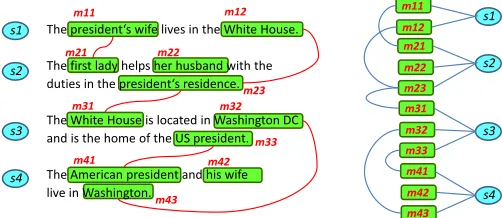
co-occurring mention groups as additional targets for semantic features. Consider the 4 example sentences in Figure 1. Suppose the local CR finds
4mention groups as shown. The mentions and the
sentences in which they occur are represented as a bipartite graph depicting their connections (right side of Fig. 1). Consider the mention group of “president’s wife” (m11) and “first lady” (m21).
Together with their immediate sentence neighbors in the bipartite graph, these mentions form what we call thebasic scopefor knowledge enrichment, i.e., {m11, s1, m21, s2}.
The sentences of this mention group contain other mentions which can be in mention groups spanning further sentences. We utilize this co-occurrence as additional cues for characterizing the mention group at hand. The union of the current scope with that of all the two-hop neighbors in the bipartite graph form the extended scope. For the group {m11, s1, m21, s2}, the two-hop men-tion neighbors are {m12, m22, m23, m31}. Hence, we include the scopes of these groups, the men-tions and sentences, yielding the extended scope {m11, s1, m21, s2, m22, m23, m31, s3}.
M(m), itsextended semsumSextended(m)is:
Sextended(m) =Sbasic(m)∪
[
m0
Sbasic(m0)| ∃s: m0 ∈s∧m∈s
!
wheresis a sentence in which bothmandm0occur.
In principle, we could consider even more aggres-sive expansions, like 4-hop neighbors or transitive closures. However, our experiments show that the 2-hop extension is a sweet spot that gains substan-tial benefits over the basic scope.
Enrichment Matching: For each local mention
group, CROCS first inspects the coarse-grained types(person, organization, location) as determined by the Stanford NER Tagger. We consider pronouns to derive additional cues for person mentions. If all tags in a group agree, we mark the group by this tag; otherwise the group as a whole is not type-tagged.
To match a mention group against a KB entity, we trigger a phrase query comprising tagged phrases from the mention group to the KB interface1. We
remove non-informative words from the phrases, dropping articles, stop-words, etc. For example, the first mention group, {m11, m21} in Fig. 1 leads to the query"president wife first lady". The
query results are filtered by matching the result type-tag with the type type-tag of the mention group. For the extended scope, we construct analogous queries for the co-occurring mentions: "White House US president residence" and "husband"in the
example. The results are processed as follows. We primarily rely on the KB service itself to rank the matching entities by confidence and/or rele-vance/importance. We simply accept the top-ranked entity and its KB properties, and extend the sem-sum’s on this basis. This is also done for the co-occurring mention groups, leading to the extended scopeof the original mention group considered.
To avoid dependency on the ranking of the KB, we can alternatively obtain the top-k results for each query and also the KB’s confidence for the entity matching. We then re-rank the candidates by our similarity measures and prune out candidates with low confidence. We introduce aconfidence thresh-old,θ, such that all candidates having matching
con-fidence below the threshold are ignored, i.e., the 1For example, (https://gate.d5.mpi-inf.mpg.de/
webyagospotlx/WebInterface) or (www.freebase.com/ query)
m22
s1
s2
s3
s4
m11 m12
m21
m23
m31 m32
m33
m43
m41 m42
s1
s2
s3
s4
m43 m41 m42 m33 m31 m32 m23 m21 m22 m11 m12 The president‘s wife lives in the White House.
The first lady helps her husband with the duties in the president‘s residence.
The White House is located in Washington DC and is the home of the US president.
[image:5.612.313.564.44.153.2]The American president and his wife live in Washington.
Figure 1: Example of local mention groups.
Algorithm 1:Extended Knowledge Enrichment
Require: TextT, SetGof mention groups (from
Stanford CoreNLP), KB Match Thresholdθ,
Knowledge baseKB
Ensure: semsum for each group inG
1: foreach mention group,M ∈Gdo
2: Basic Scope:semsumM ←sentences from T containing mentions inM
3: Extract and add KB features for mentions and phrases insemsumM (Sbasic(M))
4: Extended Scope:Append context of 2-hop co-occurring mentions (from bipartite graph) tosemsumM
5: Matching:Extract phrases fromsemsumM
for query generation to KB
6: Retrieve highest ranked KB result entitye
7: ifmatch confidence ofe > θthen
8: Extract set of features fore,LefromKB
9: AppendLetosemsumM (Sextended(M))
10: end if
11: end for
12: OutputsemsumM for allM ∈G
entire mention group is disregarded in the semsum construction. This makes extended scope robust to noise. For example, the mention group{husband}
having low confidence would likely degrade the semsum’s quality and is thus dropped.
Feature Vector: The semsum’s of the mention
groups comprise sentences and bags of phrases. For the example mention group{m11, m21}, we include the sentences{s1, s2, s3}during the extended-scope enrichment, and obtain phrases from the KB like: “Michelle Obama”, “First Lady of United States”, “capital of the United States”, etc. Algorithm 1 shows the pseudo-code for constructing semsum’s.
CROCSnext casts each semsum into two forms,
5 Similarity Computation
CROCS compares mention groups by a similarity
measure to infer whether they denote the same entity or not. The similarity is based on the feature vec-tors of mention groups (constructed as in Section 4). Each feature in a mention group’s vector is weighted using IR-style measures according to the bag-of-words (BoW) model or the keyphrases (KP) model
for the semsum’s. Empirically, the best approach is a mixture of both the words and keyphrases model, which is employed byCROCS. Similarity
compar-isons are computed on-demand and only for a small sampled set of mention groups, as required during the hierarchical clustering procedure (see Section 6). The similarity of two mentions groupsG1, G2is,
sim(G1, G2) =α×simBoW(G1, G2) +
(1−α)×simKP(G1, G2)
where α is a tunable hyper-parameter. Whenever
two mention groups are to be combined (referring to the same entity), their feature vectors are combined by computing a bag union of their words and/or phrases, and then recomputing the weights. With-out loss of generality, our default setting isα= 0.5.
Bag-of-Words Model (BoW): For this model, we
compute the term frequency, tf(w) for each word
w in the semsum’s, and also the inverse document frequency,idf(w), of the word across all semsum’s
(i.e., all mention groups from all input documents). The weight ofw,wgt(w) = tf(w)×idf(w). As the semsum’s are short, we use the simple product rather than dampeningtf values or other variations.
Alternatively, more advanced IR weighting models such as Okapi BM25 or statistical language models can be used. However, the classicaltf×idf measure
works quite well.CROCS computes the similarity
of two feature vectors by theircosine distance.
Keyphrases Model (KP):The keyphrases of a
men-tion group are obtained by extracting proper names, titles, alias names, locations, organization, etc., from its semsum’s. Similar to the BoW model, CROCS supportstf×idf style weights for entire keyphrases.
For computing the similarity of keyphrases
be-tween two mention groups G1 and G2, CROCS
matches the keyphrases of G1 in the semsum’s of
G2, and vice versa. However, entire phrases rarely match exactly. For example, the keyphrase“Peace Nobel”match only partially in the text“Nobel prize for Peace”. To consider such partial matches and
reward both high overlap of words and short dis-tances between matching words (locality), we adopt the scoring model of (Taneva et al., 2011). The score for a partial match of keyphrasepin textxis,
S(p|x) = #match words
len. of cov(p|x)
P
w∈cov(p)wgt(w) P
w∈pwgt(w)
!1+γ
where thecover(cov) ofpinxis the shortest word
span (inx) containing all the words of ppresent in
x(with a bound of 10-20 words). For the example
above, the cover ofp = “Peace Nobel” in the text xis “Nobel prize for Peace” (all 2 words matching with cover length 4). The parameterγ,(0< γ <1)
serves to tune the progression of penalizing missing words. In our experiments,γwas set to0.5and
stop-words such as “a”, “the”, etc. were removed with only keywords being considered.
For mention groupsG1andG2, we compute,
sim(G1|G2) = X
p∈KP(G1)
wgt(p)×S(p|semsum0s(G2))
Finally, we resolve the asymmetry in similarity mea-sure due to the ordering of the two groups by setting,
sim(G1, G2) =max{sim(G1|G2), sim(G2|G1)}
6 Clustering Algorithm
The final stage of CROCS takes the mention
groups and the semsum’s as input. It performs a top-down hierarchical bisection process, based on sim-ilarity scores among entities, to cluster together co-referring mention groups at each splitting level.
Clustering is invoked for each of the coarse-grained entity types separately (as obtained from Stanford NER tagger): people, places, and organiza-tions. The benefit is twofold: gaining efficiency and improving accuracy, as two different entity types would not co-refer in reality. However, the risk is that two differently tagged mention groups might actually refer to the same entity, with at least one tag being incorrect. Our experiments show that the benefits clearly outweigh this risk. Without loss of generality, we only consider chains that are tagged into one of the above types, and other co-reference chains are ignored. Although this might lead to cer-tain mentions being overlooked, improving the ac-curacy and recall of NER tagging approaches are or-thogonal to our current scope of work.
Active spectral clustering: Spectral
cluster-ing (Luxburg, 2007) uses the eigenspace of the sim-ilarity graph’s Laplacian matrix to compute graph partitions as clusters. CROCS adopts the recently
proposedActive Spectral Clusteringtechnique (Kr-ishnamurty et al., 2012; Wauthier et al., 2012), which approximates the eigenspace of a Laplacian with a small subset ofsampled data points(mention groups in CROCS). For n data points and sample
size s in the order of O(logn), this technique
re-duces the cost of spectral clustering fromO(n3)to
O(log3n)(with bounded error). CROCS initializes
each bisection step by selecting s mention groups from a cluster and computes all pair-wise similari-ties among the sampled groups. Spectral clustering is then performed on this subset to obtain a split into
2clusters. The non-sampled mention groups are
as-signed to the closest cluster in terms of average dis-tance to cluster centroids. The children clusters are iteratively split further at next levels until the stop-ping criterion fires.
Balanced graph partitioning: Balanced graph
partitioning assigns the vertices of a graph into com-ponents of nearly the same size having few edges across components. The problem is NP-complete, and several approximation algorithms have been proposed (Buluc et al., 2013). CROCS uses the
METIS software (http://glaros.dtc.umn.
edu/gkhome/metis/metis/overview) to
obtain mention group partitioning at each level of the hierarchical clustering.
The underlying mention similarity graph is con-structed by sampling s mention groups, and
sim-ilarities among them represented as edge weights.
For mention groups not selected in the sample, sim-ilarities to only the s sample points are computed
and corresponding edges created. The graph is then partitioned using METIS (Karypis & Kumar, 1998) (multi-level recursive procedure) to minimize the edge-cuts thereby partitioning dissimilar men-tion groups.
Specifics of CROCS: Active spectral clustering
(Krishnamurty et al., 2012) uses random sampling, chooses the number of final clusters, k based on
eigengap, and enforces a balancing constraint for thek clusters to be of similar sizes. CROCS
judi-ciously deviates from the design of (Krishnamurty et al., 2012) as:
• Model selection: We choose a fixed number of partitions k at each cluster-splitting step of the
hierarchical process. We use a small k value,
typicallyk= 2. This avoids selecting model
di-mension parameters, allowing the stopping cri-terion to decide the final number of clusters. • Form of graph cut: CROCS uses balanced
nor-malized cut for graph partitioning (Karypis & Kumar, 1998). However, unbalanced cluster sizes with several singleton clusters (having only one mention group) might be formed. In our CCR setting, this is actually a natural outcome as many long-tail entities occur only once in the corpus. Such mention groups significantly differ in semantic and contextual features compared to the other mention groups. Hence, singleton clus-ter mentions have low similarity score (based on semsum’s) with other mentions groups. This translates to low edge weights in the underlying similarity graph structure (between mentions), thus forming favorable candidates in the initial phases of cluster splitting using minimum edge-cut based graph partitioning. Therefore, CROCS inherently incorporates early partition (during the clustering phase) of such possibly singleton mention clusters from the “main data”, thereby helping in de-noising and efficiency.
• Sampling: Instead of sampling data points uni-formly randomly, we use biased sampling sim-ilar to initialization used in k-means clustering. Starting with a random point, we add points to the sample set such that their average similarity to the already included points is minimized, thus maximizing the diversity among the samples.
hierarchical clustering process operates without any prior knowledge of the number of clusters (entities) present in the corpus. We use theBayesian Infor-mation Criteria(BIC) (Schwarz, 1978; Hourdakis et al., 2010) as thestopping criterionto decide whether a cluster should be further split or finalized. BIC is a Bayesian variant of the Minimum Description Length(MDL) principle (Grunwald, 2007), assum-ing the points in a cluster to be Gaussian distributed. The BIC score of a clusterC withs(sampled) data
points,xi and cluster centroidC¯ is:
BIC(C) = X i=1,···,s
log2(xi−C¯)2 + log2s
The BIC score for a set of clusters is the micro-averaged BIC of the clusters.CROCSsplits a
clus-terCinto sub-clustersC1, . . . , Ckiff the combined
BIC value of the children is greater than that of the parent, elseCis marked as leaf.
7 Experimental Evaluation
Benchmark Datasets: We performed experiments
with the following three publicly available bench-marking datasets, thereby comparing the perfor-mance ofCROCSagainst state-of-the-art baselines under various input characteristics.
• John Smithcorpus: the classical benchmark for
CCR (Bagga & Baldwin, 1998) comprising197
articles selected from the New York Times. It includes mentions of 35different “John Smith” person entities. All mentions pertaining to John Smith within a document refer to the same per-son. This provides a small-scale but demanding setting for CCR, as most John Smiths are long-tail entities unknown to Wikipedia or any KB.
• WePS-2 collection: a set of 4,500 Web pages
used in the Web People Search 2 competition (Artiles et al., 2009). The documents comprise the top 150 Web search results (using Yahoo!
search (as of 2008)) for each of 30 different
people (obtained from Wikipedia, ACL’08, and US Census), covering both prominent entities (e.g., Ivan Titov, computer science researcher) and long-tailed entities (e.g., Ivan Titov, actor).
• New York Times (NYT) archive: a set of
around1.8million news article from the archives of the newspaper (Sandhaus, 2008) extracted be-tween January 1987 and June 2007. We ran-domly select 220,000 articles from the time
range of January 1, 2004 through June 19, 2007, which contain about 3.71 million mentions,
or-ganized into 1.57 million local mention chains
after the intra-document CR step.
In our experiments, we consider mentions of person entities as this is the most predominant and demand-ing class of entities in the datasets. The John Smith and WePS-2 datasets have explicit ground truth an-notations, while the NYT contains editorial annota-tions for entities present in each article. For knowl-edge enrichment, we used Freebase; although sensi-tivity studies explore alternative setups with Yago.
Evaluation Measures:We use the established
mea-sures to assess output quality of CCR methods:
• B3 F1 score (Bagga & Baldwin, 1998):
mea-sures the F1 score as a harmonic mean of preci-sion and recall of the final equivalence classes. Precision is defined as the ratio of the num-ber of correctly reported co-references (for each mention) to the total number; while recall com-putes the fraction of actual co-references cor-rectly identified. Both the final precision and re-call are computed by averaging over all mention groups.
• φ3-CEAF score(Luo, 2005): an alternate way
of computing precision, recall, and F1 scores us-ing the best 1-to-1mapping between the
equiv-alence classes obtained and those in the ground truth. The best mapping of ground-truth to out-put classes exhibits the highest mention overlap. All experiments were conducted on a 4 core Intel
i5 2.50 GHz processor with 8 GB RAM running
Ubuntu 12.04.
7.1 Parameter Tuning
The use of external features extracted from KB’s (for mention groups) forms an integral part in the work-ing ofCROCS, and is represented by the choice of
thethreshold,θ. Given an input corpus, we now
dis-cuss the tuning ofθbased on splitting the available
data intotrainingandtestingsubsets.
We randomly partition the input data into3parts
(assumed to be labeled as A, B, and C). One of
the data parts is the training data and the other two parts are the test data. Using the gold annotations of the training dataset, we empirically learn the value ofθ, that provides the best B3 F1 score for CCR,
using a simpleline search. Initially,θis set to1(no
Method P (%) R (%) F1 (%)
CROCS 78.54 72.12 75.21
Stream(Rao, 2010) 84.7 59.2 69.7
[image:9.612.55.301.44.99.2]Inference(Singh, 2011) - - 66.4
Table 1:B3F1 results on John Smith dataset.
as the step size for each of the learning phase itera-tions. As soon as the performance of CROCS is seen to degrade (compared to the previous iteration), the procedure is terminated and the previous value ofθ
is considered as the learned parameter value. The final results we report are averaged over3
indepen-dent runs, each considering different data partitions (amongA,B, andC) as the training data. Although
more advanced learning algorithms might also be used, this simple approach is observed to work well. Learning of theθvalue might converge to a local
maximum, or may be distorted due to presence of noise in the training data. However, we later show (in Section 7.5) that the performance ofCROCSis
robust to small variations ofθ.
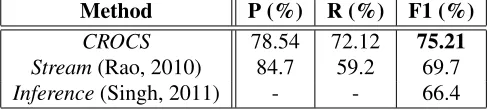
7.2 John-Smith Corpus: Long-Tail Entities Table 1 compares CROCS with two
state-of-the-art methods achieving the best published results for this benchmark. 66 randomly selected documents
were used as the training set (while the rest formed the test set) and the subsequentθvalue learned (as
described in Section 7.1) was0.96. Since the corpus contained mostly long-tail entities not present in any KB (only5-6of the 35 different John Smith’s are in Wikipedia, eg. the explorer John Smith etc.), the KB matches were too unreliable and led to the introduc-tion of noise. Hence, a high value ofθwas obtained
(i.e. KB features mostly disregarded).
CROCS (using sample-based spectral
cluster-ing) achieves anF1 scoreof75.21%, whileStream
(Rao et al., 2010) andInference(Singh et al., 2011) reach only69.7% and 66.4%resp. CROCS also
has a high φ3-CEAF score of 69.89% exhibiting substantial gains over prior methods2. Our novel
notion of semsum’s with extended scope (mentions and co-occurring mention groups) proved essential for outperforming the existing methods (see Sec-tion 7.6). The runtime of CROCS was only around
6seconds.
2Data and detailed CROCS output results are available at(www.dropbox.com/s/1grribug15yghys/John_Smith_ Dataset.zip?dl=0)
Method P (%) R (%) F1 (%)
CROCS 85.3 81.75 83.48
PolyUHK(Artiles, 2009) 87 79 82
UVA 1(Artiles, 2009) 85 80 81
Table 2:B3F1 results on WePS-2 dataset.
7.3 WePS-2 Corpus: Web Contents
We compared sampled spectral clustering based
CROCS on the WePS-2 corpus against the best
methods reported in (Artiles et al., 2009). We em-pirically obtained the KB match parameterθ= 0.68
according to the train-test setup described earlier (with1500training documents).
CROCS achieves a B3 based F1 score of
83.48%and aφ3-CEAF score of74.02%(Table 2),
providing an improvement of about 1.5 F1 score
points3. The gain observed is not as high as that for
the John Smith dataset, as in the WePS-2 corpus doc-uments are longer, giving richer context with fewer ambiguous entity mentions. Thus, simpler methods also perform fairly well. The runtime of CROCS on WePS-2 corpus was about 90 seconds.
7.4 New York Times Corpus: Web Scale The previous two datasets, John Smith and WePS-2 are too small to assess the robustness of CROCS for handling large data. We therefore ranCROCS
(with sample-based spectral clustering) on a random sample of 220,000 NYT news articles. The knowl-edge enrichment thresholdθwas learned to be0.45
with 73K training documents.
CROCS achieved a B3 F1 score of 59.17%
(with P = 56.18% and R = 62.49%) and a φ
3-CEAF score of 50.0%. No prior methods report
F1 performance figures for this large dataset. How-ever, the factor graph based approach of (Singh et al., 2010) measures the mention co-reference ac-curacy for a sample of 1,000 documents. Accu-racy is defined as the ratio of document clusters as-signed to an entity to the ground truth annotations. We also sampled 1,000 documents considering only mentions with multiple entity candidates. CROCS
achieved an accuracy of 81.71%, as compared to 69.9%for (Singh et al., 2010).
As for run-time,CROCStook 14.3 hours to
pro-cess around 150,000 news articles selected as the test corpus. We also compared this result against
CROCS configuration WePS-2 NYT
Sentences only 50.35 39.52
Basic Scope 64.14 53.88
Extended Scope 83.48 59.17
[image:10.612.81.286.43.111.2]NED baseline 61.25 59.62
Table 3: B3F1 scores for CROCS enrichment variants.
ternative algorithms within our framework (see Sec-tion 7.6). Hence, CROCS efficiently handles Web scale input data.
7.5 Sensitivity Studies
TheCROCSframework involves a number of
tun-able hyper-parameters adjusting the precise perfor-mance of the components. We now study the robust-ness ofCROCS (sample-based spectral clustering
variant) for varying parameter values. Knowledge Enrichment Scope:
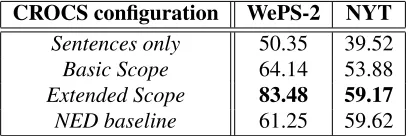
CROCS supports several levels of knowledge
en-richment for semsum’s construction: i) including only sentences of a mention group (disregarding the KB), ii) using distant KB labels for the given mention group only (basic scope), and iii) adding distant KB labels for co-occurring mention groups (extended scope). We compared these configura-tions among each other and also against a
state-of-the-art NED method alone. The results are
shown in Table 3. We used AIDA (Hoffart et al.,
2011) open-source software (https://github.
com/yago-naga/aida) for NED, and combined mentions mapped to the same KB entity. We use the trained value of θ obtained previously (for the
re-spective datasets) for constructing thebasic and ex-tended scopeof semsum’s, and report the bestB3F1
scores. Note that theSentences onlyandNED con-figurations are independent of the choice ofθvalue.
Real-life Web articles contain a mixture of promi-nent entities, ambiguous names, and long-tail en-tities; hence sole reliance on NED for CCR fares poorly. The extended scope semsum’s construction produces superior results compared to other models. Knowledge Enrichment Matching Threshold: To study the influence of different degrees of dis-tant KB feature extraction, we varied the enrich-ment matching thresholdθfrom 0.0 (accept all KB
matches) to 1.0 (no import from KB). The John Smith dataset largely containing long-tail entities uses θ ∼ 1 (trained value), and operates on sem-sum’s containing practically no feature inclusion from external KB’s. Hence, we only consider the scenario when the KB is completely disregarded (i.e.
Dataset 0.0 0.25 0.5 0.65 0.75θ 0.9 1.0
WePS-2 76.9 77.3 82.4 83.9 75.7 68.9 63.5
NYT 60.5 61.5 62.2 62.2 60.0 52.1 48.4
Table 4: B3F1 scores (%) for different choices ofθ.
Dataset θused P(%) R(%) F1(%)
WePS-2 0.45 83.46 80.21 81.9
[image:10.612.303.570.46.100.2]NYT 0.68 59.42 64.2 61.8
Table 5:θerror sensitivity of CROCS
θ= 1.0) and obtain aB3F1 score of76.47%.
For the other two datasets, the B3 F1 results for
varyingθare shown in Table 4. We observe that KB
features help the CCR process and the best results are obtained forθbetween 0.6 and 0.7. We observe
that the exact choice ofθis not a sensitive issue, and
any choice between 0.25 and 0.75 yields fairly good F1 scores (within 10% of the empirically optimal F1 results). Hence, our approach is robust regarding pa-rameter tuning.
We observe that the trained value of θ(obtained
previously) for both the WePS-2 and the NYT datasets are close to the optimal setting as seen from Table 4 and provide nearly similar F1 score perfor-mance. Therefore, we setθ= 0.65and consider the
entire input corpora as test set for the remainder of our experiments.
To reconfirm the robustness of CROCS to θ
value ranges, we use the KB threshold trained on WePS-2 dataset, and test it on the NYT dataset (and vice versa). From Table 5 we observe CROCS to render comparable performance in presence of er-rors during theθlearning phase.
Clustering Hyper-Parameters:
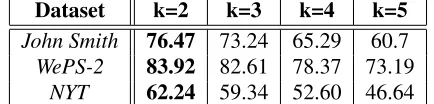
We study the effect of varyingk, the number of
sub-clusters for the bisection procedure invoked at each level of the hierarchical clustering. By default, this is set to 2 (i.e. bisection). Table 6 shows the B3 F1 scores for different choices of k, for the three
datasets (withθ= 1.0for John Smith andθ= 0.65
for the other two datasets). We observe thatk = 2
performs best in all cases. The output quality mono-tonically drops with increase ink, as this forces even similar mention groups to form separate clusters. Hence, bisection allows the hierarchical process to adjust the model selection at the global level. Alternative KB:
[image:10.612.324.528.126.178.2]Dataset k=2 k=3 k=4 k=5
John Smith 76.47 73.24 65.29 60.7
WePS-2 83.92 82.61 78.37 73.19
NYT 62.24 59.34 52.60 46.64
Table 6: B3F1 scores (%) for different # sub-clusters k.
Dataset P(%) R(%)Freebase F1 P(%) R(%)Yago F1
WePS-2 86.3 82.1 83.9 86.6 82.5 84.0
[image:11.612.75.292.50.102.2]NYT 59.8 64.9 62.2 61.3 60.8 61.0
Table 7: CROCS B3F1 scores with Freebase vs. Yago
ran alternative experiments on the WePS-2 and
NYT datasets with the Yago KB (
www.yago-knowledge.org). We obtain all approximate matches for a mention group and rank them based on the keyphrase similarity model (Section 5) us-ing sentences of the mention group and extracted features (from the YagohasLabelproperty and
in-foboxes in Wikipedia pages of the sameAs link).
Results in Table 7 show similar performance, depict-ing no preference ofCROCSto any particular KB.
7.6 Algorithmic Variants
The CROCS framework supports a variety of
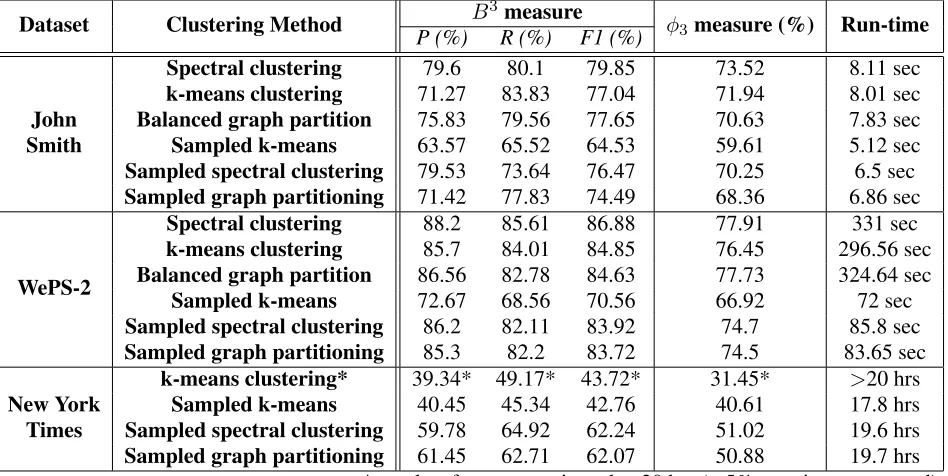
al-gorithmic building blocks, most notably, clustering methods (eg., k-means) or graph partitioning for the bisection steps, and most importantly, sampling-based methods versus methods that fully process all data points. The comparative results for the three different datasets are presented in Table 8.
For the John Smith corpus (with θ = 1.0), all
algorithms except sample-based k-means achieved similar performances in accuracy and runtime. The best method was the full-fledged spectral clustering, with about 2% F1 score improvement.
With the WePS-2 dataset, we obtain a similar pic-ture w.r.t. output quality. However, this dataset is large enough to bring out the run-time differences. Sampling-based methods, including CROCS, were about4×faster than their full-fledged counterparts,
albeit with a meager loss of about 2% in F1 score. The NYT dataset finally portrays the scenario on huge datasets. Here, only the sample-based methods ran to completion, while all the full-fledged methods were terminated after 20 hours. The fastest of them, the simple k-means method, had processed only about 5% of the data at this point (needing about 400 hours on extrapolation). In contrast, CROCS, using sample-based spectral clustering or graph
par-titioning, needed about 19.6 hours for the 220,000 documents. The sampling-based k-means competi-tor was slightly faster (17.8 hours), but lost dramat-ically on output quality: with only about 42% F1 score compared to 62% F1 score forCROCS.
Hence, we observe that CROCS is indeed well
designed for scalable sampling-based CCR, whereas other simpler methods like k-means, lacking transi-tivity awareness, fail to deliver good output quality.
8 Related Work
Co-reference Resolution (CR): Existing
intra-document CR methods combine syntactic with se-mantic features for identifying the best antecedent (preceding name or phrase) for a given mention (name, phrase, or pronoun). Syntactic features are usually derived from deep parsing of sentences and noun group parsing. Semantic features are obtained by mapping mentions to background knowledge re-sources such as Wikipedia. An overview of CR methods is given in (Ng, 2010). Recent methods adopt the paradigm of multi-phase sieves, apply-ing a cascade of rules to narrow down the choice of antecedents for a mention (e.g., (Haghighi & Klein, 2009; Raghunathan et al., 2010; Ratinov & Roth, 2012)). The cluster-ranking family of methods (e.g., (Rahman & Ng, 2011b)) extends this paradigm for connecting mentions with a cluster of preceding mentions. Person name disambiguation in CR deals with only person names, title, nicknames, and sur-face forms variations (Chen & Martin, 2007).
Distant Knowledge Labels for CR: To obtain
semantic features, additional knowledge resources such as Wikipedia, Yago ontology, and FrameNet corpus have been considered (Suchanek et al., 2007; Rahman & Ng, 2011a; Baker, 2012). To identify the entity candidate(s) that a mention (group) should use for distant supervision, CR methods such as (Rati-nov & Roth, 2012; Lee et al., 2013) use matching heuristics based on the given mention alone to iden-tify a single entity or all matching entities with con-fidence above some threshold. Zheng et al. (2013) generalizes this by maintaining a ranked list of en-tities for distant labeling, as mention groups are up-dated. Unlike CROCS, prior methods utilize only the candidates for the given mention (group) it-self and distant knowledge features for co-occurring mentions are not considered.
Cross-Document CR (CCR): Early works (Gooi
Dataset Clustering Method P (%)B3R (%)measureF1 (%) φ3 measure (%) Run-time
Spectral clustering 79.6 80.1 79.85 73.52 8.11 sec
k-means clustering 71.27 83.83 77.04 71.94 8.01 sec
John Balanced graph partition 75.83 79.56 77.65 70.63 7.83 sec
Smith Sampled k-means 63.57 65.52 64.53 59.61 5.12 sec
Sampled spectral clustering 79.53 73.64 76.47 70.25 6.5 sec
Sampled graph partitioning 71.42 77.83 74.49 68.36 6.86 sec
WePS-2
Spectral clustering 88.2 85.61 86.88 77.91 331 sec
k-means clustering 85.7 84.01 84.85 76.45 296.56 sec
Balanced graph partition 86.56 82.78 84.63 77.73 324.64 sec
Sampled k-means 72.67 68.56 70.56 66.92 72 sec
Sampled spectral clustering 86.2 82.11 83.92 74.7 85.8 sec
Sampled graph partitioning 85.3 82.2 83.72 74.5 83.65 sec
k-means clustering* 39.34* 49.17* 43.72* 31.45* >20 hrs
New York Sampled k-means 40.45 45.34 42.76 40.61 17.8 hrs
Times Sampled spectral clustering 59.78 64.92 62.24 51.02 19.6 hrs
Sampled graph partitioning 61.45 62.71 62.07 50.88 19.7 hrs
[image:12.612.74.548.39.277.2]* results after run terminated at 20 hrs (∼5% mentions processed)
Table 8: Accuracy and scalability of various algorithms embedded inCROCS
Baldwin, 1998), used IR-style similarity measures (tf×idf cosine, KL divergence, etc.) on features, similar to intra-document CR. Recent works such as (Culotta et al., 2007; Singh et al., 2010; Singh et al., 2011) are based on probabilistic graphical models for jointly learning the mappings of all mentions into equivalence classes. The features for this learning task are essentially like the ones in local CR. Baron and Freedman (2008) proposed a CCR method in-volving full clustering coupled with statistical learn-ing of parameters. However, this method does not scale to large corpora making it unsuitable for Web contents. A more light-weight online method by (Rao et al., 2010) performs well on large bench-mark corpora. It is based on a streaming cluster-ing algorithm, which incrementally adds mentions to clusters or merges mention groups into single clus-ters, and has linear time complexity; albeit with infe-rior clustering quality compared to advanced meth-ods like spectral clustering. Several CCR methmeth-ods have harnessed co-occurring entity mentions, espe-cially for the task of disambiguating person names (Mann & Yarowsky, 2003; Niu et al., 2004; Chen & Martin, 2007; Baron & Freedman, 2008). How-ever, these methods do not utilize knowledge bases, but use information extraction (IE) methods on the input corpus itself; thus facing substantial noise due to IE quality variance on stylistically diverse docu-ments like Web articles.
Spectral Clustering: (Luxburg, 2007) provides a
detailed study on spectral clustering models and al-gorithms. Yan et al. (2009) proposed two approxi-mation algorithms, based on the k-means technique and random projections, reducing the O(n3) time
complexity toO(k3) +O(kn)wherekis the num-ber of clusters. In CCR, the numnum-ber of clusters (truly distinct entities) can be huge and typically unknown; hence (Shamir & Tishby, 2011; Krishnamurty et al., 2012; Wauthier et al., 2012) developed active spectral clustering, where the expensive clustering step is based on data samples and other data points are merely “folded in”. The term “active” refers to the active learning flavor of choosing the samples (notwithstanding that these methods mostly adopt uniform random sampling).
9 Conclusions
We have presented the CROCS framework for
cross-document co-reference resolution (CCR). It performs sample-based spectral clustering or graph partitioning in a hierarchical bisection process to ob-tain the mention equivalence classes, thereby avoid-ing model-selection parameters and the high cost of clustering or partitioning. CROCS constructs
features for mention groups by considering co-occurring mentions and obtaining distant semantic labels from KB’s (for semsum’s).
References
J. Artiles, J. Gonzalo, S. Sekine: 2009. WePS 2 Evalua-tion Campaign: Overview of the Web People Search Clustering Task. WWW 2009.
A. Bagga, B. Baldwin: 1998. Entity-Based Cross-Document Coreferencing Using the Vector Space Model.In COLING-ACL, pages 79–85.
C. F. Baker: 2012. FrameNet, Current Collaborations & Future Goals.LREC, 46(2):269–286.
A. Baron, M. Freedman: 2008. Who is Who & What is What: Experiments in Cross-Document Co-Reference.In EMNLP, pages 274–283.
A. Buluc, H. Meyerhenke, I. Safro, P. Sanders, C. Schulz: 2013. Recent Advances in Graph Partitioning. Karl-sruhe Institute of Technology, Technical Report. J. Cai, M. Strube: 2010. Evaluation Metrics for
End-to-End Coreference Resolution Systems.In SIGDIAL, pages 28–36.
Y. Chen, J. Martin: 2007. Towards Robust Unsupervised Personal Name Disambiguation. In EMNLP-CoNLL, pages 190–198.
M. Cornolti, P. Ferragina, M. Ciaramita: 2013. A Frame-work for Benchmarking Entity-Annotation Systems. In WWW, pages 249–260.
S. Cucerzan: 2007. Large-Scale Named Entity Dis-ambiguation Based on Wikipedia Data. In EMNLP-CoNLL, pages 708–716.
A. Culotta, M. L. Wick, A. McCallum: 2007. First-Order Probabilistic Models for Coreference Resolution. In HLT-NAACL, pages 81–88.
P. Domingos, S. Kok, D. Lowd, H. Poon, M. Richard-son, P. Singla: 2007. Markov Logic.Probabilistic ILP. Springer-Verlag, pages 92–117.
P. Domingos, D. Lowd: 2009. Markov Logic: An In-terface Layer for Artificial Intelligence. Morgan and Claypool Publishers, 2009.
J. R. Finkel, T. Grenager, C. D. Manning: 2005. Incor-porating Non-local Information into Information Ex-traction Systems by Gibbs Sampling. In ACL, pages 363–370.
C. H. Gooi, J. Allan: 2004. Cross-Document Coreference on a Large Scale Corpus.In HLT-NAACL, pages 9–16. P. D. Gr¨unwald: 2007.The Minimum Description Length
Principle. MIT University Press.
A. Haghighi, D. Klein: 2009. Simple Coreference Reso-lution with Rich Syntactic and Semantic Features.In EMNLP, pages 1152–1161.
A. Haghighi, D. Klein: 2010. Coreference Resolution in a Modular, Entity-Centered Model. In HLT-NAACL, pages 385–393.
H. Hajishirzi, L. Zilles, D. S. Weld, L. S. Zettlemoyer: 2013. Joint Coreference Resolution and Named-Entity
Linking with Multi-Pass Sieves. In EMNLP, pages 289–299.
J. Hoffart, M. A. Yosef, I. Bordino, H. F¨urstenau, M. Pinkal, M. Spaniol, B. Taneva, S. Thater, G. Weikum: 2011. Robust Disambiguation of Named Entities in Text.In EMNLP, pages 782–792.
N. Hourdakis, M. Argyriou, G. M. Petrakis, E. E. Mil-ios: 2010. Hierarchical Clustering in Medical Docu-ment Collections: the BIC-Means Method.Journal of Digital Information Management, 8(2):71–77. G. Karypis, V. Kumar: 1998. A Fast and Highly Quality
Multilevel Scheme for Partitioning Irregular Graphs. Journal on Scientific Computing, 20(1):359–392. B. W. Kernighan, S. Lin: 1970. An efficient heuristic
pro-cedure for partitioning graphs.Bell System Technical Journal.
D. Koller, N. Friedman: 2009.Probabilistic Graphical Models: Principles and Techniques. MIT Press. A. Krishnamurty, S. Balakrishnan, M. Xu, A. Singh:
2012. Efficient Active Algorithms for Hierarchical Clustering.In ICML, pages 887–894.
H. Lee, Y. Peirsman, A. Chang, N. Chambers, M. Sur-deanu, D. Jurafsky: 2011. Stanford’s Multi-Pass Sieve Coreference Resolution System at the CoNLL-2011 Shared Task.In CoNLL, pages 28–34.
H. Lee, A. Chang, Y. Peirsman, N. Chambers, M. Sur-deanu, D. Jurafsky: 2013. Deterministic Coreference Resolution based on Entity-centric, Precision-ranked Rules.Computational Linguistics Journal, 39(4):885– 916.
H. Lee, M. Recasens, A. X. Chang, M. Surdeanu, D. Ju-rafsky: 2012. Joint Entity and Event Coreference Res-olution across Documents.In EMNLP-CoNLL, pages 489–500.
H. A. Loeliger: 2008. An Introduction to Factor Graphs. In MLSB.
X. Luo: 2005. On Coreference Resolution Performance Metrics.In HLT-EMNLP, pages 25–32.
U. von Luxburg: 2007. A Tutorial on Spectral Clustering. Statistics and Computing Journal, 17(4):395–416. G. S. Mann, D. Yarowsky: 2003. Unsupervised Personal
Name Disambiguation.In CoNLL,HLT-NAACL, pages 33–40.
D. N. Milne, I. H. Witten: 2008. Learning to Link with Wikipedia.In CIKM, pages 509–518.
V. Ng: 2010. Supervised Noun Phrase Coreference Re-search: The First Fifteen Years.In ACL, pages 1396– 1411.
K. Raghunathan, H. Lee, S. Rangarajan, N. Chambers, M. Surdeanu, D. Jurafsky, C. Manning: 2010. A Multi-Pass Sieve for Coreference Resolution. In EMNLP, pages 492–501.
A. Rahman, V. Ng: 2011a. Coreference Resolution with World Knowledge.In ACL, pages 814–824.
A. Rahman, V. Ng: 2011b. Ensemble-Based Coreference Resolution.In IJCAI, pages 1884–1889.
D. Rao, P. McNamee, M. Dredze: 2010. Streaming Cross Document Entity Coreference Resolution. In COL-ING, pages 1050–1058.
L. A. Ratinov, D. Roth, D. Downey, M. Anderson: 2011. Local and Global Algorithms for Disambiguation to Wikipedia.In ACL, pages 1375–1384 .
L. A. Ratinov, D. Roth: 2012. Learning-based Multi-Sieve Co-reference Resolution with Knowledge. In EMNLP-CoNLL, pages 1234–1244.
M. Richardson, P. Domingos: 2006. Markov Logic Net-works. Journal of Machine Learning, 62(1-2):107– 136.
E. Sandhaus: 2008. The New York Times Annotated Cor-pus Overview.Linguistic Data Consortium.
G. E. Schwarz: 1978. Estimating the Dimension of a Model.Annals of Statistics, 6(2):461–464.
O. Shamir, N. Tishby: 2011. Spectral Clustering on a Budget.Journal of Machine Learning Research- Pro-ceedings Track 15:661–669.
S. Singh, M. L. Wick, A. McCallum: 2010. Distantly La-beling Data for Large Scale Cross-Document Corefer-ence.CoRR abs/1005.4298.
S. Singh, A. Subramanya, F. Pereira, A. McCallum: 2011. Large-Scale Cross-Document Coreference Us-ing Distributed Inference and Hierarchical Models.In ACL, pages 793–803.
F. M. Suchanek, G. Kasneci, G. Weikum: 2007. YAGO: a Core of Semantic Knowledge.In WWW, pages 697– 706.
B. Taneva, M. Kacimi, G. Weikum: 2011. Finding Im-ages of Difficult Entities in the Long Tail.In CIKM, pages 189–194.
F. L. Wauthier, N. Jojic, M. I. Jordan: 2012. Active Spec-tral Clustering via Iterative Uncertainty Reduction.In KDD, pages 1339–1347.
D. Yan, L. Huang, M. I. Jordan: 2009. Fast approximate spectral clustering.In KDD, pages 907–916.