Ways of Asking and Replying in Duplicate Question Detection
Jo˜ao Rodrigues, Chakaveh Saedi, Vladislav Maraev, Jo˜ao Silva, Ant´onio Branco University of Lisbon
{joao.rodrigues,chakaveh.saedi,vlad.maraev,
jsilva,antonio.branco}@di.fc.ul.pt
Abstract
This paper presents the results of sys-tematic experimentation on the impact in duplicate question detection of different types of questions across both a number of established approaches and a novel, supe-rior one used to address this language pro-cessing task. This study permits to gain a novel insight on the different levels of robustness of the diverse detection meth-ods with respect to different conditions of their application, including the ones that approximate real usage scenarios.
1 Introduction
Automatic detection of semantically equivalent questions is a language processing task of the ut-most importance given the upsurge of interest in conversational interfaces. It is a key procedure in finding answers to questions. For instance, in a context of customer support via a chat channel, with the help of duplicate question detection, pre-vious interactions between customers and human operators can be explored to provide an increas-ingly automatic question answering service. If a new input question is equivalent to a question al-ready stored, it can be replied automatically with the answer stored with its recorded duplicate.
Though it has been less researched than simi-lar tasks, duplicate question detection (DQD) is attracting an increasing interest. It can be seen as belonging to a family of semantic text sim-ilarity tasks, which have been addressed in Se-mEval challenges since 2012, and which in the last SemEval2016, for instance, included also tasks like plagiarism detection or degree of similarity between machine translation output and its post-edited version, among others. Semantic textual similarity assesses the degree to which two
tex-tual segments are semantically equivalent to each other, which is typically scored on an ordinal scale ranging from semantic equivalence to complete semantic dissimilarity.
Paraphrase detection can be seen as a special case of semantic textual similarity, where the scale is reduced to its two extremes and the outcome for an input pair is yes/no. DQD, in turn, could be seen as a special case of paraphrase detection that is restricted to interrogative expressions.
While SemEval2016 had no task on yes/no DQD, it had a “Question-Question” graded sim-ilarity subtask of Task 1. The top performing system in this subtask (0.74 Pearson correlation) scored below the best result when all subtasks of Task 1 are considered (0.77), and also below the best scores of many of the other subtasks (e.g. 0.84 in plagiarism detection (Agirre et al.,2016)).
While scores obtained for different tasks by sys-tems trained and evaluated over different datasets cannot be compared, those results nonetheless lead one to ponder whether focusing on pairs of interrogatives may be a task that is harder than paraphrase detection that focuses on pairs of non-interrogatives (e.g. plagiarism pairs), or at least whether it needs different and specific approaches for similar levels of performance to be attained.
When checking for other research results specifically addressing DQD, pretty competitive results can be found, however, as in Bogdanova et al. (2015). These authors used a dataset that included a dump from the Meta forum in Stack-Exchange (a source that would be explored also in SemEval2016) and a dump from the AskUbuntu forum, and reported over 92% accuracy.
The pairs in these datasets are made of the tex-tual segments that are submitted by the users of the forums to elicit some feedback from other users that may be of help, and that will pile up in threads of reactions. They have two parts, known as
tle” and “body”. The title tends to be a short seg-ment identifying the issue being addressed, and the body is where that issue is expanded, and can be several paragraphs long.
To avoid a maze of exactly duplicate questions, and thus of duplicate threads, which would ham-per the usability of the forums, for the same is-sue, all duplicates except one are removed, leaving only near duplicates—that are marked as such and cross-linked to each other, and may be of help in addressing the same topic from a different angle.
The pairs of duplicate segments included in the experimental datasets mentioned above are the ti-tles and bodies of nearly duplicate threads. The pairs of non-duplicate segments are made of titles and bodies that are not near duplicate.
While these “real life” data are important for the development of DQD solutions that support the management of these community forums, their textual segments are quite far from expressions in clean and clear interrogative form. The short sup-ply of this sort of datasets has been perhaps part of the reason why the DQD has not been more researched. This may help to explain also the lack of further studies so far on how the nature of the questions and the data may impact the perfor-mance of the systems on this task.
The experiments reported in this paper aim to address this issue and help to advance our under-standing of the nature of DQD and to improve its application. We will resort to previous datasets used in the literature, just mentioned above, but we will seek to explore also a new dataset from Quora, released recently, in January 2017.
The pairs of segments in this Quora dataset con-cern any subject and are thus not restricted to any domain. The segments are typically one sentence long, clean and clear interrogative expressions. Their grammatical well-formedness is ensured by the volunteer experts that answer them and that, before writing their replies, can use the editing fa-cility to adjust the wording of the question entered by the user if needed.
This is in clear contrast with the other datasets extracted from community forums. The forums are organized by specific domains. The segments may be several sentences long and are typically of-fered in a sloppy wording, with non-standard ex-pressions and suboptimal grammaticality.
By resorting only to data of the latter type,
Bogdanova et al. (2015) confirmed that systems
trained (and evaluated) on a smaller dataset that is domain specific can perform substantially bet-ter than when they are trained (and evaluated) on a larger dataset from a generic domain.
In this paper, we seek to further advance the un-derstanding of DQD and possible constraints on their development and application. We assess the level of impact of the length of the segments in the pairs, and study whether there is a difference when systems handle well-edited, generic domain segments, versus domain specific and sloppy ones. As the datasets with labeled pairs of segments are scarce, to develop a system to a new specific domain lacking a training dataset, the natural way to go is to train it on a generic domain dataset. We also study the eventual loss of performance in this real usage scenario.
These empirical contrasts may have a differ-ent impact in differdiffer-ent types of approaches to DQD. The present study will be undertaken across a range of different techniques, encompassing a rule-based baseline, a classifier-based system and solutions based on neural networks.
To secure comparability of the individual re-sults, the experimental datasets used are organized along common settings. They have the same vol-ume (30K pairs), the same training vs. testing split rate (80%/20%), and the same class balance (50%/50% of duplicates and non-duplicates).
This paper is organized as follows. In Section
2, the datasets used are described. Sections 3, 4
and5present the experimental results of a range of different detection techniques, respectively, rule-based, supervised classifiers and neural networks. In section6, the results obtained are discussed, and further experiments are reported in Section7, ap-proximating a real usage scenarios of application. Sections8and9present the related work and the conclusions.
2 Datasets
We used two datasets, from two sources:1(i) from
1 QHow is the new Harry Potter book ’Harry Potter and the Cursed Child’?
QHow bad is the new book by J.K Rowling? 0 QShould the toothbrush be wet or dry before
apply-ing the toothpaste?
QWhat is the cheapest toothpaste?
1 QCan I install Ubuntu and Windows side by side?
[image:3.595.74.289.61.147.2]QHow do I dual boot Windows along side Ubuntu?
Figure 1: Three example question pairs and their labels from the Quora dataset
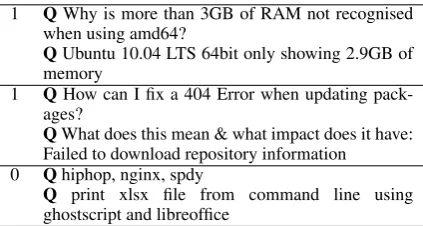
1 QWhy is more than 3GB of RAM not recognised when using amd64?
QUbuntu 10.04 LTS 64bit only showing 2.9GB of memory
1 QHow can I fix a 404 Error when updating pack-ages?
QWhat does this mean & what impact does it have: Failed to download repository information 0 Qhiphop, nginx, spdy
Q print xlsx file from command line using ghostscript and libreoffice
Figure 2: Three example segment pairs (titles only) and their labels from the AskUbuntu dataset
rogative sentence, receives an answer often from a volunteer expert. For either dataset, the language of the textual segments is English.
We resorted to the first Quora dataset, released by the end of January 2017.2 It consists of over
400k pairs of questions labeled 1 in case they are duplicates of each other, or 0 otherwise. The pairs in the dataset released were collected with sam-pling techniques and their labeling may not be fully correct, and are not restricted to any subject (Iyer et al.,2017).
The other dataset used here is similar to one of the datasets used by Bogdanova et al. (2015). It is made of queries from the AskUbuntu forum,3
which are thus on a specific domain, namely from the IT area, in particular about the Ubuntu opera-tive system. We used AskUbuntu dump available, from September 2014,4 containing 167,765
ques-tions, of which 17,115 were labeled as a duplicate. A portion with 30k randomly selected pairs of title+body was extracted, the same size as the por-tion used by Bogdanova et al. (2015). This por-tion is balanced, thus with an identical number of duplicate and non-duplicate pairs. To support the experiments described below, it was divided into 24k/6k for training/testing, an 80%/20% split.
2 https://data.quora.com/First-Quora-Dataset-Release-Question-Pairs.
3https://askubuntu.com/
4https://meta.stackexchange.com/a/224922.
The textual segments in this dataset contain both the title and the body of the query in the corresponding thread, and this dataset is referred to as AskUbuntuTB, while its counterpart with ti-tles only—obtained by removing the bodies—is referred to as AskUbuntuTO.
To support comparison, a portion with 30k ran-domly selected pairs was extracted also from the Quora release, with the same duplicate vs. non-duplicate balance and the same training vs. test split rates as for the AskUbuntu dataset.
The average length of the segments in number of words is 84 in AskUbuntuTB. Its counterpart AskUbuntuTO, with titles only, represent a very substantial (10 times) drop to 8 words per segment on average, which is similar to the 10 words per segment in the Quora dataset.
The vocabularies sizes of AskUbuntuTB, AskUbuntuTO and Quora are 45k, 16k and 24k items, respectively, and their volumes are 5M, 500k and 650k tokens, respectively. Concerning the 400k pair Quora release, in turn, it contains 9M tokens and a 125k item vocabulary.
3 Rule-based
As a first approach experimented with, inspired by (Wu et al.,2011), we resorted to the Jaccard Coef-ficient overn-grams withnranging 1 to 4.
Before applying this technique, the textual seg-ments were preprocessed by undertaking (i) to-kenization and stemming, using the NLTK tok-enizer and Porter stemmer(Bird, 2006); and (ii) markup cleaning, whereby markup tags for refer-ences, links, snippets of code, etc. were removed.
To find the best threshold, we used the train-ing set in a series of trials and applied the best results for the test sets. This led to the thresh-olds 0.1, 0.016, 0.03 for Quora, AskUbuntuTO and AskUbuntuTB, respectively.
This approach obtains 72.91% accuracy when applied over AskUbuntuTB.5
When running over AskUbuntuTO, its perfor-mance seems not to be dramatically affected by the much shorter segment length, suffering a slight de-crease to 72.35%. Interestingly, a clear drop of the accuracy of over 3 percentage points is observed when it is run over Quora, scoring 69.53%.
[image:3.595.75.287.189.302.2]Title:vsftpd not listing large directory from WAN interface
Body: I have vsftpd running on my Ubuntu server, which is behind an Asus RT-N66U router. Port 21 is forwarded to the server. I can connect via my public IP address to the server(81 more words omitted)
Title:hiphop, nginx, spdy
Body: I’m about a month young at linux and brand new to ubuntu. I can do this to install hiphop https://github.com/facebook/hiphop-php/wiki/Building-and-installing-HHVM-on-Ubuntu-12.04(69 more words omitted)
Title:No wireless ubuntu13.10
Body:Installed ubuntu 13.10 yesterday no internet connection.12.10 ok and dongle ok,13.4 no dongle, nothing now. Compac mini 110c, broadcom 4313 (AR8132 Q.Atheros.) Only have ubuntu on notebook.
Figure 3: Three example segments (titles and bodies) from AskUbuntu dataset
ening of the length of the segments, it is less robust when its application changes from a specific to an unconstrained domain.
4 Classifier
4.1 Basic features
To set up a DQD system resorting to an approach based on a supervised machine learning classi-fier, we resorted to supporting vector machines (SVM), following its acknowledged good perfor-mance in this sort of tasks and following an option also taken by Bogdanova et al. (2015). We em-ployed SVC (Support Vector Classification) im-plementation from the sklearn support vector ma-chine toolkit (Pedregosa et al.,2011)
For the first version of the classifier, a basic fea-ture set (F S) was adopted.N-grams, withnfrom 1 to 4, were extracted from the training set and the ones with at least 10 occurrences6were selected to
support theF S
For each textual segment in a pair, a vector of sizekwas generated, wherekis the number ofn -grams included in the F S. Each vector encodes the occurrences of then-grams in the correspond-ing segment, where vector position iwill be 1 if thei-thn-gram occurs in the segment, and 0 oth-erwise. Then a feature vector of size2kis created by concatenating the vectors of the two segments. This vector is further extended with the scores of the Jaccard coefficient determined over 1, 2, 3 and 4-grams. Hence, the final feature vector represent-ing the pair to the classifier has the length2k+ 4. This system achieves 70.25% accuracy7 when
trained over the AskUbuntuTB. Its accuracy drops some 1.5 percentage points, to 68.88%, when trained with the shorter segments of AskUbun-tuTO, and drops over 5 points, to 64.93%, when
6We tried thresholds ranging from 5 to 15.
7We tried also with another implementation of SVM, namely SVM-light (Joachims, 2006), and the same score 70.25 was achieved.
trained with Quora, also with shorter segments than AskUbuntuTB but from a broader, all-encompassing domain.
4.2 Advanced features
To have an insight on how strong an SVM-based DQD resolver resorting to a basicF Slike the one described above may be, we proceeded with fur-ther experiments, by adding more advanced fea-tures. We used Princeton WordNet (Fellbaum,
1998) to bring semantic knowledge to the system and used further text preprocessing to have more explicit lexical information, namely the text was normalized, e.g. “n’t” was replaced with “not”, etc., and POS tagged, with NLTK.
Lexical features The vector of each segment
was extended with an extra feature, namely the number of negative words (e.g. nothing, never, etc.) occurring in it. And, to the concatenation of segment vectors, one further feature was added, the number of nouns that are common to both seg-ments, provided they are not already included in theF S. Any pair was then represented by a vec-tor of size2(k+ 1) + 4 + 1.
Semantic features Eventually, any pair was
rep-resented by a vector of size2(k+ 1) + 4 + 2, with its length being extended with yet an extra feature, namely the value of the cosine similarity between the embeddings of the segments in the pair.
For a given segment, its embedding, or distribu-tional semantic vector, was obtained by summing up the embeddings of the nouns and verbs occur-ring in it, as these showed to support the best per-formance after experiments have been undertaken with all parts-of-speech and their subsets.
Autoex-tend (Rothe and Sch¨utze, 2015) to extract synset embeddings with the support of WordNet. We adopted the same configuration as in that paper and used version 3 of WordNet, which contains over 120k concepts, represented by synsets. The main advantage of synset embeddings over word embeddings in duplicate detection is the fact that synonyms receive exactly the same distributional vectors, which helps to appropriately take into ac-count words in the segments of the pair that are different in linguistic form but are synonyms.
Results The resulting system permitted an
im-provement of over 5 percentage points with re-spect to its previous version trained with basic fea-tures, scoring 75.87% accuracy when running over AskUbuntuTB.
This advantage is not so large when it is run over the datasets with shorter segments. It scored 70.87% with AskUbuntuTO (positive delta of al-most 2 points relative to the previous basic ver-sion), and 68.56% with Quora (over 3.5 points bet-ter).8
5 Neural Networks
We experimented with three different architectures for DQD resolvers based on neural networks. The first experiment adopts the architecture explored in one of the papers reporting the most com-petitive results for DQD, and the second adopts the neural architecture of the top performing sys-tem in the “Question-Question” subtask of Se-mEval2016. The third system adopts a hybrid ar-chitecture combining key ingredients of the previ-ous two.
5.1 Convolutional
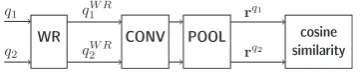
The architecture of convolutional neural network (CNN) to address DQD was introduced by Bog-danova et al.(2015). First, the CNN obtains the vectorial representations of the words, also known as word embeddings, in the two input segments. Next, a convolutional layer constructs a vectorial representation for each one of the two segments. Finally, the two representations are compared us-ing cosine similarity, whose value if above an em-pirically estimated threshold, determines that the two segments are duplicate (diagram in Figure4).
8This score was obtained resorting to 1- to 4-grams. Ex-periments with 1- to 3-grams and with 1- to 5-grams delivered worst scores, respectively 68.38% and 68.42%.
WR CONV POOL cosine
[image:5.595.327.508.63.102.2]similarity
Figure 4: CNN architecture: word representation (WR), convolution (CONV), pooling (POOL) and cosine similarity measurement layers.
To replicate this approach, we resorted to Keras (Chollet, 2015) with Tensorflow (Abadi et al.,
2015) back-end for training and evaluating the neural network. The hyper-parameters either replicate the ones reported by Bogdanova et al.
(2015) or are taken from vanilla CNN architecture as it is implemented in the above libraries.
The DeepLearning4j9 toolkit was used for
cre-ating the initial word representations. Bogdanova et al. (2015) specify only the skip-gram neural network architecture and the embeddings dimen-sionality of 200 as training parameters for their best run. In our experiment, besides these param-eters, all the other hyper-parameters were taken from a vanilla version ofword2vec implemented in DeepLearning4j. In this experiment, to train word embeddings, we used the 38 million tokens of the September 2014 AskUbuntu dump avail-able.10
When trained over AskUbuntuTB, the system performs with 73.40% accuracy. An improvement of over 1 point, to 74.50%, was obtained with a slight variant where the CNN was run without pre-trained word embeddings, and with a random ini-tialization of the embeddings using uniform distri-bution.
The drop in performance observed in the sys-tems presented above when moving to shorter segments is also observed here, with a much greater impact with Quora, coming down almost 15 points, to 59.90%, than with AskUbuntuTO, which comes down less than half a point, to 74.10%. This seems to indicate that the CNN is less robust than previous approaches when mov-ing from a specific to a generic domain.
The score of 73.40%, obtained with settings similar to Bogdanova et al. (2015), is inferior in almost 20 percentage points to the score reported in that paper. This led us to look more carefully in the two experiments.
As indicated in previous sections, in our experi-9http://deeplearning4j.org
ments the datasets were submitted to a preprocess-ing phase, includpreprocess-ing markup cleanpreprocess-ing by means of which tags for references, links, snippets of code, etc. were removed. One of these tags is rendered to the reader of a thread in the AskUbuntu forum as “Possible duplicate:<title>”, where<title>is instantiated with the title of the other thread that the present one is a possible duplicate of, and is linked to the page containing that other thread.
As we hypothesized that this might be a reason for the 20 point delta observed, we retrained our CNN-based system over AskUbuntuTB slightly modified just to keep that “Possible duplicate
<title>” phrase. Accuracy of 94.20% was ob-tained, in the same range of the 92.9% score re-ported byBogdanova et al.(2015).11
5.2 Deep
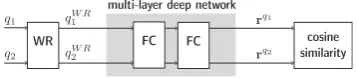
MayoNLP (Afzal et al., 2016) was the top per-forming system in the “Question-Question” sub-task of SemEval 2016 Task 1 (Agirre et al.,2016). Its architecture is based on Deep Structured Se-mantic Models, introduced byHuang et al.(2013), whose first layer is a 30k dense neural network fol-lowed by two hidden multi-layers with 300 neu-rons each and finally a 128 neuron output layer. All the layers are feed-forward and fully con-nected (diagram in Figure5).
This neural network was used to process text and given the huge dimension of the input text (around 500k tokens), a word hashing method was used that creates trigrams for every word in the input sentence: for instance, the wordgirlwould be represented as the trigrams#gi, gir, irl and rl#, including the beginning and end marks. This per-mitted to reduce the dimension of the input text to 30k, which is represented in the first neural layer.
The MayoNLP system adopts this architecture with the difference that the two hidden layer be-come a 1k neuron layer and the output layer is adapted to the SemEval2016 subtask, which is a graded textual similarity classification.
We resorted to the Keras deep learning library to replicate this architecture. Given that the dimen-sion of the input in our task was smaller, we used one neuron for each word in our vocabulary and it was not necessary to resort to word hashing for dimensionality reduction. Hence, an input layer with approximately the same size of neurons was 11Our attempt to reach the authors to obtain a copy of the dataset used in their paper remained unreplied.
WR FC cosine
similarity FC
[image:6.595.327.506.64.103.2]multi-layer deep network
Figure 5: DNN architecture: word representation layer (WR), fully connected layers (FC) and cosine similarity measurement layer.
created: 63k for the AskUbuntuTB dataset, 16k neurons for AskUbuntuTO and 24k for Quora.
When evaluating the resulting system, the same overall pattern as with previous approaches emerges. The best accuracy is obtained with AskUbuntuTB, 78.65%, which has a slight drop with AskUbuntuTO, to 78.40%.
These scores are in contrast with the accuracy of 69.53% obtained with Quora, indicating that also here moving to a generic domain imposes a sub-stantial loss of accuracy, of over 8 points.12
5.3 Hybrid DCNN
We also experimented with a novel architecture we developed by combining the convoluted and deep models discussed in the previous sections. By re-sorting to the Keras deep learning library, the key ingredients of the convoluted and the deep net-works (DCNN) were implemented together.
The hybrid DCNN starts with the same input structure as the CNN, obtaining the vectorial rep-resentations of words in two input segments. It then connects each of them to a shared convo-lutional layer followed by three hidden and fully connected layers, whose output is finally com-pared using the cosine distance. Both the convolu-tional and the deep layers share the same weights for the two sentences input, in a siamese network (diagram in Figure6).
The vectorial representation uses an embedding layer of 300 randomly initiated neurons with uni-form distribution which are trainable. The con-volution layer uses 300 neurons for the output of filters with a kernel size of 15 units, and each deep layer has 50 neurons.
WR CONV POOL cosine similarity multi-layer deep network
[image:7.595.94.269.64.98.2]FC FC FC
Figure 6: DCNN architecture.
may be an indicator that, when using the title and body, the neural network could perform better but may be failing due to the sparseness of the data, which requires possibly a higher number of neu-rons in the deep layer.
As for the result with Quora, in turn, the same pattern is observed as in previous systems. There is a substantial drop of over 8 points, to 71.48%.
6 Discussion
The experimental results reported in the previous sections are summarized in Table1. The perfor-mance of each approach or architecture for DQD was assessed in the respective section. Putting all results side by side, some patterns emerge.
Shortening the length of the segments (from 84 words per segment on average, with AskUbun-tuTB, to 8 or 10 words, respectively with AskUbuntuTO or Quora) has an overall negative impact on the accuracy of the systems, except for DCNN. For AskUbuntuTO, the negative delta ranges from 0.25 points, with DNN, to over 5 points, with SVM-adv.
NN-based solutions seem thus to be more ro-bust to the shortening of the length of the segments than SVM-based ones, even to the point where the more sophisticated DCNN approach inverts this pattern, and performs better for shorter segments than for longer ones with AskUbuntu.
As the average length of segments in AskUbun-tuTO and Quora are similar, the contrast between their scores permits to uncover yet another pattern. Moving from a specific to a generic domain has an overall negative impact on the accuracy of the sys-tems, which is wider than with the shortening of the segments. The negative delta ranges from less than 3 points, with Jaccard or SVM-base, to over 14 points, with DNN.
The level of the impact seems to be inverted here. It is the non NN-based solutions that appear as more robust to the generalization of the domain than the NN-based ones, to the point that the supe-riority shown by NN-based ones with the specific domain is reduced or even canceled with the gen-eral domain.
It is interesting to note that, for the generic do-main, the CNN approach offers the worst result. The DNN overcomes the best SVM approach by less than 2 points. And only the DCNN overcomes the overall second-best, but also by a modest mar-gin.
It is also very interesting to note that, for gen-eral domain, the rule-based approach is one of the two second best, thus challenging the immense so-phistication of any other approach, including the NN-based ones.
7 Cross-domain application
Given the scarcity of labeled datasets of pairs of interrogative segments, in real usage scenar-ios systems tend to be trained on as much data as possible from all sources and different domains. We experimentally approximated this scenario by training the best DQD system of each approach over the generic dataset (Quora) and evaluating them over the focused dataset (AskUbuntuTO).
The rule-based, the advanced SVM and the DCNN perform, respectively, with accuracies of 57.63% (dropping almost 15 points), 53.50% (dropping over 17 points) and 56.42% (dropping over 15 points).
Interestingly, leaner systems seem to be more robust in this approximation to its application in real-usage scenarios than more sophisticated ones. Importantly, however, for all types of systems, ac-curacy is observed to degrade and comes close to random decision performance.13
Given these results, it is interesting to check, for the generic domain, how this challenge may evolve when the training set is substantially en-larged, namely to the largest dataset available at present, that is to the over 400K pairs of the full Quora release. We picked the more lean technique (rule-based) and more sophisticated one (DCNN). Interestingly their accuracy scores evolved to-wards opposite directions when compared to the scores obtained with the (over 13 times) smaller experimental Quora dataset, with 30k pairs. The rule-based solution scored 66.74% accuracy, drop-ping over 2 points, while the DCNN scored 79.36%, progressing almost 8 points.14
13Recall that in our experimental conditions, the 30k datasets are balanced with 50% duplicate pairs and 50% non-duplicate, but the 400k Quora release is not. To confirm this trend, we collected yet another data point for CNN, which scored 50.20%, in line with the other systems.
imple-Jcrd SVM-bas SVM-adv CNN DNN DCNN AskUbuntu
title and body 72.91 70.25 75.87 74.50 78.65 79.00
title only 72.35 68.88 70.87 74.12 78.40 79.67
Quora 69.53 64.93 68.56 59.90 69.53 71.48
Table 1: Accuracy of the 6 systems (columns) over the 3 datasets (lines)
8 Related work
An interesting approach to DQD was introduced by Wu et al.(2011). It resorts to the Jaccard co-efficient to measure similarities between two seg-ments in the pair. Separate coefficients are calcu-lated, and assigned different weights, for the seg-ments. A threshold is empirically estimated and used to determine whether two threads are dupli-cates. An f-score of 60.29 is obtained for the titles only, trained with 3M questions and tested against 2k pairs taken from a dataset obtained from Baidu Zhidao, in Chinese. This approach is used as a baseline byBogdanova et al.(2015). This system inspired one of the architectures used in our exper-iments, presented in detail in Section5.1.
The recent SemEval-2016 Task 1 included a “Question-Question” subtask to determine the de-gree of similarity between two interrogative seg-ments. The MayoNLP system (Afzal et al.,2016) obtained the best accuracy in this task. This sys-tem inspired one of the syssys-tems used in our exper-iments, presented in detail in Section5.2.
Regarding the Quora dataset released 2 months ago, to the best of our knowledge, up to now there is only one unpublished paper concerning that task (Wang et al.,2017). It proposes a multi-perspective matching (BiMPM) model and evalu-ates it upon a 96%/2%/2% train/dev/test split. This system is reported to reach an accuracy of 88.17%. Other draft results concerning Quora dataset are available only as blog posts15,16and are based on
the model for natural language inference proposed byParikh et al.(2016).
mented a lean version of DCNN to run this experiment, which used a vectorial representation of 25 neurons randomly initi-ated, followed by a convolution layer which uses 10 neurons for the output of filters and with a 5 kernel size. The deep layers were reduced to two layers each with 10 neurons. A 70%/30% randomly extracted for training/testing was used both for the experiment with the DCNN and with the rule-based approach.
15 https://engineering.quora.com/Semantic-Question-Matching-with-Deep-Learning
16 https://explosion.ai/blog/quora-deep-text-pair-classification
9 Conclusions
The experiments reported in this paper permit-ted to advance the understanding of the duplicate question detection task and improve its applica-tion. There is consistent progress in terms of the accuracy of the systems as one moves from less to more sophisticated approaches, from rule-based to support vector machines, and from these to neu-ral networks, when its application is over a nar-row, specific domain. The same trend is observed for the range of support vector machines solutions, with better results obtained for resolvers resort-ing to more advanced features. And it is observed also for the range of neural network architectures experimented with, from convoluted to deep net-works, and from these to hybrid convoluted deep ones. Overall, the novel neural network architec-ture we propose presents the best performance of all resolvers tested.
The rate of this progress is however mitigated or even gets close to be canceled when one moves from a narrow and specific to broad and all-encompassing domain. Under our experimental conditions, the gap of over 11 points from the worst to the best performing solution with a nar-row domain is cut to almost half, and the more sophisticated solution, with the best score, over-comes the leanest one just by less than 2 points when running over a generic domain.
Interestingly, when one moves, in turn, from longer to (eight times) shorter segments, only mi-nor drops in performance are registered.
Given the scarcity of labeled datasets of pairs of interrogative segments, in real usage scenarios, systems are trained on as much data as possible from all sources and different domains and eventu-ally applied over narrow domains. We experimen-tally approximated this scenario, where the accu-racy of the systems was observed to degrade and come close to random decision performance.
Acknowledgements
The present research was partly supported by the CLARIN and ANI/3279/2016 grants.
References
Mart´ın Abadi, Ashish Agarwal, Paul Barham, Eugene Brevdo, Zhifeng Chen, Craig Citro, Greg S. Cor-rado, Andy Davis, Jeffrey Dean, Matthieu Devin, Sanjay Ghemawat, Ian Goodfellow, Andrew Harp, Geoffrey Irving, Michael Isard, Yangqing Jia, Rafal Jozefowicz, Lukasz Kaiser, Manjunath Kudlur, Josh Levenberg, Dan Man´e, Rajat Monga, Sherry Moore, Derek Murray, Chris Olah, Mike Schuster, Jonathon Shlens, Benoit Steiner, Ilya Sutskever, Kunal Tal-war, Paul Tucker, Vincent Vanhoucke, Vijay Va-sudevan, Fernanda Vi´egas, Oriol Vinyals, Pete Warden, Martin Wattenberg, Martin Wicke, Yuan Yu, and Xiaoqiang Zheng. 2015. TensorFlow: Large-scale machine learning on heterogeneous sys-tems. Software available from tensorflow.org.
http://tensorflow.org/.
Naveed Afzal, Yanshan Wang, and Hongfang Liu. 2016. MayoNLP at SemEval-2016 task 1: Semantic textual similarity based on lexical semantic net and deep learning semantic model. In Proceedings of the 10th International Workshop on Semantic Eval-uation (SemEval-2016). pages 1258–1263.
Eneko Agirre, Carmen Banea, Daniel M. Cer, Mona T. Diab, Aitor Gonzalez-Agirre, Rada Mihalcea, Ger-man Rigau, and Janyce Wiebe. 2016. Semeval-2016 task 1: Semantic textual similarity,
mono-lingual and cross-mono-lingual evaluation. In Steven
Bethard, Daniel M. Cer, Marine Carpuat, David Ju-rgens, Preslav Nakov, and Torsten Zesch, editors,
Proceedings of the 10th International Workshop on Semantic Evaluation, SemEval@NAACL-HLT 2016, San Diego, CA, USA, June 16–17, 2016. The As-sociation for Computer Linguistics, pages 497–511.
http://aclweb.org/anthology/S/S16/S16-1081.pdf.
Steven Bird. 2006. NLTK: the natural language toolkit. In Proceedings of the COLING/ACL on Interac-tive presentation sessions. Association for Compu-tational Linguistics, pages 69–72.
Dasha Bogdanova, C´ıcero Nogueira dos Santos, Lu-ciano Barbosa, and Bianca Zadrozny. 2015. Detect-ing semantically equivalent questions in online user
forums. In Afra Alishahi and Alessandro Moschitti,
editors, Proceedings of the 19th Conference on Computational Natural Language Learning, CoNLL 2015, Beijing, China, July 30–31, 2015. ACL, pages 123–131.
http://aclweb.org/anthology/K/K15/K15-1013.pdf.
Franc¸ois Chollet. 2015. Keras.
https://github.com/fchollet/keras.
Christiane Fellbaum. 1998. WordNet. Wiley Online Library.
Po-Sen Huang, Xiaodong He, Jianfeng Gao, Li Deng, Alex Acero, and Larry Heck. 2013. Learning deep structured semantic models for web search using clickthrough data. InProceedings of the 22nd ACM International Conference on Information & Knowl-edge Management. ACM, pages 2333–2338. Shankar Iyer, Nikhil Dandekar, and Korn´el
Cser-nai. 2017. First quora dataset release: Question
pairs.
https://data.quora.com/First-Quora-Dataset-Release-Question-Pairs.
Thorsten Joachims. 2006. Training linear SVMs in lin-ear time. InProceedings of the 12th ACM SIGKDD International Conference on Knowledge Discovery and Data Mining. pages 217–226.
Tomas Mikolov, Wen-tau Yih, and Geoffrey Zweig. 2013. Linguistic regularities in continuous
space word representations. In Lucy
Vander-wende, Hal Daum´e III, and Katrin Kirchhoff, ed-itors, Human Language Technologies: Confer-ence of the North American Chapter of the As-sociation of Computational Linguistics, Proceed-ings, June 9-14, 2013, Westin Peachtree Plaza Hotel, Atlanta, Georgia, USA. The Association for Computational Linguistics, pages 746–751.
http://aclweb.org/anthology/N/N13/N13-1090.pdf.
Ankur P. Parikh, Oscar T¨ackstr¨om, Dipanjan Das, and Jakob Uszkoreit. 2016. A decomposable attention
model for natural language inference. In Jian Su,
Xavier Carreras, and Kevin Duh, editors, Proceed-ings of the 2016 Conference on Empirical Meth-ods in Natural Language Processing, EMNLP 2016, Austin, Texas, USA, November 1–4, 2016. The Asso-ciation for Computational Linguistics, pages 2249– 2255.
http://aclweb.org/anthology/D/D16/D16-1244.pdf.
F. Pedregosa, G. Varoquaux, A. Gramfort, V. Michel, B. Thirion, O. Grisel, M. Blondel, P. Pretten-hofer, R. Weiss, V. Dubourg, J. Vanderplas, A. Pas-sos, D. Cournapeau, M. Brucher, M. Perrot, and E. Duchesnay. 2011. Scikit-learn: Machine learning in Python. Journal of Machine Learning Research
12:2825–2830.
Sascha Rothe and Hinrich Sch¨utze. 2015. Au-toextend: Extending word embeddings to embed-dings for synsets and lexemes. arXiv preprint arXiv:1507.01127.
Zhiguo Wang, Wael Hamza, and Radu Florian. 2017. Bilateral multi-perspective matching for
nat-ural language sentences. CoRR abs/1702.03814.
http://arxiv.org/abs/1702.03814.
Yan Wu, Qi Zhang, and Xuanjing Huang. 2011.
Ef-ficient near-duplicate detection for Q&A forum.
In Fifth International Joint Conference on Natu-ral Language Processing, IJCNLP 2011, Chiang Mai, Thailand, November 8–13, 2011. The Associ-ation for Computer Linguistics, pages 1001–1009.