The Use of Object Labels and Spatial Prepositions as Keywords in a
Web-Retrieval-Based Image Caption Generation System
Brandon BirminghamandAdrian Muscat
Communications & Computer Engineering University of Malta
Msida MSD 2080, Malta
{brandon.birmingham.12, adrian.muscat}@um.edu.mt
Abstract
In this paper, a retrieval-based caption generation system that searches the web for suitable image descriptions is studied. Google’s search-by-image is used to find potentially relevant web multimedia con-tent for query images. Sentences are ex-tracted from web pages and the likelihood of the descriptions is computed to select one sentence from the retrieved text doc-uments. The search mechanism is mod-ified to replace the caption generated by Google with a caption composed of la-bels and spatial prepositions as part of the query’s text alongside the image. The object labels are obtained using an off-the-shelf R-CNN and a machine learning model is developed to predict the prepo-sitions. The effect on the caption genera-tion system performance when using the generated text is investigated. Both hu-man evaluations and automatic metrics are used to evaluate the retrieved descriptions. Results show that the web-retrieval-based approach performed better when describ-ing sdescrib-ingle-object images with sentences extracted from stock photography web-sites. On the other hand, images with two image objects were better described with template-generated sentences com-posed of object labels and prepositions.
1 Introduction
The automatic generation of concise natural lan-guage descriptions for images is currently gain-ing immense popularity in both Computer Vi-sion and Natural Language Processing communi-ties (Bernardi et al., 2016). The general process of automatically describing an image
fundamen-tally involves the visual analysis of the image con-tent such that a succinct natural language state-ment, verbalising the most salient image features, can be generated. In addition, natural language generation methods are needed to construct lin-guistically and grammatically correct sentences. Describing image content is very useful in ap-plications for image retrieval based on detailed and specific image descriptions, caption genera-tion to enhance the accessibility of current and ex-isting image collections and most importantly as an assistive technology for visually impaired peo-ple (Kulkarni et al., 2011). Research work on au-tomatic image description generation can be or-ganised in three categories (Bernardi et al., 2016). The first group generates textual descriptions from scratch by analysing the composition of an image in terms of image objects, attributes, scene types and event actions, extracted from image visual fea-tures. The other groups describe images by re-trieving sentences either from visual space com-posed of image-description pairs or from a
multi-modalspace that combines image and sentences in
one single space. As opposed to direct-generation-based methods, the latter two approaches generate less verbose and more human-like descriptions. In this paper, a web-retrieval-based system that ex-ploits the ever-growing vision-text content is stud-ied while exploring how object labels and prepo-sitions affect the retrieval of image descriptions.
This paper is organised as follows: section 2 gives an overview of existing image caption al-gorithms. Section 3 outlines the problem defini-tion and secdefini-tion 4 presents a web-retrieval-based framework followed by its implementation details in section 5. The dataset and evaluation are dis-cussed in sections 6 and 7 respectively. The results are presented in section 8 followed by a discussion in section 9. Finally, section 10 concludes with the main observations and the future direction.
2 Related Work
Direct-generation models (Fang et al., 2015; Kulkarni et al., 2011; Li et al., 2011; Yang et al., 2011), exploit the image visual information to derive an image description by driving a natural language generation model such asn-grams, tem-plates and grammar rules. Despite producing cor-rect and relevant image descriptions, this approach tends to generate verbose and non-human-like im-age captions. The second and most relevant group of models to this paper, tackles the problem of tex-tually describing an image as aretrievalproblem. There are attempts that make use of pre-associated text or meta-data to describe images. For in-stance, Feng and Lapata (2010) generated captions for news images using an extractive and abstrac-tive generation methods that require relevant text documents as input to the model. Similarly, Aker and Gaizauskas (2010) relied on GPS metadata to access relevant text documents to be able to gener-ate captions for geo-tagged images. Other models formulate descriptions by finding visually similar images to the query images from a collection of already-annotated images. Query images are then described either by (a) reusing the whole descrip-tion of the most visually similar retrieved image, or by (b) associating relevant phrases from a large collection of image and description pairs (Ordonez et al., 2016). Retrieval models can be further sub-divided, based on the technique used for repre-senting and computing image similarity. The first subgroup uses a visual space for finding related images, while the second subgroup uses a
multi-modal space for combining both textual and
vi-sual image information. The first subgroup (Or-donez et al., 2011; Or(Or-donez et al., 2016; Gupta et al., 2012; Mason and Charniak, 2014; Yagcioglu et al., 2015), is intended to first extract visual fea-tures from the query images. Based on a visual similarity measure dependent on the extracted fea-tures, a candidate set of related images is retrieved from a large collection of pre-annotated images. Retrieved descriptions are then re-ranked by fur-ther exploiting the visual and textual information extracted from the retrieved candidate set of sim-ilar images. Conversely, retrieving descriptions from a multimodal space is characterised by the joint space between visual and textual data con-structed from a collection of image-description pairs. For example, in Farhadi et al. (2010), im-age descriptions were retrieved from a multimodal
space consisting of< object, action, scene > tu-ples. More recently, deep neural networks were introduced to map images and corresponding de-scriptions in one joint multimodal space (Socher et al., 2014; Kiros et al., 2014; Donahue et al., 2015; Karpathy and Li, 2015; Chen and Zitnick, 2015).
3 Problem Definition
Image caption generators are designed to asso-ciate images with corresponding sentences, hence they can be viewed in terms of an affinity func-tion f(i, s) that measures the degree of correla-tion between images and sentences. Based on a set of candidate images Icand annotated with
corresponding candidate sentences Scand,
typi-cal retrieval-based caption generation methods de-scribe an image by reusing sentence s ∈ Scand.
The selected sentence is the one that maximises the affinity functionf(iq, s)for a given query
im-ageiq. On the contrary, generation-based image
descriptors attempt to construct a novel sentence
sncomposed of image entities and attributes.
The system described in this paper extracts sentences from a collection of web pages W, rather than from a limited set of candidate human-authored image descriptions Scand, as done in
most existing retrieval-based studies. Websites containing visually similar images to the query image are found using search-by-image technol-ogy. The intuition to this method is based on the fact that the evergrowing Internet-based mul-timedia data is a readily-available data source as opposed to the purposely constructed and limited image-description datasets used in many studies. The search for a query image can be thought of as providing a dynamic and specialised small dataset for a given query image.
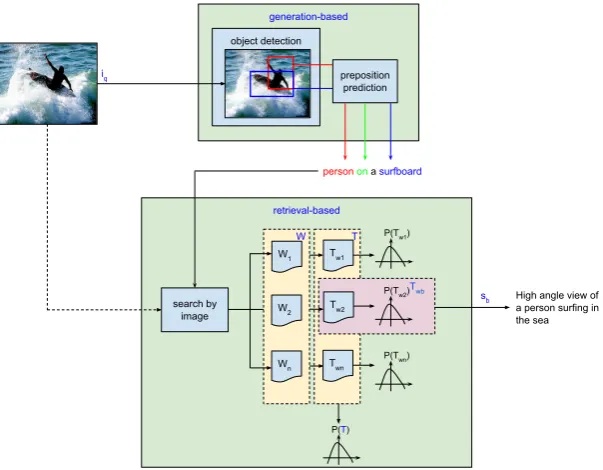
The suggested framework starts by generating a simple image description based on the image vi-sual entities and their spatial relationship. This simple description is then used as keywords to drive and optimise a web-data-driven based re-trieval process. The latter is primarily intended to retrieve the most relevant sentence from the set of candidate web pagesWby utilising the function-ality offered by a search-by-image algorithm. This strategy is adopted under the assumption that web pages featuring visually similar images to a query imageiq, can contain sentences which can be
person on asurfboard generation-based
preposition prediction object detection
retrieval-based
search by image
P(T w1)
P(T wn) P(Tw2)
P(T)
Tw1
Tw2
Twn
High angle view of a person surfing in the sea
Twb
T
sb
W1
W2
Wn
[image:3.595.148.450.65.300.2]W iq
Figure 1: The proposed web-retrieval-based system designed in two stages. The query imageiqis first
described by the keywords generated by the first stage. These are then used to retrieve image descriptions from a collection of web pagesW. The best sentencesb is extracted from the best text documentTwb,
with respect to the global word probability distributionP(T)and the query imageiq.
4 Image Description Framework
The proposed generation-retrieval-based approach is centrally decomposed into two phases. The first
generation stage of the framework is mainly
in-tended to generate simple image descriptions that will serve as keywords for the second retrieval
phase. By exploiting the vast amount of image-text data found on the Web, the latter will then ex-tract the most likely sentence for a given query im-age. A high-level overview of the proposed image description framework is presented in Figure 1.
4.1 Generation-based Image Description
The first stage of the image description generation framework analyses the image visual content and detects the most important image objects. There-fore, the aim of this step is to detect and anno-tate image objects with corresponding high-level image labels and corresponding bounding boxes. In order to describe the spatial relationship be-tween the predominant image objects, various pre-dictive models based on different textual and geo-metric feature sets, were investigated as described in section 4.2. From this simple generated image description, in the form of anobject-preposition
-article-objectkeyword structure, the framework is
then designed to drive a web-retrieval-based
pro-cess. This process exploits both the visual aspect of the query image, as well as the linguistic key-words generated by the first stage of the pipeline.
4.2 Preposition Predictive Model
The generation of prepositions was cast as a prediction-based problem through geometrical and encoded textual features. Four different pre-dictive models based on separate feature sets were analysed. This experiment confirmed that the Ran-dom Forest model obtained the best preposition prediction accuracy rate. This was achieved when predicting prepositions via word2vec (Mikolov et al., 2013) textual labels combined with the ge-ometric feature sets used by Muscat and Belz (2015) and Ramisa et al. (2015). This setup marginally outperformed the best preposition pre-diction accuracy achieved by Ramisa et al. (2015) when trained and evaluated on the same Visen’s MSCOCO Prepositions1 testing set having
origi-nal object labels. Results can be found in Table 1.
4.3 Retrieval-based Image Description
The aim of the second phase of the proposed framework is to retrieve descriptions based on the visual aspect of a query image and its
Table 1: The accuracies obtained from the Visen’s MSCOCO original object labels. The accuracies for different configuration setups are presented, based on different geometric feature sets, in relation to different textual label encoding. LE stands for the Label Encoder which encodes object labels with corresponding integers, IV for Indicator Vectors and W2V for Word2Vec.
Geometric + Textual Features
Ramisa et al. Muscat & Belz All Geometric Features
Model LE IV W2V GF LE IV W2V GF LE IV W2V GF
SVM 0.03 0.42 0.77 0.60 0.01 0.42 0.77 0.60 0.08 0.44 0.74 0.63 Decision Tree 0.53 0.66 0.75 0.69 0.52 0.65 0.76 0.67 0.53 0.64 0.75 0.69 Random Forest 0.60 0.65 0.81 0.72 0.56 0.62 0.81 0.69 0.59 0.68 0.82 0.71 Logistic Regression 0.64 0.50 0.80 0.64 0.61 0.50 0.81 0.61 0.65 0.51 0.80 0.64
ing simple generated image description, as dis-cussed in Section 4.1. This phase is designed to find a set of web pages composed of images that are visually related to the query image. This search functionality is freely available by the cur-rent two dominant search-engines, Google2 and
Bing3. These two proprietary image-search
al-gorithms are able to retrieve visually similar im-ages, which may therefore be used for collecting web pages with featured visually similar images. From the retrieved collection of web pages char-acterised with visually similar images to the query image, this phase is designed to extract the best sentence that can be used to describe the query image. Based on the idea that websites usually describe or discuss the embedded images, it is as-sumed that this stage is capable of finding human-like sentences describing the incorporated images which can be re-used to describe the query images. Given a collection of candidate web pages W
with embedded visually similar images, this phase is intended to extract the main text Twi from
each corresponding web page wi ∈ W. This
is carried out by analysing the Document Ob-ject Model (DOM) of each web page as well as by statistically distinguishing between HTML and textual data. Moreover, this stage is intended to discard any boilerplate text that is normally found in web pages, including navigational text and advertisements by exploiting shallow text fea-tures (Kohlsch¨utter et al., 2010). After transform-ing the set of web pagesW to the corresponding text documents T, this stage computes the word probability distributionP(Twi)for eachTwi,
dis-regarding any stop words in the distribution. The
2https://images.google.com
3https://www.bing.com/images/explore?
FORM=ILPSTR
text found in each text documentTwi is combined
in one text collection T and the probability dis-tribution P(T), representing all the probabilities for the words contained in collectionT, is calcu-lated. The topk most probable words from each generated probability distributionP(Twi)are
con-sidered to find the most probable relevant text doc-umentTwb, for the extraction of the best sentence
sbthat describes the query imageiq. Specifically,
the best text document is selected by the follow-ing maximisfollow-ing function over each text document probability distribution P(Twi), with respect to
the global word probability distributionP(T):
Twb = arg max
wi
k
X
n=1
P(Twi,n)P(T=Twi,n),
(1) wherenrepresents thenthmost probable word of
the probability distribution.
This strategy is used to eliminate documents that are probably irrelevant to provide correct de-scriptions for query images. A similar approach is carried out to retrieve the best sentencesb that
could potentially describe the query image. The technique used to select the most appropriate sen-tence fromTwb is initiated by extracting the set of
candidate sentences Scand from the selected best
fileTwb. The second step is to weight each
sen-tencesi ∈Scandby the summation over how
prob-able each word is, with respect to the global word probability distributionP(T). Therefore,sb is
re-trieved by maximising the following formula:
sb = arg max si
|si| X
n=1
P(T=si,n), (2)
where n represents the nth word found in
Twb, and |si| represents the number of words
found in sentencesi.
To further enhance the contextual reliability of the selected sentence, the approach used to retrieve image descriptions is combined with the image visual aspect. This is accomplished by weight-ing the visible object class labels in accordance to their corresponding image predominance level. The area of the visible image entities, with respect to the entire query image iq, was used to
priori-tise visible image objects. Therefore, the best sen-tencesb is retrieved by combining the knowledge
extracted from the most probable words found in
P(T)and the visual aspect of the query imageiq,
by the following formula:
sb = arg max si
|si| X
n=1
P(T=si,n)R(iq, si,n), (3)
whereRis a function which computes the area of the object class labelsi,nfound in thenthword
of sentencesiin the context of imageiq.
5 Implementation
The image description generation framework was modularised and implemented in two stages. To detect the main image objects, the first stage em-ploys the two-phased fast region-based convolu-tional neural network (R-CNN) proposed by Ren et al. (2015). The first module of the R-CNN is a deep fully convolutional neural network designed to propose regions, while the second module is a detector that uses the proposed regions for de-tecting image objects enclosed in bounding boxes. This architecture is trained end-to-end into a single network by sharing convolutional features. The deep VGG-16 model (Simonyan and Zisserman, 2014) pre-trained on MSCOCO (Lin et al., 2014) dataset, was utilised to detect image objects with corresponding class labels and bounding boxes. These were then used to infer the spatial relation-ship between the detected image objects as dis-cussed in section 4.2.
By using the linguistic keywords generated from the first stage, the second part of the frame-work is designed to retrieve the most probable sen-tence from a set of relevant web pages that feature visually similar images. The set of web pages is collected by using the free functionality offered by Google’s Search By Image4 proprietary
tech-4https://images.google.com
nology. For a given uploaded query image, this functionality is intended to return visually similar images. Based on extracted image visual features and automatically generated textual keywords by the same functionality, Google’s Search by Image retrieves visually similar images. The websites of the visually returned images are then retrieved from the corresponding URLs binded with each visually similar image. By using Selenium5 to
automate the headless PhantomJS browser, query images were automatically uploaded to retrieve websites featuring visually similar images. In this study, it was shown how object labels con-nected with spatial prepositions affect the retrieval search performed by Google’s search-by-image al-gorithm. This was accomplished by replacing Google’s keywords with object labels and prepo-sition generated by the first stage of the proposed framework. Furthermore, this study also investi-gated whether stock photography websites could improve the retrieval search of the designed frame-work. The retrieval of websites featuring stock photos was achieved by concatenating the phrase “stock photos” with the keywords extracted from the visual aspect of the query image. To detect and extract the main textual content of each respective web page, the boilerpipe6 toolkit was employed.
From the set of extracted text documents, the most probable sentence that best describes the query im-age is then retrieved, as discussed in Section 4.3.
6 Dataset
To evaluate the proposed image description frame-work, a specific subset of human-annotated im-ages featured in MSCOCO7 testing set was used.
Since the preposition prediction task is targeted to generate prepositions between two image objects, describing images having exactly two image ob-jects was of particular interest to this study. There-fore, the following steps were carried out to se-lect images consisting of two image objects. From the ViSen’s MSCOCO testing set, 1975 instances having strictly one single preposition between two image objects were found and extracted. Finally, 1000 images were randomly selected from the lat-ter subset. Since images may contain background image objects, the same object detector employed in the proposed framework was used for detecting
5http://docs.seleniumhq.org
6https://boilerpipe-web.appspot.com
Table 2: Configuration Setups
Setup Name Image Descriptions
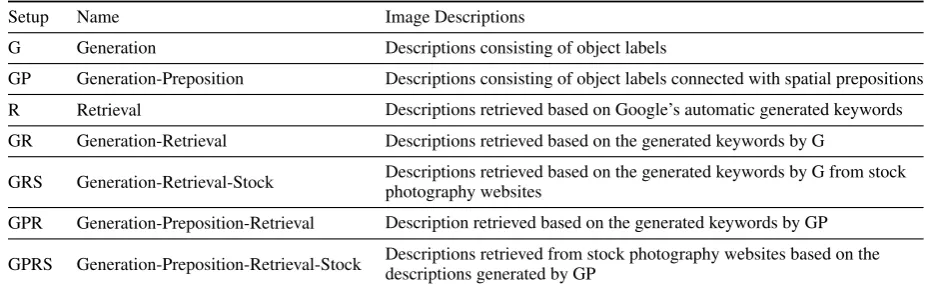
G Generation Descriptions consisting of object labels
GP Generation-Preposition Descriptions consisting of object labels connected with spatial prepositions R Retrieval Descriptions retrieved based on Google’s automatic generated keywords GR Generation-Retrieval Descriptions retrieved based on the generated keywords by G
GRS Generation-Retrieval-Stock Descriptions retrieved based on the generated keywords by G from stockphotography websites GPR Generation-Preposition-Retrieval Description retrieved based on the generated keywords by GP
GPRS Generation-Preposition-Retrieval-Stock Descriptions retrieved from stock photography websites based on thedescriptions generated by GP
objects. The fast R-CNN found 128 images con-taining one image object, 438 images concon-taining exactly two image objects, while the remaining 434 images contained more than two image ob-jects. For the evaluation of this framework, images composed of one and two image objects were only considered. Therefore, the framework was evalu-ated on a dataset consisting of 566 images, where 128 images contain one single object, while the other remaining 438 images contain exactly two image objects.
7 Evaluation
Both human and computational evaluation were used to evaluate the web-retrieval-based frame-work. The automatic evaluation was performed by using existing metrics, intended to mea-sure the similarity between generated descrip-tions and corresponding human ground truth de-scriptions. The measures include BLEU (Pap-ineni et al., 2002), ROUGE L (Lin and Hovy, 2003), METEOR (Denkowski and Lavie, 2014) and CIDEr (Vedantam et al., 2015). To comple-ment the automatic evaluation, human judgcomple-ments for image descriptions were obtained from a qual-ified English teacher. Since the human evalua-tion process is considerably time-consuming, hu-man judgments were collected for a sample of 200 images split equally for single and double-object images. The same human evaluation criteria pro-posed by Mitchell et al. (2012) was used to evalu-ate the generevalu-ated descriptions. Human evaluation was conducted by rating the grammar, main as-pects, correctness, order and the human-likeness of descriptions using a five-point Likert scale.
8 Results
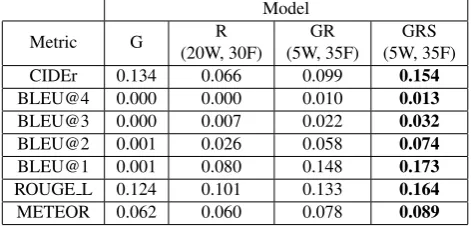
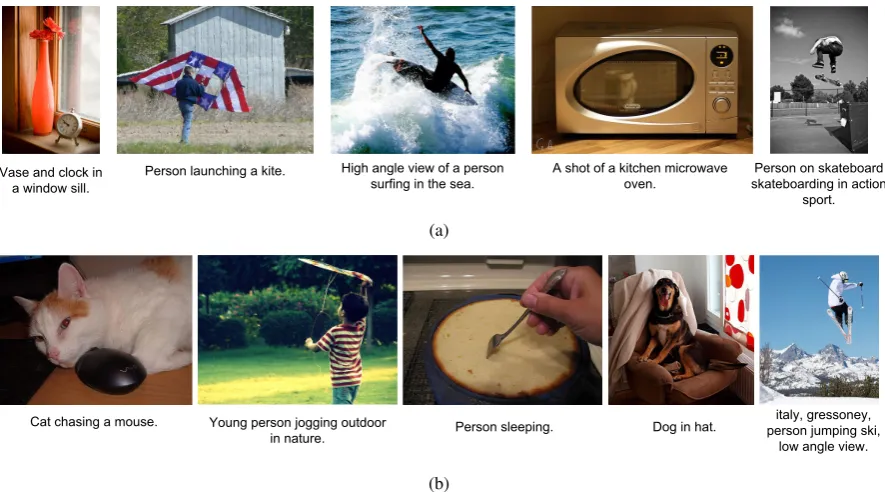
The framework was evaluated in each phase of its pipeline as described in Table 2. The re-sults are given in Tables 3 and 4 for single and double-object images respectively. The generation phase of the framework that describes images with just object labels is represented by G, while the standalone retrieval-based approach which uses Google’s automatic generated keywords is repre-sented by R. Furthermore, when describing single-object images, the joint generation-retrieval stage that uses the prototype’s keywords is represented by GR. When describing double-object images, the generation-retrieval process is denoted by GPR given that it uses both object labels and preposi-tions as keywords. Moreover, the results obtained when the retrieval phase considers stock photog-raphy websites are denoted by the letter S. The retrieval-based stages are specified by the two pa-rameters, W and F. The latter represents the num-ber of text files analysed from the correspond-ing websites, whereas W represents the number of most probable words used for the selection of the best sentence from a set of web pages. A grid search was performed to find these param-eters for each configuration. The same notation was used for the human evaluation results. Typi-cal image descriptions generated by the proposed web-retrieval-based image caption generation sys-tem can be found in Figure 2.
9 Discussion
Table 3: Automatic evaluation of single-object images.
Model
Metric G (20W, 30F)R (5W, 35F)GR (5W, 35F)GRS
CIDEr 0.134 0.066 0.099 0.154
BLEU@4 0.000 0.000 0.010 0.013
BLEU@3 0.000 0.007 0.022 0.032
BLEU@2 0.001 0.026 0.058 0.074
BLEU@1 0.001 0.080 0.148 0.173
ROUGE L 0.124 0.101 0.133 0.164
METEOR 0.062 0.060 0.078 0.089
Table 4: Automatic Evaluation of double-object images.
Model
Metric G GP (20W, 30F)R (5W, 35F)GR (5W, 25F)GRS (10W, 15F)GPR (10W, 15F)GPRS
CIDEr 0.482 0.604 0.082 0.148 0.176 0.132 0.152
BLEU@4 0.033 0.132 0.005 0.014 0.018 0.013 0.017
BLEU@3 0.085 0.187 0.015 0.030 0.036 0.028 0.035
BLEU@2 0.165 0.241 0.038 0.069 0.081 0.067 0.077
BLEU@1 0.252 0.292 0.125 0.190 0.199 0.175 0.190
ROUGE L 0.340 0.413 0.130 0.185 0.210 0.174 0.198
METEOR 0.152 0.177 0.078 0.109 0.117 0.100 0.113
(G), as well as the retrieval-based (R) setup. The latter result confirms that the replacement of Google’s Search by Image captions improved the retrieved descriptions. This concludes that more relevant images were returned by Google when re-placing its automatic caption with object labels.
Conversely, double-object images were best de-scribed via the generation-preposition (GP) con-figuration. Although replacing Google’s Search By Image keywords improved the results, the simple descriptions based on object labels con-nected with spatial prepositions were more accu-rate. Automatic evaluation also confirmed that the web-retrieval approach (GRS) performs better on double-object images. This study also showed that the retrieval process performs better without using prepositions as keywords. This resulted from the fact that prepositions constrain the search result performed by Google when indexing web pages, since most descriptive text available on the Web includes verbs rather than prepositions.
The human evaluation results for the single-object images are presented in Table 5. Particu-larly, generation-based (G) descriptions obtained a grammatical median score of 1, confirming that one-word descriptions do not produce grammati-cally correct sentences. The results also confirm that the used object detector accurately describes the dominant objects in an image. By considering
the improbability of one-word human derived de-scriptions, this stage resulted in a low human like-ness score of 2. The retrieval method applied on stock photography websites (RS) lead to grammat-ical improvement in the generated descriptions. Such descriptions were grammatically rated with a median score of 3. However, results show that the retrieval method decreases the relevancy of the re-trieved descriptions. Despite generating grammat-ically sound sentences with better human-likeness, the human evaluation showed a degree of incon-sistency between the descriptions and their corre-sponding images. When combining the generation (G) and retrieval (RS) proposed approaches, the grammar, order and the human likeness improved for single-object images.
Vase and clock in a window sill.
Person launching a kite. High angle view of a person surfing in the sea.
A shot of a kitchen microwave oven.
Person on skateboard skateboarding in action
sport.
(a)
Cat chasing a mouse. Young person jogging outdoor
in nature. Person sleeping. Dog in hat.
italy, gressoney, person jumping ski,
low angle view.
(b)
[image:8.595.79.522.74.320.2]Figure 2: (a) Correct and (b) incorrect descriptions generated by the web-retrieval-based framework.
Table 5: Human evaluation of single and double-object images with scores (1-5) obtained for each stage of the proposed framework: median, mean and standard deviation in parentheses.
single-object images
Model Grammar Main Aspects Correctness Order Humanlike G 1 (1.11, 0.31) 4 (3.82, 0.89) 5 (4.84, 0.68) 5 (4.38, 1.04) 2 (1.79, 0.65) RS 3 (3.31, 1.50) 2 (2.27, 1.26) 2 (2.07, 1.35) 3 (2.90, 1.63) 2.5 (2.68, 1.46) GRS 4 (3.56, 1.25) 2 (2.31, 1.02) 2 (2.00, 1.14) 4 (3.26, 1.60) 3 (2.75, 1.22)
double-object images
Model Grammar Main Aspects Correctness Order HumanLike G 4 (3.80, 0.65) 5 (4.42, 0.97) 5 (4.69, 0.75) 5 (4.63, 0.79) 4 (3.77, 0.72) GP 5 (4.44, 0.97) 5 (4.53, 0.81) 5 (4.81, 0.63) 5 (4.69, 0.81) 5 (4.43, 0.90) RS 4 (3.39, 1.24) 2 (2.50, 1.25) 2 (2.20, 1.14) 2 (2.27, 1.26) 3 (2.93, 1.45) GRS 3 (3.00, 1.41) 3 (3.14, 1.24) 2.5 (2.71, 1.32) 3 (2.93, 1.40) 3 (2.69, 1.52) GPRS 3 (2.70, 1.32) 3 (2.87, 1.13) 2 (2.42, 1.16) 2 (2.45, 1.31) 2.5 (2.38, 1.31)
10 Conclusion and Future Work
This paper investigated the use of object labels and prepositions as keywords in a web-retrieval-based image caption generator. By employing object de-tection technology combined with a preposition prediction module, keywords were extracted in the form of object class labels and prepositions. The proposed retrieval approach is independent of any purposely human-annotated image datasets. Im-ages were described by extracting sentences found in websites, featuring visually similar images to the query image. The search is aided with the use of the generated keywords. This approach was particularly effective when describing
single-object images, and especially so when extracting sentences from stock photography websites.
[image:8.595.123.479.393.543.2]References
Ahmet Aker and Robert Gaizauskas. 2010. Generat-ing image descriptions usGenerat-ing dependency relational
patterns. InProceedings of the 48th Annual
Meet-ing of the Association for Computational LMeet-inguis-
Linguis-tics, pages 1250–1258, Uppsala, Sweden, July.
As-sociation for Computational Linguistics.
Raffaella Bernardi, Ruket Cakici, Desmond Elliott, Aykut Erdem, Erkut Erdem, Nazli Ikizler-Cinbis, Frank Keller, Adrian Muscat, and Barbara Plank. 2016. Automatic description generation from im-ages: A survey of models, datasets, and evalua-tion measures. Journal of Artificial Intelligence Re-search, 55(1):409–442, January.
Xinlei Chen and Lawrence Zitnick. 2015. Mind’s eye: A recurrent visual representation for image caption
generation. InIEEE Conference on Computer
Vi-sion and Pattern Recognition, CVPR 2015, Boston, MA, USA, June 7-12, 2015, pages 2422–2431. Michael Denkowski and Alon Lavie. 2014. Meteor
universal: Language specific translation evaluation for any target language. InProceedings of the Ninth Workshop on Statistical Machine Translation, pages 376–380, Baltimore, Maryland, USA, June. Associ-ation for ComputAssoci-ational Linguistics.
Jeff Donahue, Lisa Anne Hendricks, Sergio Guadar-rama, Marcus Rohrbach, Subhashini Venugopalan, Trevor Darrell, and Kate Saenko. 2015. Long-term recurrent convolutional networks for visual
recogni-tion and descriprecogni-tion. InIEEE Conference on
Com-puter Vision and Pattern Recognition, CVPR 2015, Boston, MA, USA, June 7-12, 2015, pages 2625– 2634.
Hao Fang, Saurabh Gupta, Forrest N. Iandola, Ru-pesh Kumar Srivastava, Li Deng, Piotr Doll´ar, Jian-feng Gao, Xiaodong He, Margaret Mitchell, John C. Platt, Lawrence Zitnick, and Geoffrey Zweig. 2015.
From captions to visual concepts and back. InIEEE
Conference on Computer Vision and Pattern Recog-nition, CVPR 2015, Boston, MA, USA, June 7-12,
2015, pages 1473–1482.
Ali Farhadi, Mohsen Hejrati, Mohammad Amin Sadeghi, Peter Young, Cyrus Rashtchian, Julia Hockenmaier, and David Forsyth. 2010. Every pic-ture tells a story: Generating sentences from images. InProceedings of the 11th European Conference on Computer Vision: Part IV, ECCV’10, pages 15–29, Heraklion, Crete, Greece. Springer-Verlag.
Yansong Feng and Mirella Lapata. 2010. How many words is a picture worth? automatic caption
gen-eration for news images. In Proceedings of the
48th Annual Meeting of the Association for Com-putational Linguistics, pages 1239–1249, Uppsala, Sweden, July. Association for Computational Lin-guistics.
Ankush Gupta, Yashaswi Verma, and C. V. Jawahar. 2012. Choosing linguistics over vision to describe
images. In Proceedings of the Twenty-Sixth AAAI
Conference on Artificial Intelligence, AAAI’12, pages 606–612, Toronto, Ontario, Canada. AAAI Press.
Andrej Karpathy and Fei-Fei Li. 2015. Deep visual-semantic alignments for generating image
descrip-tions. InIEEE Conference on Computer Vision and
Pattern Recognition, CVPR 2015, Boston, MA, USA, June 7-12, 2015, pages 3128–3137.
Ryan Kiros, Ruslan Salakhutdinov, and Richard S. Zemel. 2014. Unifying visual-semantic embed-dings with multimodal neural language models.
CoRR, abs/1411.2539.
Christian Kohlsch¨utter, Peter Fankhauser, and Wolf-gang Nejdl. 2010. Boilerplate detection using
shal-low text features. InProceedings of the Third ACM
International Conference on Web Search and Data Mining, WSDM ’10, pages 441–450, New York, NY, USA. ACM.
Girish Kulkarni, Visruth Premraj, Vicente Ordonez, Sagnik Dhar, Siming Li, Yejin Choi, Alexander C. Berg, and Tamara L. Berg. 2011. Baby talk: Un-derstanding and generating simple image
descrip-tions. In Proceedings of the 2011 IEEE
Confer-ence on Computer Vision and Pattern Recognition, CVPR ’11, pages 1601–1608, Washington, DC, USA. IEEE Computer Society.
Siming Li, Girish Kulkarni, Tamara L. Berg, Alexan-der C. Berg, and Yejin Choi. 2011. Composing simple image descriptions using web-scale n-grams. InProceedings of the Fifteenth Conference on Com-putational Natural Language Learning, pages 220– 228, Portland, Oregon, USA, June. Association for Computational Linguistics.
Chin-Yew Lin and Eduard Hovy. 2003.
Auto-matic evaluation of summaries using n-gram
co-occurrence statistics. In Proceedings of the 2003
Conference of the North American Chapter of the Association for Computational Linguistics on Hu-man Language Technology - Volume 1, NAACL ’03, pages 71–78, Edmonton, Canada. Association for Computational Linguistics.
Tsung-Yi Lin, Michael Maire, Serge Belongie, James Hays, Pietro Perona, Deva Ramanan, Piotr Doll´ar, and Lawrence Zitnick. 2014. Microsoft COCO: Common objects in context. In David Fleet, Tomas Pajdla, Bernt Schiele, and Tinne Tuytelaars,
edi-tors,Computer Vision – ECCV 2014: 13th European
Conference, Zurich, Switzerland, September 6-12, 2014, Proceedings, Part V, pages 740–755. Springer International Publishing, Cham.
Rebecca Mason and Eugene Charniak. 2014. Non-parametric method for data-driven image
caption-ing. InProceedings of the 52nd Annual Meeting of
Tomas Mikolov, Ilya Sutskever, Kai Chen, Greg Cor-rado, and Jeffrey Dean. 2013. Distributed represen-tations of words and phrases and their composition-ality. InProceedings of the 26th International Con-ference on Neural Information Processing Systems, NIPS’13, pages 3111–3119, Lake Tahoe, Nevada. Curran Associates Inc.
Margaret Mitchell, Xufeng Han, Jesse Dodge, Alyssa Mensch, Amit Goyal, Alex Berg, Kota Yamaguchi, Tamara Berg, Karl Stratos, and Hal Daum´e III. 2012. Midge: Generating image descriptions from
computer vision detections. In Proceedings of the
13th Conference of the European Chapter of the As-sociation for Computational Linguistics, EACL ’12, pages 747–756, Avignon, France. Association for Computational Linguistics.
Adrian Muscat and Anja Belz. 2015. Generating de-scriptions of spatial relations between objects in
im-ages. InProceedings of the 15th European
Work-shop on Natural Language Generation (ENLG), pages 100–104, Brighton, UK, September. Associ-ation for ComputAssoci-ational Linguistics.
Vicente Ordonez, Girish Kulkarni, and Tamara L Berg. 2011. Im2text: Describing images using 1
mil-lion captioned photographs. InProceedings of the
24th International Conference on Neural Informa-tion Processing Systems, NIPS’11, pages 1143– 1151, Granada, Spain. Curran Associates Inc.
Vicente Ordonez, Xufeng Han, Polina Kuznetsova, Girish Kulkarni, Margaret Mitchell, Kota Yam-aguchi, Karl Stratos, Amit Goyal, Jesse Dodge, Alyssa Mensch, Hal Daum´e III, Alexander C. Berg, Yejin Choi, and Tamara L. Berg. 2016. Large scale retrieval and generation of image descriptions. Int. J. Comput. Vision, 119(1):46–59, August.
Kishore Papineni, Salim Roukos, Todd Ward, and Wei-Jing Zhu. 2002. Bleu: a method for automatic
evaluation of machine translation. In Proceedings
of 40th Annual Meeting of the Association for Com-putational Linguistics, pages 311–318, Philadelphia, Pennsylvania, USA, July. Association for Computa-tional Linguistics.
Arnau Ramisa, Josiah Wang, Ying Lu, Emmanuel Dellandrea, Francesc Moreno-Noguer, and Robert Gaizauskas. 2015. Combining geometric, tex-tual and visual features for predicting prepositions
in image descriptions. InProceedings of the 2015
Conference on Empirical Methods in Natural Lan-guage Processing, pages 214–220, Lisbon, Portugal, September. Association for Computational Linguis-tics.
Shaoqing Ren, Kaiming He, Ross Girshick, and Jian Sun. 2015. Faster r-cnn: Towards real-time object
detection with region proposal networks. In
Pro-ceedings of the 28th International Conference on Neural Information Processing Systems, NIPS’15, pages 91–99, Montreal, Canada. MIT Press.
Karen Simonyan and Andrew Zisserman. 2014. Very deep convolutional networks for large-scale image
recognition.CoRR, abs/1409.1556.
Richard Socher, Andrej Karpathy, Quoc Le, Christo-pher Manning, and Andrew Ng. 2014. Grounded compositional semantics for finding and describing images with sentences. Transactions of the Associa-tion for ComputaAssocia-tional Linguistics, 2:207–218. Ramakrishna Vedantam, Lawrence Zitnick, and Devi
Parikh. 2015. Cider: Consensus-based image
de-scription evaluation. InIEEE Conference on
Com-puter Vision and Pattern Recognition, CVPR 2015, Boston, MA, USA, June 7-12, 2015, pages 4566– 4575.
Semih Yagcioglu, Erkut Erdem, Aykut Erdem, and Ruket Cakici. 2015. A distributed representation based query expansion approach for image
caption-ing. InProceedings of the 53rd Annual Meeting of
the Association for Computational Linguistics and the 7th International Joint Conference on Natural Language Processing (Volume 2: Short Papers), pages 106–111, Beijing, China, July. Association for Computational Linguistics.
Yezhou Yang, Ching Lik Teo, Hal Daum´e III, and Yian-nis Aloimonos. 2011. Corpus-guided sentence
gen-eration of natural images. In Proceedings of the