Proceedings of the 12th International Workshop on Semantic Evaluation (SemEval-2018), pages 622–627
YNU-HPCC at SemEval-2018 Task 3: Ensemble Neural Network Models
for Irony Detection on Twitter
Bo Peng, Jin Wang and Xuejie Zhang School of Information Science and Engineering
Yunnan University Kunming, P.R. China
Contact:[email protected]
Abstract
This paper describes our proposed to partici-pate in the first year of the irony detection in English tweets competition. Previous works have demonstrated that long short-term mem-ory models have achieved remarkable perfor-mance in natural language processing; more-over, combining multiple classifications from various individual classifiers is generally more powerful than a single classification. In order to obtain more precise irony detection classi-fication, our system trains several individual neural network classifiers and combines their results according to the ensemble-learning al-gorithm.
1 Introduction
In most sentiment analysis tasks, recognition of the precise emotional polarity of a sentence form-s the baform-siform-s for further work. However, much of the corpus we used for analysis and training con-tains numerous sarcasm and irony features that will have a negative impact on the results of our analysis and training. For example, although the tweets provided by Twitter constitute a valuable and widely applicable corpus for many natural lan-guage processing tasks, Twitter users express their feelings and opinions on social networks with fre-quent irony (Amir et al., 2016). Therefore, such tweets may contain converse sentiments informa-tion compared their literal meaning. For exam-ple,@someuser Yeah keeping cricket clean, that’s what he wants #Sarcasm: ignoring the hash tag, this tweet would be positive, which would miss lead an analysis system that uses these types of tweets as input.
Thus, it makes sense to discriminate whether a text is ironic, particularly for social network texts such as tweets. Further applications including tweet sentiment analysis, will benefit from auto-matic irony detection. The SemEval-2018 Twitter
competition promotes research in this area, and is divided into two subtasks that involve binary and four-class classification.
Subtask A is a two-class (or binary) classifica-tion task whereby the system must predict whether or not a tweet is ironic. The subtask B is a multi-class multi-classification task where the system has to predict one out of four labels describing i) ver-bal irony realized through a polarity contrast, ii) verbal irony without such a polarity contrast (i.e., other verbal irony), iii) descriptions of situation-al irony, and iv) non-irony (Cynthia Van Hee and Hoste, 2018). For a more detailed description, please seeCarman et al.(2017).
In recent years, deep learning techniques have significantly outperformed traditional methods in several natural language processing (NLP) tasks (Cliche, 2017). In such task, several deep learn-ing architecture-based methods have achieved out-standing performance in irony and sarcasm detec-tion in social media. Silvio (Amir et al., 2016) presented a novel convolutional network-based method for learning user embeddings from their previous posts and used the user embeddings with lexical signals to recognize sarcasm. Ghosh and Veale (2016) proposed a combined convolutional neural network (CNN) model and long short-term memory (LSTM) method followed by a deep neu-ral network (DNN), which also achieved an im-provement compared to traditional machine learn-ing approaches such as support vector machines (SVM).In this paper, we propose an ensemble of multiple deep learning models with a voting clas-sifier in order to enhance the performance of indi-vidual neural network models for to detecting the ironic tweets. We trained six individual classifier-s, including LSTMclassifier-s, bi-directional LSTMclassifier-s, gat-ed recurrent units (GRUs), bi-directional GRUs, attention-based BiLSTMs and attention-based Bi-GRU. Thereafter, we use a voting mechanism to
LSTM BiLSTM GRU BiGRU
Voting Classifier
Input
[image:2.595.334.497.66.180.2]At-BiLSTM At-BiGRU
Figure 1: Ensemble voting classifier.
combine the results from the six classifiers in or-der to produce the final prediction label.
The remainder of this paper is organized as fol-lows. In section 2, we describe the overall struc-ture of our system and the LSTM-based models, as well as the selected individual classifiers. In sec-tion 3, we present the experimental results of our system, and conclusions are drawn in section 4.
2 System Description 2.1 Overview
Numerous previous research studies have demon-strated that the resulting classifier is generally more accurate than any of the individual classifiers making up the ensemble (Maclin and Opitz,1999). For this reason, we decided to build our system following this strategy. Our system is based on en-semble learning and combined with various pop-ular LSTM models. As illustrated in Figure 1, each classifier is a LSTM-based model, such as bi-directional LSTM (BiLSTM) and attention LST-M (AtLSTLST-M). Each classifier is trained using the complete training set for that network. Following this, for each classifier, the predicted outputs of all classifiers are combined to produce the ensemble system output. As the ironic and non-ironic sam-ples in the training set are evenly distributed (1911 irony samples; 3834 in total), and each classifier in our system is trained by the entire training set. Therefore, we selected the voting classifier as the combining scheme for our system. The principle of the voting classifier is the selection of the pre-diction supported by most of classifiers according certain rules. For example, if the predictions for a given sample are:
• classifier 1 - class 1
• classifier 2 - class 2
• classifier 3 - class 1
σ
Xt
tanh
σ
σ
tanh
Ht
Ct-1 Ct
ht-1 ht
ft it
ot
[image:2.595.82.282.77.178.2]Ct
Figure 2: The LSTM memory cell
According to majority voting rules, the voting classifier would classify the sample as class 1.
Combining the output of several classifiers is useful only if disagreement exists among them. Thus, the selection of classifiers is rather impor-tant for our system.
Neural networks, particularly for recurrent neu-ral networks (RNNs) (Mikolov et al.,2010), have achieved effective results in NLP. Owing to their circular network structure, which allows them to save previous information in a text sentence. Fur-thermore, conventional RNNs contain cyclic con-nections, making them powerful for modeling se-quences. However, RNNs will face vanishing and exploding gradient problems when dealing with lengthy sequences. The LSTM, which is also a special type of RNN, was designed to address these problems. Therefore, we selected LSTM-based models as our individual classifiers.
2.2 LSTMs
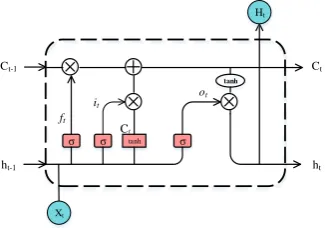
The difference between the RNN and LSTM is that an LSTM (Sak et al., 2014) includes a dif-ferent and more complex repeating module, as il-lustrated in Figure 2. This repeating module, also known as cell, provides the LSTM with the ability to discriminate whether input information is use-ful. A cell contains three gates, namely the input, forgotten and output gates. These gates determine the selection of information by means of the fol-lowing formulae:
ft=σ(Wf ·[ht−1, xt] +bf)
it=σ(Wi·[ht−1, xt] +bi) (1)
whereftanditare the forgotten and retained
fea-tures; σ denotes the sigmoid function; xt and ht
are thet-th input and output; andW andbare cell
parameters.
LSTM LSTM LSTM LSTM LSTM LSTM LSTM LSTM
X1 X2 X3 X4
Input Bidirectional
LSTM softmax Output
y
i
h
i
[image:3.595.329.500.62.256.2]h
Figure 3: BiLSTM
to the next equation. HereCt˜ represents the
can-didate values, created by a tanh gate.
˜
Ct= tanh(Wc·[ht−1, xt] +bC) (2)
Finally, updating of the cell state and calculating the output of the cell are carried out according to the equations,
ot=σ(Wo·[ht−1, xt] +bo) Ct=ft∗Ct−1+it∗C˜t
ht=ot∗tanh(Ct)
(3)
For an input tweet with lengtht, we firstly place it into an LSTM layer and generate vector ht;
then, use this vector to calculate the possibility of whether it is ironic by means of a softmax layer.
2.3 BiLSTMs
Standard RNNs use only the previous context and ignore the future context information when deal-ing with sequence texts. Bidirectional RNNs pro-cess the data in both directions with two separate hidden layers which then feed forward to the same output layer (Schuster and Paliwal, 1997). BiL-STMs replace the RNN cell with an LSTM cell based on BiRNNs, as illustrated in Figure 3. BiL-STMs compute the forward hidden state −→ht and
back forward hidden state←h−t, and then output the
sequenceyby calculating equation (4), following
which the output layer is updated.
y = −→ht⊗ ←h−t (4)
2.4 Attention BiLSTMs
LSTMs have promoted RNNs to a great extent in NLP, and a further significant step is the attention
LSTM LSTM LSTM LSTM
LSTM LSTM LSTM LSTM
X1 X2 X3 X4
Input
Bidirectional LSTM
softmax Output
Attention
i
h
i
h
[image:3.595.100.267.67.232.2]y A
Figure 4: The LSTM memory cell
mechanism. We combined the attention mecha-nism (Wang et al., 2016) with the BiLSTM as il-lustrated in Figure 4. The attention captures the context information of an entire tweet, defined as follows:
et= tanh(Weht+be)
αt=sof tmax(et) (5)
whereWe andbe denote the weight and bias,
re-spectively, and t represents the attention vector
that will be combined with the internal representa-tion generated by BiLSTM layers. The remaining steps are consistent with the BiLSTMs.
2.5 GRUs
The GRU is a variant of LSTM. GRUs reduce the gating signals to two from LSTMs to two, name-ly reset and update gates. Although GRUs are simpler in terms of structure and calculation com-pared to LSTMs, their performance and efficiency in specific tasks are not reduced (Cho et al.,2014). Therefore, we also trained three similar models using GRU cells. In total, we trained six individ-ual classifiers: they are LSTM, BiLSTM, GRU, BiGRU, Attention BiLSTM and attention BiGRU.
3 Experiment 3.1 Datasets
Subtask A Accuracy F1 score (macro) Recall (macro) Precision (macro)
LSTM 0.64163 0.64161 0.64174 0.65364
BiLSTM 0.64163 0.64161 0.64174 0.65364
GRU 0.63109 0.63108 0.63111 0.64031
BiGRU 0.64295 0.64099 0.64232 0.65110
Attention BiLSTM 0.64295 0.64085 0.64230 0.64519
Attention BiGRU 0.65744 0.65506 0.65673 0.66053
[image:4.595.83.510.208.322.2]Ensemble 0.66007 0.66871 0.61894 0.62095
Table 1: Cross-validation results for subtask A.
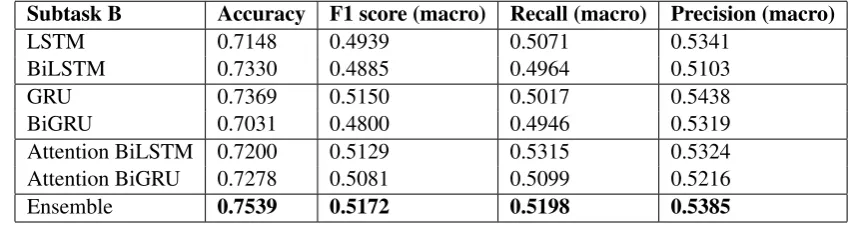
Subtask B Accuracy F1 score (macro) Recall (macro) Precision (macro)
LSTM 0.7148 0.4939 0.5071 0.5341
BiLSTM 0.7330 0.4885 0.4964 0.5103
GRU 0.7369 0.5150 0.5017 0.5438
BiGRU 0.7031 0.4800 0.4946 0.5319
Attention BiLSTM 0.7200 0.5129 0.5315 0.5324
Attention BiGRU 0.7278 0.5081 0.5099 0.5216
Ensemble 0.7539 0.5172 0.5198 0.5385
Table 2: Cross-validation results for subtask B.
indicating whether the tweet is ironic. The train-ing data for subtask B includes tweets with a nu-meric value corresponding to one of the subcate-gories, namely ironic by clash, other irony, situ-ational irony and non-ironic. For subtasks A and B, the content of the tweet is exactly the same a-part from the labels. The organizers also provided a version with no emoticons or hashtags and one with emoticons or hashtags. According to peo-ple’s tweeting habits, emoticons and hashtags are important tools for expressing emotions, thus, we used tweets with these features for training.
3.2 Preprocessing
Before feeding the tweets to any classifier, they are pre-processed by following procedure:
• All uppercase letters are converted to lower-case.
• URLs are replaced by <url>; instance of
@someone are replaced by<user>.
• Certain emoticons and emojis expressing
positive sentiments are transformed into words such as smile, like, and happy. Oth-ers that express negative emotions are all re-placed by<irony>.
• For subtask A, all hashtags are replaced by
<hashtag>; for subtask B: except for#irony,
#sarcasmand#not, all other hashtags are re-placed by<hashtag>, and the remainder are all converted to the wordirony.
We did not replace #irony, #sarcasm and #not with word irony for subtask A because it is easy for overfitting to occur while training. We con-sider that the reason for this is that the searching and labeling of these tweets mostly dependent on their hashtags. In the four-category subtask B, this does not lead to over-fitting, but aids in improving accuracy.
3.3 Word embedding
We obtain word embeddings by training with the corpus of English articles in Wikipedia pages us-ing Global Vector (GloVe) (Pennington et al.,
2014). Compared to Word2vec (Mikolov et al.,
Accuracy F1 score (macro) Recall (macro) Precision (macro)
Subtask A 0.5089 0.4086 0.4277 0.3912
[image:5.595.109.491.62.106.2]Subtask B 0.466 0.3127 0.3229 0.3384
Table 3: Evaluation for Subtask A and B.
3.4 Parameters
We used earlystopping to observe the accuracy value convergence of each epoch, with patience set to 3 and min delta set to 0.05; we found that each model stopped training with no more than 35 epochs or even less. Consequently, we set the number of epochs to 30 for the training of every classifier. Furthermore, we set the batch size to 100 and drop-out rate to 0.25 for training of each model. We selected the categorical cross-entropy as the loss function and Adagrad as the optimizer (Duchi et al.,2011).
For subtasks A and B, the individual classifiers are trained with the training dataset. Ow-ing to the lack of development dataset, we only evaluated the performance of the classifiers and prevented overfitting by cross-validation. The models were implemented in Keras using TensorFlow backend.
3.5 Results and analysis
The experimental results of the individual classi-fiers and ensemble are displayed in Table 1 for subtask A and Table 2 for subtask B.
As indicated in Table 1, BiLSTM and attention GRU achieved a superior performance. However, there is no significant difference among the results of each model. This may be the reason why the ensemble does not operate effectively, because a good ensemble is one in which the individual clas-sifiers are both ac-curate and create their errors in different parts of the input space (Maclin and Opitz, 1999). Our input space is not sufficiently large and the classifiers are similar, creating their errors in the same place.
For subtask B, our preprocessing strategy aid-s in improving accuracy. However, the aid-sampleaid-s in the training set are not as evenly distributed as subtask A, reflecting the ensemble effect. The pre-cision achieved by our system achieved in subtask B ranks 10th out of 32 participants. However, nu-merous aspects of our system require further im-provement.
The evaluation results from the committee are illustrated in Table 3. Due to our negligence, we submitted a wrong result of Subtask B. After the
organizing committee reminded us that we have corrected the error and re-evaluated our result for Subtask b. Table 3 shows the corrected results for Subtask B. We apologize for the inconvenience caused by our own negligence and we thanked the organizers for prompt reminders so that we could correct the results in a timely manner.
4 Conclusion and future work
In this paper, we have presented the system we used to compete in SemEval-2018 task 3 - Irony detection in English tweets. The purpose of our participation in this competition is to deepen our understanding of irony detection as a novel NLP application. Moreover, we hope to determine an effective combination approach to ensemble learn-ing and neural networks by means of practical ap-plication.
For future work, it would be meaningful to im-prove the neural network by combining the charac-teristic that ironic sentences are often inconsistent. Moreover, the goal is to identify superior practi-cal ensemble methods to achieve improved perfor-mance in increased NLP applications.
References
Silvio Amir, Byron C Wallace, Hao Lyu, and Paula Carvalho Mrio J Silva. 2016. Modelling context with user embeddings for sarcasm detection in so-cial media. pages 167–177.
Mark J. Carman, Mark J. Carman, and Mark J. Car-man. 2017. Automatic Sarcasm Detection: A Sur-vey. ACM.
Kyunghyun Cho, Bart Van Merrienboer, Caglar Gul-cehre, Dzmitry Bahdanau, Fethi Bougares, Holger Schwenk, and Yoshua Bengio. 2014. Learning phrase representations using rnn encoder-decoder for statistical machine translation. Computer Sci-ence.
Mathieu Cliche. 2017. BBtwtrat semeval-2017 task
4: Twitter sentiment analysis with cnns and lstms. Els Lefever Cynthia Van Hee and Vronique Hoste.
John Duchi, Elad Hazan, and Yoram Singer. 2011. Adaptive subgradient methods for online learning and stochastic optimization. Journal of Machine Learning Research, 12(7):257–269.
Aniruddha Ghosh and Tony Veale. 2016. Fracking sar-casm using neural network. In The Workshop on Computational Approaches To Subjectivity.
R. Maclin and D. Opitz. 1999. Popular ensemble meth-ods: An empirical study. Journal of Artificial Intel-ligence Research, 11:169–198.
Tomas Mikolov, Martin Karafit, Lukas Burget, Jan Cer-nocky, and Sanjeev Khudanpur. 2010. Recurren-t neural neRecurren-twork based language model. In IN-TERSPEECH 2010, Conference of the Internation-al Speech Communication Association, Makuhari, Chiba, Japan, September, pages 1045–1048.
Tomas Mikolov, Ilya Sutskever, Kai Chen, Greg Corra-do, and Jeffrey Dean. 2013. Distributed representa-tions of words and phrases and their compositional-ity. 26:3111–3119.
Jeffrey Pennington, Richard Socher, and Christopher Manning. 2014. Glove: Global vectors for word representation. In Conference on Empirical Meth-ods in Natural Language Processing, pages 1532– 1543.
Ha?im Sak, Andrew Senior, and Fran?oise Beaufays. 2014. Long short-term memory based recurren-t neural nerecurren-twork archirecurren-tecrecurren-tures for large vocabulary speech recognition. Computer Science, pages 338– 342.