Target Foresight based Attention for Neural Machine
Translation
∗Xintong Li†, Lemao Liu‡, Zhaopeng Tu‡, Shuming Shi‡, Max Meng†
†The Chinese University of Hong Kong
{xtli, qhmeng}@ee.cuhk.edu.hk ‡Tencent AI Lab
{redmondliu, zptu, shumingshi}@tencent.com
Abstract
in neural machine translation, an attention model is used to identify the aligned source words for a target word(target foresight word)in order to select translation con-text, but it does not make use of any in-formation of this target foresight word at all. previous work proposed an approach to improve the attention model by explic-itly accessing this target foresight word and demonstrated the substantial gains in alignment task. however, this approach is useless in machine translation task on which the target foresight word is unavail-able. in this paper, we propose a new attention model enhanced by the implicit information of target foresight word ori-ented to both alignment and translation tasks. empirical experiments on chinese-to-english and japanese-chinese-to-english datasets show that the proposed attention model delivers significant improvements in terms of both alignment error rate and bleu.
1 Introduction
Since neural machine translation (NMT) was proposed (Bahdanau et al., 2014), it has been attracted increasing interests in machine translation community (Luong et al., 2015b; Tu et al., 2016; Feng et al., 2016; Cohn et al., 2016). NMT not only yields impressive translation performance in practice, but also has appealing model architecture in essence. Compared with traditional statistical machine translation (Koehn et al.,2003;Chiang,2005), one of advantages in NMT is that its archi-tecture combines language model, translation model and alignment between source and tar-get words in a unified manner rather than a
∗Work done when X. Li interning at Tencent AI
Lab. L. Liu is the corresponding author.
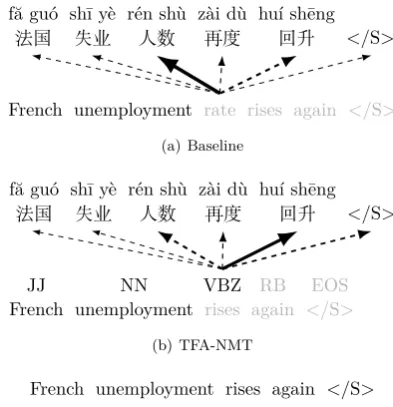
fă guó shī yè rén shù zài dù huí shēng </S>
法国 失业 人数 再度 回升 </S>
French unemployment rate rises again </S>
(a) Baseline
fă guó shī yè rén shù zài dù huí shēng </S>
法国 失业 人数 再度 回升 </S>
French unemployment rises again </S>
JJ NN VBZ RB EOS
(b) TFA-NMT
French unemployment rises again </S>
[image:1.595.315.512.228.432.2](c) Reference
Figure 1: A running example to motivate the pro-posed model. (a) The baseline obtains a transla-tion error due to the incorrect attentransla-tion. (b) With the help of the target foresight information “VBZ”, TFA-NMT is likely to figure out the exact transla-tion as the reference in (c). The light font denotes the target words to be translated in future. Both dashed or solid arrowed lines denote the alignments and solid one denotes the 1-best alignment.
pipeline manner, and it thereby has the poten-tial to alleviate the issue of error propagation. In NMT, the attention mechanism plays an important role. It calculates the alignments of a target word with respect to the source words for translation context selection. Although the source words are always available in inference, the target word, called target foresight word,1
1Note that the concept of foresight word in our
translation task is not exactly the same as the original concept in alignment task (Peter et al., 2017). How-ever, both of them share a common idea that foresight word should be at a later time step, and thus we re-spect the work in Peter et al.(2017) and maintain the same concept for easier understanding.
i.e. the first light color word in Figure1(a), is not known but to be translated at the next time step. Therefore, this may lead to inade-quate modeling for attention mechanism (Liu et al.,2016a;Peter et al.,2017). Regarding to this,Peter et al.(2017) explicitly feed this tar-get word into the attention model, and demon-strate the significant improvements in align-ment accuracy. Unfortunately, this approach relies on the premise that the target foresight word is available in advance in its alignment scenario, and thus it can not be used in the translation scenario.
To address this issue, in this paper, we pro-pose a target foresight based attention (TFA) model oriented to both alignment and trans-lation tasks. Its basic idea includes two steps: it firstly designs an auxiliary mechanism to predict some information for the target fore-sight word which is helpful for alignment; and then it feeds the predicted result into the at-tention model for translation. For the sake of efficiency, instead of predicting the target foresight word with large vocabulary size, we only predict its partial information, i.e. part-of-speech tag, which is proved to be helpful for word alignment (Liu et al.,2005). Figure1(b) shows the main idea of TFA based on NMT. In order to remit the negative effects due to the prediction errors, we feed the distribution of the prediction result instead of the maximum a posteriori result into the attention model. In addition, since the target foresight words are available during the training, we jointly learn the prediction model for the target foresight words and the translation model in a super-vised manner.
This paper makes the following contribu-tions:
• It proposes a novel TFA-NMT for neural machine translation by using an auxiliary mechanism to predict the target foresight word which is subsequently used to en-hance the attention model.
• It empirically shows that the proposed TFA-NMT can lead to better align-ment accuracy, and achieves signifi-cant improvements on both Chinese-to-English and Japanese-to-Chinese-to-English transla-tion tasks.
2 Background
Given a source sentence x = {x1, . . . , xm}
with length m and a target sentence y =
{y1, . . . , yn} with length n, neural machine
translation aims to model the conditional probability P(y|x):
P(y|x) =
n
∏
i=1
P(yi |y<i,x), (1)
wherey<i={y1, . . . , yi−1}denotes a prefix of ywith length i−1.
To achieve this, neural machine transla-tion adopts recurrent neural network (RNN) under the encoder-decoder framework ( Bah-danau et al., 2014). In encoding, an en-coder reads the source sentence x into a se-quence of representation vectors by a bidirec-tional recurrent neural network. Suppose hi
denotes the representation vector for xi, and
let h = {h1, . . . , hm}. In decoding, a decoder
sequentially generates a target word according toP(yi|y<i,x)by using another RNN.
In Eq.(1), the distribution P(yi|y<i,x) is
used to generate yi as follows:
P(yi |y<i,x) =softmax(ϕ(yi−1, si, ci)),
(2) where ϕ represents a feedforward neural net-work, ci is the context vector from h to infer yi, and si denotes the hidden state at
times-tamp i via the decoding RNN represented by
f:
si =f(si−1, yi−1, ci). (3)
Bahdanau et al. (2014) propose an atten-tion model to define the context ci, inspired
by the alignment model in statistical machine translation.
Given the last hidden statesi−1 and the en-coding vectorsh, an attention model is based on a distribution consisting of αij as follows:
αij =
exp(eij)
∑m
k=1exp(eik) ,
whereeij is computed by a feedforward neural
network represented bya:
eij =a(si−1, hj). (4)
The quantityαij denotes the possibility of
tar-get word yi aligns to the source word xj
vectorci is defined as the weighted sum ofh:
ci= m
∑
j=1
αijhj. (5)
In this way, when translating the target word
yi, the decoder will pay more attention to its
aligned source words with respect to the dis-tributionαi ={αi1,· · · , αim}. Figure2shows
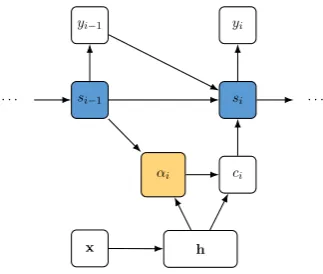
a slice of the entire architecture for NMT at timestampi.
si
si−1
ci
αi
h
· · · ·
yi
yi−1
[image:3.595.99.261.225.362.2]x
Figure 2: One slice of the architecture of Neural Machine Translation based on a generic attention.
Unfortunately, even though the entire trans-lationyis available in training, during the in-ference it is unknown in advance but to be generated sequentially. Specifically, when cal-culating αi, one can make use of the
informa-tion only from x and y<i but nothing from yi. Therefore, it is difficult to certainly
spec-ify which source words should be aligned to an unknown target word yi. This might lead
to the inadequacy of the attention model (Liu et al.,2016a; Peter et al., 2017), as explained in Figure 1(a).
3 Target Foresight Attention
In order to alleviate the issue of inadequate modeling for attention in NMT, in this sec-tion, we propose the target foresight attention for NMT, which foresees some related infor-mation of the unknown target foresight word to improve its alignments regarding to source words. The basic idea of the proposed atten-tion model includes two steps as following:
• It firstly introduce a model to predict some information of the target foresight word. (§3.1)
• It then feeds the predicted result about the foresight target word into the atten-tion as an addiatten-tional input. (§3.2)
Therefore, as shown in Figure 1(b), when translating the third word, if the prediction model shows it to be a “VBZ”, the attention model is likely to align it to the verb words such as “huí shēng” rather than “rén shù” in the source side, and then the corrected word “rises” will be translated.
3.1 Target Foresight Prediction
Ideally, it is possible to build a model to di-rectly predict the target foresight word itself. In practice, it will be inefficient due to its large vocabulary size. As a result, we instead build a model to predict the partial information of the target foresight word, such as part-of-speech (POS) tag or word cluster, which has limited vocabulary size. In this paper, we use the POS tag as the partial information of a target fore-sight word because POS tag is helpful to word alignment proved by Liu et al. (2005). Fur-thermore, predicting a POS tag is easier than a target foresight word, so the predicted re-sult will be more reliable for the downstream application on attention.
Supposeuidenotes a variable indicating the
POS tag of a target foresight wordyi. Our aim
is to define a prediction model of ui prior to
calculate the attention probability. For sim-plicity, this prediction model is generally rep-resented as βi = P(ui |y<i,x). We consider
three variant prediction models in a coarse-to-fine manner as follows.
3.1.1 Model 1
It is straightforward to define this prediction model directly based on the hidden states of the RNN in decoder by using a neural network. Formally, one can use the following equation:
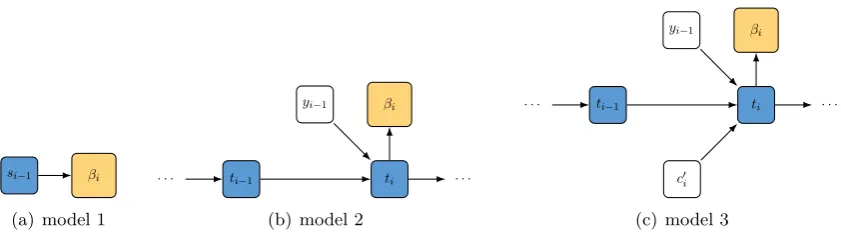
βi =P(ui |y<i,x) =softmax(ψ(yi−1, si−1)), (6) whereψis implemented by a feedforward neu-ral network. Note that Eq.(6) only depends on the decoding RNN hidden statesi−1 and it is very simple to implementation. Figure3(a) shows its architecture.
3.1.2 Model 2
βi
si−1
(a) model 1
ti
ti−1
βi
· · · ·
yi−1
(b) model 2
ti
ti−1
βi
c′ i
· · · ·
yi−1
[image:4.595.86.507.64.183.2](c) model 3
Figure 3: The prediction coarse-to-fine models for target foresight information: (a) Model 1 using only the decoding hidden statesi−1. (b) Model 2 using a hidden stateti from a specialized RNN. (c) Models
using a hidden state from a specialized RNN enhanced by the representation vector c′
i of x similar to
Eq.(5).
to provide a particular hidden state for pre-diction of ui. This improved prediction model
is defined as follows:
βi =P(ui|y<i,x) =softmax(ψ(yi−1, ti)),
(7) where ti is the hidden state of the
special-ized RNN defined by a GRU unit, i.e. ti = g(ti−1, yi−1). This prediction model architec-ture is shown in Figure3(b).
3.1.3 Model 3
In model 2, the specialized RNN for ui only
cares about the target sentence yand ignores the information from the source sentence x. We define a fine-grained model by taking a context vector c′
i from x as an additional
in-put:
βi =P(ui |y<i,x) =softmax(ψ(yi−1, ti, c′i)
)
,
(8) where c′i is a context vector extracted fromx
in a way similar to ci in Eq.(5),2 and ti = g(ti−1, yi−1, c′i) is the hidden state of the
spe-cialized RNN. The architecture of this model is shown in Figure 3(c).
3.2 Feeding the Prediction Model
Suppose we have the prediction result P(ui | y<i,x), then we consider to feed it into the at-tention model. Firstly, it is natural to feed the prediction into attention by using maximum a posteriori (MAP) strategy:
eij =a(si−1, hj, zi), (9)
2In our preliminary experiments, we triedci, but we
foundc′
iperforms better.
where a is the function for attention similar to Eq.(4) but includes an additional input zi,
which is the MAP result ofP(ui |y<i,x):
zi=z(argmax ui
P(ui |y<i,x)), (10)
where z denotes the embeddings of the POS tags of target foresight words, and z(ui)
re-turns the embedding of a particular POS tag
ui.
Note that in Eq.(10) the accuracy ofP(ui | y<i,x) is important to the attention model.
For example, suppose at timestamp i, the ground-truth POS tag is “NN”, but one has
P(ui = NN| y<i,x) = 0.4 and P(ui = VV | y<i,x) = 0.41. In this case, the prediction model selects “VV” as the POS tag of the target foresight word and ignores the ground-truth tag “NN”. Then the attention model takes this error signal and may align the target foresight word to a verb word. Subsequently, this might lead to a translation error.
Therefore, we propose another method to integrate the expected embedding of ui
ac-cording toP(ui |y<i,x) into attention as
fol-lows:
zi =
∑
ui
z(ui)P(ui |y<i,x). (11)
In this way, zi can take into account all
pos-sible POS tags ui including the ground-truth
result.
si
si−1
ci
αi
zi
h
· · · ·
yi
yi−1
x z
[image:5.595.96.263.59.196.2]βi
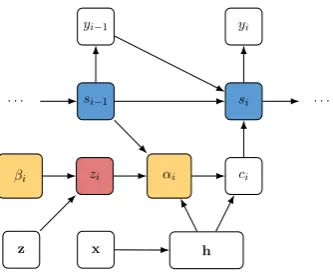
Figure 4: Neural machine translation with target Foresight attention. βiis derived from Figure3,zi
is from Eq.(10-11), and other nodes are similar to ones in Figure2.
obtained from Eq.(10-11) and the prediction model as shown in Figure3.
Note that the proposed TFA-NMT models the target foresight word, which is a future word regarding to the current time step, to conduct attention calculation. In this sense, it employs the idea of modeling future and thus resembles to the work in (Zheng et al.,2017). The main difference is that TFA-NMT models the future from the target side whereasZheng et al.(2017) models the future from the source side. In addition, Weng et al.(2017) imposes a regularization term by using future words during training. Unlike our approach, their approach does not use future words during the inference because these words are unavailable. Anyway, it is possible to put both their ap-proach and our apap-proach together for further improvements.
3.3 Learning and Inference
Suppose a set of training data is denoted by {⟨
xk,yk,uk⟩|k= 1,· · ·, K}. Here xk, yk
andukdenotes a source sentence, a target
sen-tence and a POS tag sequence of yk,
respec-tively. Then one can jointly train both the translation model for yk and the prediction
model for uk by minimizing the loss function:
ℓ=−∑
k
∑
i
(
logP(yki |yk
<i,xk)+
λlogP(uki |yk<i,xk)), (12)
whereP(yk
i |yk<i,xk)is the translation model
similar to Eq.(2) with target foresight atten-tion, and P(uki | yk
<i,xk) is the target
fore-sight prediction model as defined in Eq.(6-8),
respectively. λ≥0 is a hyper-parameter that balances the preference between the trans-lation model and target foresight prediction model.
According to the training objective, the pro-posed TFA-NMT resembles to the multi-task learning, since it jointly learns two tasks simi-lar to (Evgeniou and Pontil,2004;Luong et al., 2015a). The difference of our approach is ob-viously: in this work the prediction result of one model is integrated into the other model, while in their works, two models only share some common hidden states.
In inference, we implement two different de-coding methods according two different ways to integrate the foresight prediction model into attention as described in §3.2. For the MAP feeding style, we optimizeui according to the
loss function in Eq.(12) by beam search be-sides optimizing yi. However, for the
expec-tation feeding style, we maintain the standard beam search algorithm only regarding to the translation model, i.e. by setting λ= 0.
4 Experiments
We conduct experiments on Chinese-to-English and Japanese-to-Chinese-to-English translation tasks. The specific analyses are based on Chinese-to-English task, and the generaliza-tion ability is shown by Japanese-to-English task. Case-insensitive 4-gram BLEU is used to evaluate translation quality, and the multi-bleu.perl is adopted as its implementation.
4.1 Setup
Data The training data for Chinese-to-English task consists of 1.8M sentence pairs from NIST2008 Open Machine Campaign, with 40.1M Chinese words and 48.3M En-glish words respectively. The development set is chosen as NIST2002 (878 sentences) and the test sets are NIST2005 (1082 sentences), NIST2006 (1664 sentences), and NIST2008 (1357 sentences).
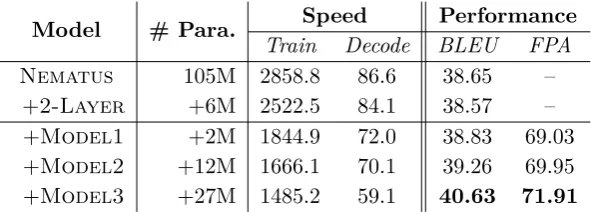
ref-Model # Para. Speed Performance Train Decode BLEU FPA
Nematus 105M 2858.8 86.6 38.65 –
+2-Layer +6M 2522.5 84.1 38.57 –
+Model1 +2M 1844.9 72.0 38.83 69.03
+Model2 +12M 1666.1 70.1 39.26 69.95
[image:6.595.152.448.62.168.2]+Model3 +27M 1485.2 59.1 40.63 71.91
Table 1: Speeds and performances of the proposed models. “Speed” is measured in words/second for both training and decoding, and performances are measured in terms of BLEU scores (“BLEU”) and foresight prediction accuracy (“FPA”) on the development set. Higher BLEU and FPA scores denote better performance.
erence, following (Goto et al.,2013;Liu et al., 2016b) for further comparison.
Implementation We compare the proposed models with two strong baselines from SMT and NMT:
• Moses (Koehn et al., 2007): an open source phrased based translation system with default configuration.
• Nematus (Sennrich et al., 2017): an generic attention based NMT.
We implement the proposed models on top of
Nematus. We use Stanford Log-linear Part-Of-Speech Tagger (Toutanova et al., 2003) to produce POS tags for the English side. For both Chinese-to-English and Japanese-to-English tasks, we limit the vocabularies to the most frequent 30K words for both sides. All the out-of-vocabulary words are mapped to a spacial token “UNK”. Only the sentences of length up to 50 words are used in training, with 80 sentences in a batch. The sion of word embedding is 620. The dimen-sions of both feed forward NN and RNN hid-den layer are 1000. The beam size for decod-ing is 12, and the cost function is optimized by Adadelta with hyper-parameters suggested by Zeiler (2012). Particularly for TFA-NMT, the foresight embedding is also 620, and the hyper-parameterλis 1.
4.2 Impact of Components
We conduct analyses on Chinese-to-English translation task, to investigate the impact of the added components and to figure out their best configuration for further testing in the next subsection.
4.2.1 Model Architectures
Table 1 lists the speeds and performances of the proposed models. Clearly the proposed approach improves the translation quality in all cases, although there are still considerable differences among the proposed variants.
Model Complexity The proposed models introduce a few parameters to the NMT base-line system Nematus, which has 105M pa-rameters. The most complex model (i.e.,
Model3) introduces 27M new parameters, which are small compared with the baseline model. As seen, the proposed models signifi-cantly slows down the training speed, which we attribute to the new softmax operation over the foresight tags and more gradient op-erations associated with the new training ob-jective, i.e., Eq.(12). For decoding, the most complex model reduces speed by around 30%, which is the cost of the proposed approach for improving translation quality.
Performance We measure the performance with BLEU and the result is shown in Ta-ble 1. Model1 marginally improves perfor-mance by guiding the decoder states to em-bed information for predicting foresight tags.
signif-Type Perc. FPA AER
Ours Base Ours
Noun 30.13% 77.49 28.97 26.50 Verb 12.39% 71.94 37.06 33.93 Adj. 9.43% 55.99 34.67 31.86
Prep. 14.66% 79.40 84.04 76.95
Dete. 10.08% 72.06 80.15 76.51
Punc. 8.01% 74.89 91.74 66.51
Others 15.30% 81.22 53.64 39.11 All 100% 74.87 49.67 42.56
Table 2: Performances on syntactic categories. “Base” denotes “Nematus”, and Ours denotes the proposed model.
icantly better than baseline, but Model2 is significantly better with p<0.05 andModel3
is significantly better with p<0.01. Given that simply introducing an additional layer (“+ 2-Layer”) does not produce any improvement on this data, we believe the gain of our model is not only from the more introduced param-eters. Besides, we augment the word bedding by concatenating the POS tag em-bedding, proposed by (Sennrich and Haddow, 2016), the BLEU is 38.96, which indicating the improvement of our model is not only from the POS tagging. In order to further validate the improvements of variant proposed mod-els, we evaluate the foresight prediction accu-racy (FPA) for three proposed prediction mod-els. We found that the fine-grained Model3
achieves the best FPA, indicating a good es-timated foresight is very important to obtain the gains in terms of BLEU.
4.2.2 Analysis on Syntactic Categories
In this experiment, we investigate which cat-egory of generated words benefit most from the proposed approach in terms of alignments measured by alignment error rate (AER) (Och,2003). We carry out experiments on the evaluation dataset from (Liu and Sun, 2015), which contains 900 manually aligned Chinese-English sentence pairs. Following (Luong et al., 2015b), we force-decode both the bilin-gual sentences including source and reference sentences to obtain the attention matrices, and then we extract one-to-one alignments by picking up the source word with the high-est alignment confidence as the hard
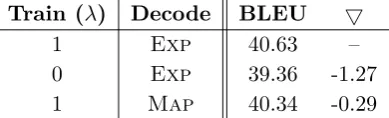
align-Train (λ) Decode BLEU ▽
1 Exp 40.63 –
0 Exp 39.36 -1.27
[image:7.595.77.289.62.212.2]1 Map 40.34 -0.29
Table 3: Effect of foresight supervision signal in training (i.e., λ) and foresight representations in decoding: Expfor expectation andMap for max-imum a posteriori.
ment. As shown in Table2, the AER improve-ments are modest for content words such as Noun, Verb, and adjective (“Adj.”) words; but there are substantial improvements for func-tion words such as preposifunc-tion words (“Prep.”) and punctuations (“Punc.”).
The reason can be explained as follows. The content words are easy to align with AER un-der 38 as shown in Table 2, and thus it is more difficult to gain over the BASE. On the other hand, as depicted in Table 2, function words are inherently more difficult than con-tent words. These findings satisfy the linguis-tic intuition: content words tend to be less in-volved in multiple potential correspondences than function words, and function words tend to be attached to content words, as pointed out by Pianta and Bentivogli (2004). Fortu-nately, TFA-NMT can predict the POS tag for target foresight word with high confidence and thus it can improve the alignment qual-ity by using of POS tags, which is useful for alignment task (Liu et al.,2005).
It is surprising that the AER for “Prep.”, “Det.” and “Punc.” is relatively low especially for Base. The main reason can be explained from the quantitiesyi−1,si, andciin Eq.(2) as
follows. These highly frequent function words are usually easy to be translated by using the history information from yi−1 and si even if ci is not confident enough. For example, it is
relatively easy to guess the “comma” by us-ing the history words in language model task, where there are no bilingual information at all. Therefore, during the training, the model tries to adjust the parameters for highly frequent words from yi−1 and si while neglecting the
attention model.
4.2.3 Foresight Strategies
[image:7.595.320.515.63.122.2]de-coding. Without an explicit objective to guide the training of foresight prediction model (i.e.,
λ = 0), the performance decreases by 1.27 BLEU points. When feeding the best fore-sight predicted result to the attention model (i.e.,Map), the performance decreases by 0.29 BLEU points. We attribute this to the prop-agation of prediction errors, which can be al-leviated by using a weighted representation of all predicted results (i.e., Exp).
In the following experiments, we use “λ= 1
and Exp” as the default setting for the final systemTFA-NMT.
4.3 Main Results
Chinese-to-English Task Table 4 shows the translation performances for the Chinese-to-English translation task. As seen, the pro-posed approach significantly outperforms the baseline system (i.e., Nematus) in all cases, demonstrating the effectiveness and university of our model.
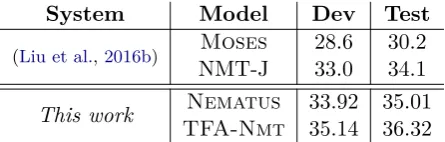
Japanese-to-English Task Table 5 shows the translation quality of the NMT baseline and our TFA-NMT on Japanese-to-English task. From the table, we can see that our model still achieves a significant improvement of 1.22 and 1.31 BLEU points on the devel-opment and test set, respectively. This shows that the proposed approach works well across different language pairs.
5 Related Work
Attention model becomes a standard compo-nent for many applications due to its ability of dynamically selecting the informative context from sequential representations. For example, Xu et al. (2015) propose an attention based neural network for image caption task and ad-vance the state-of-the-art results; Yin et al. (2015) put the attention structure between a pair of convolution networks for answer se-lection, paraphrase identification and textual entailment tasks. In the context of machine translation, the idea of attention based neu-ral networks has been pioneered byBahdanau et al.(2014);Luong et al.(2015b) and achieved impressive results over the traditional statis-tical machine translation. Since then many research works have been devoted to improve
the neural machine translation by enhancing attention models.
Tu et al. (2016) design a coverage vector for the translation history and then integrates it into the attention model. Similarly, Meng et al. (2016) maintain a tag vector to keep track of the attention history and Sankaran et al. (2016) memorize historical alignments and accumulate them as temporal memory to improve the attention model. In addition, Zhang et al.(2017) improve the attention with a gated operator for encoding states and a decoding state, and and Dutil et al. (2017) enhance attention through a planning mecha-nism. Furthermore,Feng et al.(2016) adopt a recurrent structure for attention to take long-term dependencies into account, Zhou et al. (2017) propose a look-ahead attention by addi-tionally modeling the translation history, and Cohn et al. (2016) incorporate structural bi-ases into attention models. Recently Chen et al.(2017) introduce the syntactic knowledge into attention models. These works are essen-tially similar to the propose approach, since we introduce auxiliary information from a tar-get foresight word into the attention model. However, there is a significant difference be-tween our approach and their approaches. Our auxiliary information biases to the word to be translated at next timestep while theirs biases to the information available so far at the cur-rent timestep, and thereby our approach is or-thogonal to theirs.
The works mentioned above improve the at-tention models by access auxiliary informa-tion, and thus they modify the structure of at-tention models in both inference and learning. In contrast,Mi et al.(2016);Liu et al.(2016b); Chen et al. (2016) maintain the structure of the attention models in inference but utilize some external signals to supervise the outputs of attention models during the learning. They improve the generalization abilities of atten-tion models by use of the external aligners as the signals, which typically yield alignment re-sults accurate enough to guide the learning of attention.
6 Conclusion
suf-System Model Dev MT05 MT06 MT08 Ave.
(Liu et al.,2016b) Moses – 35.4 33.7 25.0 31.37
NMT-J – 36.8 36.9 28.5 34.07
(Liu et al.,2016a) SA-NMT 40.0 37.8 37.6 29.9 35.10
This work Nematus 38.65 36.32 36.10 28.24 33.55
[image:9.595.106.493.64.162.2]TFA-NMT 40.63 37.70 38.01 30.12 35.28
Table 4: Evaluation of translation performance on Chinese-to-English task.
System Model Dev Test
(Liu et al.,2016b) Moses 28.6 30.2
NMT-J 33.0 34.1
This work Nematus 33.92 35.01
TFA-Nmt 35.14 36.32
Table 5: Evaluation of translation performance on Japanese-to-English task.
fers from model inadequacy due to the lack of information from the target foresight word (Peter et al., 2017;Liu et al., 2016a). To ad-dress this issue, this paper proposes a new at-tention model, which can serve for both align-ment and translation tasks, by implicitly mak-ing use of the target foresight word. Em-pirical experiments on Chinese-to-English and Japanese-to-English tasks demonstrate that the proposed attention based NMT delivers substantial gains in terms of both BLEU and AER scores.
In future work, it is promising to exploit other target foresight information such as word cluster besides the POS tags in this paper, and it is also interesting to apply this idea on top of other attention models such as the local at-tention inLuong et al.(2015b).
References
Dzmitry Bahdanau, Kyunghyun Cho, and Yoshua Bengio. 2014. Neural machine translation by jointly learning to align and translate. arXiv preprint arXiv:1409.0473 .
Kehai Chen, Rui Wang, Masao Utiyama, Eiichiro Sumita, and Tiejun Zhao. 2017. Syntax-directed attention for neural machine translation. arXiv preprint arXiv:1711.04231.
Wenhu Chen, Evgeny Matusov, Shahram Khadivi, and Jan-Thorsten Peter. 2016. Guided align-ment training for topic-aware neural machine translation. arXiv preprint arXiv:1607.01628.
David Chiang. 2005. A hierarchical phrase-based model for statistical machine translation. In
Proceedings of the 43rd Annual Meeting on As-sociation for Computational Linguistics. Associ-ation for ComputAssoci-ational Linguistics, pages 263– 270.
Jonathan H Clark, Chris Dyer, Alon Lavie, and Noah A Smith. 2011. Better hypothesis test-ing for statistical machine translation: Control-ling for optimizer instability. In Proceedings of the 49th Annual Meeting of the Association for Computational Linguistics: Human Language Technologies: short papers-Volume 2. Associa-tion for ComputaAssocia-tional Linguistics, pages 176– 181.
Trevor Cohn, Cong Duy Vu Hoang, Ekate-rina Vymolova, Kaisheng Yao, Chris Dyer, and Gholamreza Haffari. 2016. Incorporat-ing structural alignment biases into an atten-tional neural translation model. arXiv preprint arXiv:1601.01085 .
Francis Dutil, Caglar Gulcehre, Adam Trischler, and Yoshua Bengio. 2017. Plan, attend, gener-ate: Planning for sequence-to-sequence models.
arXiv preprint arXiv:1711.10462.
Theodoros Evgeniou and Massimiliano Pontil. 2004. Regularized multi–task learning. In Pro-ceedings of the tenth ACM SIGKDD interna-tional conference on Knowledge discovery and data mining. ACM, pages 109–117.
Shi Feng, Shujie Liu, Nan Yang, Mu Li, Ming Zhou, and Kenny Q Zhu. 2016. Improving at-tention modeling with implicit distortion and fertility for machine translation. In COLING. pages 3082–3092.
Isao Goto, Ka-Po Chow, Bin Lu, Eiichiro Sumita, and Benjamin K Tsou. 2013. Overview of the patent machine translation task at the ntcir-10 workshop. InNTCIR.
[image:9.595.72.295.203.274.2]of the ACL on interactive poster and demon-stration sessions. Association for Computational Linguistics, pages 177–180.
Philipp Koehn, Franz Josef Och, and Daniel Marcu. 2003. Statistical phrase-based transla-tion. In Proceedings of the 2003 Conference of the North American Chapter of the Associ-ation for ComputAssoci-ational Linguistics on Human Language Technology-Volume 1. Association for Computational Linguistics, pages 48–54.
Lemao Liu, Masao Utiyama, Andrew Finch, and Eiichiro Sumita. 2016a. Neural machine trans-lation with supervised attention. arXiv preprint arXiv:1609.04186 .
Lemao Liu, Masao Utiyama, Andrew M Finch, and Eiichiro Sumita. 2016b. Agreement on target-bidirectional neural machine translation. In
HLT-NAACL. pages 411–416.
Yang Liu, Qun Liu, and Shouxun Lin. 2005. Log-linear models for word alignment. In Proceed-ings of the 43rd Annual Meeting on Association for Computational Linguistics. Association for Computational Linguistics, pages 459–466.
Yang Liu and Maosong Sun. 2015. Contrastive un-supervised word alignment with non-local fea-tures. InAAAI. pages 2295–2301.
Minh-Thang Luong, Quoc V Le, Ilya Sutskever, Oriol Vinyals, and Lukasz Kaiser. 2015a. Multi-task sequence to sequence learning. arXiv preprint arXiv:1511.06114.
Minh-Thang Luong, Hieu Pham, and Christo-pher D Manning. 2015b. Effective approaches to attention-based neural machine translation.
arXiv preprint arXiv:1508.04025 .
Fandong Meng, Zhengdong Lu, Hang Li, and Qun Liu. 2016. Interactive attention for neural machine translation. arXiv preprint arXiv:1610.05011 .
Haitao Mi, Zhiguo Wang, and Abe Ittycheriah. 2016. Supervised attentions for neural machine translation. arXiv preprint arXiv:1608.00112.
Franz Josef Och. 2003. Minimum error rate train-ing in statistical machine translation. In Pro-ceedings of the 41st Annual Meeting on Asso-ciation for Computational Linguistics-Volume 1. Association for Computational Linguistics, pages 160–167.
Jan-Thorsten Peter, Arne Nix, and Hermann Ney. 2017. Generating alignments using target fore-sight in attention-based neural machine transla-tion. The Prague Bulletin of Mathematical Lin-guistics 108(1):27–36.
Emanuele Pianta and Luisa Bentivogli. 2004. Knowledge intensive word alignment with knowa. InProceedings of the 20th international conference on Computational Linguistics. As-sociation for Computational Linguistics, page 1086.
Baskaran Sankaran, Haitao Mi, Yaser Al-Onaizan, and Abe Ittycheriah. 2016. Temporal attention model for neural machine translation. arXiv preprint arXiv:1608.02927 .
Rico Sennrich, Orhan Firat, Kyunghyun Cho, Alexandra Birch, Barry Haddow, Julian Hitschler, Marcin Junczys-Dowmunt, Samuel Läubli, Antonio Valerio Miceli Barone, Jozef Mokry, et al. 2017. Nematus: a toolkit for neural machine translation. arXiv preprint arXiv:1703.04357 .
Rico Sennrich and Barry Haddow. 2016. Linguistic input features improve neural machine transla-tion. arXiv preprint arXiv:1606.02892.
Kristina Toutanova, Dan Klein, Christopher D Manning, and Yoram Singer. 2003. Feature-rich part-of-speech tagging with a cyclic dependency network. In Proceedings of the 2003 Conference of the North American Chapter of the Associ-ation for ComputAssoci-ational Linguistics on Human Language Technology-Volume 1. Association for Computational Linguistics, pages 173–180.
Zhaopeng Tu, Zhengdong Lu, Yang Liu, Xiaohua Liu, and Hang Li. 2016. Modeling coverage for neural machine translation. arXiv preprint arXiv:1601.04811 .
Rongxiang Weng, Shujian Huang, Zaixiang Zheng, XIN-YU DAI, and Jiajun CHEN. 2017. Neural machine translation with word predictions. In
Proceedings of the 2017 Conference on Empiri-cal Methods in Natural Language Processing. As-sociation for Computational Linguistics, Copen-hagen, Denmark, pages 136–145.
Kelvin Xu, Jimmy Ba, Ryan Kiros, Kyunghyun Cho, Aaron Courville, Ruslan Salakhudinov, Rich Zemel, and Yoshua Bengio. 2015. Show, at-tend and tell: Neural image caption generation with visual attention. In International Confer-ence on Machine Learning. pages 2048–2057.
Wenpeng Yin, Hinrich Schütze, Bing Xiang, and Bowen Zhou. 2015. Abcnn: Attention-based convolutional neural network for modeling sen-tence pairs. arXiv preprint arXiv:1512.05193.
Matthew D Zeiler. 2012. Adadelta: an adap-tive learning rate method. arXiv preprint arXiv:1212.5701.
Zaixiang Zheng, Hao Zhou, Shujian Huang, Lili Mou, Xinyu Dai, Jiajun Chen, and Zhaopeng Tu. 2017. Modeling past and future for neural machine translation. arXiv preprint arXiv:1711.09502 .